
Chemical structure of LA 5 mark answer
LA (Local Anaesthetics) chemical structure is a classic pharmacology topic. Let me get you a thorough answer from the medical library.
Searching sources...
Reading File
Finding Sources
Finding Sources
Finding Sources
Finding Sources
Searching Images
local anaesthetic chemical structure aromatic ring amine linkage
Excellent - found the key section "The Local Anesthetic Molecule" in Miller's Anesthesia. Let me read that along with the Morgan & Mikhail and Sabiston sections.
Reading File
Reading File
Reading File
Excellent! I have great content from Miller's. Let me now fetch the structural diagram image from Miller's and also read the structure-activity section more.
Loading Image
Reading File
I now have everything needed for a complete 5-mark answer. Here is the full response:
Chemical Structure of Local Anaesthetics (LA)
(Miller's Anesthesia, 10e - "The Local Anesthetic Molecule")
Basic Structural Template
A typical local anaesthetic molecule has three essential components arranged in sequence:
Aromatic (Lipophilic) Group — Intermediate Chain — Tertiary Amine (Hydrophilic)
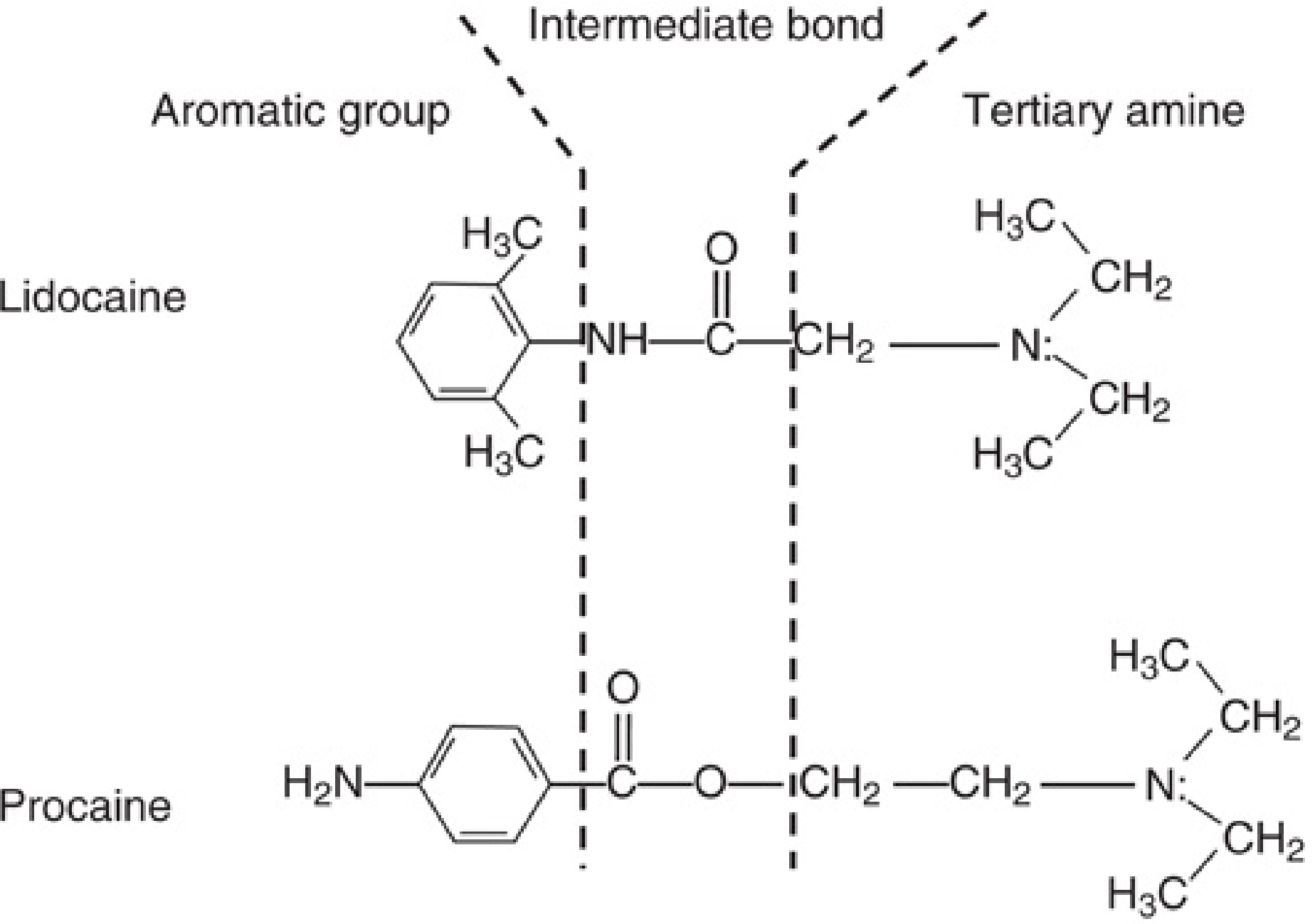
Fig. 25.1 from Miller's Anesthesia, 10e - Lidocaine (aminoamide) and Procaine (aminoester)
The Three Components in Detail
1. Aromatic (Lipophilic) Ring
- An unsaturated benzene ring (or substituted aromatic group)
- Gives the molecule its lipophilic (membrane-liking) character
- Allows the drug to penetrate the lipid bilayer of the nerve membrane
- May carry substituents like amino groups (e.g., -NH₂ in procaine) or methyl groups (e.g., two -CH₃ in lidocaine) that affect potency and duration
2. Intermediate Chain (Linkage)
- Connects the aromatic ring to the amine group
- This is the key structural feature that classifies LAs into two groups:
| Type | Bond | Examples |
|---|---|---|
| Aminoester | -C-O- (ester linkage) | Procaine, Cocaine, Chloroprocaine, Tetracaine |
| Aminoamide | -NHC- (amide linkage) | Lidocaine, Bupivacaine, Ropivacaine, Prilocaine |
The intermediate chain also influences the metabolism of the drug - esters are hydrolysed by plasma cholinesterase; amides are metabolised in the liver.
3. Tertiary Amine (Hydrophilic End)
- A nitrogen atom carrying two alkyl side chains (tertiary amine)
- Relatively hydrophilic, especially since it is partially protonated (carries a positive charge) at physiologic pH
- Responsible for the ionisation state of the molecule, which determines onset of action
Ionisation and the pKa Concept
LAs are weak bases and exist in two forms simultaneously:
- Uncharged base form (B) - lipid-soluble, penetrates nerve membrane
- Charged cationic form (BH⁺) - water-soluble, blocks the Na⁺ channel from inside
The Henderson-Hasselbalch equation governs the ratio:
pH = pKa + log₁₀ ([B] / [BH⁺])
- Lower pKa → more drug in base form at physiologic pH → faster onset
- Higher pKa → more drug in cationic form → slower onset
- In inflamed/acidic tissue (low pH) → more ionised drug → reduced efficacy
Structure-Activity Relationships
| Structural Feature | Effect |
|---|---|
| Larger alkyl substituents on amine or aromatic ring | Increased hydrophobicity → greater potency and longer duration |
| Ester vs. amide linkage | Determines route of metabolism |
| pKa of amine group | Determines speed of onset |
| Protein binding | Correlates with duration of action |
Clinical Significance of Classification
Aminoesters - metabolised by plasma (pseudo)cholinesterase → produce PABA metabolite → responsible for allergic reactions. Examples: Procaine, Cocaine, Tetracaine, Chloroprocaine.
Aminoamides - metabolised by hepatic microsomal enzymes → less allergenic. Examples: Lidocaine, Bupivacaine, Ropivacaine, Prilocaine, Mepivacaine.
Source: Miller's Anesthesia, 10e, Chapter 25 - "The Local Anesthetic Molecule"; Sabiston Textbook of Surgery, "Local Anesthetic Drugs"
This is a shared conversation. Sign in to Orris to start your own chat.