
Tell me treatment for hypocalcemia
Reading File
Now let me search the medical library and PubMed in parallel for hypocalcemia treatment.
Finding Sources
Searching PubMed
hypocalcemia treatment management
Now let me read all three relevant textbook sections in parallel.
Reading File
Reading File
Reading File
Let me also search for broader content on hypocalcemia causes and management to give a complete picture.
Finding Sources
I have comprehensive information from three authoritative textbooks. Here is the full treatment guide for hypocalcemia:
Treatment of Hypocalcemia
Classification by Severity
Before treating, hypocalcemia is broadly classified as:
- Acute / symptomatic - medical emergency (tetany, seizures, laryngospasm, QT prolongation, cardiac arrhythmia)
- Chronic / asymptomatic - managed with oral supplementation
1. Acute Symptomatic Hypocalcemia (Emergency Treatment)
Symptomatic hypocalcemia is a medical emergency requiring IV calcium immediately.
IV Calcium Options
| Preparation | Volume | Elemental Ca²⁺ |
|---|---|---|
| Calcium gluconate 10% | 10-20 mL | ~93 mg per 10 mL |
| Calcium chloride 10% | 3-5 mL | ~272 mg per 10 mL |
Calcium gluconate is preferred for peripheral IV access - it is less irritating to veins.
Calcium chloride contains ~3x more elemental calcium per mL but is reserved for cardiac arrest / CPR due to pain and risk of vein sclerosis with peripheral infusion.
Dosing Protocol
- Initial bolus: Calcium gluconate 10-20 mL (10%) IV over 10 minutes with continuous ECG monitoring (watch QT interval).
- In children: calcium gluconate 1-2 mL/kg at <1 mL/min
- If symptoms persist (tetany, seizures): repeat the bolus as needed.
- Maintenance infusion: Elemental calcium 1-2 mg/kg/hour (continuous IV infusion) until serum calcium normalizes.
Key Precautions
- Do not give IV calcium with bicarbonate- or phosphate-containing solutions (risk of precipitation).
- Do not give IV calcium in severe hyperphosphatemia (risk of ectopic calcium-phosphate deposition).
- Monitor serial ionized calcium levels throughout treatment.
- Watch for extravasation - calcium-containing fluids cause tissue necrosis.
- Avoid alkalosis - it further reduces ionized calcium.
2. Chronic / Asymptomatic Hypocalcemia
Oral supplementation is the standard approach - IV is not indicated unless the patient is symptomatic.
Oral Calcium
- Calcium carbonate is the most common oral supplement (1250 mg calcium carbonate = 500 mg elemental calcium).
- Start with 1-2 g of elemental calcium three times daily, given away from meals to maximize absorption.
Vitamin D / Calcitriol
- Calcitriol (active vitamin D) significantly improves calcium absorption from the gut.
- Start at 0.25 mcg twice daily and titrate up.
- For vitamin D deficiency (e.g., rickets), oral vitamin D 1000-2000 IU daily for 4 weeks with elemental calcium 40 mg/kg/day.
Diuretic Adjustment
- If the patient is on loop diuretics, consider switching to thiazide diuretics - thiazides reduce urinary calcium excretion, helping retain calcium.
3. Treat Underlying Causes
Hypocalcemia often has a correctable underlying cause:
| Cause | Specific Treatment |
|---|---|
| Hypomagnesemia | Treat first with magnesium sulfate IV (0.1-0.2 mL/kg of 50% solution) - hypocalcemia will not correct until Mg²⁺ is normalized |
| Hypoparathyroidism | Calcitriol + calcium supplementation long-term |
| Vitamin D deficiency | Cholecalciferol or ergocalciferol + calcium |
| Pseudohypoparathyroidism | Calcitriol + calcium (PTH resistance) |
| Post-thyroidectomy / parathyroid surgery | IV calcium initially, then oral calcitriol + calcium carbonate |
| Hyperphosphatemia | Low-phosphate diet, phosphate binders; volume expansion if acute |
| Rapid blood transfusion | IV calcium (citrate in blood products chelates Ca²⁺) |
Important: Check serum magnesium in all cases of hypocalcemia. Hypomagnesemia impairs PTH secretion and causes PTH resistance - calcium will not rise until magnesium is corrected.
4. Monitoring During Treatment
- Fasting total and ionized serum calcium - check regularly
- Serum phosphate - monitor for reciprocal changes
- 24-hour urine calcium - keep below 4 mg/kg/day to prevent hypercalciuria and nephrocalcinosis
- Spot urine calcium-to-creatinine ratio - useful for outpatient monitoring
- PTH level - if hypocalcemia is not due to PTH deficiency
- Serum magnesium - at least annually in chronic cases
5. Anesthetic Considerations
- Correct significant hypocalcemia before elective surgery.
- Monitor ionized calcium intraoperatively in patients with known hypocalcemia.
- Avoid alkalosis intraoperatively (decreases ionized Ca²⁺).
- IV calcium may be needed after rapid transfusion of citrated blood products or large albumin volumes.
- Expect potentiation of negative inotropic effects of anesthetic agents.
- Responses to neuromuscular blocking agents are inconsistent - use nerve stimulator monitoring.
Sources:
- Brenner and Rector's The Kidney, 2-Volume Set
- National Kidney Foundation Primer on Kidney Diseases, 8e
- Morgan and Mikhail's Clinical Anesthesiology, 7e
Tell me for orally med
Based on what was already retrieved from the textbooks, here is a focused summary of oral medications for hypocalcemia:
Oral Treatment of Hypocalcemia
Oral therapy is used for chronic or asymptomatic hypocalcemia. Symptomatic patients always need IV calcium first.
1. Oral Calcium Supplements
Calcium Carbonate (most common)
- Dose: 1-2 g of elemental calcium, 3 times daily
- Note: 1250 mg calcium carbonate = 500 mg elemental calcium
- Take away from meals to maximize absorption
- Preferred as first-line oral supplement
Calcium Chloride
- Generally not used orally - reserved for IV use only (causes vein sclerosis and pain even via IV peripheral routes)
2. Vitamin D Preparations (co-administered with calcium)
Calcitriol (1,25-dihydroxyvitamin D - active form)
- Dose: Start at 0.25 mcg twice daily, titrate up as needed
- Significantly increases gut calcium absorption
- Preferred in hypoparathyroidism and renal disease (kidney cannot activate vitamin D)
Cholecalciferol / Ergocalciferol (Vitamin D3 / D2)
- Used when the cause is nutritional vitamin D deficiency
- Dose: 1000-2000 IU daily for 4 weeks (for vitamin D deficiency rickets)
- Requires hepatic and renal activation - not suitable when these organs are impaired
3. Diuretic Adjustment
- Switch from loop diuretics (furosemide - increases urinary Ca²⁺ loss) to thiazide diuretics (reduce urinary calcium excretion)
- This is an adjunct measure, not a direct calcium supplement
4. Oral Magnesium (if hypomagnesemia is present)
- Hypomagnesemia must be corrected alongside calcium - oral or IV magnesium sulfate
- Without correcting Mg²⁺, calcium levels will not normalize regardless of supplementation
Quick Reference Table
| Drug | Dose | Indication |
|---|---|---|
| Calcium carbonate | 1-2 g elemental Ca, TID away from meals | Chronic hypocalcemia (all causes) |
| Calcitriol | 0.25 mcg BID, titrate up | Hypoparathyroidism, CKD, vitamin D resistance |
| Cholecalciferol (D3) | 1000-2000 IU/day | Nutritional vitamin D deficiency |
| Thiazide diuretic | As per standard dosing | Adjunct - reduce urinary Ca²⁺ loss |
| Oral magnesium | As per Mg deficit | If concurrent hypomagnesemia |
Sources: National Kidney Foundation Primer on Kidney Diseases, 8e; Brenner and Rector's The Kidney, 2-Volume Set; Morgan and Mikhail's Clinical Anesthesiology, 7e
Urticaria treatment
Reading File
Searching sources...
Finding Sources
Searching PubMed
urticaria treatment management
Reading File
Reading File
Let me read more from both sources and fetch the treatment algorithm image.
Reading File
Reading File
Loading Image
Here is a comprehensive treatment guide for urticaria:
Treatment of Urticaria
Step 1 - Identify and Remove the Trigger
Always the first step. Avoid the inciting agent (drugs, foods, physical stimuli, NSAIDs, infections). Without trigger removal, pharmacological treatment has limited effect.
Treatment Algorithm (EAACI & American Guidelines)
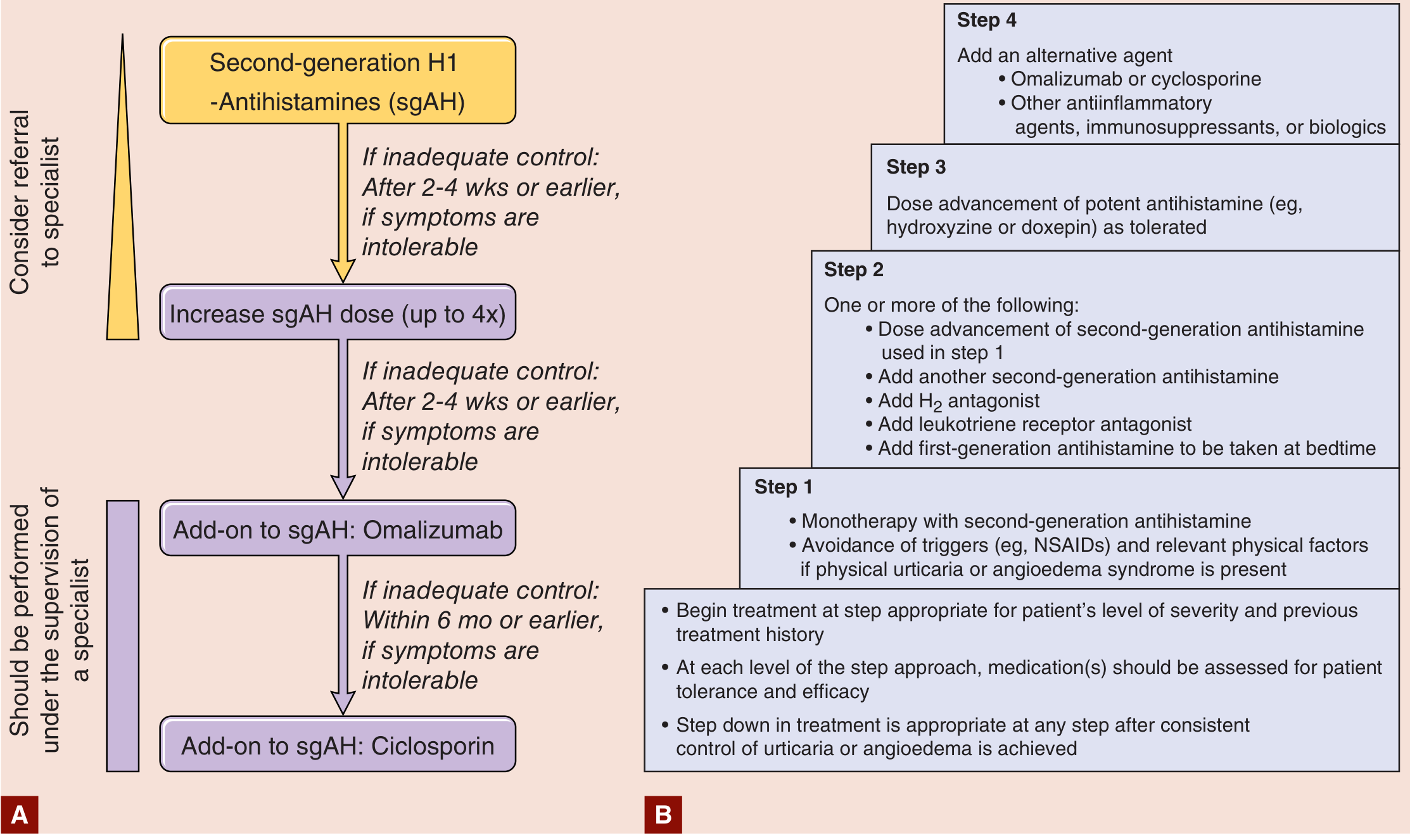
Figure: Stepwise treatment algorithm for urticaria (A = EAACI guideline; B = American Academy of Allergy, Asthma and Immunology)
A. Mild to Moderate Acute Urticaria
First-Generation H1 Antihistamines (sedating)
| Drug | Dose |
|---|---|
| Diphenhydramine | 25-50 mg PO every 4-6 hours |
| Hydroxyzine | 10-25 mg PO every 6 hours |
Second-Generation H1 Antihistamines (non-sedating - preferred)
| Drug | Dose |
|---|---|
| Cetirizine | 5-10 mg/day |
| Levocetirizine | 2.5-5 mg/day |
| Fexofenadine | 180 mg/day |
| Loratadine | 10 mg/day |
Second-generation antihistamines are preferred for long-term use due to better tolerability and no sedation.
B. Severe Urticaria with or without Angioedema
- H1 antihistamines: Diphenhydramine 25-50 mg PO q4-6h, or 10-50 mg IV/IM q4-6h (max 400 mg/24 hours)
- Corticosteroids:
- Prednisone 10-60 mg PO every morning with taper over 2 weeks
- Triamcinolone 40-60 mg IM single dose
- Dexamethasone 4-20 mg/day IV or IM
C. Anaphylaxis (most severe)
Managed as an emergency (ABC approach):
- Airway: Intubation if needed
- Breathing: Supplemental oxygen
- Circulation: Epinephrine 1:1000 IV + volume expanders (saline)
- IV methylprednisolone 1-2 mg/kg/day
- H1 + H2 antagonists IV: Diphenhydramine 25-50 mg + Famotidine 20 mg IV
D. Chronic Idiopathic / Spontaneous Urticaria (CSU) - Stepwise Approach
Step 1 - Monotherapy
- Second-generation antihistamine (cetirizine 10 mg/day or fexofenadine 60-180 mg once or twice daily)
- Avoid known triggers (NSAIDs, physical factors)
Step 2 - If inadequate control after 2-4 weeks
Add one or more of:
- Increase dose of second-generation antihistamine (up to 4x standard dose)
- Add a second-generation antihistamine
- Add an H2 antagonist: Famotidine 20 mg twice daily or Cimetidine 400 mg twice daily
- Add a leukotriene receptor antagonist: Montelukast 10 mg/day
- Add a first-generation antihistamine at bedtime
Step 3 - If still inadequate (after another 2-4 weeks)
- Dose advancement of a more potent antihistamine: Hydroxyzine or Doxepin as tolerated
Step 4 - Refractory / Specialist-managed
- Omalizumab (anti-IgE monoclonal antibody): 150-300 mg subcutaneously once monthly
- Cyclosporine: 3 mg/kg/day or higher for 8-16 weeks (added to background antihistamine)
E. Refractory and Special Cases
For delayed pressure urticaria and urticarial vasculitis (where antihistamines are often ineffective), options include:
- Systemic corticosteroids
- Dapsone
- Antifibrinolytics (tranexamic acid or epsilon-aminocaproic acid) - especially useful with angioedema
- Methotrexate
- Tacrolimus
- Hydroxychloroquine
- IV immunoglobulin (IVIG)
- Plasmapheresis
- Narrow-band UVB phototherapy
Note: Evidence for these agents is limited and mostly anecdotal. Risks vs. symptom burden must be weighed carefully.
F. Hereditary Angioedema (Bradykinin-mediated)
Distinct from histamine-mediated urticaria - antihistamines are not effective:
- Acute attacks: Icatibant, Ecallantide, or purified/recombinant C1-inhibitor
- Prophylaxis: C1-inhibitor, Lanadelumab
Special Populations
Pregnancy / Lactating Women
- Avoid systemic treatment in the first trimester if possible
- Chlorphenamine preferred (long safety record)
- Cetirizine and loratadine acceptable, preferably after first trimester, when benefits outweigh risks
Pediatric Patients
- Same treatment principles as adults
- Doses follow manufacturer's weight-based recommendations
Quick Summary Table
| Severity | First-line | Add-on / Escalation |
|---|---|---|
| Mild/acute | Non-sedating H1 antihistamine | - |
| Moderate/severe | H1 antihistamine + corticosteroids | H2 antagonist, IV diphenhydramine |
| Chronic (CSU) | 2nd-gen antihistamine | Up-dose to 4x, montelukast, omalizumab |
| Refractory CSU | Omalizumab | Cyclosporine |
| Anaphylaxis | Epinephrine + IV steroids | H1 + H2 IV antihistamines |
| HAE | C1-INH / Icatibant | Lanadelumab (prophylaxis) |
Sources:
- Goldman-Cecil Medicine, International Edition
- Fitzpatrick's Dermatology, Volumes 1 & 2
- EAACI/GA²LEN/EDF/WAO Guideline 2018; AAAAI/ACAAI 2014 Guidelines
Recent evidence (PubMed 2024-2026): A systematic review (PMID 38420865) on acute urticaria treatment and a network meta-analysis (PMID 39673624) on omalizumab dosing for chronic urticaria are available - these are broadly consistent with the stepwise approach above.
This is a shared conversation. Sign in to Orris to start your own chat.