
Why levodopa and methyldopa are given together
Reading File
Levodopa and methyldopa are not routinely given together - in fact, methyldopa can interfere with levodopa's effect. Let me search the textbooks to give you a precise, sourced answer.
Searching sources...
Finding Sources
Searching the Web
levodopa methyldopa given together pharmacology interaction reason
Finding Sources
Finding Sources
Reading File
Finding Sources
Loading Image
Reading File
Now I have enough information to give a thorough, accurate answer. Let me address the question directly - this appears to be a common exam question that involves an important clarification.
Levodopa + Methyldopa: An Important Clarification
Levodopa and methyldopa are NOT given together therapeutically. This is a common exam trap. The drug routinely co-administered with levodopa is carbidopa - not methyldopa. The two are sometimes confused because both names end in "-dopa" and both interact with DOPA decarboxylase.
Here is a breakdown of all three drugs and why the distinction matters:
1. Why Levodopa is Given WITH Carbidopa
Levodopa is used in Parkinson's disease because dopamine cannot cross the blood-brain barrier, but levodopa can. Once inside the CNS, it is converted to dopamine by DOPA decarboxylase.
The problem without carbidopa: When levodopa is given alone, ~95% of it is converted to dopamine in the periphery (GI tract, blood vessels) by peripheral DOPA decarboxylase before it ever reaches the brain. This causes:
- Severe nausea and vomiting (80% of patients)
- Cardiac arrhythmias
- Hypotension
- Very little drug actually reaching the brain (low efficacy)
What carbidopa does: Carbidopa is a peripheral DOPA decarboxylase inhibitor that does not cross the blood-brain barrier. It blocks peripheral conversion of levodopa to dopamine without affecting central conversion. The benefits:
| Without Carbidopa | With Carbidopa |
|---|---|
| ~95% converted peripherally | Peripheral conversion blocked |
| Large dose required | Dose reduced by 4-5 fold |
| Severe nausea, vomiting | Greatly reduced GI side effects |
| Arrhythmias, hypotension | Reduced cardiovascular effects |
| Poor CNS bioavailability | More levodopa reaches the brain |
This combination is marketed as Sinemet (levodopa + carbidopa).
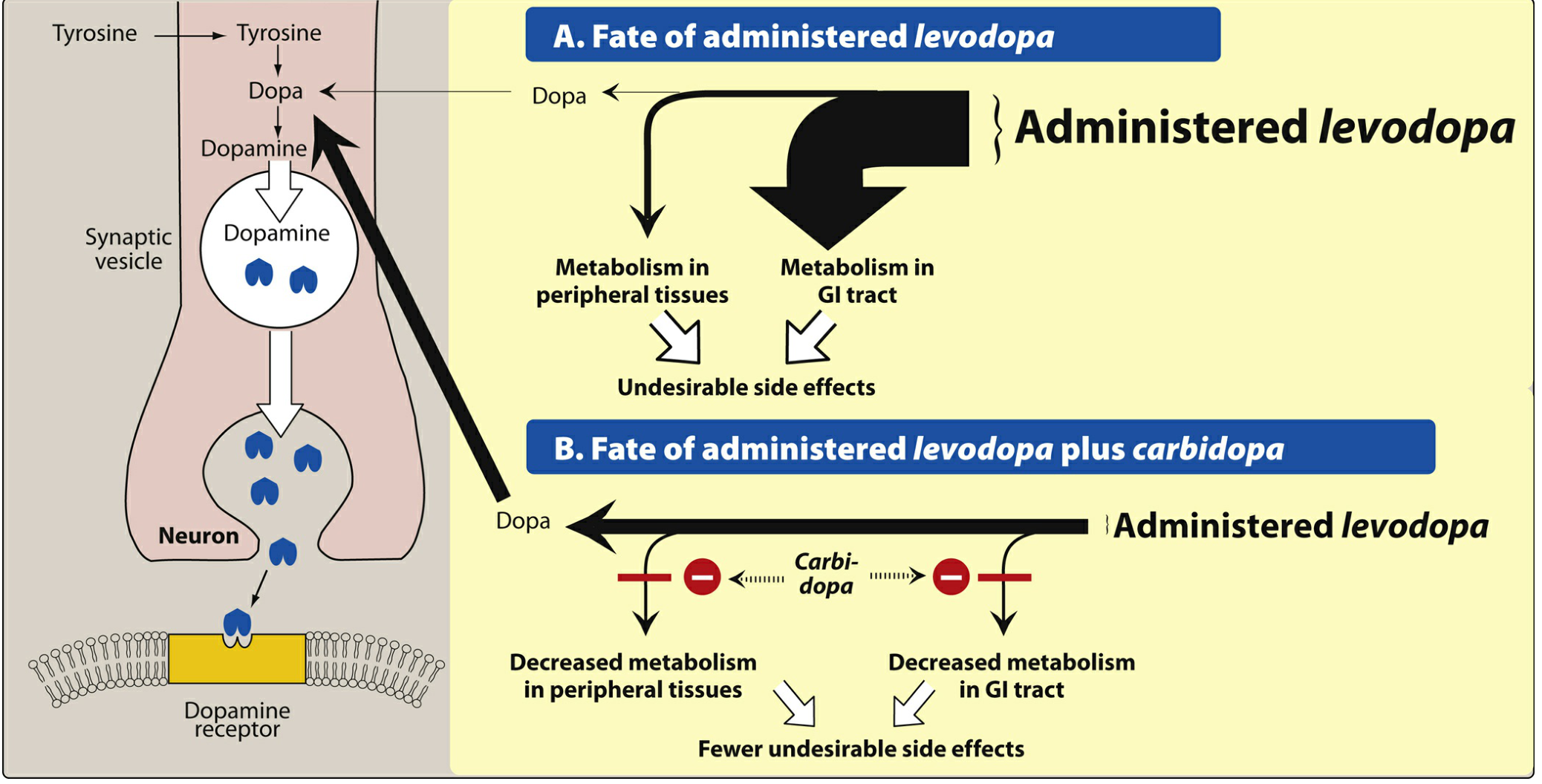
Lippincott Illustrated Reviews Pharmacology, Fig. 15.5
2. What is Methyldopa and Why It is NOT Used with Levodopa
Methyldopa (alpha-methyldopa) is an antihypertensive drug (used in hypertension, especially in pregnancy). Its mechanism:
- It is taken up and converted to alpha-methyldopamine and then to alpha-methylnorepinephrine, which acts as a false transmitter at central alpha-2 receptors, reducing sympathetic outflow and lowering blood pressure.
Methyldopa actually antagonizes levodopa's effect because:
- It competes with levodopa for the same aromatic amino acid transport carrier to enter the CNS.
- It inhibits DOPA decarboxylase centrally (where you WANT levodopa to be converted to dopamine).
- It can worsen Parkinson's symptoms and is therefore contraindicated in Parkinson's disease patients.
3. Why the Confusion Exists
The confusion between carbidopa and methyldopa arises because:
- Both are structurally related to DOPA
- Both interact with DOPA decarboxylase
- But carbidopa only inhibits it peripherally (does not cross BBB), whereas methyldopa acts centrally as well
| Drug | Crosses BBB? | Inhibits decarboxylase where? | Given with levodopa? |
|---|---|---|---|
| Carbidopa | No | Periphery only | Yes - beneficial |
| Methyldopa | Yes | Central + peripheral | No - harmful |
Summary
Levodopa is given with carbidopa (not methyldopa) because carbidopa selectively blocks peripheral decarboxylation without crossing the BBB, thereby increasing CNS bioavailability of levodopa, reducing its required dose by 4-5x, and dramatically reducing peripheral side effects (nausea, vomiting, arrhythmia, hypotension).
Methyldopa, by contrast, competes with levodopa centrally and is contraindicated in Parkinson's disease.
- Lippincott Illustrated Reviews Pharmacology, p. 515-516
- Katzung's Basic and Clinical Pharmacology, 16th Edition
This is a shared conversation. Sign in to Orris to start your own chat.