
Explainsympathetic , parasympathetic and sympatholytic and parasympatholytic In easy language to remember the concepts
Reading File
Finding Sources
Finding Sources
Finding Sources
Finding Sources
Reading File
Reading File
Reading File
Reading File
Reading File
Searching Images
sympathetic parasympathetic autonomic nervous system comparison diagram
I now have enough solid textbook content to build a comprehensive, easy-to-remember explanation. Let me compile this.
Autonomic Nervous System: The Easy Guide 🧠
Think of your body as a car. It has a gas pedal and a brake pedal. The autonomic nervous system (ANS) drives your internal organs automatically — you don't have to think about it.
🔴 SYMPATHETIC — "The Gas Pedal" (Fight or Flight)
Memory trick: SYMPATHETIC = STRESS
Imagine a lion chasing you. Your body prepares to fight or run away. Everything activates to help you survive.
Origin (Where it comes from):
- Thoracolumbar = T1 to L3 of the spinal cord
- Memory: "Thoracic-Lumbar = Tension & Loud!"
What happens when it fires:
| Organ | Effect | Why? |
|---|---|---|
| Heart | ↑ Rate, ↑ Force | Pump more blood to muscles |
| Blood vessels (muscle) | Dilate | More blood to muscles |
| Blood vessels (skin/gut) | Constrict | Redirect blood away |
| Lungs (bronchi) | Dilate | Breathe more |
| Pupils | Dilate (mydriasis) | See better |
| Bladder | Relax (holds urine) | No time for bathroom! |
| GI tract | ↓ Motility | Not digesting now |
| Liver | ↑ Glucose release | Fuel for muscles |
| Sweat glands | Secrete | Cooling the running body |
Neurotransmitter:
- Norepinephrine (NE) acts on adrenergic receptors (α and β)
- Remember: Sympathetic = adrenergic = NorEpinephrine
🔵 PARASYMPATHETIC — "The Brake Pedal" (Rest & Digest)
Memory trick: PARASYMPATHETIC = PEACE & RELAXATION
You just had a big Sunday lunch, you're lying on the sofa. Your body is resting, digesting, recovering.
Origin (Where it comes from):
- Craniosacral = Cranial nerves (III, VII, IX, X) + S2–S4
- Memory: "Cranio-Sacral = Calm & Safe"
- The vagus nerve (CN X) is the superstar — it controls heart, lungs, and most of the gut
What happens when it fires:
| Organ | Effect | Why? |
|---|---|---|
| Heart | ↓ Rate | Rest and recover |
| Bronchi | Constrict | Normal breathing is enough |
| Pupils | Constrict (miosis) | Relax, no need for wide vision |
| GI tract | ↑ Motility, ↑ secretions | Digest that food! |
| Bladder | Contract (empties) | Now there's time for bathroom |
| Salivary glands | ↑ Saliva | Digestion starts in mouth |
| Sexual organs | Erection | "Rest and digest (and reproduce)" |
Neurotransmitter:
- Acetylcholine (ACh) acts on muscarinic receptors (on organs) & nicotinic receptors (at ganglia)
- Remember: Parasympathetic = cholinergic = Acetylcholine
Quick Comparison Table
| Feature | Sympathetic | Parasympathetic |
|---|---|---|
| Nickname | Fight or Flight | Rest and Digest |
| Origin | Thoracolumbar (T1–L3) | Craniosacral (CN III,VII,IX,X + S2–S4) |
| Ganglia location | Near spinal cord | Near/in the organ |
| Preganglionic fiber | Short | Long |
| Postganglionic fiber | Long | Short |
| Main neurotransmitter | Norepinephrine | Acetylcholine |
| Receptor type | Adrenergic (α, β) | Muscarinic (M), Nicotinic (N) |
| Heart rate | ↑ Up | ↓ Down |
| Pupils | Dilate (wide) | Constrict (small) |
| GI motility | ↓ Slows | ↑ Speeds up |
| Bronchi | Dilate | Constrict |
| Bladder | Relaxes (fills) | Contracts (empties) |
💊 SYMPATHOMIMETIC — "Fake Sympathetic"
"Mimetic" = Mimics/Copies
These are drugs that copy the sympathetic response — they act like norepinephrine/epinephrine.
Memory trick: SYMPATHO-MIMETIC = Mimics the STRESS response
Examples:
- Epinephrine / Norepinephrine — direct adrenergic stimulation
- Phenylephrine → stimulates α₁ (vasoconstriction, nasal decongestant)
- Isoproterenol → stimulates β receptors (used in heart block)
- Albuterol → stimulates β₂ only (bronchodilator for asthma)
- Ephedrine, Amphetamine → indirect (release NE from nerve endings)
Clinical uses: Anaphylaxis (epinephrine), hypotension, asthma, nasal congestion, ADHD
🔪 SYMPATHOLYTIC — "Kills/Blocks Sympathetic"
"Lytic" = Breaks down / Blocks
These are drugs that BLOCK the sympathetic response — they block adrenergic receptors or deplete NE.
Memory trick: SYMPATHO-LYTIC = "Lyses" (destroys) the STRESS response → you RELAX
Examples by mechanism:
| Mechanism | Drug | Clinical Use |
|---|---|---|
| Block α₁ receptors | Prazosin, Doxazosin | Hypertension, BPH |
| Block α₁ + α₂ | Phenoxybenzamine, Phentolamine | Pheochromocytoma |
| Block β₁ + β₂ | Propranolol | HTN, arrhythmia, angina |
| Block β₁ only | Metoprolol, Atenolol | HTN, heart failure |
| Deplete NE from nerve endings | Reserpine | Hypertension |
| Block NE release | Guanethidine | Hypertension |
Clinical effects: ↓ Heart rate, ↓ Blood pressure, ↓ anxiety, bronchospasm (if β₂ blocked)
🌿 PARASYMPATHOMIMETIC — "Fake Parasympathetic"
Mimics the rest-and-digest response (cholinergic effect)
Memory trick: PARA-SYMPATH-OMIMETIC = Mimics PEACE (acetylcholine-like)
Examples:
- Pilocarpine → muscarinic agonist (used in glaucoma — constricts pupil, drains eye fluid)
- Methacholine → muscarinic agonist (used to provoke bronchospasm in asthma testing)
- Neostigmine, Pyridostigmine → anticholinesterase (prevent ACh breakdown → more ACh effect) — used in Myasthenia Gravis
Clinical effects: ↓ Heart rate, ↑ GI motility, pupil constriction, bronchospasm, bladder contraction, ↑ secretions (SLUDGE: Salivation, Lacrimation, Urination, Defecation, GI cramps, Emesis)
❌ PARASYMPATHOLYTIC — "Kills/Blocks Parasympathetic"
Blocks the rest-and-digest response (anticholinergic/antimuscarinic)
Memory trick: PARA-SYMPATHO-LYTIC = "Lyses" (blocks) the RELAXATION → EXCITES the body
Memory trick for effects: "Hot as a hare, dry as a bone, blind as a bat, red as a beet, mad as a hatter" (classic anticholinergic toxidrome)
Examples:
- Atropine — prototype; ↑ heart rate, dilates pupils, dries secretions
- Scopolamine — motion sickness
- Homatropine — pupil dilation for eye exams
- Ipratropium — blocks bronchoconstriction (used in COPD)
- Oxybutynin, Tolterodine — overactive bladder
Clinical effects: ↑ Heart rate, dry mouth, constipation, urinary retention, mydriasis (big pupils), flushing, confusion
🧠 The Big 4 — Master Summary
SYMPATHOMIMETIC   = Acts LIKE sympathetic   → ↑ HR, ↑ BP, dilate bronchi, dilate pupils
SYMPATHOLYTIC     = BLOCKS sympathetic      → ↓ HR, ↓ BP (β-blockers, α-blockers)

PARASYMPATHOMIMETIC = Acts LIKE parasympathetic → ↓ HR, ↑ GI, constrict pupils, SLUDGE
PARASYMPATHOLYTIC   = BLOCKS parasympathetic    → ↑ HR, dry, constipated, dilated pupils
The easy flip rule:
Sympatholytic = Parasympathomimetic in effect Parasympatholytic = Sympathomimetic in effect
Because blocking one side lets the other side dominate! Block the gas pedal (sympatholytic) → the brake takes over = same as pressing the brake (parasympathomimetic).
Diagram: ANS Pathways
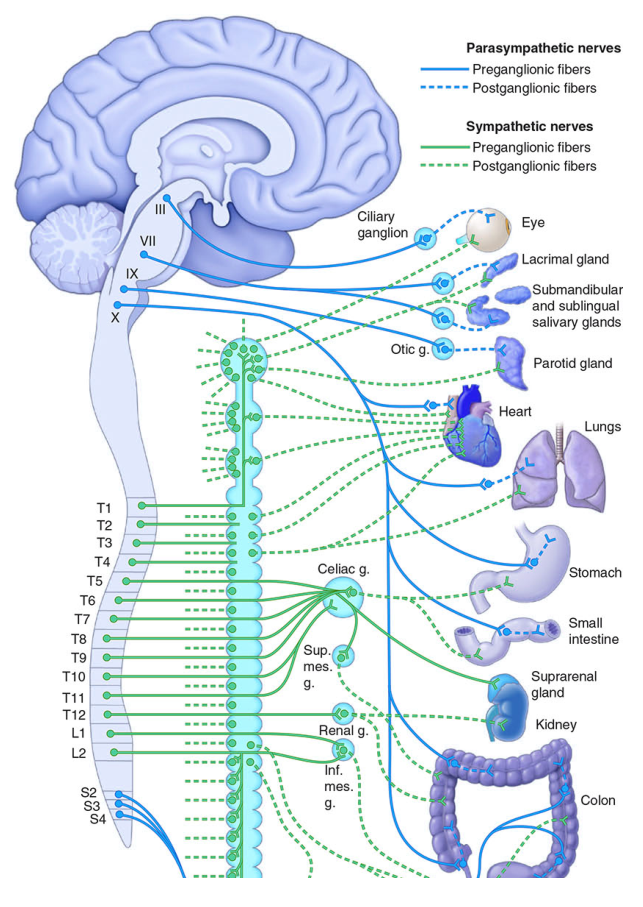
Sources: Costanzo Physiology 7th Edition, p. 56–59; Guyton and Hall Textbook of Medical Physiology, p. 765
This is a shared conversation. Sign in to Orris to start your own chat.