
retractors used for upper and lower 3rd molar extraction
"third molar" AND extraction
third molar extraction retractors upper lower dental surgery
Upper third molar extraction
- Laster retractor: especially useful posteriorly to retract cheek/flap and reflect light toward the maxillary tuberosity.
- Minnesota retractor: retracts the buccal mucoperiosteal flap and cheek.
- Kilner cheek retractor: retracts cheek/lip to improve access.
- Molt or periosteal elevator: may assist with flap reflection, rather than being the main static retractor.
Lower third molar extraction
- Minnesota retractor: most commonly used on the buccal side to retract and protect the mucoperiosteal flap.
- Howarth / Ward's retractor: commonly used to retract the buccal flap in mandibular third molar surgery.
- Langenbeck retractor: another option for buccal flap retraction.
- Bowdler-Henry rake retractor: useful for broad, firm buccal flap retraction.
- Austin retractor: can also retract the buccal mucoperiosteal flap.
- Lack tongue retractor: retracts and stabilizes the tongue when needed.
Create a comparison table of upper vs lower third-molar instruments
"third molar" AND extraction
StatPearls oral surgery instruments retractors upper and mandibular third molar extraction Minnesota Laster
| Instrument group | Upper third molar, maxillary | Lower third molar, mandibular |
|---|---|---|
| Primary retractor | Laster retractor: retracts soft tissue and directs light posteriorly toward the maxillary tuberosity | Minnesota or Bowdler-Henry rake retractor: retracts and protects the buccal mucoperiosteal flap |
| Additional cheek/flap retraction | Minnesota retractor, Kilner cheek retractor | Minnesota, Austin, Howarth/Ward's, or Langenbeck retractor |
| Tongue control | Usually not required | Lack tongue retractor if tongue retraction is needed |
| Periosteal elevation | Molt No. 9 periosteal elevator | Molt No. 9 periosteal elevator |
| Elevators / luxators | Straight elevators, small Coupland elevators, Warwick-James elevators, luxators | Straight elevators, Coupland elevators, Cryer/east-west elevators, Warwick-James elevators, luxators |
| Bone removal | Surgical handpiece with round or fissure bur, mainly for tuberosity/distal bone as required | Surgical handpiece with round or fissure bur for buccal guttering and distal bone removal |
| Tooth sectioning | Fissure bur if roots or crown need separation | Fissure bur, commonly used for crown sectioning and root division in impacted teeth |
| Extraction forceps | Upper third-molar forceps, often bayonet-type or upper universal forceps where appropriate | Lower third-molar forceps, mandibular molar forceps or lower universal forceps where appropriate |
| Root delivery | Root-tip pick, small straight elevator, bayonet forceps | Root-tip pick, Cryer elevator, small straight elevator |
| Suction | Frazier / surgical suction tip | Frazier / surgical suction tip |
| Closure | Needle holder, tissue forceps, scissors, sutures | Needle holder, tissue forceps, scissors, sutures |
Main distinction
- Upper third molar: access is limited posteriorly by the cheek and maxillary tuberosity. The Laster retractor is particularly helpful.
- Lower third molar: the procedure more often needs buccal bone guttering and tooth sectioning. Buccal flap retraction with a Minnesota or rake retractor is standard. Avoid uncontrolled lingual retraction because the lingual nerve lies close to the lingual cortical plate near the lower third molar.
comparision of designs of retractors used for lower 3rd molar extraction
mandibular third molar extraction Minnesota Austin Bowdler Henry rake Howarth retractors design
Minnesota retractor Bowdler Henry rake Austin retractor dental oral surgery instruments
"third molar" AND retractor
Retractors for lower third-molar extraction: design comparison
| Retractor | Characteristic design | Main use in mandibular third-molar surgery | Advantages | Limitations / cautions |
|---|---|---|---|---|
| Minnesota retractor | Broad, smooth, concave or gently curved flat blade set at an angle to a stout handle | Standard buccal flap retractor. Holds the mucoperiosteal flap, cheek, and buccal mucosa away during bone guttering, sectioning, and delivery of the tooth | Wide, atraumatic blade distributes pressure over a large area; good protection of cheek and flap; strong and versatile | Bulky in a small mouth or when access is restricted; excessive pressure can bruise or tear the flap |
| Howarth retractor | Narrower, flatter blade with an angled or curved terminal end, usually less broad than a Minnesota | Buccal flap retraction in more confined posterior access; can also assist in retracting cheek tissue | Slim profile gives access around the mandibular ramus; useful where Minnesota is too broad | Provides less broad flap support than Minnesota; may concentrate pressure if held forcefully |
| Langenbeck retractor | Flat blade with a right-angled bend and a relatively narrow, rectangular working end | Retracting the buccal flap or cheek, particularly in a deeper surgical field | Firm, direct retraction; narrow blade can fit posteriorly | The square edge is less forgiving than a broad concave blade, so it must be positioned carefully to avoid soft-tissue trauma |
| Austin retractor | Broad, curved smooth blade, commonly with a more pronounced curve than a Minnesota | Buccal mucoperiosteal flap and cheek retraction during surgical extraction | Broad tissue support and good visibility; appropriate for sustained buccal retraction | Can obstruct the operative field if poorly positioned; not intended for forceful bone leverage |
| Bowdler-Henry rake retractor | Multiple blunt prongs, resembling a small rake, attached to a handle | Gripping and retracting a thick buccal flap or mobile soft tissue | Secure purchase in a thick flap; less likely to slip than a flat blade | Prongs can traumatize or perforate thin tissue. Use gentle, controlled traction and avoid placing it where it may catch delicate structures |
| Lack tongue retractor | Broad, smooth, curved tongue blade, often with a handle designed for posterior oral access | Retracts and stabilizes the tongue when it encroaches on the field | Improves visibility and protects the tongue from instruments | Not a routine flap retractor. Do not use it as a lever against the lingual tissues |
| Weider / sweetheart tongue retractor | Heart-shaped or broad curved blade with a central notch or contour | Tongue and floor-of-mouth control when required | Broad, relatively atraumatic tongue control | Requires careful placement and intermittent release to avoid excessive tongue compression |
Practical selection
- Routine lower third-molar surgery: a Minnesota retractor is usually the first choice for buccal flap retraction.
- Deep or restricted posterior access: Howarth or Langenbeck may be easier to position.
- Thick, mobile flap that slips: a Bowdler-Henry rake can provide a more secure hold.
- Tongue entering the field: use a Lack or Weider tongue retractor, only as needed.
Safety point
comparision of designs of retractors used for upper 3rd molar extraction
upper maxillary third molar extraction retractors Laster Minnesota Kilner design
"third molar" AND extraction
Laster retractor Minnesota retractor Kilner cheek retractor oral surgery instrument
Retractors for upper third-molar extraction: design comparison
| Retractor | Characteristic design | Main role for maxillary third molar | Design advantage | Limitations / cautions |
|---|---|---|---|---|
| Laster retractor | Long handle with a narrow, curved, angled blade designed for posterior maxillary access | Preferred posterior retractor for retracting the buccal flap and soft tissue around the maxillary tuberosity | Its long, curved profile reaches the posterior maxilla and helps reflect light toward the tuberosity, improving visibility | Use gentle traction. Excessive distal force may traumatize the flap or contribute to displacement risk in the posterior region |
| Minnesota retractor | Broad, smooth, shallow concave blade at an angle to a heavy handle | Retracts the cheek and buccal mucoperiosteal flap | Broad blade distributes pressure over a large surface area, protecting the cheek and flap during bone removal or elevation | Can be bulky in posterior maxillary access and may obstruct visibility compared with a Laster |
| Austin retractor | Broad, smoothly curved blade with an angled shank | Buccal flap and cheek retraction during surgical extraction | Broad, atraumatic contact surface and stable support of a raised flap | Less specifically shaped for reaching behind the maxillary tuberosity than the Laster |
| Kilner cheek retractor | Broad, smooth, curved or spoon-shaped cheek/lip blade | Primarily retracts the cheek and lip to increase the oral opening and access | Excellent for lateral soft-tissue retraction; helps maintain a clear working field without placing the blade under the flap | It is principally a cheek retractor, not the best choice for deep posterior flap retraction |
| Langenbeck retractor | Narrow, flat, rectangular blade with a right-angle bend to the handle | Can retract a limited buccal flap in restricted access | Slim blade can enter confined posterior areas | The narrower, relatively flat blade concentrates pressure more than Minnesota or Austin designs |
| Molt No. 9 periosteal elevator | Double-ended instrument, with broad pointed and rounded working ends | Raises the mucoperiosteal flap before a retractor is placed | Not primarily a retractor, but its angled ends permit controlled flap reflection | Should not be held under sustained tension as a substitute for a retractor |
Key design-based distinction
- Minnesota and Austin retractors are broader flap-and-cheek retractors.
- Kilner is designed mainly for cheek/lip retraction.
- Langenbeck has a narrow right-angled blade for confined spaces.
Practical choice
- Routine upper third-molar surgery: Laster plus, if needed, a cheek retractor.
- Broad buccal flap needing protection: Minnesota or Austin.
- Cheek obstructing access: Kilner.
- Very restricted access: Langenbeck may be helpful.
comparision of designs of retractors used for upper 3rd molar extraction with images
Laster retractor maxillary third molar extraction instrument
Kilner cheek retractor dental instrument
Austin retractor dental oral surgery instrument
Laster retractor Minnesota retractor Kilner cheek retractor images maxillary third molar extraction
"third molar" AND extraction
https://www.ncbi.nlm.nih.gov/sites/books/NBK585063
Upper third-molar retractors: design comparison
| Retractor | Image | Design features | Role in upper third-molar extraction |
|---|---|---|---|
| Laster third-molar retractor | 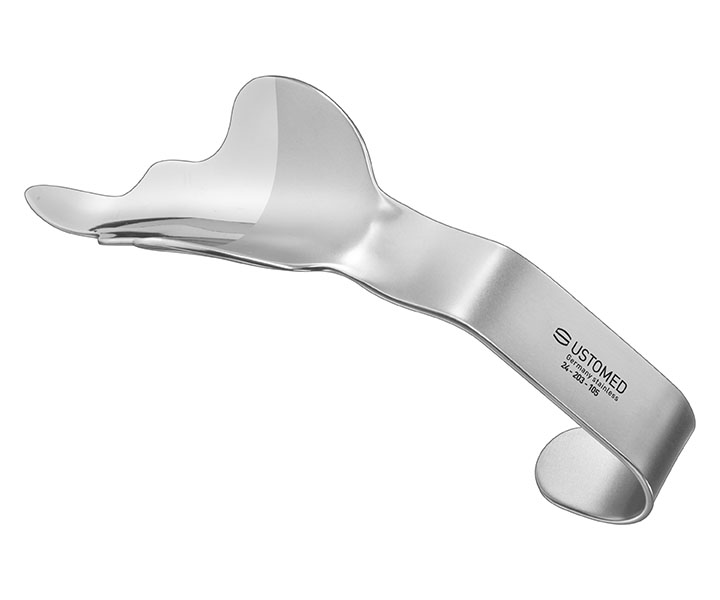 | Long, slender handle with a narrow, curved and posteriorly directed working end. Its profile is made for access behind the maxillary second molar. | Most specific design for upper third molars. Retracts the posterior buccal flap and tissues near the maxillary tuberosity. Its curvature also helps direct light posteriorly into this relatively deep field. |
| Minnesota retractor | 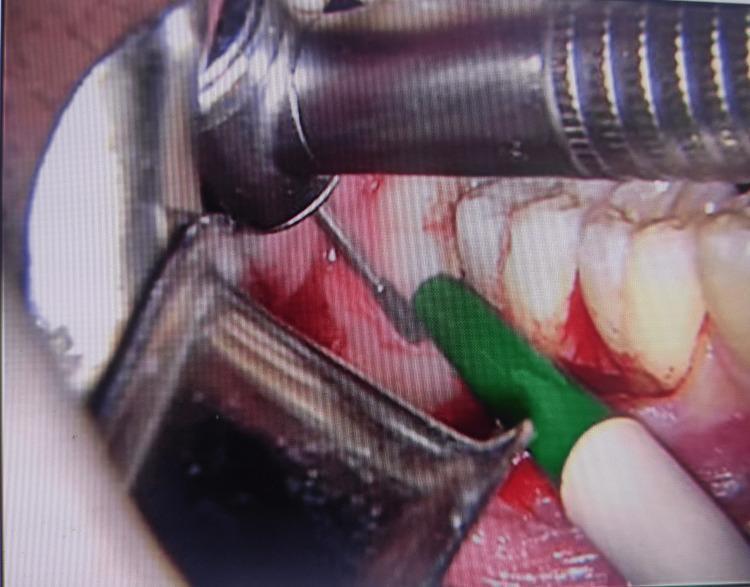 | Heavy handle with a broad, smooth, shallow concave blade bent at an angle. It has a wide tissue-contact surface. | General-purpose cheek and buccal mucoperiosteal flap retraction. Its broad blade protects tissue during elevation, bone removal, or tooth delivery, but it is bulkier than the Laster in the posterior maxilla. |
| Austin retractor | Similar broad flap-retractor class to Minnesota | Broad, smoothly curved blade with an angled shank. The tissue-contact end is wider than Laster and designed to spread pressure across the flap. | Used for broad buccal flap and cheek retraction where strong, stable exposure is required. Less specialized for reaching the tuberosity region than the Laster. |
| Kilner cheek retractor | Cheek/lip rather than deep flap retractor | Smooth, broad, curved or spoon-like blade that follows the contour of the cheek or lip. | Pulls the cheek and lip laterally to increase access and visibility. It complements, rather than replaces, a Laster or Minnesota when a posterior flap is raised. |
| Langenbeck retractor | Narrow-access alternative | Flat, rectangular blade with a near right-angle bend to a long handle. The blade is usually narrower and less concave than Minnesota. | May be used for limited flap retraction in a confined posterior field. The narrower blade is easier to insert but distributes pressure over a smaller tissue area. |
Design-based summary
- Laster: narrow, curved, posteriorly directed. Best adapted to the upper third-molar and maxillary tuberosity region.
- Minnesota / Austin: broad, curved tissue blades. Best for wide flap and cheek support.
- Kilner: broad smooth cheek blade. Best for lateral cheek and lip retraction.
- Langenbeck: narrow flat right-angled blade. Useful in restricted access, but should be held gently to prevent pressure injury.