
1. Supination/Pronation twist (all forms) 2. Osteokinematics & Arthrokinematics 3. Determinants / Parameters of gait 4. Scapulo-humeral rhythm 5. Meniscus / Functions of menisci 6. Bursae around knee joint 7. Ligamentum flavum 8. Sliding filament theory 9. Linear force system 10. Sensory receptors (muscle) 11. TFCC (Triangular Fibro-Cartilage Complex) 12. Patello-femoral joint reaction force 13. Composition of connective tissue 14. Loading of the foot 15. Arches of foot & its biomechanics 16. Pelvic tilt 17. Scoliosis 18. Load deformation curve 19. Grip and grasp / Power grip 20. Active & Passive insufficiency 21. Angles of hip joint 22. Anterior cruciate ligament (ACL) 23. Supra humeral arch 24. Ideal / Optimal posture 25. Anatomical pulleys / Patella as anatomical pulley 26. Pivot joint 27. Importance of angles/curves in femur 28. Extensor mechanism / Expansion of wrist & fingers 29. Shoulder joint stability / Static stabilization 30. Factors affecting muscle functions Bio mechanics format answer for the 5 marks questions 3 , it should have content to write 3 pages , 2 or 1 or enough diagram, one page flowchart to save the time Now send the answer for 15 question
Q.15 — Arches of the Foot & Their Biomechanics
DEFINITION
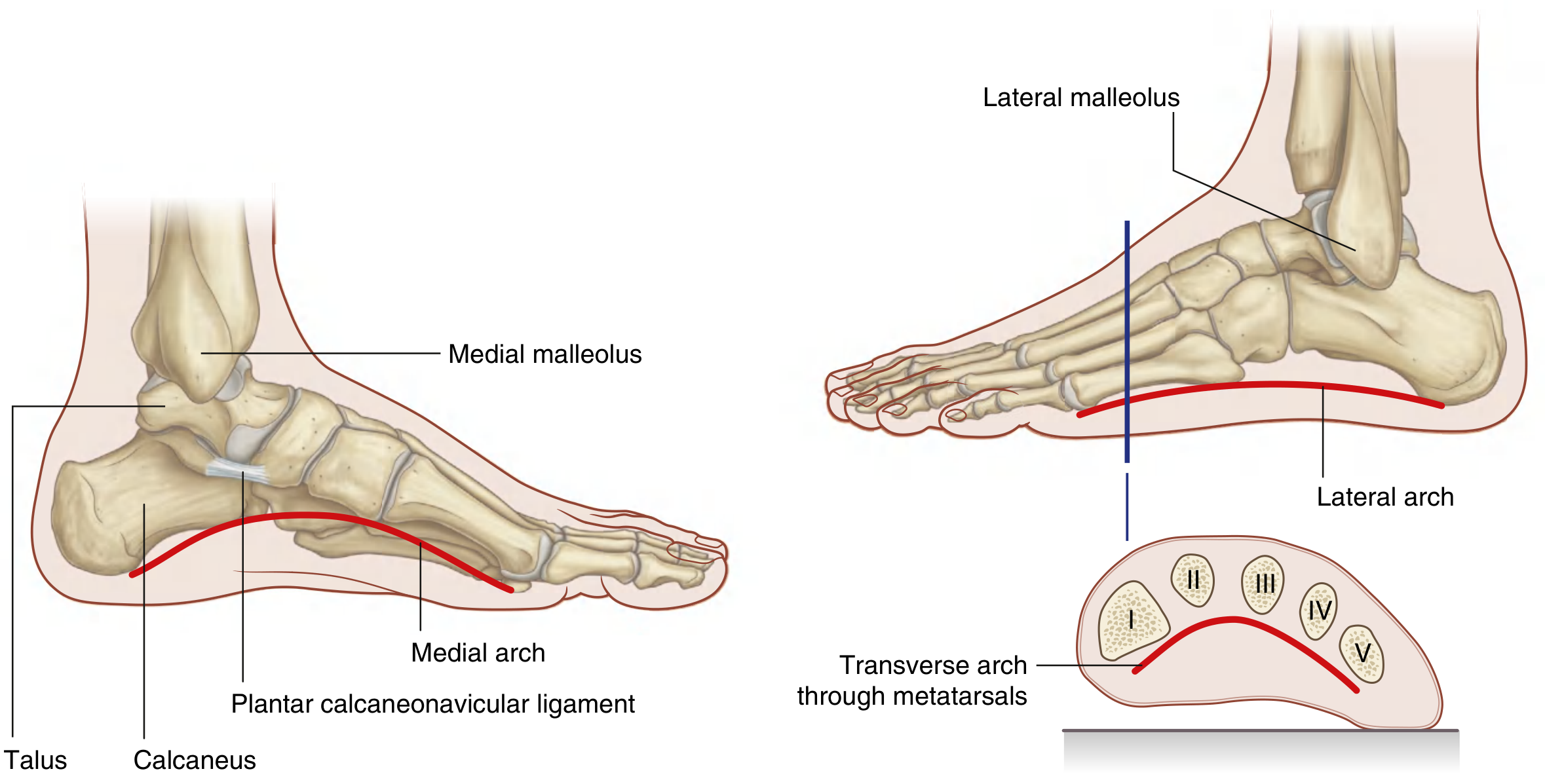
TYPES OF ARCHES (3 arches)
1. Medial Longitudinal Arch (MLA) -- Highest & Most Important
- Bones: Calcaneus → Talus → Navicular → 3 Cuneiforms → Medial 3 Metatarsals (1st, 2nd, 3rd)
- Extends from the posterior calcaneal tuberosity to the heads of the medial three metatarsals
- Keystone: Talus (head of talus is the summit)
- Height: Highest on medial side
- Function: Primary shock absorber; energy storage during gait
2. Lateral Longitudinal Arch (LLA) -- Lower & More Rigid
- Bones: Calcaneus → Cuboid → Lateral 2 Metatarsals (4th, 5th)
- Lies almost flat on the ground - transmits weight more directly
- Keystone: Cuboid
- Function: Weight transmission and stability
3. Transverse Arch
- Runs mediolaterally across the foot at the level of the cuneiforms and metatarsal bases
- Keystone: Intermediate and lateral cuneiforms (wedge-shaped bones)
- Disappears near the metatarsal heads where bones are held by deep transverse metatarsal ligaments
- Function: Helps distribute load across the width of the foot
DIAGRAM 1 -- Arches of the Foot
SUPPORT MECHANISMS FOR ARCHES
A. Passive (Static) Support
| Structure | Arch Supported |
|---|---|
| Plantar calcaneonavicular (Spring) ligament | Medial longitudinal |
| Short plantar (plantar calcaneocuboid) ligament | Lateral longitudinal |
| Long plantar ligament | Both longitudinal arches |
| Plantar aponeurosis | Longitudinal arch (primary tie-beam) |
| Interosseous ligaments | Transverse arch |
- Arises from medial process of calcaneal tuberosity
- Runs forward as thick longitudinal fibers that diverge to enter the toes
- Acts as a tie-beam connecting the two ends of the arch, preventing splaying
- Supports the longitudinal arch and protects deeper plantar structures
B. Active (Dynamic) Support -- Muscular
| Muscle | Arch Supported |
|---|---|
| Tibialis posterior | Medial longitudinal (primary active support) |
| Tibialis anterior | Medial longitudinal |
| Fibularis (Peroneus) longus | Transverse + lateral longitudinal |
| Flexor hallucis longus | Medial longitudinal (dynamic) |
| Flexor digitorum brevis | Longitudinal arch generally |
| Intrinsic foot muscles | All arches |
BIOMECHANICS OF THE ARCHES
Tripod Weight-Bearing Concept
- Heel (calcaneus) -- posterior point
- 1st metatarsal head -- medial anterior point
- 5th metatarsal head -- lateral anterior point
Arch Function During Gait (3 phases)
- Hindfoot is inverted/locked at initial contact
- Arches are in a higher, stiffer configuration for initial stability
- Hindfoot everts/unlocks - foot becomes flexible
- Transverse tarsal joint (calcaneocuboid + talonavicular) becomes "unlocked" (joints in parallel plane)
- Arches flatten slightly to absorb shock and accommodate ground surface
- Gastrocnemius-soleus contracts eccentrically to control forward progression
- MTP joints dorsiflex - this activates the Windlass Mechanism
- Hindfoot supinates (posterior tibial tendon fires)
- Transverse tarsal joint locks (joints no longer parallel) → rigid lever arm for propulsion
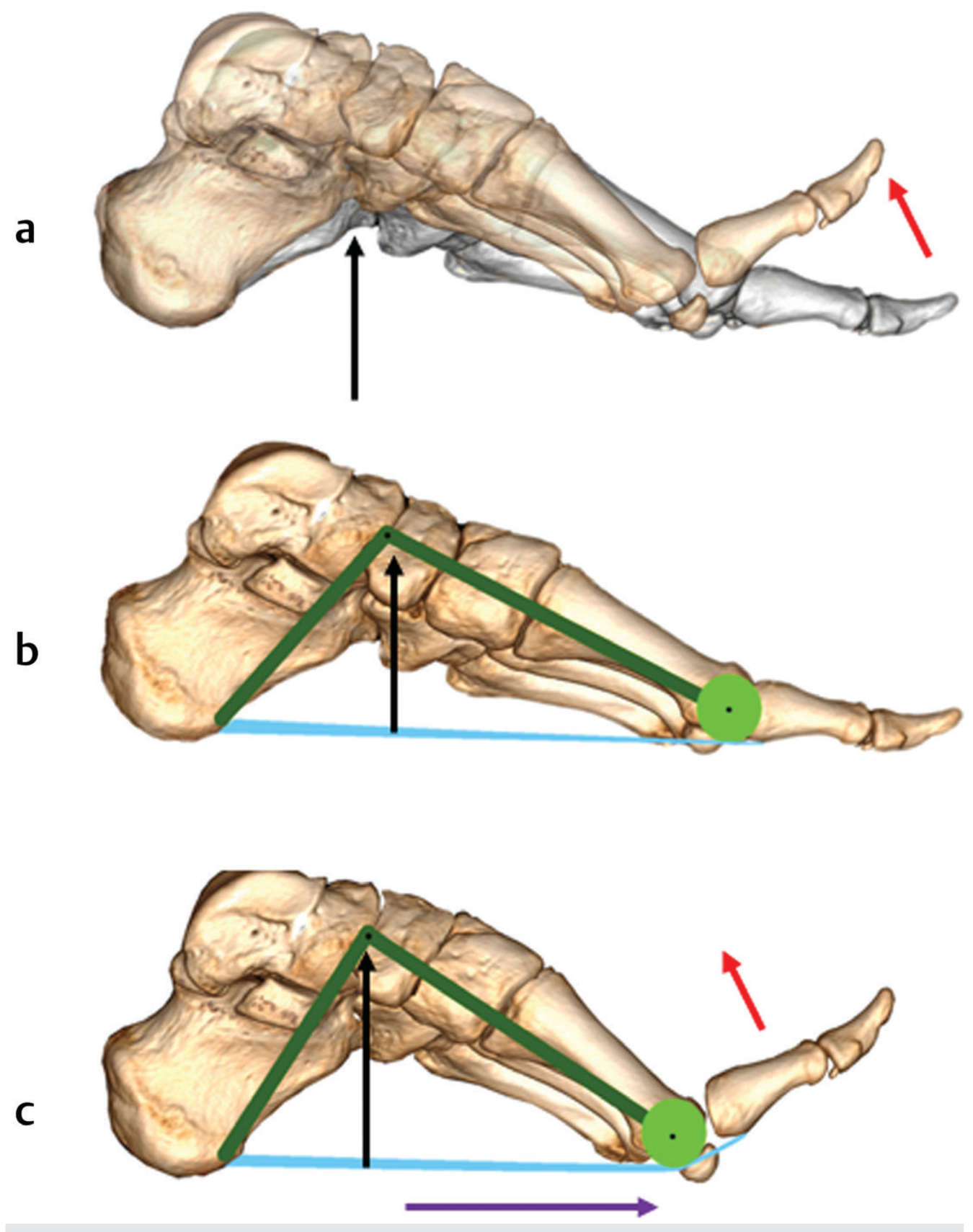
THE WINDLASS MECHANISM
- Plantar fascia inserts at bases of proximal phalanges
- As toes dorsiflex at toe-off → plantar fascia is pulled distally (like winding a windlass/capstan)
- The calcaneus and metatarsal heads are drawn together → arch height increases
- Hindfoot supinates → transverse tarsal joint locks → foot becomes rigid for push-off
DIAGRAM 2 -- Windlass Mechanism
FLOWCHART -- Biomechanics of the Foot Arches During Gait
HEEL STRIKE
│
▼
Hindfoot INVERTED → Transverse Tarsal Joint LOCKED
Arches HIGH + STIFF → Stability for initial contact
│
▼
FOOT FLAT (Midstance)
│
▼
Hindfoot EVERTS → Transverse Tarsal Joint UNLOCKED
Arches FLATTEN slightly → Shock absorption + Ground accommodation
Gastrocnemius-Soleus contracts eccentrically (controls forward motion)
│
▼
HEEL RISE (Terminal Stance)
│
▼
MTP joints DORSIFLEX
│
▼
WINDLASS MECHANISM ACTIVATES
│
├── Plantar fascia pulled distally
├── Arch HEIGHT INCREASES
├── Hindfoot SUPINATES (PTT fires)
└── Transverse Tarsal Joint LOCKS → RIGID LEVER
│
▼
TOE-OFF
(Propulsion: Gastrocnemius-Soleus concentrically)
│
▼
SWING PHASE begins
CLINICAL RELEVANCE
| Condition | Arch Involved | Mechanism |
|---|---|---|
| Pes planus (Flat foot) | Medial longitudinal arch collapse | Failure of spring ligament + PTT dysfunction → talus drops medially |
| Pes cavus (High arch) | Excessively high MLA | Muscle imbalance (intrinsic weakness); increased lateral stress → 5th metatarsal stress fractures |
| Plantar fasciitis | Longitudinal arch tie-beam | Overload of plantar aponeurosis at calcaneal attachment |
| Splayfoot | Transverse arch flattening | Weak intrinsics; collapse causes metatarsal head pain |
SUMMARY BOX (Quick Recall)
| Arch | Bones | Keystone | Support |
|---|---|---|---|
| Medial longitudinal | Calcaneus-Talus-Navicular-3 Cuneiforms-MT1,2,3 | Talus | Spring ligament, PTT, FHL |
| Lateral longitudinal | Calcaneus-Cuboid-MT4,5 | Cuboid | Long & short plantar ligaments |
| Transverse | Cuneiforms + MT bases | Intermediate cuneiform | Fibularis longus, interosseous ligaments |
I mean you to send the answer for 1 to 15 question in pdf with points by point for headings and flow chart to save the time and send the answer in pdf format
You are a biomechanics expert helping compile detailed 5-mark exam answers for a physiotherapy/biomechanics exam. Research the following 8 topics from the medical library database and return comprehensive, structured content for each. Use query_library_db with paragraphs_fts and headings_fts searches, then read_file to get the actual content. For EACH topic below, provide: - Definition (2-3 lines) - Key points / Classification in bullet form - Biomechanical significance - A simple ASCII flowchart or table where applicable - Clinical relevance (1-2 lines) Topics to research (search the medical library for each): 1. **Supination/Pronation Twist (all forms)** - search "supination pronation twist forearm" and "pronation supination biomechanics" 2. **Osteokinematics & Arthrokinematics** - search "osteokinematics arthrokinematics" and "convex concave rule" 3. **Determinants/Parameters of Gait** - search "determinants of gait" and "gait parameters" 4. **Scapulohumeral Rhythm** - search "scapulohumeral rhythm" and "scapular rotation shoulder abduction" 5. **Meniscus / Functions of Menisci** - search "meniscus function knee" and "menisci biomechanics" 6. **Bursae around knee joint** - search "bursae knee joint" and "prepatellar infrapatellar bursa" 7. **Ligamentum Flavum** - search "ligamentum flavum" and its biomechanical role 8. **Sliding Filament Theory** - search "sliding filament theory" and "muscle contraction actin myosin" For each topic, use these SQL queries on the medical library: - headings_fts: SELECT title, book_title, '/textbooks/' || block_file_path AS file_path, line_number, para_line_ranges FROM headings_fts WHERE headings_fts MATCH '[search term]' ORDER BY rank LIMIT 5 - paragraphs_fts: SELECT book_title, section_heading, '/textbooks/' || block_file_path AS file_path, line_start, line_end, snippet(paragraphs_fts, 0, '>>>', '<<<', '...', 30) AS snippet FROM paragraphs_fts WHERE paragraphs_fts MATCH '[search term]' ORDER BY rank LIMIT 5 Then read the relevant file sections using read_file with appropriate offset/limit (100 lines at a time). Return the full structured content for all 8 topics as plain text, well organized with clear headings for each topic. Include ALL the biomechanical details needed for a 3-page exam answer per topic. Return image URLs if found (format: IMAGE_URL: https://...).
You are a biomechanics expert helping compile detailed 5-mark exam answers for a physiotherapy/biomechanics exam. Research the following 7 topics from the medical library database and return comprehensive, structured content for each. Use query_library_db with paragraphs_fts and headings_fts searches, then read_file to get the actual content. For EACH topic below, provide: - Definition (2-3 lines) - Key points / Classification in bullet form - Biomechanical significance - A simple ASCII flowchart or table where applicable - Clinical relevance (1-2 lines) Topics to research (search the medical library for each): 9. **Linear Force System** - search "linear force system mechanics" and "force vectors biomechanics" 10. **Sensory Receptors (Muscle)** - search "muscle spindle sensory receptor" and "Golgi tendon organ proprioception" 11. **TFCC (Triangular Fibrocartilage Complex)** - search "triangular fibrocartilage complex TFCC" and "TFCC wrist" 12. **Patellofemoral Joint Reaction Force** - search "patellofemoral joint reaction force" and "patella biomechanics" 13. **Composition of Connective Tissue** - search "connective tissue composition collagen" and "extracellular matrix" 14. **Loading of the Foot** - search "foot loading weight bearing" and "ground reaction force foot" 15. **Arches of Foot & Biomechanics** - search "arches foot biomechanics" and "medial longitudinal arch windlass mechanism" For each topic, use these SQL queries on the medical library: - headings_fts: SELECT title, book_title, '/textbooks/' || block_file_path AS file_path, line_number, para_line_ranges FROM headings_fts WHERE headings_fts MATCH '[search term]' ORDER BY rank LIMIT 5 - paragraphs_fts: SELECT book_title, section_heading, '/textbooks/' || block_file_path AS file_path, line_start, line_end, snippet(paragraphs_fts, 0, '>>>', '<<<', '...', 30) AS snippet FROM paragraphs_fts WHERE paragraphs_fts MATCH '[search term]' ORDER BY rank LIMIT 5 Then read the relevant file sections using read_file with appropriate offset/limit (100 lines at a time). Return the full structured content for all 7 topics as plain text, well organized with clear headings for each topic. Include ALL the biomechanical details needed for a 3-page exam answer per topic. Return image URLs if found (format: IMAGE_URL: https://...).
mkdir -p /tmp/workspace/biomechanics-pdf && ls /tmp/workspace/biomechanics-pdf/