
Thyroid anatomy Thyroid swelling surgery
Reading File
Now let me search the medical library for both topics in parallel.
Finding Sources
Finding Sources
Finding Sources
Reading File
Reading File
Reading File
Reading File
Reading File
Reading File
Reading File
Loading Image
Reading File
Loading Image
Reading File
I now have extensive content from multiple authoritative surgery textbooks. Let me compile the full answer.
Thyroid Anatomy and Surgery for Thyroid Swelling
PART 1: THYROID ANATOMY
General Description
The thyroid gland is a bilobed, brown, firm structure weighing 15-30 g in adults. It sits anterior to the trachea, just inferior to the cricoid cartilage, within the central compartment of the neck. Each lobe measures approximately:
- Craniocaudal: ~5 cm
- Anteroposterior: 2-3 cm
- Width: ~3 cm
The two lobes are connected by the isthmus, and a pyramidal lobe extends superiorly from the isthmus in ~50% of individuals (a remnant of the thyroglossal duct).
(Mulholland and Greenfield's Surgery, 7e)
Anatomical Relations
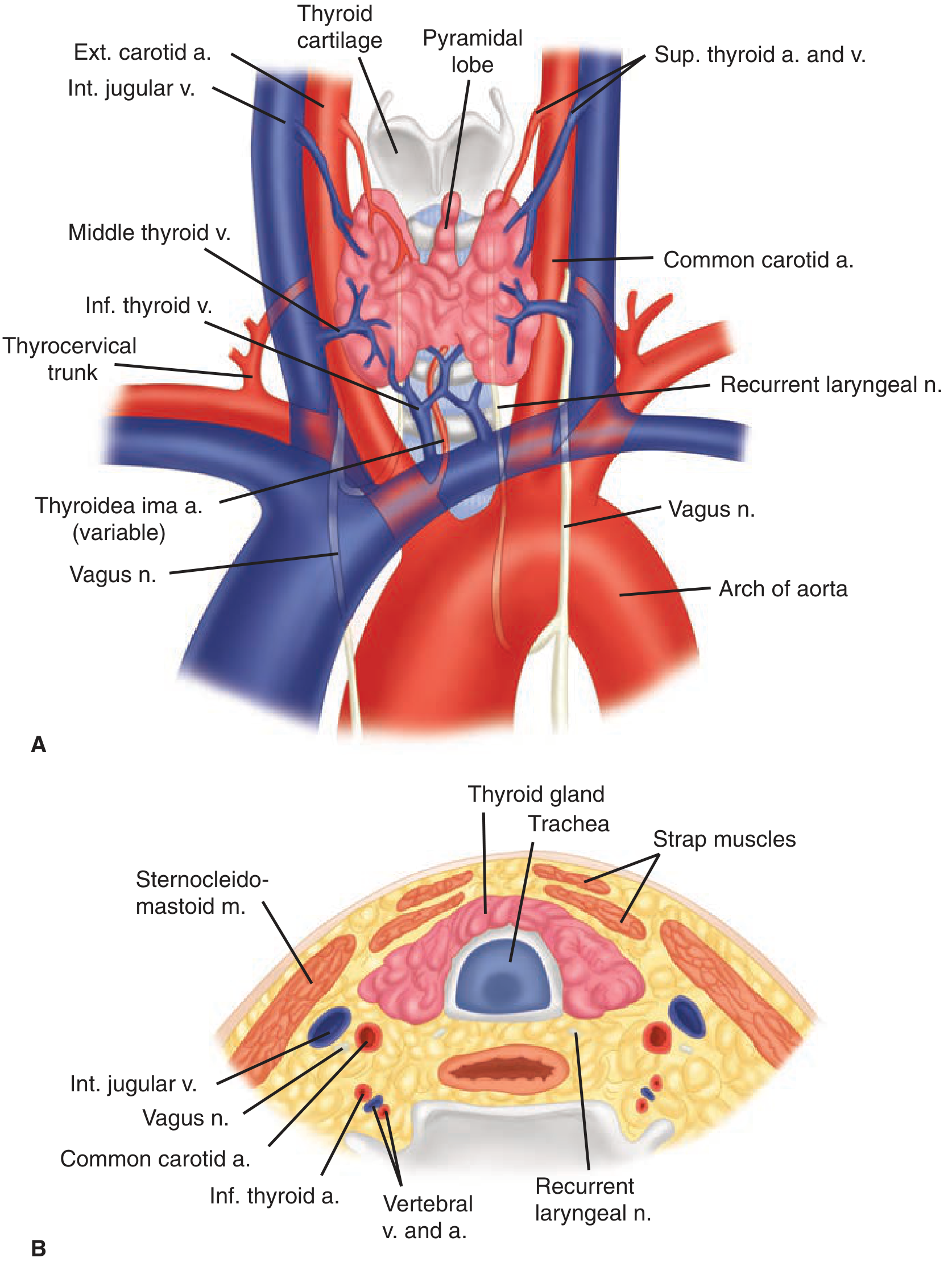
Figure: Anatomy of the thyroid gland - anterior view (A) and cross-section (B) showing key vascular and neural relationships
| Direction | Structures |
|---|---|
| Anterior | Sternothyroid and sternohyoid (strap) muscles |
| Posterior | Trachea and esophagus (esp. on the left) |
| Lateral | Medial aspects of the carotid sheath |
| Posterior medial | Ligament of Berry (firm attachment to trachea) |
The pretracheal fascia invests the thyroid and forms a thin, easily mobilized plane in the absence of thyroiditis or invasive malignancy. It also condenses as the anterior suspensory ligament above the isthmus.
Embryology
The thyroid arises from two anlages:
-
Median thyroid anlage - a thickening of pharyngeal floor endoderm. Descends caudally as a bilobed diverticulum connected to the tongue by the thyroglossal duct. The duct becomes solid by week 5, leaving behind the foramen cecum superiorly and the pyramidal lobe inferiorly. Thyroid reaches final position by week 7; follicle formation and thyroid hormone production begin by week 10.
-
Lateral thyroid anlage - arises from pharyngeal endoderm and fuses to the median anlage during descent at week 5. Contains ultimobranchial body cells from the 4th and 5th pharyngeal pouches, which become the calcitonin-secreting parafollicular C cells. Contributes approximately one-third of the final gland mass.
(Sabiston Textbook of Surgery, Biological Basis of Modern Surgical Practice)
Embryologic anomalies:
| Anomaly | Mechanism | Presentation | Treatment |
|---|---|---|---|
| Thyroid agenesis | Failure of anlage to form | Congenital hypothyroidism (cretinism) | Thyroid hormone replacement |
| Thyroglossal duct cyst | Failure of duct to resorb | Midline neck mass that elevates on tongue protrusion | Sistrunk procedure |
| Lingual thyroid | Failure of median portion to descend | Mass at base of tongue | Surgical excision or RAI |
| Ectopic thyroid | Embryologic rests in central compartment | Ectopic thyroid mass | Surgical excision |
| Nonrecurrent laryngeal nerve | Abnormal aortic arch development (usually right) | Usually silent; may have dysphagia lusoria | Preoperative imaging |
Blood Supply
Arterial:
- Superior thyroid artery - first branch of the external carotid artery; divides into anterior and posterior branches at the apex of each lobe
- Inferior thyroid artery - arises from the thyrocervical trunk (branch of subclavian artery); courses medially deep to the carotid artery and enters the thyroid at its midpoint. Intimately and variably associated with the RLN
- Thyroidea ima artery - arises directly from the aorta or innominate in 1-10% of individuals; enters the isthmus or replaces a missing inferior thyroid artery
Venous drainage via three named veins:
- Superior thyroid vein - drains to internal jugular vein
- Middle thyroid vein - drains to internal jugular vein (may be absent or duplicated)
- Inferior thyroid vein - forms a plexus draining into the brachiocephalic vein
(Schwartz's Principles of Surgery, 11e; Mulholland & Greenfield Surgery, 7e)
Nerves
Two key nerves at risk during thyroid surgery:
1. Recurrent Laryngeal Nerve (RLN)
- Left RLN: arises from the vagus at the level of the aortic arch, loops around the ligamentum arteriosum, ascends in the tracheoesophageal groove
- Right RLN: arises from the vagus at the right subclavian artery, loops posteriorly, and ascends more obliquely than the left
- Both cross the inferior thyroid artery (critical surgical landmark) and may branch
- The tubercle of Zuckerkandl (lateral/posterior extension of the thyroid at the cricoid level) marks where the RLN must be identified
- The RLN is most vulnerable at the ligament of Berry where it enters the larynx
- Nonrecurrent RLN: right side in 0.5-1% of individuals (associated with aberrant right subclavian artery)
2. External Branch of the Superior Laryngeal Nerve (EBSLN)
- Runs with the superior thyroid artery to supply the cricothyroid muscle (voice pitch control)
- At risk during ligation of the superior thyroid artery; injury causes loss of high-pitched phonation
Lymphatics
The lymphatic plexus is rich and variable. The central compartment (levels VI and VII) includes:
- Pre-laryngeal (Delphian) lymph nodes - midline above the isthmus; their involvement signals adverse tumor characteristics
- Pretracheal nodes
- Paratracheal nodes
Thyroid cancer typically spreads to the central compartment before the lateral compartment, though "skip" metastases to lateral nodes can occur, particularly from superior pole tumors.
PART 2: SURGERY FOR THYROID SWELLING (THYROIDECTOMY)
Indications
- Hyperthyroidism - when nonsurgical management has failed or is not preferred (Graves disease, toxic multinodular goiter, solitary toxic adenoma)
- Goiter with or without compressive symptoms - dyspnea, dysphagia, hoarseness, superior vena cava syndrome
- Thyroid nodules and thyroid cancer
- Symptomatic goiter or failure of medical treatment
(Scott-Brown's Otorhinolaryngology Head & Neck Surgery; Sabiston Textbook of Surgery)
Extent of Resection (Nomenclature)
| Procedure | Description | Common Use |
|---|---|---|
| Total thyroidectomy | All visible thyroid excised | Thyroid cancer, Graves disease, large goiter |
| Near-total thyroidectomy | <1 g remnant left at ligament of Berry | Similar to total; preserves parathyroid supply |
| Thyroid lobectomy (hemithyroidectomy) | One lobe + isthmus + pyramidal lobe | Solitary nodule, indeterminate FNA, low-risk DTC |
| Subtotal thyroidectomy | 3-5 g remnant left | Less common today |
| Isthmusectomy | Isthmus + pyramidal lobe only | Isthmic nodules |
Preoperative Preparation
- Biochemical assessment: TSH, T3, T4; calcium in patients at risk for concurrent PHPT (MEN2A)
- Imaging: Neck ultrasound mandatory; CT if substernal extension or tracheal compression suspected
- FNA biopsy for nodular disease as indicated
- Euthyroid state: For hyperthyroidism, antithyroid drugs ± beta-blockade before surgery. For Graves disease, Lugol solution or SSKI within 10 days of surgery reduces vascularity
- Voice/laryngeal assessment: Mandatory history; selective laryngoscopy for high-risk patients (voice changes, prior neck surgery, posterior extrathyroidal extension, bulky nodal metastases)
- Airway assessment: For large or substernal goiter - indirect laryngoscopy + CT to assess tracheal deviation/compression before intubation
Anesthesia
- General endotracheal anesthesia is standard
- Neuromonitoring ETT with embedded electrodes placed at vocal cords when intraoperative nerve monitoring (IONM) is planned; muscle relaxation is contraindicated with IONM
- Laryngeal mask with spontaneous breathing is an alternative allowing real-time endoscopic vocal cord monitoring
- Deep and superficial cervical plexus blocks can supplement analgesia
Surgical Technique (Key Steps)
- Positioning: Supine with neck extended (shoulder roll), reverse Trendelenburg to reduce venous engorgement
- Incision: Kocher (transverse cervical) incision ~2 cm above sternal notch, within skin crease
- Subplatysmal flaps raised superiorly and inferiorly
- Midline raphe divided between strap muscles; Delphian nodes encountered first
- Superior pole dissection: superior thyroid vessels ligated close to the thyroid capsule to protect the EBSLN
- RLN identification: nerve found in the tracheoesophageal groove; traced to the ligament of Berry - the most dangerous point
- Inferior thyroid artery branches ligated close to capsule (preserves parathyroid blood supply); the RLN crosses this artery and must be visualized before ligation
- Parathyroid glands identified and preserved in situ with their vascular pedicles; inadvertently devascularized glands are auto-transplanted to the sternocleidomastoid or forearm
- Medial tracheal attachments divided under the isthmus; isthmus is included in the specimen
- Closure with or without drain; wound closed in layers
(Sabiston Textbook of Surgery; Schwartz's Principles of Surgery, 11e)
Postoperative Care and Complications
| Complication | Notes |
|---|---|
| RLN injury | Unilateral: hoarseness; bilateral: stridor, airway compromise. Temporary <6 months vs. permanent. Up to 1-2% in expert hands |
| Hypoparathyroidism | Most common major complication. Transient hypocalcemia in 20-30%; permanent in 1-3%. Symptoms: perioral/fingertip tingling, Chvostek's, Trousseau's signs, tetany |
| Neck hematoma | 0.3-1.5%; can cause airway compromise - surgical emergency requiring bedside opening of wound |
| EBSLN injury | Difficulty with high-pitched phonation; cricothyroid denervation |
| Thyroid storm | Rare; risk higher in uncontrolled preoperative hyperthyroidism |
| Wound infection | Uncommon |
Post-thyroidectomy calcium protocol: Serum calcium checked at 6-hour intervals; oral calcium ± calcitriol started prophylactically or when levels fall below 8 mg/dL.
Hospital stay: Outpatient thyroidectomy is now safe for selected patients (those living near hospital, with reliable support, no significant comorbidities, no anticoagulation).
Indications for Surgery in Thyroid Swelling Specifically
When a goiter (thyroid swelling) causes:
- Compression symptoms: dyspnea (tracheal compression), dysphagia (esophageal compression), hoarseness (RLN involvement), facial flushing/SVC syndrome
- Substernal extension with airway compromise
- Cosmetic concerns or rapid growth
- Suspicion of malignancy (hard, fixed, irregular nodule; associated lymphadenopathy; rapid growth)
- Failure of medical management in hyperthyroid states
Thyroid surgery is the most common endocrine surgical procedure, with over 130,000 thyroidectomies performed annually in the United States. Outcomes are strongly tied to surgeon volume - outcomes continue to improve up to a threshold of approximately 26 cases/year for total thyroidectomy.
Sources: Schwartz's Principles of Surgery 11e; Sabiston Textbook of Surgery (Biological Basis of Modern Surgical Practice); Mulholland and Greenfield's Surgery 7e; Scott-Brown's Otorhinolaryngology Head & Neck Surgery
This is a shared conversation. Sign in to Orris to start your own chat.