
Explain the mechanism of acute respiratory distress syndrome
Reading File
Now I'll search the library and PubMed in parallel for ARDS mechanism content.
Finding Sources
Searching PubMed
"acute respiratory distress syndrome"[MeSH Terms] AND pathogenesis
I'll read the main ARDS sections from Murray & Nadel's and Goldman-Cecil in parallel, plus search for images and do a PubMed search.
Reading File
Reading File
Finding Sources
Searching PubMed
"acute respiratory distress syndrome"[MeSH Terms] AND mechanism
Now I'll read the dedicated ARDS chapter from Murray & Nadel's block 31 (the most detailed mechanistic content) and block 32, plus the Sabiston chapter.
Reading File
Reading File
Searching Images
ARDS pathogenesis alveolar capillary membrane neutrophil diagram
Now let me read the core mechanistic section from Murray & Nadel's block 31 more carefully (the neutrophil and alveolar-capillary membrane sections):
Reading File
Reading File
Now let me read the neutrophil section and the phases of ARDS section from Murray & Nadel's:
Reading File
I now have comprehensive mechanistic content. Let me fetch the neutrophil pathogenesis diagram from Murray & Nadel's:
Loading Image
Loading Image
I now have rich mechanistic content from the textbooks plus excellent diagrams. Let me compose a comprehensive answer.
Mechanism of Acute Respiratory Distress Syndrome (ARDS)
ARDS is a syndrome of acute inflammatory lung injury characterized by non-cardiogenic pulmonary edema, severe hypoxemia (PaO₂/FiO₂ ≤ 300 mmHg), bilateral chest infiltrates, and onset within one week of a known precipitant. Its mechanism is best understood through three overlapping layers: the initial insult, cellular and molecular injury to the alveolar-capillary membrane, and the downstream consequences of barrier failure.
1. Precipitating Insults
ARDS arises from either direct (pulmonary) or indirect (extrapulmonary) injury:
| Direct | Indirect |
|---|---|
| Pneumonia, aspiration, inhalation injury, pulmonary contusion | Sepsis, severe pancreatitis, blood transfusions (TRALI), trauma, hemorrhage/hypotension |
Sepsis is the most common precipitant. Regardless of the trigger, the resulting lung injury is histologically identical — diffuse alveolar damage (DAD).
2. The Alveolar-Capillary Membrane — The Central Target
The alveolar-capillary unit consists of the alveolar epithelium (primarily Type I pneumocytes for gas exchange, Type II for surfactant production), the interstitium, and the microvascular endothelium. ARDS results from injury to both sides:
- Endothelial injury: Loss of pulmonary vascular endothelial barrier integrity is both necessary and sufficient for ARDS development. Endothelial cells become damaged via direct insult, cytokine-mediated apoptosis, and neutrophil-induced injury, causing tight junction disruption and massive increases in vascular permeability.
- Epithelial injury: Type I pneumocyte death (via necrosis, apoptosis, coagulation, and mechanical stretch) disrupts the epithelial barrier and impairs alveolar fluid clearance. Type II cell injury reduces surfactant production.
Murray & Nadel's Textbook of Respiratory Medicine, p. 3146
3. The Neutrophil — Central Cellular Mediator
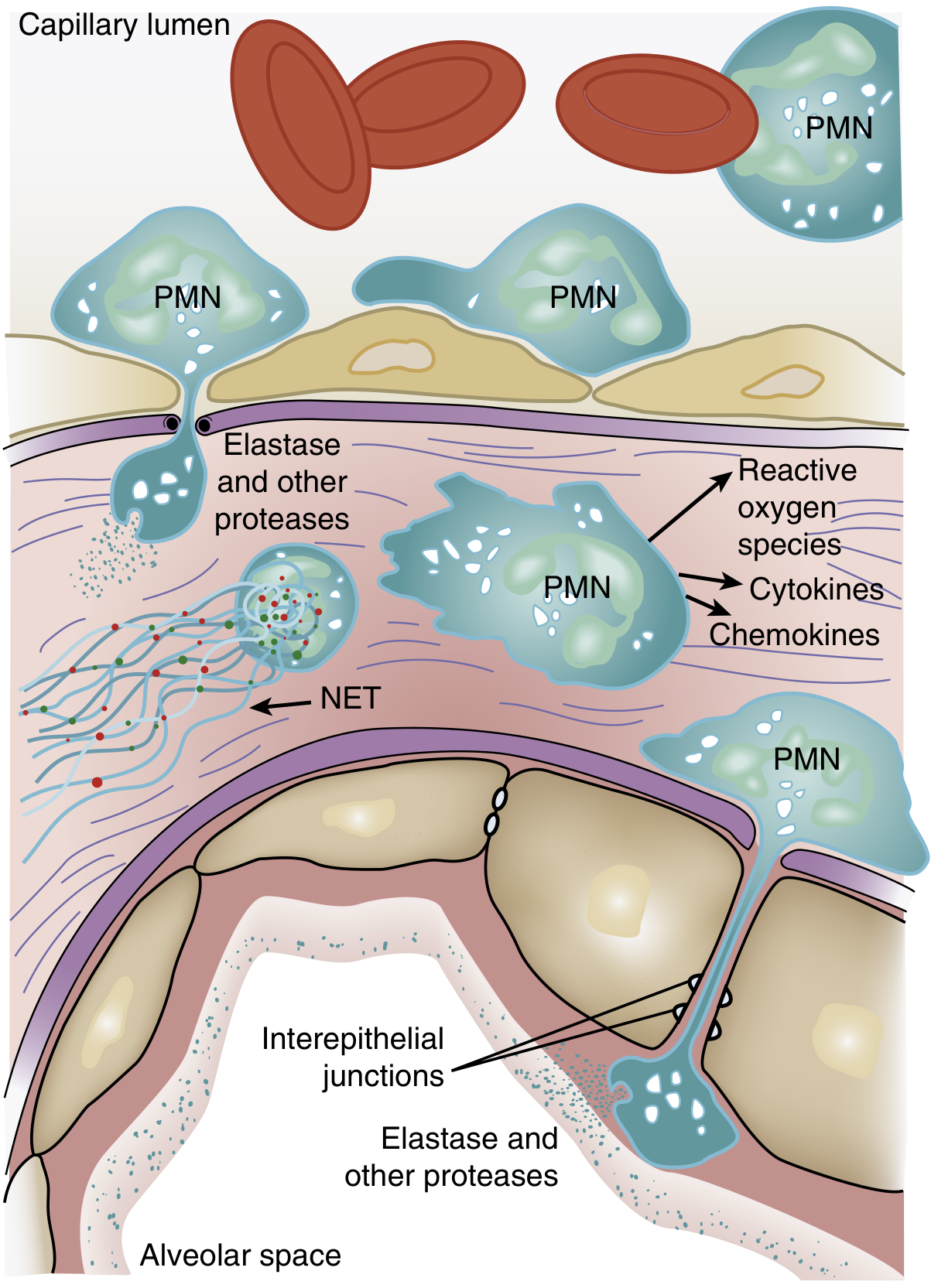
Neutrophil accumulation in the pulmonary microvasculature is one of the earliest and most characteristic features of ARDS:
Step-by-step neutrophil cascade:
- Sequestration: The average pulmonary capillary is narrower than a neutrophil. Activated neutrophils stiffen (due to actin cytoskeleton remodeling) and cannot deform adequately, becoming physically trapped in capillary segments. This produces a transient leukopenia — one of the earliest clinical signs.
- Transmigration: Sequestered neutrophils migrate across the endothelium into the interstitium and alveolar space, aided by chemokines (e.g., IL-8) released by macrophages and epithelial cells. Early migration can occur even without classic adhesion molecules (L-selectin, β2-integrins).
- Tissue destruction: Once in the alveolar space, activated PMNs release:
- Reactive oxygen species (ROS) — oxidative damage to membranes
- Proteolytic enzymes (elastase, matrix metalloproteinases) — degrade extracellular matrix and interepithelial junctions, and directly degrade surfactant protein A
- Cytokines: TNF-α, IL-1β — amplify the inflammatory response and recruit additional cells
- Neutrophil extracellular traps (NETs) — chromatin-based structures that trap pathogens but also promote tissue injury and coagulopathy
- Neutrophil–platelet interaction: Mutual activation of neutrophils and platelets amplifies both inflammation and microvascular thrombosis.
Murray & Nadel's, pp. 3147–3148
4. Cytokines, Macrophages, and the Inflammatory Cascade
Alveolar macrophages are the first responders to lung injury. They:
- Recognize pathogen-associated (PAMPs) and damage-associated (DAMPs) molecular patterns via toll-like receptors (TLRs)
- Release TNF-α, IL-1β, IL-6, IL-8, and platelet-activating factor (PAF)
- Activate the p38 MAP kinase pathway, further amplifying TNF-α production and macrophage inflammatory protein-2 (a neutrophil chemokine)
This cytokine storm creates a self-perpetuating feed-forward loop: macrophages activate neutrophils, neutrophils damage tissue and release more cytokines, more neutrophils are recruited.
5. Surfactant Dysfunction
Type II pneumocyte injury and the inflammatory milieu cause:
- Decreased production of surfactant (especially dipalmitoylphosphatidylcholine)
- Shift from large (active) to small (inactive) surfactant aggregates
- Plasma protein leak into alveoli, which inhibits surfactant function
- Elastase-mediated degradation of surfactant protein A
The result: alveolar units collapse (atelectasis), worsening ventilation-perfusion (V/Q) mismatch and hypoxemia. Unlike neonatal RDS, adult surfactant supplementation trials have consistently failed to reduce mortality.
6. Angiopoietin Axis and Vascular Permeability
- Angiopoietin-1 (Ang1) stabilizes endothelial tight junctions via the Tie2 receptor.
- Angiopoietin-2 (Ang2) is released by injured endothelial cells as a competitive antagonist, disrupting barrier integrity. Elevated plasma Ang2 is a biomarker of severity in sepsis and ARDS. Genetic variants in Ang2 are associated with increased ARDS risk.
Murray & Nadel's, p. 3149
7. Failure of Alveolar Fluid Clearance
Normally, Na⁺ channels (ENaC) on apical epithelial surfaces drive sodium into the cell, with water following osmotically. Na⁺/K⁺-ATPase on the basolateral surface maintains the gradient. In ARDS:
- Hypoxia suppresses ENaC expression and Na⁺/K⁺-ATPase activity
- Nitric oxide (from inflammatory activation) impairs β-adrenergic-mediated fluid clearance upregulation
This means even if permeability is restored, the lung cannot actively clear the protein-rich edema fluid. Attempts to pharmacologically boost fluid clearance with β2-agonists have been disappointing in clinical trials.
8. Phases of ARDS
| Phase | Timing | Pathology |
|---|---|---|
| Exudative | Days 1–7 | Diffuse alveolar damage, hyaline membrane formation, protein-rich edema, neutrophil infiltration |
| Proliferative | Days 7–21 | Type II pneumocyte hyperplasia, fibroblast infiltration, early fibrosis, organizing exudate |
| Fibrotic | Weeks–months | Progressive fibrosis, architectural distortion; associated with prolonged ventilation dependence |
9. Ventilator-Induced Lung Injury (VILI) — A Perpetuating Mechanism
Mechanical ventilation, while life-sustaining, can worsen ARDS through:
- Volutrauma/Barotrauma: Overdistension of aerated alveoli at high tidal volumes → epithelial and endothelial tears
- Atelectrauma: Repetitive opening and collapse of unstable alveoli at low end-expiratory volumes
- Biotrauma: Mechanical stretch triggers cytokine release (IL-6, IL-8, TNF-α) from the lung into the systemic circulation → distal organ dysfunction
This is the mechanistic basis for lung-protective ventilation (6 mL/kg IBW, plateau pressure ≤30 cmH₂O, adequate PEEP).
Summary Diagram of Mechanism
Precipitant (sepsis, aspiration, trauma)
          ↓
Macrophage activation → Cytokine storm (TNF-α, IL-1β, IL-8)
          ↓
Neutrophil sequestration in pulmonary capillaries
          ↓
PMN transmigration + activation
          ↓
ROS + Elastase + NETs → Alveolar-capillary barrier destruction
          ↓
Protein-rich edema floods alveoli
          ↓
Surfactant dysfunction + Type I/II pneumocyte death
          ↓
Alveolar collapse (atelectasis) + impaired fluid clearance
          ↓
Severe V/Q mismatch → Refractory hypoxemia (ARDS)
          ↓
Mechanical ventilation → VILI → Perpetuates injury
The net result is a diffusely stiff, edematous, non-homogeneous lung with severely impaired gas exchange, requiring mechanical ventilatory support until the alveolar-capillary barrier recovers — or progressing to fibrosis.
Sources: Murray & Nadel's Textbook of Respiratory Medicine, pp. 3081–3230; Goldman-Cecil Medicine, p. 1065; Sabiston Textbook of Surgery, p. 940
This is a shared conversation. Sign in to Orris to start your own chat.