I now have comprehensive material from multiple authoritative pharmacology and emergency medicine textbooks. Let me compile a thorough, well-organized response.
Pharmacology of Status Asthmaticus
Sources: Katzung's Basic & Clinical Pharmacology 16th Ed., Tintinalli's Emergency Medicine 9th Ed., Rosen's Emergency Medicine 9th Ed., Harriet Lane Handbook 23rd Ed., Goldman-Cecil Medicine
Definition
Status asthmaticus is acute severe asthma that fails to respond to usual doses of inhaled bronchodilators and corticosteroids. It is characterized by hypoxemia, tachypnea, tachycardia, accessory muscle use, and wheezing (which may be absent when airflow is severely reduced). Rapid, aggressive bronchodilator therapy is the cornerstone of preventing cardiopulmonary arrest.
Mechanism of Pharmacological Targets
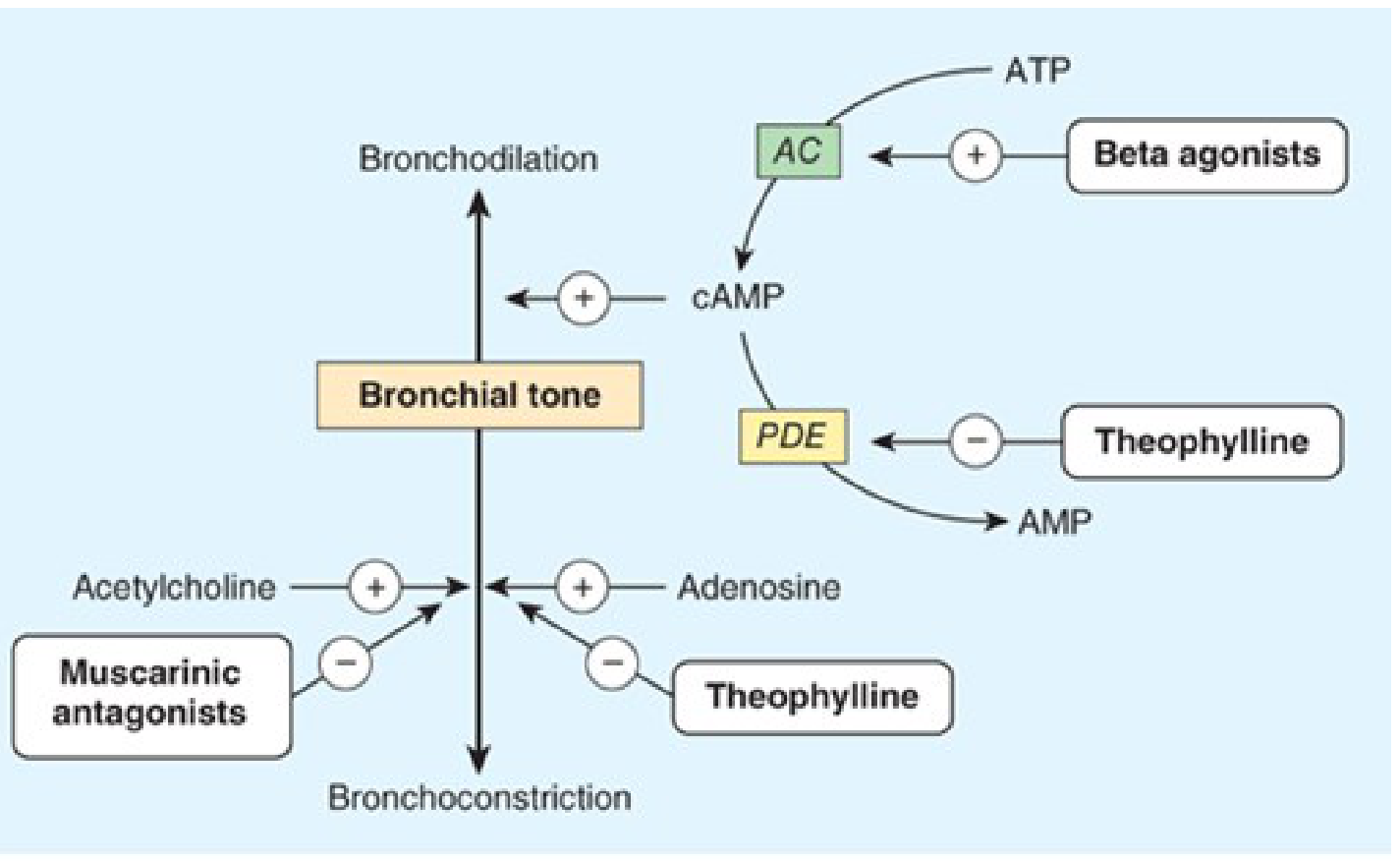
Figure: Drug mechanisms at the bronchial level. Beta-agonists activate adenylyl cyclase (AC) → ↑cAMP → bronchodilation. Theophylline inhibits phosphodiesterase (PDE) → prevents cAMP degradation → bronchodilation. Muscarinic antagonists block acetylcholine-mediated bronchoconstriction. (Katzung, Ch. 20)
Treatment Algorithm
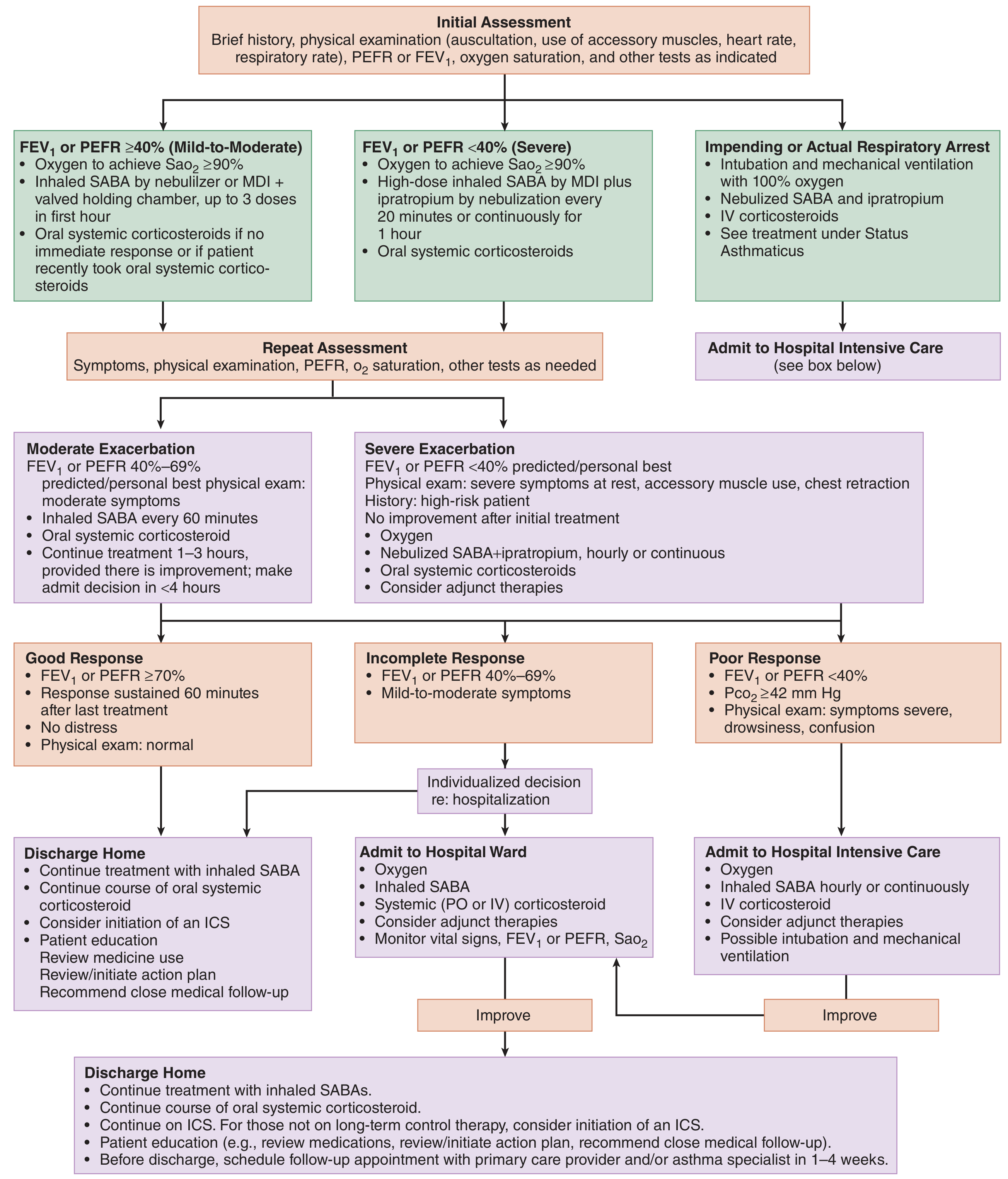
Figure: ED and hospital-based management of acute asthma by FEV₁/PEFR severity. (Tintinalli, Ch. 69)
1. SHORT-ACTING β₂-AGONISTS (SABAs) - FIRST LINE
Mechanism: Bind β₂-adrenoceptors on airway smooth muscle → activate adenylyl cyclase → ↑intracellular cAMP → smooth muscle relaxation and bronchodilation. Also inhibit mast cell mediator release and microvascular leakage, and increase mucociliary transport.
Drug of choice: Albuterol (Salbutamol)
| Setting | Dose |
|---|
| Mild-moderate (nebulizer) | 2.5-5 mg every 20 min for 3 doses; then 2.5-10 mg every 1-4 h as needed |
| Severe (continuous nebulization) | 10-15 mg/h continuously |
| MDI | 4-8 puffs (90 mcg/puff) every 20 min for up to 4 h |
| Pediatric (continuous) | 0.5 mg/kg/hr (max 30 mg/hr) |
Levalbuterol (R-albuterol): The active R-enantiomer of albuterol; administered at half the nebulized dose of albuterol with comparable efficacy and safety. Not validated for continuous nebulization.
Adverse effects: Tachycardia, skeletal muscle tremor, hypokalemia (↓serum K⁺), and mild hypomagnesemia with large doses.
Katzung note: β-adrenoceptor agonists are best delivered by inhalation - greatest local effect with least systemic toxicity. MDI with spacer is as effective as nebulized therapy in mild-to-moderate attacks.
2. PARENTERAL β-AGONISTS (for severe/refractory cases)
When inhalation is not feasible or response is poor:
Epinephrine (non-selective, α+β):
- IM: 0.01 mg/kg of 1 mg/mL solution (max 0.5 mg) every 15-20 min, up to 3 doses
- Also used as IV continuous infusion in intubated patients with refractory bronchospasm
Terbutaline (selective β₂):
- Subcutaneous: 0.01 mg/kg (max 0.25 mg/dose) every 20 min for up to 3 doses
- IV load: 4-10 mcg/kg IV
- IV continuous: 0.2-5 mcg/kg/min (doses up to 10 mcg/kg/min reported)
- Considered for severe exacerbations with minimal air entry; IV administration may reduce the need for mechanical ventilation
Rosen's note: The place of epinephrine and isoproterenol has markedly diminished because of their effects on heart rate and force of cardiac contraction via β₁ receptors.
3. ANTICHOLINERGICS (IPRATROPIUM BROMIDE) - ADDITIVE BENEFIT
Mechanism: Muscarinic (M₃) receptor antagonist → blocks acetylcholine-mediated bronchoconstriction → bronchodilation via reduced smooth muscle tone.
Role: Effects are nearly as great as, but not greater than, sympathomimetics alone. The airway effects of anticholinergic + sympathomimetic drugs in full doses have been shown to be additive only in reducing hospitalization rates in patients with severe airflow obstruction.
Dose:
- Nebulizer: 0.5 mg combined with albuterol, every 20 min for 3 doses (adults); 0.25-0.5 mg (children)
- MDI: 4-8 puffs (17 mcg/puff) every 20 min for 3 doses
- No additional benefit shown in the inpatient setting beyond initial ED use
4. SYSTEMIC CORTICOSTEROIDS - ANTI-INFLAMMATORY BACKBONE
Mechanism: Suppress the multi-cellular inflammatory cascade (eosinophils, T-helper cells, mast cells, dendritic cells) that underlies airway wall edema, hypersecretion, and bronchial hyperreactivity. Reduce microvascular congestion and restore β-receptor responsiveness.
Onset: Anti-inflammatory effects begin within 4-6 hours; maximal effect may take 12-24 hours.
| Drug | Dose | Notes |
|---|
| Methylprednisolone | IV: 60-125 mg; repeat every 6-12 h | Standard IV option in severe cases |
| Prednisone/Prednisolone | 40-60 mg PO daily for 5-7 days (adults); 2 mg/kg/day (children, max 60 mg) | Oral bioequivalent to IV if GI absorption intact |
| Dexamethasone | 0.6 mg/kg/day PO/IV/IM for 1-2 days (pediatric, max 16 mg) | Equally efficacious as prednisone; better palatability, compliance, and fewer side effects in pediatric use |
No proven advantage of IV over oral administration in severe exacerbations provided GI absorption is normal. Taper if course ≥7 days or patient had recent bounce-back exacerbation.
5. MAGNESIUM SULFATE - ADJUNCT FOR VERY SEVERE DISEASE
Mechanism: Smooth muscle relaxation via calcium antagonism (blocks calcium entry into smooth muscle cells) → bronchodilation. May also inhibit acetylcholine and histamine release.
Indication: FEV₁ or PEFR <25% predicted; patients not responding to standard therapy.
| Route | Dose |
|---|
| IV | 1-2 g over 20-30 minutes (pediatric: 25-75 mg/kg, max 2 g) |
| Nebulized | 95 mg in 4 divided doses 20 min apart, or 384 mg in sterile water |
Monitoring: Blood pressure and deep tendon reflexes during administration (hypotension or neuromuscular blockade, though rare at recommended doses).
6. KETAMINE - FOR INTUBATION AND REFRACTORY BRONCHOSPASM
Mechanism: NMDA receptor antagonist; causes catecholamine release → bronchodilation. Has direct bronchodilatory properties on airway smooth muscle.
Role:
- Preferred induction agent for emergency RSI in status asthmaticus
- Can mitigate bronchospasm in non-intubated patients and those already intubated who are not improving on mechanical ventilation
Dose: 1-2 mg/kg IV bolus for induction; 1 mg/kg/hr infusion for sedation/bronchodilation in intubated patients
Rosen's RSI protocol: Ketamine 1.5 mg/kg + Succinylcholine 1.5 mg/kg at time zero, preceded by continuous albuterol nebulization and IV/SC β-agonists in the pre-intubation optimization phase.
7. HELIOX - ADJUNCT FOR REFRACTORY CASES
Mechanism: A mixture of 80% helium and 20% oxygen. Helium is less dense than nitrogen → reduces turbulent airflow resistance → improves delivery of nebulized medications to distal airways.
Dose/Preparation: Typically 70:30 or 80:20 helium:oxygen mixtures.
Role: No role in routine care; reserved for patients who fail standard therapy. Note: FiO₂ is limited to 20-30%, so not suitable when higher oxygen concentrations are needed.
8. AMINOPHYLLINE/THEOPHYLLINE - NOW THIRD-LINE/ADJUNCT ONLY
Mechanism:
- Inhibits phosphodiesterase (PDE) → prevents cAMP degradation → smooth muscle relaxation
- Antagonizes adenosine receptors → inhibits adenosine-mediated bronchoconstriction
- Anti-inflammatory effects at low concentrations
Current status: Aminophylline is no longer a first- or second-line treatment for acute asthma (Tintinalli). Listed as an adjunct in refractory pediatric cases.
Dose (if used): 6 mg/kg IV loading dose over 20 min, followed by 0.5-1.2 mg/kg/hr infusion (age-dependent).
Adverse effects (narrow therapeutic window, target level 10-20 mcg/mL):
- Tachycardia, nausea, vomiting, headache, nervousness
- At plasma levels >30 mg/mL: seizures, cardiac dysrhythmias
9. OXYGEN - SUPPORTIVE
Target: SaO₂ ≥90% (≥95% in children and pregnant women). Supplemental O₂ via nasal cannula or face mask. High-flow oxygen and BiPAP (NIV) can reduce work of breathing and stave off respiratory arrest, and are used for preoxygenation before intubation.
Agents of NO Benefit in Acute Status Asthmaticus
| Agent | Reason Not Used |
|---|
| Cromolyn / Nedocromil (mast cell stabilizers) | Not indicated for acute bronchospasm; only prophylactic |
| Leukotriene modifiers (montelukast, zafirlukast, zileuton) | Limited evidence for IV/oral use in acute disease despite trials; used for chronic management only |
| Antihistamines | No role in acute bronchospasm |
| Lidocaine (IV/aerosolized) | Studied for blunting intubation-related bronchospasm; no high-level evidence; not recommended |
| Antibiotics | Not indicated unless clear bacterial infection (most triggers are viral) |
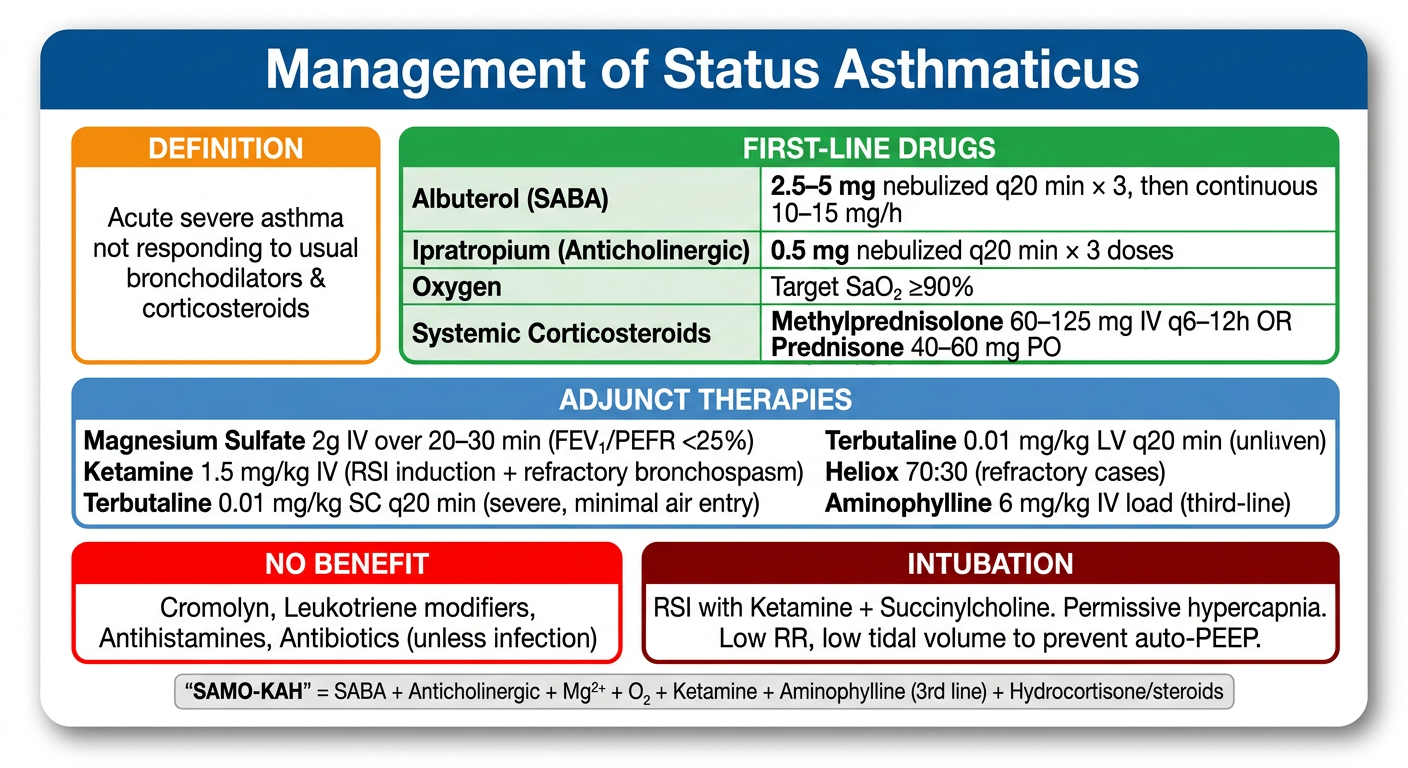
Summary Table: Drugs in Status Asthmaticus
| Drug Class | Agent | Mechanism | Role | Dose |
|---|
| SABA | Albuterol | β₂ agonist → ↑cAMP | First-line, immediate | 2.5-5 mg nebulized q20 min × 3, then continuous 10-15 mg/h |
| Anticholinergic | Ipratropium | M₃ antagonist | First-line add-on (ED only) | 0.5 mg nebulized q20 min × 3 |
| Corticosteroid | Methylprednisolone | Anti-inflammatory | First-line, given early | 60-125 mg IV q6-12h |
| Magnesium | MgSO₄ | Ca²⁺ antagonist | Adjunct (PEFR/FEV₁ <25%) | 2 g IV over 20-30 min |
| Dissociative anesthetic | Ketamine | NMDA antagonist, catecholamine release | RSI induction + refractory bronchospasm | 1.5 mg/kg IV |
| Parenteral β-agonist | Terbutaline | β₂ agonist | Adjunct (severe, minimal air entry) | 0.01 mg/kg SC q20 min |
| Gas mixture | Heliox | ↓airway resistance | Rescue (refractory) | 70:30 He:O₂ |
| Methylxanthine | Aminophylline | PDE inhibitor, adenosine antagonist | Third-line/pediatric adjunct | 6 mg/kg IV load then infusion |
References:
- Katzung's Basic & Clinical Pharmacology, 16th Ed., Ch. 20 (Drugs Used in Asthma), pp. 550-568
- Tintinalli's Emergency Medicine, 9th Ed., Ch. 69 (Acute Asthma and Status Asthmaticus), pp. 504-508
- Rosen's Emergency Medicine, 9th Ed., pp. 35-36 (RSI for Status Asthmaticus)
- Harriet Lane Handbook, 23rd Ed., pp. 40-41 (Status Asthmaticus Medications table)