
Vertical root fractures
"vertical root fracture" diagnosis treatment
PMID: 38402413
PMID: 39840523
vertical root fractures VRF etiology diagnosis management endodontics 2024
https://pmc.ncbi.nlm.nih.gov/articles/PMC10903158
Vertical Root Fractures (VRFs)
Definition
Epidemiology
- Incidence among root-canal-treated teeth: 4% to 32%
- 80% of VRFs are detected within 2 years after onset of initial symptoms
- Most common in posterior teeth (premolars > molars), especially maxillary premolars and mandibular molars
- Often diagnosed late due to nonspecific presentation, resulting in unnecessary treatments and progressive bone loss
Classification
| Parameter | Types |
|---|---|
| Trajectory | Vertical, transverse, oblique |
| Extent | Complete (total separation) or incomplete (partial crack) |
| Location | Apical, mid-root, cervical |
| Origin | Internal canal wall extending outward (most common in endodontically treated teeth) |
Etiology and Risk Factors
- Excessive removal of healthy dentin during root canal preparation (over-instrumentation)
- Prolonged contact with intracanal disinfectants and medicaments (e.g., NaOCl, Ca(OH)2) - alters dentin mechanical properties
- Aggressive lateral or vertical condensation of gutta-percha during obturation (excessive hydraulic pressure)
- Overly large preparation (thin dentinal walls)
- Improper post selection (rigid posts in curved roots, oversized posts)
- Excessive force during post preparation (widening the canal excessively)
- Improper post cementation or expansion forces
- Advanced patient age (dentin becomes more brittle)
- Type of tooth (maxillary premolars particularly vulnerable due to thin roots)
- Pre-existing dentinal cracks
- Heavy occlusal loading, bruxism
- Reduced moisture content of endodontically treated dentin (more brittle)
Pathogenesis
- Destruction of the surrounding alveolar bone
- Progressive periodontal breakdown
- Potential compromising of future implant placement if extraction is delayed
Clinical Features
| Feature | Description |
|---|---|
| Sinus tract / parulis | Present near the mid-root or cervical region (not just at the apex) |
| Deep, narrow periodontal pocket | Localized, isolated ("halo" or "J-shaped" pattern on X-ray) |
| Tenderness to percussion | Lateral percussion often positive |
| Swelling / abscess | Localized gingival or facial swelling |
| Gingival recession | On the affected side of the root |
| Symptoms often vague | Mild, intermittent discomfort; can be asymptomatic |
- Narrow isolated periodontal pocket
- Sinus tract at the fracture site
- History of root canal treatment
Diagnosis
Clinical Examination
- Probing depths - look for narrow, deep, isolated pockets ("halo" pattern)
- Transillumination - may reveal fracture lines
- Staining with methylene blue or iodine - helps detect fracture lines intraorally or during surgery
- Exploratory surgery - the gold standard for definitive diagnosis
Radiographic Examination
- Limited: 2D nature creates anatomical noise and distortion
- Signs: J-shaped radiolucency alongside the root, apical and lateral bone loss, angular bone defects
- Fracture line is often NOT visible
- Superior to periapical X-ray - provides 3D imaging with reduced noise
- Signs: "Halo" sign, presence of the fracture line, bone loss pattern
- Best available non-invasive diagnostic tool
- Can detect fractures missed on conventional radiographs
- Periapical bone loss + lateral bone loss together
- Diffuse lateral widening of the periodontal ligament space
- Alveolar bone loss along the full length of the root
Differential Diagnosis
- Endodontic failure / persistent apical periodontitis - but typically associated with technical failures, no narrow pocket
- Primary/secondary periodontal disease - generalized pattern, multiple teeth
- Cemental tear - a separate condition that also causes localized bone loss and may mimic VRF; can coexist
- Perforations - from iatrogenic root perforations
- Cracked tooth syndrome - affects coronal dentin, pain on biting, not longitudinal to root
Management
1. Extraction (Traditional and Most Common)
- Standard treatment for complete VRF
- Early extraction is recommended to minimize progressive bone destruction that may compromise future implant placement
- Followed by implant rehabilitation or prosthetic replacement
2. Conservative / Tooth-Preserving Approaches
- Tooth is extracted, fracture surfaces are bonded/sealed extra-orally, then the tooth is replanted
- Success depends on careful handling, minimal extra-oral time, and intact periodontal status
- Variable long-term outcomes; best for single-rooted teeth with accessible fractures
- Fracture segments bonded with materials such as SuperEBA cement, MTA (Mineral Trioxide Aggregate), or adhesive resins
- Can be done via intentional replantation or surgical access
- Guided tissue regeneration to address bone loss
- Experimental and limited evidence
- For multi-rooted teeth: removal of the affected root while preserving the rest of the tooth
- Mandibular molars are best candidates
- Mucoperiosteal flap reflection to access the fracture
- Bonding under direct vision with MTA or similar materials
Key Decision Factors for Treatment:
- Periodontal status - intact bone = better prognosis for preservation
- Extent and location - incomplete vs. complete; apical vs. cervical
- Tooth type - single-rooted vs. multi-rooted
- Fragment condition - viability of root segments
- Clinician skill and patient consent
Prevention (Best Approach)
- Avoid over-instrumentation during root canal preparation
- Use appropriate canal shaping instruments and techniques (minimize dentin removal)
- Avoid excessive condensation pressures during obturation
- Select post type and size appropriately (prefer fiber posts over rigid metallic posts)
- Use proper cementation technique for posts
- Early identification of susceptible teeth and roots (thin roots, narrow canals)
Prognosis
- Complete VRFs in endodontically treated teeth carry a poor prognosis for tooth retention
- Extraction rates remain high overall
- Tooth-preserving techniques (intentional replantation, adhesive bonding) show variable short-term success but lack strong long-term evidence
- A 2025 systematic review (Corbella et al., Aust Endod J 2025) evaluated surgical techniques for confirmed VRFs, reflecting continued investigation into preservation options
- The 2025 ESE Position Statement (PMID 39840523) provides current evidence-based guidance on longitudinal cracks and fractures including VRFs
- A 2024 review by Salihu & Stavileci (PMID 38402413) emphasizes that standardized protocols and further long-term research are still needed
Summary Table
| Aspect | Key Points |
|---|---|
| Definition | Longitudinal fracture along the root's long axis |
| Most common in | Endodontically treated teeth (4-32% incidence) |
| Main causes | Over-instrumentation, gutta-percha condensation, improper posts |
| Classic signs | Isolated narrow pocket, sinus tract, history of RCT |
| Best imaging | CBCT > periapical X-ray |
| Gold standard diagnosis | Exploratory surgery |
| Treatment | Extraction (most common); preservation possible in select cases |
| Prevention | Conservative endodontic technique, appropriate post selection |
Butterfly effect of vertical root fracture ??
butterfly effect vertical root fracture radiographic sign bone loss pattern
"vertical root fracture" butterfly radiographic sign bone loss
https://suffolkrootcanal.co.uk/wp-content/uploads/2015/04/Pa…
"butterfly" "vertical root fracture" buccal lingual bone loss bilateral pattern radiograph
The "Butterfly Effect" in Vertical Root Fractures
What It Is
Why It Happens - The Mechanism
- The fracture line runs along the long axis of the root in the bucco-lingual plane
- The inflammatory response and bacterial penetration follow the fracture line outward to the periodontal ligament
- Bone resorption begins facing the fracture - i.e., on both the buccal and lingual sides simultaneously
- This creates two opposing bone defects, one on each side of the root
The Two Wings - Different Shapes (Lustig et al., 2000)
| Side | Pattern | Shape | Reason |
|---|---|---|---|
| Buccal | Dehiscence (V-shaped, oblong triangle) | Narrow, deep, rapid | Thin cortical plate - resorbs quickly in apicocoronal direction, propagates diagonally |
| Lingual/Palatal | U-shaped, shallow, rounded | Wider, slower | Thicker cortex + spongeous bone creates a "shield phenomenon" - spongeous bone resorbs first, then lateral spread |
Key Findings from Lustig et al. (2000) Study
- 91% of VRF cases showed the V-shaped dehiscence (buccal)
- 9% showed fenestration of the buccal plate
- Lingual resorption was present in additional cases but was always less severe than buccal
- Strong positive correlation (p < 0.0001) between type/duration of symptoms and amount of buccal bone resorption
- The resorptive defect always faced the fracture line
Clinical Significance
1. Surgical Diagnosis
2. CBCT Diagnosis
- Bone loss on both the buccal and palatal/lingual sides of the root
- Two crescentic radiolucent areas flanking the root symmetrically or asymmetrically
- When both buccal and palatal bone loss are present on CBCT in an endodontically treated tooth, VRF is strongly suspected
3. Probing Pattern
4. Sinus Tracts
Comparison with Other Bone Loss Patterns in VRF
| Radiographic/Clinical Pattern | Description |
|---|---|
| Halo sign | 360° periradicular radiolucency surrounding the root (periapical + lateral) |
| J-shaped radiolucency | Periapical + lateral bone loss on one side only |
| Butterfly pattern | Bilateral buccal + lingual bone loss (the wings) |
| Fenestration | Isolated window defect through the buccal plate |
| Widened PDL space | Early sign along the lateral root surface |
Why Radiographic Detection Is Difficult
- Standard periapical X-rays miss the butterfly pattern
- Only when resorption extends interproximally does it become visible on 2D X-ray
- CBCT is essential to visualize this bilateral butterfly pattern as it provides true cross-sectional (axial) views
Summary
The "butterfly effect" in VRF = bilateral, opposing bone resorption on both the buccal (V-shaped/sharp) and lingual (U-shaped/rounded) surfaces of a fractured root. It reflects the bucco-lingual propagation of the fracture line and the differential cortical bone thickness on each side. It is best seen on CBCT axial slices or during exploratory surgery, and is a powerful diagnostic indicator of VRF that is virtually invisible on standard 2D periapical radiographs.
Yes create a image
Medical dental diagram showing the "Butterfly Effect" of Vertical Root Fracture (VRF). The image should show: 1. A cross-sectional (axial/top-down) view of a tooth root in the center, with the root canal shown inside 2. A vertical fracture line running bucco-lingually through the root (left to right) 3. On the BUCCAL side (top): a V-shaped, deep, narrow bone defect (dehiscence) - labeled "Buccal Bone Loss - V-shaped (Dehiscence)" with a sharp triangular resorption cavity 4. On the LINGUAL/PALATAL side (bottom): a U-shaped, shallower, rounded bone defect - labeled "Lingual Bone Loss - U-shaped (Rounded)" 5. The two opposing bone defects together visually forming butterfly wings around the root - with a label "Butterfly Pattern" 6. Arrows showing the fracture propagation direction (bucco-lingual) 7. A second inset diagram showing a 3D perspective of the same tooth with the bilateral bone loss visible on both surfaces 8. Labels: "Fracture Line", "Buccal Plate", "Lingual Plate", "Alveolar Bone", "PDL Space" 9. Clean white background, medical illustration style, professional dental anatomy diagram with color coding - bone in light yellow/tan, tooth root in ivory, fracture line in red, bone loss areas in dark red/orange
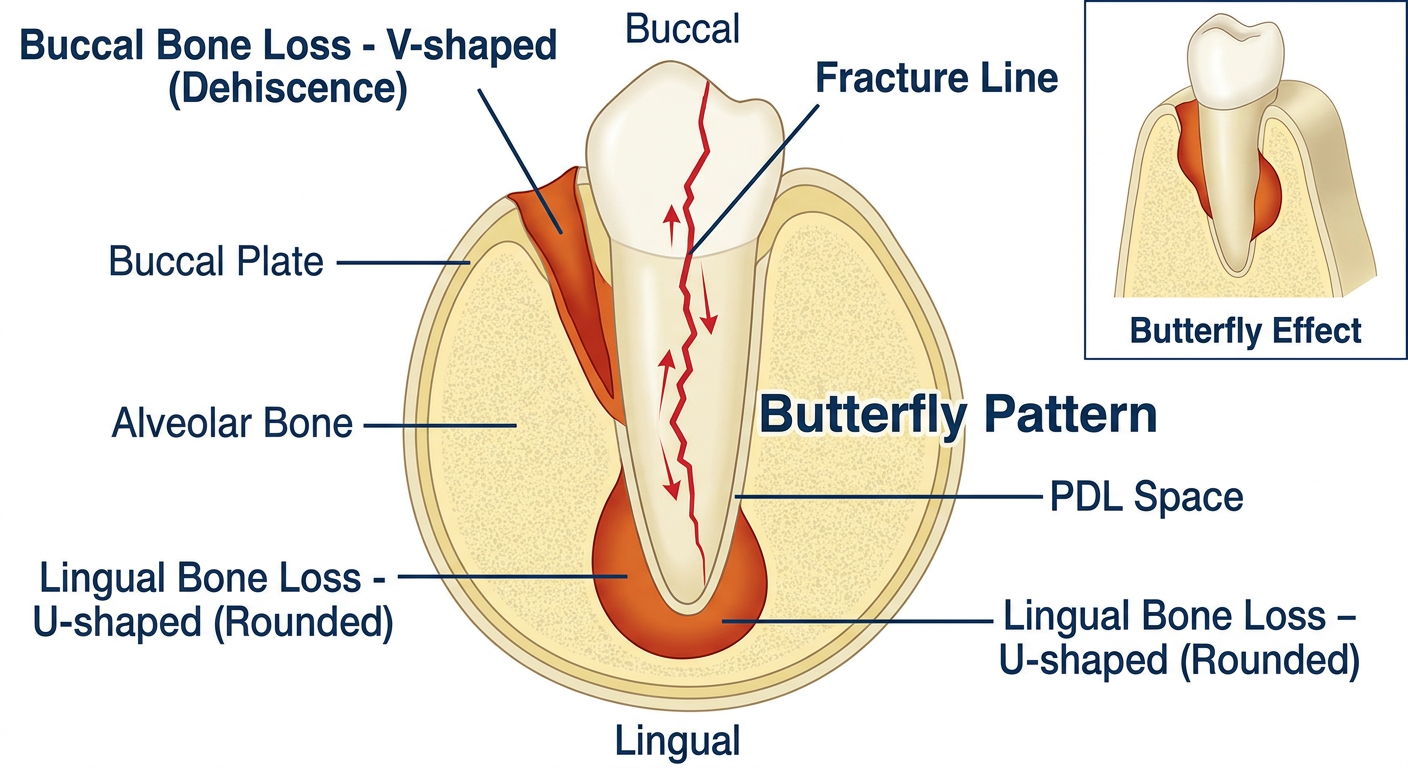
- Center: The root in cross-section (axial view) with the vertical fracture line running bucco-lingually (in red)
- Buccal wing (top): The sharp, deep V-shaped dehiscence - rapid resorption due to the thin buccal cortical plate
- Lingual wing (bottom): The shallow, rounded U-shaped defect - slower resorption due to the thicker lingual cortex ("shield phenomenon")
- Together, the two opposing bone defects create the classic butterfly wings appearance around the fractured root