
Oxygen therapy devices
Reading File
Oxygen therapy devices are used to deliver supplemental O2 to patients with hypoxemia, ranging from low-flow nasal cannulas to high-flow and invasive systems. Key devices include nasal cannulas (1-6 L/min, FiO2 ~24-44%), simple face masks, Venturi masks (precise FiO2), non-rebreather masks (~60-90% FiO2), high-flow nasal cannula (HFNC), and mechanical ventilators.
Searching sources...
Finding Sources
Finding Sources
Good - I found relevant sections in Fishman's Pulmonary Diseases, Murray & Nadel's, and Morgan & Mikhail's. Let me read the most comprehensive sections in parallel.
Reading File
Reading File
Reading File
Excellent content. Let me get the remaining sections on HFNC, Venturi mask, non-rebreather, and the image from Murray & Nadel's, plus more from Fishman's.
Reading File
Reading File
Now let me get the HFNC section from Murray & Nadel's and fetch the key device image.
Reading File
Loading Image
I now have comprehensive information from multiple authoritative textbooks. Let me compile the full answer.
Oxygen Therapy Devices
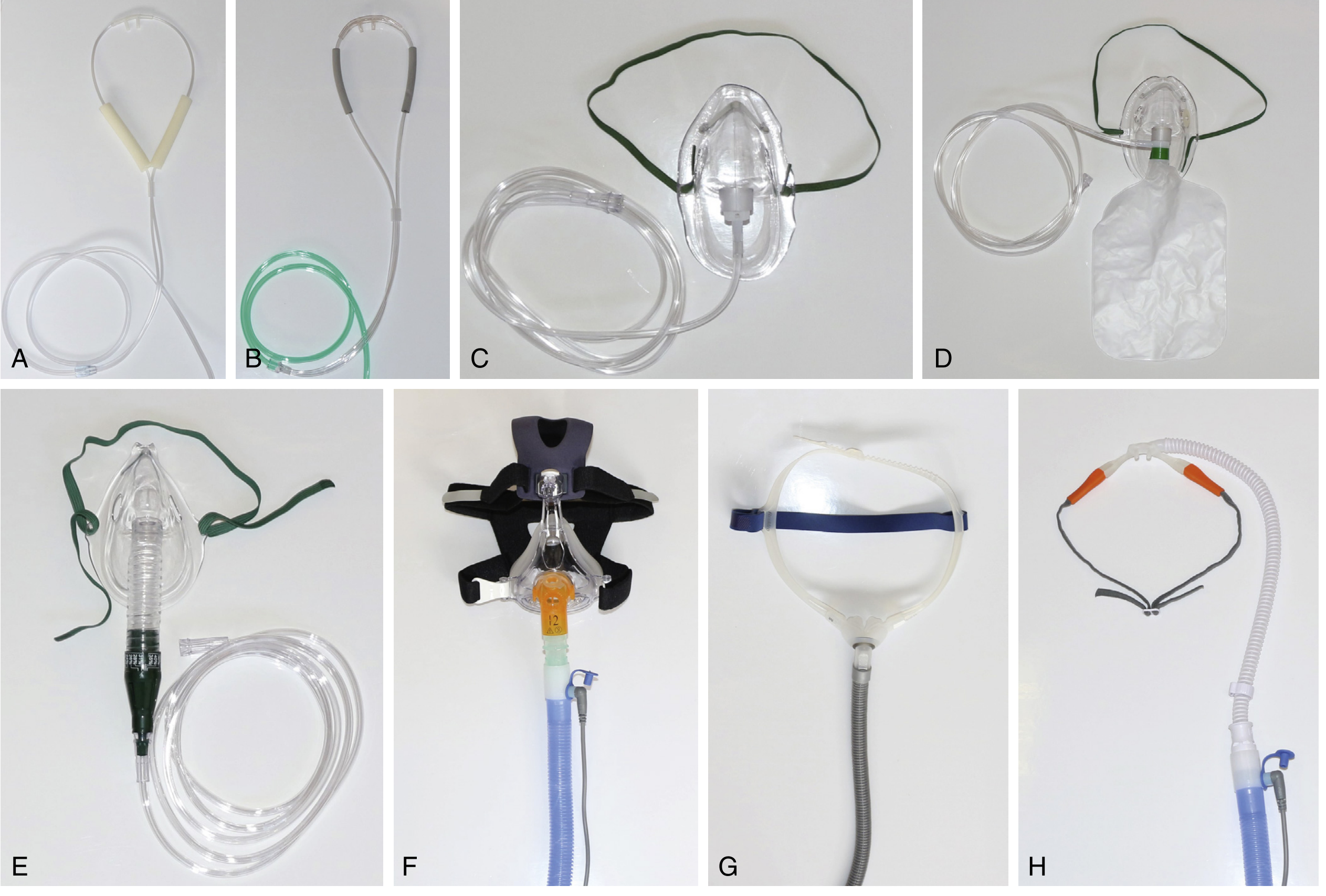
Figure: Noninvasive oxygenation interfaces - Murray & Nadel's Textbook of Respiratory Medicine
Oxygen therapy devices are broadly classified into low-flow (variable-performance) and high-flow (fixed-performance) systems, based on whether the delivered FiO2 changes with the patient's breathing pattern.
Classification Overview
| Device | Flow Rate | FiO2 Range | Performance Type |
|---|---|---|---|
| Nasal cannula | 1-6 L/min | 0.21-0.44 | Low-flow (variable) |
| Simple face mask | 5-10 L/min | 0.30-0.60 | Low-flow (variable) |
| Partial rebreathing mask | 10-15 L/min | 0.35-0.75 | Low-flow (variable) |
| Non-rebreathing mask | 15 L/min | 0.65-1.00 | Low-flow (variable) |
| Venturi mask | 4-6 L/min source (15-50 L/min total) | 0.24-0.50 | High-flow (fixed) |
| HFNC | 40-60 L/min | 0.21-1.00 | High-flow (fixed) |
| CPAP/NIV | Variable | 0.21-1.00 | High-flow (fixed) |
| BVM / Anesthesia bag | Variable | Up to 1.00 | High-flow (fixed) |
1. Low-Flow (Variable-Performance) Devices
These deliver a fixed flow of oxygen but entrain variable amounts of room air depending on the patient's respiratory pattern. The actual FiO2 fluctuates with tidal volume and respiratory rate.
Nasal Cannula
- The most widely used outpatient oxygen delivery device; comfortable and allows eating, drinking, and speech.
- Available in standard (1-6 L/min) and enhanced (up to 15 L/min) configurations.
- FiO2 rises approximately 2-4% per L/min above room air: at 1 L/min FiO2 ~24%, at 6 L/min FiO2 ~44%.
- Flows >5-6 L/min are poorly tolerated - they jet gas uncomfortably into the nasal cavity and dry the mucosa; humidification is advised for long-term use.
- ~80% of delivered oxygen is wasted during expiration.
- Limitation: FiO2 is unpredictable in tachypneic or mouth-breathing patients.
Simple Face Mask (Hudson Mask)
- Flow rates of 5-10 L/min, FiO2 approximately 35-60%.
- Has a 100-300 mL internal reservoir (the mask cavity itself).
- Minimum flow of 5 L/min is required to flush exhaled CO2 from the mask; flows below this cause CO2 rebreathing and increased inspiratory resistance.
- Suitable for short-term use (transport, PACU, ED) but not for profoundly hypoxemic or tachypneic patients.
2. Reservoir Systems
These add a bag reservoir to increase delivered FiO2.
Partial Rebreathing Mask
- A 600-1000 mL reservoir bag attached to a simple face mask; source oxygen at 10-15 L/min.
- During exhalation, initial expired gas (largely dead-space air, low in CO2) fills the bag; on the next breath, this is rebreathed mixed with fresh O2.
- FiO2 approximately 50-75%, depending on minute ventilation.
- Largely replaced by the non-rebreathing mask in practice.
Non-rebreathing Mask (NRB)
- Same as above but with a one-way valve between the reservoir bag and mask, preventing exhaled gas from entering the bag.
- Source flow: 15 L/min; FiO2 can reach approximately 60-95% (up to ~1.0 under ideal conditions).
- First-line oxygen delivery for severe hypoxemia (SpO2 <85%) in the acute setting.
- Risk of hyperoxia-related pulmonary and systemic toxicity with prolonged use.
3. High-Flow (Fixed-Performance) Devices
These deliver a total flow exceeding the patient's peak inspiratory demand (~30-60 L/min in tachypnea), so room air entrainment is minimized and FiO2 remains predictable regardless of breathing pattern.
Venturi Mask
- Developed by E.J. Campbell in 1967; operates on Bernoulli's principle (Venturi effect).
- High-velocity 100% O2 passes through a narrow jet, creating negative pressure that entrains a precise ratio of ambient air through calibrated apertures.
- Color-coded adapters deliver fixed FiO2 of 24%, 28%, 31%, 35%, 40%, or 50%.
- Total gas flow is 15-50 L/min, which flushes the mask and prevents CO2 accumulation even in tachypnea.
- Key advantage: Precise, reliable FiO2 delivery - essential in hypercapnic patients (e.g., COPD exacerbation) where uncontrolled oxygen can blunt hypoxic drive.
- Currently first-line for patients at risk of hypercarbia.
Bag-Valve-Mask (BVM) / Anesthesia Bag Systems
- Self-inflating bags (~1.5 L) with oxygen inlet reservoir, capable of FiO2 approaching 1.0 when correctly assembled and sealed.
- Used for manual ventilation in resuscitation or pre-intubation; requires a tight mask seal.
- A tailpiece inlet valve in self-inflating bags requires negative pressure recoil to open - a spontaneously breathing patient cannot reliably trigger it, so care is needed to avoid misleading the clinician.
4. High-Flow Nasal Cannula (HFNC)
- Delivers heated, humidified oxygen at 40-60 L/min through wide-bore nasal prongs.
- An air-oxygen blender allows FiO2 titration from 0.21 to 1.00.
- Humidification to near 100% relative humidity at 37°C is mandatory for tolerance at these flow rates.
- Prongs should not fully occlude the nares - a 50% gap is recommended for adequate exhalation and to prevent gastric distention.
Physiologic benefits beyond O2 delivery:
- Each 10 L/min increase in flow generates approximately 0.3-1.0 cmH2O of CPAP effect.
- Reduces respiratory rate, minute ventilation, and work of breathing.
- Washes out upper airway dead space, providing a small CO2 clearance benefit.
- Increases end-expiratory lung volume and improves ventilation distribution.
Clinical use: Preferred for acute hypoxemic respiratory failure (e.g., pneumonia, ARDS), post-extubation support, and as an alternative to NIV in selected patients.
5. CPAP and Non-invasive Ventilation (NIV)
- CPAP delivers continuous positive pressure throughout the respiratory cycle via a full face mask, total face mask, or nasal mask.
- It supports oxygenation by increasing mean airway pressure and alveolar recruitment, but does not augment ventilation per se.
- Indications: COPD exacerbations, cardiogenic pulmonary edema, obstructive sleep apnea, and post-extubation support.
- BiPAP and other NIV modes add inspiratory pressure support on top of PEEP, assisting ventilation as well as oxygenation.
6. Special Considerations
Hypercapnic Patients (e.g., COPD)
The Venturi mask is preferred - precise FiO2 avoids excess oxygenation, which can worsen hypercapnia (Haldane effect, suppression of hypoxic drive, atelectrauma). Target SpO2 of 88-92%.
Long-Term Oxygen Therapy (LTOT)
- Indicated when resting PaO2 ≤55 mmHg or SpO2 ≤88%, or PaO2 56-59 mmHg with cor pulmonale or polycythemia.
- Delivered via nasal cannula for ≥15 hours/day - based on the MRC and NOTT trials, this threshold improves survival in COPD.
- The 2016 LOTT trial found no benefit in patients with moderate resting or exercise-induced desaturation (SpO2 89-93%).
Air Travel
Cabin pressure at cruise altitude is equivalent to ~8,000 ft (PiO2 ~108 mmHg vs 149 mmHg at sea level). Patients with PaO2 <70 mmHg at ground level may require supplemental oxygen during flight. The Hypoxia Altitude Simulation Test (HAST) using 15.1% FiO2 can help determine need; PaO2 <50 mmHg on HAST is an indication for in-flight supplemental O2.
Sources:
- Murray & Nadel's Textbook of Respiratory Medicine (Chapter 137)
- Morgan & Mikhail's Clinical Anesthesiology, 7e (Chapter 58)
- Fishman's Pulmonary Diseases and Disorders (Chapter on LTOT)
This is a shared conversation. Sign in to Orris to start your own chat.