
female patient has been diagnosed with sensory ataxia by neurologist and ia ma na audio vestibular specialist, patient came to us for the complaint of dizziness but more of imbalance her head has shievenirng moving to left she has not been taken left side turn since a year during vestibular screening i could not found anything significant but heer sharpened romberg and fukuda stepping was affected but all positional tests were normal whats could be the probable diagnosis ? i have given no known cause for vestibular dizziness
sensory ataxia dizziness imbalance normal vestibular tests abnormal Romberg fukuda no vestibular cause diagnosis
Clinical Analysis: Probable Diagnosis
What the Clinical Signs Tell You
| Finding | Interpretation |
|---|---|
| Sharpened Romberg positive | Dorsal column / proprioceptive deficit (sensory ataxia). Not a pure vestibular test — chronic vestibular compensation does NOT typically fail the standard Romberg. |
| Fukuda stepping test deviated (consistently to left) | Uncompensated unilateral vestibular weakness OR a cerebellar/posterior column asymmetry |
| All positional tests normal (Dix-Hallpike, roll test) | Rules out BPPV, and normal positional nystagmus rules out cupulolithiasis |
| No significant vestibular findings on screening | Normal VOR gain or head impulse suggests either (a) bilateral loss where neither side triggers catch-up saccades, or (b) a non-vestibular source |
| Head shivering/oscillation to the left | Suggests either vestibular-cerebellar titubation or a compensatory head position related to the Fukuda deviation direction — she is avoiding leftward turning to reduce vestibulo-ocular conflict |
| Neurologist diagnosis: sensory ataxia | Posterior column / large-fiber proprioceptive pathway disease |
Most Probable Diagnosis: CANVAS Syndrome
(Cerebellar Ataxia, Neuropathy, and Vestibular Areflexia Syndrome)
- She has a neurologist-confirmed sensory ataxia — the hallmark of CANVAS is sensory neuropathy/neuronopathy causing large-fiber proprioceptive loss
- The vestibular screening is "not significant" — in bilateral vestibular areflexia (the "areflexia" in CANVAS), there is no asymmetric nystagmus to find. Standard VNG/caloric tests will often show bilaterally reduced or absent responses rather than a unilateral finding. This is frequently missed on routine screening because the clinician expects a lateralizing sign
- Positive sharpened Romberg + Fukuda with normal positional tests is the classic dissociation in CANVAS
- Onset typically in middle adult life, progressive over 10–15 years
"CANVAS appears to be the most common cause of autosomal recessive ataxia. It usually manifests in middle adult life with a sensory neuropathy/neuronopathy... Examination reveals loss of large-fiber sensory modalities with a sensory ataxia as well as cerebellar ataxia." — Harrison's Principles of Internal Medicine 22E, p. 553
"Vestibular areflexia may be detected as diminished vestibulo-ocular reflex gain on the head impulse test, abnormal dynamic visual acuity, and abnormal occlusive fundoscopy (Zee test)." — Bradley & Daroff's Neurology in Clinical Practice
Why She Avoids Turning Left for a Year
- Develop en bloc turning (turning the whole body rather than the head)
- Avoid rapid head movements in certain planes — if the loss is asymmetric, the more-affected side causes more oscillopsia and she avoids it
- The head shivering/nodding toward the left may represent a cerebellar titubation or a compensatory postural head tilt toward the side of lesser vestibular input
What You Should Do Next as the Audio-Vestibular Specialist
- Video Head Impulse Test (vHIT) — Specifically look for bilaterally reduced VOR gain with catch-up saccades. Standard caloric testing may underestimate bilateral loss. This is the critical investigation you may have missed.
- Rotational chair testing — More sensitive for bilateral vestibular hypofunction; reduced gain at all frequencies is the hallmark.
- Caloric irrigation with quantitative recording — Bilateral Canal Paresis? If both ears show < 50% of normal, this confirms bilateral vestibular hypofunction consistent with CANVAS.
- Dynamic Visual Acuity test — A bedside surrogate for VOR failure during head movement.
- Refer back to neurology for:
- NCS/EMG — Non-length-dependent sensory neuropathy (low/absent SNAPs) is expected in CANVAS
- RFC1 gene repeat expansion testing — now commercially available
- MRI brain — may show cerebellar atrophy (posterior lobe dominant)
- Ask about chronic dry cough — seen in 25–35% of CANVAS cases, highly specific when present
Differential Diagnosis to Keep Open
| Condition | Why it fits / doesn't |
|---|---|
| CANVAS (RFC1) | Best fit: sensory ataxia + likely bilateral vestibular areflexia + leftward avoidance |
| Friedreich ataxia | Sensory + cerebellar ataxia, but usually younger onset; check for foot deformity, cardiomyopathy, areflexia |
| Vitamin B12 deficiency (subacute combined degeneration) | Positive Romberg, dorsal column signs — check serum B12 and MMA |
| Anti-Hu / paraneoplastic ganglionopathy | Sensory neuronopathy + vestibular involvement; check anti-neuronal antibodies if progressive |
| Spinocerebellar ataxia (SCA) | If family history present; MRI and genetic panel |
| Vitamin E deficiency (AVED) | Friedreich-like; check serum vitamin E |
| Chronic bilateral vestibular hypofunction (gentamicin, autoimmune) | Ask about ototoxic drug history |
Summary
provide all follow up siugegetsions
CANVAS syndrome RFC1 vestibular areflexia diagnosis management
CANVAS RFC1 repeat expansion clinical features
bilateral vestibular hypofunction rehabilitation management
PMID: 39721397
Complete Follow-Up Plan
As the Audio-Vestibular Specialist
TIER 1 — Immediate Vestibular Investigations (Your Domain)
1. Video Head Impulse Test (vHIT) — Most Critical
- Expected finding: Bilateral horizontal canal gain < 0.6 (normal ≥ 0.8), with bilateral corrective saccades
- Her avoidance of leftward turns likely reflects asymmetric bilateral loss — the left side having greater VOR deficit, causing worse oscillopsia on left head rotation
2. Bithermal Caloric Testing (VNG/ENG)
- Look for bilateral canal paresis (not a unilateral weakness)
- In bilateral vestibular hypofunction: total response (sum of all four irrigations) markedly reduced, no asymmetry
- If both ears show < 6°/sec peak slow-phase velocity, this confirms bilateral hypofunction
- Do NOT rely on just a unilateral canal paresis percentage (Jongkees formula) — it will mislead you if both sides are equally hypo-responsive
3. Rotational Chair (Sinusoidal Harmonic Acceleration)
- More sensitive than calorics for detecting bilateral loss
- Expected finding: Reduced VOR gain at low frequencies (0.01–0.04 Hz), marked phase lead, reduced time constant (Tc)
- Absence of directional preponderance at asymmetric frequencies helps confirm bilateral symmetrical hypofunction vs. unilateral compensated
4. Cervical VEMP (cVEMP) and Ocular VEMP (oVEMP)
- cVEMP assesses saccular function (inferior vestibular nerve)
- oVEMP assesses utricular function (superior vestibular nerve)
- In CANVAS: both are typically absent or severely attenuated bilaterally
- This is an often-missed test that will confirm bilateral end-organ vestibular failure at the otolith level
- "Vestibular diagnostic testing has extended the region of identifiable pathology to include the otolith organs. Cervical and ocular VEMP potentials are clinical tests of saccular and utricular function respectively." — Cummings Otolaryngology
5. Dynamic Visual Acuity (DVA) Test
- Bedside surrogate for VOR failure
- Measure Snellen acuity with head still, then with passive horizontal oscillation at ~2 Hz
- Loss of ≥ 3 lines of acuity = clinically significant VOR failure
- Specifically test with head moving to the left — she will lose more lines on leftward oscillation if left-sided VOR loss is greater
6. Computerised Dynamic Posturography (CDP) / Sensory Organisation Test (SOT)
- Will objectively quantify the sensory weighting problem
- Expected pattern: Normal conditions 1–2, impaired conditions 3 (eyes-closed surface stable), 5–6 (vestibular conditions) — "vestibular pattern" failure
- Confirms she cannot use vestibular inputs to maintain balance when proprioception is also unreliable (dual sensory ataxia)
7. Tandem Romberg / Foam Pad Romberg
- Standard and sharpened Romberg already done — now add:
- Foam pad Romberg (eliminates proprioceptive input from feet) — she will be highly unstable, confirming she cannot use either proprioception or vestibular fallback
- Eyes open vs. eyes closed on foam — isolation of pure vestibular contribution
TIER 2 — Neurological Investigations (Refer to Neurology)
8. Nerve Conduction Studies (NCS) + EMG — High Priority
- 100% had moderate-to-severe sensory axonal neuropathy/neuronopathy
- Motor nerve conduction — normal
- H-reflexes — preserved in 85.7%
- Tibial nerve somatosensory evoked potentials (SEPs) — absent or severely attenuated in ALL patients
- The pattern is a non-length-dependent sensory neuronopathy (dorsal root ganglion involvement), unlike typical length-dependent diabetic neuropathy
This is the electrophysiological fingerprint of CANVAS — order it urgently.
9. Somatosensory Evoked Potentials (SEPs)
- Tibial and median nerve SEPs
- Expected: absent/attenuated tibial SEPs bilaterally
- Reflects dorsal column/posterior pathway failure
10. MRI Brain + Spine
- Brain: Look for cerebellar atrophy, predominantly posterior lobe/vermis
- Spine: Look for posterior column signal change (T2 hyperintensity) in cervical/thoracic cord — seen in vitamin B12 deficiency and other posterior column diseases
- Sequences: Include DWI (stroke), FLAIR (demyelination), post-contrast (tumour/paraneoplastic)
11. RFC1 Gene Testing — Diagnostic Confirmation
- Biallelic (AAGGG)n pentanucleotide repeat expansion in intron 2 of RFC1 gene (chromosome 4p14)
- Standard sequencing will MISS this — repeat-primed PCR or long-read sequencing required
- Now commercially available in most neurology genetics centres
- This single test can confirm or exclude CANVAS definitively
TIER 3 — Blood Tests (Rule Out Treatable Causes)
| Test | Looking For |
|---|---|
| Serum Vitamin B12 + Methylmalonic Acid (MMA) | Subacute combined degeneration — treatable |
| Serum Vitamin E | AVED (ataxia with vitamin E deficiency) — treatable |
| Fasting Blood Glucose + HbA1c | Diabetic sensory neuropathy |
| Anti-neuronal antibodies panel | Anti-Hu, anti-CV2/CRMP5, anti-amphiphysin (paraneoplastic ganglionopathy) |
| Anti-Ro/SSA, Anti-La/SSB | Sjögren's syndrome — a common, underdiagnosed cause of sensory neuronopathy and vestibular involvement |
| Serum Copper + Ceruloplasmin | Copper deficiency myelopathy (posterior column) |
| ANA, ANCA, ESR, CRP | Autoimmune/vasculitic neuropathy |
| VDRL/TPHA | Tabes dorsalis (syphilis) — the classic cause of sensory ataxia |
| Thyroid function (TSH, T4) | Hypothyroid neuropathy |
| Serum protein electrophoresis (SPEP) | Paraproteinaemic neuropathy (MGUS) |
| Lipid profile + LFTs | Abetalipoproteinemia if early onset |
TIER 4 — Specific Tests if Paraneoplastic Suspected
- CT Chest/Abdomen/Pelvis (or PET-CT) — occult malignancy (small cell lung, breast, ovary, thymoma)
- CSF analysis — oligoclonal bands, raised protein, lymphocytes
- Urgent oncology referral
TIER 5 — Management / Rehabilitation Plan (Your Role)
Vestibular Rehabilitation Therapy (VRT)
- Gaze stabilisation exercises — VOR × 1 and × 2 substitution training (horizontal and vertical)
- Balance retraining on foam/unstable surfaces — force her to use the vestibular system, not just proprioception or vision
- Walking in low-light or eyes-closed environments — supervised, progressive challenge
- Head movement desensitisation — graduated exposure to the leftward turns she is avoiding (bilateral VOR substitution)
- Canalith repositioning is NOT indicated — positional tests are normal, no BPPV component
Note: VRT in sensory ataxia with bilateral vestibular loss is more challenging than unilateral vestibular lesions — improvement is slower, gains are functional rather than curative. Set realistic expectations.
Fall Prevention Counselling
- High-risk of falls in darkness, on uneven ground, stairs
- Home environment modification: adequate lighting, handrails, remove loose rugs
- Walking aid assessment (stick/frame)
- Advise on driving — oscillopsia from VOR failure may impair safe driving; this must be formally assessed
Avoid Ototoxic Agents
- If CANVAS confirmed, document bilateral vestibular hypofunction and add to medical records
- Any future aminoglycoside use (gentamicin, tobramycin) must be avoided — will cause catastrophic worsening
TIER 6 — Multidisciplinary Referrals
| Specialist | Reason |
|---|---|
| Neurologist (Ataxia Clinic) | CANVAS confirmation, RFC1 genetic testing, cerebellar component management |
| Neurophysiologist | NCS, EMG, SEPs |
| Cardiologist | If Friedreich ataxia not fully excluded (hypertrophic cardiomyopathy risk) |
| Ophthalmology | If oscillopsia is functionally disabling; check visual acuity formally |
| Clinical Geneticist | RFC1 testing, family counselling (autosomal recessive) |
| Physiotherapy | Gait training, ataxia-specific balance rehabilitation |
| Occupational Therapy | Activities of daily living, home assessment, driving evaluation |
| Dietitian | If vitamin deficiency identified (B12/E) |
| Pulmonology | If chronic dry cough present (seen in 25–35% of CANVAS) |
Priority Action Summary
URGENT (this week):
1. vHIT — bilateral gain measurement
2. Caloric bithermal (quantitative)
3. cVEMP + oVEMP (bilateral)
4. Bloods: B12/MMA, Vitamin E, HbA1c, anti-neuronal antibodies, Anti-Ro/SSA

SOON (within 2–4 weeks):
5. Rotational chair
6. Computerised posturography / SOT
7. NCS + EMG (neurology referral)
8. MRI brain + spine with posterior fossa sequences

DEFINITIVE:
9. RFC1 repeat expansion genetic test
10. SEPs (tibial + median)
11. Start VRT once diagnosis confirmed
provide information about sensoriy ataxia and CANVAS SYNDROME
CANVAS syndrome RFC1 cerebellar ataxia vestibular areflexia
CANVAS syndrome sensory ataxia RFC1 gene pathophysiology clinical features diagnosis 2024 2025
PMID: 38898197
https://www.ncbi.nlm.nih.gov/books/NBK564656/
CANVAS syndrome cerebellar ataxia neuropathy vestibular areflexia MRI pathology
SENSORY ATAXIA & CANVAS SYNDROME
A Comprehensive Clinical Reference
PART 1: SENSORY ATAXIA
Definition
- Cerebellar ataxia — due to cerebellar/cerebellar pathway disease
- Vestibular ataxia — due to peripheral or central vestibular dysfunction
- Motor/spastic ataxia — due to upper motor neuron lesions
Neuroanatomical Basis
Peripheral large-fiber nerve (Ia afferents)
        ↓
Dorsal root ganglion (DRG)
        ↓
Posterior columns (dorsal funiculi) of spinal cord
  [Gracile tract — lower limb; Cuneate tract — upper limb]
        ↓
Nucleus gracilis / cuneatus (medulla)
        ↓
Medial lemniscus
        ↓
Thalamus (VPLc nucleus)
        ↓
Somatosensory cortex (parietal lobe)
- Peripheral large-fiber neuropathy (e.g., diabetes, CANVAS, paraneoplastic)
- Dorsal root ganglion (DRG) neuronopathy/ganglionopathy (e.g., CANVAS, Sjögren's, paraneoplastic anti-Hu)
- Posterior column disease (e.g., Vitamin B12 deficiency/subacute combined degeneration, tabes dorsalis, MS)
- Medial lemniscus lesions (brainstem strokes)
"Dorsal horn and column injury alone may result from tabes dorsalis... Friedreich ataxia represents a genetic etiology, and vitamin B12 deficiency may result in subacute combined degeneration with spastic paretic gait and sensory ataxia." — Bradley & Daroff's Neurology in Clinical Practice
Clinical Features of Sensory Ataxia
Gait
- High-stepping, stamping, or stomping gait — patient lifts feet high and brings them down forcefully to get ground-contact feedback
- Wide-based stance — compensatory base widening for stability
- Worsens dramatically in darkness or with eyes closed — vision is the primary compensatory mechanism
- Patient looks at the ground when walking (visual substitution)
- Tandem walking severely impaired
Romberg Sign (Positive / Sharpened)
- Eyes open: patient stands adequately (visual compensation active)
- Eyes closed: patient sways markedly and may fall
- Positive = sensory ataxia — the test specifically unmasks proprioceptive failure by removing vision
- Cerebellar ataxia produces instability with eyes OPEN as well; sensory ataxia is markedly worse with eyes CLOSED
Fukuda Stepping Test
- 50 marching steps in place, eyes closed, arms forward
- Rotation > 30° or marked drift toward one side = positive
- In sensory ataxia, there is deviation because proprioceptive feedback cannot correct body position during stepping
Limb/Digit Signs
- Loss of joint position sense (JPS) — patient cannot detect finger/toe movement
- Loss of vibration sense — tuning fork (128 Hz) not felt at toes/ankles
- Pseudo-athetosis — involuntary writhing movements of fingers/toes when eyes closed (loss of position sense allows drift)
- Positive Romberg with pseudo-athetosis of hands is highly specific for posterior column / DRG pathology
- Finger-nose test may be normal (proprioception in upper limbs often relatively preserved early)
- Heel-shin test impaired — foot slides off the shin when eyes closed
Other Features
- Deep tendon reflexes often reduced or absent (large Ia afferent fibers carry the reflex arc)
- No weakness (purely sensory syndrome)
- Sensory examination: loss of vibration, JPS, light touch, 2-point discrimination; pain and temperature usually preserved (small-fiber involvement occurs in some subtypes)
Causes of Sensory Ataxia (Classification)
| Category | Examples |
|---|---|
| Genetic | CANVAS (RFC1), Friedreich ataxia (FXN), AVED (vitamin E deficiency), abetalipoproteinemia |
| Metabolic/Nutritional | Vitamin B12 deficiency (subacute combined degeneration), copper deficiency, vitamin E deficiency |
| Infectious | Tabes dorsalis (tertiary syphilis — the classic cause) |
| Autoimmune/Inflammatory | Sjögren's syndrome (sensory neuronopathy), paraneoplastic (anti-Hu, anti-CV2), Miller-Fisher, CIDP |
| Toxic | Pyridoxine (B6) toxicity, cisplatin, taxanes |
| Vascular | Posterior spinal artery infarction (posterior cord syndrome) |
| Demyelinating | Multiple sclerosis (posterior column plaques) |
| Compressive | Subacute myelopathy from disc/tumour affecting posterior columns |
Distinguishing Sensory vs Cerebellar Ataxia (Key Table)
| Feature | Sensory Ataxia | Cerebellar Ataxia |
|---|---|---|
| Worsens with eyes closed | Yes (markedly) | Mild worsening |
| Romberg sign | Positive | May be positive (different mechanism) |
| Gait | Stamping, high-stepping | Wide-based, lurching, reeling |
| Dysmetria (finger-nose) | Usually normal | Abnormal |
| Nystagmus | Absent | Often present |
| Deep tendon reflexes | Reduced/absent | Normal or pendular |
| JPS / vibration sense | Lost | Normal |
| Speech | Normal | Dysarthric |
| Pseudo-athetosis | Present | Absent |
| MRI | Posterior column T2 signal / DRG atrophy | Cerebellar atrophy |
PART 2: CANVAS SYNDROME
Definition and Historical Overview
- First described clinically by Szmulewicz et al. in 2011 as a triad of bilateral vestibular areflexia, cerebellar ataxia, and sensory neuropathy
- Genetic basis identified in 2019 by Cortese et al.: biallelic AAGGG pentanucleotide repeat expansions in intron 2 of the RFC1 gene
- Now recognised as the most common cause of autosomal recessive ataxia in adults
- Mean age at onset: 54 ± 9 years (range: onset always after age 35)
Genetics
| Feature | Detail |
|---|---|
| Gene | RFC1 (Replication Factor C Subunit 1) |
| Chromosome | 4p14 |
| Mutation | Biallelic (AAGGG)n intronic repeat expansion in intron 2 |
| Normal allele | (AAAAG)n repeat |
| Pathogenic allele | (AAGGG)n expansion — biallelic (homozygous or compound heterozygous) |
| Inheritance | Autosomal recessive |
| Asian/Pacific variant | ACAGG repeats may be found instead of AAGGG in Asian populations |
| Detection | Standard exome/genome sequencing CANNOT detect this — requires repeat-primed PCR or long-read sequencing |
Pathology — What Degenerates?
1. DORSAL ROOT GANGLIA (DRG) — "Ganglionopathy"
   → Large sensory neurons degenerate
   → Loss of proprioception → sensory ataxia
   → Non-length-dependent pattern (feet AND hands affected early)
   → Sural nerve biopsy: loss of large myelinated axons

2. VESTIBULAR END-ORGAN / NERVE
   → Bilateral degeneration of hair cells and/or vestibular ganglia
   → Absent or severely reduced bilateral VOR
   → No nystagmus (bilateral loss = no asymmetry)
   → Oscillopsia and gait failure in darkness

3. CEREBELLUM — especially posterior lobe/vermis
   → Progressive Purkinje cell degeneration
   → MRI: cerebellar atrophy (posterior lobe, vermis lobules VI–VIIb)
   → Contributes additional kinetic ataxia beyond the sensory component
Clinical Features
The Core Triad
| Component | Clinical Manifestation | Frequency |
|---|---|---|
| Sensory neuropathy | Loss of JPS, vibration, proprioception; sensory ataxia; positive Romberg | 100% |
| Bilateral vestibular impairment | Oscillopsia, imbalance worsening in dark/on unstable surfaces, no spontaneous nystagmus | 69–93% of those tested |
| Cerebellar syndrome | Gait ataxia, limb dysmetria, kinetic tremor | 63% |
Additional Features (Expanding Spectrum)
| Feature | Frequency |
|---|---|
| Chronic dry cough | 64% — often the earliest symptom, preceding ataxia by years; due to hypersensitive cough reflex (vagal neuropathy) |
| Dysautonomia | 32–50% — orthostatic hypotension, bladder dysfunction, constipation |
| Parkinsonism | Rare — reported in some RFC1-positive patients |
| ALS-like features | Rare — upper and lower motor neuron involvement (spasticity, fasciculations) |
| Cognitive/memory impairment | Generally spared in typical CANVAS |
"CANVAS can also present with dysautonomia and features of parkinsonism. NCS reveal low-amplitude or absent sensory responses that are in a non-length-dependent pattern." — Harrison's Principles of Internal Medicine 22E (2025)
RFC1 Spectrum Disorder (Not Just Classic CANVAS)
- 63% had full CANVAS triad
- 16% had complex sensory ataxia + cerebellar OR vestibular (incomplete triad)
- 15% had sensory neuropathy only — no clinically detectable cerebellar or vestibular features
Neuroimaging Findings (MRI)
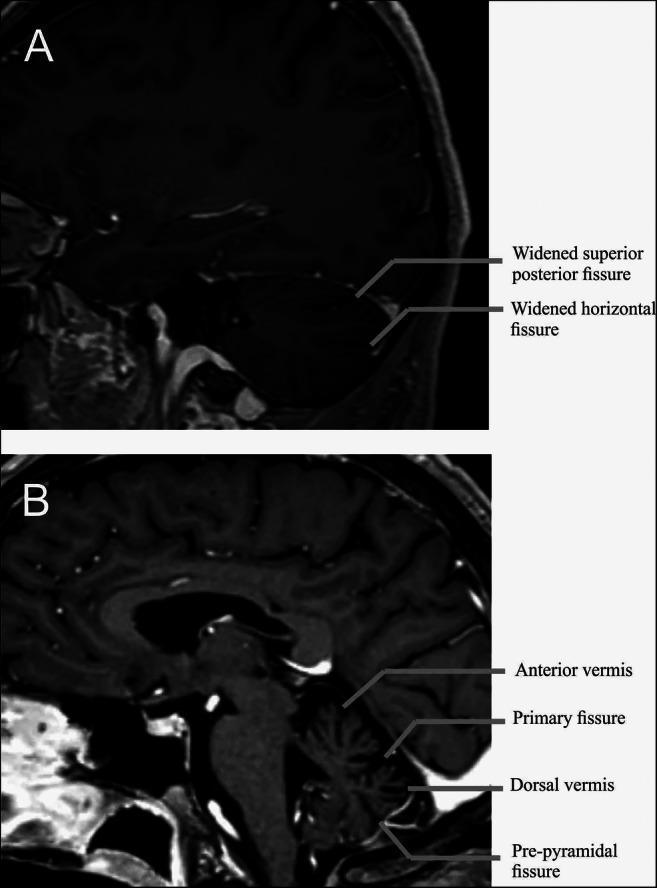

- Cerebellar vermal atrophy — most prevalent (~90%), predominantly posterior vermis
- Cerebellar hemispheric atrophy
- Brainstem atrophy — pontine in more severe cases
- Spinal cord thinning — cervical and thoracic, reflecting posterior column degeneration
- Some cases show bilateral pallidal T2 abnormalities (less common)
Electrophysiology
| Test | Finding |
|---|---|
| Sensory NCS | Absent or severely low amplitude SNAPs — 100% of patients |
| Motor NCS | Normal — purely sensory disorder |
| NCS pattern | Non-length-dependent (upper and lower limb SNAPs equally affected — DRG ganglionopathy pattern, not distal neuropathy) |
| Tibial SEPs | Absent or severely attenuated — 100% |
| Median SEPs | Moderately affected |
| H-reflexes | Preserved in 85.7% — distinguishes from lower motor neuron disease |
| Needle EMG | May show active denervation/chronic reinnervation in some |
| Autonomic tests | Predominantly normal, but 74% showed impaired quantitative sensory test (thermoalgesic) |
Vestibular Testing in CANVAS
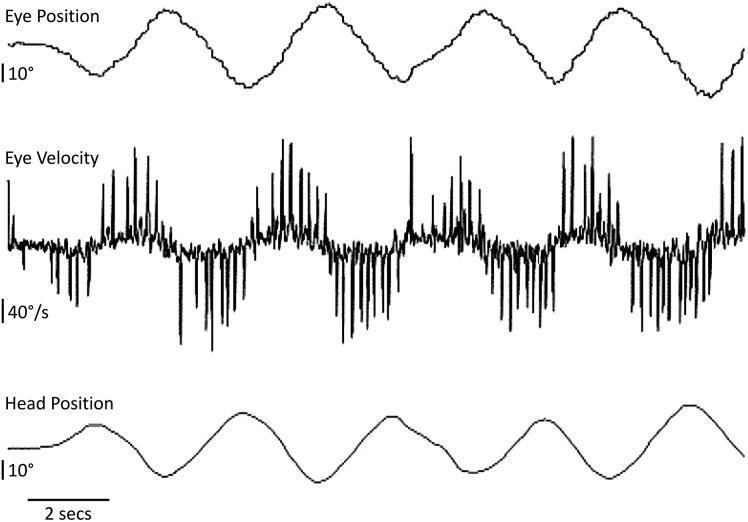
| Test | Expected Finding in CANVAS |
|---|---|
| vHIT | Bilaterally reduced VOR gain (< 0.6); bilateral corrective saccades |
| Caloric | Bilaterally reduced or absent responses; no canal paresis asymmetry |
| Rotational chair | Reduced gain all frequencies; reduced time constant; no directional preponderance (symmetric) |
| cVEMP | Absent or severely attenuated bilaterally (saccular failure) |
| oVEMP | Absent or severely attenuated bilaterally (utricular failure) |
| Spontaneous nystagmus | Absent — bilateral symmetric loss = no asymmetric drive |
| Positional tests | Normal — no BPPV |
Diagnostic Criteria / When to Suspect CANVAS
- Onset after age 35
- Any combination of:
- Complex imbalance/coordination problem of peripheral + vestibular + cerebellar origin
- Sensory neuropathy or neuronopathy (non-length-dependent)
- Bilateral vestibular areflexia (or bilateral hyporeflexia)
- Cerebellar dysfunction (progressive)
- Chronic dry cough (highly specific — pursue RFC1 testing in any ataxia patient with unexplained chronic cough)
- Dysautonomia
- NCS showing absent/low SNAPs, non-length-dependent, normal motor
- Bilateral vestibular hypofunction on vHIT / caloric / rotational chair
- MRI brain: cerebellar (posterior lobe/vermis) atrophy
- Absent tibial SEPs
- RFC1 biallelic AAGGG repeat expansion confirmed on repeat-primed PCR
Differential Diagnosis
| Condition | Key Distinguishing Feature |
|---|---|
| Friedreich ataxia | Younger onset (< 25 yrs), cardiomyopathy, scoliosis, FXN GAA expansion |
| SCA3 (MJD) | Autosomal dominant, pyramidal/extrapyramidal signs, sensorimotor (not pure sensory) neuropathy |
| Sjögren's neuronopathy | Anti-Ro/La antibodies, dry eyes/mouth, keratoconjunctivitis sicca |
| Paraneoplastic ganglionopathy | Rapid onset, anti-Hu/CV2, associated malignancy |
| Vitamin B12 deficiency | Posterior column T2 signal on MRI spine, elevated MMA/homocysteine, treatable |
| Vitamin E deficiency (AVED) | Low serum vitamin E, Friedreich-like, treatable |
| POLG1 mutations (SANDO) | Ophthalmoplegia, epilepsy, myopathy |
| Copper deficiency myelopathy | Posterior column T2 signal, low serum copper, often post-gastric surgery |
Management
Symptomatic
- Chronic cough: Gabapentin, pregabalin, speech therapy (laryngeal sensory retraining); avoid ACE inhibitors (worsen cough)
- Neuropathic pain (if thermoalgesic fibers involved): Duloxetine, pregabalin, amitriptyline
- Dysautonomia: Fludrocortisone, compression stockings (orthostatic hypotension); bladder anticholinergics if indicated
- Cerebellar tremor/ataxia: No proven pharmacotherapy; riluzole and acetyl-DL-leucine are under investigation
Rehabilitation
- Vestibular rehabilitation — gaze stabilisation exercises, bilateral VOR substitution training
- Balance physiotherapy — ataxia-specific programs (progressive foam/unstable surface training)
- Occupational therapy — fall prevention, home adaptation
- Walking aids — canes, rollators; particularly important in darkness
Safety
- Avoid aminoglycosides absolutely (will catastrophically worsen bilateral vestibular function)
- Driving assessment — oscillopsia from VOR failure may render driving unsafe
- Adequate lighting at home; remove trip hazards
Genetic Counselling
- Autosomal recessive — siblings have 25% risk
- Offspring are obligate carriers (not affected), but partner carrier status matters
- Family cascade testing if symptomatic relatives
Prognosis
- Slowly progressive over 10–15 years
- Most patients eventually require a walking aid
- Cognitive function generally preserved
- Life expectancy not markedly reduced in typical CANVAS
- Severe cases with ALS-like features or marked dysautonomia have worse prognosis
Summary Diagram
RFC1 gene — biallelic (AAGGG)n repeat expansion
                        ↓
         Degeneration of 3 systems:

  DRG Ganglionopathy        Vestibular Areflexia       Cerebellar Atrophy
        ↓                          ↓                          ↓
Sensory neuropathy          Bilateral loss of          Posterior lobe
(non-length-dependent)       VOR/otolith function        vermis atrophy
Loss of proprioception,     No nystagmus; oscillopsia  Limb dysmetria
vibration, JPS              Imbalance in dark           Kinetic tremor
        ↓                          ↓                          ↓
Positive Romberg         vHIT bilat gain ↓↓          MRI cerebellar atrophy
Fukuda deviation         Caloric bilat absent         Gait cerebellar component
Stamping gait            cVEMP/oVEMP absent

                + Chronic cough (64%) + Dysautonomia (32%)