
Give me exapmles for scleroderma with explanations
Reading File
Now I'll search the medical library for scleroderma content in parallel:
Finding Sources
Finding Sources
Searching PubMed
"scleroderma" OR "systemic sclerosis"
Good. Now let me pull the detailed content from the most comprehensive sources in parallel:
Reading File
Reading File
Reading File
Excellent — rich content retrieved. Let me now fetch the clinical images and get more content on specific organ manifestations:
Loading Image
Loading Image
Loading Image
Reading File
I now have comprehensive content from multiple authoritative textbooks. Here is a thorough, well-illustrated overview:
Scleroderma — Types, Features & Explanations
Scleroderma (literally "hard skin") is a chronic connective tissue disease characterized by fibrosis, vascular abnormalities, and immune dysregulation. It ranges from purely localized skin disease to a severe multisystem disorder.
Classification Overview
| Type | Skin Involvement | Systemic Involvement |
|---|---|---|
| Morphea | Localized plaques | No |
| Linear scleroderma | Band-like, unilateral | Rarely |
| Limited cutaneous SSc (lcSSc) | Distal extremities + face | Yes — gradual |
| Diffuse cutaneous SSc (dcSSc) | Proximal + trunk | Yes — widespread, rapid |
| SSc sine scleroderma | None | Yes |
— Washington Manual of Medical Therapeutics; Fitzpatrick's Dermatology, Vol. 1–2
1. Localized Scleroderma
A. Morphea (Circumscribed/Plaque Scleroderma)
What it is: Fibrosis confined to patches of skin and subcutaneous tissue, with no internal organ involvement.
Example: A young woman develops an oval, ivory-white, indurated plaque on her abdomen surrounded by a violaceous border ("lilac ring"), which represents active inflammation. The center becomes waxy and firm over months. She has no Raynaud phenomenon, normal lung function, and negative ANA.
Key features:
- Subtypes include plaque morphea, generalized morphea, deep morphea (morphea profunda), and linear morphea
- Synonyms: "localized scleroderma," "circumscribed scleroderma"
- Usually self-limiting; internal organs are spared
- Treatment: topical/intralesional corticosteroids, phototherapy (UVA1)
— Dermatology 2-Volume Set 5e; Textbook of Family Medicine 9e
B. Linear Scleroderma
What it is: A band-like strip of sclerotic skin running along a limb or the face/scalp, often crossing joints and causing contractures.
Example: A 10-year-old girl develops a linear streak of tight, hyperpigmented skin running from the forehead down to the left cheek — the classic "en coup de sabre" (sword-stroke) pattern. The underlying skull and facial muscles may atrophy over time.
Key features:
- More common in children than adults
- Can extend to underlying fascia, muscle, and bone
- When on the face: "en coup de sabre" or Parry-Romberg syndrome (hemifacial atrophy)
- May cause limb length discrepancy in growing children
- Interstitial pneumonitis is an extremely rare complication
— Dermatology 2-Volume Set 5e; Fishman's Pulmonary Diseases
2. Systemic Sclerosis (Systemic Scleroderma)
All systemic forms involve Raynaud phenomenon (RP) as the near-universal presenting feature (96–99% of patients), plus skin thickening at varying distributions.
C. Limited Cutaneous Systemic Sclerosis (lcSSc) — CREST Syndrome
What it is: Skin tightening restricted to the face and extremities distal to the knees and elbows. Internal organ damage develops slowly, over years to decades.
CREST acronym:
- C — Calcinosis (calcium deposits in skin, especially fingertips)
- R — Raynaud phenomenon
- E — Esophageal dysmotility (dysphagia, reflux)
- S — Sclerodactyly (tight, shiny, tapered fingers)
- T — Telangiectasias (dilated capillary mats on lips, face, hands)
Example: A 55-year-old woman with a 20-year history of Raynaud's develops dysphagia, visible red telangiectasias on her lips and face, calcium nodules on her fingertips, and tight shiny skin up to her wrists. Echo shows pulmonary arterial hypertension (PAH). Anticentromere antibody (ACA) is positive.
Key features:
- Strong association with anticentromere antibodies (ACA)
- Leading cause of death: pulmonary arterial hypertension (PAH) — occurring in the absence of ILD
- Strong association with primary biliary cirrhosis
- Better prognosis than diffuse form
— Washington Manual of Medical Therapeutics; Fishman's Pulmonary Diseases
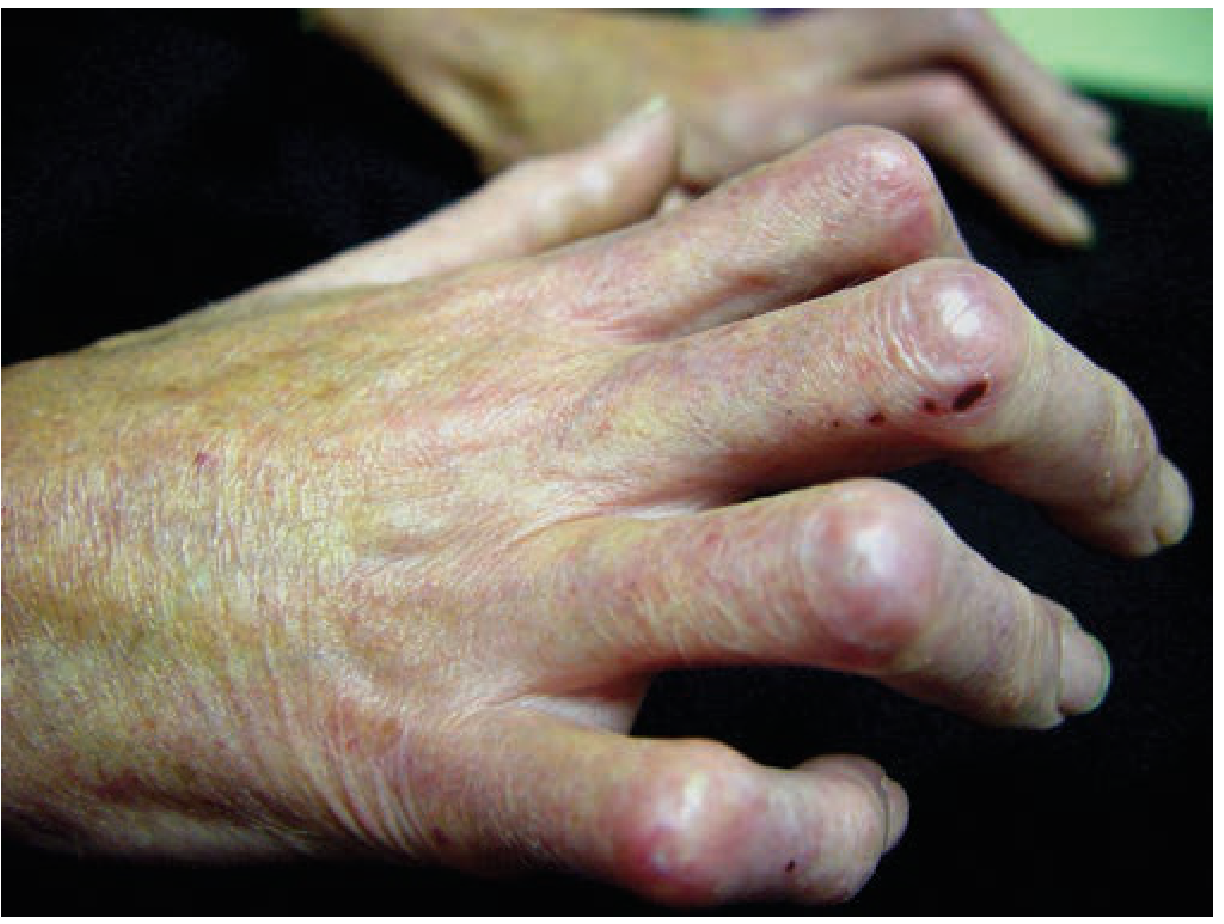
D. Diffuse Cutaneous Systemic Sclerosis (dcSSc)
What it is: Widespread skin sclerosis extending to the proximal extremities and trunk, with rapid and severe internal organ involvement.
Example: A 45-year-old woman presents with 6 months of bilateral hand swelling and Raynaud's. Skin hardening quickly spreads from her hands up to her arms, chest, and face. She has dyspnea on exertion from interstitial lung disease (ILD), and then develops sudden severe hypertension with rising creatinine — scleroderma renal crisis (SRC). Anti-Scl-70 (anti-topoisomerase I) antibody is positive.
Key features:
- Sclerodactyly → tapered, claw-like deformity of the hands
- Facial changes: fixed stare, pinched nose, thinned lips, narrowed mouth — inability to open mouth wide
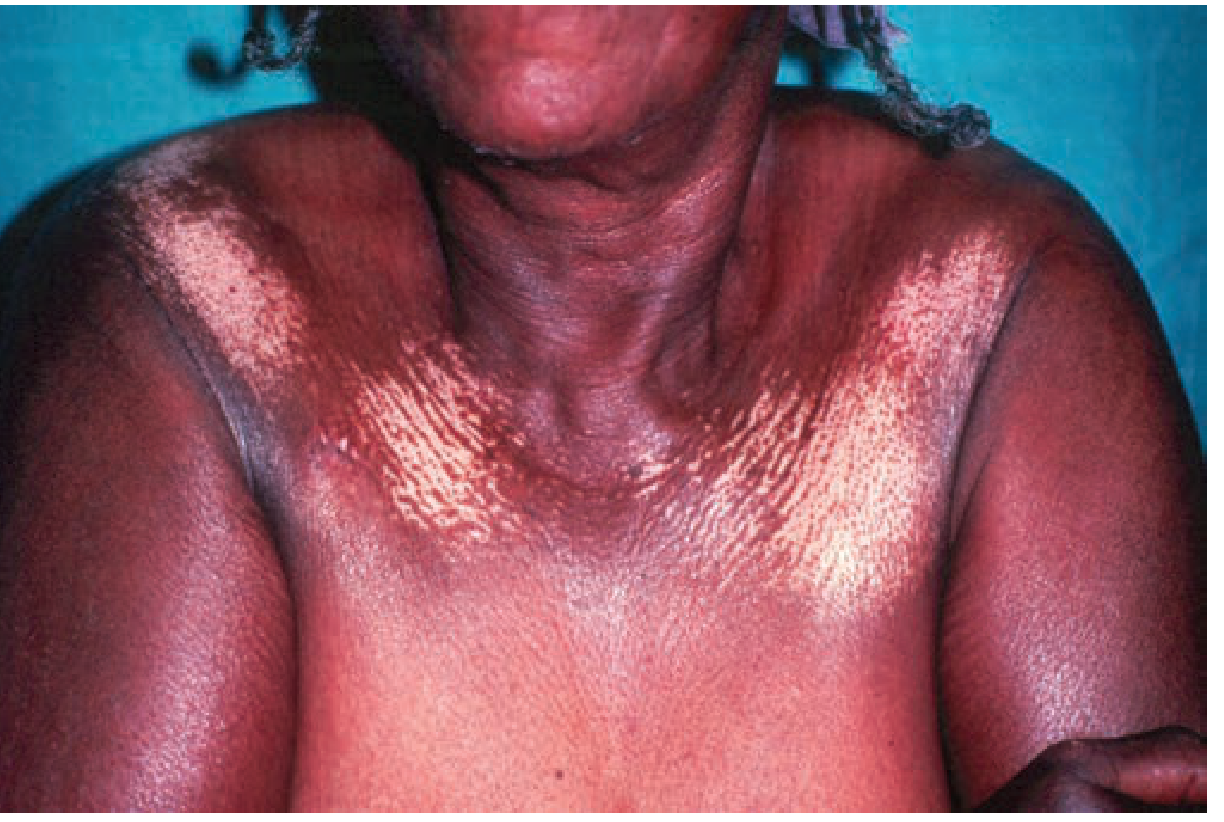
- "Salt and pepper" skin: hyperpigmented and hypopigmented patches (perifollicular pigmentation)
- Tendon friction rubs over hand tendons — very specific for dcSSc
- Yellowish-brown hue spreads from chest to extremities
- Associated antibody: anti-Scl-70 (anti-topoisomerase I) → predicts ILD, severe disease
Organ involvement in dcSSc:
| Organ | Manifestation | Frequency |
|---|---|---|
| Lung (fibrosis) | ILD — predominantly NSIP pattern | ~63% (Germany) |
| GI tract | Dysmotility, bacterial overgrowth, GAVE ("watermelon stomach"), pseudo-obstruction | ~65–90% |
| Kidney | Scleroderma renal crisis | Significant |
| Heart | Patchy myocardial fibrosis → heart failure, arrhythmias | Present |
| Vessels | Raynaud → digital ulcers, autoamputation | ~36% with ulcers |
— Washington Manual; Fitzpatrick's Dermatology; Fishman's Pulmonary Diseases
E. Scleroderma Renal Crisis (SRC) — A Medical Emergency
What it is: Sudden onset of severe hypertension + acute kidney injury in a patient with dcSSc.
Example: A known dcSSc patient on corticosteroids develops a sudden headache, blurred vision, and blood pressure of 190/120 mmHg with rising creatinine and microangiopathic hemolytic anemia on blood film. This is SRC.
Key features:
- Occurs predominantly in diffuse disease
- Associated with microangiopathic hemolytic anemia
- Treatment: ACE inhibitors URGENTLY (captopril is first-line) — before their use, mortality was >90% at 12 months
- ~2/3 of SRC patients require renal replacement therapy; ~1/2 eventually recover and can discontinue dialysis (recovery can occur up to 24 months later)
- Decisions on renal transplantation should be postponed to allow for this late recovery
— Fitzpatrick's Dermatology, Vol. 1–2
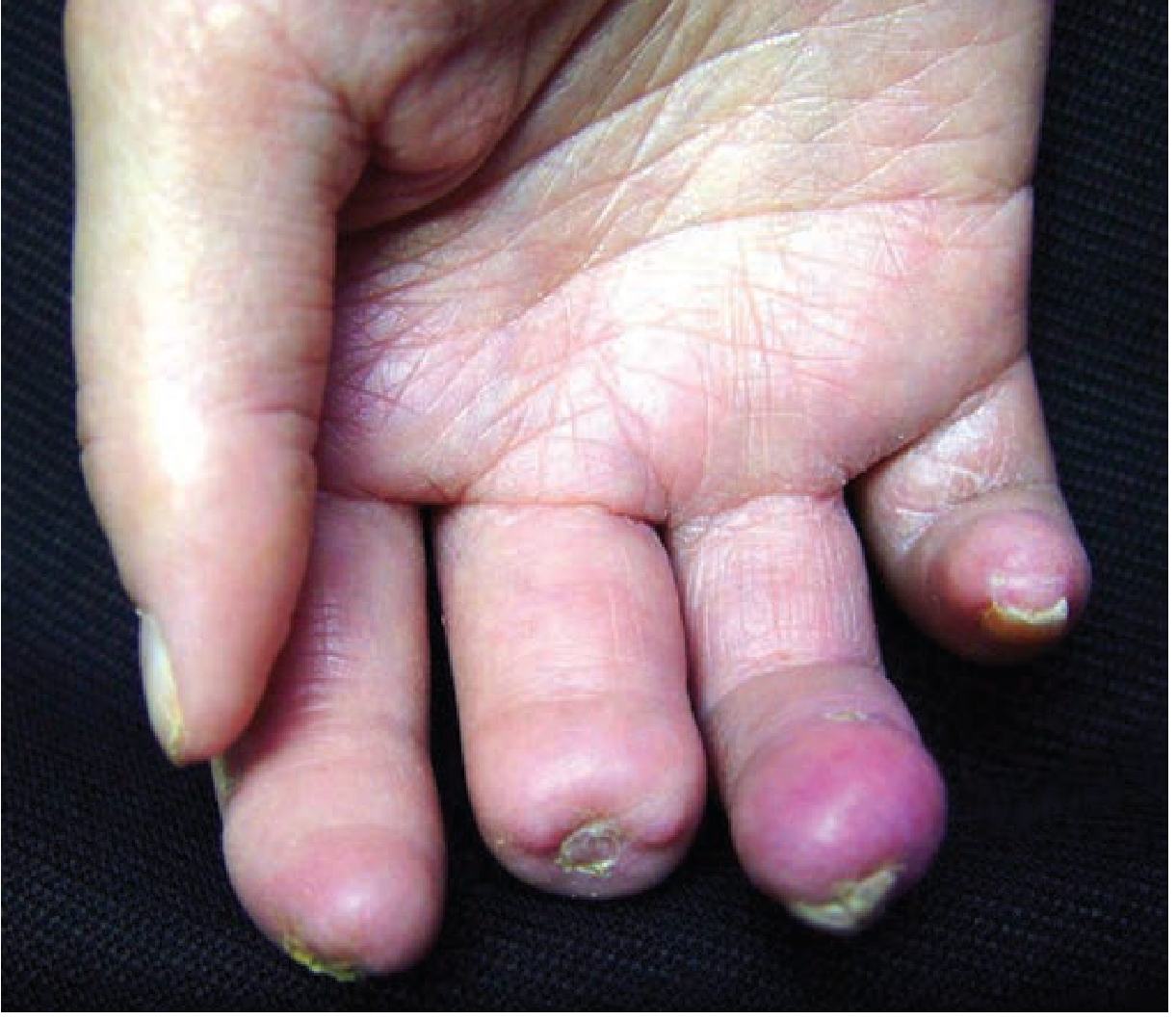
F. Raynaud Phenomenon with Digital Autoamputation
What it is: Episodic vasospasm triggered by cold or stress causing triphasic color change (white → blue → red) of the fingers. In severe disease, it leads to digital ulcers and gangrene.
Example: A scleroderma patient with long-standing severe Raynaud's loses the tips of two fingers through ischemic autoamputation. Nail fold capillaroscopy shows dilated, distorted capillary loops (the scleroderma pattern).
3. Skin & Pigmentary Changes
"Vitiligo-like" dyspigmentation in diffuse SSc shows areas of perifollicular pigmentation that can resemble vitiligo — pigment is retained around follicles while surrounding skin depigments, giving the characteristic "salt and pepper" appearance.
Diagnostic Antibodies Summary
| Antibody | Scleroderma Subtype | Associated Manifestations |
|---|---|---|
| Anticentromere (ACA) | Limited (lcSSc) | PAH, ILD, digital ulcers, calcinosis |
| Anti-Scl-70 (anti-topoisomerase I) | Diffuse (dcSSc) | ILD, renal crisis, severe disease |
| Anti-RNA polymerase III | Diffuse | Renal crisis risk |
| Anti-Th/To | Limited | ILD, PAH |
| ANA | Both | >95% positive in all scleroderma |
— Washington Manual of Medical Therapeutics
Key Takeaway
Scleroderma exists on a spectrum — from the benign self-limiting morphea (skin only, no systemic risk) to diffuse systemic sclerosis (rapidly progressive fibrosis affecting lungs, kidneys, heart, and GI tract). The antibody profile, distribution of skin involvement, and pace of progression determine subtype, prognosis, and treatment approach.
This is a shared conversation. Sign in to Orris to start your own chat.