
Blood supply of intra orbital part of optic nerve
Reading File
Finding Sources
Finding Sources
Searching the Web
blood supply intraorbital part optic nerve anatomy
Reading File
Finding Sources
Searching Images
blood supply intraorbital optic nerve anatomy diagram
Reading File
Loading Image
Now I have comprehensive information. Let me compile the answer.
Blood Supply of the Intraorbital Part of the Optic Nerve
The intraorbital segment is 25–30 mm long, extending from the posterior globe to the optic foramen at the orbital apex. It is the longest portion and has a somewhat less robust blood supply than the optic nerve head — particularly in its posterior watershed zones. It is supplied by two interconnected systems:
1. Periaxial (Extrinsic / Peripheral) System
This is the dominant system. Blood is delivered via a pial arterial plexus that wraps the surface of the nerve and sends centripetal branches inward through fibrous septae to supply the peripheral fascicles.
Sources feeding the pial plexus:
- Ophthalmic artery (branch of the internal carotid artery) — the primary contributor, giving off small recurrent branches
- Short posterior ciliary arteries (SPCAs) — branches of the ophthalmic artery that supply the retrolaminar region and contribute pial branches along the intraorbital nerve
- Long posterior ciliary arteries — contribute via choroidal branches near the nerve
- Lacrimal artery — minor contribution
- Middle meningeal artery (branch of external carotid) — can provide collateral supply near the orbital apex via anastomoses with the ophthalmic artery
The pial vessels run longitudinally and circumferentially, forming a vascular network in the pia mater that is the main source of nutrition to the outer two-thirds of the nerve.
2. Axial (Intrinsic / Central) System
- The central retinal artery (CRA) enters the nerve 8–12 mm posterior to the globe by piercing the inferior aspect of the dural sheath
- After entry, it runs centrally within the nerve substance toward the optic disc
- It gives off centrifugal branches that supply the axial (central) core of the nerve
This system supplies the inner/central portion of the intraorbital nerve, while the pial periaxial system supplies the peripheral portion.
Summary Table
| System | Vessel(s) | Region Supplied |
|---|---|---|
| Periaxial (pial plexus) | Ophthalmic artery, SPCAs, long PCAs, lacrimal artery | Peripheral/outer nerve fascicles |
| Axial (CRA branches) | Central retinal artery (centrifugal branches) | Central/inner nerve core |
| Collateral | Middle meningeal artery | Near orbital apex |
Clinical Relevance
- Posterior ischemic optic neuropathy (PION): The posterior intraorbital nerve (between lamina cribrosa and optic canal) is a watershed zone with the least overlap between the axial and periaxial systems. It is vulnerable to hypoperfusion, especially during prolonged prone-position spine surgery.
- Optic nerve sheath meningioma and retrobulbar masses can compress the pial vessels, impairing the periaxial system and producing progressive visual loss often with optociliary shunt vessels.
- The CRA pierces the nerve ≈ 8–12 mm behind the globe — meaning a needle passed retrobulbar for anesthesia risks injuring it if aimed too close to the nerve.
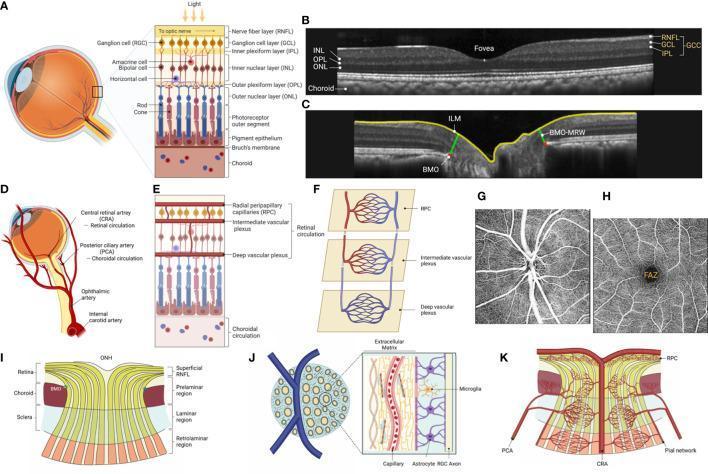
Panel D above shows the ophthalmic artery branching into the CRA and posterior ciliary arteries; Panels I–K detail the ONH and retrolaminar/pial vascular network.
Sources: Kanski's Clinical Ophthalmology (10th ed.); Miller's Anesthesia (10th ed.); Kenhub — Optic nerve anatomy; AAO Optic Nerve lecture notes
This is a shared conversation. Sign in to Orris to start your own chat.