
Treatment of malaria
I'll start by reading the medical library skill, then search for malaria treatment information in parallel.
Reading File
Now I'll search the medical library and PubMed in parallel for malaria treatment.
Finding Sources
Searching PubMed
"malaria"[MeSH Terms] AND "antimalarial"[MeSH Terms]
Searching the Web
WHO malaria treatment guidelines 2023 2024
Good results. Now I'll read the most comprehensive sections in parallel - from Goodman & Gilman, Goldman-Cecil, Park's, and Katzung.
Reading File
Reading File
Reading File
Reading File
Excellent - I now have rich content. Let me read a bit more from Park's to get the severe malaria and vivax sections, and also the Goldman-Cecil multimodal treatment section.
Reading File
Reading File
I now have comprehensive information to write a detailed, well-structured answer. Let me also fetch the malaria treatment flowchart image from Goodman & Gilman for visual clarity.
Loading Image
Reading File
I now have comprehensive information from multiple authoritative textbooks. Here is the full structured answer:
Treatment of Malaria
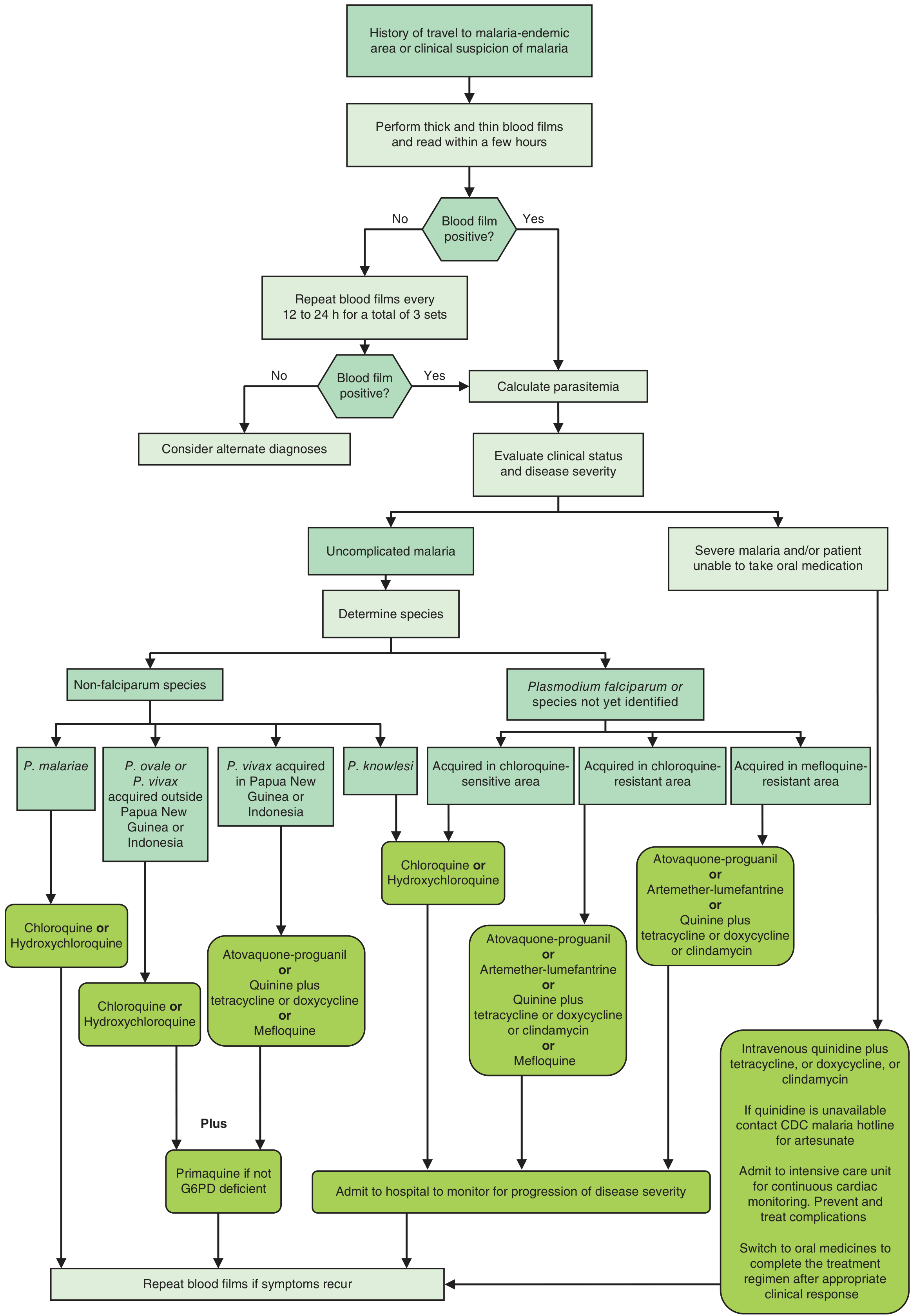
Overview
Treatment depends on three factors:
- Species - P. falciparum, P. vivax, P. ovale, P. malariae, or P. knowlesi
- Severity - uncomplicated vs. severe/complicated malaria
- Resistance pattern - chloroquine-sensitive vs. chloroquine/mefloquine-resistant area
All confirmed malaria cases (by microscopy or RDT) should receive prompt, effective treatment. - Park's Textbook of Preventive and Social Medicine, p. 307
1. Uncomplicated P. falciparum Malaria
A. Chloroquine-Sensitive Areas (rare globally)
| Drug | Dose |
|---|---|
| Chloroquine phosphate | 1 g, then 500 mg at 6, 24, and 48 hr |
B. Chloroquine-Resistant Areas (most of the world)
Artemisinin-based Combination Therapy (ACT) is the WHO-recommended first-line treatment. Artemisinin monotherapy alone is banned - it promotes resistance. - Park's, p. 307
Options (adult doses):
| Regimen | Dose |
|---|---|
| Artemether-lumefantrine (Coartem) | 4 tablets (artemether 20 mg + lumefantrine 120 mg) twice daily for 3 days |
| Atovaquone-proguanil (Malarone) | 4 tablets daily for 3 days |
| Artesunate + sulfadoxine-pyrimethamine (ACT-SP) | Artesunate x 3 days + SP single dose on Day 1; primaquine single dose 0.75 mg/kg on Day 2 |
| Artesunate-amodiaquine (ASAQ) | First-line in many African countries |
| Dihydroartemisinin-piperaquine | Highly effective; resistance seen in parts of Southeast Asia |
| Quinine sulfate 650 mg TID x 3-7 days | + doxycycline 100 mg BD x 7 days (or clindamycin 600 mg BD x 7 days for children/pregnant) |
| Mefloquine | 750 mg then 500 mg after 6-8 hr (or 1250 mg single dose) |
- Goldman-Cecil Medicine, Table 316-1 & 316-2, p. 3397
C. Mefloquine-Resistant Areas (parts of Southeast Asia)
- Atovaquone-proguanil, or
- Quinine + tetracycline/doxycycline/clindamycin
2. Uncomplicated P. vivax / P. ovale Malaria
- Chloroquine 25 mg/kg divided over 3 days (blood schizonticide) - Park's, p. 307
- PLUS Primaquine 0.25 mg/kg/day for 14 days (to eliminate hypnozoites and prevent relapse)
- Alternatively: Tafenoquine 300 mg single dose (anti-relapse)
- Relapse rate for vivax in India is ~30%; primaquine is essential to prevent it
Important: Primaquine/tafenoquine must ONLY be given after confirming normal G6PD levels - they cause haemolytic anaemia in G6PD-deficient patients. Contraindicated in pregnancy and infants. - Goldman-Cecil Medicine, p. 3397; Park's, p. 307
For P. vivax from Papua New Guinea or Indonesia (chloroquine resistance common): use atovaquone-proguanil or quinine + doxycycline/mefloquine.
3. P. malariae and P. knowlesi
- Treat with chloroquine (chloroquine-sensitive)
- No primaquine needed for P. malariae (no hypnozoite stage)
4. Severe / Complicated Malaria
Features Defining Severe Malaria
- Impaired consciousness/coma
- Repeated convulsions
- Renal failure (creatinine >3 mg/dL)
- Severe anaemia (Hb <5 g/dL)
- Pulmonary oedema/ARDS
- Hypoglycaemia (glucose <40 mg/dL)
- Circulatory collapse (systolic BP <80 mmHg)
- Haemoglobinuria
- Hyperparasitaemia (>5% parasitized RBCs)
- Park's, p. 308
Treatment of Severe Malaria (Parenteral First)
| Drug | Dose |
|---|---|
| IV Artesunate (preferred) | 2.4 mg/kg IV at 0, 12, 24 hr, then daily for 2 more days |
| IV Quinine dihydrochloride (if artesunate unavailable) | Loading dose 20 mg/kg over 4 hr; then 10 mg/kg every 8 hr (with cardiac monitoring) |
| IM Artemether | 3.2 mg/kg IM initially; then 1.6 mg/kg/day |
- IV artesunate is now clearly preferred over IV quinine for severe malaria - more efficacious and better tolerated. - Katzung's Basic and Clinical Pharmacology; Goldman-Cecil
- IV regimens should be maintained until oral therapy can be tolerated, then transitioned to a full oral ACT course (+ doxycycline or clindamycin)
- Admit to ICU with cardiac monitoring (especially if using quinine)
- Treat complications: hypoglycaemia, fluid balance, anaemia, seizures
5. Treatment in Pregnancy
| Trimester | P. falciparum | P. vivax |
|---|---|---|
| 1st trimester | Quinine + clindamycin (ACTs avoided) | Chloroquine |
| 2nd and 3rd trimester | ACT (artemether-lumefantrine preferred) | Chloroquine |
- Primaquine is contraindicated throughout pregnancy (risk of haemolysis in foetus)
- Severe malaria in pregnancy: IV artesunate following general severe malaria guidelines
- In lactating mothers, chloroquine/hydroxychloroquine are preferred; atovaquone-proguanil only if infant >5 kg with normal G6PD
- Goodman & Gilman's, p. 1322; Park's, p. 307
6. Treatment in Children
- Same regimens as adults (paediatric weight-based dosing; dose should never exceed adult dose)
- Tetracyclines contraindicated in children <8 years; use clindamycin instead
- Atovaquone-proguanil approved only for children >5 kg
- Goodman & Gilman's, p. 1322
7. Mixed Infections
- Treat as P. falciparum malaria (most aggressive species takes priority). - Park's, p. 307
8. Key Drugs - Quick Reference
| Drug | Class | Main Use | Key Toxicity |
|---|---|---|---|
| Artesunate / Artemether | Sesquiterpene lactone | Blood schizonticide; first-line severe disease | Generally well tolerated |
| Lumefantrine / Amodiaquine | ACT partner | Combined with artemisinin | GI side effects |
| Chloroquine | 4-aminoquinoline | Vivax/malariae/sensitive falciparum | Retinopathy (chronic); QTc prolongation |
| Primaquine | 8-aminoquinoline | Hypnozoite elimination (vivax/ovale) | Haemolysis in G6PD deficiency |
| Tafenoquine | 8-aminoquinoline | Relapse prevention (single dose) | Same as primaquine; contraindicated in G6PD deficiency |
| Quinine | Cinchona alkaloid | Severe disease; 1st trimester pregnancy | Cinchonism (tinnitus, nausea, dizziness); hypoglycaemia |
| Atovaquone-proguanil | Mixed | Resistant falciparum | GI intolerance; not in pregnancy |
| Mefloquine | 4-methanolquinoline | Resistant falciparum; prophylaxis | Neuropsychiatric effects; GI intolerance |
| Doxycycline | Tetracycline | Partner drug to quinine | Photosensitivity; contraindicated <8 yr, pregnancy |
9. Treatment Failure
Suspect if no clinical/parasitological response within 72 hours of full treatment with no vomiting. Treat with oral quinine + tetracycline/doxycycline. Report to the concerned malaria officer for therapeutic efficacy studies. - Park's, p. 307
10. WHO 2024 Update
The WHO Guidelines for Malaria (November 2024) are the most current consolidated guidance, including updated recommendations on:
- Malaria vaccines (RTS,S/AS01 and R21/Matrix-M)
- Use of near-patient G6PD tests to guide anti-relapse treatment
- Indoor residual spraying and spatial repellents (vector control)
The CDC Treatment Guidelines (June 2024) for uncomplicated and severe malaria are also available for US-specific practice.
Sources: Goodman & Gilman's Pharmacological Basis of Therapeutics, p. 1322 | Goldman-Cecil Medicine, Tables 316-1 & 316-2 | Katzung's Basic and Clinical Pharmacology, 16th Ed. | Park's Textbook of Preventive and Social Medicine, pp. 307-308
This is a shared conversation. Sign in to Orris to start your own chat.