
Explain epistaxis
Reading File
Finding Sources
Searching PubMed
epistaxis management
Good results. Let me read the most comprehensive sources in parallel — Cummings Otolaryngology (most authoritative for ENT), Rosen's Emergency Medicine, and Tintinalli's.
Reading File
Reading File
Reading File
Now let me get the detailed clinical content from Rosen's (the main epistaxis chapter) and Roberts & Hedges' (procedural detail).
Reading File
Reading File
Let me get more of the Rosen's clinical content including management and the nasal anatomy image.
Reading File
Reading File
I now have comprehensive information. Let me fetch the nasal anatomy image.
Loading Image
I now have all the information needed for a comprehensive explanation. Here is the full answer:
Epistaxis (Nosebleed)
Epistaxis — bleeding from the nasal cavity — is one of the most common otolaryngologic presentations. While distressing, it is rarely life-threatening.
Anatomy & Vascular Supply
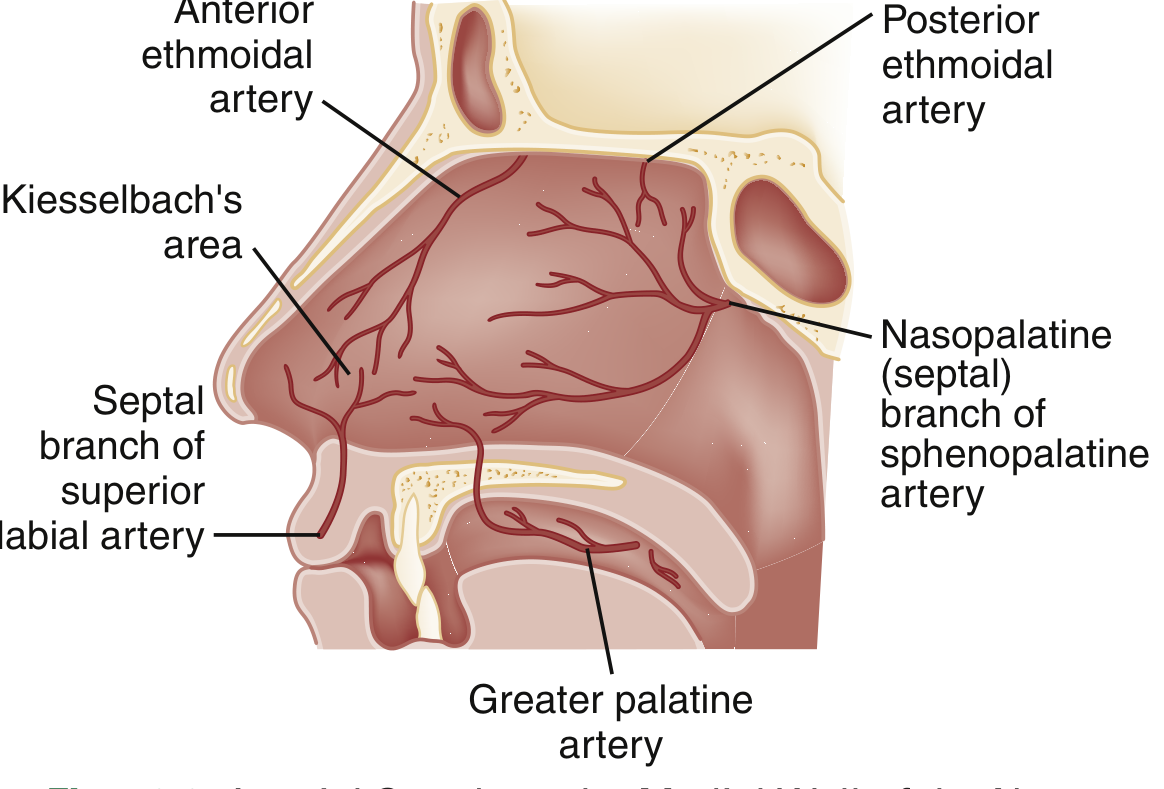
Three arterial systems supply the nasal mucosa:
| Artery | Origin | Area Supplied |
|---|---|---|
| Sphenopalatine artery | External carotid → maxillary | Turbinates, posterior/inferior septum |
| Anterior & posterior ethmoidal arteries | Internal carotid → ophthalmic | Superior mucosa, medially and laterally |
| Superior labial artery | External carotid → facial | Anterior mucosal septum |
Kiesselbach's plexus (also called Little's area) is the anastomotic confluence of all three systems on the anteroinferior nasal septum — the origin of ~90% of all nosebleeds.
Classification
| Type | Frequency | Source | Features |
|---|---|---|---|
| Anterior | ~90% | Kiesselbach's plexus | Unilateral, self-limited, visible |
| Posterior | ~10% | Sphenopalatine artery | Bilateral, profuse, older adults, harder to manage |
Posterior bleeding originates deep in the nasal cavity, is more severe, tends to occur in older patients with multiple comorbidities, and carries risk of airway compromise and aspiration.
Epidemiology
- Bimodal age distribution: peaks in children and the elderly
- Higher incidence in winter months and cold/dry climates — dry heated air desiccates nasal mucosa and cold affects coagulation
- In children, most common between ages 2–10
Causes
Local (nasal/facial):
- Nose picking (most common in children)
- Upper respiratory tract infections / rhinitis
- Low humidity / desiccation (rhinitis sicca)
- Allergic rhinitis
- Nasal foreign bodies
- Nasal polyps, septal deviation
- Environmental irritants (cocaine, chronic nasal vasoconstrictors)
- Barotrauma
- Trauma / surgery
- Neoplasms (e.g., juvenile nasopharyngeal angiofibroma in adolescent males — suspect when there is profuse unilateral bleeding with nasal obstruction)
Systemic:
- Anticoagulant or antiplatelet therapy
- Coagulopathies (von Willebrand disease type 1 is the most commonly identified — found in ~⅓ of children with recurrent epistaxis)
- Thrombocytopenia (leukemia, aplastic anemia, chemotherapy)
- Hepatic disease / vitamin K deficiency
- Hereditary hemorrhagic telangiectasia (Osler-Weber-Rendu disease) — a congenital vascular malformation causing recurrent, multifocal bleeding
- Hypertension: no proven causal relationship, but elevated BP at presentation is associated with persistent bleeding
Clinical Evaluation
Initial priorities
- Airway — assess patency, especially in posterior bleeds
- Hemodynamics — tissue perfusion, signs of significant blood loss
- History — timing, frequency, severity; trauma; medications; family history of bleeding disorders
Physical examination
- Instruct patient to blow the nose to clear clots
- Apply bilateral pressure on the cartilaginous part of the nose for 10–15 minutes (a nose clip is superior to manual pressure alone)
- Administer 0.05% oxymetazoline (2 sprays) before applying pressure to optimize hemostasis and aid examination
- Tilt head slightly forward (not back) to avoid swallowing blood
- Examine with nasal speculum opened vertically, floor of nose parallel to the room floor
Diagnostics
Not routinely required. Reserve labs for:
- Patients on anticoagulants (INR, PT, aPTT, platelets)
- Severe or prolonged bleeding (CBC)
- Underlying liver disease or hematologic malignancy
Management (Stepwise)
Step 1 — Direct pressure + vasoconstriction
- Pinch the cartilaginous nose for 10–15 min
- Topical oxymetazoline or phenylephrine
- Topical anesthetic (2% lidocaine) to facilitate examination
Step 2 — Identify the bleeding site + cautery
- Silver nitrate chemical cautery — most effective when the site is identified
- Apply from periphery → center, superior → inferior (to avoid blood)
- Contact ≤15 seconds; never cauterize both sides of the septum simultaneously (risk of necrosis)
Step 3 — Topical hemostatics
If cautery fails:
- Absorbable gelatin sponge (Gelfoam)
- Oxidized cellulose (Surgicel)
- Topical tranexamic acid (500 mg IV solution on pledget or atomized): moderate-quality evidence supports reduced bleeding at 10 min and re-bleeding at 7–10 days; superior to anterior nasal packing in antiplatelet users
Step 4 — Anterior nasal packing
For persistent anterior epistaxis:
- Merocel (polyvinyl acetal nasal tampon) or Rapid Rhino (procoagulant-coated inflatable balloon) inserted along the floor of the nose
- If uncontrolled despite an adequately placed anterior pack → insert a second pack in the opposite naris
- Routine prophylactic antibiotics are not recommended
Step 5 — Posterior packing
When bleeding persists despite anterior packing, suspect posterior source:
- Double balloon catheter (e.g., Epistat): posterior balloon inflated first, device seated by pulling anteriorly, then anterior balloon inflated
- Foley catheter (if commercial device unavailable): 5–7 mL water in balloon, seated in nasopharynx; caution for pressure necrosis
- Requires inpatient monitoring (risk of airway compromise, hypoxia, cardiac events — especially in elderly)
Step 6 — Refractory / definitive
- Endovascular embolization — >80–91% success rate; preferred in coagulopathic patients and those on anticoagulants; requires bilateral selective internal + external carotid angiography; targets sphenopalatine, facial, and ascending pharyngeal arteries
- Surgical ligation — historically the gold standard for intractable bleeds
Special Situations
| Scenario | Consideration |
|---|---|
| Anticoagulated patient | Anticoagulant reversal rarely needed unless markedly supratherapeutic or life-threatening; topical thrombin/cellulose/gelatin compounds work even in fully anticoagulated patients |
| Child < 2 years | Consider non-accidental trauma and bleeding disorders |
| Recurrent childhood epistaxis | Refer to hematology — ~⅓ have a coagulopathy (most often vWD type 1) |
| Adolescent male, unilateral profuse bleeding | Suspect juvenile nasopharyngeal angiofibroma; CT scan warranted |
| HHT / Osler-Weber-Rendu | Requires specialized multidisciplinary approach; embolization often needed |
Disposition
- Anterior epistaxis controlled in ED → discharge with instructions: avoid nose-picking, apply topical antibiotic ointment nightly to lubricate mucosa
- Anterior pack placed → ENT follow-up in 2–3 days for pack removal; no routine antibiotics
- Posterior pack placed → hospital admission for monitoring
- Refractory → urgent ENT consultation for embolization or surgical planning
Sources: Rosen's Emergency Medicine, 9e • Tintinalli's Emergency Medicine, 9e • Cummings Otolaryngology, 7e • Roberts & Hedges' Clinical Procedures in Emergency Medicine, 7e
This is a shared conversation. Sign in to Orris to start your own chat.