
Ecg all
Reading File
The query "ECG all" is broad. Let me clarify what you need before diving in.
Asking for Preferences
What aspect of ECG are you looking for?
Finding Sources
Finding Sources
Searching the Web
ECG basics interpretation comprehensive guide P wave QRS T wave
Reading File
Finding Sources
Searching Images
ECG normal waveform P wave QRS complex T wave intervals diagram
Reading File
Finding Sources
Reading File
Reading File
Reading File
Loading Image
Loading Image
Loading Image
Loading Image
Now I have comprehensive material. Let me compile the full ECG basics & interpretation guide.
ECG Basics & Interpretation — Complete Guide
Source: Harrison's Principles of Internal Medicine 22E (2025)
1. What is an ECG?
The electrocardiogram (ECG/EKG) records the electrical activity of the heart from the body surface. It is the single most important bedside cardiac test — providing information on rhythm, conduction, ischemia, hypertrophy, electrolyte disturbances, and drug effects.
2. ECG Paper & Calibration
| Feature | Value |
|---|---|
| Paper speed | 25 mm/s |
| 1 small box (1 mm) | 40 ms (0.04 s) horizontal |
| 1 large box (5 mm) | 200 ms (0.20 s) horizontal |
| Standard voltage | 1 mV = 10 mm vertical |
Heart rate calculation:
- Count large boxes between two R waves → divide 300 by that number
- Or: divide 1500 by the number of small boxes between R waves
3. ECG Waveforms & Intervals
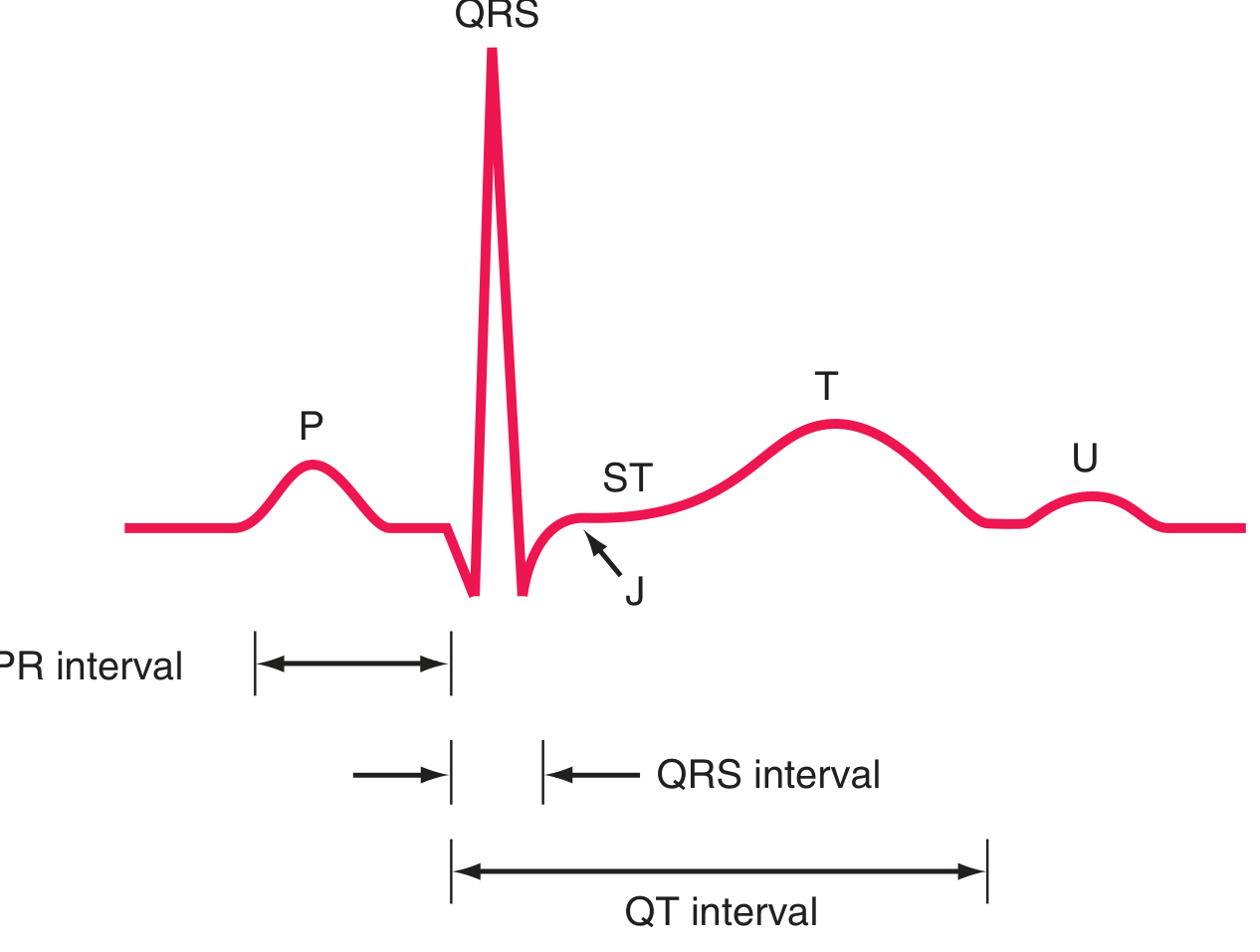
| Component | What it represents | Normal values |
|---|---|---|
| P wave | Atrial depolarization | Duration < 120 ms; amplitude < 2.5 mm |
| PR interval | Atrial depol. + AV nodal delay | 120–200 ms (3–5 small boxes) |
| QRS complex | Ventricular depolarization | ≤ 100–110 ms (≤ 2.5 small boxes) |
| ST segment | Isoelectric (plateau of action potential, phase 2) | At baseline |
| J point | Junction of QRS end and ST start | At or near baseline |
| T wave | Ventricular repolarization (phase 3) | Same direction as QRS |
| QT interval | Total ventricular depol. + repol. | ≤ 460 ms (women), ≤ 450 ms (men) |
| U wave | Purkinje/slow repolarization | Small; same direction as T wave |
Action potential correlation: QRS = rapid phase 0 upstroke; isoelectric ST = plateau (phase 2); T wave = active repolarization (phase 3).
4. The 12 ECG Leads
The standard ECG uses 12 leads — 6 limb leads + 6 precordial (chest) leads.
Limb Leads (Frontal Plane)
| Lead | Type | Views |
|---|---|---|
| I | Bipolar | Left lateral |
| II | Bipolar | Inferior (most useful rhythm strip) |
| III | Bipolar | Inferior |
| aVR | Unipolar augmented | Cavity (right shoulder) |
| aVL | Unipolar augmented | Left lateral |
| aVF | Unipolar augmented | Inferior |
Precordial Leads (Horizontal Plane)
| Lead | Position | Views |
|---|---|---|
| V1 | 4th ICS, right sternal border | Septal/RV |
| V2 | 4th ICS, left sternal border | Septal/RV |
| V3 | Between V2 and V4 | Anterior |
| V4 | 5th ICS, midclavicular | Anterior |
| V5 | 5th ICS, anterior axillary | Lateral |
| V6 | 5th ICS, midaxillary | Lateral |
Each lead is like a "camera" recording electrical events from a different angle. A positive deflection occurs when the depolarization wave moves toward the positive pole of that lead.
5. Normal 12-Lead ECG Example
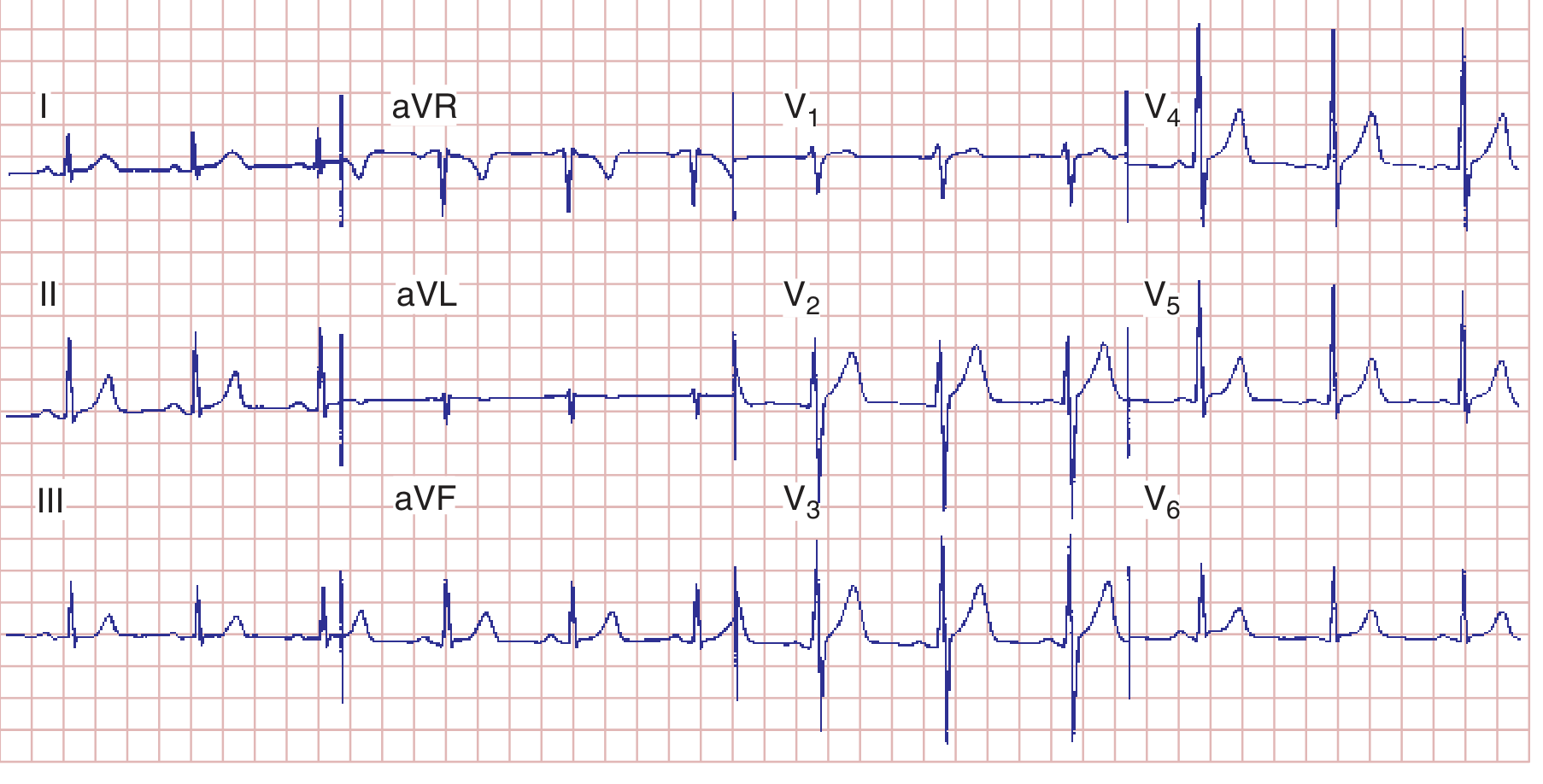
Normal ECG: HR 75 bpm, PR 160 ms, QRS 80 ms, QTc ~390 ms, mean QRS axis ~+70°
6. Genesis of Normal Waveforms
P Wave
- Originates from the sinoatrial (SA) node
- Vector directed downward and leftward → positive in lead II, negative in aVR
- In V1: may be biphasic (positive right atrial component → small negative left atrial component)
- Retrograde P waves (negative in II, positive in aVR) = ectopic atrial or junctional pacemaker
QRS Complex
- Normal ventricular depolarization: rapid spread through Purkinje system
- R-wave progression: R waves should increase from V1 → V5
- Transition zone (R = S amplitude) normally occurs at V3–V4
- Septal Q waves: small, narrow Q waves are normal in I, aVL, V5–V6 (septal depolarization left→right)
ST Segment
- Normally isoelectric (flat, at baseline)
- Elevation or depression > 1 mm = significant (see ischemia section)
T Wave
- Normally in same direction as QRS
- Asymmetrical — slower rise, faster fall
7. Mean QRS Axis
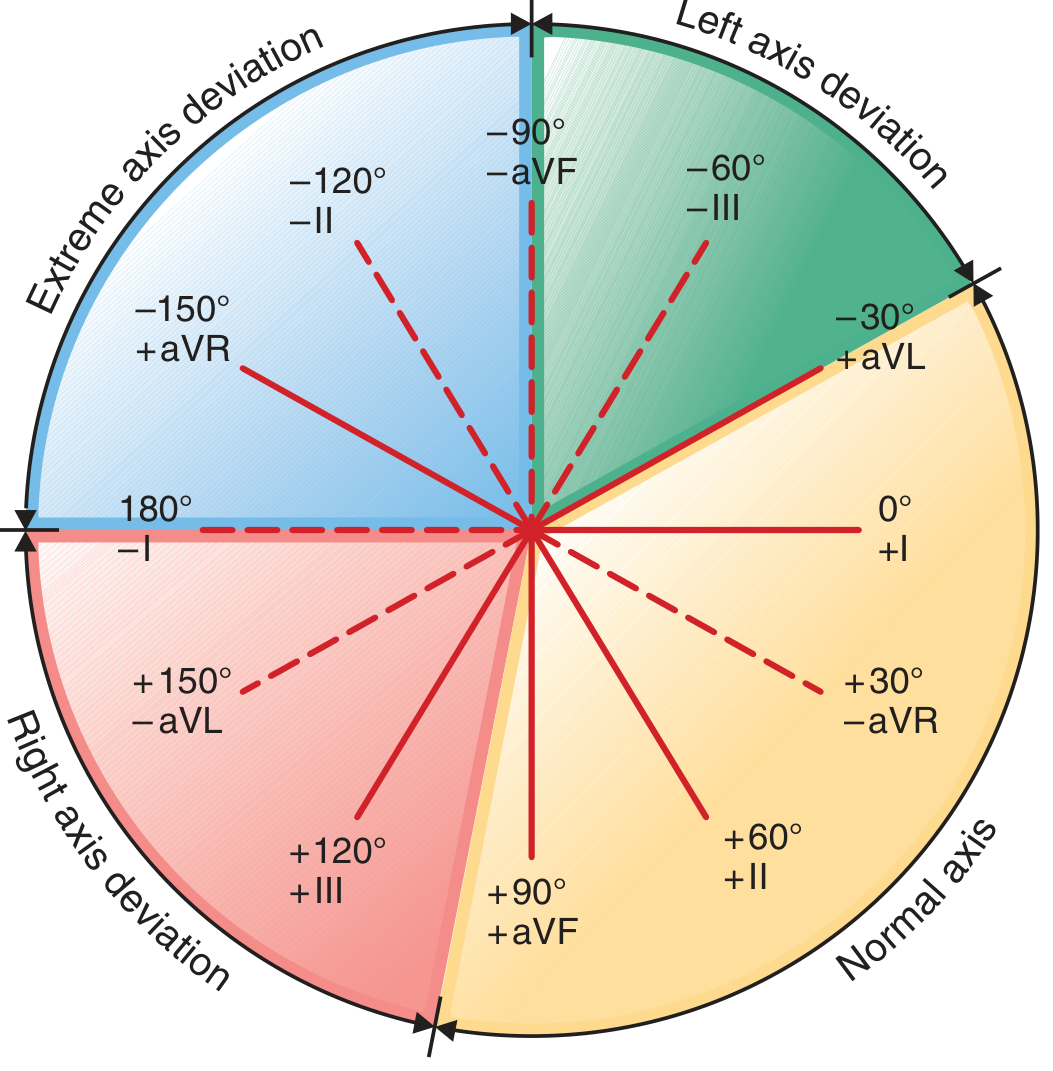
| Axis | Range |
|---|---|
| Normal | −30° to +90° |
| Left axis deviation (LAD) | −30° to −90° |
| Right axis deviation (RAD) | +90° to +180° |
| Extreme (indeterminate) | −90° to ±180° |
Quick method:
- Lead I positive + aVF positive → Normal axis
- Lead I positive + aVF negative → LAD
- Lead I negative + aVF positive → RAD
- Lead I negative + aVF negative → Extreme axis deviation
8. Systematic 14-Step Interpretation (Harrison's)
Every ECG should be analyzed systematically:
- Standardization & technical quality (calibration, lead placement, artifacts)
- Rhythm — sinus vs. non-sinus
- Heart rate
- PR interval / AV conduction
- QRS duration
- QT/QTc interval
- Mean QRS electrical axis
- P waves (morphology, size)
- QRS voltages (hypertrophy criteria)
- Precordial R-wave progression
- Abnormal Q waves
- ST segments
- T waves
- U waves
Always compare with previous ECGs when available.
9. Key Abnormalities at a Glance
Rate
| Finding | Value |
|---|---|
| Bradycardia | < 60 bpm |
| Normal | 60–100 bpm |
| Tachycardia | > 100 bpm |
Intervals
| Abnormality | Finding | Causes |
|---|---|---|
| 1st-degree AV block | PR > 200 ms | AV nodal disease, digoxin, vagal tone |
| Short PR | PR < 120 ms | WPW, LGL syndrome, junctional rhythm |
| Wide QRS | QRS > 120 ms | BBB, ventricular rhythm, WPW, hyperkalemia |
| Long QT | QTc > 450 ms (M) / 460 ms (F) | Drugs, electrolytes, congenital LQTS |
| Short QT | QTc < 340 ms | Hypercalcemia, digoxin, hereditary short QT |
P Wave Abnormalities
| Finding | Cause |
|---|---|
| Tall peaked P in II (P pulmonale, > 2.5 mm) | Right atrial enlargement |
| Broad notched P in II + biphasic in V1 (P mitrale) | Left atrial abnormality |
ST Changes
| Finding | Significance |
|---|---|
| ST elevation ≥ 1 mm (limb) / ≥ 2 mm (precordial) | STEMI, pericarditis, Brugada, early repolarization |
| ST depression | Subendocardial ischemia, reciprocal changes, digoxin |
| Diffuse saddle-shaped ST elevation | Pericarditis |
T Wave Changes
| Finding | Significance |
|---|---|
| Inverted T waves V1–V4 | Anterior ischemia, RVH, RBBB |
| Peaked symmetric T waves | Hyperkalemia, hyperacute MI |
| Wellens T waves (deep inv. V2–V3) | Critical LAD stenosis |
| Flattened/inverted diffuse | Ischemia, cardiomyopathy, metabolic |
Hypertrophy
| Finding | Criteria |
|---|---|
| LVH | S in V1 + R in V5 or V6 ≥ 35 mm (Sokolow-Lyon) |
| RVH | R > S in V1, right axis deviation, T inversion V1–V3 |
Bundle Branch Blocks
| RBBB | LBBB | |
|---|---|---|
| QRS duration | ≥ 120 ms | ≥ 120 ms |
| rSR' pattern | V1 | — |
| Broad notched R | — | V5–V6 |
| Axis | Normal or RAD | LAD |
10. QTc Correction Formulas
| Formula | Method |
|---|---|
| Bazett (classic) | QTc = QT / √RR (in seconds) — inaccurate at extremes of HR |
| Framingham (preferred) | QT = QT + 0.154 × (1000 − RR) in ms |
11. Precordial R-Wave Progression
- R wave should increase from V1 to V5
- Poor R-wave progression (PRWP): R < 3 mm in V3 → anterior MI, LVH, LBBB, incorrect lead placement
- Reverse R-wave progression: R decreasing across precordium → pathological
Summary Mnemonic: "RIPS, QATV"
A systematic approach:
- Rate & Rhythm
- Intervals (PR, QRS, QT)
- P waves
- Segments (ST)
- Q waves (pathological)
- Axis
- T waves
- Voltage (hypertrophy)
Harrison's Principles of Internal Medicine 22E (2025), Chapter 247 — Electrocardiography
This is a shared conversation. Sign in to Orris to start your own chat.