
explain me bones in general, bones of upper limbs and lower limbs, joints, anatomical terms and range of motions , veretebral column, skull. take reference from moore and grays anatomy book
Reading File
Now let me search for all the relevant anatomy topics in parallel from Moore's and Gray's anatomy books.
Finding Sources
Finding Sources
Finding Sources
Finding Sources
Finding Sources
Gray's Anatomy for Students (ISBN 9780323934237) is available. Let me now read the relevant sections in parallel.
Reading File
Finding Sources
Finding Sources
Reading File
Reading File
Reading File
Excellent content found. Now let me read the bones classification section, upper/lower limb bones, and skull sections.
Reading File
Reading File
Reading File
Now let me read the bones general section and lower limb bones, joints, and skull sections.
Reading File
Reading File
Reading File
Reading File
Reading File
I now have comprehensive content from Gray's Anatomy for Students. Let me fetch a few key images to include in the answer.
Loading Image
Loading Image
Loading Image
I now have all the content needed. Let me also read the joints and range of motion section more thoroughly, plus the upper limb bones section from block2.
Reading File
Reading File
I now have extensive, comprehensive content from Gray's Anatomy for Students. Let me compile the complete, detailed answer.
Comprehensive Anatomy Guide
Based on Gray's Anatomy for Students (ISBN 9780323934237)
1. Anatomical Terms and the Anatomical Position
The Anatomical Position
The body is in the anatomical position when standing upright with feet together, hands by the side, palms facing forward, fingers straight and together, face looking forward. The thumb pad is turned 90° to the finger pads. This is the universal reference position for all anatomical descriptions.
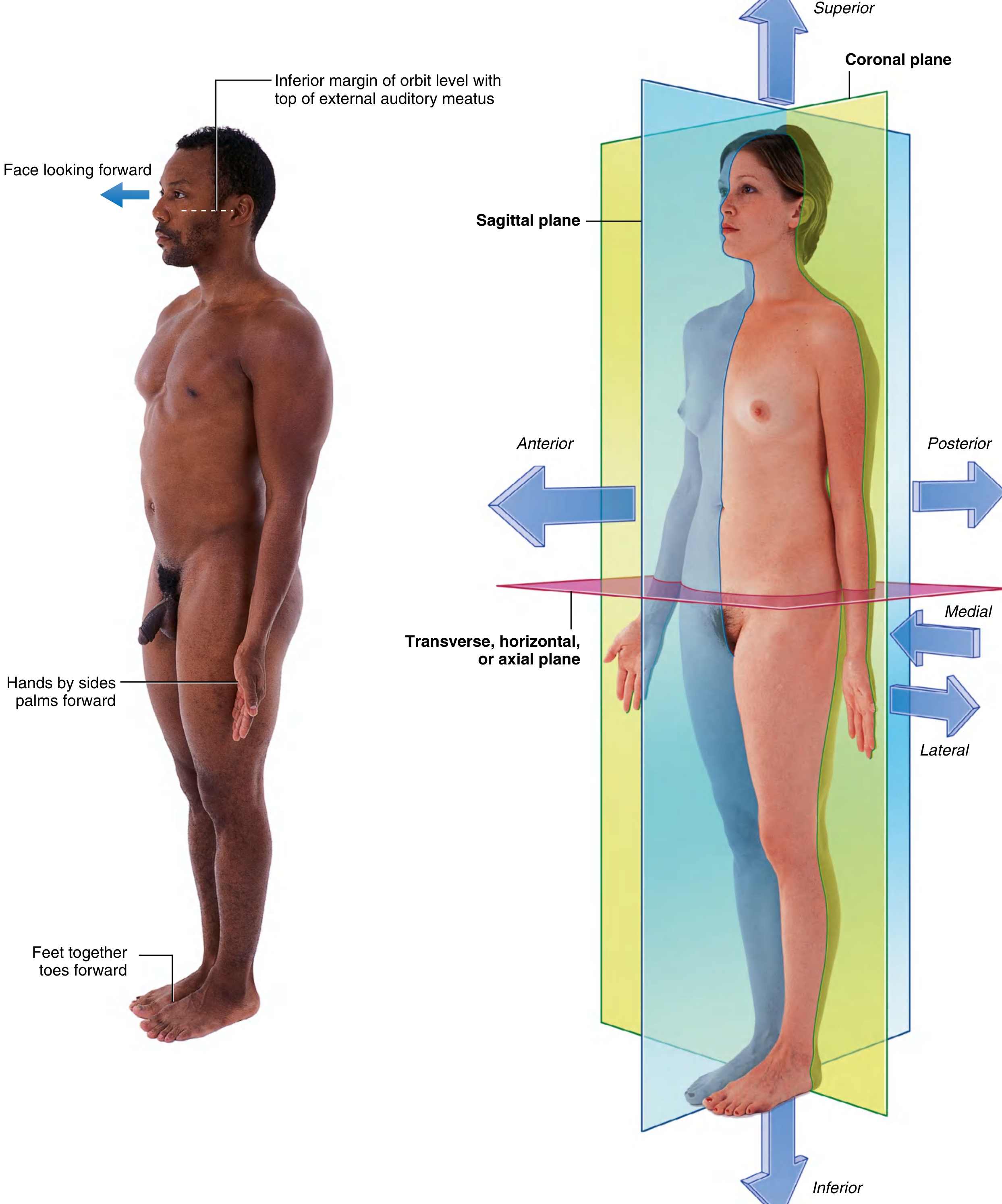
Anatomical Planes
Three major planes divide the body in the anatomical position:
| Plane | Orientation | Divides Body Into |
|---|---|---|
| Coronal (frontal) | Vertical | Anterior and posterior parts |
| Sagittal | Vertical, at right angles to coronal | Right and left parts |
| Median sagittal | Passes through center | Equal right and left halves |
| Transverse (axial/horizontal) | Horizontal | Superior and inferior parts |
Terms to Describe Location
Anterior/Posterior
- Anterior (ventral) = toward the front; Posterior (dorsal) = toward the back
- Example: the nose is anterior to the ears; the vertebral column is posterior to the sternum
Medial/Lateral
- Medial = toward the median sagittal plane; Lateral = toward the sides
- Example: the thumb is lateral to the little finger; the nose is medial to the eyes
Superior/Inferior
- Superior = toward the head; Inferior = toward the feet
- Example: the head is superior to the shoulders; the knee is inferior to the hip
Proximal/Distal
- Proximal = closer to origin/root of limb; Distal = farther from origin
- Example: the hand is distal to the elbow; the glenohumeral joint is proximal to the elbow
Cranial/Caudal/Rostral
- Cranial = toward the head; Caudal = toward the tail
- Rostral = toward the front of the brain (used in neuroanatomy)
Superficial/Deep
- Superficial = toward the surface; Deep = toward the core
- Example: skin is superficial to muscle; bone is deep to muscle
Ipsilateral/Contralateral
- Ipsilateral = on the same side; Contralateral = on the opposite side
Terms of Movement (Range of Motion)
Flexion and Extension
- Flexion = decreasing the angle at a joint (e.g., bending elbow)
- Extension = increasing the angle (straightening); hyperextension = extension beyond anatomical position
Abduction and Adduction
- Abduction = moving away from the median plane
- Adduction = moving toward the median plane
Medial (Internal) and Lateral (External) Rotation
- Rotation of a limb about its long axis toward or away from the midline
Circumduction
- Circular movement combining flexion, extension, abduction, adduction (e.g., shoulder)
Pronation and Supination (forearm)
- Supination = palm faces anteriorly (as in anatomical position)
- Pronation = palm faces posteriorly (rotating radius over ulna)
Eversion and Inversion (foot)
- Eversion = sole faces laterally; Inversion = sole faces medially
Dorsiflexion and Plantarflexion (ankle)
- Dorsiflexion = dorsum of foot moves toward shin (toes up)
- Plantarflexion = foot points downward
Opposition (thumb)
- Moving thumb pad to meet fingertips - unique to the thumb and little finger
Elevation and Depression
- Elevation = superior movement (e.g., shrugging shoulders)
- Depression = inferior movement (e.g., pulling shoulders down)
Protraction and Retraction
- Protraction = anterior movement (e.g., pushing mandible forward)
- Retraction = posterior movement
2. Bones in General
The Skeletal System
The skeleton is divided into two sub-groups:
- Axial skeleton: skull (cranium), vertebral column, ribs, and sternum
- Appendicular skeleton: bones of the upper and lower limbs
Cartilage
Cartilage is an avascular connective tissue with no blood vessels, lymphatics, or nerves - it is nourished by diffusion. Three types:
| Type | Characteristics | Examples |
|---|---|---|
| Hyaline | Most common; moderate collagen | Articular surfaces, costal cartilages |
| Elastic | Collagen + many elastic fibers | External ear, epiglottis |
| Fibrocartilage | Dense collagen, few cells | Intervertebral discs, pubic symphysis |
Functions of cartilage: supports soft tissues, provides smooth gliding surfaces for joints, enables growth of long bones.
Bone - Structure and Function
Bone is a calcified, living, connective tissue consisting of an intercellular calcified matrix containing collagen fibers and several cell types (osteoblasts, osteocytes, osteoclasts).
Functions of bone:
- Structural support for the body
- Protection of vital organs (e.g., skull protects brain, ribs protect lungs)
- Reservoir of calcium and phosphorus
- Levers on which muscles act to produce movement
- Container for blood-producing cells (red bone marrow)
Two structural types:
- Compact (cortical) bone: dense, forms the outer shell of all bones; surrounds spongy bone
- Spongy (trabecular/cancellous) bone: spicules enclosing cavities containing blood-forming marrow
Classification of Bones by Shape
| Type | Description | Examples |
|---|---|---|
| Long bones | Tubular, longer than wide | Humerus, femur, tibia, radius |
| Short bones | Cuboidal | Carpals (wrist), tarsals (ankle) |
| Flat bones | Two compact bone plates separated by spongy bone | Skull, scapula, sternum |
| Irregular bones | Various shapes | Vertebrae, facial bones |
| Sesamoid bones | Round/oval, develop in tendons | Patella (largest), sesamoids in thumb/big toe flexor tendons |
Vascular Supply and Periosteum
- Each bone is supplied by a nutrient artery that enters the internal cavity and supplies the marrow, spongy bone, and inner compact bone layers
- All bones (except articular surfaces) are covered by periosteum - a fibrous connective tissue membrane capable of forming new bone; it is richly innervated with sensory fibers and very sensitive to injury
- Bone deprived of its periosteum will not survive
Ossification (Bone Development)
- Intramembranous ossification: mesenchymal models undergo direct ossification (e.g., flat bones of skull)
- Endochondral ossification: cartilaginous models form from mesenchyme and then ossify (e.g., long bones)
3. Bones of the Upper Limb
The upper limb consists of the shoulder girdle plus the arm, forearm, and hand.
Shoulder Girdle
- Clavicle (collarbone): connects upper limb to axial skeleton via the sternoclavicular joint
- Scapula (shoulder blade): flat, triangular bone on the posterior thoracic wall; provides the glenoid cavity for the glenohumeral (shoulder) joint
Arm (Brachium)
Humerus - single bone of the arm
- Has a head articulating with glenoid cavity (ball-and-socket glenohumeral joint)
- Surgical neck - common fracture site
- Greater and lesser tubercles - muscle attachments
- Shaft marked by the radial groove (carries radial nerve and profunda brachii artery)
- Distal end has: condyle (with capitulum + trochlea), medial and lateral epicondyles, and three fossae (coronoid, radial, olecranon)
- Capitulum articulates with radius; trochlea articulates with ulna
Forearm (Antebrachium)
Two bones - radius (lateral) and ulna (medial):
Radius:
- Head proximally articulates with capitulum of humerus and radial notch of ulna
- Distal end is wider and articulates with carpal bones at the wrist
- Styloid process at the distal lateral end
Ulna:
- Olecranon process (the "point of the elbow") = proximal end
- Trochlear notch articulates with trochlea of humerus (hinge joint)
- Coronoid process below the trochlear notch
- Head at the distal end; styloid process distally
Hand
- 8 Carpal bones (wrist) - arranged in two rows:
- Proximal row: Scaphoid, Lunate, Triquetrum, Pisiform
- Distal row: Trapezium, Trapezoid, Capitate, Hamate
- Mnemonic: "Some Lovers Try Positions That They Can't Handle"
- 5 Metacarpals (palm) - numbered I-V from thumb
- 14 Phalanges (fingers): thumb has 2 (proximal + distal); fingers 2-5 have 3 each (proximal, middle, distal)
4. Bones of the Lower Limb
Pelvic Girdle
Each pelvic (hip) bone is formed by three fused elements:
- Ilium (superior, wing-shaped): forms the iliac crest, anterior superior iliac spine (ASIS), anterior inferior iliac spine (AIIS); articulates with sacrum at sacroiliac joint
- Ischium (posteroinferior): forms the ischial tuberosity (weight-bearing when seated) and ischial spine
- Pubis (anterior): forms the pubic symphysis anteriorly; pubic tubercle is a key landmark
The three bones fuse in the acetabulum (at ages 16-18). The acetabulum articulates with the femoral head to form the hip joint. Below the acetabulum is the obturator foramen.
The bones of the pelvis collectively consist of right and left pelvic bones, the sacrum, and the coccyx.
Thigh
Femur - longest and strongest bone in the body
- Head articulates with acetabulum (ball-and-socket hip joint)
- Neck - connects head to shaft; angle of inclination ~126°; common fracture site in elderly
- Greater and lesser trochanters - muscle attachments (hip abductors and iliopsoas)
- Shaft bowed forward, oblique course - brings knee close to midline under body's center of gravity
- Linea aspera - broad roughened crest on posterior shaft for muscle attachment
- Distal end: medial and lateral condyles articulate with tibia; intercondylar fossa separates condyles posteriorly; adductor tubercle on medial condyle
- Patella - sesamoid bone in the quadriceps tendon; articulates with patellar surface of femur
Leg (Crus)
Two bones - tibia (medial, weight-bearing) and fibula (lateral, non-weight-bearing):
Tibia:
- Medial and lateral condyles proximally articulate with femoral condyles
- Tibial plateau - flat articular surface superiorly
- Tibial tuberosity anteriorly - attachment of patellar ligament (quadriceps insertion)
- Medial malleolus at distal end (forms medial part of ankle mortise)
Fibula:
- Head proximally (just below lateral tibial condyle)
- Lateral malleolus distally (forms lateral part of ankle mortise)
- Non-weight-bearing; mainly for muscle attachment and ankle stability
Foot
- 7 Tarsal bones: Calcaneus (heel), Talus (articulates with tibia/fibula), Navicular, Cuboid, and three Cuneiforms (medial, intermediate, lateral)
- 5 Metatarsals - numbered I-V from medial to lateral
- 14 Phalanges: great toe has 2; toes 2-5 have 3 each
5. Joints
Classification of Joints
Joints (articulations) are sites where two skeletal elements meet. Two general categories:
A. Synovial Joints (bones separated by a cavity)
B. Solid Joints (no cavity; bones held by connective tissue)
Solid Joints
| Type | Connective Tissue | Examples | Movement |
|---|---|---|---|
| Fibrous (syndesmosis) | Dense fibrous tissue | Inferior tibiofibular joint, skull sutures | Little to none |
| Cartilaginous - Primary (synchondrosis) | Hyaline cartilage | Epiphyseal plates, 1st sternocostal joint | None (or slight) |
| Cartilaginous - Secondary (symphysis) | Fibrocartilage | Pubic symphysis, intervertebral discs | Limited |
Synovial Joints - Key Features
Synovial joints are the most common and most mobile joints. Their characteristics:
- Articular cartilage (hyaline) covers the articulating bone surfaces - bones do not contact each other directly
- Joint capsule with two layers:
- Inner synovial membrane: highly vascular, produces synovial fluid for lubrication
- Outer fibrous membrane: dense connective tissue; thickened regions form ligaments
- Articular cavity filled with synovial fluid
- Additional structures may include:
- Articular discs (fibrocartilage): absorb compression, adjust to contour changes, increase range of motion (e.g., menisci of knee, disc of TMJ)
- Fat pads: between synovial membrane and capsule
- Bursae: closed synovial sacs reducing friction between tendons, bones, and skin
- Tendon sheaths: surround tendons, reduce friction
Types of Synovial Joints by Shape and Movement
| Type | Shape | Axes | Movement | Example |
|---|---|---|---|---|
| Plane (gliding) | Flat surfaces | Non-axial | Gliding only | Intercarpal, intertarsal joints |
| Hinge | Convex fits concave | Uniaxial | Flexion/extension only | Elbow (humeroulnar), ankle |
| Pivot | Round process in ring | Uniaxial | Rotation only | Atlantoaxial joint, proximal radioulnar |
| Condylar (ellipsoid) | Oval head in oval socket | Biaxial | Flexion/extension + abduction/adduction | Radiocarpal (wrist), metacarpophalangeal |
| Saddle | Each surface concave + convex | Biaxial | Flexion/extension + abduction/adduction | 1st carpometacarpal (thumb) |
| Ball and socket | Spherical head in cup | Multiaxial | All movements | Glenohumeral (shoulder), hip |
| Bicondylar | Two condyles | Mainly uniaxial | Primarily flexion/extension | Knee, temporomandibular |
6. Vertebral Column
Overview
The vertebral column consists of 33 vertebrae divided into 5 regions:
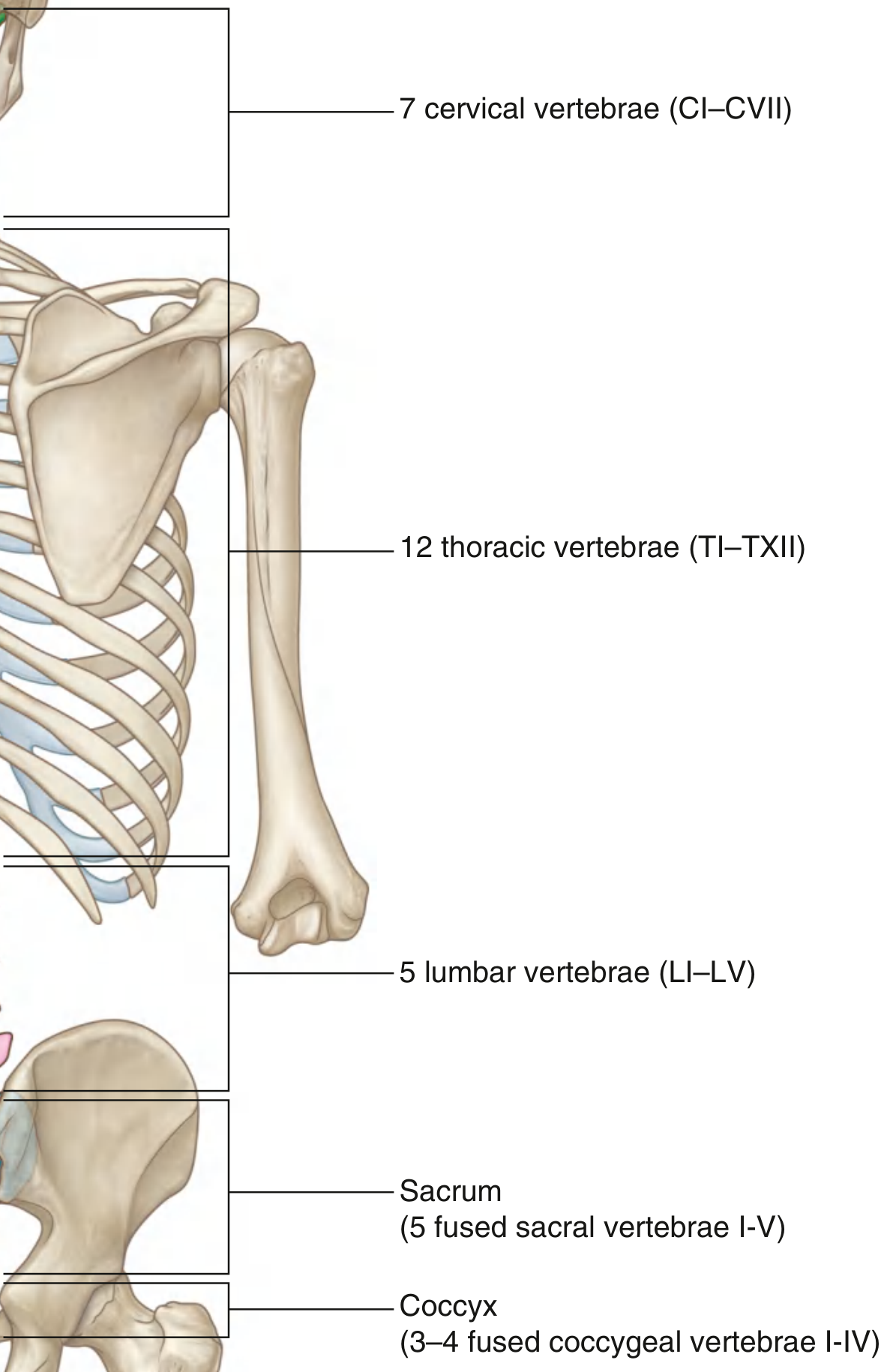
| Region | Count | Characteristics |
|---|---|---|
| Cervical | 7 (CI-CVII) | Small bodies, bifid spinous processes, transverse foramen |
| Thoracic | 12 (TI-TXII) | Costal facets for rib articulation, long downward spinous processes |
| Lumbar | 5 (LI-LV) | Massive bodies, stubby spinous processes, oriented for flexion/extension |
| Sacral | 5 (fused = sacrum) | Wedge-shaped; sacral foramina for nerve rami |
| Coccygeal | 3-4 (often fused = coccyx) | Rudimentary; vestigial tail bones |
Typical Vertebra Structure
A typical vertebra has two main parts:
- Vertebral body (anterior): major weight-bearing component; increases in size from CII to LV; separated from adjacent bodies by intervertebral discs
- Vertebral arch (posterior): attached to body by two pedicles (lateral pillars); roof formed by right and left laminae fusing at midline
The vertebral arch has characteristic projections:
- Spinous process: projects posteriorly/inferiorly from junction of laminae
- Transverse processes: extend laterally from lamina-pedicle junction (bilateral)
- Superior and inferior articular processes: articulate with processes of adjacent vertebrae (form zygapophyseal/facet joints)
The vertebral canal - formed by aligned vertebral arches from CI to SV - contains the spinal cord, its protective membranes, blood vessels, fat, and proximal spinal nerve roots.
Regional Characteristics
Cervical vertebrae (CI-CVII):
- Small bodies; bifid spinous processes; foramen transversarium in each transverse process (transmits vertebral artery and veins)
- CI (Atlas): No body or spinous process; ring-shaped; articulates with occipital condyles (atlanto-occipital joint - nodding "yes")
- CII (Axis): Has the dens (odontoid process) - a tooth-like projection that fits into atlas (pivot joint - rotation "no")
- CVII: Vertebra prominens - most prominent spinous process, used as palpation landmark
Thoracic vertebrae:
- Have costal facets on bodies and transverse processes for rib articulation
- Long spinous processes angled downward
- Relatively limited mobility (ribs restrict movement)
Lumbar vertebrae:
- Massive vertebral bodies (progressively larger LI to LV)
- Short, stocky pedicles; long slender transverse processes; large stubby spinous processes
- Articular processes oriented medially/laterally - promotes flexion and extension
Sacrum:
- Formed by fusion of 5 sacral vertebrae; wedge-shaped (broad superiorly, narrow inferiorly)
- Concave anterior surface with anterior sacral foramina (for anterior rami)
- Convex posterior surface with posterior sacral foramina (for posterior rami)
- Articulates with ilia at sacroiliac joints
Spinal Curvatures
The vertebral column has four curves in the sagittal plane:
- Cervical: secondary curve (concave posteriorly = lordosis) - develops when infant begins to hold head up
- Thoracic: primary curve (concave anteriorly = kyphosis) - retained from fetal position
- Lumbar: secondary curve (concave posteriorly = lordosis) - develops when child begins to walk
- Sacral/Coccygeal: primary curve (concave anteriorly = kyphosis)
Primary curves are present at birth; secondary curves develop postnatally.
7. Skull
Overview
The skull has 22 bones (excluding the 6 ear ossicles). Except for the mandible, all bones are interconnected by sutures (immovable fibrous joints) and together form the cranium.
Division of the Cranium
A. Calvaria (vault)
- Covers the cranial cavity (containing brain)
- Formed mainly by: paired temporal and parietal bones + parts of unpaired frontal, sphenoid, and occipital bones
B. Base of the Cranium (floor)
- Formed by: parts of sphenoid, temporal, and occipital bones
C. Facial skeleton (viscerocranium)
- Paired bones: nasal, palatine, lacrimal, zygomatic, maxillae, inferior nasal conchae
- Unpaired: vomer
D. Mandible (lower jaw)
- Only truly mobile bone of the skull (via temporomandibular joints)
- Not part of the cranium or facial skeleton
Bones of the Skull - Individual Bones
| Bone | Count | Key Features |
|---|---|---|
| Frontal | 1 | Forms forehead, superior orbital rims; superciliary arches; supra-orbital foramen |
| Parietal | 2 | Form the sides and roof of the cranium |
| Temporal | 2 | Houses internal ear; external acoustic meatus; mastoid process; styloid process; zygomatic process |
| Occipital | 1 | Forms the posterior skull base; foramen magnum; occipital condyles (articulate with atlas) |
| Sphenoid | 1 | "Butterfly-shaped" central bone of skull base; greater/lesser wings; sella turcica (houses pituitary) |
| Ethmoid | 1 | Between nasal cavities; cribriform plate (transmits olfactory nerve fibers) |
| Nasal | 2 | Form the bridge of the nose |
| Maxillae | 2 | Form the upper jaw, hard palate, floor of orbits |
| Mandible | 1 | Lower jaw; only movable skull bone; mental foramen |
| Zygomatic | 2 | Cheekbones; forms zygomatic arch with temporal bone |
| Lacrimal | 2 | Smallest facial bones; medial orbital wall; nasolacrimal duct |
| Palatine | 2 | Form posterior hard palate |
| Inferior nasal conchae | 2 | Project into nasal cavity |
| Vomer | 1 | Forms inferior nasal septum |
Sutures
- Coronal suture: between frontal and parietal bones
- Sagittal suture: between right and left parietal bones
- Lambdoid suture: between parietal bones and occipital bone
- Squamous suture: between parietal and temporal bones
Fontanelles
In the fetus and newborn, fontanelles are membranous gaps between skull bones allowing:
-
Head deformation during birth passage
-
Postnatal brain growth
-
Anterior fontanelle (largest): between frontal and parietal bones; closes at ~18 months
-
Posterior fontanelle: between parietal and occipital bones; closes at ~3 months
-
Most fontanelles close during the first year of life
-
Full ossification of sutures begins in the late twenties and is normally complete by the fifth decade
Synovial Joints of the Skull
There are only three pairs of synovial joints in the head:
- Temporomandibular joints (TMJ) - between mandible condyle and temporal bone (largest)
- Incudomalleolar joint - between malleus and incus (middle ear ossicles)
- Incudostapedial joint - between incus and stapes (middle ear ossicles)
Key Foramina of the Skull
| Foramen | Structures Passing Through |
|---|---|
| Foramen magnum | Brainstem/spinal cord junction, vertebral arteries, spinal accessory nerve (CN XI) roots |
| Supra-orbital foramen | Supra-orbital nerve and vessels |
| Infra-orbital foramen | Infra-orbital nerve and vessels |
| Mental foramen | Mental nerve and vessels |
| Foramen ovale | CN V3 (mandibular division of trigeminal) |
| Foramen spinosum | Middle meningeal artery |
| Cribriform plate foramina | CN I (olfactory nerve fibers) |
| Optic canal | CN II (optic nerve), ophthalmic artery |
| Superior orbital fissure | CN III, IV, VI, V1 (ophthalmic) |
| Jugular foramen | CN IX, X, XI; internal jugular vein |
| Hypoglossal canal | CN XII |
| Internal acoustic meatus | CN VII, VIII |
Quick Reference Summary Table
| Topic | Key Points |
|---|---|
| Bone types | Long, short, flat, irregular, sesamoid |
| Bone components | Compact + spongy; periosteum; nutrient artery |
| Joints | Synovial (cavity) vs solid (no cavity) |
| Synovial subtypes | Plane, hinge, pivot, condylar, saddle, ball-and-socket, bicondylar |
| Upper limb bones | Clavicle, scapula, humerus, radius, ulna, 8 carpals, 5 metacarpals, 14 phalanges |
| Lower limb bones | Hip bone (ilium+ischium+pubis), femur, patella, tibia, fibula, 7 tarsals, 5 metatarsals, 14 phalanges |
| Vertebral column | 33 vertebrae: 7C + 12T + 5L + 5S (fused) + 3-4Coc (fused) |
| Skull | 22 bones; calvaria + base + facial skeleton + mandible |
| Anatomical planes | Coronal, sagittal, transverse |
| Directional terms | Anterior/posterior, medial/lateral, superior/inferior, proximal/distal |
All content referenced from: Gray's Anatomy for Students, Gray's Anatomy for Students (ISBN 9780323934237), pp. 17-34 (anatomical terms, skeletal system, joints), pp. 71-75 (vertebral column), pp. 869-875 (upper limb bones), pp. 3172-3200 (lower limb bones), pp. 4639-4963 (skull).
This is a shared conversation. Sign in to Orris to start your own chat.