
Barr body and it's significance and where it presents
Reading File
Now let me search the medical library for Barr body content in parallel.
Finding Sources
Finding Sources
Excellent results. Now let me read the most content-rich sections in parallel.
Reading File
Reading File
Reading File
I have excellent content. Let me also fetch the textbook image and read the genetics/Klinefelter/Turner content in parallel for clinical significance.
Loading Image
Reading File
Reading File
I now have comprehensive, authoritative content from multiple textbooks. Let me also read the Parikh's section on sex determination from hair roots and check for the Triple X syndrome (XXX) Barr body count quickly.
Reading File
Reading File
I have comprehensive information from multiple authoritative textbooks. Here is a detailed, well-organized answer:
Barr Body
Definition and Discovery
A Barr body (also called sex chromatin) is the condensed, inactivated X chromosome visible as a small, darkly staining mass of heterochromatin in the interphase nucleus. It was described by Murray Barr and Ewart Bertram and is formed through the process of lyonization (X-chromosome inactivation).
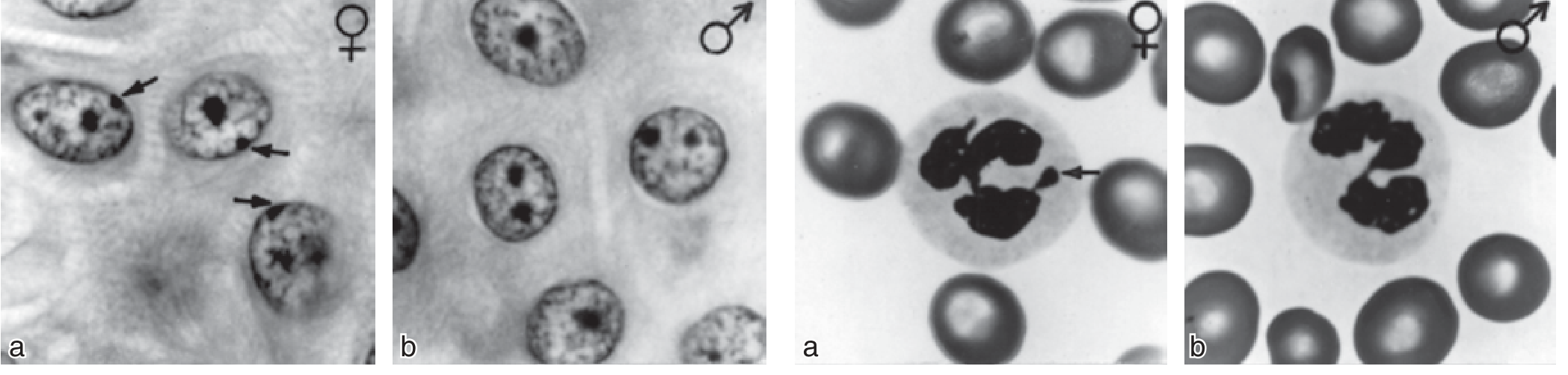
Mechanism: X-Chromosome Inactivation (Lyonization)
- Soon after the blastocyst stage, one X chromosome in each somatic cell of a genetic female is randomly inactivated.
- The choice (maternal vs. paternal X) is random and then permanent - all daughter cells carry the same inactivated X.
- Inactivation is initiated at the X-inactivation center on the chromosome, partly via the transactivating factor CTCF (CCCTC-binding factor).
- The inactivated X condenses into facultative heterochromatin - this is what appears as the Barr body.
- Key rule: Number of Barr bodies = (Number of X chromosomes) - 1
| Karyotype | No. of X chromosomes | No. of Barr bodies |
|---|---|---|
| 46,XY (normal male) | 1 | 0 |
| 46,XX (normal female) | 2 | 1 |
| 45,X (Turner syndrome) | 1 | 0 |
| 47,XXY (Klinefelter) | 2 | 1 |
| 47,XXX (Triple X) | 3 | 2 |
| 48,XXXY | 3 | 2 |
Where It Is Found (Sites of Demonstration)
The Barr body can be identified in any nucleated somatic cell. Clinically used sites include:
1. Buccal Smear (Buccal Mucosa Scraping) - Most Common
- The buccal smear test (Barr body test) is the standard method.
- Barr body appears as a small planoconvex mass, ~1 micron in diameter, lying near/against the nuclear membrane (Dixon and Tarr).
- Females: 20-80% of nuclei contain chromatin bodies.
- Males: Only 0-4% of nuclei show chromatin bodies (considered negative).
2. Polymorphonuclear Leukocytes (Neutrophils) - Davidson Body
- In females, the inactive X forms a small drumstick-shaped nuclear appendage called the Davidson body, seen in 1-15% (Ganong) or ~3% (Essentials of FMT) of neutrophil nuclei.
- Completely absent in males.
3. Peripheral Blood Smear
- Can be assessed from blood samples when buccal smear is unavailable.
4. Hair Root Sheath Cells
- Root sheath cells are particularly useful because they resist putrefaction.
- Both the Barr body and Y chromosome can be demonstrated in hair root cells, making them valuable in decomposed/skeletal forensic samples.
5. Epidermal Cells (Spinous Layer)
- Demonstrated in skin biopsies (as shown in the textbook image above).
6. Amniotic Fluid Cells (Antenatal Sex Determination)
- Used in amniocentesis for fetal sex determination.
Clinical Significance
1. Sex Determination (Nuclear Sexing)
- Presence of a Barr body indicates at least two X chromosomes - suggesting a genetic female (or an XXY male).
- Used in forensic medicine for sex identification from buccal smears, blood stains, or hair in living persons, decomposed remains, and skeletal material.
- Stained with orcein reagent (for Barr body) or quinacrine (for Y body fluorescence in males).
2. Klinefelter Syndrome (47,XXY)
- Barr body is found in 80% of cases (Langman's).
- Clinical features: sterility, testicular atrophy, hyalinization of seminiferous tubules, gynecomastia.
- Incidence ~1 in 500 males; most common cause is nondisjunction of XX homologues.
- More X chromosomes (e.g., 48,XXXY) = more likely cognitive impairment.
3. Turner Syndrome (45,X)
- Barr body absent (chromatin body negative) because only one X is present.
- ~55% of affected females are monosomic 45,X; the absence of Barr body was noted in 1954.
- Clinical features: gonadal dysgenesis, short stature, webbed neck, lymphedema, broad chest with widely spaced nipples.
4. Triple X Syndrome (47,XXX)
- Two Barr bodies present.
- Often undiagnosed due to mild features; affected females may have speech problems and self-esteem issues.
5. Antenatal Sex Determination
- Important for X-linked conditions (hemophilia, Duchenne MD, etc.) where knowing fetal sex guides genetic counseling.
6. Forensic Medicine / Medicolegal Importance
- Sex determination from evidence (crime scene stains, unidentified remains).
- Can be performed on advanced decomposed or skeletal remains using hair root sheath cells.
- Y chromosome can be demonstrated with quinacrine fluorescence (at least 50 positive nuclei required for a positive result).
Y Body (for Comparison)
While the Barr body identifies the inactive X, the Y body (fluorescent body) is used to identify the Y chromosome in males. Stained with quinacrine, it appears as a bright fluorescent spot in interphase nuclei. At least 50 nuclei must show Y bodies to report a positive result.
Sources: Ganong's Review of Medical Physiology (26th ed.), p. 397 | Langman's Medical Embryology, p. 41 | The Essentials of Forensic Medicine and Toxicology (36th ed., 2026), p. 74 | Parikh's Textbook of Medical Jurisprudence, p. 526 | Medical Physiology (Boron & Boulpaep), p. 1574 | Histology: A Text and Atlas
From answer questions in a well presented way under proper headings with conceptual clarity
I'll reformat and present the Barr body answer with full conceptual clarity, proper headings, and structured flow.
Barr Body
1. What Is a Barr Body?
A Barr body is the condensed, transcriptionally inactive X chromosome visible as a small, darkly staining mass of heterochromatin inside the interphase nucleus, typically located at the periphery of the nuclear membrane.
It is also called sex chromatin and was first described by Murray Barr and Ewart Bertram (1949) while studying nerve cells in cats.
Core concept: It is not a separate structure - it is simply one of the X chromosomes that has been permanently switched off and compacted.
2. How Does a Barr Body Form? (Mechanism)
The formation of a Barr body is the result of a process called X-chromosome inactivation, also known as Lyonization (after Mary Lyon who proposed it in 1961).
Steps of Lyonization:
| Step | What Happens |
|---|---|
| Timing | Occurs at the blastocyst stage of embryonic development |
| Selection | Either the maternal or paternal X chromosome is randomly inactivated in each cell |
| Permanence | Once inactivated, it stays inactivated in all daughter cells (clonal) |
| Mechanism | Initiated at the X-inactivation center (XIC) via the XIST gene and the transactivating factor CTCF |
| Result | The inactivated X condenses into facultative heterochromatin - visible as the Barr body |
Why Does This Happen?
The X chromosome carries nearly 10% of the human genome. Females (XX) would have double the dose of X-linked gene products compared to males (XY). Lyonization equalizes gene dosage between sexes - this is called dosage compensation.
Important caveat: Not all genes on the inactivated X are silenced. Genes in the pseudoautosomal regions (PAR) escape inactivation - which is why 45,X (Turner) females are abnormal despite having one active X, because these escaping genes are absent.
3. The Golden Rule: Barr Body Count
$$\boxed{\text{Number of Barr Bodies} = \text{Number of X chromosomes} - 1}$$
| Karyotype | Condition | X chromosomes | Barr Bodies |
|---|---|---|---|
| 46,XY | Normal male | 1 | 0 |
| 46,XX | Normal female | 2 | 1 |
| 45,X | Turner syndrome | 1 | 0 |
| 47,XXY | Klinefelter syndrome | 2 | 1 |
| 47,XXX | Triple X syndrome | 3 | 2 |
| 48,XXXY | Klinefelter variant | 3 | 2 |
| 48,XXXX | Tetrasomy X | 4 | 3 |
Memory trick: However many X chromosomes you have, one always stays active. The rest get inactivated = become Barr bodies.
4. Where Is the Barr Body Found? (Sites of Demonstration)
The Barr body can be identified in any nucleated somatic cell. The key clinical and forensic sites are:
A. Buccal Mucosa Smear - The Standard Test
- Most commonly used site in clinical and forensic practice.
- Barr body appears as a small planoconvex mass (~1 micron in diameter) lying against the inner nuclear membrane (described by Dixon and Tarr).
- Stained with cresyl violet or orcein and examined under high-power microscopy.
| Sex | % of Nuclei Showing Barr Body |
|---|---|
| Female | 20-80% of nuclei |
| Male | 0-4% of nuclei (negative) |
B. Polymorphonuclear Neutrophils - The Davidson Body
- In females, the inactive X forms a drumstick-shaped nuclear appendage attached to the nucleus of neutrophils.
- This is called the Davidson body (or drumstick appendage).
- Seen in ~3% of neutrophil nuclei in females; completely absent in males.
- Identified on a peripheral blood smear.
Distinction: Barr body = in any nucleated somatic cell; Davidson body = specifically in neutrophils.
C. Hair Root Sheath Cells
- Particularly valuable in forensic cases involving putrefied or decomposed remains.
- Hair root sheath cells resist putrefaction and can survive long after death.
- Both the Barr body (X) and Y body (fluorescent Y chromosome) can be demonstrated from a single hair root.
D. Other Sites
| Site | Use |
|---|---|
| Amniotic fluid cells | Antenatal sex determination |
| Epidermal spinous cells | Skin biopsy |
| Blood stains (crime scene) | Forensic sex identification |
| Saliva | Combined with other advanced techniques |
5. Appearance and Staining
| Feature | Detail |
|---|---|
| Shape | Small, planoconvex (flat on one side, convex on the other) |
| Size | ~1 micron in diameter |
| Location | Periphery of nucleus, against the inner nuclear membrane |
| Staining | Cresyl violet, orcein, Feulgen reaction |
| Nature | Facultative heterochromatin (can be either active or inactive depending on cell type) |
6. Clinical Significance
A. Sex Determination (Nuclear Sexing)
- A positive Barr body test (female pattern) = at least two X chromosomes present.
- A negative test = only one X chromosome (male, or Turner syndrome).
- Used clinically to determine chromosomal sex when external sex is ambiguous.
- Used forensically to identify sex from crime scene materials, remains, or decomposed bodies.
B. Klinefelter Syndrome (47,XXY)
- Phenotype: Male (Y chromosome present)
- Barr body: Present (1 Barr body) - found in 80% of cases
- Key features: Sterility, testicular atrophy, hyalinization of seminiferous tubules, gynecomastia
- Incidence: ~1 in 500 males
- Cause: Nondisjunction of XX homologues (most commonly during maternal meiosis)
- More X chromosomes (48,XXXY, 49,XXXXY) = greater likelihood of intellectual disability
C. Turner Syndrome (45,X)
- Phenotype: Female (no Y chromosome)
- Barr body: Absent (chromatin body negative)
- Key features: Gonadal dysgenesis (streak ovaries), short stature, webbed neck, lymphedema, widely spaced nipples, broad chest
- Only monosomy compatible with life; 98% of affected fetuses are spontaneously aborted
- Barr body absence was first noted in 1954; cytogenetic confirmation in 1959
- Cause: Nondisjunction in the paternal gamete in ~80% of monosomic cases
D. Triple X Syndrome (47,XXX)
- Phenotype: Female
- Barr body: 2 Barr bodies
- Often undiagnosed due to mild or absent features
- May present with speech delay, learning difficulties, and self-esteem issues
E. Antenatal Diagnosis
- Barr body status in amniotic fluid cells helps determine fetal sex.
- Critical for counseling in X-linked recessive disorders (hemophilia A/B, Duchenne muscular dystrophy, etc.) where affected offspring are predominantly male.
F. Forensic Medicine (Medicolegal Importance)
- Sex determination from evidence at crime scenes - blood stains, hair, saliva, buccal smear.
- Applicable to living persons, decomposed bodies, and skeletal remains.
- Combined with Y body demonstration (quinacrine fluorescence): At least 50 Y-positive nuclei are required to report a positive male result.
- Hair root sheath cells provide sex chromatin evidence even after significant decomposition.
7. Y Body - The Male Counterpart
While the Barr body identifies inactive X chromosomes, the Y body identifies the Y chromosome in males:
| Feature | Barr Body (X chromatin) | Y Body (Y chromatin) |
|---|---|---|
| What it is | Inactive X chromosome | Y chromosome |
| Stain | Orcein / cresyl violet | Quinacrine (fluorescent) |
| Present in | Females (and XXY) | Males |
| Location | Near nuclear membrane | Interphase nucleus |
| Forensic cutoff | 20% nuclei positive = female | 50 Y-positive nuclei = male |
8. Summary Concept Map
X-chromosome inactivation (Lyonization)
            ↓
  One X stays ACTIVE → gene expression
  Other X(s) INACTIVATED → condense
            ↓
     Forms BARR BODY
  (facultative heterochromatin)
            ↓
  Visible at nuclear periphery in interphase
            ↓
  No. of Barr bodies = (No. of X) - 1
            ↓
  Clinical use:
  ├── Normal female → 1 Barr body
  ├── Klinefelter (XXY) → 1 Barr body (present in a male!)
  ├── Turner (45,X) → 0 Barr bodies
  └── Triple X (XXX) → 2 Barr bodies
Sources: Ganong's Review of Medical Physiology (26th ed.) | Langman's Medical Embryology | The Essentials of Forensic Medicine and Toxicology (36th ed., 2026) | Parikh's Textbook of Medical Jurisprudence | Medical Physiology (Boron & Boulpaep) | Histology: A Text and Atlas (Pawlina)
This is a shared conversation. Sign in to Orris to start your own chat.