
DAS difficult airway management
Reading File
The DAS (Difficult Airway Society) guidelines provide structured algorithms for managing anticipated and unanticipated difficult airways. Let me search the medical library and current guidelines in parallel.
Searching sources...
Finding Sources
Finding Sources
Searching the Web
DAS difficult airway society guidelines 2023 2024 algorithm
Now let me read the key textbook sections and extract the latest DAS 2025 guideline details in parallel:
Reading File
Reading File
Reading Web Page
https://das.uk.com/guidelines/das_intubation_guidelines
Now let me get the detailed textbook content on the specific DAS algorithm steps and the Morgan & Mikhail content on difficult airway management:
Reading File
Finding Sources
Finding Sources
Now let me read the core DAS algorithm section from Morgan & Mikhail and fetch the algorithm image:
Reading File
Finding Sources
Let me read the rest of the DAS algorithm section and fetch the key algorithm images:
Reading File
Loading Image
I now have the full DAS algorithm image and comprehensive textbook content. Let me also fetch the Plan C/D detail image and check the 2025 updates:
Loading Image
Searching PubMed
difficult airway management DAS guidelines unanticipated intubation
Reading Article
PMID: 41203471
I now have comprehensive information from the textbooks, algorithm images, and the 2025 DAS guidelines. Here is the full response:
DAS Difficult Airway Management
The Difficult Airway Society (DAS) guidelines are the de facto standard for managing patients with difficult airways in the UK and internationally. The most recent version is the DAS 2025 guidelines (Ahmad et al., Br J Anaesth 2026, PMID 41203471), produced after a 3-year process involving a systematic review of 1,241 papers and a three-round Delphi consensus across 65 meetings. The core framework - a linear four-plan algorithm - is preserved from the 2015 version with significant additions.
1. Core Concept: Linear Four-Plan Algorithm
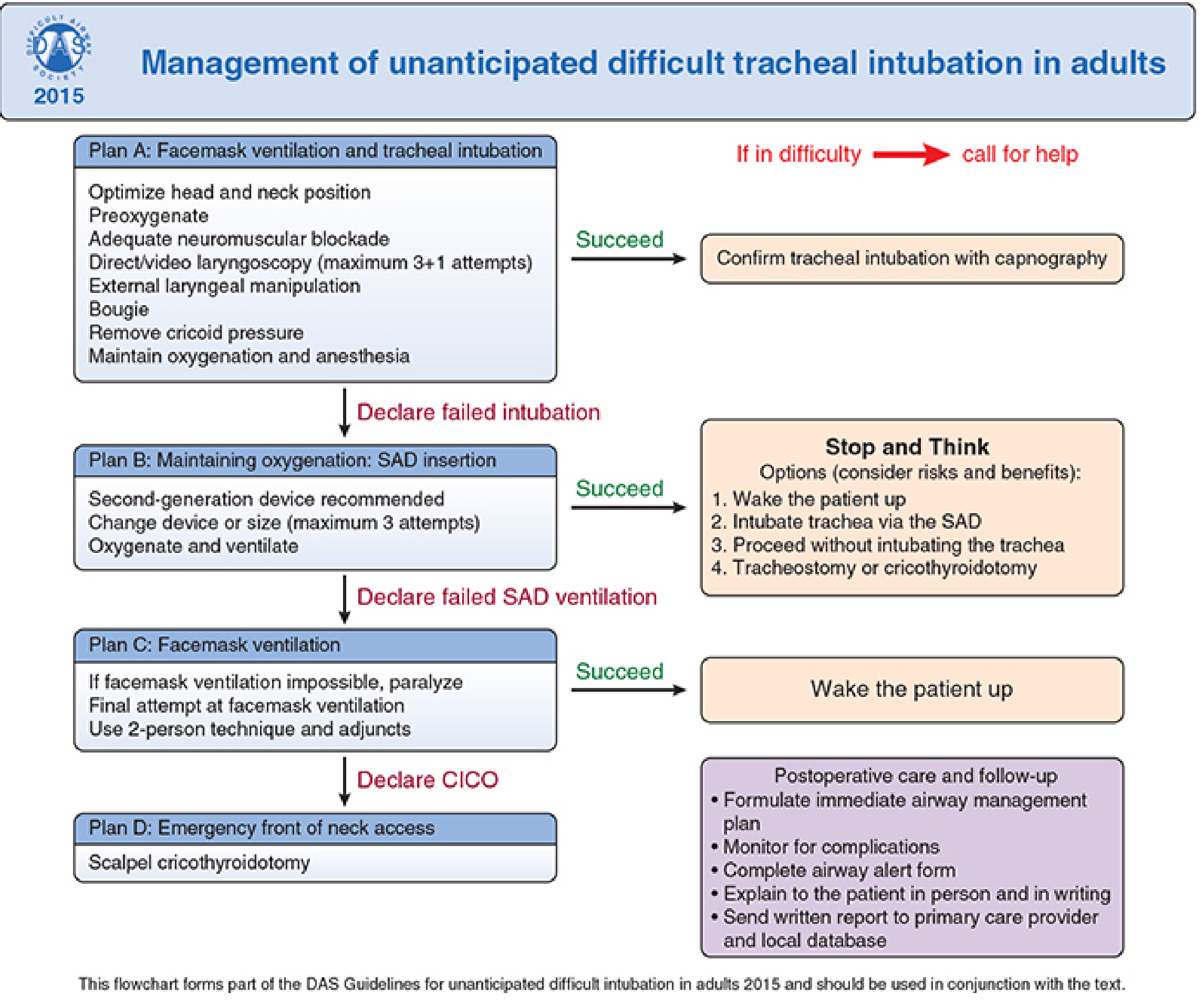
The DAS approach prevents repetition of failed techniques by progressing through four plans, always with the unifying principle: maintain oxygenation at every step.
2. The Four Plans
Plan A - Facemask Ventilation and Tracheal Intubation
- Optimize head and neck position (ramped position in obese patients)
- Pre-oxygenate (target EtO₂ >87%)
- Ensure adequate neuromuscular blockade
- Direct laryngoscopy or video laryngoscopy - maximum 3 + 1 attempts (the "+1" is by a senior colleague using a different technique)
- Use adjuncts: bougie, external laryngeal manipulation (BURP/bimanual)
- Remove cricoid pressure if it impedes view
- Maintain oxygenation and anaesthesia throughout
- Confirm successful intubation with waveform capnography
If Plan A fails: Declare failed intubation - Call for help - Move to Plan B
Plan B - Maintaining Oxygenation: SAD (Supraglottic Airway Device) Insertion
- Second-generation SAD recommended (e.g., ProSeal LMA, LMA Supreme, i-gel) - provides a better seal and allows gastric venting
- Change device or size if needed - maximum 3 attempts
- Oxygenate and ventilate
If SAD insertion succeeds → "Stop and Think" decision point:
- Wake the patient up (safest if surgery not immediately life-saving)
- Intubate the trachea via the SAD (fiberoptic-guided)
- Proceed with surgery using SAD alone (if appropriate)
- Tracheostomy or cricothyroidotomy (if needed urgently)
If SAD fails → Declare failed SAD ventilation - Move to Plan C
Plan C - Facemask Ventilation
- If facemask ventilation was previously impossible: consider paralysis (succinylcholine or rocuronium) if not already done
- Final attempt at two-handed facemask ventilation using adjuncts (oropharyngeal/nasopharyngeal airways, two-person technique)
- Use 2-person technique and all adjuncts
If facemask ventilation succeeds → Wake the patient up
If facemask ventilation fails → Declare CICO (Can't Intubate, Can't Oxygenate) → Move to Plan D
Plan D - Emergency Front-of-Neck Access (eFONA)
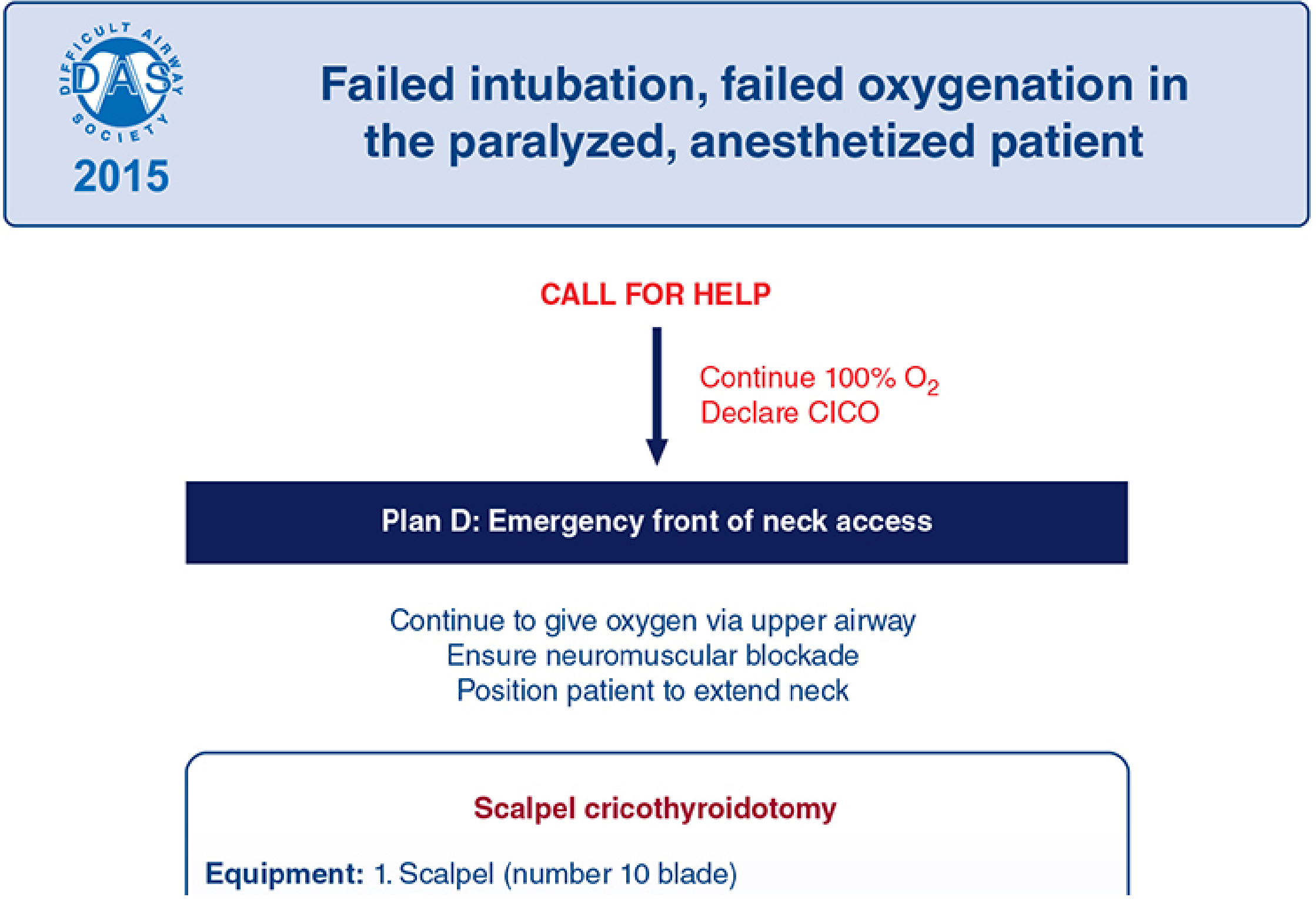
This is a surgical emergency - no further delay is acceptable.
Preparation:
- Continue 100% O₂ via upper airway
- Ensure neuromuscular blockade
- Extend the neck
DAS recommends: Scalpel Cricothyroidotomy
Equipment: No. 10 scalpel blade, bougie, cuffed 6.0 mm ETT
Steps - Palpable CTM:
- "Laryngeal handshake" to identify cricothyroid membrane (CTM)
- Transverse stab incision through the CTM
- Turn blade 90° (sharp edge caudally)
- Slide coudé tip of bougie along blade into trachea
- Railroad lubricated 6.0 mm cuffed tube into trachea
- Ventilate, inflate cuff, confirm with capnography
- Secure tube
Impalpable CTM (obese, distorted neck):
- Make 8-10 cm vertical skin incision (caudad to cephalad)
- Blunt dissection to separate tissues
- Identify and stabilize larynx
- Then proceed as above
Note: Needle/cannula cricothyroidotomy is no longer the DAS first-line technique due to high failure rates - scalpel-bougie-tube is preferred.
3. Key Principles in the 2025 Update
The 2025 DAS guidelines (PMID 41203471) introduced 65 recommendations, including new domains not covered in 2015:
| Domain | Key Points |
|---|---|
| Airway assessment | Multimodal prediction tools; ultrasound of CTM pre-op |
| Pre-oxygenation | High-flow nasal oxygen (HFNO) during apnoeic period; target EtO₂ >87% |
| Rapid Sequence Induction (RSI) | Maintain cricoid pressure during Plan A; remove if impedes laryngoscopy |
| Physiologically difficult airway | Hypoxic/haemodynamically unstable patients need pre-optimisation before induction |
| Obesity | Ramped/HELP position; HFNO mandatory during apnoeic phase; early second-generation SAD consideration |
| Waveform capnography | Mandatory for confirmation of tracheal tube placement AND ongoing ventilation |
| Human factors | Closed-loop communication; pre-briefing; cognitive aids; leadership roles clearly assigned |
| POCUS | Point-of-care ultrasound to identify CTM pre-operatively in all predicted difficult airways |
| Documentation | Airway alert form, written report to patient and GP, database entry |
| Education | Simulation training; multidisciplinary team training |
4. Anticipated Difficult Airway
When difficulty is anticipated (e.g., Mallampati III-IV, limited mouth opening <3 finger-breadths, thyromental distance <6 cm, short neck, history of difficult airway, infectious/structural pathology), the algorithm changes:
Awake Tracheal Intubation (ATI) is the gold standard (DAS 2019 ATI guidelines):
- Preferred: flexible bronchoscopic intubation (awake fiberoptic) OR awake video laryngoscopy
- Topicalisation with lidocaine ± dexmedetomidine/remifentanil sedation
- Preserves spontaneous ventilation throughout
Key conditions mandating awake technique:
- Submandibular/peritonsillar abscess displacing airway
- Pierre Robin syndrome, Treacher Collins syndrome
- Significant neck pathology (hematoma, radiation changes)
- Morbid obesity with predicted impossible mask ventilation
- Ankylosing spondylitis, rheumatoid arthritis with limited neck extension
(Morgan & Mikhail's Clinical Anesthesiology, 7e, p. 629-630)
5. Post-Intubation/Airway Event Care
Whether the difficult airway was anticipated or unanticipated, the DAS requires structured follow-up:
- Postpone non-urgent surgery
- Urgent surgical review of cricothyroidotomy site (if performed)
- Formulate immediate airway management plan for extubation
- Complete Airway Alert Form - filed in patient records
- Explain to the patient in person and in writing what happened
- Send written report to primary care provider
- Submit to local/national database (NAP4/DARA)
6. Other DAS Guidelines (Full Suite)
| Guideline | Year |
|---|---|
| Management of unanticipated difficult intubation (adults) | 2025 |
| Awake tracheal intubation (adults) | 2019 |
| Management of tracheal intubation in critically ill adults (ICU) | 2017 |
| Difficult and failed intubation in obstetrics (OAA/DAS) | 2015 |
| Paediatric difficult airway (APA/DAS) | 2015 |
| Tracheal extubation guidelines | 2012 (revision pending) |
| Post-thyroid surgery haematoma (DAS/BAETS/ENT UK) | 2021 |
| Airway management in cervical spine injury (DAS/AoA/ICS/RCEM) | 2024 |
Quick Reference: Key Numbers
| Parameter | Threshold |
|---|---|
| Plan A intubation attempts | Maximum 3 + 1 (different operator/technique) |
| Plan B SAD attempts | Maximum 3 |
| Thyromental distance (difficult airway predictor) | <6 cm (or <3 finger-breadths) |
| Sternomental distance (with neck extended, mouth closed) | <12.5 cm |
| Neck extension (limited) | <35° |
| Hyomental distance | <7 cm |
| ETT size for cricothyroidotomy | Cuffed 6.0 mm ID |
| Scalpel blade for cricothyroidotomy | No. 10 |
| Vertical skin incision (impalpable CTM) | 8-10 cm |
(Morgan & Mikhail's Clinical Anesthesiology, 7e; Scott-Brown's Otorhinolaryngology; DAS 2025 Guidelines)
The 2025 DAS guidelines represent a shift from managing failure to maximising first-attempt success - emphasising thorough assessment, pre-oxygenation, human factors, and POCUS identification of the CTM before any airway crisis occurs.
This is a shared conversation. Sign in to Orris to start your own chat.