
I have my university exam of 1 st year of subject biochemistry These are the important long answer give me answer of this question"Cori cycle" and remeber it's a university examination
Reading File
Now let me search the medical library for comprehensive Cori cycle content.
Finding Sources
Finding Sources
Excellent! Multiple sources found. Let me now read the most relevant biochemistry textbook sections in parallel.
Reading File
Reading File
Reading File
Now let me fetch the Cori cycle diagram image and get more detailed content from Basic Medical Biochemistry.
Loading Image
Reading File
Reading File
Let me also fetch the Cori cycle diagram from Basic Medical Biochemistry and get more content on energy balance and significance.
Loading Image
Loading Image
Reading File
I now have all the material needed - three diagrams and comprehensive textbook content. Let me compose a thorough university-level long answer.
The Cori Cycle
Introduction
The Cori cycle (also called the lactic acid cycle) is a metabolic pathway that describes the cycling of glucose and lactate between peripheral tissues (mainly skeletal muscle and red blood cells) and the liver. It was first described by Carl Ferdinand Cori and Gerty Cori in 1929, for which they were awarded the Nobel Prize in Physiology or Medicine in 1947.
In simple terms: peripheral tissues convert glucose to lactate via anaerobic glycolysis; this lactate is transported to the liver, which converts it back to glucose via gluconeogenesis; that glucose is then released into the blood and re-used by peripheral tissues - completing the cycle.
Historical Background
The cycle was discovered by Carl and Gerty Cori while studying carbohydrate metabolism. They demonstrated that lactate produced in muscles during exercise could serve as a gluconeogenic precursor in the liver, thus preventing lactate accumulation and maintaining blood glucose levels. The cycle bears their name in recognition of this discovery.
Tissues Involved
| Tissue | Role |
|---|---|
| Skeletal muscle | Anaerobic glycolysis → lactate production |
| Red blood cells (RBCs) | No mitochondria → obligate anaerobic glycolysis → lactate |
| Renal medulla, lens of eye, skin | Additional lactate-producing tissues |
| Liver (and renal cortex) | Takes up lactate → converts to glucose via gluconeogenesis |
| Blood | Transport medium for glucose and lactate between tissues |
Diagram
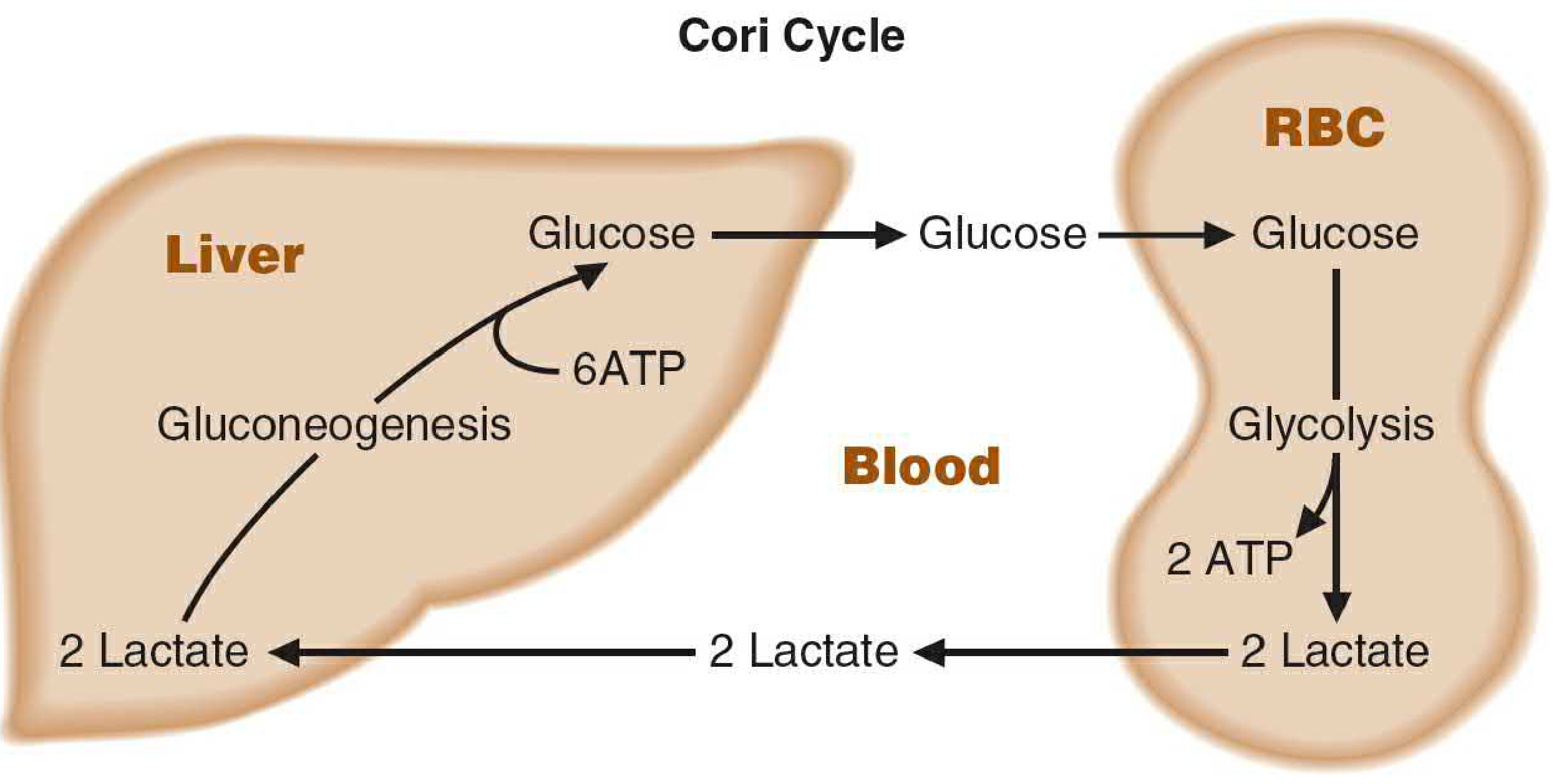
The Cori cycle: Glucose produced in the liver by gluconeogenesis is converted to lactate by glycolysis in RBCs and muscle. Lactate returns to the liver and is reconverted to glucose. (Basic Medical Biochemistry, 6e, Fig. 22.12)
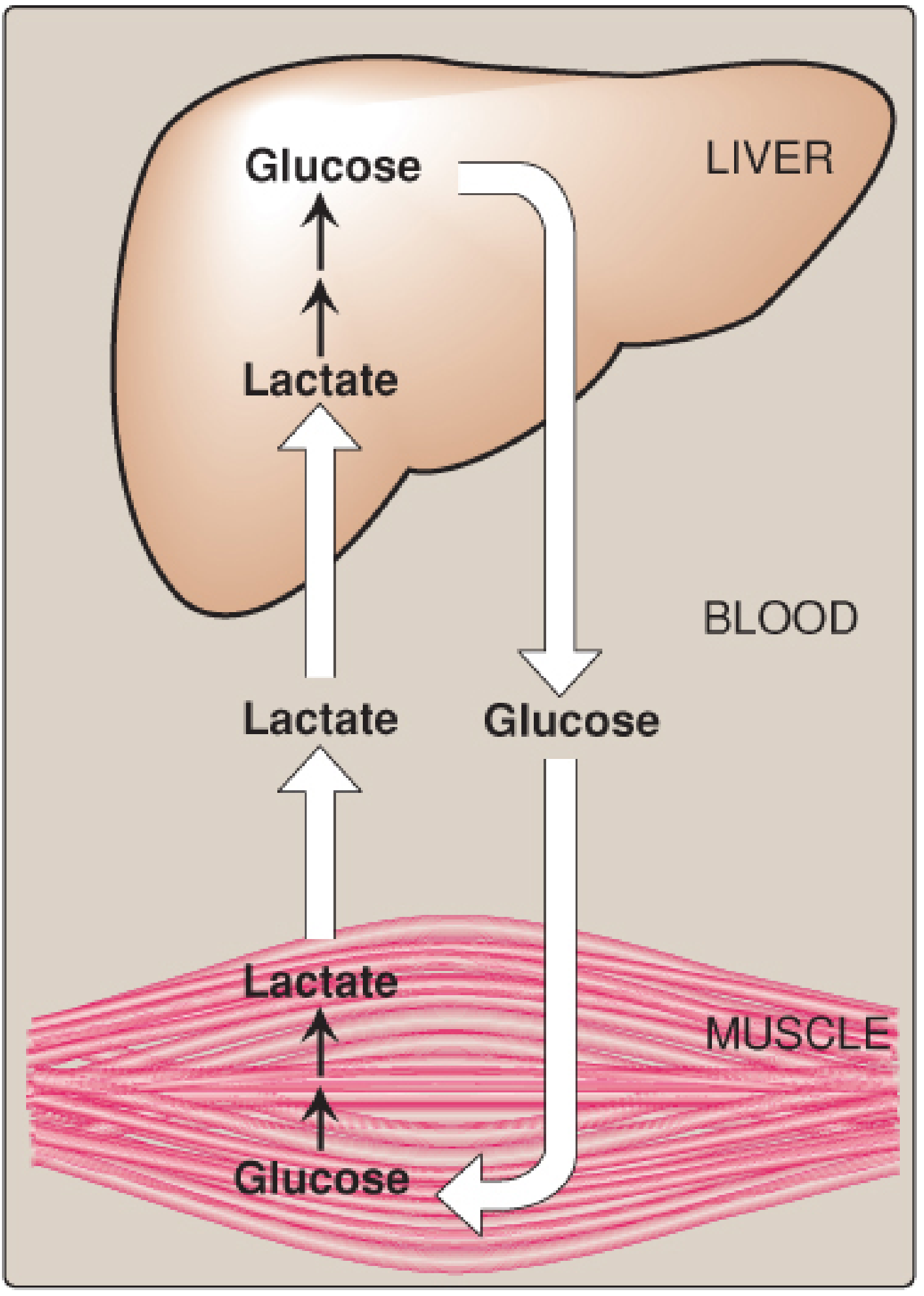
The intertissue Cori cycle linking gluconeogenesis (liver) with glycolysis (muscle). (Lippincott Biochemistry, 8e, Fig. 10.2)
Steps of the Cori Cycle
Part 1: In Peripheral Tissues (Skeletal Muscle / RBCs)
-
Glucose uptake from the blood into skeletal muscle or RBCs.
-
Glycolysis: Glucose (6C) is broken down to 2 molecules of pyruvate (3C each), yielding 2 ATP net.
-
Under anaerobic conditions (e.g., during intense exercise or in RBCs which lack mitochondria), NADH accumulates and cannot be re-oxidized by the mitochondrial electron transport chain.
-
Lactate dehydrogenase (LDH) reduces pyruvate to lactate, using NADH and regenerating NAD+:Pyruvate + NADH + H⁺ → Lactate + NAD⁺
-
The regenerated NAD⁺ allows glycolysis to continue, providing ATP for energy.
-
Lactate (and H⁺) is exported into the blood via monocarboxylate transporters (MCTs) on the plasma membrane.
Part 2: Transport in Blood
- Lactate travels via the bloodstream to the liver (and to a lesser extent, the renal cortex).
Part 3: In the Liver (Gluconeogenesis)
-
Lactate is taken up by hepatocytes.
-
LDH in the liver (which operates in the reverse direction due to the lower NADH/NAD⁺ ratio and high oxidative capacity of liver cells) converts lactate back to pyruvate:Lactate + NAD⁺ → Pyruvate + NADH + H⁺
-
Pyruvate enters gluconeogenesis. Since the direct reversal of the pyruvate kinase step (pyruvate → phosphoenolpyruvate, PEP) is irreversible, the liver uses two special bypass reactions:
- Pyruvate carboxylase (in mitochondria, requires biotin and ATP): Pyruvate + CO₂ + ATP → Oxaloacetate (OAA)
- PEPCK (phosphoenolpyruvate carboxykinase): OAA + GTP → PEP + CO₂ + GDP
-
PEP proceeds through 7 reversible glycolytic reactions (in the reverse direction) to ultimately form glucose-6-phosphate (G6P).
-
Glucose-6-phosphatase (found only in liver and kidney) removes the phosphate group: G6P → Glucose + Pi (free glucose is released into the blood).
-
This free glucose is exported into the blood for uptake by peripheral tissues, completing the cycle.
Energy Balance of the Cori Cycle
This is one of the most important points examiners ask about:
| Location | ATP Produced/Consumed | Reaction |
|---|---|---|
| Peripheral tissue (glycolysis) | +2 ATP produced | Glucose → 2 Lactate |
| Liver (gluconeogenesis) | -6 ATP consumed | 2 Lactate → Glucose |
| Net energy cost of cycle | -4 ATP (net expenditure) | Per glucose molecule |
The liver consumes 6 ATP to regenerate one glucose molecule, while the peripheral tissue only gains 2 ATP from that glucose. This means the Cori cycle is energetically expensive for the organism as a whole. The liver uses aerobic oxidation of fatty acids and other substrates to generate the ATP needed to power gluconeogenesis.
This net energy "debt" is ultimately paid by the liver using oxidative metabolism (fatty acid oxidation, TCA cycle, and oxidative phosphorylation) - processes that require oxygen.
Mechanism: How the Direction of LDH is Determined
Lactate dehydrogenase (LDH) catalyzes a reversible reaction. The direction of flux depends on the NADH/NAD⁺ ratio:
- In exercising muscle / RBCs: High NADH → equilibrium favors lactate production (pyruvate → lactate)
- In liver: Low NADH, high oxidative capacity → equilibrium favors pyruvate production (lactate → pyruvate)
Diagram: Pyruvate Metabolism and the Cori Cycle
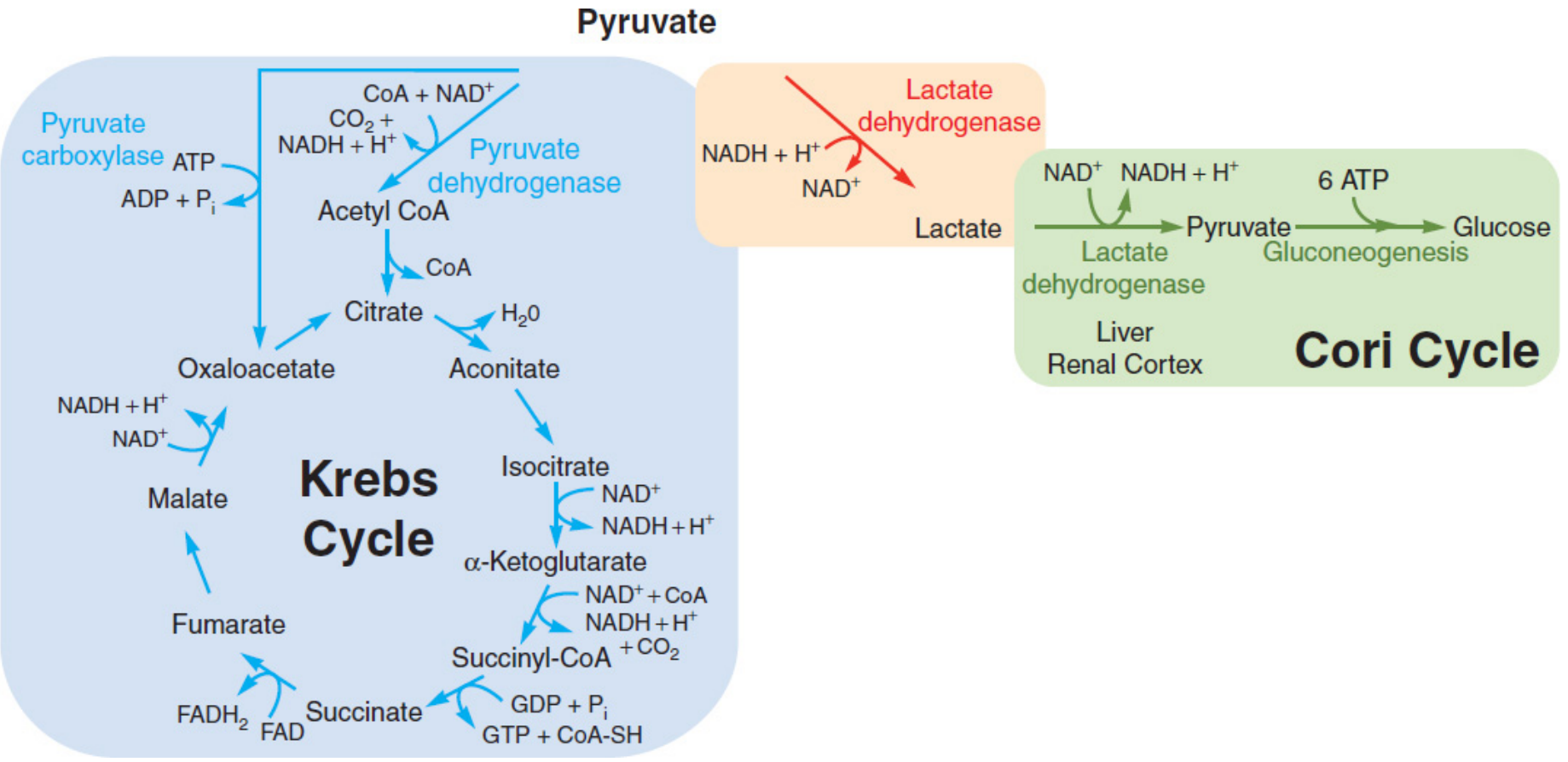
During hypoxic conditions, pyruvate is reduced to lactate by LDH. In the liver, this lactate is converted back to pyruvate and then to glucose by gluconeogenesis (Cori Cycle). (Mulholland & Greenfield's Surgery, 7e, Fig. 2.3)
Physiological Significance
-
Prevents lactic acidosis during exercise: Without the Cori cycle, lactate would accumulate in the blood, causing a dangerous drop in pH (lactic acidosis). The liver continuously removes lactate and prevents this.
-
Sustains anaerobic energy supply: By converting lactate back to glucose and returning it to muscle, the Cori cycle allows tissues that rely on anaerobic glycolysis to continue generating ATP even when oxygen is limited.
-
Maintains blood glucose levels: During fasting, exercise, or stress, the Cori cycle is a major mechanism by which the liver produces glucose (via gluconeogenesis) to maintain euglycemia.
-
Recycling of carbon skeletons: Lactate produced in peripheral tissues is not wasted - it is recycled back into glucose by the liver, conserving carbon.
-
Supports obligate glycolytic tissues: Red blood cells (no mitochondria), lens and cornea of the eye, renal medulla, white blood cells, and skin - all rely heavily on anaerobic glycolysis and contribute lactate to the Cori cycle.
-
Role during fasting: In the first few hours of a fast, the brain consumes glucose at 4-5 g/hr. Obligate anaerobic tissues also metabolize glucose but convert it primarily to lactate and pyruvate. The liver takes up these products and uses gluconeogenesis to regenerate glucose, thus completing the Cori cycle and maintaining brain fuel supply (Medical Physiology, Boron & Boulpaep, p. 1394).
The Glucose-Alanine Cycle (Related Concept)
Often discussed alongside the Cori cycle, the glucose-alanine cycle involves:
- In muscle: Pyruvate receives an amino group (from transamination) → Alanine is formed and exported to the liver.
- In liver: Alanine is transaminated back to pyruvate → enters gluconeogenesis → glucose is formed and released.
- This cycle also transfers amino groups (as urea precursors) from muscle to liver.
Both the Cori cycle and the glucose-alanine cycle are examples of intertissue metabolic cooperation - different organs working together to maintain metabolic homeostasis.
Clinical Relevance
| Condition | Relation to Cori Cycle |
|---|---|
| Lactic acidosis | Overwhelmed Cori cycle; lactate accumulates faster than liver can clear it (e.g., severe hypoxia, metformin toxicity) |
| Liver failure (cirrhosis) | Impaired gluconeogenesis → reduced lactate clearance; but baseline lactate remains normal unless very severe |
| Vigorous exercise | Cori cycle is maximally activated; liver gluconeogenesis rate increases greatly |
| Type 1 glycogen storage disease (Von Gierke's) | G6Pase deficiency → liver cannot release free glucose from G6P → hypoglycemia and lactic acidosis |
| Cancer (Warburg effect) | Tumor cells exhibit aerobic glycolysis, producing excess lactate even in the presence of oxygen; Cori cycle is used to supply glucose to tumors |
Summary
| Step | Location | Reaction |
|---|---|---|
| 1 | Muscle/RBC | Glucose → 2 Pyruvate (glycolysis, +2 ATP) |
| 2 | Muscle/RBC | Pyruvate + NADH → Lactate + NAD⁺ (LDH) |
| 3 | Blood | Lactate transported to liver |
| 4 | Liver | Lactate + NAD⁺ → Pyruvate + NADH (LDH) |
| 5 | Liver | Pyruvate → OAA (pyruvate carboxylase) → PEP (PEPCK) → Glucose (gluconeogenesis, -6 ATP) |
| 6 | Blood | Glucose transported back to muscle/RBC |
Net cost: 4 ATP per cycle (paid by liver's oxidative metabolism)
Key Points to Remember for Exams
- Named after Carl and Gerty Cori (Nobel Prize 1947)
- Links anaerobic glycolysis (peripheral tissues) with hepatic gluconeogenesis
- Key tissues: skeletal muscle, RBCs (lactate producers) ↔ liver, renal cortex (lactate consumers)
- Key enzyme in both directions: Lactate Dehydrogenase (LDH)
- Energy balance: peripheral tissue gains 2 ATP; liver spends 6 ATP → net cost of 4 ATP per glucose recycled
- Prevents lactic acidosis and maintains blood glucose homeostasis
- Glucose-alanine cycle is the analogous cycle involving amino acid nitrogen transfer
Sources: Lippincott Illustrated Reviews Biochemistry 8th Ed; Basic Medical Biochemistry: A Clinical Approach 6e; Medical Physiology (Boron & Boulpaep); Mulholland & Greenfield's Surgery 7e
This is a shared conversation. Sign in to Orris to start your own chat.