
Create an image of, uh, illustrative for a path of hernia, inguinal, uh, hernia, and describing different types of hernia from that image. And it should be, uh, made in a way that I can easily replicate that in exam, so it should be a handwritten infographic.
Handwritten-style medical infographic on inguinal hernia types, suitable for exam revision. Hand-drawn anatomy diagram showing the inguinal canal region with labeled structures (inguinal ligament, deep inguinal ring, superficial inguinal ring, Hesselbach's triangle, inferior epigastric vessels, rectus abdominis). Three main hernia types illustrated with hand-drawn arrows and sketches: 1) Indirect inguinal hernia - path goes through deep inguinal ring, along inguinal canal, out through superficial ring, possibly into scrotum; note "lateral to inferior epigastric vessels", congenital/patent processus vaginalis. 2) Direct inguinal hernia - bulges straight through Hesselbach's triangle (medial to inferior epigastric vessels), acquired/weakness in posterior wall. 3) Femoral hernia - passes through femoral canal, below inguinal ligament, medial to femoral vein. Handwritten bullet-point notes beside each type: mnemonic "MDs Don't Lie" (Medial=Direct, Lateral=Indirect). Color-coded in pen/pencil style with blue, red, and green ink. Rough sketchy hand-drawn style as if written in a student notebook, with clear labels, arrows, and a small comparison table at the bottom comparing all three types. Title at top: "Inguinal Hernia - Types & Paths"
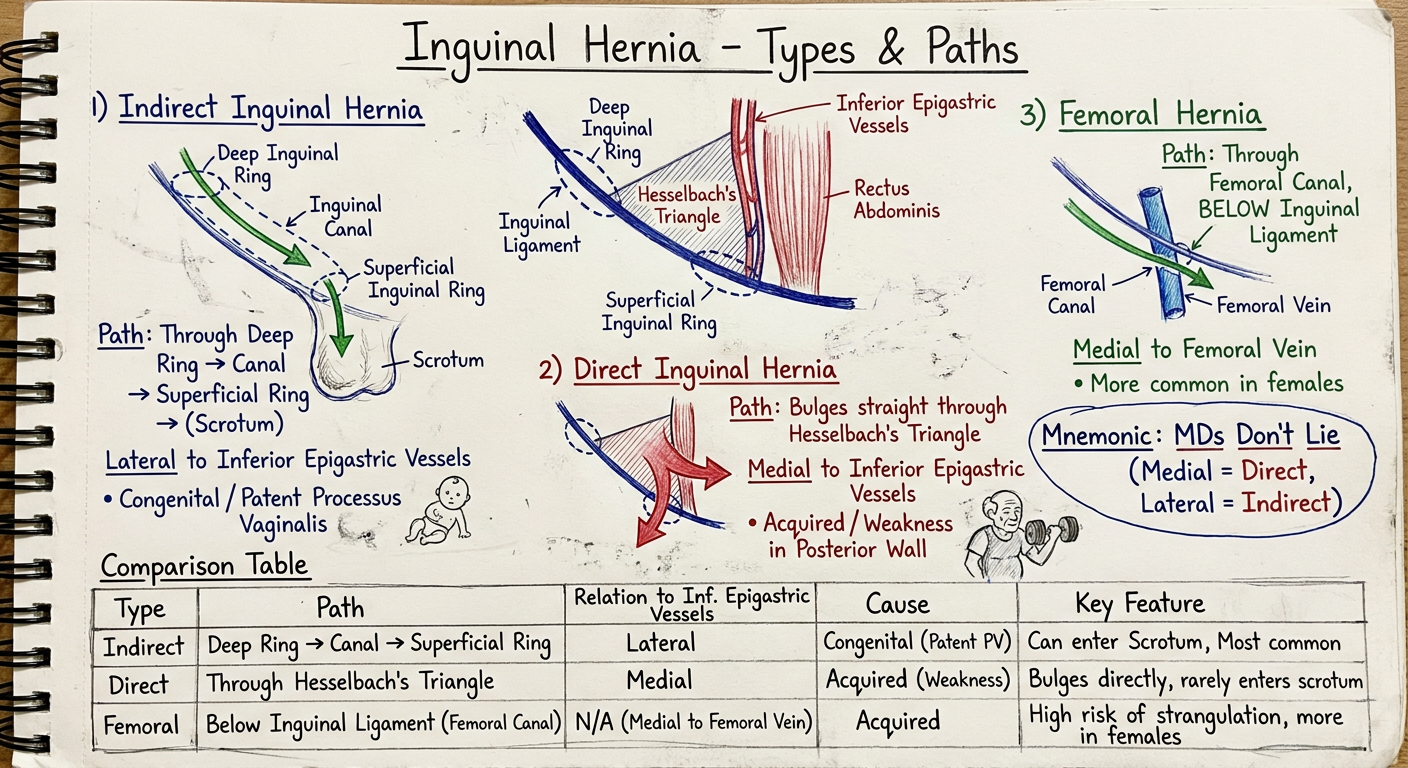
| Type | Path | Key Landmark | Notes |
|---|---|---|---|
| Indirect inguinal | Through deep ring → along canal → out superficial ring → possibly scrotum | Lateral to inferior epigastric vessels | Most common; congenital (patent processus vaginalis) |
| Direct inguinal | Straight through Hesselbach's triangle | Medial to inferior epigastric vessels | Acquired; weakness in posterior wall (transversalis fascia) |
| Femoral | Through femoral canal, below inguinal ligament | Medial to femoral vein | More common in women; high risk of strangulation |
- "MDs Don't Lie" - Medial = Direct, Lateral = Indirect (relative to inferior epigastric vessels)
- Hesselbach's triangle boundaries: Inferior epigastric vessels (lateral), Rectus abdominis (medial), Inguinal ligament (inferior) - mnemonic "RIL"
- Indirect hernia is the most common overall; femoral is more common in females but still rarer than inguinal types