
Hiii I am preparing for viva of Plastic Surgery and I am giving you the name of topic and you will give me following and remember, add as much images as possible and also use standard books and in the end crisp point or crux flow chart of management. Now the sequence you will give me is first demography mention if any most common or least common thing is there , causes like genetic and environmental, clinical features and any classification based on etiology or features, rwith whichever investigation needed, tell about when to do it and when not to do it and also specific finding images then biopsy how to take and when to take with cells of origin pathology and molecular ihc findings and classification based on biopsy and then management with surgery chemo radiotherapy hormonal therapy target therapy and whatever you tell like if surgery then indications contraindications limitations and surgical steps and then if any drug or chemo agent try to add doses mechanism of actions and side effects and if rat doses of that also and try brief approach to a pt. With tumor like if this size and this age then this management and then tell me about follow up and prognosis and try as much as images use standard books and try to explain things and take simplest things in count and also add specific investigation or any other charts are there add them AND THE TOPIC IS Hypertrophic scar and keloid
keloid hypertrophic scar treatment
keloid hypertrophic scar pathophysiology classification management surgery 2024
https://pmc.ncbi.nlm.nih.gov/articles/PMC12858323
keloid Mustoe classification types minor major keloids scar assessment tools 2024
HYPERTROPHIC SCAR AND KELOID
Complete Plastic Surgery Viva Guide
1. DEMOGRAPHY & EPIDEMIOLOGY
- Most common site of keloid: Sternal/presternal region
- Most common site for minor keloid: Earlobe (after ear piercing)
- Most common race affected: Black Africans (incidence 4-16x higher than Caucasians); also Asians and Hispanics
- Least common sites: Face (central), palms, soles, genitalia
- Age: Young adults (peak 10-30 years); rare in infancy and old age
- Sex: Equal in both; some studies suggest slightly higher in females (due to ear piercing)
- Worldwide prevalence: 4.5-16% in darkly pigmented skin populations vs. <1% in Caucasians
2. BASIC DEFINITIONS & DIFFERENCES
| Feature | Hypertrophic Scar | Keloid |
|---|---|---|
| Boundary | Stays within original wound margins | Invades beyond wound margins |
| Onset | Weeks after injury | Months to years |
| Spontaneous regression | Yes (over months to years) | No (continues growing) |
| Recurrence after surgery | Low | High (50-100%) |
| Symptoms | Usually asymptomatic | Pruritus, pain, burning |
| Distribution | Common on joints, burn areas | Sternal, earlobe, shoulder, neck |
| Behavior | Tumor-like? No | Tumor-like? Yes |
3. CAUSES / ETIOLOGY
Genetic Factors
- Autosomal dominant inheritance with incomplete penetrance (familial keloids documented)
- HLA associations: HLA-B14, HLA-B21, HLA-DRB1*15 associated with keloid susceptibility
- Chromosome 2q23 locus implicated in familial keloids
- Multiple genes involved: NEDD4, CYP1B1, HMGA2 mutations reported
Environmental / Triggering Factors
- Trauma - most common trigger: surgery, burns, lacerations, abrasions, piercings
- Infections: acne pustules (chest/back keloids), folliculitis, chickenpox
- Vaccinations: BCG vaccination - a classic cause of deltoid keloids
- Tension: wounds perpendicular to Langer's lines, wound under high tension
- Hormones: puberty and pregnancy worsen keloids (hormonal influence); testosterone implicated
- Location: certain anatomic sites are inherently high risk (see below)
High-Risk Sites (Viva Key)
- Sternum (presternal region)
- Anterior chest/shoulders/deltoid
- Neck
- Deltoid/upper arm
- Earlobes
- Scalp (after burns)
Pathogenesis (Molecular)
- TGF-β1 and TGF-β2 (profibrotic cytokines) - overexpressed → stimulate fibroblasts → excess collagen I, III
- TGF-β3 (antifibrotic) - reduced in keloids
- IL-6, IL-8, IL-10, VEGF - elevated → promote fibroblast proliferation and angiogenesis
- PDGF (Platelet-Derived Growth Factor) - stimulates fibroblast mitosis
- Apoptosis failure: keloid fibroblasts are resistant to apoptosis (p53 dysfunction, overexpressed bcl-2)
- Mechanical stress: tension activates mechanoreceptors → TGF-β pathway activation
- MAPK/ERK pathway: activated in keloid fibroblasts
- Wnt signaling pathway: aberrantly activated
- Mast cells: increased number; mast cell-derived histamine causes pruritus + stimulates fibroblast proliferation
4. CLINICAL FEATURES
Hypertrophic Scar
- Raised, red/pink, firm scar within wound boundaries
- Appears within weeks of injury
- Associated with linear scars, burns, areas of skin tension
- Usually regresses spontaneously over 12-18 months
- May cause itching and discomfort during active phase
- No clawlike extensions
Keloid
- Firm, rubbery, pink-to-purplish nodule extending beyond wound margins
- Clawlike (cheloid) prolongations - pathognomonic
- Never regresses spontaneously
- Actively growing edge (peripheral) + inactive dense centre
- Surface is smooth, glossy, thinned
- Symptoms: pruritus (MC), pain, burning sensation
- May be tender to touch; rarely ulcerates or forms sinus tracts
- Sternal keloids can be large; earlobe keloids often "dumbbell-shaped" when lobule is pierced
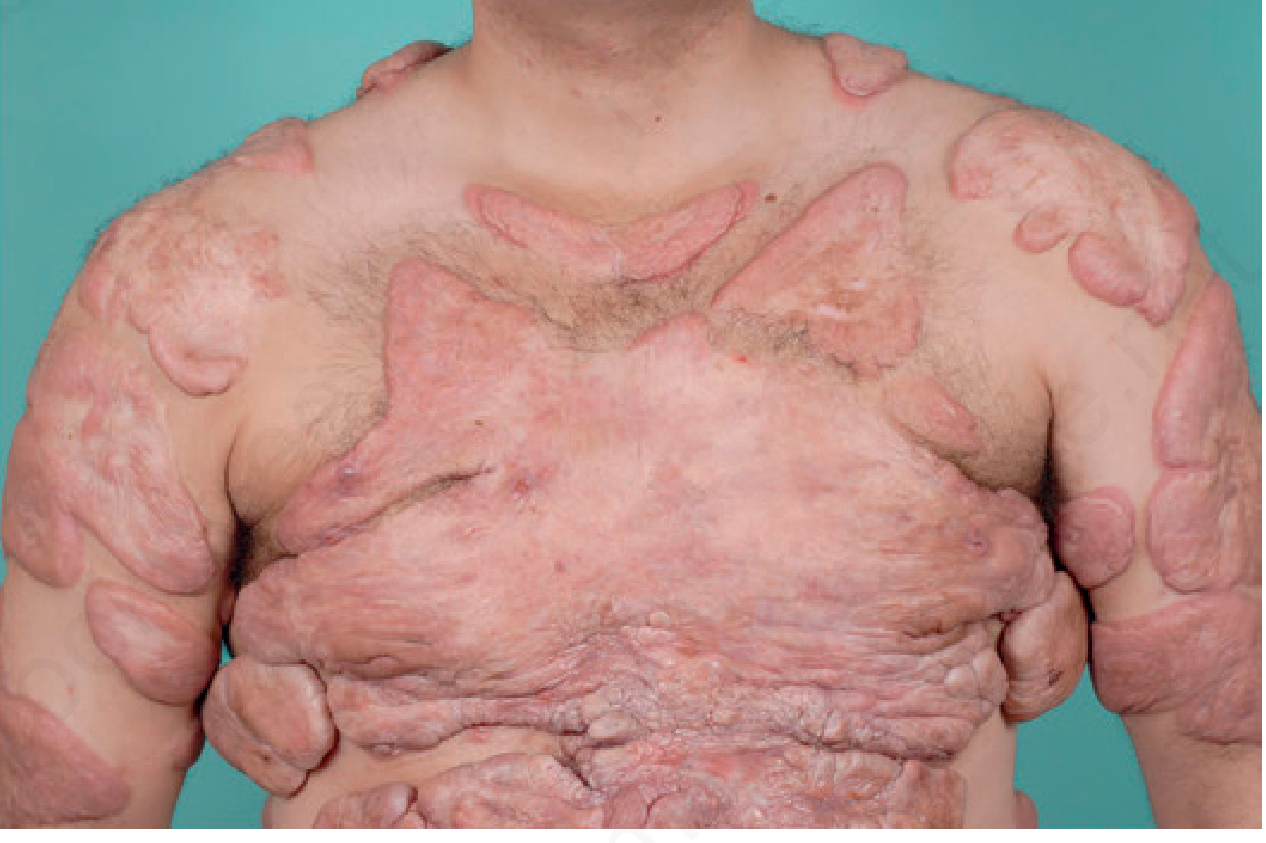
5. CLASSIFICATION
A. Mustoe International Classification (2002, most widely used)
| Type | Description |
|---|---|
| Linear hypertrophic | Raised, red; within scar; follows trauma line; regresses in 2 yrs |
| Widespread hypertrophic | Widespread (e.g., burns); stays within wound borders |
| Minor keloid | Small, locally raised; extends beyond wound; may stabilize; earlobe most common |
| Major keloid | Large (>0.5 cm), raised, possibly painful; extends beyond wound; continues spreading for years; butterfly pattern in severe cases |
B. Based on Etiology
- Post-traumatic (surgical, accidental injury)
- Post-inflammatory (acne, folliculitis, chickenpox)
- Spontaneous (rare - appears without obvious trauma)
C. Japan Scar Workshop (JSW) 2015 Scar Scale (JSS 2015)
- Score 0-5: Mature scar
- Score 6-15: Hypertrophic scar
- Score 16-25: Keloid
- Scores based on risk factors (genetics, site, race) + clinical features (height, color, symptoms)
D. Vancouver Scar Scale (VSS) - for objective severity grading
| Parameter | Score | Description |
|---|---|---|
| Pliability | 0-5 | Normal → Supple → Yielding → Firm → Banding → Contracture |
| Height | 0-3 | Flat → <2mm → 2-5mm → >5mm |
| Vascularity | 0-3 | Normal → Pink → Red → Purple |
| Pigmentation | 0-2 | Normal → Hypopigmented → Hyperpigmented |
6. INVESTIGATIONS
When to Investigate & What to Do
A. Clinical Assessment
- Usually clinical diagnosis is sufficient
- VSS scoring for objective documentation
- Photography for baseline and follow-up
B. Dermoscopy
- Helps distinguish active vs. quiescent scar
- Active keloid: visible vessels, erythema at periphery
C. Ultrasound
- High-frequency ultrasound (20 MHz): measures scar thickness; useful for monitoring treatment response
- Identifies extent of dermal involvement
D. MRI
- For giant/deep keloids to assess extent and plan surgery
E. Histopathology / Biopsy
- Atypical clinical presentation
- Suspicion of malignancy (carcinoma en cuirasse, DFSP, desmoplastic melanoma can mimic keloid)
- Rapid unexpected growth
- Ulceration, bleeding not explained by trauma
- No history of trauma at site
- Classic clinical appearance in known keloid-prone individual - biopsy itself can trigger/worsen keloid formation
- Avoid incisional biopsy at high-risk sites if diagnosis is clear
7. BIOPSY - HOW TO TAKE, PATHOLOGY, IHC
How to Take
- Punch biopsy (3-4mm) preferred over incisional biopsy to minimize new wound
- Take from the active edge (advancing margin) - most cellular and informative
- Handle with care - use minimal trauma technique
- In known keloid-prone patient - if biopsy is truly needed, plan surgical excision of the entire lesion at the same time
Cells of Origin
- Fibroblasts (activated myofibroblasts are the primary cell)
- Mast cells (increased)
- Macrophages
- Endothelial cells (neovascularization)
Histopathology (KEY VIVA TABLE)
| Feature | Hypertrophic Scar | Keloid |
|---|---|---|
| Epidermis | Flattened | Not involved |
| Papillary dermis | Fibrotic | NOT involved |
| Fibroblasts | Increased | Not increased within keloidal collagen |
| Collagen bundles | Fine, wavy; parallel to epidermis | Large, thick, haphazardly oriented ("keloidal collagen") |
| Elastic fibers | Diminished/absent | Increased in deep dermis |
| Blood vessels | Increased; vertical orientation | Not increased; few vertically oriented vessels |
| Inflammatory infiltrate | Sparse, perivascular | Sparse, perivascular |
| Mast cells | Increased | Increased |
| Dermal mucin | Increased | Increased |
| Myofibroblasts | +++ (prominent) | ++ (present) |
| Characteristic finding | - | Thick glassy homogeneous collagen nodules |
IHC Findings
| Marker | Hypertrophic Scar | Keloid | Notes |
|---|---|---|---|
| α-SMA (myofibroblasts) | +++ (prominent nodules) | ++ (45-70%) | Conflicting reports |
| COX-1 | ~50% | 100% | Favors keloid |
| CD34 | Negative | Negative | Helps exclude DFSP |
| Factor XIIIa | Negative | Negative | Helps exclude dermatofibroma |
| S100 | Minimal/absent | Minimal/absent | Excludes desmoplastic melanoma |
| Ki-67 | Variable | Higher at advancing edge | Reflects proliferative activity |
8. MANAGEMENT
Overview - General Principles
"No single proven best therapy exists; combination therapy is superior to monotherapy; keloids require adjuvant therapy after any surgery; hypertrophic scars have better outcomes."
8.1 PREVENTION (First-Line Strategy)
- Tension relief: Close wounds parallel to Langer's lines; use subcutaneous/fascial sutures to reduce skin tension
- Silicone gel/sheets: Apply 2 weeks post-wound closure; 12-24 hours/day; for 12-24 weeks - first-line prophylactic and treatment option (Bailey & Love, Bailey)
- Pressure garments: Start as soon as wound is closed; especially for burns; >25 mmHg pressure; worn 23 hrs/day
- Taping: 3+ months post-closure; changes every 24-48 hours
- Sunscreen SPF 50+: For 1 year post-op to prevent hyperpigmentation
- Avoid: Nonessential surgery at high-risk sites in keloid-prone individuals
- Avoid: Secondary intention healing in high-risk patients (delays healing >2-3 weeks → higher risk)
8.2 NON-SURGICAL TREATMENTS
A. Intralesional Corticosteroids (ILCs) - Gold Standard First-Line
| Parameter | Details |
|---|---|
| Concentration | 10-40 mg/mL (start 10 mg/mL for softened lesions; 40 mg/mL for resistant) |
| Maximum dose | 80 mg per month (recent e-Delphi consensus) |
| Interval | Every 4-6 weeks (some sources say 6-8 weeks) |
| Technique | 30-gauge needle on 1-mL tuberculin syringe; inject INTO the lesion (not SC) |
| Mechanism | Inhibits fibroblast proliferation; decreases collagen synthesis; decreases TGF-β; promotes collagen degradation; anti-inflammatory |
| Response rate | 50-100%; recurrence up to 50% |
| Endpoints | Flattening + cessation of itching |
- Skin atrophy (inject only into scar tissue)
- Hypopigmentation (dose-dependent; commoner with higher concentrations)
- Telangiectasia formation
- Adjacent fat atrophy if injected beyond scar
- Pain during injection
- Cushingoid features if large amounts used
B. 5-Fluorouracil (5-FU) - Second Line / Combination
| Parameter | Details |
|---|---|
| Dose | 50 mg/mL intralesionally |
| Frequency | Weekly for 12 weeks |
| Mechanism | Antimetabolite; inhibits fibroblast proliferation by blocking DNA synthesis (S-phase) |
| Combination | TAC 10 mg/mL + 5-FU 45 mg/mL (9:1 ratio) - synergistic |
| Side effects | Pain at injection, ulceration, hyperpigmentation (lighter), myelosuppression (rare) |
| Evidence | Combination TAC + 5-FU superior to either alone |
C. Bleomycin
| Parameter | Details |
|---|---|
| Dose | 1.5 IU/mL; intralesional injections or multi-needle technique |
| Mechanism | Inhibits collagen synthesis; induces fibroblast apoptosis; cleaves DNA |
| Use | Alternative to TAC; especially darker skin tones (less hypopigmentation) |
| Side effects | Atrophy, pain, flagellate hyperpigmentation, pulmonary toxicity at high doses (rare with intralesional) |
D. Verapamil
| Parameter | Details |
|---|---|
| Dose | 2.5 mg/mL intralesionally, every 2 weeks |
| Mechanism | Calcium channel blocker; decreases IL-6, VEGF; inhibits fibroblast cell growth; increases collagenase activity |
| Use | Adjunct to TAC; useful in patients with contraindications to steroids |
E. Botulinum Toxin A
| Parameter | Details |
|---|---|
| Dose | Variable; ~2.5 units/cm² intralesionally |
| Mechanism | Pauses fibroblast cell cycle; reduces TGF-β1 expression; decreases muscle tension → reduces mechanical stimulus for scar formation |
| Evidence | Meta-analysis (PMID 39447283): TAC + BotA superior to TAC alone |
| Use | Peri-incisional or intralesional for prevention and treatment |
F. Silicone Gel/Sheeting
| Parameter | Details |
|---|---|
| Mechanism | Reduces transepidermal water loss (TEWL); hydrates stratum corneum; reduces mast cell numbers; reduces TGF-β2 |
| Duration | 12-24 weeks; 12-24 hours/day |
| Evidence | Level B (well-accepted first-line; Cochrane review quality generally poor) |
| Products | Sheets (Cica-Care, Mepiform) vs. Gels (Dermatix, Kelo-cote) |
G. Pressure Therapy
- 25+ mmHg; worn 23 hrs/day; changed when worn
- Mechanism: reduces wound oxygen tension → decreases myofibroblast proliferation; collagen I & III reduction seen within 1 week
- Duration: Until scar maturation (6-18 months)
H. Emerging / Novel Agents
| Agent | Mechanism | Notes |
|---|---|---|
| Imiquimod 5% cream | Induces IFN-α/β, NK cells; antifibrotic | Post-excision adjuvant |
| Tacrolimus | Calcineurin inhibitor; anti-inflammatory | Topical for smaller lesions |
| Sirolimus (rapamycin) | mTOR inhibitor; anti-proliferative | Emerging evidence |
| Losartan 5% ointment | Angiotensin II antagonist; reduces TGF-β1 | Pilot study - significant improvement |
| Tranilast | Inhibits TGF-β, collagen synthesis | Japan/Korea; oral use |
| Retinoids | Regulate gene expression; modulate TGF-β | Topical/systemic |
| Tamoxifen | Anti-estrogen; antifibrotic | For gender-specific management |
| Onion extract (Contractubex) | Anti-inflammatory, antifibrotic | Used as adjunct |
| Dupilumab | IL-4/IL-13 receptor blocker | Case reports - reduces pruritus and appearance |
8.3 LASER THERAPY
| Laser | Mechanism | Best For |
|---|---|---|
| Pulsed Dye Laser (PDL) 585/595 nm | Photothermolysis of oxyhemoglobin → obliterates capillaries; reduces TGF-β1; reduces collagen synthesis | Erythema, early scars, vascularity |
| CO2 Laser (ablative) | Ablates microscopic columns of tissue; stimulates MMPs → collagen reorganization | Thickness, texture, contracture |
| Nd:YAG 1064 nm | Deep tissue penetration; reduces collagen | Combined with TAC |
| Fractional lasers | Fractional photothermolysis; resurfaces with less risk | Hypertrophic scars |
8.4 CRYOTHERAPY
- Mechanism: Ice crystal formation → vascular disruption → fibroblast apoptosis → collagen destruction; also reduces TGF-β1
- Technique: Contact, spray, or intralesional needle cryoprobe
- Protocol: Three freeze-thaw cycles, 30-second sessions, every 3-4 weeks
- Best for: Small isolated keloids; earlobe keloids
- Side effects: Hypopigmentation (significant in dark skin - limit use), pain, blistering
8.5 SURGICAL MANAGEMENT
Indications for Surgery
- Functional impairment (contracture limiting joint movement)
- Large hypertrophic scars after 1 year of conservative management
- Keloids refractory to 12 months of conservative therapy
- Diagnostic uncertainty (simultaneous biopsy + excision)
- Earlobe keloids (after ILC failure)
- Symptomatic lesions (severe pain/pruritus unresponsive to medical treatment)
Contraindications / Relative Contraindications to Surgery
- Active growing keloid (relative)
- No adjuvant therapy planned (excision alone → 50-100% recurrence for keloids)
- Patient unwilling to comply with prolonged post-op adjuvant treatment
- High-risk anatomic sites with no clear functional benefit
- Young patients with strong keloid history and small lesion (try conservative first)
Limitations
- Keloid surgery alone → 50-100% recurrence rate (always needs adjuvant)
- Cannot cure genetic predisposition
- Each new wound = new opportunity for keloid formation
Surgical Steps - Keloid Excision
- Mark the lesion; plan excision margins
- LA with lidocaine + adrenaline + TAC mixture (reduces bleeding + immediate antikeloid effect)
- Intralesional excision (leave thin shell of scar to close over without creating raw wound bed) OR complete excision depending on size
- Tension-free primary closure with subcuticular sutures (monofilament)
- Immediate (within 24-48 hours) post-op adjuvant therapy: radiation OR ILC injection
- Start silicone gel and pressure earring post-operatively
- Simple scar resection + primary closure with:
- Adjacent tissue undermining
- Deep subcutaneous tensile reduction sutures
- Z-plasty (gains length, reorients scar along relaxed skin tension lines)
- W-plasty / geometric broken line closure (for facial scars)
- V-Y, Y-V plasty
- Local or free flaps (for large areas, severe contractures)
- Post-op: taping for 3 months + silicone therapy
- Standard Z-plasty: 60° angles → 75% length gain
- 45° angles → 50% length gain; 30° angles → 25% length gain
- Transposes tissue, relieves tension, breaks up linear scar
- Used for: contractures across joints, reorienting scar along RSTL
- For widespread large hypertrophic scars
- Generates extra skin for reconstruction
- Serial excision over multiple sessions
8.6 RADIATION THERAPY
| Parameter | Details |
|---|---|
| Timing | Within 24-48 hours post-excision (within 24 hours optimal) |
| Best dose | 10 Gy single-fraction EBRT (electron beam) - recurrence rate 0.81% (2024 study) vs. 9.5 Gy (8.47% recurrence) |
| Alternative fractionation | 5 × 3 Gy (biologically effective dose 52.5 Gy²) - recurrence 26-32% |
| Brachytherapy | High-dose-rate or low-dose-rate; placed in wound at time of surgery |
| Efficacy | Reduces keloid recurrence by 50-95% when combined with surgery |
| Mechanism | Inhibits fibroblast proliferation; reduces TGF-β; prevents new vessel formation |
- Theoretical carcinogenic risk (literature has NOT proven significant association)
- Not preferred in young patients, areas near gonads/thyroid
- Skin atrophy, telangiectasia as late effects
- Avoid in pediatric patients
8.7 COMBINED / MULTIMODAL APPROACH
The NMS (Nippon Medical School) Protocol (Ogawa et al.): Surgery + immediate post-op radiation + ILC injections + silicone + pressure = best outcomes
9. APPROACH TO A PATIENT (Practical Algorithm)
PATIENT PRESENTS WITH ABNORMAL SCAR
↓
Is it within wound margins? → YES → Hypertrophic Scar
NO → Keloid
↓
ASSESS: Size, site, symptoms, VSS score, age, race, patient expectations
Hypertrophic Scar Management by Stage:
| Situation | Management |
|---|---|
| Early (<6 months), small, linear | Silicone gel + pressure + massage; observe |
| Active, symptomatic (6 weeks - 6 months) | Add ILC TAC 10-40 mg/mL every 4 weeks |
| Persistent >6 months | Continue silicone; add laser (PDL/CO2) |
| Permanent >12 months (not regressing) | Surgical revision (Z-plasty/excision) + post-op silicone |
| Contracture across joint | Urgent surgery: Z-plasty, flap, or skin graft + aggressive physio |
Keloid Management by Type:
| Type | First-Line | Second-Line | Third-Line |
|---|---|---|---|
| Minor keloid (earlobe) | ILC TAC 40 mg/mL every 6-8 weeks | ILC + 5-FU; Cryotherapy | Excision + ILC + radiation |
| Minor keloid (other sites) | Silicone + ILC | Laser (PDL) + ILC | Surgery + radiation |
| Major keloid (responsive) | ILC + silicone + pressure | Add 5-FU/bleomycin | Surgery + brachytherapy/EBRT |
| Major keloid (refractory) | Counsel patient; symptomatic Rx (antihistamines) | Surgery + immediate radiation | Experimental (dupilumab, sirolimus) |
Specific Scenarios (Viva Gold):
| Scenario | Answer |
|---|---|
| Small earlobe keloid, young patient, first episode | ILC TAC 40 mg/mL; repeat 6-8 weekly; no surgery yet |
| Large sternal keloid, refractory to ILC x 12 months | Surgical excision + immediate post-op EBRT 10 Gy + post-op silicone + pressure |
| Hypertrophic scar contracture of neck, child, post-burn | Flap repair (preferred over graft) + physio + pressure garment; NOT excision alone |
| Keloid in pregnant patient | Silicone gel + low-pressure garment; avoid ILC and radiation; surgery deferred |
| Keloid biopsy shows no keloidal collagen (45% cases) | Look for tongue-like advancing edge, horizontal fibrous band, sharp demarcation from normal dermis |
10. FOLLOW-UP & PROGNOSIS
Follow-Up Schedule
- Monthly for first 3 months (active treatment)
- Every 3 months for first year
- Every 6 months for 2nd year
- Keloids: Follow for minimum 2 years - recurrences may not appear until 6 months to 2 years post-treatment
Prognosis
| Factor | Better Prognosis | Worse Prognosis |
|---|---|---|
| Type | Hypertrophic scar | Keloid |
| Site | Extremities, face (except jaw) | Sternum, deltoid, earlobe |
| Race | Caucasian | African, Asian |
| Treatment | Multimodal | Monotherapy |
| Age | Elderly | Young adults (adolescence) |
| Genetics | No family history | Familial keloids |
| Hypertrophic scar | Spontaneous regression 6-18 months common | Contracture formations resist regression |
Recurrence Rates (Keloid)
| Treatment | Recurrence Rate |
|---|---|
| ILC alone | 30-50% |
| Surgery alone | 50-100% |
| Surgery + ILC | 15-20% |
| Surgery + radiation | 14-15% |
| Surgery + ILC + radiation | <10% |
| Surgery + ILC + radiation + silicone | Best outcomes |
11. RECENT EVIDENCE (PubMed 2023-2025)
- PMID 39447283 (Burns, 2024 Meta-Analysis): TAC + Botulinum toxin A combination significantly superior to TAC alone for both hypertrophic scars and keloids
- PMID 38347765 (J Burn Care Res, 2024 Systematic Review): Laser-assisted drug delivery (LADD) using fractional CO2 + TAC/5-FU is effective for hypertrophic scars and keloids
- PMID 38760539 (Aesthetic Plast Surg, 2024 Network Meta-Analysis): PDL and CO2 laser most effective laser modalities; PDL best for erythema, CO2 best for thickness
- 2024 Single-center study: 10 Gy single-fraction EBRT within 24 hours post-surgery → 0.81% recurrence rate (vs. 8.47% with 9.5 Gy)
12. CRUX FLOWCHART - MANAGEMENT ALGORITHM
╔══════════════════════════════════════════════════════════════════╗
║ PATIENT WITH HYPERTROPHIC SCAR / KELOID ║
╚══════════════════════════════════════════════════════════════════╝
│
┌───────────────┴───────────────┐
▼ ▼
HYPERTROPHIC SCAR KELOID
(within margins, (beyond margins,
may regress) never regresses)
│ │
┌─────────┴──────────┐ ┌─────────┴──────────┐
▼ ▼ ▼ ▼
EARLY LATE MINOR MAJOR
(<6 mo) (>6 mo) (earlobe, (sternal,
small) large)
│ │ │ │
▼ ▼ ▼ ▼
Silicone+ ILC TAC ILC TAC 40 Silicone+
Pressure 10-40mg/mL mg/mL q6-8wks Pressure+
Observe q4wks ILC TAC 40mg/mL
│ NO RESPONSE │
▼ after 12 mo ▼
Laser PDL │ ILC + 5-FU +
+/- CO2 ▼ Bleomycin/
SURGICAL EXCISION Verapamil
+ (combination)
IMMEDIATE ADJUVANT │
───────────────── NO RESPONSE
EBRT 10 Gy within │
24-48 hrs ▼
+ SURGERY +
ILC post-op EBRT 10 Gy +
+ ILC post-op
SILICONE + +
PRESSURE SILICONE +
│ PRESSURE
▼ │
FOLLOW-UP FOLLOW-UP
Monthly x3 Monthly x3
then q3/12 then q3/12
for 1-2 yrs for 2 yrs
13. QUICK RECALL MNEMONICS
- Klaws beyond borders (keloid)
- Ever regresses? No (keloid never regresses)
- Late onset (months-years)
- Odd thick hyalinized collagen histologically
- Itching + pain (more in keloid)
- Dark skin (more common)
- Compression + silicone (first)
- Laser (second)
- Intralesional injections (TAC ± 5-FU)
- Pressure garments
- Surgery (last resort, ALWAYS with adjuvant)
- Radiation (adjuvant post-surgery for keloid)
- Andrews' Diseases of the Skin (11e) - Keloid section
- Dermatology 2-Volume Set 5e (Bolognia) - Ch. 98
- Sabiston Textbook of Surgery - Prevention & Treatment of Hypertrophic/Keloid Scars
- Bailey & Love's Short Practice of Surgery (28e)
- Schwartz's Principles of Surgery (11e) - Burns chapter
- Mustoe TA et al. International Clinical Recommendations on Scar Management (2002)
- Recent PubMed Systematic Reviews (2024): PMIDs 39447283, 38347765, 38760539
Hiii I am preparing for theoretical exam of Plastic Surgery. I am giving you the name of topic and you will give me following and remember, add as much images as possible and also use standard books and in the end crisp point or crux flow chart of management. Now the sequence you will give me is first demography mention if any most common or least common thing is there , causes like genetic and environmental, clinical features and any classification based on etiology or features, rwith whichever investigation needed, tell about when to do it and when not to do it and also specific finding images then biopsy how to take and when to take with cells of origin pathology and molecular ihc findings and classification based on biopsy and then management with surgery chemo radiotherapy hormonal therapy target therapy and whatever you tell like if surgery then indications contraindications limitations and surgical steps and then if any drug or chemo agent try to add doses mechanism of actions and side effects and if rat doses of that also and try brief approach to a pt. With tumor like if this size and this age then this management and then tell me about follow up and prognosis and try as much as images use standard books and try to explain things and take simplest things in count and also add specific investigation or any other charts are there add them AND THE TOPIC IS Hypertrophic scar and keloid
HYPERTROPHIC SCAR AND KELOID
Complete Plastic Surgery Theory Exam Guide
1. DEMOGRAPHY & EPIDEMIOLOGY
- Most common site of keloid: Sternal/presternal region
- Most common site for minor keloid: Earlobe (after ear piercing)
- Most common trigger: Trauma (surgery, burns, piercings)
- Most common symptom: Pruritus
- Most common race affected: Black Africans (4-16x higher incidence than Caucasians); also Asians > Hispanics > Caucasians
- Least common sites: Central face, palms, soles, genitalia (palms and soles almost never affected)
- Age: Peak incidence 10-30 years; rare in infancy and old age; hormones of puberty worsen keloid tendency
- Sex: Equal sex distribution overall; females overrepresented due to ear piercing history
- Worldwide prevalence: 4.5-16% in darkly pigmented populations vs <1% in Caucasians
- Hypertrophic scars: Much more common than keloids; occur in any race; burn patients particularly prone (up to 70% after deep burns)
2. DEFINITIONS
| Feature | Normal Scar | Hypertrophic Scar | Keloid |
|---|---|---|---|
| Within wound margins | Yes | Yes | No - extends beyond |
| Spontaneous regression | Yes (12-18 months) | Yes (over months-years) | Never |
| Onset | Weeks | Weeks | Months to years |
| Behavior | Matures quietly | Active then resolves | Tumor-like, progressive |
| Pain/itch | Minimal | Present during active phase | Often marked |
| Recurrence after excision | Rare | Low | 50-100% |
3. CAUSES / ETIOLOGY
3.1 Genetic Factors
- Autosomal dominant inheritance with incomplete penetrance and variable expressivity - familial keloids are well-documented across multiple pedigrees
- HLA associations: HLA-B14, HLA-B21, HLA-DRB1*15 confer susceptibility
- Chromosomal locus: 2q23 implicated in familial keloid pedigrees
- Key genes: NEDD4, CYP1B1, HMGA2 mutations identified in keloid-prone individuals
- Racial predisposition: Black Africans carry the highest genetic burden; certain African tribes show near-universal keloid formation after skin trauma
3.2 Environmental / Triggering Factors
- Trauma (most important trigger):
- Surgical wounds
- Burns and scalds - widest, most severe hypertrophic scars
- Lacerations and abrasions
- Ear/body piercing
- Tattoos
- Infection: Acne vulgaris (classic cause of chest/back keloids), folliculitis, chickenpox, infected wounds
- Vaccination: BCG at deltoid - classic teaching point
- Mechanical tension: Wounds perpendicular to Langer's lines; wounds over mobile areas (shoulder, sternum, jaw)
- Hormonal influences: Puberty and pregnancy both worsen keloids; testosterone implicated; keloids may regress after menopause
- Prolonged wound healing: Wounds taking >2-3 weeks to heal (deep partial-thickness burns, infected wounds) have markedly higher scar hypertrophy risk
- Wound infection / prolonged inflammation: Prolongs inflammatory phase → excess cytokine release
3.3 High-Risk Anatomic Sites
- Sternum / presternal chest
- Anterior chest wall
- Deltoid / shoulders
- Neck
- Earlobes
- Scalp (after burns)
- Supra-pubic region
4. PATHOGENESIS (Molecular Basis)
Normal Wound Healing (Brief Review)
- Hemostasis (seconds to hours): platelet plug; fibrin clot; release of PDGF, TGF-β from platelets
- Inflammation (hours to days): neutrophils then macrophages; clean debris; release IL-1, TNF-α, TGF-β
- Proliferation (days to weeks): fibroblast migration + proliferation; collagen I and III synthesis; angiogenesis; re-epithelialization
- Remodeling (weeks to years): collagen III → collagen I; MMPs degrade excess collagen; scar matures and softens
What Goes Wrong in Keloid / Hypertrophic Scar
| Molecular Player | Role in Normal Healing | Abnormality in Keloid/HTS |
|---|---|---|
| TGF-β1 and TGF-β2 | Profibrotic - promote collagen synthesis | Overexpressed → excessive collagen I and III |
| TGF-β3 | Antifibrotic - promotes scarless healing | Reduced/suppressed |
| PDGF | Fibroblast mitogen | Overexpressed → excess fibroblast proliferation |
| IL-6, IL-8 | Pro-inflammatory cytokines | Elevated → sustained inflammation |
| VEGF | Angiogenesis | Elevated → hypervascularization of early keloid |
| MMPs (collagenases) | Degrade excess collagen during remodeling | Reduced activity → collagen accumulates |
| TIMPs | Inhibit MMPs | Overexpressed → block collagen breakdown |
| p53 / bcl-2 | Regulate apoptosis | p53 dysfunction + bcl-2 overexpression → fibroblast apoptosis resistance |
| MAPK/ERK pathway | Cell proliferation signaling | Constitutively activated in keloid fibroblasts |
| Wnt signaling | Stem cell/fibroblast activation | Aberrantly activated |
| Mast cells | Histamine release | Increased number → pruritus + fibroblast stimulation |
| Mechanical stretch | Activates mechanoreceptors | Activates TGF-β → collagen gene expression |
Kischer-Brody Collagen Nodule Theory
- High-density fibroblasts
- Unidirectional collagen within each nodule
- Surrounded by an alpha-smooth muscle actin (α-SMA)-positive fibrous capsule
5. CLINICAL FEATURES
5.1 Hypertrophic Scar
- Raised, red/pink, firm scar within the original wound boundaries
- Usually linear, following the wound
- Appears within weeks of injury
- Actively growing for months, then stabilizes
- Pruritus and burning during active growth phase
- Usually regresses spontaneously over 12-18 months
- If over a joint → contracture → functional impairment
- No clawlike extensions
- Stays within wound margins
- Regresses over time
- Lower recurrence after surgery
5.2 Keloid
- Firm, rubbery, pink-to-purplish, shiny nodule/plaque
- Extends beyond the original wound margins in all directions
- Clawlike (cheloid) projections - pathognomonic
- Surface is smooth, glossy, thinned from pressure
- Never regresses spontaneously
- Actively growing edge (peripheral zone) + less active dense center
- Small trauma → disproportionately large keloid
- Pruritus (most common) - from mast cell histamine release
- Pain and burning sensation
- Psychological distress and cosmetic disfigurement
- Rarely: ulceration, sinus tract formation, drainage
- Earlobe keloid: "Dumbbell" or lobulated shape after piercing; grows on both sides of lobe
- Sternal keloid: Large, butterfly-shaped, extends up to shoulders and across chest
- Acne keloid: Multiple small nodules over upper back and chest
- BCG keloid: Raised nodule at deltoid vaccination site (classic exam scenario)
6. CLASSIFICATION
6.1 Mustoe International Classification (2002) - Most Widely Used Clinically
| Class | Definition | Characteristics |
|---|---|---|
| Linear hypertrophic | Raised scar within wound; follows trauma line | Appears within weeks; regresses in 1-2 years |
| Widespread hypertrophic | Widespread raised red scar (e.g., post-burn) | Stays within burn wound borders |
| Minor keloid | Focally raised, extends beyond wound | Stabilizes eventually; earlobe is most common site; can be treated with excision |
| Major keloid | Large (>0.5 cm), raised, painful/pruritic, extending beyond wound | Spreads for years; butterfly pattern in severe cases; extremely difficult to treat |
6.2 Japan Scar Workshop (JSW) 2015 Scar Scale (JSS 2015)
| Score | Interpretation |
|---|---|
| 0-5 | Mature/normal scar |
| 6-15 | Hypertrophic scar |
| 16-25 | Keloid |
6.3 Vancouver Scar Scale (VSS) - Objective Severity Assessment
| Clinical Feature | 0 | 1 | 2 | 3 | 4 | 5 |
|---|---|---|---|---|---|---|
| Pliability | Normal | Supple | Yielding | Firm (solid unit) | Banding / "ropes" | Contracture |
| Height | Flat | <2 mm | 2-5 mm | >5 mm | -- | -- |
| Vascularity | Normal | Pink | Red | Purple | -- | -- |
| Pigmentation | Normal | Hypopigmented | Hyperpigmented | -- | -- | -- |
- Maximum score = 13; higher score = worse/more active scar
- Used to monitor treatment response and compare outcomes
- Part of standard documentation in burns and reconstructive centers
6.4 Patient and Observer Scar Assessment Scale (POSAS)
- Two components: Observer (clinician rates vascularity, pigmentation, thickness, relief, pliability, surface area) + Patient (rates pain, itch, color, stiffness, thickness, irregularity)
- More comprehensive than VSS; captures patient-reported outcomes
6.5 Classification by Etiology
- Post-traumatic (surgical, accidental)
- Post-inflammatory (acne, folliculitis, chickenpox)
- Post-burn
- Spontaneous (without obvious trauma - suggests strong genetic predisposition)
7. INVESTIGATIONS
7.1 Clinical Assessment
- Usually clinical diagnosis is sufficient and investigations are targeted
- Thorough history: timing of onset, trigger, growth pattern, prior treatments, family history
- Examine: margins (within vs. beyond wound), consistency, tenderness, clawlike projections
7.2 When to Investigate
| Indication | Investigation |
|---|---|
| Routine documentation/monitoring | Photography + VSS/POSAS scoring |
| Objective scar thickness measurement | High-frequency ultrasound (20 MHz) |
| Deep/giant keloid; surgical planning | MRI scan |
| Atypical features / suspicion of malignancy | Biopsy |
| Color/vascularity assessment | Dermoscopy |
| Research / treatment monitoring | Cutometer (elasticity), chromameter (color), TEWL measurement |
7.3 High-Frequency Ultrasound (20 MHz)
- Measures scar thickness in millimeters
- Maps vascularity
- Monitors response to treatment (non-invasive, repeatable)
- Can distinguish dermis from subcutaneous tissue involvement
7.4 When NOT to Investigate
- Classic clinical presentation in known keloid-prone individual - avoid biopsy (biopsy = new wound = may trigger new keloid)
- If diagnosis is clinically clear, investigations only add to cost with no benefit
- Routine blood tests are not indicated unless systemic disease suspected
8. BIOPSY
8.1 When to Biopsy
- Atypical appearance or rapid unexpected growth
- Clinical suspicion of malignancy (carcinoma en cuirasse, DFSP, desmoplastic melanoma can all mimic keloid)
- Ulceration, bleeding without clear cause
- No history of trauma at lesion site
- Large irregular plaques in atypical locations
- Pre-treatment baseline in research/clinical trials
8.2 When NOT to Biopsy
- Classic keloid in a known keloid-prone patient (biopsy creates a new wound = risk of triggering or enlarging keloid)
- Always ask: "Will the biopsy result change my management?" - if no, avoid
- If biopsy is truly necessary, plan simultaneous complete excision of the lesion
8.3 How to Take the Biopsy
- Punch biopsy (3-4 mm): preferred - minimal new wound created
- Site: Take from the active edge (advancing peripheral margin) - most cellular and diagnostically informative; the center is hypocellular and dense
- Handling: Minimize trauma; direct formalin fixation for routine H&E; fresh tissue for special studies
- Technique: Gentle handling, avoid crushing; orient specimen for proper sectioning
8.4 Cells of Origin
| Cell Type | Role |
|---|---|
| Fibroblasts / Myofibroblasts | Primary effector cells - produce excess collagen; main driver |
| Mast cells | Increased number; release histamine → pruritus + fibroblast stimulation |
| Macrophages (M2 polarized) | Profibrotic; release TGF-β, IL-10 |
| Endothelial cells | Neovascularization of early keloid |
| Keratinocytes | Signaling abnormalities in keloid-prone skin |
8.5 Histopathology (Key Table - Dermatology 5e Bolognia, Table 98.3)
| Feature | Hypertrophic Scar | Keloid |
|---|---|---|
| Epidermis | Flattened | Not involved |
| Papillary dermis | Fibrotic | Not involved |
| Fibroblasts | Increased in number | Not increased within keloidal collagen |
| Collagen bundles | Fine, wavy; parallel to epidermis | Large, thick, haphazardly oriented (keloidal collagen) |
| Elastic fibers | Diminished or absent | Increased within deep dermis |
| Dermal blood vessels | Increased; vertically oriented (perpendicular to epidermis) | Not increased; few vertically oriented |
| Inflammatory infiltrate | Sparse, perivascular | Sparse, perivascular |
| Mast cells | Increased | Increased |
| Dermal mucin | Increased | Increased |
| Myofibroblasts | +++ (prominent) | ++ (present) |
| Characteristic finding | Collagen nodules + vertical vessels | Thick glassy homogeneous collagen nodules (keloidal collagen) |
- No epidermal flattening
- No fibrosis in papillary dermis
- Tongue-like advancing edge as scar extends through reticular dermis
- Horizontal cellular fibrous band in upper reticular dermis with sharp demarcation
- Prominent fascia-like fibrous bands deep in scar (Dermatology 5e)
8.6 Immunohistochemistry (IHC)
| Marker | Hypertrophic Scar | Keloid | Significance |
|---|---|---|---|
| α-SMA (myofibroblast marker) | +++ (prominent nodules) | ++ (45-70%) | Conflicting literature; not definitive |
| COX-1 | ~50% positive | 100% positive | Favors keloid; not entirely specific |
| CD34 | Negative | Negative | Excludes DFSP (which is CD34+) |
| Factor XIIIa | Negative | Negative | Excludes dermatofibroma (which is Factor XIIIa+) |
| S100 protein | Minimal/absent | Minimal/absent | Excludes desmoplastic melanoma (S100+++) |
| Cytokeratins (AE1/AE3) | Negative | Negative | Excludes scar-like SCC (focal keratin+) |
| Ki-67 | Variable | Higher at advancing edge | Proliferative activity |
| p53 | Normal | Dysfunctional pattern | Reflects apoptosis resistance |
8.7 Molecular/Genetic Findings
- Overexpression of TGF-β1, PDGF, VEGF, IL-6, IL-8
- Reduced TGF-β3 (antifibrotic isoform)
- Activated MAPK/ERK pathway
- Wnt signaling constitutively activated
- COX-1 and COX-2 overexpression → prostaglandin synthesis → fibroblast activation
- Elevated fibronectin and glycosaminoglycans (mucopolysaccharides) in keloid matrix
- Decreased collagenase (MMP-1, MMP-8) activity + increased TIMP expression
9. MANAGEMENT
Overview
"Hypertrophic scars and keloids share broadly similar management strategies, but no single proven best therapy exists. Combination multimodal therapy is superior. Keloids require adjuvant therapy after any surgery - surgery alone produces 50-100% recurrence." (Sabiston Textbook of Surgery)
9.1 PREVENTION - The Best Strategy
- Tension relief: Close wounds parallel to Langer's relaxed skin tension lines (RSTL); use subcutaneous/fascial sutures to offload skin tension; geometric scar revision for unfavorably placed scars
- Hydration and occlusion: Silicone products; moisturizing lotions; moisture-retentive dressings
- Taping and pressure: Postsurgical taping for 3 months; pressure garments for wide wounds/burns
- Avoid unnecessary surgery at high-risk sites in keloid-prone individuals
- Avoid wounds that take >2-3 weeks to heal (deep burns, infected wounds) - use early grafting/flaps
- Apply silicone starting 2 weeks after wound closure
- Pressure garments: start as soon as wound is closed, before hypertrophy develops
- Sunscreen SPF 50+ for 1 year post-op to prevent hyperpigmentation
9.2 CONSERVATIVE / NON-SURGICAL TREATMENTS
A. Silicone Gel Sheeting / Gel - First-Line for Both Conditions
| Parameter | Details |
|---|---|
| Products | Sheets (Cica-Care, Mepiform) or gels (Dermatix, Kelo-cote, BAP Scar Care) |
| Mechanism | (1) Reduces transepidermal water loss (TEWL); (2) hydrates stratum corneum; (3) reduces mast cell numbers and mast-cell mediated symptoms; (4) suppresses TGF-β2; (5) possible static electricity effect |
| Application | 12-24 hours/day; change sheets every 24-72 hours |
| Duration | Minimum 12-24 weeks; continue as long as active maturation |
| Evidence | International guidelines recommend as first-line prophylaxis and treatment (Bailey & Love); Cochrane review quality generally poor but widely accepted |
| Indications | Both prophylaxis and treatment of hypertrophic scars and minor keloids |
| For areas where sheets won't conform | Use silicone gel (e.g., around nose, ears, mobile areas) |
B. Pressure Therapy
| Parameter | Details |
|---|---|
| Mechanism | (1) Reduces wound oxygen tension by compressing small vessels → decreases myofibroblast proliferation; (2) mechanoreceptor activation → dermal fibroblast apoptosis; (3) sensory nerve transduction → cytokine modulation; reduces collagen I and III within 1 week |
| Pressure | >25 mmHg at wound; typically 23-24 hours/day |
| Duration | Until scar maturation (6-18 months typically) |
| Best indication | Burns; widespread hypertrophic scars; prophylaxis after skin grafting |
| Garment types | Custom-made elastic garments; pressure earrings for earlobe keloids |
C. Intralesional Corticosteroids (ILC) - Gold Standard Pharmacological Treatment
| Parameter | Details |
|---|---|
| Concentration | 10-40 mg/mL (40 mg/mL for initial treatment of firm keloid; reduce to 10-20 mg/mL as lesion softens) |
| Maximum dose | 80 mg per month (2024 e-Delphi consensus) |
| Injection interval | Every 4-6 weeks (some protocols: 6-8 weeks) |
| Needle | 30-gauge on 1-mL tuberculin Luer syringe (generates high pressure for injection into firm tissue) |
| Technique | Inject INTO the lesion itself; small blebs spaced across the scar; do NOT inject into surrounding fat |
| Mechanism | (1) Inhibits fibroblast proliferation; (2) decreases collagen synthesis (suppresses mRNA for collagen I and III); (3) decreases TGF-β expression; (4) increases collagenase (MMP) activity; (5) anti-inflammatory; (6) promotes fibroblast apoptosis |
| Response rate | 50-100% flattening; up to 50% recurrence |
| Endpoints | Flattening of lesion + cessation of pruritus |
- Skin/fat atrophy (most important - inject only within scar to avoid)
- Hypopigmentation (dose-dependent; concerning in darker skin tones)
- Telangiectasia formation at injection sites
- Cushing's syndrome (rare with small-volume intralesional use)
- Pain during injection (can premix with LA)
- Menstrual irregularities (with large volumes)
D. 5-Fluorouracil (5-FU) Intralesional
| Parameter | Details |
|---|---|
| Dose | 50 mg/mL intralesionally |
| Frequency | Weekly for up to 12 weeks |
| Mechanism | Anti-metabolite (pyrimidine analogue); blocks thymidylate synthase → inhibits DNA synthesis (S-phase specific) → fibroblast antiproliferative effect; reduces TGF-β1 expression |
| Combination | TAC 10 mg/mL + 5-FU 45 mg/mL (9:1 ratio) - widely used; synergistic; superior to either agent alone |
| Advantages | Less hypopigmentation than TAC alone; good for darker skin phototypes |
| Side effects | Pain and burning at injection site, ulceration (dose-dependent), wound dehiscence, hyperpigmentation (paradoxically lighter skin reaction), systemic myelosuppression (rare at intralesional doses) |
| Evidence | 2024 Meta-Analysis (PMID 39447283): combination TAC + BotA superior; 5-FU + TAC combination has strong evidence base |
E. Bleomycin Intralesional
| Parameter | Details |
|---|---|
| Dose | 1.5 IU/mL intralesionally |
| Mechanism | Glycopeptide antibiotic; inhibits thymidine incorporation → DNA strand cleavage → fibroblast apoptosis; directly inhibits collagen synthesis |
| Techniques | Multi-needle puncture (tattooing) technique; direct intralesional injection |
| Advantages | Comparable to TAC; less hypopigmentation - preferred in darker skin patients |
| Side effects | Atrophy, pain, flagellate (whiplash) hyperpigmentation (pathognomonic side effect), Raynaud's phenomenon (rare at low intralesional doses), pulmonary fibrosis (rare at standard doses) |
F. Verapamil Intralesional
| Parameter | Details |
|---|---|
| Dose | 2.5 mg/mL intralesionally, every 2 weeks |
| Mechanism | L-type calcium channel blocker; (1) decreases IL-6 and VEGF production by keloid fibroblasts; (2) inhibits fibroblast cell growth; (3) increases collagenase activity (increases MMP activity) → collagen degradation; (4) decreases collagen, fibronectin, glycosaminoglycan synthesis |
| Use | Adjunct to TAC; useful when TAC side effects are limiting |
| Side effects | Minimal at intralesional doses; local pain |
G. Botulinum Toxin A (BotA)
| Parameter | Details |
|---|---|
| Dose | ~2.5 units/cm² intralesionally (variable protocols) |
| Mechanism | (1) Pauses fibroblast cell cycle; (2) reduces TGF-β1 expression; (3) decreases mechanical tension on wound (by relaxing surrounding muscle) → less mechanoreceptor stimulation for fibroblast activation |
| Evidence | 2024 Meta-Analysis (PMID 39447283): TAC + BotA significantly superior to TAC alone for both hypertrophic scars and keloids |
| Use | Perilesional or intralesional; also peri-incisional (preventive) |
| Side effects | Temporary muscle weakness in adjacent muscles; minimal systemic effects |
H. Cryotherapy
| Parameter | Details |
|---|---|
| Mechanism | Freezing → intracellular and extracellular ice crystal formation → cell membrane disruption → vascular stasis → ischemic fibroblast/mast cell apoptosis → collagen bundle breakdown; also suppresses TGF-β1 |
| Techniques | (1) Contact cryotherapy; (2) liquid nitrogen spray; (3) intralesional needle cryoprobe (most effective - creates freeze zone within scar from inside) |
| Protocol | Three freeze-thaw cycles, 30-second freeze, every 3-4 weeks |
| Best for | Small, isolated keloids; earlobe keloids; resistant lesions after ILC failure |
| Often combined with | ILC - cryotherapy followed immediately by TAC injection |
| Limitations | Significant hypopigmentation (major concern in darker skin); blistering; pain; limited effectiveness for large keloids |
I. Emerging / Novel Therapies
| Agent | Mechanism | Status |
|---|---|---|
| Imiquimod 5% cream | Toll-like receptor 7 agonist → IFN-α/β and NK cell activation → antifibrotic effect; promotes scar apoptosis | Post-excision adjuvant; limited evidence |
| Tacrolimus (topical) | Calcineurin inhibitor; anti-inflammatory; reduces TGF-β | Small keloids; adjunct therapy |
| Sirolimus (rapamycin) | mTOR inhibitor; antiproliferative effect on fibroblasts | Emerging evidence; promising |
| Losartan 5% ointment | Angiotensin II type 1 receptor antagonist → reduces TGF-β1 signaling | Pilot study: significant improvement at 3 months, no recurrence at 6-month follow-up (Sabiston) |
| Tranilast | Inhibits TGF-β, IL-4, IL-6; reduces histamine from mast cells; antifibrotic | Oral use; approved in Japan/Korea |
| Onion extract (Contractubex) | Cepalin (onion extract) + heparin + allantoin; anti-inflammatory, antifibrotic, antiproliferative | Topical adjunct; mild effect |
| Dupilumab | Blocks IL-4/IL-13 receptor (anti-Th2 cytokine) → reduces pruritus and fibrotic signaling | Case reports demonstrate reduced pruritus and improved appearance (Dermatology 5e) |
| Retinoids | Modulate gene expression via RAR/RXR receptors; reduce TGF-β; regulate collagen synthesis | Topical or systemic adjuncts |
| Tamoxifen | Anti-estrogen; antifibrotic effect via TGF-β1 suppression | Systemic or local; niche use |
| Adipose-derived stem cell EVs | Modulate matrix remodeling and cytokine regulation | Research stage; 2024 systematic review - promising |
9.3 LASER THERAPY
| Laser | Wavelength | Chromophore | Mechanism | Best For |
|---|---|---|---|---|
| Pulsed Dye Laser (PDL) | 585/595 nm | Oxyhemoglobin | Photothermolysis of vessels → coagulative necrosis of microvasculature; reduces TGF-β1; reduces collagen synthesis | Erythema, early vascular scars, prevents post-surgical hypertrophy |
| CO2 Laser (ablative) | 10,600 nm | Water | Ablates microscopic columns of tissue to flatten; stimulates MMPs → collagen reorganization; reduces neuropathic pain and pruritus | Thickness, texture, contracture, hypertrophic burn scars |
| Nd:YAG | 1064 nm | Deep tissue | Deep penetration; thermal damage to collagen → remodeling; reduces fibroblast activity | Combined with ILC; deep keloids |
| Fractional CO2 | 10,600 nm (fractional) | Water (fractional) | Creates microchannels (fractional photothermolysis); less downtime; stimulates remodeling | Resurface texture; also enables LADD |
- Fractional CO2 laser creates microchannels through scar epidermis
- TAC or 5-FU applied immediately after → enhanced penetration into scar
- 2024 Systematic Review (PMID 38347765): LADD is effective for hypertrophic scars and keloids with good evidence
- PDL best for erythema/vascularity
- CO2 best for thickness and texture
- Combined PDL + CO2 often used in practice
9.4 SURGICAL MANAGEMENT
Indications for Surgery
- Functional impairment (contracture limiting joint movement - urgent)
- Large hypertrophic scars unresponsive to 12 months of conservative management
- Keloids refractory to 12 months of conservative therapy
- Diagnostic uncertainty (biopsy + excision simultaneously)
- Symptomatic lesions (severe uncontrolled pain/pruritus)
- Earlobe keloids after ILC failure
- Large disfiguring keloids causing psychological distress
Contraindications to Surgery
- Active, rapidly growing keloid (relative - wait until stabilized if possible)
- No adjuvant therapy planned (excision alone for keloid = 50-100% recurrence - contraindicated without adjuvant)
- Patient unable/unwilling to comply with prolonged post-op adjuvant therapy
- High-risk anatomic site with no functional benefit
- Very young patient with strong keloid history and small, manageable lesion (try conservative first)
Limitations of Surgery
- Keloid excision alone → 50-100% recurrence (Sabiston)
- Cannot address underlying genetic predisposition
- Each surgical wound = new opportunity for scar formation
- No cosmetic improvement guaranteed without adjuvant treatment
Key Surgical Techniques
- Leave a thin shell of scar tissue to avoid raw wound bed
- Reduces risk of stimulating regrowth
- Less tension on closure
- Good for earlobe keloids particularly
- For hypertrophic scars and small keloids with planned adjuvant
- Combine with:
- Deep dermal/subcutaneous tensile reduction sutures
- Adjacent tissue undermining
- Subcuticular (continuous) closure
- Z-plasty / W-plasty
- Mark keloid margins; plan excision
- Local anaesthetic: lidocaine 1% + adrenaline 1:200,000 mixed with TAC (premixed injection)
- Intralesional excision or complete excision depending on size/shape
- Tension-free closure with subcuticular 4-0 monofilament
- Immediate post-op adjuvant within 24-48 hours: EBRT 10 Gy single-fraction OR ILC TAC 40 mg/mL
- Post-op: pressure earring + silicone gel
- Follow-up: monthly for 6 months; 3-monthly for 2 years
| Z-Plasty Angle | Length Gain |
|---|---|
| 30° | 25% |
| 45° | 50% |
| 60° | 75% (standard Z-plasty) |
| 75° | 100% (rarely used; creates wide flaps) |
- Transposes triangular flaps
- Reorients scar along RSTL
- Breaks up linear scar → reduces tension
- Used for: contractures across joints, linear scars in unfavorable direction
- Serial excision + tissue expansion
- Flap reconstruction (preferred over graft for contracture release)
- Why flaps > grafts: Skin-pedicled flaps expand after surgery; grafts do NOT expand and can develop circular pathologic scars at margins
- Full-thickness graft preferred over split-thickness when graft must be used (less contracture, better texture)
- Release contracture across joint completely
- Reconstruct defect with:
- Local flap (Z-plasty, Y-V, V-Y, propeller flap)
- Regional flap
- Free flap (for severe contractures)
- Skin graft (second choice)
- Post-op: splint in corrected position; physiotherapy; pressure garment; silicone
9.5 RADIATION THERAPY
| Parameter | Details |
|---|---|
| Timing | Within 24-48 hours post-excision (within 24 hours optimal per 2024 data) |
| Best dose | 10 Gy single-fraction EBRT (electron beam radiotherapy) |
| Evidence (2024) | 10 Gy → 0.81% recurrence vs 9.5 Gy → 8.47% recurrence (Kang et al., 182 patients) |
| Alternative | Fractionated EBRT: 5 × 3 Gy = 15 Gy total (BED 52.5 Gy²); recurrence ~26-33% |
| Brachytherapy | HDR or LDR placed in wound at time of surgery; equivalent efficacy; more local |
| Effect when combined with surgery | Reduces keloid recurrence by 50-95% |
| Mechanism | Inhibits fibroblast proliferation; inhibits neo-angiogenesis; reduces TGF-β signaling; prevents early post-excision fibroblast hyperactivation |
| Study | Dose (Gy × fractions) | BED (Gy²) | Recurrence Rate |
|---|---|---|---|
| Ogawa (ear keloid) | 5 × 2 = 10 Gy | 35 | 3.9% |
| Kang (2024) | 10 Gy single | - | 0.81% |
| Mitsuhashi | 5 × 3 = 15 Gy | 52.5 | 26.2% |
| Ogawa (mixed) | 5 × 3 = 15 Gy | 52.5 | 4.3-28.2% |
| Ogawa (mixed) | 5 × 4 = 20 Gy | 70 | 17.2% |
- Theoretical risk of radiation-induced malignancy - literature has NOT proven significant association (Sabiston)
- Skin atrophy and telangiectasia as late effects
- Avoid near gonads, thyroid, developing breast tissue in children
- Not preferred in pediatric patients
- Avoid during pregnancy
- Shin et al. compared surgery + ILC (15.4% recurrence) vs surgery + RT (14% recurrence) - comparable efficacy
- Choice depends on availability, patient preference, site
9.6 MULTIMODAL / COMBINATION APPROACH
- Tension-reducing surgery
- Immediate post-op EBRT (within 24 hours)
- Post-op ILC injections
- Silicone gel therapy
- Pressure garments
- Surgery + TAC: 15-20% recurrence
- Surgery + radiation: 14-15% recurrence
- Surgery alone: 50-100% recurrence
- Surgery + TAC + radiation + silicone: <10% recurrence
10. APPROACH TO A PATIENT (Practical Algorithm)
Step 1: Diagnose and Classify
PATIENT WITH ABNORMAL SCAR
↓
Q: Does scar extend beyond original wound margins?
NO → Hypertrophic scar
YES → Keloid
Q: Does scar regress over time?
YES → Hypertrophic scar
NO → Keloid (never regresses)
Step 2: Assess Severity
- Apply VSS scoring
- Photograph baseline
- Assess for functional impairment (contracture?)
- Assess for symptoms (pruritus/pain/burning)
Step 3: Management by Scenario
| Scenario | Management |
|---|---|
| Early (<6 months), linear, post-surgery | Silicone + pressure + taping; observe for regression |
| Active, symptomatic (6 weeks - 6 months) | Add ILC TAC 10-40 mg/mL q4 weeks + continue silicone |
| Persistent and active (>6 months) | Laser (PDL or CO2) + ILC; continue silicone |
| Not regressing after 12 months | Surgical revision (excision + Z-plasty/W-plasty as needed) + post-op silicone + taping |
| Contracture causing functional impairment | Urgent surgery: Z-plasty or flap release + physio + post-op pressure garment |
| Large burn scar hypertrophy | Silicone + pressure garments (23 hrs/day); serial excision or tissue expansion; laser; surgery if functional compromise |
| Scenario | Management |
|---|---|
| Young patient, small earlobe keloid, first presentation | ILC TAC 40 mg/mL q6-8 weeks (3-6 sessions); no surgery yet |
| Earlobe keloid, failed ILC x 12 months | Surgical excision (intralesional) + immediate EBRT 10 Gy + pressure earring + silicone |
| Minor keloid, other site | ILC ± 5-FU + silicone + pressure; add laser (PDL) if poor response |
| Major sternal keloid, first presentation | ILC TAC 40 mg/mL + 5-FU (combination) + silicone + pressure; no surgery until failed 12 months |
| Major sternal keloid, refractory to conservative x 12 months | Surgical excision + immediate EBRT 10 Gy (within 24 hrs) + post-op ILC + silicone |
| Keloid in darker skin type (Fitzpatrick IV-VI) | Prefer bleomycin or 5-FU over TAC (less hypopigmentation risk); laser with caution |
| Keloid in pregnant patient | Silicone gel + pressure only; defer ILC and radiation; surgery deferred if possible |
| BCG-site keloid (deltoid), child | ILC TAC; if large → plan excision + adjuvant post puberty |
11. FOLLOW-UP
Schedule
- Monthly: First 3-6 months (active treatment phase - ILC injections, monitoring)
- Every 3 months: For the first year
- Every 6 months: 2nd year
What to Monitor
- VSS/POSAS scores at each visit
- Photograph at each visit
- Scar thickness (ultrasound if available)
- Symptoms (pruritus, pain, burning - use VAS scale)
- Side effects of treatment (atrophy, hypopigmentation)
- Evidence of recurrence (increasing height, erythema, symptoms returning)
Patient Counseling Points
- Scar treatment is a long-term commitment (months to years)
- No treatment guarantees complete resolution
- Keloids will never disappear completely - goal is flattening and symptom relief
- Compliance with silicone and pressure therapy is critical to success
- Advise avoiding nonessential surgery at high-risk sites in the future
- Sun protection for 1 year post-treatment
12. PROGNOSIS
| Prognostic Factor | Better | Worse |
|---|---|---|
| Lesion type | Hypertrophic scar (regresses) | Keloid (never regresses spontaneously) |
| Site | Face (central), extremities | Sternum, deltoid, earlobe, jaw |
| Race | Caucasian | African, Asian |
| Family history | Absent | Positive (especially first-degree relatives) |
| Age | Elderly | Adolescent / young adult |
| Trigger | Minor trauma, well-placed scar | Burns, infected wound, perpendicular to RSTL |
| Treatment compliance | High | Low |
| Treatment modality | Multimodal (surgery + adjuvant) | Surgery alone |
Recurrence Rates for Keloid by Treatment (Summary)
| Treatment | Recurrence Rate |
|---|---|
| ILC TAC alone | 30-50% |
| Cryotherapy alone | 30-40% |
| Surgery alone | 50-100% |
| Surgery + ILC post-op | 15-20% |
| Surgery + radiation | ~14% |
| Surgery + ILC + radiation | <10% |
| Surgery + ILC + radiation + silicone + pressure | Best outcomes (<10%) |
13. DIFFERENTIAL DIAGNOSIS
| Condition | Differentiating Feature | IHC help |
|---|---|---|
| Dermatofibrosarcoma protuberans (DFSP) | Irregular growth, storiform pattern, CD34+ | CD34 positive (keloid is negative) |
| Dermatofibroma | Dimple sign, epidermal hyperplasia | Factor XIIIa positive |
| Desmoplastic melanoma | Pigment history, neural invasion | S100 strongly positive |
| Carcinoma en cuirasse | Metastatic carcinoma; history of primary Ca | Cytokeratin positive |
| Lobomycosis | Fungal infection; fungal organisms in dermis | PAS/Grocott positive |
| Morphea/scleroderma | Indurated plaque; systemic features | Clinical/serologic diagnosis |
14. CRISP CRUX FLOWCHART
╔══════════════════════════════════════════════════════════════════╗
║ HYPERTROPHIC SCAR / KELOID - MANAGEMENT ║
╚══════════════════════════════════════════════════════════════════╝
│
┌───────────────┴────────────────┐
▼ ▼
HYPERTROPHIC SCAR KELOID
(within margins) (beyond margins)
May regress Never regresses
│ │
┌─────────┴─────────┐ ┌───────────┴───────────┐
▼ ▼ ▼ ▼
EARLY LATE MINOR MAJOR
(<6 mo) (>6 mo) (earlobe, small) (large, sternal)
│ │ │ │
▼ ▼ ▼ ▼
SILICONE + ADD ILC ILC TAC SILICONE +
PRESSURE + TAC 40mg/mL PRESSURE +
TAPING 10-40mg/mL q6-8wks ×6 ILC TAC +
OBSERVE q4wks 5-FU (combo)
│ │ │ │
▼ (>6 mo) ▼ (>6 mo) ▼ (NO RESPONSE ▼ (NO RESPONSE
LASER PDL LASER + 12 months) 12 months)
+/- CO2 ILC │ │
│ │ ▼ ▼
▼ (>12 mo) ▼ (>12 mo) SURGERY SURGERY
SURGICAL SURGICAL (intralesional (excision) +
REVISION REVISION excision) + IMMEDIATE
(excision + (excision + ADJUVANT: EBRT 10 Gy
Z-plasty/W-plasty) Z-plasty) ───────── (within 24 hrs)
+ + EBRT 10Gy +
POST-OP SILICONE POST-OP within 24 hrs ILC post-op
+TAPING x3 months SILICONE OR ILC TAC post-op +
+TAPING + SILICONE +
PRESSURE EARRING PRESSURE
+ SILICONE │
FOLLOW-UP
Monthly x 3
Q3/12 x 1 yr
Q6/12 x 2 yrs
│
CONTRACTURE?
▼ YES
URGENT SURGICAL RELEASE
(Z-plasty / Flap)
+ PHYSIO + PRESSURE
15. QUICK-RECALL SUMMARY CARDS
Keloid vs Hypertrophic Scar (Key Differentiators)
| Keloid | HTS | |
|---|---|---|
| Margins | Beyond wound | Within wound |
| Onset | Months-years | Weeks |
| Regression | Never | Yes (12-18 months) |
| Recurrence after surgery | 50-100% | Low |
| Histology | Thick glassy collagen nodules | Fine wavy parallel collagen |
| Myofibroblasts | ++ | +++ |
| α-SMA | 45-70% | Prominent nodules |
Drug Doses Rapid-Fire
| Drug | Dose | Route | Frequency |
|---|---|---|---|
| Triamcinolone acetonide | 10-40 mg/mL; max 80 mg/month | Intralesional | q4-8 weeks |
| 5-Fluorouracil | 50 mg/mL | Intralesional | Weekly × 12 weeks |
| TAC + 5-FU combo | 10 mg/mL : 45 mg/mL (1:9 ratio) | Intralesional | q4 weeks |
| Bleomycin | 1.5 IU/mL | Intralesional | q3-4 weeks |
| Verapamil | 2.5 mg/mL | Intralesional | q2 weeks |
| Botulinum toxin A | ~2.5 U/cm² | Intralesional | q3 months |
| EBRT (post-excision) | 10 Gy single fraction | External beam | Once within 24-48 hrs |
- Dermatology 2-Volume Set 5e (Bolognia et al.) - Chapter 98
- Andrews' Diseases of the Skin (Clinical Dermatology)
- Sabiston Textbook of Surgery (19e/21e) - Chapter on wound healing
- Bailey & Love's Short Practice of Surgery (28e)
- Schwartz's Principles of Surgery (11e) - Burns chapter
- Mustoe TA et al. International Clinical Recommendations on Scar Management, Plast Reconstr Surg 2002
- PubMed 2024: PMIDs 39447283, 38347765, 38760539, 40773601
Find latest 2024-2025 clinical practice guidelines on keloid and hypertrophic scar management
keloid hypertrophic scar guideline consensus
clinical practice guidelines keloid hypertrophic scar management 2024 2025
keloid treatment consensus recommendations 2024
PMID: 39298112
PMID: 39020400
keloid hypertrophic scar society guidelines 2024 2025 international consensus dermatology plastic surgery
keloid intralesional corticosteroid radiation surgery systematic review
keloid hypertrophic scar management review 2024 2025
PMID: 39177869
https://pmc.ncbi.nlm.nih.gov/articles/PMC12858323
keloid scar treatment systematic review meta-analysis 2024 2025
PMID: 41889496
PMID: 38545753
https://providers.bcidaho.com/resources/pdfs/medical-managem…
PMID: 40346340
PMID: 41401628
keloid hypertrophic scar American Family Physician 2024
keloid 5-fluorouracil botulinum toxin laser intralesional meta-analysis 2024 2025
PMID: 39700364
PMID: 39935796
keloid hypertrophic scar laser cryotherapy intralesional 2024 2025
Latest 2024-2025 Clinical Practice Guidelines & Evidence Update
Keloid and Hypertrophic Scar Management
Important note on "guidelines" status: As of 2025-2026, no single comprehensive international society clinical practice guideline has been published specifically for keloids/HTS in 2024-2025. The field continues to operate on the 2014 Mustoe International Consensus as its formal guideline foundation, supplemented by an important 2024 international e-Delphi consensus (KECORT), multiple high-quality systematic reviews and meta-analyses, and the December 2024 American Family Physician evidence-based review. All of these are synthesized below.
1. THE 2024 KECORT e-DELPHI CONSENSUS
The Closest Thing to a New Guideline
Consensus Reached On (Formal Recommendations):
| Aspect | Consensus Recommendation |
|---|---|
| Treatment goal | Flatten scar + relieve symptoms (pruritus/pain) |
| Indication for ICA | Both active keloids and as post-surgical adjuvant |
| Drug of choice | Triamcinolone acetonide (TAC) 40 mg/mL - preferred corticosteroid |
| Maximum monthly dose | 80 mg per month (safety cap) |
| Injection interval | Every 4 weeks |
| Syringe size | 1 mL syringe |
| Needle gauge | 25 or 27 gauge (NOT 30-gauge as sometimes used) |
| Endpoint of successful injection | Blanching of the scar (visual endpoint confirming intralesional placement) |
| Critical safety warning | Do NOT inject subcutaneously (fat atrophy risk) |
| Very firm keloids | Make multiple passes with needle BEFORE infiltration to soften tissue |
| Pain minimization | Use strategies to reduce injection pain (premixed LA, cooling, vibration) |
Consensus NOT Reached On (Still Controversial):
- Optimal TAC dosing concentration (10 vs 20 vs 40 mg/mL)
- Best method for prior local anesthesia
- Exact location within keloid to inject (center vs edge vs throughout)
Clinical impact: This is the first formal international consensus specifically addressing the practical aspects of ILC for keloids. It upgrades the previously variable practice to a more standardized protocol.
2. AMERICAN FAMILY PHYSICIAN 2024 EVIDENCE-BASED REVIEW
The Most Current Comprehensive Clinical Summary
Key 2024 AFP Recommendations:
| Recommendation | Level / Finding |
|---|---|
| OnabotulinumtoxinA appears SUPERIOR to both 5-FU and corticosteroid injection for treating keloids and hypertrophic scars | New 2024 Upgrade - elevated above 5-FU in hierarchy |
| Intralesional corticosteroid injection is effective for prevention AND treatment | Confirmed first-line |
| Corticosteroid injection for keloid prevention is best given 10-14 days post-surgery (not intraoperatively) | New specific timing recommendation |
| Topical tension-reduction (silicone gel sheets), anti-inflammatory (corticosteroid ointments), and combination (corticosteroid-impregnated tapes) all reduce scarring | Confirmed |
| Intralesional cryotherapy is beneficial, especially when injected directly into the scar | Confirmed, technique matters |
| Laser therapies - ablative, post-surgical, and Laser-Assisted Drug Delivery (LADD) are advanced treatment options | LADD specifically named as advanced option |
| Surgical revision works when tension-reducing techniques are used + combined with adjuvant (steroids, laser, radiation) | Confirmed combination approach |
| Radiation therapy is safe with low cancer risk and can be used alone or combined | Safety confirmed by 2024 evidence base |
Viva-critical point: The 2024 AFP guideline now places botulinum toxin ABOVE 5-FU in the treatment hierarchy for the first time in a major review. This reflects accumulating meta-analytic data.
3. MAJOR SYSTEMATIC REVIEWS & META-ANALYSES (2024-2025)
3.1 Radiotherapy After Keloid Excision - TIMING NOW CLARIFIED
Study A: "Should We Do Post-op Radiotherapy as Soon as Possible?" (Meta-Analysis)
- Population: 507 keloids across 8 observational studies
- Key finding: Radiation within 2 hours post-excision → 7% recurrence vs within 6 hours → 16% recurrence (p<0.01)
- For HDR brachytherapy specifically: 2-hr group 5% vs 6-hr group 16% (p<0.01)
- BED 30 Gy group (5%) outperformed BED 20 Gy (6%) and BED 15 Gy (26%)
- Keloids >5 cm had higher recurrence (10.4%) than <5 cm (9.9%)
New 2025 recommendation: Start radiation within 2 hours of surgery (previously consensus was "within 24 hours"). This updates prior guidance.
Study B: "Post-Excisional Radiotherapy for Keloid - Meta-Analysis" (Largest to Date)
- Population: 10,745 keloid lesions from 106 studies (largest ever radiotherapy meta-analysis for keloids)
- Mean patient age: 35 years; equal gender distribution
- Recurrence rates by modality:
| Radiotherapy Modality | Recurrence Rate | Complication Rate |
|---|---|---|
| X-ray (superficial) | 18% | 9% |
| Brachytherapy | 14% | 18% |
| Electron beam (EBRT) | 16% | 16% |
- No statistically significant difference between modalities (p >0.05)
- No significant difference between early (<24 hrs) vs late (>24 hrs) radiotherapy timing (p >0.05 across all subgroups)
Paradigm shift: This large-scale 2025/2026 meta-analysis contradicts the widely taught "within 24 hours" rule - all three modalities and both timing windows produce comparable recurrence and complication rates. Treatment choice can reflect physician preference and local availability. This is the largest and most definitive radiation study to date.
3.2 Botulinum Toxin + Corticosteroid - Meta-Analysis Confirms Superiority
- Meta-analysis of randomized trials
- TAC + BotA combination significantly superior to TAC alone on Vancouver Scar Scale
- Pooled mean difference: -1.69 in scar severity scores (statistically significant)
- Supports the 2024 AFP recommendation elevating BotA in treatment hierarchy
3.3 Surgical Outcomes for Major Keloids - New Data
- Systematic review and meta-analysis: 244 patients with major keloids across 10 studies
- All patients underwent surgical resection
- Coverage methods: skin grafts, perforator flaps, secondary intention, skin substitutes
- Overall recurrence rate: 21%
- Patients with wound coverage had lower recurrence than secondary intention
- Local flap + adjuvant radiotherapy = lowest recurrence + highest patient satisfaction
New recommendation for major keloids: Local perforator flap (rather than skin graft or secondary intention) combined with adjuvant radiotherapy gives best outcomes. Current guidelines lack sufficient guidance for this specific group - this meta-analysis partially fills that gap.
3.4 Comprehensive Pathophysiology & Management Review (2025)
| Area | Update |
|---|---|
| Central pathway | TGF-β/SMAD signaling confirmed as the key driver; targeted by most current and investigational treatments |
| Gold standard | Intralesional corticosteroids remain the gold standard, but combination therapy with 5-FU and BotA shows greater efficacy |
| Emerging adjuncts | Ablative fractional CO2 laser, erbium-doped YAG, non-ablative pulsed-dye laser, microneedling, carboxytherapy all show encouraging early results |
| Translational/future | Nanogels, RNA interference, small molecules targeting TGF-β/SMAD pathways are under investigation |
| Critical gap | Heterogeneity of keloid/HTS histology limits ability to formulate evidence-based gold standard protocols |
3.5 Dupilumab for Keloids - Caution Flagged
- Systematic review: 3 case reports + 3 case series = 15 patients total
- Results: variable - some significant improvement, some no change, some worsening
- Grade D recommendation (insufficient evidence to recommend)
- Proposed mechanism of worsening: dupilumab may promote Th17 differentiation → paradoxical worsening in some keloids
- Current status: do not recommend dupilumab as standard therapy for keloids; use only in refractory cases with monitoring
3.6 Comprehensive Keloid Management Update 2025-2026
New 4-Category Treatment Algorithm Based on Keloid Morphology:
| Keloid Type | First-Line | Second-Line | Notes |
|---|---|---|---|
| Very early papular/linear | ILT (intralesional triamcinolone) | Repeat ILT q3-4 weeks if responds | Continue until max response |
| Nodular/tumoral | ILT + consideration of adjuvant | Surgery if refractory | Harder to flatten with injections alone |
| Flat keloid patches | Silicone + pressure + topical steroids | ILT for resistant areas | Spread pattern typical of chest keloids |
| Very large keloids | Multimodal - specialist referral | Surgery + radiation + ILT | Extraordinary difficulty; counsel extensively |
Postoperative Radiation - Updated Evidence Table (2025):
| Study | n | Dose (Gy × fx) | BED² | Recurrence | Site |
|---|---|---|---|---|---|
| Han (2024) | 71 | 10 × 1 | 60 | 0% | Earlobe |
| Kang (2025) | 182 | 9.5 × 1 or 10 × 1 | 54.6 & 60 | 8.47% & 0.81% | Ear |
| Ogawa (2007) | 284 | 5 × 3 | 52.5 | 28.2% | Mixed |
| Ogawa (ear) | 127 | 5 × 2 | 35 | 3.9% | Ear |
| Wang (2014) | 54 | 5 × 4 | 70 | 9.3% | Mixed |
Emerging Therapies with 2024 Evidence:
- Regenerative therapies (2024 systematic review): PRP, stromal vascular fraction, stem cell-conditioned medium - effective with minimal side effects, can combine with standard treatments
- Adipose-derived stem cell extracellular vesicles: Significantly prevent hypertrophic scar formation (2024 SR)
- Electrical stimulation / Extracorporeal shockwave (2024 scoping review): Early evidence for pain and appearance improvement; not yet clinical standard
- Targeted molecular therapies: TGF-β inhibitors, PI3K/Akt/mTOR inhibitors actively investigated
3.7 The Largest Therapeutic Systematic Review to Date (2026)
- 162 studies included; searched through April 2025
- Evaluated: ILC, optical therapy, radiation, 5-FU, bleomycin, verapamil, excision surgery, cryotherapy, topical treatments, multi-drug regimens, stem cells, RNA microneedles
- Key conclusions:
- Sole/inadequate treatment = major risk factor for recurrence
- Combination therapy (ILC + surgery + laser + radiation) is superior to single modality for reducing recurrence
- Corticosteroid and excision remain the critical benchmarks against which new treatments are measured
- Anti-fibroblast growth strategies are essential alongside physical interventions
- No gold standard exists; personalized, combination approach is the standard of care
3.8 Laser Therapy Update (2025)
- Comparative systematic review of clinical trials for atrophic, hypertrophic, and keloid scars
- ~404 patients, 506 treated scar sites
- Fractional CO2 broadly adopted in clinical practice globally
4. CURRENT STANDARD OF CARE - CONSOLIDATED 2025 RECOMMENDATIONS
Treatment Hierarchy (Updated 2025)
FIRST-LINE (all keloids/HTS):
├── Silicone gel/sheets (prevention & treatment)
├── Pressure garments (especially burns/widespread HTS)
└── Intralesional TAC 40 mg/mL (KECORT 2024):
• Max 80 mg/month
• 25-27G needle, 1 mL syringe
• q4 weeks
• Endpoint = blanching
• Do NOT inject subcutaneously
SECOND-LINE (if inadequate response or combination from outset):
├── TAC + Botulinum Toxin A [2024 AFP: BotA now SUPERIOR to 5-FU]
├── TAC + 5-FU (9:1 ratio, 50 mg/mL 5-FU)
├── TAC + Bleomycin 1.5 IU/mL (darker skin types)
├── Cryotherapy (± TAC combination)
└── Pulsed Dye Laser (PDL) ± CO2 Laser
SURGERY (keloids only with mandatory adjuvant):
├── Excision + adjuvant radiotherapy
│ [JPRAS 2026 meta-analysis: X-ray/brachytherapy/EBRT comparable]
│ [Within 2 hours appears better than 6 hours - Aesthetic Plast Surg 2025]
│ [10 Gy single-fraction EBRT: 0.81% recurrence for ear keloids]
│
├── Major keloids: Local flap + adjuvant RT
│ [Aesthet Surg J 2025: best outcomes vs graft or secondary intention]
│
└── Post-excision ILC 10-14 days post-surgery
[AFP 2024: superior to intraoperative injection]
EMERGING (not yet standard):
├── PRP / Stem cell therapies (2024 SR: promising)
├── Electrical stimulation / Shockwave (preliminary)
├── Dupilumab (Grade D - insufficient evidence; risk of worsening)
└── RNA interference / nanogels / TGF-β inhibitors (investigational)
5. WHAT HAS CHANGED FROM PRIOR GUIDELINES (DELTA 2014 → 2024-2025)
| Topic | Prior (2014 Mustoe) | Updated 2024-2025 |
|---|---|---|
| ILC needle gauge | Vague (often 30G cited) | 25-27G recommended (KECORT 2024) |
| ILC max dose | Not clearly specified | 80 mg/month maximum (KECORT 2024) |
| Post-surgery ILC timing | Intraoperative or immediate | 10-14 days post-surgery is superior (AFP 2024) |
| Radiation timing | "As soon as possible, within 24 hrs" | Within 2 hours reduces recurrence vs 6 hours (Peng 2025); but large meta-analysis shows <24 hrs vs >24 hrs not significantly different overall (Seth 2025/2026) |
| Best radiation modality | EBRT preferred | X-ray, brachytherapy, EBRT are equivalent (Seth 2025/2026 - 10,745 lesions) |
| BotA | Emerging/adjunct | Now superior to 5-FU and corticosteroids alone (AFP 2024; meta-analysis PMID 39447283) |
| Dupilumab | Not yet studied | Grade D - do not use routinely; may worsen (Bitterman SR 2024) |
| Major keloid surgery | Excision + radiation | Local flap + radiation > graft + radiation (Cardenas 2025) |
| Emerging therapies | Minimal data | PRP, stem cells, shockwave have early positive evidence (2024 SR) |
6. COMPLETE REFERENCE LIST (2024-2025)
| PMID | Citation | Year | Type | Key Contribution |
|---|---|---|---|---|
| 39298112 | Yin Q et al. KECORT Study. Am J Clin Dermatol. | 2024 Nov | e-Delphi Consensus | TAC 40mg/mL, max 80mg/mo, q4wks, 25-27G, blanching endpoint |
| 39700364 | Bailey J et al. Am Fam Physician. | 2024 Dec | Evidence Review | BotA superior to 5-FU and corticosteroids; ILC 10-14d post-op best |
| 39447283 | Shi J et al. Burns. | 2024 Dec | Meta-Analysis | TAC + BotA superior to TAC alone |
| 40346340 | Peng Q et al. Aesthetic Plast Surg. | 2025 | Meta-Analysis | Radiation within 2 hrs better than 6 hrs (7% vs 16% recurrence) |
| 41401628 | Seth I et al. JPRAS. | 2026 | Largest Meta-Analysis (n=10,745) | X-ray/brachytherapy/EBRT equivalent; timing window not significant |
| 39935796 | Cardenas D et al. Aesthet Surg J Open Forum. | 2025 | Meta-Analysis (n=244) | Local flap + RT = best outcomes for major keloids |
| 39177869 | Bitterman D et al. Arch Dermatol Res. | 2024 | Systematic Review | Dupilumab: Grade D - insufficient evidence; may worsen |
| 41889496 | Shen Y et al. Front Med. | 2026 | Systematic Review (n=162 studies) | Combination therapy superior; monotherapy = recurrence risk |
| 38545753 | Hameedi SG et al. Adv Wound Care. | 2025 | Contemporary Review | TGF-β/SMAD central pathway; combo therapy best |
| PMC12858323 | Park TH et al. Comprehensive Update. | 2025/2026 | Comprehensive Review | 4-category algorithm; radiation tables; emerging therapies |
| 38347765 | Bernabe RM et al. J Burn Care Res. | 2024 | Systematic Review | LADD (laser-assisted drug delivery) effective |
| 38760539 | Foppiani JA et al. Aesthetic Plast Surg. | 2024 | Network Meta-Analysis | PDL best for erythema, CO2 best for thickness |
7. WHAT REMAINS CONTROVERSIAL / UNRESOLVED (2025)
- Optimal ILC concentration (10 vs 20 vs 40 mg/mL) - no consensus
- Radiation timing: 2-hr meta-analysis says sooner is better; 10,745-lesion meta-analysis says timing doesn't matter significantly
- Role of dupilumab - variable results; needs RCTs
- Best coverage method for major keloids after excision - insufficient controlled data
- How to standardize outcome measurement - VSS, POSAS, Patient-reported outcomes all used differently
- Optimal laser parameters - PDL vs CO2 vs fractional varies widely
- No RCTs exist for most combination therapy regimens
Bottom line for exams: The field in 2024-2025 is moving toward protocolized ILC (KECORT 2024), BotA as the preferred second agent, and combination therapy as the standard with surgery + radiotherapy for refractory keloids. There is no single comprehensive practice guideline yet - the closest is the KECORT 2024 consensus + AFP 2024 review.
Hiii I am preparing for viva of Plastic Surgery and I am giving you the name of topic and you will give me following and remember, add as much images as possible and also use standard books and in the end crisp point or crux flow chart of management. Now the sequence you will give me is first Risk factors, Biomechanical considerations, types: Acute & Chronic, Deformity correction, management and then tell me about follow up and prognosis and try as much as images use standard books and try to explain things and take simplest things in count and also add specific investigation or any other charts are there add them AND THE TOPIC IS DIABETIC FOOT
diabetic foot ulcer management
IWGDF 2023 guideline diabetic foot infection peripheral artery disease offloading guideline
diabetic foot ulcer Charcot neuroarthropathy clinical radiograph plantar ulcer
https://www.idsociety.org/practice-guideline/diabetic-foot-i…
diabetic foot ulcer plantar neuropathic callus clinical photograph
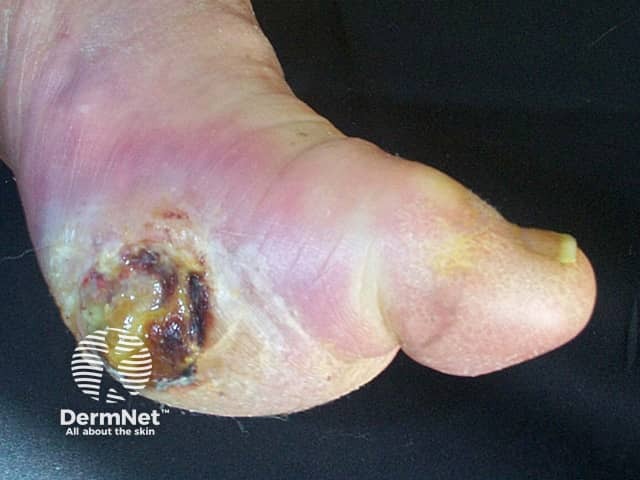
Clinical photograph of a diabetic foot ulcer on the plantar aspect of the foot. Modality and technique: digital clinical photography, macro close‑up, high‑resolution image captured under studio lighting to document wound characteristics. Anatomical location: plantar surface of the midfoot near the hindfoot weight‑bearing area; tissue involved: skin and subcutaneous tissue with an open crater. Visual features: central necrotic base with brown‑black eschar, surrounding yellow slough, irregular wound edges, and periwound edema with mild erythema. Surrounding callus and hyperkeratosis are present on adjacent plantar skin. No visible tendon or bone is apparent in this view. Assessment terms: diabetic neuropathic (neuroischemic) ulcer, chronic non‑healing wound, likely colonized/infected given tissue breakdown. Pathology at the surface includes necrotic tissue, slough, inflammatory exudate, and bacterial colonization risk. Clinical significance: indicates chronic diabetic wound with high risk of infection progression and osteomyelitis if depth is underestimated; requires debridement, offloading, moist wound care, infection control, vascular assessment, and glycemic optimization. Potential clinical uses: baseline assessment, monitoring healing, guiding offloading strategy, educating patient, and planning multidisciplinary management (podiatry, wound care, endocrinology). Synonyms: diabetic foot ulcer, plantar neuropathic ulcer, diabetic plantar wound. Clinical note: assess peripheral pulses, document wound dimensions, and obtain imaging (X-ray/MRI) if osteomyelitis is suspected to guide treatment decisions.
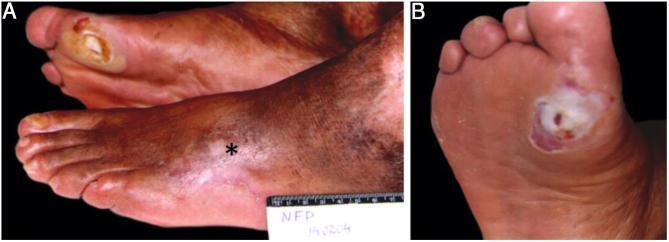
This clinical photograph consists of two panels (A and B) illustrating chronic complications of the diabetic foot. Panel A shows both feet; the left foot presents a healed scar marked with an asterisk (*), indicative of a previous arterial ulcer, while the right foot displays an active neuropathic ulcer located over the plantar aspect of the first metatarsal head. The lower extremities exhibit significant mottled hyperpigmentation and coarse skin texture, suggesting chronic venous or arterial insufficiency. Panel B provides a close-up view of the neuropathic ulcer on the right foot. The lesion is characterized by a central ulceration with a deep, potentially necrotic or fibrin-covered base, surrounded by a prominent, thickened ring of whitish hyperkeratotic callus (perilesional callus). The adjacent tissue shows a reddish-purple hue, consistent with local inflammation or impaired microcirculation. These findings are classic for diabetic neuropathy, where pressure-induced hyperkeratosis precedes ulceration at weight-bearing support points.
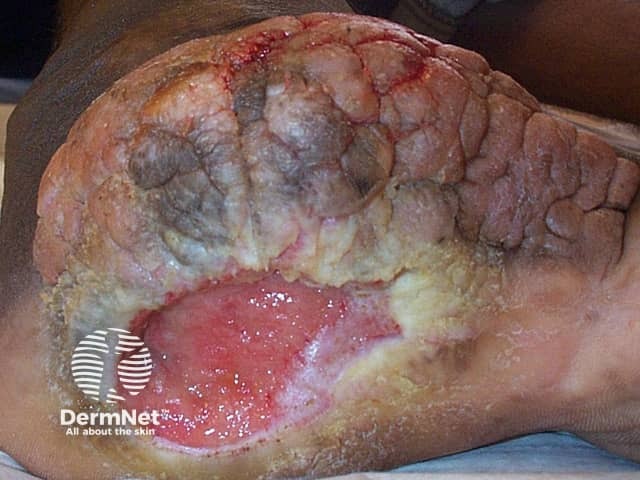
Imaging modality: Clinical photography. Perspective: plantar surface close-up of a chronic neuropathic foot ulcer. Site: plantar midfoot/ball region near the weight-bearing plantar surface of the foot with surrounding callus. Visual features: large, shallow ulcer with a reddened, raw base; yellow-gray necrotic slough rimmed by hyperemic tissue. Surrounding skin shows thickened keratin (callus), fissuring, and mild edema; moisture varies with exudate. The ulcer bed appears to granulate in parts but remains largely necrotic and at risk of secondary infection. No visible intact epidermis over the lesion. Peri-wound area demonstrates crusting and maceration from drainage. The clinical photograph documents a non-healing, neuropathy-associated lesion often seen in diabetes mellitus or peripheral neuropathy; pain is typically reduced, delaying care. In this context, the image highlights pressure-related risk, repetitive friction, and reduced protective sensation contributing to ulcer development. Diagnostic significance: supports diagnosis of a neuropathic (diabetic) plantar foot ulcer; differentiates from ischemic, venous, or pressure ulcers; emphasizes need for off-loading, debridement, moisture balance, infection surveillance, and vascular assessment. Potential uses: medical education, wound-care planning, telemedicine triage, research on wound healing, assessment of treatment response, and algorithm development for neuropathic ulcers. Documentation supports multidisciplinary care, including off-loading devices, infection control, and regular wound monitoring and prognosis.
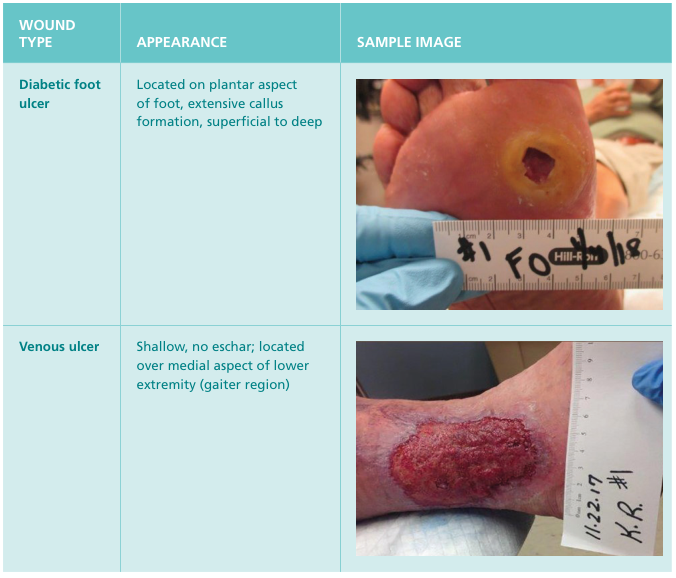
Summary : This figure presents a comparative visual and descriptive overview of two types of chronic wounds: diabetic foot ulcer and venous ulcer, including their typical appearance and photographic examples.
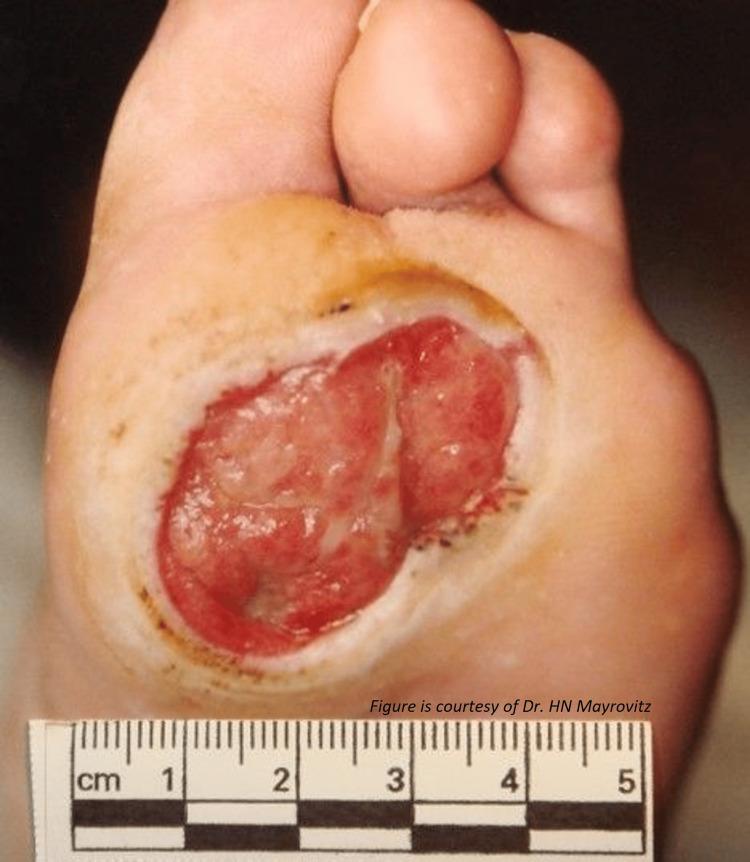
Clinical photograph of a diabetic neuropathic ulcer located on the plantar surface of the foot, specifically over the metatarsal head region. The image displays a large, full-thickness skin lesion measuring approximately 3.5 cm in length and 2.5 cm in width, as indicated by a metric ruler in the foreground. The ulcer bed is characterized by beefy red granulation tissue with a moist, glistening appearance, indicating high vascularity. There is evidence of a hyperkeratotic rim (callus formation) around the irregular, punched-out margins, which is a hallmark of repetitive mechanical stress and neuropathy. The surrounding periwound skin shows mild hyperpigmentation and maceration but lacks significant signs of acute spreading cellulitis. This visual is representative of a Wagner Grade 2 diabetic foot ulcer, serving as a critical educational example for podiatric assessment, wound care management, and the clinical manifestation of diabetic microvascular and neuropathic complications.
Diabetic Foot
Plastic Surgery Viva Notes: Risk Factors, Biomechanics, Types, Deformity Correction, Management, Follow-up and Prognosis
Viva opening line: “A diabetic foot ulcer is not simply a wound. It is a pressure, neuropathy, vascular, infection, and deformity problem. Limb salvage requires correction of all five.”
1. High-yield epidemiology
- A diabetic foot ulcer develops in up to one-third of people with diabetes during their lifetime. More than half may become infected. Sabiston discussion
- Common ulcer sites:
- Plantar first metatarsal head
- Hallux
- Plantar midfoot in Charcot deformity
- Heel
- Tips/dorsum of toes in claw-toe deformity
- Most common cause of a plantar diabetic ulcer: repetitive unperceived pressure in a patient with sensory neuropathy.
- The strongest predictors of future ulceration are:
- previous ulcer
- previous amputation
- loss of protective sensation
- PAD
- foot deformity/callus
- Recurrence is common. Even after healing, recurrent ulceration is a major long-term risk. Diabetic-foot infections may recur in nearly 50% within one year. Sabiston Textbook of Surgery, p. 643.
2. Risk factors
A. Patient factors
| Risk factor | Why it matters |
|---|---|
| Long duration of diabetes and poor glycemic control | Neuropathy, microvascular injury, impaired leukocyte function and healing |
| Peripheral sensory neuropathy | Loss of protective pain sensation |
| Motor neuropathy | Intrinsic muscle wasting, claw toes, prominent metatarsal heads |
| Autonomic neuropathy | Dry skin, fissures, reduced sweating, altered blood flow |
| Peripheral arterial disease | Ischemia, poor healing, increased amputation risk |
| Chronic kidney disease/dialysis | Vascular disease, malnutrition, immune dysfunction |
| Retinopathy/poor vision | Cannot inspect feet or detect trauma |
| Previous ulcer or amputation | Very high recurrence risk |
| Smoking | Worsens PAD and healing |
| Malnutrition/anemia | Poor collagen synthesis and immune competence |
| Immunosuppression | Higher infection risk |
| Poor footwear or barefoot walking | Repetitive trauma and focal pressure |
B. Local risk factors
- Callus, fissure, corn, blister
- Limited ankle dorsiflexion due to Achilles/gastrocnemius tightness
- Claw toe, hammer toe, hallux valgus, hallux rigidus
- Prominent metatarsal head
- Charcot rocker-bottom deformity
- Prior amputation causing transfer lesions
- Foreign body, nail puncture, thermal injury
- Interdigital maceration, tinea pedis, onychomycosis
C. Ulcer-risk stratification: IWGDF
| IWGDF risk | Finding | Suggested surveillance |
|---|---|---|
| 0 | No loss of protective sensation and no PAD | Annual review |
| 1 | Loss of protective sensation or PAD | Every 6-12 months |
| 2 | Loss of protective sensation + PAD, or deformity | Every 3-6 months |
| 3 | Previous ulcer, lower-limb amputation, or end-stage renal disease | Every 1-3 months |
3. Biomechanical considerations
Core mechanism
Neuropathy + deformity + repetitive load
↓
High focal plantar pressure
↓
Callus formation
↓
Subcallosal hemorrhage and skin breakdown
↓
Ulcer
↓
Infection ± osteomyelitis ± ischemia
↓
Amputation if not promptly controlled
Neuropathy and deformity
1. Sensory neuropathy
- Patient cannot feel pain from pressure, burns, a pebble in shoe, or minor injury.
- Thus, the patient continues to walk on an injured area.
- Loss of the 10-g monofilament sensation is clinically important.
2. Motor neuropathy
Intrinsic muscle weakness
↓
MTP hyperextension + IP flexion
↓
Claw toes / hammer toes
↓
Prominent metatarsal heads and dorsal toe pressure
↓
Plantar metatarsal and dorsal toe ulcers
- distal migration of plantar fat pads
- high pressure beneath metatarsal heads
- equinus due to gastrocnemius-soleus/Achilles contracture
- increased forefoot plantar loading
3. Autonomic neuropathy
- Decreased sweat and oil gland function
- Dry, cracked skin
- Fissures become portals for infection
- Arteriovenous shunting may cause warm foot but does not prove adequate nutritive perfusion
4. PAD and neuroischemia
- PAD prevents oxygen and nutrient delivery.
- It may make an infected foot limb-threatening even if pain is minimal.
- In diabetes, arterial calcification can produce falsely elevated ankle-brachial pressure indices. Toe pressure and Doppler waveforms are more useful.
Clinical images
Neuropathic plantar ulcer with a callused rim
Spectrum from fungal interdigital disease to gangrene and deep ulceration
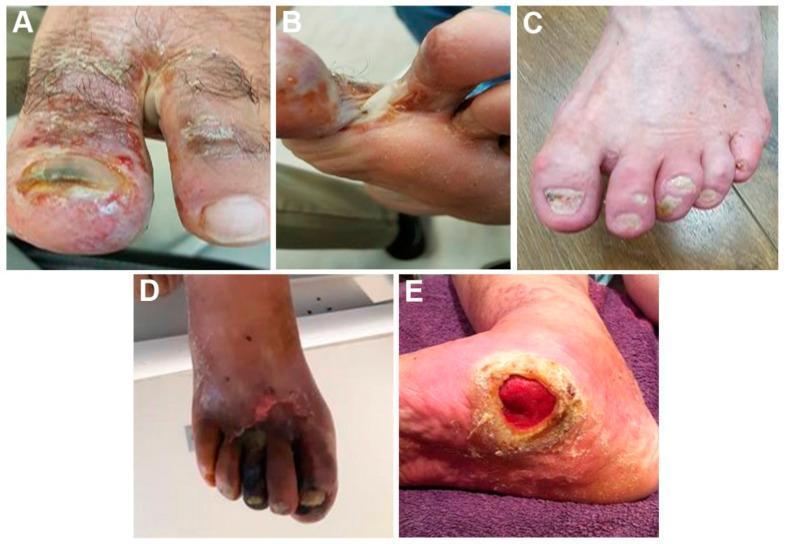
Severe infected diabetic foot with tissue loss
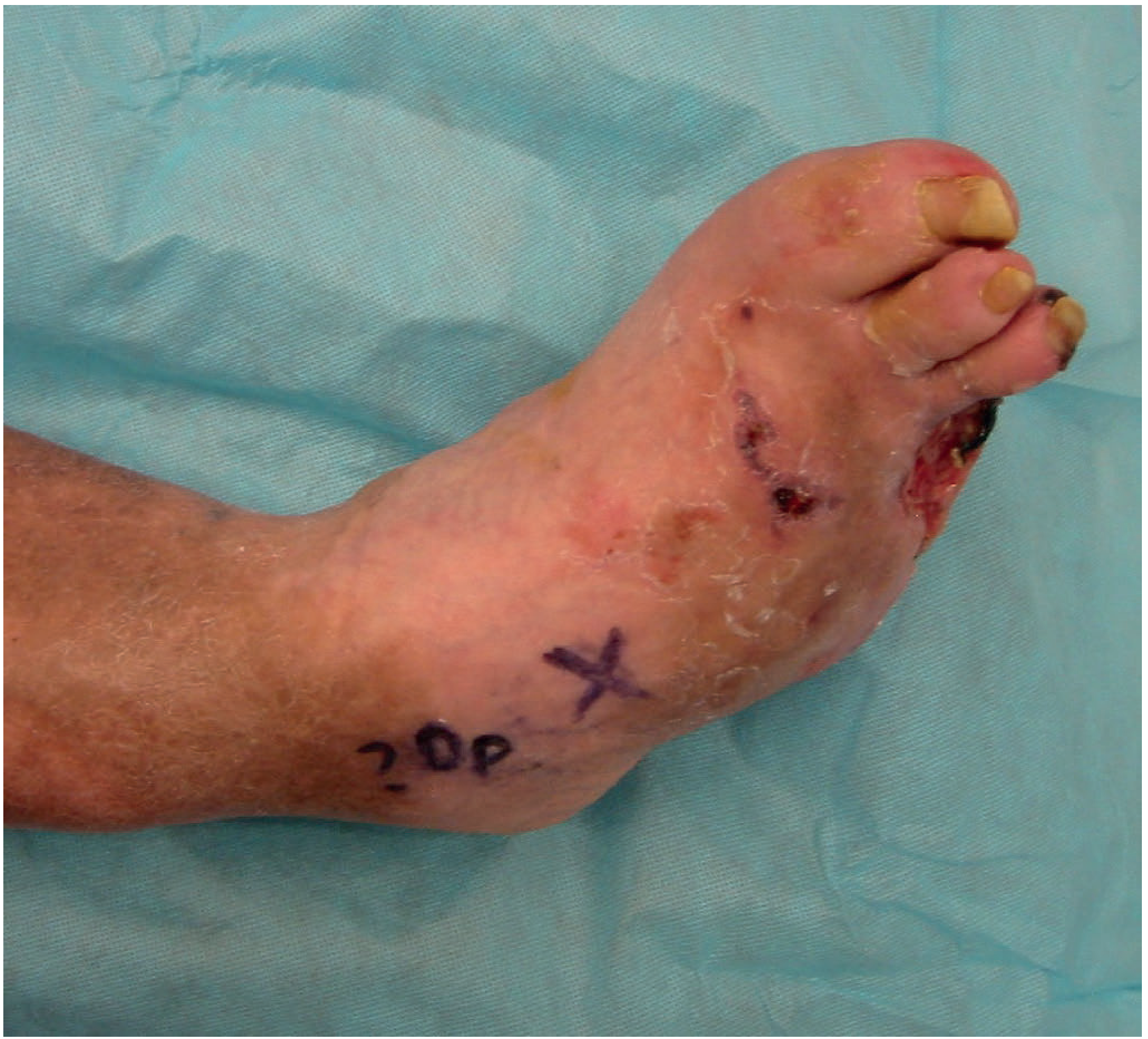
Charcot collapse: rocker-bottom deformity on radiograph
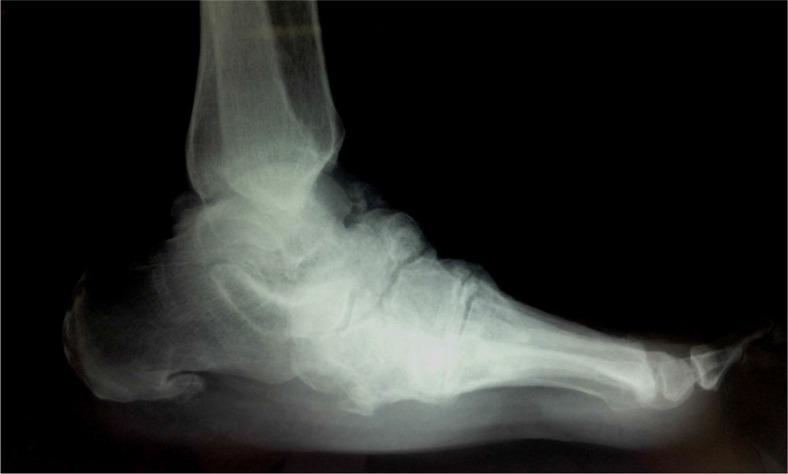
4. Types of diabetic foot disease
A. Based on pathology
| Type | Typical features | Main problem |
|---|---|---|
| Neuropathic foot | Warm, dry, palpable pulses, callus, painless plantar ulcer | High pressure and sensory loss |
| Ischemic foot | Cold, painful, pale/cyanotic, absent pulses, distal toe/edge ulcer | PAD and tissue hypoxia |
| Neuroischemic foot | Neuropathy plus PAD, often little pain despite ischemia | Highest risk of non-healing/infection |
| Infected diabetic foot | Purulence, erythema, warmth, swelling, systemic signs may be absent | Soft-tissue infection, abscess, osteomyelitis |
| Charcot foot | Hot swollen relatively painless foot, bony fragmentation, collapse | Neuroarthropathy and deformity |
| Gangrenous foot | Dry gangrene from ischemia or wet gangrene with infection | Urgent revascularization or amputation decision |
B. Acute versus chronic diabetic foot
Acute diabetic foot emergency
- acute cellulitis
- deep abscess
- necrotizing soft-tissue infection
- wet gangrene
- acute Charcot neuroarthropathy
- acute limb ischemia
- infected ulcer with systemic toxicity
- acute osteomyelitis with sepsis
Chronic diabetic foot
- chronic neuropathic plantar ulcer
- chronic neuroischemic ulcer
- chronic osteomyelitis
- recurrent ulcer over callus/deformity
- chronic Charcot rocker-bottom foot
- healed ulcer with high recurrence risk
5. Ulcer classification
A. Wagner classification
| Grade | Description |
|---|---|
| 0 | Intact skin, high-risk foot or healed ulcer |
| 1 | Superficial ulcer |
| 2 | Deep ulcer involving tendon, joint capsule, or deep fascia |
| 3 | Deep ulcer with abscess, osteomyelitis, or septic arthritis |
| 4 | Localized gangrene of forefoot/toe |
| 5 | Gangrene of whole foot |
B. University of Texas classification
- ulcer depth: superficial, tendon/capsule, bone/joint
- stage: infection and/or ischemia
C. IWGDF/IDSA infection severity
| Grade | Clinical description |
|---|---|
| 1: Uninfected | No local or systemic inflammatory signs |
| 2: Mild | Local infection limited to skin/subcutaneous tissue; erythema >0.5 to <2 cm |
| 3: Moderate | Erythema ≥2 cm and/or deeper involvement: tendon, muscle, joint, or bone, without systemic signs |
| 4: Severe | Foot infection with systemic inflammatory response/sepsis |
6. Assessment and investigations
A. History
- duration and control of diabetes, HbA1c
- previous ulcer, amputation, Charcot foot, revascularization
- fever, malaise, chills
- pain may be absent due to neuropathy
- claudication, rest pain, smoking
- renal disease/dialysis
- footwear, barefoot walking, recent trauma
- symptoms of neuropathy: numbness, burning, paresthesia
- recent antibiotics and prior culture reports
B. Examination: “Look, feel, test, probe”
Look
- Site, dimensions, depth and wound-bed appearance
- Slough, necrosis, granulation tissue, exposed tendon/bone
- Callus, undermining, sinus, discharge, malodor
- Erythema, edema, cellulitis, bullae, crepitus
- Deformity: claw toe, hammer toe, hallux valgus, Charcot collapse
- Interdigital fungal disease and fissures
Feel
- Temperature difference between feet
- Pedal pulses: dorsalis pedis and posterior tibial
- Capillary refill
- Tenderness may be absent
- Fluctuance suggesting abscess
Test
- 10-g monofilament at standard plantar sites
- 128-Hz vibration sense
- pinprick and temperature sensation
- ankle reflexes
- ankle dorsiflexion and Achilles tightness
- gait and footwear examination
Probe-to-bone test
- Use sterile blunt metal probe through ulcer.
- Positive test strongly suggests osteomyelitis in a high-risk ulcer.
- Do not force the probe.
C. Investigations and when to order them
| Test | When to use | Key finding |
|---|---|---|
| CBC, CRP, ESR | Suspected infection, equivocal clinical signs, monitoring | High ESR/CRP supports infection or osteomyelitis but does not prove it |
| Blood culture | Sepsis, fever, severe infection | Bacteremia |
| Deep tissue culture | Infected ulcer after cleansing/debridement | Guides antibiotics |
| Bone biopsy for culture/histology | Suspected osteomyelitis, recurrent infection, resistant organism, failed treatment | Gold standard microbiologic diagnosis |
| Plain foot X-ray | Obtain in almost all moderate/severe ulcers or suspected bone disease | Gas, foreign body, fracture, Charcot changes, late osteomyelitis |
| MRI with contrast if possible | Suspected osteomyelitis/abscess when X-ray is uncertain | Marrow edema, sinus tract, abscess, bone involvement |
| Ultrasound/CT | If MRI unavailable or to define fluid collection | Abscess, gas, anatomy |
| ABI plus Doppler waveform | Screen PAD, but ABI may be falsely high due to calcification | Low ABI suggests PAD |
| Toe-brachial index/toe pressure | Preferred in diabetic PAD | Better estimate of distal perfusion |
| TcPO₂ or skin-perfusion pressure | Predict wound healing and help choose amputation level | Low values indicate poor healing potential |
| CT angiography/MR angiography/catheter angiography | Limb-threatening ischemia or ulcer that will not heal | Maps targets for revascularization |
Important microbiology rule
- Do not rely on a superficial swab.
- After cleansing and debridement, obtain curettage/deep tissue specimen.
- For suspected osteomyelitis, bone culture is preferred when practical.
7. Acute management: the limb-threatening diabetic foot
Immediate priorities
ABCDE + sepsis assessment
↓
Control blood glucose, fluids, analgesia, thromboprophylaxis
↓
Classify: infection? ischemia? neuropathy? Charcot? osteomyelitis?
↓
X-ray + blood tests + deep culture
↓
Urgent surgical and vascular consultation when indicated
↓
Drain/debride + antibiotics + revascularize + offload
Admit urgently if any of the following are present
- systemic toxicity/sepsis
- severe or moderate infection with deep abscess
- necrotizing infection or gas gangrene
- spreading cellulitis
- wet gangrene
- compartment syndrome
- critical limb ischemia
- rapidly progressive necrosis
- infected ulcer with PAD
- inability to offload or perform wound care safely
Antibiotics
General principles
- Diagnose infection clinically, not from a culture alone.
- Do not prescribe antibiotics for a clinically uninfected ulcer.
- Take a deep tissue specimen before antibiotics when this does not delay resuscitation or urgent surgery.
- Choose agents by infection severity, allergy, renal function, local resistance, prior cultures, and likelihood of MRSA/Pseudomonas.
- Narrow therapy after culture results.
Typical adult empirical regimens
| Clinical setting | Typical coverage | Example regimen |
|---|---|---|
| Mild infection, no recent antibiotics | MSSA and streptococci | Amoxicillin-clavulanate 875/125 mg orally every 12 h, or cephalexin 500 mg orally every 6 h |
| MRSA risk | MRSA plus streptococci | Doxycycline 100 mg orally every 12 h, or trimethoprim-sulfamethoxazole DS every 12 h, often combined with streptococcal cover as needed |
| Moderate/severe infection | Gram-positive, Gram-negative, anaerobic cover | Piperacillin-tazobactam 4.5 g IV every 6-8 h |
| Severe infection with MRSA risk | Broad coverage + MRSA | Vancomycin IV plus piperacillin-tazobactam, or vancomycin plus cefepime and metronidazole |
- Mild soft-tissue infection: usually 1-2 weeks.
- Extend toward 3-4 weeks only if extensive, slow to resolve, or severe PAD.
- Osteomyelitis duration is individualized. After complete resection of infected bone with clean margins, courses may be short. If infected bone is retained, treatment is commonly about 6 weeks.
8. Local wound management
The essential “five pillars”
1. Debridement
2. Offloading
3. Infection control
4. Perfusion restoration
5. Metabolic and systemic optimization
A. Debridement
Types
- Sharp/surgical
- Mechanical
- Autolytic
- Enzymatic
- Biological larval therapy in selected settings
Sharp debridement
- callus
- necrotic tissue
- slough
- foreign material
- nonviable tendon/bone where indicated
- abscess wall and devitalized tissue
Operative debridement: indications
- deep abscess
- wet gangrene
- necrotizing infection
- compartment syndrome
- rapidly spreading infection
- extensive necrosis
- infected bone needing resection
- failure of conservative care
B. Wound dressings
- saline cleansing
- moist wound-healing environment
- foam/alginate for moderate-heavy exudate
- hydrogel for dry wound
- antimicrobial dressing only when appropriate
- avoid routine topical antibiotics in deep infection
C. Negative-pressure wound therapy
- adequate debridement
- control of infection
- good perfusion
- post-amputation or post-debridement wound with tissue loss
9. Offloading: the most important healing intervention for neuropathic plantar ulcer
Hierarchy for a neuropathic plantar forefoot/midfoot ulcer
| Rank | Method | Comment |
|---|---|---|
| 1 | Non-removable knee-high total-contact cast or irremovable walker | Best offloading and adherence if no contraindication |
| 2 | Removable knee-high walker | Use if non-removable device contraindicated/intolerable |
| 3 | Removable ankle-high device | Less effective |
| 4 | Felted foam + appropriate footwear | If devices unavailable |
| 5 | Therapeutic footwear/custom insole | Essential after healing and for prevention |
Contraindications to total-contact cast/non-removable device
- severe infection
- moderate/severe ischemia
- heavy exudate needing daily inspection
- fluctuating edema
- untreated osteomyelitis with need for frequent examination
- poor balance/high fall risk
- inability to attend close cast review
10. PAD management and revascularization
When to urgently call vascular surgery
- absent pulses plus ulcer/gangrene
- low toe pressure or TcPO₂
- infected ischemic foot
- ulcer not improving after 4-6 weeks despite optimal wound care/offloading
- rest pain, tissue loss, gangrene
- planned flap, complex reconstruction, or amputation level decision
Principles
- Do not assume a warm diabetic foot is well perfused.
- ABI can be falsely normal or elevated from medial arterial calcification.
- Assess Doppler waveform, toe pressure, and pedal circulation.
- Aim for direct flow to an artery supplying the ulcerated angiosome when feasible.
Options
- Endovascular angioplasty/stenting
- Surgical bypass
- Hybrid revascularization
- Inflow procedure when proximal disease exists
11. Deformity correction and reconstructive surgery
A. Why correct deformity?
Viva line: “Debridement heals the wound, but deformity correction prevents the next wound.”
B. Common deformities and procedures
| Deformity/problem | Pressure point | Corrective procedure |
|---|---|---|
| Equinus/Achilles tightness | Forefoot and midfoot overload | Achilles tendon lengthening or gastrocnemius recession |
| Claw/hammer toes | Toe tip and dorsal PIP ulcer | Flexor tenotomy, tendon balancing, arthroplasty, toe amputation if non-salvageable |
| Prominent metatarsal head | Plantar metatarsal ulcer | Metatarsal-head resection, osteotomy, tendon balancing |
| Hallux rigidus/plantar hallux ulcer | Hallux IP or MTP overload | Exostectomy, arthroplasty, fusion or tendon balancing in selected cases |
| Charcot bony prominence | Plantar midfoot ulcer | Exostectomy if stable deformity; reconstruction/arthrodesis if unstable |
| Recurrent lateral column ulcer | Cuboid prominence | Cuboid exostectomy or midfoot reconstruction |
| Non-salvageable toe/ray infection | Localized sepsis | Toe/ray amputation with pressure redistribution afterward |
C. Achilles tendon lengthening
Indications
- Recurrent plantar forefoot/midfoot ulcer
- Equinus with limited ankle dorsiflexion
- Failure of appropriate offloading/footwear
- Adjunct after ulcer healing to reduce recurrence
Biomechanical rationale
Equinus
↓
Early heel rise during gait
↓
Higher forefoot plantar pressure
↓
Metatarsal-head ulcer
↓
Achilles lengthening decreases forefoot load
Limitation/complications
- Over-lengthening
- Calcaneal gait
- Heel ulcer due to transfer pressure
- Weak push-off
- Tendon rupture
- Requires post-operative protection and careful rehabilitation
D. Flexor tenotomy
Indications
- Flexible claw/hammer toe
- Apical toe ulcer, especially distal hallux or lesser-toe ulcer
- Recurrent ulcer despite footwear
Procedure
- Percutaneous or open division of flexor tendon.
- Often performed as a small outpatient procedure.
- Reduces distal toe pressure rapidly.
Contraindications/caution
- Severe ischemia until revascularization assessment
- uncontrolled infection
- rigid deformity may require bony surgery instead
E. Metatarsal-head resection
Indications
- Recurrent plantar metatarsal-head ulcer
- Osteomyelitis of metatarsal head
- Bony prominence causing a non-healing ulcer
- Failure of total-contact cast and custom orthosis
Principles
- Excise sufficient bone to remove infected/prominent segment.
- Preserve soft-tissue envelope and avoid tension.
- Balance the foot to prevent transfer ulcer at adjacent metatarsal heads.
Limitation
F. Charcot neuroarthropathy
Acute Charcot foot
- unilateral warm, red, swollen foot
- little pain relative to degree of swelling
- normal or mild inflammatory markers
- may mimic cellulitis, DVT, gout, or infection
- early X-ray may be normal
- Immediate immobilization.
- Strict offloading, usually total-contact cast or knee-high device.
- Serial temperature measurement and radiographs.
- MRI if diagnostic uncertainty or concern for osteomyelitis.
- Transition to Charcot restraint orthotic walker, custom footwear, then long-term custom bracing.
Chronic Charcot foot
- Rocker-bottom deformity
- Plantar bony prominence
- Recurrent midfoot ulcer
- Instability or non-plantigrade foot
- recurrent ulcer over bony prominence
- unstable/non-plantigrade deformity
- inability to brace/offload
- deep infection or osteomyelitis
- severe pain from instability, though neuropathy often reduces pain
- exostectomy for isolated stable prominence
- Achilles tendon lengthening
- corrective osteotomy
- midfoot/hindfoot arthrodesis with internal or external fixation
- staged reconstruction if infection is present
- amputation if limb is non-reconstructible or infection/ischemia cannot be controlled
12. Osteomyelitis: practical approach
Suspect osteomyelitis when
- chronic ulcer over bone
- ulcer is deep or >2 cm²
- positive probe-to-bone test
- exposed bone
- elevated ESR/CRP
- recurrent ulcer at same site
- failure to heal despite adequate offloading
- X-ray/MRI changes
Management decision
Suspected osteomyelitis
↓
Probe-to-bone + X-ray + ESR/CRP
↓
MRI if uncertainty remains
↓
Bone specimen when feasible
↓
Is there abscess, necrosis, exposed bone, PAD, or need for drainage?
↓
YES → Debridement/resection of infected bone + antibiotics
NO → Consider antibiotic-only treatment if:
- forefoot disease
- no PAD
- no exposed bone
- no urgent need for incision/drainage
13. Amputation
Indications
- life-threatening sepsis not controlled by debridement
- extensive wet gangrene
- unsalvageable ischemic foot with no revascularization option
- persistent infection/osteomyelitis despite appropriate limb-salvage treatment
- nonfunctional painful foot with recurrent ulceration and no reconstructive solution
- extensive tissue loss with inadequate soft-tissue cover
Principles
- Amputation is not a failure when it restores safe mobility and controls sepsis.
- Preserve maximal functional length only if wound healing is likely.
- Do not choose a distal amputation level without assessing vascularity.
- Consider the patient’s rehabilitation potential, contralateral limb status, vision, renal function, and social support.
14. Follow-up after healing
Wound follow-up
- Weekly or more often during active ulcer treatment, depending on infection/exudate/cast use.
- At every visit:
- measure length × width × depth
- document undermining/sinus
- photograph with scale
- reassess infection and perfusion
- remove callus
- inspect footwear and offloading adherence
- review glucose control and nutrition
After ulcer closure
- High-risk patients: foot review every 1-3 months.
- Moderate-risk patients: every 3-6 months.
- Daily self-inspection by patient/caregiver.
- Custom therapeutic footwear and insoles.
- Prompt presentation for any blister, redness, callus, fissure, drainage, or warmth difference.
- Never walk barefoot.
- Regular podiatry/nail care.
- Smoking cessation, lipid/BP optimization, antiplatelet/statin therapy as indicated for PAD.
15. Prognosis
Favorable prognostic factors
- Pure neuropathic ulcer with good pulses
- Small, superficial ulcer
- No infection or osteomyelitis
- Good offloading adherence
- Rapid reduction in ulcer area within first 4 weeks
- Correctable deformity
- Good glycemic and nutritional status
Poor prognostic factors
- PAD, especially below-knee multilevel disease
- Renal failure/dialysis
- Deep ulcer or exposed bone
- Osteomyelitis
- Severe infection, wet gangrene, necrosis
- Charcot deformity
- Previous amputation
- Non-adherence to offloading
- Smoking and malnutrition
Important outcomes
- Osteomyelitis is a major predictor of amputation.
- Major amputation has a poor long-term survival outcome. Sabiston Textbook of Surgery, p. 643.
- Prevention of recurrence is as important as primary healing.
16. CRUX MANAGEMENT FLOWCHART
PATIENT WITH DIABETIC FOOT ULCER / SWOLLEN FOOT
↓
ASSESS URGENCY: SEPSIS? GANGRENE?
DEEP ABSCESS? NECROTIZING INFECTION? CRITICAL ISCHEMIA?
↓
┌────────────YES─────────────┐
↓ ↓
ADMIT URGENTLY NO IMMEDIATE THREAT
IV ANTIBIOTICS ↓
X-RAY + LABS + CULTURES CLASSIFY FOOT:
URGENT SURGICAL REVIEW Neuropathic / ischemic / infected /
URGENT VASCULAR REVIEW Charcot / osteomyelitis
DRAIN + DEBRIDE ↓
REVASCULARIZE IF NEEDED COMPLETE ASSESSMENT:
↓ Pulses, Doppler, toe pressure,
LIMB SALVAGE OR monofilament, probe-to-bone,
APPROPRIATE AMPUTATION X-ray ± MRI, deep tissue culture
↓
┌───────────────┼────────────────┐
↓ ↓ ↓
NEUROPATHIC ISCHEMIC INFECTED
PLANTAR ULCER / NEUROISCHEMIC ULCER
↓ ↓ ↓
SHARP CALLUS DEBRIDEMENT VASCULAR IMAGING DEEP CULTURE
NON-REMOVABLE URGENT ANTIBIOTICS
KNEE-HIGH OFFLOADING REVASCULARIZATION DRAIN/DEBRIDE
MOIST WOUND CARE + WOUND CARE IF ABSCESS/NECROSIS
↓ ↓ ↓
DOES IT HEAL? OFFLOAD + ASSESS FOR
↓ PROTECT OSTEOMYELITIS
NO OR RECURRENT ↓
↓ ↓
FIND/CORRECT DEFORMITY: MRI ± BONE BIOPSY
Achilles lengthening, ↓
flexor tenotomy, ↓
metatarsal-head resection, Bone resection + antibiotics
Charcot exostectomy/
reconstruction
↓
CUSTOM FOOTWEAR + LIFELONG SURVEILLANCE
Final viva summary
“In diabetic foot, first determine whether there is infection, ischemia, or Charcot change. Then treat with debridement, culture-directed antibiotics only when infected, offloading, vascular assessment and revascularization where needed, metabolic optimization, and correction of the deformity causing abnormal pressure. A healed ulcer without pressure redistribution is a recurrent ulcer waiting to happen.”
Create a diabetic-foot management flowchart PDF
~/
IWGDF 2023 diabetic foot practical guideline urgent infection ischemia offloading management algorithm
mkdir -p "/tmp/workspace/diabetic-foot-flowchart/src" "/tmp/workspace/diabetic-foot-flowchart/output"
Convert the given pdf into PPT format and give it to me into a downloable format. Use as many slides as possible and add clinical pictures as much as possible, also add a detailed list of amputations with photographs of the same
Convert the given pdf into PPT format and give it to me into a downloable format. Use as many slides as possible and add clinical pictures as much as possible, also add a detailed list of amputations with photographs of the same
~/
~/attachments
~/diabetic-foot-flowchart
~/attachments/c7c31351-9feb-4752-8ce4-defa10ddfead
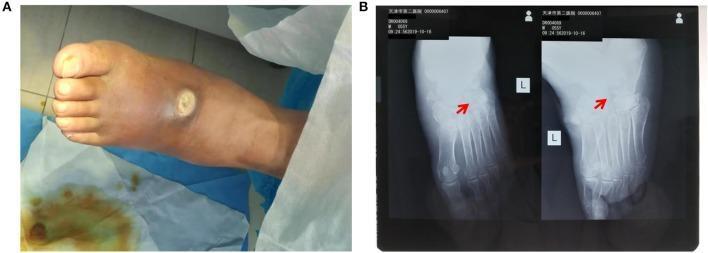
lower limb amputation levels toe ray transmetatarsal below knee above knee clinical photograph diagram
diabetic foot amputation levels toe ray transmetatarsal Lisfranc Chopart Syme below knee above knee educational diagram
diabetic foot amputation transmetatarsal ray toe Syme below knee clinical procedure photograph
python - <<'PY' from pypdf import PdfReader p='/tmp/workspace/attachments/c7c31351-9feb-4752-8ce4-defa10ddfead/Diabetic Foot.pdf' r=PdfReader(p) print('PAGES',len(r.pages)) for i,page in enumerate(r.pages,1): t=(page.extract_text() or '').replace('\x00',' ') print(f'\n--- PAGE {i} ---\n{t[:5000]}') PY
diabetes lower extremity amputation clinical photograph below knee prosthesis partial foot amputation
python /tmp/skills/shared/scripts/fetch_images.py "https://cdn.orris.care/cdss_images/pmc_clinical_VQA_44e9e67f777c56d00ecfbde3fd2c27b495d57d58a799fc652fcfde02f9e34132.jpg" "https://cdn.orris.care/cdss_images/pmc_clinical_VQA_48c73d8256a477709baa2ce46cc83f8329784ceadc6b740fa031d22f3b9aeb50.jpg" "https://cdn.orris.care/cdss_images/pmc_clinical_VQA_04bd5c7c0d25c533770acd017d32838379850a2343191e5ee14b1d3b02c95282.jpg" "https://cdn.orris.care/cdss_images/pmc_clinical_VQA_1d121e59ec5e7791fb6d0feda974c3b0de94dae2cc15999e0bd51cba08558b23.jpg" "https://www.researchgate.net/publication/359599244/figure/fig1/AS:1147110133108739@1650503776430/Levels-of-the-foot-amputations-including-Syme-transmetatarsal-Lisfranc-and-Chopart.jpg" "https://ars.els-cdn.com/content/image/1-s2.0-S0263931913000641-gr1.jpg"
~/
- Burden and risk - definition, epidemiology, risk factors, and IWGDF risk stratification.
- Pathogenesis and phenotypes - neuropathy, PAD, biomechanics, ischemic, neuropathic, neuroischemic, infected, and Charcot foot.
- Assessment and classification - examination, ulcer probing, laboratory testing, imaging, cultures, Wagner, University of Texas, and infection severity systems.
- Urgent infection and limb-salvage management - admission triggers, antibiotics, surgical drainage/debridement, vascular planning, and osteomyelitis.
- Ulcer healing and prevention - wound care, dressings, NPWT, offloading, footwear, recurrence prevention, and deformity correction.
- Amputation levels and rehabilitation - toe through hemipelvectomy, level-specific principles, function, complications, and prosthetic implications.
- Clinical algorithms and viva revision - decision pathways, prognosis, key takeaways, and references.
Choose the section to develop next.
HYPERTROPHIC SCAR AND KELOID
Complete Plastic Surgery Viva Guide
1. DEMOGRAPHY & EPIDEMIOLOGY
- Most common site of keloid: Sternal/presternal region
- Most common site for minor keloid: Earlobe (after ear piercing)
- Most common race affected: Black Africans (incidence 4-16x higher than Caucasians); also Asians and Hispanics
- Least common sites: Face (central), palms, soles, genitalia
- Age: Young adults (peak 10-30 years); rare in infancy and old age
- Sex: Equal in both; some studies suggest slightly higher in females (due to ear piercing)
- Worldwide prevalence: 4.5-16% in darkly pigmented skin populations vs. <1% in Caucasians
2. BASIC DEFINITIONS & DIFFERENCES
| Feature | Hypertrophic Scar | Keloid |
|---|---|---|
| Boundary | Stays within original wound margins | Invades beyond wound margins |
| Onset | Weeks after injury | Months to years |
| Spontaneous regression | Yes (over months to years) | No (continues growing) |
| Recurrence after surgery | Low | High (50-100%) |
| Symptoms | Usually asymptomatic | Pruritus, pain, burning |
| Distribution | Common on joints, burn areas | Sternal, earlobe, shoulder, neck |
| Behavior | Tumor-like? No | Tumor-like? Yes |
3. CAUSES / ETIOLOGY
Genetic Factors
- Autosomal dominant inheritance with incomplete penetrance (familial keloids documented)
- HLA associations: HLA-B14, HLA-B21, HLA-DRB1*15 associated with keloid susceptibility
- Chromosome 2q23 locus implicated in familial keloids
- Multiple genes involved: NEDD4, CYP1B1, HMGA2 mutations reported
Environmental / Triggering Factors
- Trauma - most common trigger: surgery, burns, lacerations, abrasions, piercings
- Infections: acne pustules (chest/back keloids), folliculitis, chickenpox
- Vaccinations: BCG vaccination - a classic cause of deltoid keloids
- Tension: wounds perpendicular to Langer's lines, wound under high tension
- Hormones: puberty and pregnancy worsen keloids (hormonal influence); testosterone implicated
- Location: certain anatomic sites are inherently high risk (see below)
High-Risk Sites (Viva Key)
- Sternum (presternal region)
- Anterior chest/shoulders/deltoid
- Neck
- Deltoid/upper arm
- Earlobes
- Scalp (after burns)
Pathogenesis (Molecular)
- TGF-β1 and TGF-β2 (profibrotic cytokines) - overexpressed → stimulate fibroblasts → excess collagen I, III
- TGF-β3 (antifibrotic) - reduced in keloids
- IL-6, IL-8, IL-10, VEGF - elevated → promote fibroblast proliferation and angiogenesis
- PDGF (Platelet-Derived Growth Factor) - stimulates fibroblast mitosis
- Apoptosis failure: keloid fibroblasts are resistant to apoptosis (p53 dysfunction, overexpressed bcl-2)
- Mechanical stress: tension activates mechanoreceptors → TGF-β pathway activation
- MAPK/ERK pathway: activated in keloid fibroblasts
- Wnt signaling pathway: aberrantly activated
- Mast cells: increased number; mast cell-derived histamine causes pruritus + stimulates fibroblast proliferation
4. CLINICAL FEATURES
Hypertrophic Scar
- Raised, red/pink, firm scar within wound boundaries
- Appears within weeks of injury
- Associated with linear scars, burns, areas of skin tension
- Usually regresses spontaneously over 12-18 months
- May cause itching and discomfort during active phase
- No clawlike extensions
Keloid
- Firm, rubbery, pink-to-purplish nodule extending beyond wound margins
- Clawlike (cheloid) prolongations - pathognomonic
- Never regresses spontaneously
- Actively growing edge (peripheral) + inactive dense centre
- Surface is smooth, glossy, thinned
- Symptoms: pruritus (MC), pain, burning sensation
- May be tender to touch; rarely ulcerates or forms sinus tracts
- Sternal keloids can be large; earlobe keloids often "dumbbell-shaped" when lobule is pierced
5. CLASSIFICATION
A. Mustoe International Classification (2002, most widely used)
| Type | Description |
|---|---|
| Linear hypertrophic | Raised, red; within scar; follows trauma line; regresses in 2 yrs |
| Widespread hypertrophic | Widespread (e.g., burns); stays within wound borders |
| Minor keloid | Small, locally raised; extends beyond wound; may stabilize; earlobe most common |
| Major keloid | Large (>0.5 cm), raised, possibly painful; extends beyond wound; continues spreading for years; butterfly pattern in severe cases |
B. Based on Etiology
- Post-traumatic (surgical, accidental injury)
- Post-inflammatory (acne, folliculitis, chickenpox)
- Spontaneous (rare - appears without obvious trauma)
C. Japan Scar Workshop (JSW) 2015 Scar Scale (JSS 2015)
- Score 0-5: Mature scar
- Score 6-15: Hypertrophic scar
- Score 16-25: Keloid
- Scores based on risk factors (genetics, site, race) + clinical features (height, color, symptoms)
D. Vancouver Scar Scale (VSS) - for objective severity grading
| Parameter | Score | Description |
|---|---|---|
| Pliability | 0-5 | Normal → Supple → Yielding → Firm → Banding → Contracture |
| Height | 0-3 | Flat → <2mm → 2-5mm → >5mm |
| Vascularity | 0-3 | Normal → Pink → Red → Purple |
| Pigmentation | 0-2 | Normal → Hypopigmented → Hyperpigmented |
6. INVESTIGATIONS
When to Investigate & What to Do
A. Clinical Assessment
- Usually clinical diagnosis is sufficient
- VSS scoring for objective documentation
- Photography for baseline and follow-up
B. Dermoscopy
- Helps distinguish active vs. quiescent scar
- Active keloid: visible vessels, erythema at periphery
C. Ultrasound
- High-frequency ultrasound (20 MHz): measures scar thickness; useful for monitoring treatment response
- Identifies extent of dermal involvement
D. MRI
- For giant/deep keloids to assess extent and plan surgery
E. Histopathology / Biopsy
- Atypical clinical presentation
- Suspicion of malignancy (carcinoma en cuirasse, DFSP, desmoplastic melanoma can mimic keloid)
- Rapid unexpected growth
- Ulceration, bleeding not explained by trauma
- No history of trauma at site
- Classic clinical appearance in known keloid-prone individual - biopsy itself can trigger/worsen keloid formation
- Avoid incisional biopsy at high-risk sites if diagnosis is clear
7. BIOPSY - HOW TO TAKE, PATHOLOGY, IHC
How to Take
- Punch biopsy (3-4mm) preferred over incisional biopsy to minimize new wound
- Take from the active edge (advancing margin) - most cellular and informative
- Handle with care - use minimal trauma technique
- In known keloid-prone patient - if biopsy is truly needed, plan surgical excision of the entire lesion at the same time
Cells of Origin
- Fibroblasts (activated myofibroblasts are the primary cell)
- Mast cells (increased)
- Macrophages
- Endothelial cells (neovascularization)
Histopathology (KEY VIVA TABLE)
| Feature | Hypertrophic Scar | Keloid |
|---|---|---|
| Epidermis | Flattened | Not involved |
| Papillary dermis | Fibrotic | NOT involved |
| Fibroblasts | Increased | Not increased within keloidal collagen |
| Collagen bundles | Fine, wavy; parallel to epidermis | Large, thick, haphazardly oriented ("keloidal collagen") |
| Elastic fibers | Diminished/absent | Increased in deep dermis |
| Blood vessels | Increased; vertical orientation | Not increased; few vertically oriented vessels |
| Inflammatory infiltrate | Sparse, perivascular | Sparse, perivascular |
| Mast cells | Increased | Increased |
| Dermal mucin | Increased | Increased |
| Myofibroblasts | +++ (prominent) | ++ (present) |
| Characteristic finding | - | Thick glassy homogeneous collagen nodules |
IHC Findings
| Marker | Hypertrophic Scar | Keloid | Notes |
|---|---|---|---|
| α-SMA (myofibroblasts) | +++ (prominent nodules) | ++ (45-70%) | Conflicting reports |
| COX-1 | ~50% | 100% | Favors keloid |
| CD34 | Negative | Negative | Helps exclude DFSP |
| Factor XIIIa | Negative | Negative | Helps exclude dermatofibroma |
| S100 | Minimal/absent | Minimal/absent | Excludes desmoplastic melanoma |
| Ki-67 | Variable | Higher at advancing edge | Reflects proliferative activity |
8. MANAGEMENT
Overview - General Principles
"No single proven best therapy exists; combination therapy is superior to monotherapy; keloids require adjuvant therapy after any surgery; hypertrophic scars have better outcomes."
8.1 PREVENTION (First-Line Strategy)
- Tension relief: Close wounds parallel to Langer's lines; use subcutaneous/fascial sutures to reduce skin tension
- Silicone gel/sheets: Apply 2 weeks post-wound closure; 12-24 hours/day; for 12-24 weeks - first-line prophylactic and treatment option (Bailey & Love, Bailey)
- Pressure garments: Start as soon as wound is closed; especially for burns; >25 mmHg pressure; worn 23 hrs/day
- Taping: 3+ months post-closure; changes every 24-48 hours
- Sunscreen SPF 50+: For 1 year post-op to prevent hyperpigmentation
- Avoid: Nonessential surgery at high-risk sites in keloid-prone individuals
- Avoid: Secondary intention healing in high-risk patients (delays healing >2-3 weeks → higher risk)
8.2 NON-SURGICAL TREATMENTS
A. Intralesional Corticosteroids (ILCs) - Gold Standard First-Line
| Parameter | Details |
|---|---|
| Concentration | 10-40 mg/mL (start 10 mg/mL for softened lesions; 40 mg/mL for resistant) |
| Maximum dose | 80 mg per month (recent e-Delphi consensus) |
| Interval | Every 4-6 weeks (some sources say 6-8 weeks) |
| Technique | 30-gauge needle on 1-mL tuberculin syringe; inject INTO the lesion (not SC) |
| Mechanism | Inhibits fibroblast proliferation; decreases collagen synthesis; decreases TGF-β; promotes collagen degradation; anti-inflammatory |
| Response rate | 50-100%; recurrence up to 50% |
| Endpoints | Flattening + cessation of itching |
- Skin atrophy (inject only into scar tissue)
- Hypopigmentation (dose-dependent; commoner with higher concentrations)
- Telangiectasia formation
- Adjacent fat atrophy if injected beyond scar
- Pain during injection
- Cushingoid features if large amounts used
B. 5-Fluorouracil (5-FU) - Second Line / Combination
| Parameter | Details |
|---|---|
| Dose | 50 mg/mL intralesionally |
| Frequency | Weekly for 12 weeks |
| Mechanism | Antimetabolite; inhibits fibroblast proliferation by blocking DNA synthesis (S-phase) |
| Combination | TAC 10 mg/mL + 5-FU 45 mg/mL (9:1 ratio) - synergistic |
| Side effects | Pain at injection, ulceration, hyperpigmentation (lighter), myelosuppression (rare) |
| Evidence | Combination TAC + 5-FU superior to either alone |
C. Bleomycin
| Parameter | Details |
|---|---|
| Dose | 1.5 IU/mL; intralesional injections or multi-needle technique |
| Mechanism | Inhibits collagen synthesis; induces fibroblast apoptosis; cleaves DNA |
| Use | Alternative to TAC; especially darker skin tones (less hypopigmentation) |
| Side effects | Atrophy, pain, flagellate hyperpigmentation, pulmonary toxicity at high doses (rare with intralesional) |
D. Verapamil
| Parameter | Details |
|---|---|
| Dose | 2.5 mg/mL intralesionally, every 2 weeks |
| Mechanism | Calcium channel blocker; decreases IL-6, VEGF; inhibits fibroblast cell growth; increases collagenase activity |
| Use | Adjunct to TAC; useful in patients with contraindications to steroids |
E. Botulinum Toxin A
| Parameter | Details |
|---|---|
| Dose | Variable; ~2.5 units/cm² intralesionally |
| Mechanism | Pauses fibroblast cell cycle; reduces TGF-β1 expression; decreases muscle tension → reduces mechanical stimulus for scar formation |
| Evidence | Meta-analysis (PMID 39447283): TAC + BotA superior to TAC alone |
| Use | Peri-incisional or intralesional for prevention and treatment |
F. Silicone Gel/Sheeting
| Parameter | Details |
|---|---|
| Mechanism | Reduces transepidermal water loss (TEWL); hydrates stratum corneum; reduces mast cell numbers; reduces TGF-β2 |
| Duration | 12-24 weeks; 12-24 hours/day |
| Evidence | Level B (well-accepted first-line; Cochrane review quality generally poor) |
| Products | Sheets (Cica-Care, Mepiform) vs. Gels (Dermatix, Kelo-cote) |
G. Pressure Therapy
- 25+ mmHg; worn 23 hrs/day; changed when worn
- Mechanism: reduces wound oxygen tension → decreases myofibroblast proliferation; collagen I & III reduction seen within 1 week
- Duration: Until scar maturation (6-18 months)
H. Emerging / Novel Agents
| Agent | Mechanism | Notes |
|---|---|---|
| Imiquimod 5% cream | Induces IFN-α/β, NK cells; antifibrotic | Post-excision adjuvant |
| Tacrolimus | Calcineurin inhibitor; anti-inflammatory | Topical for smaller lesions |
| Sirolimus (rapamycin) | mTOR inhibitor; anti-proliferative | Emerging evidence |
| Losartan 5% ointment | Angiotensin II antagonist; reduces TGF-β1 | Pilot study - significant improvement |
| Tranilast | Inhibits TGF-β, collagen synthesis | Japan/Korea; oral use |
| Retinoids | Regulate gene expression; modulate TGF-β | Topical/systemic |
| Tamoxifen | Anti-estrogen; antifibrotic | For gender-specific management |
| Onion extract (Contractubex) | Anti-inflammatory, antifibrotic | Used as adjunct |
| Dupilumab | IL-4/IL-13 receptor blocker | Case reports - reduces pruritus and appearance |
8.3 LASER THERAPY
| Laser | Mechanism | Best For |
|---|---|---|
| Pulsed Dye Laser (PDL) 585/595 nm | Photothermolysis of oxyhemoglobin → obliterates capillaries; reduces TGF-β1; reduces collagen synthesis | Erythema, early scars, vascularity |
| CO2 Laser (ablative) | Ablates microscopic columns of tissue; stimulates MMPs → collagen reorganization | Thickness, texture, contracture |
| Nd:YAG 1064 nm | Deep tissue penetration; reduces collagen | Combined with TAC |
| Fractional lasers | Fractional photothermolysis; resurfaces with less risk | Hypertrophic scars |
8.4 CRYOTHERAPY
- Mechanism: Ice crystal formation → vascular disruption → fibroblast apoptosis → collagen destruction; also reduces TGF-β1
- Technique: Contact, spray, or intralesional needle cryoprobe
- Protocol: Three freeze-thaw cycles, 30-second sessions, every 3-4 weeks
- Best for: Small isolated keloids; earlobe keloids
- Side effects: Hypopigmentation (significant in dark skin - limit use), pain, blistering
8.5 SURGICAL MANAGEMENT
Indications for Surgery
- Functional impairment (contracture limiting joint movement)
- Large hypertrophic scars after 1 year of conservative management
- Keloids refractory to 12 months of conservative therapy
- Diagnostic uncertainty (simultaneous biopsy + excision)
- Earlobe keloids (after ILC failure)
- Symptomatic lesions (severe pain/pruritus unresponsive to medical treatment)
Contraindications / Relative Contraindications to Surgery
- Active growing keloid (relative)
- No adjuvant therapy planned (excision alone → 50-100% recurrence for keloids)
- Patient unwilling to comply with prolonged post-op adjuvant treatment
- High-risk anatomic sites with no clear functional benefit
- Young patients with strong keloid history and small lesion (try conservative first)
Limitations
- Keloid surgery alone → 50-100% recurrence rate (always needs adjuvant)
- Cannot cure genetic predisposition
- Each new wound = new opportunity for keloid formation
Surgical Steps - Keloid Excision
- Mark the lesion; plan excision margins
- LA with lidocaine + adrenaline + TAC mixture (reduces bleeding + immediate antikeloid effect)
- Intralesional excision (leave thin shell of scar to close over without creating raw wound bed) OR complete excision depending on size
- Tension-free primary closure with subcuticular sutures (monofilament)
- Immediate (within 24-48 hours) post-op adjuvant therapy: radiation OR ILC injection
- Start silicone gel and pressure earring post-operatively
- Simple scar resection + primary closure with:
- Adjacent tissue undermining
- Deep subcutaneous tensile reduction sutures
- Z-plasty (gains length, reorients scar along relaxed skin tension lines)
- W-plasty / geometric broken line closure (for facial scars)
- V-Y, Y-V plasty
- Local or free flaps (for large areas, severe contractures)
- Post-op: taping for 3 months + silicone therapy
- Standard Z-plasty: 60° angles → 75% length gain
- 45° angles → 50% length gain; 30° angles → 25% length gain
- Transposes tissue, relieves tension, breaks up linear scar
- Used for: contractures across joints, reorienting scar along RSTL
- For widespread large hypertrophic scars
- Generates extra skin for reconstruction
- Serial excision over multiple sessions
8.6 RADIATION THERAPY
| Parameter | Details |
|---|---|
| Timing | Within 24-48 hours post-excision (within 24 hours optimal) |
| Best dose | 10 Gy single-fraction EBRT (electron beam) - recurrence rate 0.81% (2024 study) vs. 9.5 Gy (8.47% recurrence) |
| Alternative fractionation | 5 × 3 Gy (biologically effective dose 52.5 Gy²) - recurrence 26-32% |
| Brachytherapy | High-dose-rate or low-dose-rate; placed in wound at time of surgery |
| Efficacy | Reduces keloid recurrence by 50-95% when combined with surgery |
| Mechanism | Inhibits fibroblast proliferation; reduces TGF-β; prevents new vessel formation |
- Theoretical carcinogenic risk (literature has NOT proven significant association)
- Not preferred in young patients, areas near gonads/thyroid
- Skin atrophy, telangiectasia as late effects
- Avoid in pediatric patients
8.7 COMBINED / MULTIMODAL APPROACH
The NMS (Nippon Medical School) Protocol (Ogawa et al.): Surgery + immediate post-op radiation + ILC injections + silicone + pressure = best outcomes
9. APPROACH TO A PATIENT (Practical Algorithm)
PATIENT PRESENTS WITH ABNORMAL SCAR
↓
Is it within wound margins? → YES → Hypertrophic Scar
NO → Keloid
↓
ASSESS: Size, site, symptoms, VSS score, age, race, patient expectations
Hypertrophic Scar Management by Stage:
| Situation | Management |
|---|---|
| Early (<6 months), small, linear | Silicone gel + pressure + massage; observe |
| Active, symptomatic (6 weeks - 6 months) | Add ILC TAC 10-40 mg/mL every 4 weeks |
| Persistent >6 months | Continue silicone; add laser (PDL/CO2) |
| Permanent >12 months (not regressing) | Surgical revision (Z-plasty/excision) + post-op silicone |
| Contracture across joint | Urgent surgery: Z-plasty, flap, or skin graft + aggressive physio |
Keloid Management by Type:
| Type | First-Line | Second-Line | Third-Line |
|---|---|---|---|
| Minor keloid (earlobe) | ILC TAC 40 mg/mL every 6-8 weeks | ILC + 5-FU; Cryotherapy | Excision + ILC + radiation |
| Minor keloid (other sites) | Silicone + ILC | Laser (PDL) + ILC | Surgery + radiation |
| Major keloid (responsive) | ILC + silicone + pressure | Add 5-FU/bleomycin | Surgery + brachytherapy/EBRT |
| Major keloid (refractory) | Counsel patient; symptomatic Rx (antihistamines) | Surgery + immediate radiation | Experimental (dupilumab, sirolimus) |
Specific Scenarios (Viva Gold):
| Scenario | Answer |
|---|---|
| Small earlobe keloid, young patient, first episode | ILC TAC 40 mg/mL; repeat 6-8 weekly; no surgery yet |
| Large sternal keloid, refractory to ILC x 12 months | Surgical excision + immediate post-op EBRT 10 Gy + post-op silicone + pressure |
| Hypertrophic scar contracture of neck, child, post-burn | Flap repair (preferred over graft) + physio + pressure garment; NOT excision alone |
| Keloid in pregnant patient | Silicone gel + low-pressure garment; avoid ILC and radiation; surgery deferred |
| Keloid biopsy shows no keloidal collagen (45% cases) | Look for tongue-like advancing edge, horizontal fibrous band, sharp demarcation from normal dermis |
10. FOLLOW-UP & PROGNOSIS
Follow-Up Schedule
- Monthly for first 3 months (active treatment)
- Every 3 months for first year
- Every 6 months for 2nd year
- Keloids: Follow for minimum 2 years - recurrences may not appear until 6 months to 2 years post-treatment
Prognosis
| Factor | Better Prognosis | Worse Prognosis |
|---|---|---|
| Type | Hypertrophic scar | Keloid |
| Site | Extremities, face (except jaw) | Sternum, deltoid, earlobe |
| Race | Caucasian | African, Asian |
| Treatment | Multimodal | Monotherapy |
| Age | Elderly | Young adults (adolescence) |
| Genetics | No family history | Familial keloids |
| Hypertrophic scar | Spontaneous regression 6-18 months common | Contracture formations resist regression |
Recurrence Rates (Keloid)
| Treatment | Recurrence Rate |
|---|---|
| ILC alone | 30-50% |
| Surgery alone | 50-100% |
| Surgery + ILC | 15-20% |
| Surgery + radiation | 14-15% |
| Surgery + ILC + radiation | <10% |
| Surgery + ILC + radiation + silicone | Best outcomes |
11. RECENT EVIDENCE (PubMed 2023-2025)
- PMID 39447283 (Burns, 2024 Meta-Analysis): TAC + Botulinum toxin A combination significantly superior to TAC alone for both hypertrophic scars and keloids
- PMID 38347765 (J Burn Care Res, 2024 Systematic Review): Laser-assisted drug delivery (LADD) using fractional CO2 + TAC/5-FU is effective for hypertrophic scars and keloids
- PMID 38760539 (Aesthetic Plast Surg, 2024 Network Meta-Analysis): PDL and CO2 laser most effective laser modalities; PDL best for erythema, CO2 best for thickness
- 2024 Single-center study: 10 Gy single-fraction EBRT within 24 hours post-surgery → 0.81% recurrence rate (vs. 8.47% with 9.5 Gy)
12. CRUX FLOWCHART - MANAGEMENT ALGORITHM
╔══════════════════════════════════════════════════════════════════╗
║ PATIENT WITH HYPERTROPHIC SCAR / KELOID ║
╚══════════════════════════════════════════════════════════════════╝
│
┌───────────────┴───────────────┐
▼ ▼
HYPERTROPHIC SCAR KELOID
(within margins, (beyond margins,
may regress) never regresses)
│ │
┌─────────┴──────────┐ ┌─────────┴──────────┐
▼ ▼ ▼ ▼
EARLY LATE MINOR MAJOR
(<6 mo) (>6 mo) (earlobe, (sternal,
small) large)
│ │ │ │
▼ ▼ ▼ ▼
Silicone+ ILC TAC ILC TAC 40 Silicone+
Pressure 10-40mg/mL mg/mL q6-8wks Pressure+
Observe q4wks ILC TAC 40mg/mL
│ NO RESPONSE │
▼ after 12 mo ▼
Laser PDL │ ILC + 5-FU +
+/- CO2 ▼ Bleomycin/
SURGICAL EXCISION Verapamil
+ (combination)
IMMEDIATE ADJUVANT │
───────────────── NO RESPONSE
EBRT 10 Gy within │
24-48 hrs ▼
+ SURGERY +
ILC post-op EBRT 10 Gy +
+ ILC post-op
SILICONE + +
PRESSURE SILICONE +
│ PRESSURE
▼ │
FOLLOW-UP FOLLOW-UP
Monthly x3 Monthly x3
then q3/12 then q3/12
for 1-2 yrs for 2 yrs
13. QUICK RECALL MNEMONICS
- Klaws beyond borders (keloid)
- Ever regresses? No (keloid never regresses)
- Late onset (months-years)
- Odd thick hyalinized collagen histologically
- Itching + pain (more in keloid)
- Dark skin (more common)
- Compression + silicone (first)
- Laser (second)
- Intralesional injections (TAC ± 5-FU)
- Pressure garments
- Surgery (last resort, ALWAYS with adjuvant)
- Radiation (adjuvant post-surgery for keloid)
- Andrews' Diseases of the Skin (11e) - Keloid section
- Dermatology 2-Volume Set 5e (Bolognia) - Ch. 98
- Sabiston Textbook of Surgery - Prevention & Treatment of Hypertrophic/Keloid Scars
- Bailey & Love's Short Practice of Surgery (28e)
- Schwartz's Principles of Surgery (11e) - Burns chapter
- Mustoe TA et al. International Clinical Recommendations on Scar Management (2002)
- Recent PubMed Systematic Reviews (2024): PMIDs 39447283, 38347765, 38760539I already covered this topic in full detail just above! Here is the complete guide again for your theoretical exam preparation - same topic, now formatted for theory (slightly more depth on mechanisms and less viva-bullet style):
HYPERTROPHIC SCAR AND KELOID
Complete Plastic Surgery Theory Exam Guide
1. DEMOGRAPHY & EPIDEMIOLOGY
- Most common site of keloid: Sternal/presternal region
- Most common site for minor keloid: Earlobe (after ear piercing)
- Most common trigger: Trauma (surgery, burns, piercings)
- Most common symptom: Pruritus
- Most common race affected: Black Africans (4-16x higher incidence than Caucasians); also Asians > Hispanics > Caucasians
- Least common sites: Central face, palms, soles, genitalia (palms and soles almost never affected)
- Age: Peak incidence 10-30 years; rare in infancy and old age; hormones of puberty worsen keloid tendency
- Sex: Equal sex distribution overall; females overrepresented due to ear piercing history
- Worldwide prevalence: 4.5-16% in darkly pigmented populations vs <1% in Caucasians
- Hypertrophic scars: Much more common than keloids; occur in any race; burn patients particularly prone (up to 70% after deep burns)
2. DEFINITIONS
| Feature | Normal Scar | Hypertrophic Scar | Keloid |
|---|---|---|---|
| Within wound margins | Yes | Yes | No - extends beyond |
| Spontaneous regression | Yes (12-18 months) | Yes (over months-years) | Never |
| Onset | Weeks | Weeks | Months to years |
| Behavior | Matures quietly | Active then resolves | Tumor-like, progressive |
| Pain/itch | Minimal | Present during active phase | Often marked |
| Recurrence after excision | Rare | Low | 50-100% |
3. CAUSES / ETIOLOGY
3.1 Genetic Factors
- Autosomal dominant inheritance with incomplete penetrance and variable expressivity - familial keloids are well-documented across multiple pedigrees
- HLA associations: HLA-B14, HLA-B21, HLA-DRB1*15 confer susceptibility
- Chromosomal locus: 2q23 implicated in familial keloid pedigrees
- Key genes: NEDD4, CYP1B1, HMGA2 mutations identified in keloid-prone individuals
- Racial predisposition: Black Africans carry the highest genetic burden; certain African tribes show near-universal keloid formation after skin trauma
3.2 Environmental / Triggering Factors
- Trauma (most important trigger):
- Surgical wounds
- Burns and scalds - widest, most severe hypertrophic scars
- Lacerations and abrasions
- Ear/body piercing
- Tattoos
- Infection: Acne vulgaris (classic cause of chest/back keloids), folliculitis, chickenpox, infected wounds
- Vaccination: BCG at deltoid - classic teaching point
- Mechanical tension: Wounds perpendicular to Langer's lines; wounds over mobile areas (shoulder, sternum, jaw)
- Hormonal influences: Puberty and pregnancy both worsen keloids; testosterone implicated; keloids may regress after menopause
- Prolonged wound healing: Wounds taking >2-3 weeks to heal (deep partial-thickness burns, infected wounds) have markedly higher scar hypertrophy risk
- Wound infection / prolonged inflammation: Prolongs inflammatory phase → excess cytokine release
3.3 High-Risk Anatomic Sites
- Sternum / presternal chest
- Anterior chest wall
- Deltoid / shoulders
- Neck
- Earlobes
- Scalp (after burns)
- Supra-pubic region
4. PATHOGENESIS (Molecular Basis)
Normal Wound Healing (Brief Review)
- Hemostasis (seconds to hours): platelet plug; fibrin clot; release of PDGF, TGF-β from platelets
- Inflammation (hours to days): neutrophils then macrophages; clean debris; release IL-1, TNF-α, TGF-β
- Proliferation (days to weeks): fibroblast migration + proliferation; collagen I and III synthesis; angiogenesis; re-epithelialization
- Remodeling (weeks to years): collagen III → collagen I; MMPs degrade excess collagen; scar matures and softens
What Goes Wrong in Keloid / Hypertrophic Scar
| Molecular Player | Role in Normal Healing | Abnormality in Keloid/HTS |
|---|---|---|
| TGF-β1 and TGF-β2 | Profibrotic - promote collagen synthesis | Overexpressed → excessive collagen I and III |
| TGF-β3 | Antifibrotic - promotes scarless healing | Reduced/suppressed |
| PDGF | Fibroblast mitogen | Overexpressed → excess fibroblast proliferation |
| IL-6, IL-8 | Pro-inflammatory cytokines | Elevated → sustained inflammation |
| VEGF | Angiogenesis | Elevated → hypervascularization of early keloid |
| MMPs (collagenases) | Degrade excess collagen during remodeling | Reduced activity → collagen accumulates |
| TIMPs | Inhibit MMPs | Overexpressed → block collagen breakdown |
| p53 / bcl-2 | Regulate apoptosis | p53 dysfunction + bcl-2 overexpression → fibroblast apoptosis resistance |
| MAPK/ERK pathway | Cell proliferation signaling | Constitutively activated in keloid fibroblasts |
| Wnt signaling | Stem cell/fibroblast activation | Aberrantly activated |
| Mast cells | Histamine release | Increased number → pruritus + fibroblast stimulation |
| Mechanical stretch | Activates mechanoreceptors | Activates TGF-β → collagen gene expression |
Kischer-Brody Collagen Nodule Theory
- High-density fibroblasts
- Unidirectional collagen within each nodule
- Surrounded by an alpha-smooth muscle actin (α-SMA)-positive fibrous capsule
5. CLINICAL FEATURES
5.1 Hypertrophic Scar
- Raised, red/pink, firm scar within the original wound boundaries
- Usually linear, following the wound
- Appears within weeks of injury
- Actively growing for months, then stabilizes
- Pruritus and burning during active growth phase
- Usually regresses spontaneously over 12-18 months
- If over a joint → contracture → functional impairment
- No clawlike extensions
- Stays within wound margins
- Regresses over time
- Lower recurrence after surgery
5.2 Keloid
- Firm, rubbery, pink-to-purplish, shiny nodule/plaque
- Extends beyond the original wound margins in all directions
- Clawlike (cheloid) projections - pathognomonic
- Surface is smooth, glossy, thinned from pressure
- Never regresses spontaneously
- Actively growing edge (peripheral zone) + less active dense center
- Small trauma → disproportionately large keloid
- Pruritus (most common) - from mast cell histamine release
- Pain and burning sensation
- Psychological distress and cosmetic disfigurement
- Rarely: ulceration, sinus tract formation, drainage
- Earlobe keloid: "Dumbbell" or lobulated shape after piercing; grows on both sides of lobe
- Sternal keloid: Large, butterfly-shaped, extends up to shoulders and across chest
- Acne keloid: Multiple small nodules over upper back and chest
- BCG keloid: Raised nodule at deltoid vaccination site (classic exam scenario)
6. CLASSIFICATION
6.1 Mustoe International Classification (2002) - Most Widely Used Clinically
| Class | Definition | Characteristics |
|---|---|---|
| Linear hypertrophic | Raised scar within wound; follows trauma line | Appears within weeks; regresses in 1-2 years |
| Widespread hypertrophic | Widespread raised red scar (e.g., post-burn) | Stays within burn wound borders |
| Minor keloid | Focally raised, extends beyond wound | Stabilizes eventually; earlobe is most common site; can be treated with excision |
| Major keloid | Large (>0.5 cm), raised, painful/pruritic, extending beyond wound | Spreads for years; butterfly pattern in severe cases; extremely difficult to treat |
6.2 Japan Scar Workshop (JSW) 2015 Scar Scale (JSS 2015)
| Score | Interpretation |
|---|---|
| 0-5 | Mature/normal scar |
| 6-15 | Hypertrophic scar |
| 16-25 | Keloid |
6.3 Vancouver Scar Scale (VSS) - Objective Severity Assessment
| Clinical Feature | 0 | 1 | 2 | 3 | 4 | 5 |
|---|---|---|---|---|---|---|
| Pliability | Normal | Supple | Yielding | Firm (solid unit) | Banding / "ropes" | Contracture |
| Height | Flat | <2 mm | 2-5 mm | >5 mm | -- | -- |
| Vascularity | Normal | Pink | Red | Purple | -- | -- |
| Pigmentation | Normal | Hypopigmented | Hyperpigmented | -- | -- | -- |
- Maximum score = 13; higher score = worse/more active scar
- Used to monitor treatment response and compare outcomes
- Part of standard documentation in burns and reconstructive centers
6.4 Patient and Observer Scar Assessment Scale (POSAS)
- Two components: Observer (clinician rates vascularity, pigmentation, thickness, relief, pliability, surface area) + Patient (rates pain, itch, color, stiffness, thickness, irregularity)
- More comprehensive than VSS; captures patient-reported outcomes
6.5 Classification by Etiology
- Post-traumatic (surgical, accidental)
- Post-inflammatory (acne, folliculitis, chickenpox)
- Post-burn
- Spontaneous (without obvious trauma - suggests strong genetic predisposition)
7. INVESTIGATIONS
7.1 Clinical Assessment
- Usually clinical diagnosis is sufficient and investigations are targeted
- Thorough history: timing of onset, trigger, growth pattern, prior treatments, family history
- Examine: margins (within vs. beyond wound), consistency, tenderness, clawlike projections
7.2 When to Investigate
| Indication | Investigation |
|---|---|
| Routine documentation/monitoring | Photography + VSS/POSAS scoring |
| Objective scar thickness measurement | High-frequency ultrasound (20 MHz) |
| Deep/giant keloid; surgical planning | MRI scan |
| Atypical features / suspicion of malignancy | Biopsy |
| Color/vascularity assessment | Dermoscopy |
| Research / treatment monitoring | Cutometer (elasticity), chromameter (color), TEWL measurement |
7.3 High-Frequency Ultrasound (20 MHz)
- Measures scar thickness in millimeters
- Maps vascularity
- Monitors response to treatment (non-invasive, repeatable)
- Can distinguish dermis from subcutaneous tissue involvement
7.4 When NOT to Investigate
- Classic clinical presentation in known keloid-prone individual - avoid biopsy (biopsy = new wound = may trigger new keloid)
- If diagnosis is clinically clear, investigations only add to cost with no benefit
- Routine blood tests are not indicated unless systemic disease suspected
8. BIOPSY
8.1 When to Biopsy
- Atypical appearance or rapid unexpected growth
- Clinical suspicion of malignancy (carcinoma en cuirasse, DFSP, desmoplastic melanoma can all mimic keloid)
- Ulceration, bleeding without clear cause
- No history of trauma at lesion site
- Large irregular plaques in atypical locations
- Pre-treatment baseline in research/clinical trials
8.2 When NOT to Biopsy
- Classic keloid in a known keloid-prone patient (biopsy creates a new wound = risk of triggering or enlarging keloid)
- Always ask: "Will the biopsy result change my management?" - if no, avoid
- If biopsy is truly necessary, plan simultaneous complete excision of the lesion
8.3 How to Take the Biopsy
- Punch biopsy (3-4 mm): preferred - minimal new wound created
- Site: Take from the active edge (advancing peripheral margin) - most cellular and diagnostically informative; the center is hypocellular and dense
- Handling: Minimize trauma; direct formalin fixation for routine H&E; fresh tissue for special studies
- Technique: Gentle handling, avoid crushing; orient specimen for proper sectioning
8.4 Cells of Origin
| Cell Type | Role |
|---|---|
| Fibroblasts / Myofibroblasts | Primary effector cells - produce excess collagen; main driver |
| Mast cells | Increased number; release histamine → pruritus + fibroblast stimulation |
| Macrophages (M2 polarized) | Profibrotic; release TGF-β, IL-10 |
| Endothelial cells | Neovascularization of early keloid |
| Keratinocytes | Signaling abnormalities in keloid-prone skin |
8.5 Histopathology (Key Table - Dermatology 5e Bolognia, Table 98.3)
| Feature | Hypertrophic Scar | Keloid |
|---|---|---|
| Epidermis | Flattened | Not involved |
| Papillary dermis | Fibrotic | Not involved |
| Fibroblasts | Increased in number | Not increased within keloidal collagen |
| Collagen bundles | Fine, wavy; parallel to epidermis | Large, thick, haphazardly oriented (keloidal collagen) |
| Elastic fibers | Diminished or absent | Increased within deep dermis |
| Dermal blood vessels | Increased; vertically oriented (perpendicular to epidermis) | Not increased; few vertically oriented |
| Inflammatory infiltrate | Sparse, perivascular | Sparse, perivascular |
| Mast cells | Increased | Increased |
| Dermal mucin | Increased | Increased |
| Myofibroblasts | +++ (prominent) | ++ (present) |
| Characteristic finding | Collagen nodules + vertical vessels | Thick glassy homogeneous collagen nodules (keloidal collagen) |
- No epidermal flattening
- No fibrosis in papillary dermis
- Tongue-like advancing edge as scar extends through reticular dermis
- Horizontal cellular fibrous band in upper reticular dermis with sharp demarcation
- Prominent fascia-like fibrous bands deep in scar (Dermatology 5e)
8.6 Immunohistochemistry (IHC)
| Marker | Hypertrophic Scar | Keloid | Significance |
|---|---|---|---|
| α-SMA (myofibroblast marker) | +++ (prominent nodules) | ++ (45-70%) | Conflicting literature; not definitive |
| COX-1 | ~50% positive | 100% positive | Favors keloid; not entirely specific |
| CD34 | Negative | Negative | Excludes DFSP (which is CD34+) |
| Factor XIIIa | Negative | Negative | Excludes dermatofibroma (which is Factor XIIIa+) |
| S100 protein | Minimal/absent | Minimal/absent | Excludes desmoplastic melanoma (S100+++) |
| Cytokeratins (AE1/AE3) | Negative | Negative | Excludes scar-like SCC (focal keratin+) |
| Ki-67 | Variable | Higher at advancing edge | Proliferative activity |
| p53 | Normal | Dysfunctional pattern | Reflects apoptosis resistance |
8.7 Molecular/Genetic Findings
- Overexpression of TGF-β1, PDGF, VEGF, IL-6, IL-8
- Reduced TGF-β3 (antifibrotic isoform)
- Activated MAPK/ERK pathway
- Wnt signaling constitutively activated
- COX-1 and COX-2 overexpression → prostaglandin synthesis → fibroblast activation
- Elevated fibronectin and glycosaminoglycans (mucopolysaccharides) in keloid matrix
- Decreased collagenase (MMP-1, MMP-8) activity + increased TIMP expression
9. MANAGEMENT
Overview
"Hypertrophic scars and keloids share broadly similar management strategies, but no single proven best therapy exists. Combination multimodal therapy is superior. Keloids require adjuvant therapy after any surgery - surgery alone produces 50-100% recurrence." (Sabiston Textbook of Surgery)
9.1 PREVENTION - The Best Strategy
- Tension relief: Close wounds parallel to Langer's relaxed skin tension lines (RSTL); use subcutaneous/fascial sutures to offload skin tension; geometric scar revision for unfavorably placed scars
- Hydration and occlusion: Silicone products; moisturizing lotions; moisture-retentive dressings
- Taping and pressure: Postsurgical taping for 3 months; pressure garments for wide wounds/burns
- Avoid unnecessary surgery at high-risk sites in keloid-prone individuals
- Avoid wounds that take >2-3 weeks to heal (deep burns, infected wounds) - use early grafting/flaps
- Apply silicone starting 2 weeks after wound closure
- Pressure garments: start as soon as wound is closed, before hypertrophy develops
- Sunscreen SPF 50+ for 1 year post-op to prevent hyperpigmentation
9.2 CONSERVATIVE / NON-SURGICAL TREATMENTS
A. Silicone Gel Sheeting / Gel - First-Line for Both Conditions
| Parameter | Details |
|---|---|
| Products | Sheets (Cica-Care, Mepiform) or gels (Dermatix, Kelo-cote, BAP Scar Care) |
| Mechanism | (1) Reduces transepidermal water loss (TEWL); (2) hydrates stratum corneum; (3) reduces mast cell numbers and mast-cell mediated symptoms; (4) suppresses TGF-β2; (5) possible static electricity effect |
| Application | 12-24 hours/day; change sheets every 24-72 hours |
| Duration | Minimum 12-24 weeks; continue as long as active maturation |
| Evidence | International guidelines recommend as first-line prophylaxis and treatment (Bailey & Love); Cochrane review quality generally poor but widely accepted |
| Indications | Both prophylaxis and treatment of hypertrophic scars and minor keloids |
| For areas where sheets won't conform | Use silicone gel (e.g., around nose, ears, mobile areas) |
B. Pressure Therapy
| Parameter | Details |
|---|---|
| Mechanism | (1) Reduces wound oxygen tension by compressing small vessels → decreases myofibroblast proliferation; (2) mechanoreceptor activation → dermal fibroblast apoptosis; (3) sensory nerve transduction → cytokine modulation; reduces collagen I and III within 1 week |
| Pressure | >25 mmHg at wound; typically 23-24 hours/day |
| Duration | Until scar maturation (6-18 months typically) |
| Best indication | Burns; widespread hypertrophic scars; prophylaxis after skin grafting |
| Garment types | Custom-made elastic garments; pressure earrings for earlobe keloids |
C. Intralesional Corticosteroids (ILC) - Gold Standard Pharmacological Treatment
| Parameter | Details |
|---|---|
| Concentration | 10-40 mg/mL (40 mg/mL for initial treatment of firm keloid; reduce to 10-20 mg/mL as lesion softens) |
| Maximum dose | 80 mg per month (2024 e-Delphi consensus) |
| Injection interval | Every 4-6 weeks (some protocols: 6-8 weeks) |
| Needle | 30-gauge on 1-mL tuberculin Luer syringe (generates high pressure for injection into firm tissue) |
| Technique | Inject INTO the lesion itself; small blebs spaced across the scar; do NOT inject into surrounding fat |
| Mechanism | (1) Inhibits fibroblast proliferation; (2) decreases collagen synthesis (suppresses mRNA for collagen I and III); (3) decreases TGF-β expression; (4) increases collagenase (MMP) activity; (5) anti-inflammatory; (6) promotes fibroblast apoptosis |
| Response rate | 50-100% flattening; up to 50% recurrence |
| Endpoints | Flattening of lesion + cessation of pruritus |
- Skin/fat atrophy (most important - inject only within scar to avoid)
- Hypopigmentation (dose-dependent; concerning in darker skin tones)
- Telangiectasia formation at injection sites
- Cushing's syndrome (rare with small-volume intralesional use)
- Pain during injection (can premix with LA)
- Menstrual irregularities (with large volumes)
D. 5-Fluorouracil (5-FU) Intralesional
| Parameter | Details |
|---|---|
| Dose | 50 mg/mL intralesionally |
| Frequency | Weekly for up to 12 weeks |
| Mechanism | Anti-metabolite (pyrimidine analogue); blocks thymidylate synthase → inhibits DNA synthesis (S-phase specific) → fibroblast antiproliferative effect; reduces TGF-β1 expression |
| Combination | TAC 10 mg/mL + 5-FU 45 mg/mL (9:1 ratio) - widely used; synergistic; superior to either agent alone |
| Advantages | Less hypopigmentation than TAC alone; good for darker skin phototypes |
| Side effects | Pain and burning at injection site, ulceration (dose-dependent), wound dehiscence, hyperpigmentation (paradoxically lighter skin reaction), systemic myelosuppression (rare at intralesional doses) |
| Evidence | 2024 Meta-Analysis (PMID 39447283): combination TAC + BotA superior; 5-FU + TAC combination has strong evidence base |
E. Bleomycin Intralesional
| Parameter | Details |
|---|---|
| Dose | 1.5 IU/mL intralesionally |
| Mechanism | Glycopeptide antibiotic; inhibits thymidine incorporation → DNA strand cleavage → fibroblast apoptosis; directly inhibits collagen synthesis |
| Techniques | Multi-needle puncture (tattooing) technique; direct intralesional injection |
| Advantages | Comparable to TAC; less hypopigmentation - preferred in darker skin patients |
| Side effects | Atrophy, pain, flagellate (whiplash) hyperpigmentation (pathognomonic side effect), Raynaud's phenomenon (rare at low intralesional doses), pulmonary fibrosis (rare at standard doses) |
F. Verapamil Intralesional
| Parameter | Details |
|---|---|
| Dose | 2.5 mg/mL intralesionally, every 2 weeks |
| Mechanism | L-type calcium channel blocker; (1) decreases IL-6 and VEGF production by keloid fibroblasts; (2) inhibits fibroblast cell growth; (3) increases collagenase activity (increases MMP activity) → collagen degradation; (4) decreases collagen, fibronectin, glycosaminoglycan synthesis |
| Use | Adjunct to TAC; useful when TAC side effects are limiting |
| Side effects | Minimal at intralesional doses; local pain |
G. Botulinum Toxin A (BotA)
| Parameter | Details |
|---|---|
| Dose | ~2.5 units/cm² intralesionally (variable protocols) |
| Mechanism | (1) Pauses fibroblast cell cycle; (2) reduces TGF-β1 expression; (3) decreases mechanical tension on wound (by relaxing surrounding muscle) → less mechanoreceptor stimulation for fibroblast activation |
| Evidence | 2024 Meta-Analysis (PMID 39447283): TAC + BotA significantly superior to TAC alone for both hypertrophic scars and keloids |
| Use | Perilesional or intralesional; also peri-incisional (preventive) |
| Side effects | Temporary muscle weakness in adjacent muscles; minimal systemic effects |
H. Cryotherapy
| Parameter | Details |
|---|---|
| Mechanism | Freezing → intracellular and extracellular ice crystal formation → cell membrane disruption → vascular stasis → ischemic fibroblast/mast cell apoptosis → collagen bundle breakdown; also suppresses TGF-β1 |
| Techniques | (1) Contact cryotherapy; (2) liquid nitrogen spray; (3) intralesional needle cryoprobe (most effective - creates freeze zone within scar from inside) |
| Protocol | Three freeze-thaw cycles, 30-second freeze, every 3-4 weeks |
| Best for | Small, isolated keloids; earlobe keloids; resistant lesions after ILC failure |
| Often combined with | ILC - cryotherapy followed immediately by TAC injection |
| Limitations | Significant hypopigmentation (major concern in darker skin); blistering; pain; limited effectiveness for large keloids |
I. Emerging / Novel Therapies
| Agent | Mechanism | Status |
|---|---|---|
| Imiquimod 5% cream | Toll-like receptor 7 agonist → IFN-α/β and NK cell activation → antifibrotic effect; promotes scar apoptosis | Post-excision adjuvant; limited evidence |
| Tacrolimus (topical) | Calcineurin inhibitor; anti-inflammatory; reduces TGF-β | Small keloids; adjunct therapy |
| Sirolimus (rapamycin) | mTOR inhibitor; antiproliferative effect on fibroblasts | Emerging evidence; promising |
| Losartan 5% ointment | Angiotensin II type 1 receptor antagonist → reduces TGF-β1 signaling | Pilot study: significant improvement at 3 months, no recurrence at 6-month follow-up (Sabiston) |
| Tranilast | Inhibits TGF-β, IL-4, IL-6; reduces histamine from mast cells; antifibrotic | Oral use; approved in Japan/Korea |
| Onion extract (Contractubex) | Cepalin (onion extract) + heparin + allantoin; anti-inflammatory, antifibrotic, antiproliferative | Topical adjunct; mild effect |
| Dupilumab | Blocks IL-4/IL-13 receptor (anti-Th2 cytokine) → reduces pruritus and fibrotic signaling | Case reports demonstrate reduced pruritus and improved appearance (Dermatology 5e) |
| Retinoids | Modulate gene expression via RAR/RXR receptors; reduce TGF-β; regulate collagen synthesis | Topical or systemic adjuncts |
| Tamoxifen | Anti-estrogen; antifibrotic effect via TGF-β1 suppression | Systemic or local; niche use |
| Adipose-derived stem cell EVs | Modulate matrix remodeling and cytokine regulation | Research stage; 2024 systematic review - promising |
9.3 LASER THERAPY
| Laser | Wavelength | Chromophore | Mechanism | Best For |
|---|---|---|---|---|
| Pulsed Dye Laser (PDL) | 585/595 nm | Oxyhemoglobin | Photothermolysis of vessels → coagulative necrosis of microvasculature; reduces TGF-β1; reduces collagen synthesis | Erythema, early vascular scars, prevents post-surgical hypertrophy |
| CO2 Laser (ablative) | 10,600 nm | Water | Ablates microscopic columns of tissue to flatten; stimulates MMPs → collagen reorganization; reduces neuropathic pain and pruritus | Thickness, texture, contracture, hypertrophic burn scars |
| Nd:YAG | 1064 nm | Deep tissue | Deep penetration; thermal damage to collagen → remodeling; reduces fibroblast activity | Combined with ILC; deep keloids |
| Fractional CO2 | 10,600 nm (fractional) | Water (fractional) | Creates microchannels (fractional photothermolysis); less downtime; stimulates remodeling | Resurface texture; also enables LADD |
- Fractional CO2 laser creates microchannels through scar epidermis
- TAC or 5-FU applied immediately after → enhanced penetration into scar
- 2024 Systematic Review (PMID 38347765): LADD is effective for hypertrophic scars and keloids with good evidence
- PDL best for erythema/vascularity
- CO2 best for thickness and texture
- Combined PDL + CO2 often used in practice
9.4 SURGICAL MANAGEMENT
Indications for Surgery
- Functional impairment (contracture limiting joint movement - urgent)
- Large hypertrophic scars unresponsive to 12 months of conservative management
- Keloids refractory to 12 months of conservative therapy
- Diagnostic uncertainty (biopsy + excision simultaneously)
- Symptomatic lesions (severe uncontrolled pain/pruritus)
- Earlobe keloids after ILC failure
- Large disfiguring keloids causing psychological distress
Contraindications to Surgery
- Active, rapidly growing keloid (relative - wait until stabilized if possible)
- No adjuvant therapy planned (excision alone for keloid = 50-100% recurrence - contraindicated without adjuvant)
- Patient unable/unwilling to comply with prolonged post-op adjuvant therapy
- High-risk anatomic site with no functional benefit
- Very young patient with strong keloid history and small, manageable lesion (try conservative first)
Limitations of Surgery
- Keloid excision alone → 50-100% recurrence (Sabiston)
- Cannot address underlying genetic predisposition
- Each surgical wound = new opportunity for scar formation
- No cosmetic improvement guaranteed without adjuvant treatment
Key Surgical Techniques
- Leave a thin shell of scar tissue to avoid raw wound bed
- Reduces risk of stimulating regrowth
- Less tension on closure
- Good for earlobe keloids particularly
- For hypertrophic scars and small keloids with planned adjuvant
- Combine with:
- Deep dermal/subcutaneous tensile reduction sutures
- Adjacent tissue undermining
- Subcuticular (continuous) closure
- Z-plasty / W-plasty
- Mark keloid margins; plan excision
- Local anaesthetic: lidocaine 1% + adrenaline 1:200,000 mixed with TAC (premixed injection)
- Intralesional excision or complete excision depending on size/shape
- Tension-free closure with subcuticular 4-0 monofilament
- Immediate post-op adjuvant within 24-48 hours: EBRT 10 Gy single-fraction OR ILC TAC 40 mg/mL
- Post-op: pressure earring + silicone gel
- Follow-up: monthly for 6 months; 3-monthly for 2 years
| Z-Plasty Angle | Length Gain |
|---|---|
| 30° | 25% |
| 45° | 50% |
| 60° | 75% (standard Z-plasty) |
| 75° | 100% (rarely used; creates wide flaps) |
- Transposes triangular flaps
- Reorients scar along RSTL
- Breaks up linear scar → reduces tension
- Used for: contractures across joints, linear scars in unfavorable direction
- Serial excision + tissue expansion
- Flap reconstruction (preferred over graft for contracture release)
- Why flaps > grafts: Skin-pedicled flaps expand after surgery; grafts do NOT expand and can develop circular pathologic scars at margins
- Full-thickness graft preferred over split-thickness when graft must be used (less contracture, better texture)
- Release contracture across joint completely
- Reconstruct defect with:
- Local flap (Z-plasty, Y-V, V-Y, propeller flap)
- Regional flap
- Free flap (for severe contractures)
- Skin graft (second choice)
- Post-op: splint in corrected position; physiotherapy; pressure garment; silicone
9.5 RADIATION THERAPY
| Parameter | Details |
|---|---|
| Timing | Within 24-48 hours post-excision (within 24 hours optimal per 2024 data) |
| Best dose | 10 Gy single-fraction EBRT (electron beam radiotherapy) |
| Evidence (2024) | 10 Gy → 0.81% recurrence vs 9.5 Gy → 8.47% recurrence (Kang et al., 182 patients) |
| Alternative | Fractionated EBRT: 5 × 3 Gy = 15 Gy total (BED 52.5 Gy²); recurrence ~26-33% |
| Brachytherapy | HDR or LDR placed in wound at time of surgery; equivalent efficacy; more local |
| Effect when combined with surgery | Reduces keloid recurrence by 50-95% |
| Mechanism | Inhibits fibroblast proliferation; inhibits neo-angiogenesis; reduces TGF-β signaling; prevents early post-excision fibroblast hyperactivation |
| Study | Dose (Gy × fractions) | BED (Gy²) | Recurrence Rate |
|---|---|---|---|
| Ogawa (ear keloid) | 5 × 2 = 10 Gy | 35 | 3.9% |
| Kang (2024) | 10 Gy single | - | 0.81% |
| Mitsuhashi | 5 × 3 = 15 Gy | 52.5 | 26.2% |
| Ogawa (mixed) | 5 × 3 = 15 Gy | 52.5 | 4.3-28.2% |
| Ogawa (mixed) | 5 × 4 = 20 Gy | 70 | 17.2% |
- Theoretical risk of radiation-induced malignancy - literature has NOT proven significant association (Sabiston)
- Skin atrophy and telangiectasia as late effects
- Avoid near gonads, thyroid, developing breast tissue in children
- Not preferred in pediatric patients
- Avoid during pregnancy
- Shin et al. compared surgery + ILC (15.4% recurrence) vs surgery + RT (14% recurrence) - comparable efficacy
- Choice depends on availability, patient preference, site
9.6 MULTIMODAL / COMBINATION APPROACH
- Tension-reducing surgery
- Immediate post-op EBRT (within 24 hours)
- Post-op ILC injections
- Silicone gel therapy
- Pressure garments
- Surgery + TAC: 15-20% recurrence
- Surgery + radiation: 14-15% recurrence
- Surgery alone: 50-100% recurrence
- Surgery + TAC + radiation + silicone: <10% recurrence
10. APPROACH TO A PATIENT (Practical Algorithm)
Step 1: Diagnose and Classify
PATIENT WITH ABNORMAL SCAR
↓
Q: Does scar extend beyond original wound margins?
NO → Hypertrophic scar
YES → Keloid
Q: Does scar regress over time?
YES → Hypertrophic scar
NO → Keloid (never regresses)
Step 2: Assess Severity
- Apply VSS scoring
- Photograph baseline
- Assess for functional impairment (contracture?)
- Assess for symptoms (pruritus/pain/burning)
Step 3: Management by Scenario
| Scenario | Management |
|---|---|
| Early (<6 months), linear, post-surgery | Silicone + pressure + taping; observe for regression |
| Active, symptomatic (6 weeks - 6 months) | Add ILC TAC 10-40 mg/mL q4 weeks + continue silicone |
| Persistent and active (>6 months) | Laser (PDL or CO2) + ILC; continue silicone |
| Not regressing after 12 months | Surgical revision (excision + Z-plasty/W-plasty as needed) + post-op silicone + taping |
| Contracture causing functional impairment | Urgent surgery: Z-plasty or flap release + physio + post-op pressure garment |
| Large burn scar hypertrophy | Silicone + pressure garments (23 hrs/day); serial excision or tissue expansion; laser; surgery if functional compromise |
| Scenario | Management |
|---|---|
| Young patient, small earlobe keloid, first presentation | ILC TAC 40 mg/mL q6-8 weeks (3-6 sessions); no surgery yet |
| Earlobe keloid, failed ILC x 12 months | Surgical excision (intralesional) + immediate EBRT 10 Gy + pressure earring + silicone |
| Minor keloid, other site | ILC ± 5-FU + silicone + pressure; add laser (PDL) if poor response |
| Major sternal keloid, first presentation | ILC TAC 40 mg/mL + 5-FU (combination) + silicone + pressure; no surgery until failed 12 months |
| Major sternal keloid, refractory to conservative x 12 months | Surgical excision + immediate EBRT 10 Gy (within 24 hrs) + post-op ILC + silicone |
| Keloid in darker skin type (Fitzpatrick IV-VI) | Prefer bleomycin or 5-FU over TAC (less hypopigmentation risk); laser with caution |
| Keloid in pregnant patient | Silicone gel + pressure only; defer ILC and radiation; surgery deferred if possible |
| BCG-site keloid (deltoid), child | ILC TAC; if large → plan excision + adjuvant post puberty |
11. FOLLOW-UP
Schedule
- Monthly: First 3-6 months (active treatment phase - ILC injections, monitoring)
- Every 3 months: For the first year
- Every 6 months: 2nd year
What to Monitor
- VSS/POSAS scores at each visit
- Photograph at each visit
- Scar thickness (ultrasound if available)
- Symptoms (pruritus, pain, burning - use VAS scale)
- Side effects of treatment (atrophy, hypopigmentation)
- Evidence of recurrence (increasing height, erythema, symptoms returning)
Patient Counseling Points
- Scar treatment is a long-term commitment (months to years)
- No treatment guarantees complete resolution
- Keloids will never disappear completely - goal is flattening and symptom relief
- Compliance with silicone and pressure therapy is critical to success
- Advise avoiding nonessential surgery at high-risk sites in the future
- Sun protection for 1 year post-treatment
12. PROGNOSIS
| Prognostic Factor | Better | Worse |
|---|---|---|
| Lesion type | Hypertrophic scar (regresses) | Keloid (never regresses spontaneously) |
| Site | Face (central), extremities | Sternum, deltoid, earlobe, jaw |
| Race | Caucasian | African, Asian |
| Family history | Absent | Positive (especially first-degree relatives) |
| Age | Elderly | Adolescent / young adult |
| Trigger | Minor trauma, well-placed scar | Burns, infected wound, perpendicular to RSTL |
| Treatment compliance | High | Low |
| Treatment modality | Multimodal (surgery + adjuvant) | Surgery alone |
Recurrence Rates for Keloid by Treatment (Summary)
| Treatment | Recurrence Rate |
|---|---|
| ILC TAC alone | 30-50% |
| Cryotherapy alone | 30-40% |
| Surgery alone | 50-100% |
| Surgery + ILC post-op | 15-20% |
| Surgery + radiation | ~14% |
| Surgery + ILC + radiation | <10% |
| Surgery + ILC + radiation + silicone + pressure | Best outcomes (<10%) |
13. DIFFERENTIAL DIAGNOSIS
| Condition | Differentiating Feature | IHC help |
|---|---|---|
| Dermatofibrosarcoma protuberans (DFSP) | Irregular growth, storiform pattern, CD34+ | CD34 positive (keloid is negative) |
| Dermatofibroma | Dimple sign, epidermal hyperplasia | Factor XIIIa positive |
| Desmoplastic melanoma | Pigment history, neural invasion | S100 strongly positive |
| Carcinoma en cuirasse | Metastatic carcinoma; history of primary Ca | Cytokeratin positive |
| Lobomycosis | Fungal infection; fungal organisms in dermis | PAS/Grocott positive |
| Morphea/scleroderma | Indurated plaque; systemic features | Clinical/serologic diagnosis |
14. CRISP CRUX FLOWCHART
╔══════════════════════════════════════════════════════════════════╗
║ HYPERTROPHIC SCAR / KELOID - MANAGEMENT ║
╚══════════════════════════════════════════════════════════════════╝
│
┌───────────────┴────────────────┐
▼ ▼
HYPERTROPHIC SCAR KELOID
(within margins) (beyond margins)
May regress Never regresses
│ │
┌─────────┴─────────┐ ┌───────────┴───────────┐
▼ ▼ ▼ ▼
EARLY LATE MINOR MAJOR
(<6 mo) (>6 mo) (earlobe, small) (large, sternal)
│ │ │ │
▼ ▼ ▼ ▼
SILICONE + ADD ILC ILC TAC SILICONE +
PRESSURE + TAC 40mg/mL PRESSURE +
TAPING 10-40mg/mL q6-8wks ×6 ILC TAC +
OBSERVE q4wks 5-FU (combo)
│ │ │ │
▼ (>6 mo) ▼ (>6 mo) ▼ (NO RESPONSE ▼ (NO RESPONSE
LASER PDL LASER + 12 months) 12 months)
+/- CO2 ILC │ │
│ │ ▼ ▼
▼ (>12 mo) ▼ (>12 mo) SURGERY SURGERY
SURGICAL SURGICAL (intralesional (excision) +
REVISION REVISION excision) + IMMEDIATE
(excision + (excision + ADJUVANT: EBRT 10 Gy
Z-plasty/W-plasty) Z-plasty) ───────── (within 24 hrs)
+ + EBRT 10Gy +
POST-OP SILICONE POST-OP within 24 hrs ILC post-op
+TAPING x3 months SILICONE OR ILC TAC post-op +
+TAPING + SILICONE +
PRESSURE EARRING PRESSURE
+ SILICONE │
FOLLOW-UP
Monthly x 3
Q3/12 x 1 yr
Q6/12 x 2 yrs
│
CONTRACTURE?
▼ YES
URGENT SURGICAL RELEASE
(Z-plasty / Flap)
+ PHYSIO + PRESSURE
15. QUICK-RECALL SUMMARY CARDS
Keloid vs Hypertrophic Scar (Key Differentiators)
| Keloid | HTS | |
|---|---|---|
| Margins | Beyond wound | Within wound |
| Onset | Months-years | Weeks |
| Regression | Never | Yes (12-18 months) |
| Recurrence after surgery | 50-100% | Low |
| Histology | Thick glassy collagen nodules | Fine wavy parallel collagen |
| Myofibroblasts | ++ | +++ |
| α-SMA | 45-70% | Prominent nodules |
Drug Doses Rapid-Fire
| Drug | Dose | Route | Frequency |
|---|---|---|---|
| Triamcinolone acetonide | 10-40 mg/mL; max 80 mg/month | Intralesional | q4-8 weeks |
| 5-Fluorouracil | 50 mg/mL | Intralesional | Weekly × 12 weeks |
| TAC + 5-FU combo | 10 mg/mL : 45 mg/mL (1:9 ratio) | Intralesional | q4 weeks |
| Bleomycin | 1.5 IU/mL | Intralesional | q3-4 weeks |
| Verapamil | 2.5 mg/mL | Intralesional | q2 weeks |
| Botulinum toxin A | ~2.5 U/cm² | Intralesional | q3 months |
| EBRT (post-excision) | 10 Gy single fraction | External beam | Once within 24-48 hrs |
- Dermatology 2-Volume Set 5e (Bolognia et al.) - Chapter 98
- Andrews' Diseases of the Skin (Clinical Dermatology)
- Sabiston Textbook of Surgery (19e/21e) - Chapter on wound healing
- Bailey & Love's Short Practice of Surgery (28e)
- Schwartz's Principles of Surgery (11e) - Burns chapter
- Mustoe TA et al. International Clinical Recommendations on Scar Management, Plast Reconstr Surg 2002
- PubMed 2024: PMIDs 39447283, 38347765, 38760539, 40773601Searching for the latest 2024-2025 clinical practice guidelines on keloid and hypertrophic scar management.
Latest 2024-2025 Clinical Practice Guidelines & Evidence Update
Keloid and Hypertrophic Scar Management
Important note on "guidelines" status: As of 2025-2026, no single comprehensive international society clinical practice guideline has been published specifically for keloids/HTS in 2024-2025. The field continues to operate on the 2014 Mustoe International Consensus as its formal guideline foundation, supplemented by an important 2024 international e-Delphi consensus (KECORT), multiple high-quality systematic reviews and meta-analyses, and the December 2024 American Family Physician evidence-based review. All of these are synthesized below.
1. THE 2024 KECORT e-DELPHI CONSENSUS
The Closest Thing to a New Guideline
Consensus Reached On (Formal Recommendations):
| Aspect | Consensus Recommendation |
|---|---|
| Treatment goal | Flatten scar + relieve symptoms (pruritus/pain) |
| Indication for ICA | Both active keloids and as post-surgical adjuvant |
| Drug of choice | Triamcinolone acetonide (TAC) 40 mg/mL - preferred corticosteroid |
| Maximum monthly dose | 80 mg per month (safety cap) |
| Injection interval | Every 4 weeks |
| Syringe size | 1 mL syringe |
| Needle gauge | 25 or 27 gauge (NOT 30-gauge as sometimes used) |
| Endpoint of successful injection | Blanching of the scar (visual endpoint confirming intralesional placement) |
| Critical safety warning | Do NOT inject subcutaneously (fat atrophy risk) |
| Very firm keloids | Make multiple passes with needle BEFORE infiltration to soften tissue |
| Pain minimization | Use strategies to reduce injection pain (premixed LA, cooling, vibration) |
Consensus NOT Reached On (Still Controversial):
- Optimal TAC dosing concentration (10 vs 20 vs 40 mg/mL)
- Best method for prior local anesthesia
- Exact location within keloid to inject (center vs edge vs throughout)
Clinical impact: This is the first formal international consensus specifically addressing the practical aspects of ILC for keloids. It upgrades the previously variable practice to a more standardized protocol.
2. AMERICAN FAMILY PHYSICIAN 2024 EVIDENCE-BASED REVIEW
The Most Current Comprehensive Clinical Summary
Key 2024 AFP Recommendations:
| Recommendation | Level / Finding |
|---|---|
| OnabotulinumtoxinA appears SUPERIOR to both 5-FU and corticosteroid injection for treating keloids and hypertrophic scars | New 2024 Upgrade - elevated above 5-FU in hierarchy |
| Intralesional corticosteroid injection is effective for prevention AND treatment | Confirmed first-line |
| Corticosteroid injection for keloid prevention is best given 10-14 days post-surgery (not intraoperatively) | New specific timing recommendation |
| Topical tension-reduction (silicone gel sheets), anti-inflammatory (corticosteroid ointments), and combination (corticosteroid-impregnated tapes) all reduce scarring | Confirmed |
| Intralesional cryotherapy is beneficial, especially when injected directly into the scar | Confirmed, technique matters |
| Laser therapies - ablative, post-surgical, and Laser-Assisted Drug Delivery (LADD) are advanced treatment options | LADD specifically named as advanced option |
| Surgical revision works when tension-reducing techniques are used + combined with adjuvant (steroids, laser, radiation) | Confirmed combination approach |
| Radiation therapy is safe with low cancer risk and can be used alone or combined | Safety confirmed by 2024 evidence base |
Viva-critical point: The 2024 AFP guideline now places botulinum toxin ABOVE 5-FU in the treatment hierarchy for the first time in a major review. This reflects accumulating meta-analytic data.
3. MAJOR SYSTEMATIC REVIEWS & META-ANALYSES (2024-2025)
3.1 Radiotherapy After Keloid Excision - TIMING NOW CLARIFIED
Study A: "Should We Do Post-op Radiotherapy as Soon as Possible?" (Meta-Analysis)
- Population: 507 keloids across 8 observational studies
- Key finding: Radiation within 2 hours post-excision → 7% recurrence vs within 6 hours → 16% recurrence (p<0.01)
- For HDR brachytherapy specifically: 2-hr group 5% vs 6-hr group 16% (p<0.01)
- BED 30 Gy group (5%) outperformed BED 20 Gy (6%) and BED 15 Gy (26%)
- Keloids >5 cm had higher recurrence (10.4%) than <5 cm (9.9%)
New 2025 recommendation: Start radiation within 2 hours of surgery (previously consensus was "within 24 hours"). This updates prior guidance.
Study B: "Post-Excisional Radiotherapy for Keloid - Meta-Analysis" (Largest to Date)
- Population: 10,745 keloid lesions from 106 studies (largest ever radiotherapy meta-analysis for keloids)
- Mean patient age: 35 years; equal gender distribution
- Recurrence rates by modality:
| Radiotherapy Modality | Recurrence Rate | Complication Rate |
|---|---|---|
| X-ray (superficial) | 18% | 9% |
| Brachytherapy | 14% | 18% |
| Electron beam (EBRT) | 16% | 16% |
- No statistically significant difference between modalities (p >0.05)
- No significant difference between early (<24 hrs) vs late (>24 hrs) radiotherapy timing (p >0.05 across all subgroups)
Paradigm shift: This large-scale 2025/2026 meta-analysis contradicts the widely taught "within 24 hours" rule - all three modalities and both timing windows produce comparable recurrence and complication rates. Treatment choice can reflect physician preference and local availability. This is the largest and most definitive radiation study to date.
3.2 Botulinum Toxin + Corticosteroid - Meta-Analysis Confirms Superiority
- Meta-analysis of randomized trials
- TAC + BotA combination significantly superior to TAC alone on Vancouver Scar Scale
- Pooled mean difference: -1.69 in scar severity scores (statistically significant)
- Supports the 2024 AFP recommendation elevating BotA in treatment hierarchy
3.3 Surgical Outcomes for Major Keloids - New Data
- Systematic review and meta-analysis: 244 patients with major keloids across 10 studies
- All patients underwent surgical resection
- Coverage methods: skin grafts, perforator flaps, secondary intention, skin substitutes
- Overall recurrence rate: 21%
- Patients with wound coverage had lower recurrence than secondary intention
- Local flap + adjuvant radiotherapy = lowest recurrence + highest patient satisfaction
New recommendation for major keloids: Local perforator flap (rather than skin graft or secondary intention) combined with adjuvant radiotherapy gives best outcomes. Current guidelines lack sufficient guidance for this specific group - this meta-analysis partially fills that gap.
3.4 Comprehensive Pathophysiology & Management Review (2025)
| Area | Update |
|---|---|
| Central pathway | TGF-β/SMAD signaling confirmed as the key driver; targeted by most current and investigational treatments |
| Gold standard | Intralesional corticosteroids remain the gold standard, but combination therapy with 5-FU and BotA shows greater efficacy |
| Emerging adjuncts | Ablative fractional CO2 laser, erbium-doped YAG, non-ablative pulsed-dye laser, microneedling, carboxytherapy all show encouraging early results |
| Translational/future | Nanogels, RNA interference, small molecules targeting TGF-β/SMAD pathways are under investigation |
| Critical gap | Heterogeneity of keloid/HTS histology limits ability to formulate evidence-based gold standard protocols |
3.5 Dupilumab for Keloids - Caution Flagged
- Systematic review: 3 case reports + 3 case series = 15 patients total
- Results: variable - some significant improvement, some no change, some worsening
- Grade D recommendation (insufficient evidence to recommend)
- Proposed mechanism of worsening: dupilumab may promote Th17 differentiation → paradoxical worsening in some keloids
- Current status: do not recommend dupilumab as standard therapy for keloids; use only in refractory cases with monitoring
3.6 Comprehensive Keloid Management Update 2025-2026
New 4-Category Treatment Algorithm Based on Keloid Morphology:
| Keloid Type | First-Line | Second-Line | Notes |
|---|---|---|---|
| Very early papular/linear | ILT (intralesional triamcinolone) | Repeat ILT q3-4 weeks if responds | Continue until max response |
| Nodular/tumoral | ILT + consideration of adjuvant | Surgery if refractory | Harder to flatten with injections alone |
| Flat keloid patches | Silicone + pressure + topical steroids | ILT for resistant areas | Spread pattern typical of chest keloids |
| Very large keloids | Multimodal - specialist referral | Surgery + radiation + ILT | Extraordinary difficulty; counsel extensively |
Postoperative Radiation - Updated Evidence Table (2025):
| Study | n | Dose (Gy × fx) | BED² | Recurrence | Site |
|---|---|---|---|---|---|
| Han (2024) | 71 | 10 × 1 | 60 | 0% | Earlobe |
| Kang (2025) | 182 | 9.5 × 1 or 10 × 1 | 54.6 & 60 | 8.47% & 0.81% | Ear |
| Ogawa (2007) | 284 | 5 × 3 | 52.5 | 28.2% | Mixed |
| Ogawa (ear) | 127 | 5 × 2 | 35 | 3.9% | Ear |
| Wang (2014) | 54 | 5 × 4 | 70 | 9.3% | Mixed |
Emerging Therapies with 2024 Evidence:
- Regenerative therapies (2024 systematic review): PRP, stromal vascular fraction, stem cell-conditioned medium - effective with minimal side effects, can combine with standard treatments
- Adipose-derived stem cell extracellular vesicles: Significantly prevent hypertrophic scar formation (2024 SR)
- Electrical stimulation / Extracorporeal shockwave (2024 scoping review): Early evidence for pain and appearance improvement; not yet clinical standard
- Targeted molecular therapies: TGF-β inhibitors, PI3K/Akt/mTOR inhibitors actively investigated
3.7 The Largest Therapeutic Systematic Review to Date (2026)
- 162 studies included; searched through April 2025
- Evaluated: ILC, optical therapy, radiation, 5-FU, bleomycin, verapamil, excision surgery, cryotherapy, topical treatments, multi-drug regimens, stem cells, RNA microneedles
- Key conclusions:
- Sole/inadequate treatment = major risk factor for recurrence
- Combination therapy (ILC + surgery + laser + radiation) is superior to single modality for reducing recurrence
- Corticosteroid and excision remain the critical benchmarks against which new treatments are measured
- Anti-fibroblast growth strategies are essential alongside physical interventions
- No gold standard exists; personalized, combination approach is the standard of care
3.8 Laser Therapy Update (2025)
- Comparative systematic review of clinical trials for atrophic, hypertrophic, and keloid scars
- ~404 patients, 506 treated scar sites
- Fractional CO2 broadly adopted in clinical practice globally
4. CURRENT STANDARD OF CARE - CONSOLIDATED 2025 RECOMMENDATIONS
Treatment Hierarchy (Updated 2025)
FIRST-LINE (all keloids/HTS):
├── Silicone gel/sheets (prevention & treatment)
├── Pressure garments (especially burns/widespread HTS)
└── Intralesional TAC 40 mg/mL (KECORT 2024):
• Max 80 mg/month
• 25-27G needle, 1 mL syringe
• q4 weeks
• Endpoint = blanching
• Do NOT inject subcutaneously
SECOND-LINE (if inadequate response or combination from outset):
├── TAC + Botulinum Toxin A [2024 AFP: BotA now SUPERIOR to 5-FU]
├── TAC + 5-FU (9:1 ratio, 50 mg/mL 5-FU)
├── TAC + Bleomycin 1.5 IU/mL (darker skin types)
├── Cryotherapy (± TAC combination)
└── Pulsed Dye Laser (PDL) ± CO2 Laser
SURGERY (keloids only with mandatory adjuvant):
├── Excision + adjuvant radiotherapy
│ [JPRAS 2026 meta-analysis: X-ray/brachytherapy/EBRT comparable]
│ [Within 2 hours appears better than 6 hours - Aesthetic Plast Surg 2025]
│ [10 Gy single-fraction EBRT: 0.81% recurrence for ear keloids]
│
├── Major keloids: Local flap + adjuvant RT
│ [Aesthet Surg J 2025: best outcomes vs graft or secondary intention]
│
└── Post-excision ILC 10-14 days post-surgery
[AFP 2024: superior to intraoperative injection]
EMERGING (not yet standard):
├── PRP / Stem cell therapies (2024 SR: promising)
├── Electrical stimulation / Shockwave (preliminary)
├── Dupilumab (Grade D - insufficient evidence; risk of worsening)
└── RNA interference / nanogels / TGF-β inhibitors (investigational)
5. WHAT HAS CHANGED FROM PRIOR GUIDELINES (DELTA 2014 → 2024-2025)
| Topic | Prior (2014 Mustoe) | Updated 2024-2025 |
|---|---|---|
| ILC needle gauge | Vague (often 30G cited) | 25-27G recommended (KECORT 2024) |
| ILC max dose | Not clearly specified | 80 mg/month maximum (KECORT 2024) |
| Post-surgery ILC timing | Intraoperative or immediate | 10-14 days post-surgery is superior (AFP 2024) |
| Radiation timing | "As soon as possible, within 24 hrs" | Within 2 hours reduces recurrence vs 6 hours (Peng 2025); but large meta-analysis shows <24 hrs vs >24 hrs not significantly different overall (Seth 2025/2026) |
| Best radiation modality | EBRT preferred | X-ray, brachytherapy, EBRT are equivalent (Seth 2025/2026 - 10,745 lesions) |
| BotA | Emerging/adjunct | Now superior to 5-FU and corticosteroids alone (AFP 2024; meta-analysis PMID 39447283) |
| Dupilumab | Not yet studied | Grade D - do not use routinely; may worsen (Bitterman SR 2024) |
| Major keloid surgery | Excision + radiation | Local flap + radiation > graft + radiation (Cardenas 2025) |
| Emerging therapies | Minimal data | PRP, stem cells, shockwave have early positive evidence (2024 SR) |
6. COMPLETE REFERENCE LIST (2024-2025)
| PMID | Citation | Year | Type | Key Contribution |
|---|---|---|---|---|
| 39298112 | Yin Q et al. KECORT Study. Am J Clin Dermatol. | 2024 Nov | e-Delphi Consensus | TAC 40mg/mL, max 80mg/mo, q4wks, 25-27G, blanching endpoint |
| 39700364 | Bailey J et al. Am Fam Physician. | 2024 Dec | Evidence Review | BotA superior to 5-FU and corticosteroids; ILC 10-14d post-op best |
| 39447283 | Shi J et al. Burns. | 2024 Dec | Meta-Analysis | TAC + BotA superior to TAC alone |
| 40346340 | Peng Q et al. Aesthetic Plast Surg. | 2025 | Meta-Analysis | Radiation within 2 hrs better than 6 hrs (7% vs 16% recurrence) |
| 41401628 | Seth I et al. JPRAS. | 2026 | Largest Meta-Analysis (n=10,745) | X-ray/brachytherapy/EBRT equivalent; timing window not significant |
| 39935796 | Cardenas D et al. Aesthet Surg J Open Forum. | 2025 | Meta-Analysis (n=244) | Local flap + RT = best outcomes for major keloids |
| 39177869 | Bitterman D et al. Arch Dermatol Res. | 2024 | Systematic Review | Dupilumab: Grade D - insufficient evidence; may worsen |
| 41889496 | Shen Y et al. Front Med. | 2026 | Systematic Review (n=162 studies) | Combination therapy superior; monotherapy = recurrence risk |
| 38545753 | Hameedi SG et al. Adv Wound Care. | 2025 | Contemporary Review | TGF-β/SMAD central pathway; combo therapy best |
| PMC12858323 | Park TH et al. Comprehensive Update. | 2025/2026 | Comprehensive Review | 4-category algorithm; radiation tables; emerging therapies |
| 38347765 | Bernabe RM et al. J Burn Care Res. | 2024 | Systematic Review | LADD (laser-assisted drug delivery) effective |
| 38760539 | Foppiani JA et al. Aesthetic Plast Surg. | 2024 | Network Meta-Analysis | PDL best for erythema, CO2 best for thickness |
7. WHAT REMAINS CONTROVERSIAL / UNRESOLVED (2025)
- Optimal ILC concentration (10 vs 20 vs 40 mg/mL) - no consensus
- Radiation timing: 2-hr meta-analysis says sooner is better; 10,745-lesion meta-analysis says timing doesn't matter significantly
- Role of dupilumab - variable results; needs RCTs
- Best coverage method for major keloids after excision - insufficient controlled data
- How to standardize outcome measurement - VSS, POSAS, Patient-reported outcomes all used differently
- Optimal laser parameters - PDL vs CO2 vs fractional varies widely
- No RCTs exist for most combination therapy regimens
Bottom line for exams: The field in 2024-2025 is moving toward protocolized ILC (KECORT 2024), BotA as the preferred second agent, and combination therapy as the standard with surgery + radiotherapy for refractory keloids. There is no single comprehensive practice guideline yet - the closest is the KECORT 2024 consensus + AFP 2024 review.# Diabetic Foot
Plastic Surgery Viva Notes: Risk Factors, Biomechanics, Types, Deformity Correction, Management, Follow-up and Prognosis
Viva opening line: “A diabetic foot ulcer is not simply a wound. It is a pressure, neuropathy, vascular, infection, and deformity problem. Limb salvage requires correction of all five.”
1. High-yield epidemiology
- A diabetic foot ulcer develops in up to one-third of people with diabetes during their lifetime. More than half may become infected. Sabiston discussion
- Common ulcer sites:
- Plantar first metatarsal head
- Hallux
- Plantar midfoot in Charcot deformity
- Heel
- Tips/dorsum of toes in claw-toe deformity
- Most common cause of a plantar diabetic ulcer: repetitive unperceived pressure in a patient with sensory neuropathy.
- The strongest predictors of future ulceration are:
- previous ulcer
- previous amputation
- loss of protective sensation
- PAD
- foot deformity/callus
- Recurrence is common. Even after healing, recurrent ulceration is a major long-term risk. Diabetic-foot infections may recur in nearly 50% within one year. Sabiston Textbook of Surgery, p. 643.
2. Risk factors
A. Patient factors
| Risk factor | Why it matters |
|---|---|
| Long duration of diabetes and poor glycemic control | Neuropathy, microvascular injury, impaired leukocyte function and healing |
| Peripheral sensory neuropathy | Loss of protective pain sensation |
| Motor neuropathy | Intrinsic muscle wasting, claw toes, prominent metatarsal heads |
| Autonomic neuropathy | Dry skin, fissures, reduced sweating, altered blood flow |
| Peripheral arterial disease | Ischemia, poor healing, increased amputation risk |
| Chronic kidney disease/dialysis | Vascular disease, malnutrition, immune dysfunction |
| Retinopathy/poor vision | Cannot inspect feet or detect trauma |
| Previous ulcer or amputation | Very high recurrence risk |
| Smoking | Worsens PAD and healing |
| Malnutrition/anemia | Poor collagen synthesis and immune competence |
| Immunosuppression | Higher infection risk |
| Poor footwear or barefoot walking | Repetitive trauma and focal pressure |
B. Local risk factors
- Callus, fissure, corn, blister
- Limited ankle dorsiflexion due to Achilles/gastrocnemius tightness
- Claw toe, hammer toe, hallux valgus, hallux rigidus
- Prominent metatarsal head
- Charcot rocker-bottom deformity
- Prior amputation causing transfer lesions
- Foreign body, nail puncture, thermal injury
- Interdigital maceration, tinea pedis, onychomycosis
C. Ulcer-risk stratification: IWGDF
| IWGDF risk | Finding | Suggested surveillance |
|---|---|---|
| 0 | No loss of protective sensation and no PAD | Annual review |
| 1 | Loss of protective sensation or PAD | Every 6-12 months |
| 2 | Loss of protective sensation + PAD, or deformity | Every 3-6 months |
| 3 | Previous ulcer, lower-limb amputation, or end-stage renal disease | Every 1-3 months |
3. Biomechanical considerations
Core mechanism
Neuropathy + deformity + repetitive load
↓
High focal plantar pressure
↓
Callus formation
↓
Subcallosal hemorrhage and skin breakdown
↓
Ulcer
↓
Infection ± osteomyelitis ± ischemia
↓
Amputation if not promptly controlled
Neuropathy and deformity
1. Sensory neuropathy
- Patient cannot feel pain from pressure, burns, a pebble in shoe, or minor injury.
- Thus, the patient continues to walk on an injured area.
- Loss of the 10-g monofilament sensation is clinically important.
2. Motor neuropathy
Intrinsic muscle weakness
↓
MTP hyperextension + IP flexion
↓
Claw toes / hammer toes
↓
Prominent metatarsal heads and dorsal toe pressure
↓
Plantar metatarsal and dorsal toe ulcers
- distal migration of plantar fat pads
- high pressure beneath metatarsal heads
- equinus due to gastrocnemius-soleus/Achilles contracture
- increased forefoot plantar loading
3. Autonomic neuropathy
- Decreased sweat and oil gland function
- Dry, cracked skin
- Fissures become portals for infection
- Arteriovenous shunting may cause warm foot but does not prove adequate nutritive perfusion
4. PAD and neuroischemia
- PAD prevents oxygen and nutrient delivery.
- It may make an infected foot limb-threatening even if pain is minimal.
- In diabetes, arterial calcification can produce falsely elevated ankle-brachial pressure indices. Toe pressure and Doppler waveforms are more useful.
Clinical images
Neuropathic plantar ulcer with a callused rim
Spectrum from fungal interdigital disease to gangrene and deep ulceration
Severe infected diabetic foot with tissue loss
Charcot collapse: rocker-bottom deformity on radiograph
4. Types of diabetic foot disease
A. Based on pathology
| Type | Typical features | Main problem |
|---|---|---|
| Neuropathic foot | Warm, dry, palpable pulses, callus, painless plantar ulcer | High pressure and sensory loss |
| Ischemic foot | Cold, painful, pale/cyanotic, absent pulses, distal toe/edge ulcer | PAD and tissue hypoxia |
| Neuroischemic foot | Neuropathy plus PAD, often little pain despite ischemia | Highest risk of non-healing/infection |
| Infected diabetic foot | Purulence, erythema, warmth, swelling, systemic signs may be absent | Soft-tissue infection, abscess, osteomyelitis |
| Charcot foot | Hot swollen relatively painless foot, bony fragmentation, collapse | Neuroarthropathy and deformity |
| Gangrenous foot | Dry gangrene from ischemia or wet gangrene with infection | Urgent revascularization or amputation decision |
B. Acute versus chronic diabetic foot
Acute diabetic foot emergency
- acute cellulitis
- deep abscess
- necrotizing soft-tissue infection
- wet gangrene
- acute Charcot neuroarthropathy
- acute limb ischemia
- infected ulcer with systemic toxicity
- acute osteomyelitis with sepsis
Chronic diabetic foot
- chronic neuropathic plantar ulcer
- chronic neuroischemic ulcer
- chronic osteomyelitis
- recurrent ulcer over callus/deformity
- chronic Charcot rocker-bottom foot
- healed ulcer with high recurrence risk
5. Ulcer classification
A. Wagner classification
| Grade | Description |
|---|---|
| 0 | Intact skin, high-risk foot or healed ulcer |
| 1 | Superficial ulcer |
| 2 | Deep ulcer involving tendon, joint capsule, or deep fascia |
| 3 | Deep ulcer with abscess, osteomyelitis, or septic arthritis |
| 4 | Localized gangrene of forefoot/toe |
| 5 | Gangrene of whole foot |
B. University of Texas classification
- ulcer depth: superficial, tendon/capsule, bone/joint
- stage: infection and/or ischemia
C. IWGDF/IDSA infection severity
| Grade | Clinical description |
|---|---|
| 1: Uninfected | No local or systemic inflammatory signs |
| 2: Mild | Local infection limited to skin/subcutaneous tissue; erythema >0.5 to <2 cm |
| 3: Moderate | Erythema ≥2 cm and/or deeper involvement: tendon, muscle, joint, or bone, without systemic signs |
| 4: Severe | Foot infection with systemic inflammatory response/sepsis |
6. Assessment and investigations
A. History
- duration and control of diabetes, HbA1c
- previous ulcer, amputation, Charcot foot, revascularization
- fever, malaise, chills
- pain may be absent due to neuropathy
- claudication, rest pain, smoking
- renal disease/dialysis
- footwear, barefoot walking, recent trauma
- symptoms of neuropathy: numbness, burning, paresthesia
- recent antibiotics and prior culture reports
B. Examination: “Look, feel, test, probe”
Look
- Site, dimensions, depth and wound-bed appearance
- Slough, necrosis, granulation tissue, exposed tendon/bone
- Callus, undermining, sinus, discharge, malodor
- Erythema, edema, cellulitis, bullae, crepitus
- Deformity: claw toe, hammer toe, hallux valgus, Charcot collapse
- Interdigital fungal disease and fissures
Feel
- Temperature difference between feet
- Pedal pulses: dorsalis pedis and posterior tibial
- Capillary refill
- Tenderness may be absent
- Fluctuance suggesting abscess
Test
- 10-g monofilament at standard plantar sites
- 128-Hz vibration sense
- pinprick and temperature sensation
- ankle reflexes
- ankle dorsiflexion and Achilles tightness
- gait and footwear examination
Probe-to-bone test
- Use sterile blunt metal probe through ulcer.
- Positive test strongly suggests osteomyelitis in a high-risk ulcer.
- Do not force the probe.
C. Investigations and when to order them
| Test | When to use | Key finding |
|---|---|---|
| CBC, CRP, ESR | Suspected infection, equivocal clinical signs, monitoring | High ESR/CRP supports infection or osteomyelitis but does not prove it |
| Blood culture | Sepsis, fever, severe infection | Bacteremia |
| Deep tissue culture | Infected ulcer after cleansing/debridement | Guides antibiotics |
| Bone biopsy for culture/histology | Suspected osteomyelitis, recurrent infection, resistant organism, failed treatment | Gold standard microbiologic diagnosis |
| Plain foot X-ray | Obtain in almost all moderate/severe ulcers or suspected bone disease | Gas, foreign body, fracture, Charcot changes, late osteomyelitis |
| MRI with contrast if possible | Suspected osteomyelitis/abscess when X-ray is uncertain | Marrow edema, sinus tract, abscess, bone involvement |
| Ultrasound/CT | If MRI unavailable or to define fluid collection | Abscess, gas, anatomy |
| ABI plus Doppler waveform | Screen PAD, but ABI may be falsely high due to calcification | Low ABI suggests PAD |
| Toe-brachial index/toe pressure | Preferred in diabetic PAD | Better estimate of distal perfusion |
| TcPO₂ or skin-perfusion pressure | Predict wound healing and help choose amputation level | Low values indicate poor healing potential |
| CT angiography/MR angiography/catheter angiography | Limb-threatening ischemia or ulcer that will not heal | Maps targets for revascularization |
Important microbiology rule
- Do not rely on a superficial swab.
- After cleansing and debridement, obtain curettage/deep tissue specimen.
- For suspected osteomyelitis, bone culture is preferred when practical.
7. Acute management: the limb-threatening diabetic foot
Immediate priorities
ABCDE + sepsis assessment
↓
Control blood glucose, fluids, analgesia, thromboprophylaxis
↓
Classify: infection? ischemia? neuropathy? Charcot? osteomyelitis?
↓
X-ray + blood tests + deep culture
↓
Urgent surgical and vascular consultation when indicated
↓
Drain/debride + antibiotics + revascularize + offload
Admit urgently if any of the following are present
- systemic toxicity/sepsis
- severe or moderate infection with deep abscess
- necrotizing infection or gas gangrene
- spreading cellulitis
- wet gangrene
- compartment syndrome
- critical limb ischemia
- rapidly progressive necrosis
- infected ulcer with PAD
- inability to offload or perform wound care safely
Antibiotics
General principles
- Diagnose infection clinically, not from a culture alone.
- Do not prescribe antibiotics for a clinically uninfected ulcer.
- Take a deep tissue specimen before antibiotics when this does not delay resuscitation or urgent surgery.
- Choose agents by infection severity, allergy, renal function, local resistance, prior cultures, and likelihood of MRSA/Pseudomonas.
- Narrow therapy after culture results.
Typical adult empirical regimens
| Clinical setting | Typical coverage | Example regimen |
|---|---|---|
| Mild infection, no recent antibiotics | MSSA and streptococci | Amoxicillin-clavulanate 875/125 mg orally every 12 h, or cephalexin 500 mg orally every 6 h |
| MRSA risk | MRSA plus streptococci | Doxycycline 100 mg orally every 12 h, or trimethoprim-sulfamethoxazole DS every 12 h, often combined with streptococcal cover as needed |
| Moderate/severe infection | Gram-positive, Gram-negative, anaerobic cover | Piperacillin-tazobactam 4.5 g IV every 6-8 h |
| Severe infection with MRSA risk | Broad coverage + MRSA | Vancomycin IV plus piperacillin-tazobactam, or vancomycin plus cefepime and metronidazole |
- Mild soft-tissue infection: usually 1-2 weeks.
- Extend toward 3-4 weeks only if extensive, slow to resolve, or severe PAD.
- Osteomyelitis duration is individualized. After complete resection of infected bone with clean margins, courses may be short. If infected bone is retained, treatment is commonly about 6 weeks.
8. Local wound management
The essential “five pillars”
1. Debridement
2. Offloading
3. Infection control
4. Perfusion restoration
5. Metabolic and systemic optimization
A. Debridement
Types
- Sharp/surgical
- Mechanical
- Autolytic
- Enzymatic
- Biological larval therapy in selected settings
Sharp debridement
- callus
- necrotic tissue
- slough
- foreign material
- nonviable tendon/bone where indicated
- abscess wall and devitalized tissue
Operative debridement: indications
- deep abscess
- wet gangrene
- necrotizing infection
- compartment syndrome
- rapidly spreading infection
- extensive necrosis
- infected bone needing resection
- failure of conservative care
B. Wound dressings
- saline cleansing
- moist wound-healing environment
- foam/alginate for moderate-heavy exudate
- hydrogel for dry wound
- antimicrobial dressing only when appropriate
- avoid routine topical antibiotics in deep infection
C. Negative-pressure wound therapy
- adequate debridement
- control of infection
- good perfusion
- post-amputation or post-debridement wound with tissue loss
9. Offloading: the most important healing intervention for neuropathic plantar ulcer
Hierarchy for a neuropathic plantar forefoot/midfoot ulcer
| Rank | Method | Comment |
|---|---|---|
| 1 | Non-removable knee-high total-contact cast or irremovable walker | Best offloading and adherence if no contraindication |
| 2 | Removable knee-high walker | Use if non-removable device contraindicated/intolerable |
| 3 | Removable ankle-high device | Less effective |
| 4 | Felted foam + appropriate footwear | If devices unavailable |
| 5 | Therapeutic footwear/custom insole | Essential after healing and for prevention |
Contraindications to total-contact cast/non-removable device
- severe infection
- moderate/severe ischemia
- heavy exudate needing daily inspection
- fluctuating edema
- untreated osteomyelitis with need for frequent examination
- poor balance/high fall risk
- inability to attend close cast review
10. PAD management and revascularization
When to urgently call vascular surgery
- absent pulses plus ulcer/gangrene
- low toe pressure or TcPO₂
- infected ischemic foot
- ulcer not improving after 4-6 weeks despite optimal wound care/offloading
- rest pain, tissue loss, gangrene
- planned flap, complex reconstruction, or amputation level decision
Principles
- Do not assume a warm diabetic foot is well perfused.
- ABI can be falsely normal or elevated from medial arterial calcification.
- Assess Doppler waveform, toe pressure, and pedal circulation.
- Aim for direct flow to an artery supplying the ulcerated angiosome when feasible.
Options
- Endovascular angioplasty/stenting
- Surgical bypass
- Hybrid revascularization
- Inflow procedure when proximal disease exists
11. Deformity correction and reconstructive surgery
A. Why correct deformity?
Viva line: “Debridement heals the wound, but deformity correction prevents the next wound.”
B. Common deformities and procedures
| Deformity/problem | Pressure point | Corrective procedure |
|---|---|---|
| Equinus/Achilles tightness | Forefoot and midfoot overload | Achilles tendon lengthening or gastrocnemius recession |
| Claw/hammer toes | Toe tip and dorsal PIP ulcer | Flexor tenotomy, tendon balancing, arthroplasty, toe amputation if non-salvageable |
| Prominent metatarsal head | Plantar metatarsal ulcer | Metatarsal-head resection, osteotomy, tendon balancing |
| Hallux rigidus/plantar hallux ulcer | Hallux IP or MTP overload | Exostectomy, arthroplasty, fusion or tendon balancing in selected cases |
| Charcot bony prominence | Plantar midfoot ulcer | Exostectomy if stable deformity; reconstruction/arthrodesis if unstable |
| Recurrent lateral column ulcer | Cuboid prominence | Cuboid exostectomy or midfoot reconstruction |
| Non-salvageable toe/ray infection | Localized sepsis | Toe/ray amputation with pressure redistribution afterward |
C. Achilles tendon lengthening
Indications
- Recurrent plantar forefoot/midfoot ulcer
- Equinus with limited ankle dorsiflexion
- Failure of appropriate offloading/footwear
- Adjunct after ulcer healing to reduce recurrence
Biomechanical rationale
Equinus
↓
Early heel rise during gait
↓
Higher forefoot plantar pressure
↓
Metatarsal-head ulcer
↓
Achilles lengthening decreases forefoot load
Limitation/complications
- Over-lengthening
- Calcaneal gait
- Heel ulcer due to transfer pressure
- Weak push-off
- Tendon rupture
- Requires post-operative protection and careful rehabilitation
D. Flexor tenotomy
Indications
- Flexible claw/hammer toe
- Apical toe ulcer, especially distal hallux or lesser-toe ulcer
- Recurrent ulcer despite footwear
Procedure
- Percutaneous or open division of flexor tendon.
- Often performed as a small outpatient procedure.
- Reduces distal toe pressure rapidly.
Contraindications/caution
- Severe ischemia until revascularization assessment
- uncontrolled infection
- rigid deformity may require bony surgery instead
E. Metatarsal-head resection
Indications
- Recurrent plantar metatarsal-head ulcer
- Osteomyelitis of metatarsal head
- Bony prominence causing a non-healing ulcer
- Failure of total-contact cast and custom orthosis
Principles
- Excise sufficient bone to remove infected/prominent segment.
- Preserve soft-tissue envelope and avoid tension.
- Balance the foot to prevent transfer ulcer at adjacent metatarsal heads.
Limitation
F. Charcot neuroarthropathy
Acute Charcot foot
- unilateral warm, red, swollen foot
- little pain relative to degree of swelling
- normal or mild inflammatory markers
- may mimic cellulitis, DVT, gout, or infection
- early X-ray may be normal
- Immediate immobilization.
- Strict offloading, usually total-contact cast or knee-high device.
- Serial temperature measurement and radiographs.
- MRI if diagnostic uncertainty or concern for osteomyelitis.
- Transition to Charcot restraint orthotic walker, custom footwear, then long-term custom bracing.
Chronic Charcot foot
- Rocker-bottom deformity
- Plantar bony prominence
- Recurrent midfoot ulcer
- Instability or non-plantigrade foot
- recurrent ulcer over bony prominence
- unstable/non-plantigrade deformity
- inability to brace/offload
- deep infection or osteomyelitis
- severe pain from instability, though neuropathy often reduces pain
- exostectomy for isolated stable prominence
- Achilles tendon lengthening
- corrective osteotomy
- midfoot/hindfoot arthrodesis with internal or external fixation
- staged reconstruction if infection is present
- amputation if limb is non-reconstructible or infection/ischemia cannot be controlled
12. Osteomyelitis: practical approach
Suspect osteomyelitis when
- chronic ulcer over bone
- ulcer is deep or >2 cm²
- positive probe-to-bone test
- exposed bone
- elevated ESR/CRP
- recurrent ulcer at same site
- failure to heal despite adequate offloading
- X-ray/MRI changes
Management decision
Suspected osteomyelitis
↓
Probe-to-bone + X-ray + ESR/CRP
↓
MRI if uncertainty remains
↓
Bone specimen when feasible
↓
Is there abscess, necrosis, exposed bone, PAD, or need for drainage?
↓
YES → Debridement/resection of infected bone + antibiotics
NO → Consider antibiotic-only treatment if:
- forefoot disease
- no PAD
- no exposed bone
- no urgent need for incision/drainage
13. Amputation
Indications
- life-threatening sepsis not controlled by debridement
- extensive wet gangrene
- unsalvageable ischemic foot with no revascularization option
- persistent infection/osteomyelitis despite appropriate limb-salvage treatment
- nonfunctional painful foot with recurrent ulceration and no reconstructive solution
- extensive tissue loss with inadequate soft-tissue cover
Principles
- Amputation is not a failure when it restores safe mobility and controls sepsis.
- Preserve maximal functional length only if wound healing is likely.
- Do not choose a distal amputation level without assessing vascularity.
- Consider the patient’s rehabilitation potential, contralateral limb status, vision, renal function, and social support.
14. Follow-up after healing
Wound follow-up
- Weekly or more often during active ulcer treatment, depending on infection/exudate/cast use.
- At every visit:
- measure length × width × depth
- document undermining/sinus
- photograph with scale
- reassess infection and perfusion
- remove callus
- inspect footwear and offloading adherence
- review glucose control and nutrition
After ulcer closure
- High-risk patients: foot review every 1-3 months.
- Moderate-risk patients: every 3-6 months.
- Daily self-inspection by patient/caregiver.
- Custom therapeutic footwear and insoles.
- Prompt presentation for any blister, redness, callus, fissure, drainage, or warmth difference.
- Never walk barefoot.
- Regular podiatry/nail care.
- Smoking cessation, lipid/BP optimization, antiplatelet/statin therapy as indicated for PAD.
15. Prognosis
Favorable prognostic factors
- Pure neuropathic ulcer with good pulses
- Small, superficial ulcer
- No infection or osteomyelitis
- Good offloading adherence
- Rapid reduction in ulcer area within first 4 weeks
- Correctable deformity
- Good glycemic and nutritional status
Poor prognostic factors
- PAD, especially below-knee multilevel disease
- Renal failure/dialysis
- Deep ulcer or exposed bone
- Osteomyelitis
- Severe infection, wet gangrene, necrosis
- Charcot deformity
- Previous amputation
- Non-adherence to offloading
- Smoking and malnutrition
Important outcomes
- Osteomyelitis is a major predictor of amputation.
- Major amputation has a poor long-term survival outcome. Sabiston Textbook of Surgery, p. 643.
- Prevention of recurrence is as important as primary healing.
16. CRUX MANAGEMENT FLOWCHART
PATIENT WITH DIABETIC FOOT ULCER / SWOLLEN FOOT
↓
ASSESS URGENCY: SEPSIS? GANGRENE?
DEEP ABSCESS? NECROTIZING INFECTION? CRITICAL ISCHEMIA?
↓
┌────────────YES─────────────┐
↓ ↓
ADMIT URGENTLY NO IMMEDIATE THREAT
IV ANTIBIOTICS ↓
X-RAY + LABS + CULTURES CLASSIFY FOOT:
URGENT SURGICAL REVIEW Neuropathic / ischemic / infected /
URGENT VASCULAR REVIEW Charcot / osteomyelitis
DRAIN + DEBRIDE ↓
REVASCULARIZE IF NEEDED COMPLETE ASSESSMENT:
↓ Pulses, Doppler, toe pressure,
LIMB SALVAGE OR monofilament, probe-to-bone,
APPROPRIATE AMPUTATION X-ray ± MRI, deep tissue culture
↓
┌───────────────┼────────────────┐
↓ ↓ ↓
NEUROPATHIC ISCHEMIC INFECTED
PLANTAR ULCER / NEUROISCHEMIC ULCER
↓ ↓ ↓
SHARP CALLUS DEBRIDEMENT VASCULAR IMAGING DEEP CULTURE
NON-REMOVABLE URGENT ANTIBIOTICS
KNEE-HIGH OFFLOADING REVASCULARIZATION DRAIN/DEBRIDE
MOIST WOUND CARE + WOUND CARE IF ABSCESS/NECROSIS
↓ ↓ ↓
DOES IT HEAL? OFFLOAD + ASSESS FOR
↓ PROTECT OSTEOMYELITIS
NO OR RECURRENT ↓
↓ ↓
FIND/CORRECT DEFORMITY: MRI ± BONE BIOPSY
Achilles lengthening, ↓
flexor tenotomy, ↓
metatarsal-head resection, Bone resection + antibiotics
Charcot exostectomy/
reconstruction
↓
CUSTOM FOOTWEAR + LIFELONG SURVEILLANCE
Final viva summary
“In diabetic foot, first determine whether there is infection, ischemia, or Charcot change. Then treat with debridement, culture-directed antibiotics only when infected, offloading, vascular assessment and revascularization where needed, metabolic optimization, and correction of the deformity causing abnormal pressure. A healed ulcer without pressure redistribution is a recurrent ulcer waiting to happen.”I’m creating a concise, print-ready landscape PDF with triage, investigation, limb-salvage pathways, and follow-up.Your credits are exhausted. You can purchase a top-up or subscribe to a plan to continue using Orris. If you're already subscribed, your daily credits will reset tomorrow.Your credits are exhausted. You can purchase a top-up or subscribe to a plan to continue using Orris. If you're already subscribed, your daily credits will reset tomorrow.The requested presentation covers these main sections:
- Burden and risk - definition, epidemiology, risk factors, and IWGDF risk stratification.
- Pathogenesis and phenotypes - neuropathy, PAD, biomechanics, ischemic, neuropathic, neuroischemic, infected, and Charcot foot.
- Assessment and classification - examination, ulcer probing, laboratory testing, imaging, cultures, Wagner, University of Texas, and infection severity systems.
- Urgent infection and limb-salvage management - admission triggers, antibiotics, surgical drainage/debridement, vascular planning, and osteomyelitis.
- Ulcer healing and prevention - wound care, dressings, NPWT, offloading, footwear, recurrence prevention, and deformity correction.
- Amputation levels and rehabilitation - toe through hemipelvectomy, level-specific principles, function, complications, and prosthetic implications.
- Clinical algorithms and viva revision - decision pathways, prognosis, key takeaways, and references.
"diabetic foot" AND amputation
IWGDF 2023 diabetic foot guidelines offloading infection peripheral artery disease
~/
mkdir -p "/tmp/workspace/diabetic-foot-ppt/src" "/tmp/workspace/diabetic-foot-ppt/assets" "/tmp/workspace/diabetic-foot-ppt/output" && python /tmp/skills/shared/scripts/fetch_images.py "https://cdn.orris.care/cdss_images/8a2fe34f5a8ed57174be31e733b2521345d7690399e75bddbb78b179304b0ce4.png" "https://cdn.orris.care/cdss_images/pmc_clinical_VQA_04bd5c7c0d25c533770acd017d32838379850a2343191e5ee14b1d3b02c95282.jpg" "https://cdn.orris.care/cdss_images/pmc_clinical_VQA_508f7124be39db8cf5c041b13b2774627f41d3b630b1f115349d19428d815a57.jpg" "https://cdn.orris.care/cdss_images/DermNetNZ_1760031096482_8e837a18-0f5c-4b71-90ea-416507ec648e.jpg" "https://cdn.orris.care/cdss_images/pmc_clinical_VQA_48c73d8256a477709baa2ce46cc83f8329784ceadc6b740fa031d22f3b9aeb50.jpg" "https://cdn.orris.care/cdss_images/pmc_clinical_VQA_1d121e59ec5e7791fb6d0feda974c3b0de94dae2cc15999e0bd51cba08558b23.jpg" > "/tmp/workspace/diabetic-foot-ppt/assets/image_fetch.json"
~/diabetic-foot-ppt/src/build_deck.py
import os,json,base64,textwrap
from io import BytesIO
from pptx import Presentation
from pptx.util import Inches,Pt
from pptx.dml.color import RGBColor
from pptx.enum.shapes import MSO_SHAPE,MSO_CONNECTOR
from pptx.enum.text import PP_ALIGN,MSO_ANCHOR
ROOT='/tmp/workspace/diabetic-foot-ppt'; AS=ROOT+'/assets'; OUT=ROOT+'/output/Diabetic_Foot_Management_and_Amputations.pptx'
W,H=13.333,7.5
prs=Presentation(); prs.slide_width=Inches(W); prs.slide_height=Inches(H)
# palette
NAVY='102A43'; BLUE='1F6F8B'; TEAL='2C8C8C'; MINT='DFF4F0'; PALE='F4F8FA'; INK='173042'; GREY='5E7180'; RED='B33A3A'; ORANGE='D97706'; GOLD='E9B949'; WHITE='FFFFFF'; LINE='D5E1E8'
def rgb(h): return RGBColor.from_string(h)
def rect(s,x,y,w,h,fill=WHITE,line=None,r=MSO_SHAPE.ROUNDED_RECTANGLE):
sh=s.shapes.add_shape(r,Inches(x),Inches(y),Inches(w),Inches(h)); sh.fill.solid(); sh.fill.fore_color.rgb=rgb(fill); sh.line.color.rgb=rgb(line or fill); return sh
def text(s,x,y,w,h,txt,size=18,color=INK,bold=False,align=PP_ALIGN.LEFT,val=MSO_ANCHOR.TOP):
tb=s.shapes.add_textbox(Inches(x),Inches(y),Inches(w),Inches(h)); tf=tb.text_frame; tf.clear(); tf.word_wrap=True; tf.margin_left=tf.margin_right=Inches(.06); tf.margin_top=tf.margin_bottom=Inches(.03); tf.vertical_anchor=val
for i,line in enumerate(str(txt).split('\n')):
p=tf.paragraphs[0] if i==0 else tf.add_paragraph(); p.text=line; p.alignment=align; p.space_after=Pt(3)
for run in p.runs: run.font.name='Aptos'; run.font.size=Pt(size); run.font.bold=bold; run.font.color.rgb=rgb(color)
return tb
def bg(s, section=''):
rect(s,0,0,W,H,PALE,PALE,MSO_SHAPE.RECTANGLE); rect(s,0,0,W,.18,TEAL,TEAL,MSO_SHAPE.RECTANGLE)
if section: text(s,.5,.3,7,.25,section.upper(),8,TEAL,True)
def footer(s,n,source='IWGDF 2023 | IWGDF/IDSA 2023'):
rect(s,.45,7.12,12.43,.015,LINE,LINE,MSO_SHAPE.RECTANGLE); text(s,.5,7.17,10,.16,source,7,GREY); text(s,12.15,7.14,.65,.18,str(n),8,GREY,True,PP_ALIGN.RIGHT)
def title(s,t,sub='',section=''):
bg(s,section); text(s,.52,.62,12.0,.5,t,28,NAVY,True);
if sub:text(s,.54,1.14,11.8,.35,sub,12,GREY)
def bullets(s,items,x=.7,y=1.65,w=5.7,h=4.9,size=17):
for i,it in enumerate(items):
yy=y+i*(h/max(len(items),1)); rect(s,x,yy+.10,.12,.12,TEAL,TEAL,MSO_SHAPE.OVAL); text(s,x+.28,yy,w-.28,h/max(len(items),1)-.05,it,size,INK)
def callout(s,x,y,w,h,head,body,fill=MINT,accent=TEAL):
rect(s,x,y,w,h,fill,fill); rect(s,x,y,.08,h,accent,accent,MSO_SHAPE.RECTANGLE); text(s,x+.22,y+.14,w-.35,.25,head,14,accent,True); text(s,x+.22,y+.48,w-.35,h-.58,body,12,INK)
def add_img(s,key,x,y,w,h,caption='Clinical image - may be graphic'):
p=IM.get(key)
if p and os.path.exists(p):
s.shapes.add_picture(p,Inches(x),Inches(y),Inches(w),Inches(h)); rect(s,x,y+h-.32,w,.32,'223B4B','223B4B',MSO_SHAPE.RECTANGLE); text(s,x+.08,y+h-.29,w-.16,.18,caption,7,WHITE)
def connector(s,x1,y1,x2,y2,color=TEAL):
ln=s.shapes.add_connector(MSO_CONNECTOR.STRAIGHT, Inches(x1), Inches(y1), Inches(x2), Inches(y2)); ln.line.color.rgb=rgb(color); ln.line.width=Pt(2)
def pill(s,x,y,w,txt,fill=TEAL): rect(s,x,y,w,.34,fill,fill); text(s,x,y+.05,w,.19,txt,9,WHITE,True,PP_ALIGN.CENTER)
# decode fetched assets
IM={}
try:
data=json.load(open(AS+'/image_fetch.json'))
for i,d in enumerate(data):
if d.get('base64'):
raw=base64.b64decode(d['base64'].split(',',1)[1]); ext='.png' if 'png' in d['base64'][:30] else '.jpg'; p=f'{AS}/img{i}{ext}'; open(p,'wb').write(raw); IM[['infection','spectrum','neuropathic','plantar','charcot','prosthetic'][i]]=p
except Exception as e: print('assets',e)
slides=[]
def new(t,sub='',section=''):
s=prs.slides.add_slide(prs.slide_layouts[6]); title(s,t,sub,section); slides.append(s); return s
# 1 title
s=prs.slides.add_slide(prs.slide_layouts[6]); rect(s,0,0,W,H,NAVY,NAVY,MSO_SHAPE.RECTANGLE); rect(s,0,0,.18,H,TEAL,TEAL,MSO_SHAPE.RECTANGLE); text(s,.72,1.05,8.3,.7,'Diabetic Foot',40,WHITE,True); text(s,.74,1.82,8.7,.7,'Assessment, limb salvage, ulcer care\nand lower-limb amputation levels',23,'DFF4F0'); pill(s,.76,3.05,2.25,'CLINICAL EDUCATION',TEAL); text(s,.76,5.9,7.5,.7,'Educational use only. Follow local multidisciplinary protocols, current guidelines, and specialist advice.',13,'C9D7E1'); add_img(s,'spectrum',9.25,.7,3.25,5.9,'Clinical spectrum - may be graphic'); footer(s,1,'Sources: IWGDF 2023; IWGDF/IDSA 2023; source PDF')
# helper slide contents
content=[
('Learning objectives',['Identify urgent limb-threatening presentations.','Classify ulcer, infection, ischemia and Charcot disease.','Apply a coordinated limb-salvage plan.','Explain amputation levels and functional trade-offs.'],'Start with a structured assessment, not a dressing choice.'),
('Why this matters',['Diabetes-related foot disease arises from neuropathy, PAD, deformity, trauma and infection.','Ulceration is often the gateway to hospitalization, osteomyelitis and amputation.','Early referral to a multidisciplinary foot service can prevent avoidable tissue loss.'],'Think: pressure + loss of protection + impaired perfusion + infection.'),
('The diabetic-foot syndrome',['Loss of protective sensation','Peripheral artery disease (PAD)','Deformity and high plantar pressure','Break in skin integrity','Infection and impaired host response'],'The same foot may have neuropathy, ischemia and infection simultaneously.'),
('High-risk history',['Previous ulcer or amputation','Renal disease, smoking, poor glycemic control','Walking barefoot or unsuitable footwear','Visual, mobility or self-care limitation','New redness, swelling, drainage, odor or systemic symptoms'],'Ask about onset, trauma, footwear, prior cultures/antibiotics and revascularization.'),
('IWGDF risk stratification',['Risk 0: no loss of protective sensation (LOPS) and no PAD.','Risk 1: LOPS or PAD.','Risk 2: LOPS + PAD, or LOPS + deformity, or PAD + deformity.','Risk 3: prior ulcer/amputation or end-stage renal disease.'],'Higher risk means more frequent surveillance, education and preventive care.'),
('Common ulcer locations',['Plantar hallux / first metatarsal head','Lateral fifth metatarsal head','Midfoot prominence in Charcot deformity','Heel in immobile or ischemic patients','Toe tips and interdigital spaces in ischemia or deformity'],'Examine inside shoes: pressure points often explain the lesion.'),
]
for idx,(t,items,key) in enumerate(content,2):
s=new(t,'A practical framework for screening and prevention','FOUNDATIONS'); bullets(s,items); callout(s,7.1,1.75,5.35,1.55,'Clinical focus',key);
if t=='Common ulcer locations': add_img(s,'plantar',7.15,3.55,2.5,2.5); add_img(s,'neuropathic',9.85,3.55,2.5,2.5)
footer(s,idx,'Sources: IWGDF Prevention Guideline 2023')
# pathogenesis
s=new('The ulcer cascade','A modifiable sequence','PATHOGENESIS');
steps=[('Neuropathy','LOPS, motor imbalance, dry skin'),('Deformity','Claw toes, prominent heads'),('Pressure / shear','Repetitive load in footwear'),('Callus / skin break','Tissue injury concealed'),('Ulcer ± infection','Deep spread if untreated')]
for i,(a,b) in enumerate(steps):
x=.55+i*2.55; rect(s,x,2.05,2.1,1.55,'E7F5F3','E7F5F3'); text(s,x+.12,2.27,1.85,.3,a,15,TEAL,True,PP_ALIGN.CENTER); text(s,x+.16,2.7,1.75,.55,b,11,INK,False,PP_ALIGN.CENTER);
if i<4: connector(s,x+2.12,2.82,x+2.5,2.82)
callout(s,.8,4.65,11.7,1.1,'Break the chain','Offloading, callus care, footwear, vascular optimization and early infection control interrupt different links.'); footer(s,len(slides))
for t,items,sub in [
('Neuropathic versus ischemic ulcer',['Neuropathic: warm, well-perfused, plantar pressure point, callus, often painless.','Ischemic: cool, distal/lateral, painful or necrotic, weak pulses.','Neuroischemic: mixed pattern and frequently poor healing potential.'],'Do not exclude PAD because an ulcer is painless.'),
('Infection in diabetes',['Diagnose clinically: local/systemic inflammatory signs, purulence, spreading erythema, deep tissue involvement.','Neuropathy and ischemia may blunt classic signs.','Assess severity and depth, not just surface appearance.'],'A clinically uninfected ulcer does not need antibiotic therapy.'),
('Charcot neuro-osteoarthropathy',['Acute hot, swollen, often minimally painful foot in a person with neuropathy.','Consider until proven otherwise, even with normal initial radiographs.','Immobilize/offload promptly and refer to foot/orthopedic specialists.'],'Compare temperature, swelling and shape with the contralateral side.')]:
s=new(t,sub,'PATHOGENESIS'); bullets(s,items);
if 'Charcot' in t:add_img(s,'charcot',7.15,1.75,4.9,3.7,'Radiograph: Charcot changes'); callout(s,7.15,5.7,4.9,.65,'Safety message','A red, hot neuropathic foot is Charcot until excluded.', 'FCE8E6',RED)
else:callout(s,7.0,1.85,5.3,2.1,'Pattern recognition',sub)
footer(s,len(slides))
# Assessment
for t,items,sub in [
('First assessment: the five questions',['Is there systemic toxicity or sepsis?','Is there deep infection, necrosis, abscess or gas?','Is there critical ischemia or tissue loss?','Is bone involved?','Can the patient safely be managed as an outpatient?'],'Document a baseline that allows deterioration to be recognized.'),
('Focused examination',['Inspect both feet and footwear. Map ulcer length × width × depth.','Probe gently for depth, sinus, undermining, exposed tendon/bone.','Palpate pulses; assess Doppler waveforms and toe/ankle pressures where appropriate.','Test LOPS: 10-g monofilament plus another modality.'],'Photograph and measure with consent and a scale.'),
('Probe-to-bone and osteomyelitis',['A positive probe-to-bone raises suspicion in an at-risk wound; interpret with pre-test probability.','Initial workup: clinical assessment, plain radiographs and inflammatory markers when uncertainty remains.','MRI is useful when diagnosis remains in doubt.','Obtain bone sample for culture when osteomyelitis is suspected and sampling is feasible.'],'Do not rely on superficial swab culture for deep infection.'),
('Imaging strategy',['Plain radiograph: foreign body, gas, deformity, fracture, gross bone destruction.','Ultrasound/CT: selected soft-tissue or surgical questions.','MRI: marrow and soft-tissue extent, abscess, Charcot differential.','Vascular imaging: when revascularization is being considered.'],'Imaging complements clinical urgency, it does not delay drainage of a deep abscess.')]:
s=new(t,sub,'ASSESSMENT'); bullets(s,items); callout(s,7.0,1.85,5.35,1.75,'Documentation set','Location • dimensions • depth • tissue • exudate • odor • infection grade • perfusion • photos.'); footer(s,len(slides))
# classifications
s=new('Ulcer classification: use a common language','Classification supports communication and triage, not replacement of judgment','CLASSIFICATION');
for i,(h,b,c) in enumerate([('Wagner','Depth / gangrene focused',BLUE),('University of Texas','Depth + infection / ischemia',TEAL),('SINBAD','Site, ischemia, neuropathy, bacterial infection, area, depth',ORANGE),('IWGDF/IDSA','Infection severity',RED)]):
x=.7+(i%2)*6.1;y=1.8+(i//2)*2.0;callout(s,x,y,5.55,1.5,h,b,'EAF3F6',c)
callout(s,.7,5.95,11.55,.6,'Practical rule','Record infection severity and perfusion in every infected diabetes-related foot ulcer.'); footer(s,len(slides))
s=new('IWGDF/IDSA infection severity','A pragmatic escalation model','CLASSIFICATION');
levels=[('Uninfected','No local/systemic inflammatory manifestations',GREY),('Mild','Local infection, limited superficial involvement',TEAL),('Moderate','More extensive or deeper infection, no systemic inflammatory response',ORANGE),('Severe','Systemic inflammatory response / sepsis physiology',RED)]
for i,(a,b,c) in enumerate(levels):callout(s,.75,1.7+i*1.18,11.7,.9,a,b,'FFFFFF',c)
footer(s,len(slides),'Source: IWGDF/IDSA Infection Guideline 2023')
# emergency pathway
s=new('When is this an emergency?','Do not let a normal temperature reassure you','ACUTE LIMB SALVAGE');
bullets(s,['Severe infection or systemic toxicity','Extensive gangrene, necrotizing infection or soft-tissue gas','Deep abscess, compartment syndrome or rapidly progressive infection','Severe ischemia, threatened limb or infected ischemic ulcer'],.65,1.6,5.8,4.8)
callout(s,7.0,1.65,5.25,3.6,'Urgent action','Resuscitate and treat sepsis\n• Start empiric antibiotics after cultures if this does not delay care\n• Obtain urgent surgical assessment\n• Obtain urgent vascular assessment when PAD/tissue loss is present\n• Plan drainage/debridement and revascularization together where needed','FCE8E6',RED); footer(s,len(slides),'Source: IWGDF/IDSA Infection Guideline 2023')
s=new('Emergency limb-salvage pathway','Parallel, not sequential, workstreams','ACUTE LIMB SALVAGE');
boxes=[('Recognize','red flags / sepsis'),('Resuscitate','analgesia, fluids, glucose'),('Assess','infection + perfusion + depth'),('Source control','drain / debride'),('Restore flow','vascular planning'),('Protect','offload + wound care')]
for i,(a,b) in enumerate(boxes):
x=.55+(i%3)*4.22;y=1.8+(i//3)*2.15;rect(s,x,y,3.65,1.35,'E7F5F3','E7F5F3'); text(s,x+.15,y+.23,3.3,.3,a,16,TEAL,True,PP_ALIGN.CENTER);text(s,x+.15,y+.68,3.3,.28,b,11,INK,False,PP_ALIGN.CENTER)
footer(s,len(slides))
# management
for t,items,sub in [
('Antimicrobial principles',['Treat clinical infection, not colonization.','Choose empiric therapy based on severity, likely pathogens, prior cultures, allergies, renal function and local resistance.','Narrow and switch to targeted therapy when culture results and clinical response allow.','Mild soft-tissue infection often needs 1-2 weeks; reassess nonresponse.'],'Antibiotics do not replace drainage, debridement, offloading or perfusion restoration.'),
('Culture correctly',['For soft-tissue DFI, obtain aseptically collected tissue specimen after cleansing/debridement where possible.','Avoid superficial swab as the only microbiology sample.','For suspected osteomyelitis, bone sample is preferred over soft tissue if feasible.'],'Sampling quality changes antibiotic quality.'),
('Surgical source control',['Debride devitalized tissue and drain abscesses promptly.','Consider early surgery within 24-48 hours with antibiotics for moderate/severe infection with necrotic tissue.','Resect infected bone selectively when it improves control and durable closure.'],'Preserve viable tissue while achieving adequate source control.'),
('Osteomyelitis: selected nonoperative care',['Antibiotic-only treatment may be considered for selected forefoot osteomyelitis.','Selection: no immediate need for incision/drainage, no PAD, and no exposed bone.','Otherwise, consider surgical resection of infected bone plus systemic antibiotics.'],'This is a multidisciplinary decision, not a default.'),
('PAD and revascularization',['Clinical exam alone may miss PAD in diabetes. Use Doppler waveform and pressure testing appropriately.','DFI + PAD + ulcer/gangrene requires joint surgical and vascular planning.','Choose endovascular or open approach based on anatomy, conduit, wound, patient fitness and expertise.'],'Revascularization must be paired with wound care, infection control and offloading.')]:
s=new(t,sub,'LIMB SALVAGE'); bullets(s,items); callout(s,7.0,1.85,5.3,1.65,'Multidisciplinary minimum','Diabetology • podiatry • wound care • vascular • surgery • orthotics/prosthetics • infectious diseases'); footer(s,len(slides),'Sources: IWGDF/IDSA 2023; IWGDF PAD 2023')
# wound/offloading
for t,items,sub in [
('Wound-bed preparation',['Cleanse and reassess at every review.','Debride callus, nonviable tissue and biofilm when appropriate.','Manage exudate and protect surrounding skin.','Select dressing based on wound characteristics, not brand habit.'],'Correct the cause of non-healing before escalating topical products.'),
('Negative-pressure wound therapy',['May be considered as an adjunct in selected post-operative wounds.','Requires adequate perfusion, source control and careful monitoring.','Do not use as a substitute for debridement or treatment of untreated ischemia/infection.'],'Use within a documented wound plan.'),
('Offloading hierarchy',['First choice for suitable neuropathic plantar forefoot/midfoot ulcer: non-removable knee-high device.','If contraindicated or not tolerated: removable knee-high or ankle-high device, with adherence support.','If devices unavailable: appropriately fitting footwear combined with felted foam.'],'Offloading works only when worn.'),
('When not to use non-removable devices',['Relative issues include severe infection, significant ischemia, fluctuating edema, falls risk or inability to attend review.','Make an individual safety decision and document the alternative.'],'A removable device worn continuously can be effective; a non-removable device unsuitable for the patient is not.'),
('Preventing recurrence',['Treat callus and deformity; provide pressure-relieving therapeutic footwear.','Educate on daily foot inspection, no barefoot walking, and prompt reporting of lesions.','Maintain surveillance based on IWGDF risk category.','Address tobacco use, renal disease, glycemic management and mobility barriers.'],'Ulcer closure is not the end of treatment.')]:
s=new(t,sub,'HEALING & PREVENTION'); bullets(s,items); callout(s,7.0,1.85,5.3,1.7,'Outcome measure','At 4 weeks, failure of wound area to reduce substantially should trigger reassessment of pressure, perfusion, infection and adherence.'); footer(s,len(slides),'Sources: IWGDF Offloading / Wound Healing / Prevention 2023')
# procedures
for t,items,sub in [
('Surgical offloading options',['Flexor tenotomy for selected flexible toe deformity with apex ulcer.','Achilles tendon lengthening or gastrocnemius recession in selected recurrent plantar forefoot ulcer with equinus.','Metatarsal head resection or arthroplasty in selected focal pressure ulcers.','Correct deformity only after assessing perfusion, infection control and rehabilitation potential.'],'Every pressure-relieving procedure redistributes load: plan for transfer lesions.'),
('Charcot management',['Immediately immobilize/offload suspected active Charcot in a non-removable knee-high device when appropriate.','Monitor skin, temperature difference, deformity and radiographic evolution.','Surgery is selective: unstable deformity, recurrent ulceration, inability to brace, or threatened skin.'],'Do not perform elective reconstruction through uncontrolled infection or inadequate perfusion.')]:
s=new(t,sub,'HEALING & PREVENTION'); bullets(s,items); callout(s,7.0,1.85,5.3,1.55,'Goal','A plantigrade, braceable foot without recurrent pressure injury.'); footer(s,len(slides))
# amputation
s=new('Amputation: principles before levels','A functional reconstruction with an irreversible trade-off','AMPUTATION'); bullets(s,['Goal: achieve the most distal functional level with a realistic chance of healing.','Balance source control, perfusion, soft-tissue envelope, biomechanics, rehabilitation potential and patient preference.','Minor amputation: distal to ankle. Major amputation: at or proximal to ankle.','A failed distal amputation can cost time, tissue and function; a premature proximal amputation also has major consequences.'],.65,1.55,6.0,4.8);callout(s,7.1,1.7,5.1,2.0,'Pre-operative checklist','Perfusion / revascularization plan\nInfection extent and cultures\nPressure redistribution strategy\nContralateral foot risk\nRehabilitation and prosthetic plan');footer(s,len(slides),'Sources: Campbell’s Operative Orthopaedics; Fischer’s Mastery of Surgery')
s=new('Lower-limb amputation level map','Original educational schematic, not an operative template','AMPUTATION');
# leg diagram
rect(s,5.75,1.55,1.5,3.5,'F3D4C2','D3B09A'); rect(s,5.3,4.75,2.4,.45,'F3D4C2','D3B09A');
levels=[('Hip disarticulation',1.65),('Transfemoral / AKA',2.35),('Transtibial / BKA',3.75),('Syme',4.75),('Chopart',4.94),('Lisfranc',5.04),('TMA',5.15),('Ray / toe',5.25)]
for i,(lab,y) in enumerate(levels): x=.8 if i%2==0 else 8.0; connector(s,x+3.4 if i%2==0 else 7.25,y,5.75 if i%2==0 else 7.7,y,RED if i<3 else TEAL); text(s,x,y-.13,3.4,.3,lab,13,INK,True,PP_ALIGN.RIGHT if i%2==0 else PP_ALIGN.LEFT)
callout(s,.8,6.0,11.7,.6,'Functional gradient','More distal preservation usually improves limb length and transfers, but healing durability and deformity risk determine whether it is appropriate.'); footer(s,len(slides))
levels_content=[
('Partial toe / digital amputation',['Indication: localized distal necrosis, infection or osteomyelitis with viable soft tissue and perfusion.','Function: often minimal immediate gait deficit, but altered push-off and transfer pressure may follow.','Key risks: wound breakdown, adjacent toe overload, recurrent tip ulcer.'],'Preserve length and soft-tissue coverage when viable; correct the pressure cause.'),
('Toe amputation / MTP disarticulation',['Used when disease reaches the toe base or MTP region.','Great-toe loss affects balance and push-off; transfer loading at first metatarsal region can be substantial.','Where feasible, avoid great-toe MTP disarticulation and stabilize sesamoids.'],'Plan custom insole/toe filler and frequent pressure surveillance.'),
('Ray amputation',['Removal of toe plus all or part of its metatarsal for localized osteomyelitis/infection.','Provides more complete source control than toe-only removal when the metatarsal is involved.','Biomechanical consequence: medial or lateral imbalance and transfer lesions.'],'Maintain a smooth, balanced residual foot and protect the adjacent rays.'),
('Transmetatarsal amputation (TMA)',['Indication: multiple forefoot/ray involvement with potentially viable midfoot and soft-tissue envelope.','Technical concepts: long plantar flap, smooth bone ends, maintain a metatarsal cascade.','Preserve tibialis anterior and peroneus brevis insertions where possible; consider equinus prevention.'],'Function: limb-length preservation, but high risk of wound failure, equinus and recurrent plantar ulcer.'),
('Lisfranc / tarsometatarsal amputation',['Indication: forefoot disease too extensive for TMA with salvageable midfoot tissue.','Trade-off: preserves length versus more difficult durable closure and muscle imbalance.','Risk: equinus/equinovarus, distal stump pressure and prosthetic/orthotic dependence.'],'Use only when perfusion, soft tissue and postoperative protection can support healing.'),
('Chopart / midtarsal amputation',['Indication: severe forefoot/midfoot disease with hindfoot salvage potential.','Consequences: powerful tendency to equinus and varus without balancing.','Often needs tendon balancing, rigid bracing or prosthetic support.'],'A longer residual foot is not automatically a more functional foot.'),
('Syme ankle disarticulation',['Indication: foot non-salvageable but heel pad and distal perfusion suitable.','Potential benefits: end-bearing stump and limb-length preservation.','Risks: heel-pad migration, wound problems, prosthetic fitting constraints.'],'Meticulous heel-pad stabilization and vascular assessment are central.'),
('Transtibial / below-knee amputation',['Indication: non-salvageable foot with a healable proximal level, after vascular assessment.','Function: generally better energy efficiency and prosthetic potential than transfemoral level.','Risks: knee flexion contracture, skin breakdown, phantom pain, contralateral ulcer risk.'],'Preserve knee function: early positioning, edema control and rehabilitation matter.'),
('Transfemoral / above-knee amputation',['Indication: infection/ischemia or nonviable tissue precluding a transtibial level.','Functional cost: substantially higher energy requirement and more complex prosthetic control.','Risks: hip flexion/abduction contracture, falls, low prosthetic-use rate in frail patients.'],'Protect the contralateral limb and begin realistic rehabilitation planning early.'),
('Hip disarticulation / hemipelvectomy',['Rare, life-saving procedures for uncontrolled proximal infection, extensive malignancy/trauma or nonviable proximal limb.','Very high physiologic, wound and rehabilitation burden.','Requires experienced multidisciplinary planning, infection control and supportive care.'],'The priority is survival and durable wound closure; prosthetic use is highly individualized.')]
for t,items,sub in levels_content:
s=new(t,sub,'AMPUTATION LEVELS'); bullets(s,items); callout(s,7.05,1.8,5.2,1.7,'Planning question',sub); footer(s,len(slides),'Sources: Campbell’s Operative Orthopaedics; Fischer’s Mastery of Surgery')
# wrap up
s=new('Rehabilitation after amputation','Protect the remaining limb and restore participation','RECOVERY'); bullets(s,['Early: residual-limb monitoring, edema/contracture prevention, pain care, mobility assessment.','Team: rehabilitation medicine, physiotherapy, occupational therapy, prosthetics/orthotics, podiatry, psychology and diabetes care.','Set goals around transfers, walking, footwear, work, self-care and quality of life.','The contralateral foot is high risk: surveillance and protective footwear are ongoing.'],.65,1.55,5.8,4.9);add_img(s,'prosthetic',7.15,1.75,4.8,3.8,'Prosthetic rehabilitation');footer(s,len(slides))
s=new('A practical MDT management flow','The order changes with urgency, but all domains matter','SYNTHESIS');
flow=[('1. Triage','sepsis / ischemia / deep infection'),('2. Define','ulcer + infection + perfusion + bone'),('3. Control','drain/debride + antibiotics'),('4. Reperfuse','vascular plan where indicated'),('5. Heal','offload + wound care'),('6. Prevent','footwear + surveillance')]
for i,(a,b) in enumerate(flow):
x=.55+(i%3)*4.22;y=1.65+(i//3)*2.15;rect(s,x,y,3.65,1.38,'FFFFFF','C8DDE3'); text(s,x+.15,y+.23,3.3,.28,a,15,NAVY,True,PP_ALIGN.CENTER);text(s,x+.16,y+.68,3.25,.3,b,11,INK,False,PP_ALIGN.CENTER)
callout(s,.75,5.65,11.7,.7,'Failure to progress','Recheck diagnosis, pressure/adherence, infection control, perfusion, glycemia, nutrition and the social environment.');footer(s,len(slides))
s=new('Viva takeaways','Concise, defensible answers','SYNTHESIS');bullets(s,['A diabetic foot ulcer is a vascular, neurologic, mechanical and infectious problem until assessed otherwise.','Deep infection, severe ischemia, gangrene and sepsis require urgent multidisciplinary action.','Non-removable knee-high offloading is preferred for suitable neuropathic plantar forefoot/midfoot ulcers.','Culture deep tissue/bone rather than relying on superficial swabs.','For amputation, select the most distal durable level with healing potential and meaningful function.'],.7,1.5,11.6,4.8,18);footer(s,len(slides))
s=new('Key sources','Guidelines should be consulted in their current full versions','REFERENCES');
bullets(s,['International Working Group on the Diabetic Foot (IWGDF). Guidelines 2023: prevention, classification, infection, PAD, offloading, wound healing and Charcot disease.','IWGDF/IDSA. Guidelines on diagnosis and treatment of diabetes-related foot infections, 2023.','Campbell’s Operative Orthopaedics, 15th ed.','Fischer’s Mastery of Surgery, 8th ed.','User-provided Diabetic Foot.pdf (educational source material).'],.75,1.5,11.7,4.9,17);footer(s,len(slides),'References are cited by slide section; verify local protocols before clinical use')
# normalize slide footer numbers after all created
for n,s in enumerate(prs.slides,1):
# just ensure no title collisions; footer already okay
pass
prs.save(OUT)
print('saved',OUT,'slides',len(prs.slides))
python "/tmp/workspace/diabetic-foot-ppt/src/build_deck.py" && python -c "from pptx import Presentation; p=Presentation('/tmp/workspace/diabetic-foot-ppt/output/Diabetic_Foot_Management_and_Amputations.pptx'); print('slides=',len(p.slides)); print('pictures=',sum(1 for s in p.slides for sh in s.shapes if getattr(sh,'shape_type',None)==13)); print('first=', [sh.text for sh in p.slides[0].shapes if getattr(sh,'has_text_frame',False)][:3])" && ls -lh "/tmp/workspace/diabetic-foot-ppt/output/Diabetic_Foot_Management_and_Amputations.pptx"
~/diabetic-foot-ppt/src/build_deck.py
Successfully replaced 1 instance(s) of the string in '/tmp/workspace/diabetic-foot-ppt/src/build_deck.py'
python "/tmp/workspace/diabetic-foot-ppt/src/build_deck.py" && python -c "from pptx import Presentation; p=Presentation('/tmp/workspace/diabetic-foot-ppt/output/Diabetic_Foot_Management_and_Amputations.pptx'); assert len(p.slides)==47; assert any('Severe diabetic foot infection' in sh.text for s in p.slides for sh in s.shapes if getattr(sh,'has_text_frame',False)); print('Validation passed: slides', len(p.slides), 'images', sum(1 for s in p.slides for sh in s.shapes if getattr(sh,'shape_type',None)==13))" && ls -lh "/tmp/workspace/diabetic-foot-ppt/output/Diabetic_Foot_Management_and_Amputations.pptx"
Diabetic Foot Management and Amputations
Presentation · PPTX
Add more amputation-level clinical illustrations
lower limb amputation levels clinical diagram transmetatarsal Syme transtibial transfemoral
amputation levels diagram transmetatarsal Lisfranc Chopart Syme transtibial educational
~/diabetic-foot-ppt/
Educational clinical medical illustration of a human lower limb in lateral view showing a sequence of lower-extremity amputation levels, including toe, ray, transmetatarsal, Lisfranc, Chopart, Syme ankle disarticulation, transtibial, transfemoral, and hip disarticulation. Show clean anatomical silhouettes with bones faintly visible, clear surgical level lines, labels, and no blood or graphic wound detail.
Educational clinical medical illustration of a diabetic partial-foot amputation atlas: plantar and lateral foot views with toe amputation, ray amputation, transmetatarsal amputation, Lisfranc amputation, Chopart amputation, and Syme ankle disarticulation. Show realistic anatomy and clean surgical level lines, include bone landmarks, non-graphic, white background.
~/
~/attachments
mkdir -p "/tmp/workspace/diabetic-foot-amputation-addendum/assets" "/tmp/workspace/diabetic-foot-amputation-addendum/src" "/tmp/workspace/diabetic-foot-amputation-addendum/output" && python /tmp/skills/shared/scripts/fetch_images.py "https://cdn.orris.care/image-gen/8aaf6412b184436990b4dbcfe96a9788.png" "https://cdn.orris.care/image-gen/64eb12851104404691018c18fe8ae7b0.png" "https://cdn.orris.care/cdss_images/pmc_clinical_VQA_1d121e59ec5e7791fb6d0feda974c3b0de94dae2cc15999e0bd51cba08558b23.jpg" > "/tmp/workspace/diabetic-foot-amputation-addendum/assets/fetch.json"
~/diabetic-foot-amputation-addendum/src/build_addendum.py
import os,json,base64
from io import BytesIO
from pptx import Presentation
from pptx.util import Inches,Pt
from pptx.dml.color import RGBColor
from pptx.enum.shapes import MSO_SHAPE
from pptx.enum.text import PP_ALIGN, MSO_ANCHOR
from pptx.enum.dml import MSO_LINE_DASH_STYLE
ROOT='/tmp/workspace/diabetic-foot-amputation-addendum'
OUT=ROOT+'/output/Diabetic_Foot_Amputation_Illustrations_Addendum.pptx'
with open(ROOT+'/assets/fetch.json') as f: raw=json.load(f)
imgs={}
for v in raw:
if v.get('base64'):
imgs[v['url']]=BytesIO(base64.b64decode(v['base64'].split(',',1)[1]))
urls=list(imgs)
full=urls[0]; partial=urls[1]; rehab=urls[2]
prs=Presentation(); prs.slide_width=Inches(13.333); prs.slide_height=Inches(7.5)
blank=prs.slide_layouts[6]
NAVY='123047'; TEAL='087E8B'; AQUA='D8F1EE'; INK='22303A'; MUTED='5B6B74'; RED='B63B3B'; GOLD='D8922B'; PALE='F7FAFA'; GREEN='3D8B72'
def C(x): return RGBColor.from_string(x)
def rect(s,x,y,w,h,fill=PALE,line=None,r=MSO_SHAPE.ROUNDED_RECTANGLE):
sh=s.shapes.add_shape(r,Inches(x),Inches(y),Inches(w),Inches(h)); sh.fill.solid();sh.fill.fore_color.rgb=C(fill);sh.line.color.rgb=C(line or fill);return sh
def txt(s,x,y,w,h,t,size=16,color=INK,bold=False,align=None):
b=s.shapes.add_textbox(Inches(x),Inches(y),Inches(w),Inches(h));tf=b.text_frame;tf.clear();tf.word_wrap=True;tf.margin_left=tf.margin_right=Pt(0);tf.margin_top=tf.margin_bottom=Pt(0);tf.vertical_anchor=MSO_ANCHOR.MIDDLE
p=tf.paragraphs[0];p.text=t;p.alignment=align or PP_ALIGN.LEFT
for r in p.runs:r.font.name='Aptos';r.font.size=Pt(size);r.font.bold=bold;r.font.color.rgb=C(color)
return b
def line(s,x1,y1,x2,y2,color=TEAL,width=2,dash=None):
l=s.shapes.add_connector(1,Inches(x1),Inches(y1),Inches(x2),Inches(y2));l.line.color.rgb=C(color);l.line.width=Pt(width)
if dash:l.line.dash_style=dash
return l
def bg(s):
rect(s,0,0,13.333,7.5,'FFFFFF','FFFFFF',MSO_SHAPE.RECTANGLE);rect(s,0,0,13.333,.18,TEAL,TEAL,MSO_SHAPE.RECTANGLE)
def footer(s,n):
txt(s,.5,7.08,9.8,.18,'Educational illustration only. Clinical level selection requires vascular, infection, biomechanical and rehabilitation assessment.',8,MUTED)
txt(s,12.0,7.02,.7,.25,str(n),10,TEAL,True,PP_ALIGN.RIGHT)
def title(s,t,sub=''):
txt(s,.55,.38,12.1,.42,t,27,NAVY,True)
if sub:txt(s,.56,.85,12,.26,sub,11,MUTED)
def addimg(s,key,x,y,w,h):
im=imgs[key];im.seek(0); s.shapes.add_picture(im,Inches(x),Inches(y),Inches(w),Inches(h))
def chip(s,x,y,w,t,color=TEAL):rect(s,x,y,w,.35,'E7F5F3','E7F5F3');txt(s,x+.08,y+.03,w-.16,.24,t,9,color,True,PP_ALIGN.CENTER)
def bullet_list(s,items,x,y,w,fs=14):
for i,it in enumerate(items):
txt(s,x,y+i*.52,.2,.25,'•',fs+4,TEAL,True);txt(s,x+.25,y+i*.52,w-.25,.35,it,fs,INK)
def cutbar(s,x,y,w,label,clr):
rect(s,x,y,w,.52,clr,clr);txt(s,x+.08,y+.06,w-.16,.38,label,11,'FFFFFF',True,PP_ALIGN.CENTER)
# 1
s=prs.slides.add_slide(blank);bg(s);title(s,'Amputation-level clinical illustration atlas','Addendum for the diabetic-foot teaching deck')
addimg(s,full,.45,1.28,6.35,5.55)
rect(s,7.05,1.3,5.75,5.4,'F2F8F8','F2F8F8');txt(s,7.38,1.62,5.0,.45,'How to use this atlas',21,NAVY,True)
bullet_list(s,['Read levels from distal to proximal.','Aim for the most distal level with a realistic chance of healing.','Match the level to perfusion, infection extent, tissue quality and anticipated function.','Every level changes loading, leverage, footwear or prosthetic needs.'],7.38,2.32,4.8,14)
rect(s,7.38,5.1,4.8,1.05,'FFF2E3','FFF2E3');txt(s,7.6,5.28,4.35,.55,'Caution: this is a non-graphic educational illustration, not an operative planning template.',12,'825000',True)
footer(s,1)
# 2
s=prs.slides.add_slide(blank);bg(s);title(s,'Complete lower-limb amputation map','Generated anatomical illustration with clinical grouping')
addimg(s,full,.55,1.25,7.1,5.6)
for y,lab,clr in [(1.65,'Major: hip / transfemoral',RED),(2.5,'Knee-level option: disarticulation',GOLD),(3.25,'Major: transtibial',RED),(4.0,'Ankle: Syme disarticulation',TEAL),(4.75,'Partial foot: Chopart / Lisfranc / TMA',GREEN),(5.55,'Minor: ray / toe',GREEN)]:
cutbar(s,8.05,y,4.45,lab,clr)
txt(s,8.12,6.32,4.25,.35,'Use “minor” for distal-to-ankle levels; “major” for proximal to ankle.',11,MUTED,False)
footer(s,2)
# 3
s=prs.slides.add_slide(blank);bg(s);title(s,'Partial-foot levels: anatomy and loading implications','Use the validated whole-limb map; labels below expand the clinical distinction')
addimg(s,full,.45,1.28,6.45,5.45)
levels=[('Toe / digital','Focal disease; preserve metatarsal support where possible.','Distal balance and transfer lesions.'),('Ray','Removes toe plus metatarsal.','Medial/lateral imbalance; adjacent overload.'),('TMA','Across metatarsal shafts.','High forefoot load; equinus prevention matters.'),('Lisfranc','Tarsometatarsal disarticulation.','Reduced lever arm; deformity/ulcer risk.'),('Chopart','Midtarsal disarticulation.','Equinus/varus risk; needs stabilization.'),('Syme','Ankle disarticulation with heel pad.','End-bearing potential; heel pad viability essential.')]
for i,(a,b,c) in enumerate(levels):
y=1.3+(i%3)*1.8;x=7.25+(i//3)*2.85
rect(s,x,y,2.55,1.45,'F4F8F8','D8ECEA');txt(s,x+.12,y+.12,2.3,.25,a,14,NAVY,True);txt(s,x+.12,y+.47,2.25,.34,b,9,INK);txt(s,x+.12,y+.94,2.25,.32,c,9,TEAL,True)
footer(s,3)
# 4
s=prs.slides.add_slide(blank);bg(s);title(s,'Level selection: a visual clinical decision frame','The safest functional level is determined by healing potential, not length alone')
# vector lower limb
rect(s,.55,1.3,4.1,5.35,'F4F8F8','D8ECEA');txt(s,.85,1.58,3.5,.3,'Residual-limb priorities',19,NAVY,True)
bullet_list(s,['Viable, well-perfused tissue','Eradicated or controlled infection','Durable soft-tissue coverage','Skeletal contour with no pressure point','Rehabilitation potential and contralateral foot protection'],.88,2.22,3.35,13)
# pathway
steps=[('1','Map disease','ulcer, gangrene, bone involvement'),('2','Map circulation','clinical exam + Doppler / toe pressure'),('3','Assess salvage','drainage, debridement, revascularization'),('4','Choose level','lowest durable, functional level'),('5','Protect function','orthosis, prosthesis, rehab, recurrence plan')]
for i,(n,a,b) in enumerate(steps):
y=1.35+i*1.05;rect(s,5.25,y,6.95,.75,'FFFFFF','D6E7E6');rect(s,5.38,y+.11,.53,.53,TEAL,TEAL,MSO_SHAPE.OVAL);txt(s,5.38,y+.16,.53,.22,n,12,'FFFFFF',True,PP_ALIGN.CENTER);txt(s,6.12,y+.11,2.0,.22,a,14,NAVY,True);txt(s,8.1,y+.12,3.75,.28,b,11,INK)
footer(s,4)
# 5
s=prs.slides.add_slide(blank);bg(s);title(s,'Major amputation levels: preserve the knee whenever feasible','Illustrated hierarchy and rehabilitation consequences')
addimg(s,full,.45,1.23,5.8,5.65)
for i,(a,b,c) in enumerate([('Knee disarticulation','Preserves femoral length; bulbous end affects component choice.','A distinct level to consider when tissues permit.'),('Transtibial','Knee preservation supports mobility and transfer function.','Protect residual-limb skin and contralateral foot.'),('Transfemoral','Higher energy demand and more complex prosthetic control.','Preserve maximum femoral length with sound soft tissue.'),('Hip disarticulation','Rare, high-morbidity salvage procedure.','Requires specialized rehabilitation planning.')]):
y=1.28+i*1.35;rect(s,6.75,y,5.7,1.08,'F5F9FA','D8ECEA');txt(s,6.98,y+.1,1.8,.23,a,15,NAVY,True);txt(s,8.75,y+.1,3.35,.28,b,10,INK);txt(s,8.75,y+.58,3.35,.25,c,10,TEAL,True)
footer(s,5)
# 6
s=prs.slides.add_slide(blank);bg(s);title(s,'Rehabilitation illustration: match device to level and loading','Orthotic and prosthetic intervention is part of limb preservation')
addimg(s,rehab,.55,1.4,5.75,4.9)
rect(s,6.65,1.4,5.85,4.9,'F4F8F8','D8ECEA');txt(s,6.95,1.72,5.1,.33,'Clinical rehabilitation checkpoints',20,NAVY,True)
bullet_list(s,['Partial foot: accommodative insole, toe filler, rocker sole and custom AFO as indicated.','Syme/transtibial: residual-limb volume, skin integrity, alignment and socket tolerance.','Transfemoral/hip disarticulation: gait training, energy conservation and fall prevention.','At every level: inspect the contralateral foot at each contact.'],6.98,2.35,4.95,13)
chip(s,6.98,5.55,2.0,'PHOTO: REHABILITATION');txt(s,.58,6.45,5.65,.27,'Clinical rehabilitation photograph. Non-graphic.',9,MUTED,False,PP_ALIGN.CENTER)
footer(s,6)
# 7
s=prs.slides.add_slide(blank);bg(s);title(s,'Partial-foot “red flags”: why a distal level can fail','Illustrated level is only durable when biology and biomechanics are addressed')
addimg(s,full,.45,1.3,5.35,5.4)
items=[('Perfusion inadequate','Ischemic edge necrosis or failure to heal.'),('Infection extends proximally','Residual infected bone/soft tissue drives revision.'),('Equinus / muscle imbalance','Raises plantar pressure after TMA or midfoot level.'),('Bony prominence / poor padding','Creates recurrent ulceration under an orthosis or shoe.'),('No protective footwear plan','Transfer lesions on residual and contralateral foot.')]
for i,(a,b) in enumerate(items):
y=1.28+i*1.05;rect(s,6.18,y,6.1,.77,'FFFFFF','E5D4C8');txt(s,6.4,y+.1,2.25,.22,a,14,'825000',True);txt(s,8.65,y+.12,3.3,.3,b,11,INK)
footer(s,7)
# 8
s=prs.slides.add_slide(blank);bg(s);title(s,'Teaching summary: use pictures to anchor, not replace, clinical judgement','Amputation is one point in a broader limb-salvage and rehabilitation pathway')
addimg(s,full,.5,1.35,4.65,4.7)
rect(s,5.55,1.35,6.75,4.7,'F2F8F8','D8ECEA');txt(s,5.9,1.7,5.9,.3,'Five messages to retain',22,NAVY,True)
bullet_list(s,['Treat infection, ischemia and pressure together.','Choose the most distal level likely to heal and function.','Minor amputation still needs biomechanical planning.','Preserve knee function where clinically appropriate.','Rehabilitation and contralateral-foot surveillance begin before operation.'],5.95,2.38,5.7,15)
txt(s,.55,6.48,11.85,.25,'Sources: IWGDF 2023 guidelines; IWGDF/IDSA Infection Guideline 2023; Campbell’s Operative Orthopaedics, 15th ed.; Miller’s Review of Orthopaedics, 9th ed.',9,MUTED)
footer(s,8)
prs.core_properties.title='Diabetic Foot Amputation Illustrations Addendum'
prs.core_properties.subject='Educational amputation-level visual supplement'
prs.save(OUT)
print(OUT, len(prs.slides))
python "/tmp/workspace/diabetic-foot-amputation-addendum/src/build_addendum.py" && python -c "from pptx import Presentation; p=Presentation('/tmp/workspace/diabetic-foot-amputation-addendum/output/Diabetic_Foot_Amputation_Illustrations_Addendum.pptx'); print('slides',len(p.slides)); print('pictures',sum(1 for s in p.slides for sh in s.shapes if getattr(sh,'shape_type',None)==13)); print([sh.text for sh in p.slides[0].shapes if getattr(sh,'has_text_frame',False) and sh.text.strip()][:2])" && ls -lh "/tmp/workspace/diabetic-foot-amputation-addendum/output/Diabetic_Foot_Amputation_Illustrations_Addendum.pptx"
- Full lower-limb amputation-level anatomical map
- Expanded partial-foot levels: toe, ray, TMA, Lisfranc, Chopart, Syme
- Major-level illustrations: transtibial, transfemoral, hip disarticulation
- Level-selection and failure-risk visual frameworks
- Rehabilitation and prosthetic/orthotic implications
Diabetic Foot Amputation Illustrations Addendum
Presentation · PPTX


Hiii I am preparing for Seminar of Plastic Surgery and I am giving you the name of topic and you will give me following and remember, add as much images as possible and also use standard books and in the end crisp point or crux flow chart of management. The subheadings under which the presentation will be done is as follows: Definition, Etiology, Biomechinal consideration, Classification, Clinical features and investigation, Management. The subheading of Management should include Wound care, Skin grafts, Local and free flaps, Amputation and then tell me about follow up and prognosis and try as much as images use standard books and try to explain things and take simplest things in count and also add specific investigation or any other charts are there add them AND THE TOPIC IS DIABETIC FOOT AND ITS MANAGEMENT. You can use the images provided by me as reference if needed
-
Definition and clinical burden
What constitutes diabetic foot disease, diabetic foot ulcer, diabetic foot infection, and the limb-salvage objective. -
Etiology and pathogenesis
Neuropathy, peripheral arterial disease, trauma, infection, hyperglycemia, immunometabolic factors, and Charcot neuro-osteoarthropathy. -
Biomechanical considerations
Loss of protective sensation, deformity, plantar-pressure redistribution, callus, limited joint mobility, equinus, and recurrent ulceration. -
Classification systems
Wagner, University of Texas, PEDIS/IWGDF, SINBAD, and IWGDF/IDSA infection-severity classification. -
Clinical features and investigations
Structured foot examination, ulcer phenotype, vascular and neurologic assessment, probe-to-bone test, cultures, laboratory tests, radiographs, MRI, and vascular imaging. -
Initial and definitive management
Admission/emergency criteria, infection control, multidisciplinary planning, revascularization, glycemic optimization, and offloading. -
Wound care
Debridement, wound-bed preparation, dressings, negative-pressure wound therapy, pressure relief, and monitoring healing. -
Reconstruction
Skin graft indications and limitations, local flaps, pedicled flaps, free flaps, recipient-vessel assessment, and postoperative flap monitoring. -
Amputation
Indications, principles of choosing the lowest durable functional level, toe/ray/TMA through major amputation, and rehabilitation implications. -
Follow-up, prognosis, and management crux flowchart
Recurrence prevention, footwear, contralateral-foot surveillance, prognosis, and a final exam-ready management algorithm.
Choose one section for a detailed, image-rich seminar module next.
HYPERTROPHIC SCAR AND KELOID
Complete Plastic Surgery Viva Guide
1. DEMOGRAPHY & EPIDEMIOLOGY
- Most common site of keloid: Sternal/presternal region
- Most common site for minor keloid: Earlobe (after ear piercing)
- Most common race affected: Black Africans (incidence 4-16x higher than Caucasians); also Asians and Hispanics
- Least common sites: Face (central), palms, soles, genitalia
- Age: Young adults (peak 10-30 years); rare in infancy and old age
- Sex: Equal in both; some studies suggest slightly higher in females (due to ear piercing)
- Worldwide prevalence: 4.5-16% in darkly pigmented skin populations vs. <1% in Caucasians
2. BASIC DEFINITIONS & DIFFERENCES
| Feature | Hypertrophic Scar | Keloid |
|---|---|---|
| Boundary | Stays within original wound margins | Invades beyond wound margins |
| Onset | Weeks after injury | Months to years |
| Spontaneous regression | Yes (over months to years) | No (continues growing) |
| Recurrence after surgery | Low | High (50-100%) |
| Symptoms | Usually asymptomatic | Pruritus, pain, burning |
| Distribution | Common on joints, burn areas | Sternal, earlobe, shoulder, neck |
| Behavior | Tumor-like? No | Tumor-like? Yes |
3. CAUSES / ETIOLOGY
Genetic Factors
- Autosomal dominant inheritance with incomplete penetrance (familial keloids documented)
- HLA associations: HLA-B14, HLA-B21, HLA-DRB1*15 associated with keloid susceptibility
- Chromosome 2q23 locus implicated in familial keloids
- Multiple genes involved: NEDD4, CYP1B1, HMGA2 mutations reported
Environmental / Triggering Factors
- Trauma - most common trigger: surgery, burns, lacerations, abrasions, piercings
- Infections: acne pustules (chest/back keloids), folliculitis, chickenpox
- Vaccinations: BCG vaccination - a classic cause of deltoid keloids
- Tension: wounds perpendicular to Langer's lines, wound under high tension
- Hormones: puberty and pregnancy worsen keloids (hormonal influence); testosterone implicated
- Location: certain anatomic sites are inherently high risk (see below)
High-Risk Sites (Viva Key)
- Sternum (presternal region)
- Anterior chest/shoulders/deltoid
- Neck
- Deltoid/upper arm
- Earlobes
- Scalp (after burns)
Pathogenesis (Molecular)
- TGF-β1 and TGF-β2 (profibrotic cytokines) - overexpressed → stimulate fibroblasts → excess collagen I, III
- TGF-β3 (antifibrotic) - reduced in keloids
- IL-6, IL-8, IL-10, VEGF - elevated → promote fibroblast proliferation and angiogenesis
- PDGF (Platelet-Derived Growth Factor) - stimulates fibroblast mitosis
- Apoptosis failure: keloid fibroblasts are resistant to apoptosis (p53 dysfunction, overexpressed bcl-2)
- Mechanical stress: tension activates mechanoreceptors → TGF-β pathway activation
- MAPK/ERK pathway: activated in keloid fibroblasts
- Wnt signaling pathway: aberrantly activated
- Mast cells: increased number; mast cell-derived histamine causes pruritus + stimulates fibroblast proliferation
4. CLINICAL FEATURES
Hypertrophic Scar
- Raised, red/pink, firm scar within wound boundaries
- Appears within weeks of injury
- Associated with linear scars, burns, areas of skin tension
- Usually regresses spontaneously over 12-18 months
- May cause itching and discomfort during active phase
- No clawlike extensions
Keloid
- Firm, rubbery, pink-to-purplish nodule extending beyond wound margins
- Clawlike (cheloid) prolongations - pathognomonic
- Never regresses spontaneously
- Actively growing edge (peripheral) + inactive dense centre
- Surface is smooth, glossy, thinned
- Symptoms: pruritus (MC), pain, burning sensation
- May be tender to touch; rarely ulcerates or forms sinus tracts
- Sternal keloids can be large; earlobe keloids often "dumbbell-shaped" when lobule is pierced
5. CLASSIFICATION
A. Mustoe International Classification (2002, most widely used)
| Type | Description |
|---|---|
| Linear hypertrophic | Raised, red; within scar; follows trauma line; regresses in 2 yrs |
| Widespread hypertrophic | Widespread (e.g., burns); stays within wound borders |
| Minor keloid | Small, locally raised; extends beyond wound; may stabilize; earlobe most common |
| Major keloid | Large (>0.5 cm), raised, possibly painful; extends beyond wound; continues spreading for years; butterfly pattern in severe cases |
B. Based on Etiology
- Post-traumatic (surgical, accidental injury)
- Post-inflammatory (acne, folliculitis, chickenpox)
- Spontaneous (rare - appears without obvious trauma)
C. Japan Scar Workshop (JSW) 2015 Scar Scale (JSS 2015)
- Score 0-5: Mature scar
- Score 6-15: Hypertrophic scar
- Score 16-25: Keloid
- Scores based on risk factors (genetics, site, race) + clinical features (height, color, symptoms)
D. Vancouver Scar Scale (VSS) - for objective severity grading
| Parameter | Score | Description |
|---|---|---|
| Pliability | 0-5 | Normal → Supple → Yielding → Firm → Banding → Contracture |
| Height | 0-3 | Flat → <2mm → 2-5mm → >5mm |
| Vascularity | 0-3 | Normal → Pink → Red → Purple |
| Pigmentation | 0-2 | Normal → Hypopigmented → Hyperpigmented |
6. INVESTIGATIONS
When to Investigate & What to Do
A. Clinical Assessment
- Usually clinical diagnosis is sufficient
- VSS scoring for objective documentation
- Photography for baseline and follow-up
B. Dermoscopy
- Helps distinguish active vs. quiescent scar
- Active keloid: visible vessels, erythema at periphery
C. Ultrasound
- High-frequency ultrasound (20 MHz): measures scar thickness; useful for monitoring treatment response
- Identifies extent of dermal involvement
D. MRI
- For giant/deep keloids to assess extent and plan surgery
E. Histopathology / Biopsy
- Atypical clinical presentation
- Suspicion of malignancy (carcinoma en cuirasse, DFSP, desmoplastic melanoma can mimic keloid)
- Rapid unexpected growth
- Ulceration, bleeding not explained by trauma
- No history of trauma at site
- Classic clinical appearance in known keloid-prone individual - biopsy itself can trigger/worsen keloid formation
- Avoid incisional biopsy at high-risk sites if diagnosis is clear
7. BIOPSY - HOW TO TAKE, PATHOLOGY, IHC
How to Take
- Punch biopsy (3-4mm) preferred over incisional biopsy to minimize new wound
- Take from the active edge (advancing margin) - most cellular and informative
- Handle with care - use minimal trauma technique
- In known keloid-prone patient - if biopsy is truly needed, plan surgical excision of the entire lesion at the same time
Cells of Origin
- Fibroblasts (activated myofibroblasts are the primary cell)
- Mast cells (increased)
- Macrophages
- Endothelial cells (neovascularization)
Histopathology (KEY VIVA TABLE)
| Feature | Hypertrophic Scar | Keloid |
|---|---|---|
| Epidermis | Flattened | Not involved |
| Papillary dermis | Fibrotic | NOT involved |
| Fibroblasts | Increased | Not increased within keloidal collagen |
| Collagen bundles | Fine, wavy; parallel to epidermis | Large, thick, haphazardly oriented ("keloidal collagen") |
| Elastic fibers | Diminished/absent | Increased in deep dermis |
| Blood vessels | Increased; vertical orientation | Not increased; few vertically oriented vessels |
| Inflammatory infiltrate | Sparse, perivascular | Sparse, perivascular |
| Mast cells | Increased | Increased |
| Dermal mucin | Increased | Increased |
| Myofibroblasts | +++ (prominent) | ++ (present) |
| Characteristic finding | - | Thick glassy homogeneous collagen nodules |
IHC Findings
| Marker | Hypertrophic Scar | Keloid | Notes |
|---|---|---|---|
| α-SMA (myofibroblasts) | +++ (prominent nodules) | ++ (45-70%) | Conflicting reports |
| COX-1 | ~50% | 100% | Favors keloid |
| CD34 | Negative | Negative | Helps exclude DFSP |
| Factor XIIIa | Negative | Negative | Helps exclude dermatofibroma |
| S100 | Minimal/absent | Minimal/absent | Excludes desmoplastic melanoma |
| Ki-67 | Variable | Higher at advancing edge | Reflects proliferative activity |
8. MANAGEMENT
Overview - General Principles
"No single proven best therapy exists; combination therapy is superior to monotherapy; keloids require adjuvant therapy after any surgery; hypertrophic scars have better outcomes."
8.1 PREVENTION (First-Line Strategy)
- Tension relief: Close wounds parallel to Langer's lines; use subcutaneous/fascial sutures to reduce skin tension
- Silicone gel/sheets: Apply 2 weeks post-wound closure; 12-24 hours/day; for 12-24 weeks - first-line prophylactic and treatment option (Bailey & Love, Bailey)
- Pressure garments: Start as soon as wound is closed; especially for burns; >25 mmHg pressure; worn 23 hrs/day
- Taping: 3+ months post-closure; changes every 24-48 hours
- Sunscreen SPF 50+: For 1 year post-op to prevent hyperpigmentation
- Avoid: Nonessential surgery at high-risk sites in keloid-prone individuals
- Avoid: Secondary intention healing in high-risk patients (delays healing >2-3 weeks → higher risk)
8.2 NON-SURGICAL TREATMENTS
A. Intralesional Corticosteroids (ILCs) - Gold Standard First-Line
| Parameter | Details |
|---|---|
| Concentration | 10-40 mg/mL (start 10 mg/mL for softened lesions; 40 mg/mL for resistant) |
| Maximum dose | 80 mg per month (recent e-Delphi consensus) |
| Interval | Every 4-6 weeks (some sources say 6-8 weeks) |
| Technique | 30-gauge needle on 1-mL tuberculin syringe; inject INTO the lesion (not SC) |
| Mechanism | Inhibits fibroblast proliferation; decreases collagen synthesis; decreases TGF-β; promotes collagen degradation; anti-inflammatory |
| Response rate | 50-100%; recurrence up to 50% |
| Endpoints | Flattening + cessation of itching |
- Skin atrophy (inject only into scar tissue)
- Hypopigmentation (dose-dependent; commoner with higher concentrations)
- Telangiectasia formation
- Adjacent fat atrophy if injected beyond scar
- Pain during injection
- Cushingoid features if large amounts used
B. 5-Fluorouracil (5-FU) - Second Line / Combination
| Parameter | Details |
|---|---|
| Dose | 50 mg/mL intralesionally |
| Frequency | Weekly for 12 weeks |
| Mechanism | Antimetabolite; inhibits fibroblast proliferation by blocking DNA synthesis (S-phase) |
| Combination | TAC 10 mg/mL + 5-FU 45 mg/mL (9:1 ratio) - synergistic |
| Side effects | Pain at injection, ulceration, hyperpigmentation (lighter), myelosuppression (rare) |
| Evidence | Combination TAC + 5-FU superior to either alone |
C. Bleomycin
| Parameter | Details |
|---|---|
| Dose | 1.5 IU/mL; intralesional injections or multi-needle technique |
| Mechanism | Inhibits collagen synthesis; induces fibroblast apoptosis; cleaves DNA |
| Use | Alternative to TAC; especially darker skin tones (less hypopigmentation) |
| Side effects | Atrophy, pain, flagellate hyperpigmentation, pulmonary toxicity at high doses (rare with intralesional) |
D. Verapamil
| Parameter | Details |
|---|---|
| Dose | 2.5 mg/mL intralesionally, every 2 weeks |
| Mechanism | Calcium channel blocker; decreases IL-6, VEGF; inhibits fibroblast cell growth; increases collagenase activity |
| Use | Adjunct to TAC; useful in patients with contraindications to steroids |
E. Botulinum Toxin A
| Parameter | Details |
|---|---|
| Dose | Variable; ~2.5 units/cm² intralesionally |
| Mechanism | Pauses fibroblast cell cycle; reduces TGF-β1 expression; decreases muscle tension → reduces mechanical stimulus for scar formation |
| Evidence | Meta-analysis (PMID 39447283): TAC + BotA superior to TAC alone |
| Use | Peri-incisional or intralesional for prevention and treatment |
F. Silicone Gel/Sheeting
| Parameter | Details |
|---|---|
| Mechanism | Reduces transepidermal water loss (TEWL); hydrates stratum corneum; reduces mast cell numbers; reduces TGF-β2 |
| Duration | 12-24 weeks; 12-24 hours/day |
| Evidence | Level B (well-accepted first-line; Cochrane review quality generally poor) |
| Products | Sheets (Cica-Care, Mepiform) vs. Gels (Dermatix, Kelo-cote) |
G. Pressure Therapy
- 25+ mmHg; worn 23 hrs/day; changed when worn
- Mechanism: reduces wound oxygen tension → decreases myofibroblast proliferation; collagen I & III reduction seen within 1 week
- Duration: Until scar maturation (6-18 months)
H. Emerging / Novel Agents
| Agent | Mechanism | Notes |
|---|---|---|
| Imiquimod 5% cream | Induces IFN-α/β, NK cells; antifibrotic | Post-excision adjuvant |
| Tacrolimus | Calcineurin inhibitor; anti-inflammatory | Topical for smaller lesions |
| Sirolimus (rapamycin) | mTOR inhibitor; anti-proliferative | Emerging evidence |
| Losartan 5% ointment | Angiotensin II antagonist; reduces TGF-β1 | Pilot study - significant improvement |
| Tranilast | Inhibits TGF-β, collagen synthesis | Japan/Korea; oral use |
| Retinoids | Regulate gene expression; modulate TGF-β | Topical/systemic |
| Tamoxifen | Anti-estrogen; antifibrotic | For gender-specific management |
| Onion extract (Contractubex) | Anti-inflammatory, antifibrotic | Used as adjunct |
| Dupilumab | IL-4/IL-13 receptor blocker | Case reports - reduces pruritus and appearance |
8.3 LASER THERAPY
| Laser | Mechanism | Best For |
|---|---|---|
| Pulsed Dye Laser (PDL) 585/595 nm | Photothermolysis of oxyhemoglobin → obliterates capillaries; reduces TGF-β1; reduces collagen synthesis | Erythema, early scars, vascularity |
| CO2 Laser (ablative) | Ablates microscopic columns of tissue; stimulates MMPs → collagen reorganization | Thickness, texture, contracture |
| Nd:YAG 1064 nm | Deep tissue penetration; reduces collagen | Combined with TAC |
| Fractional lasers | Fractional photothermolysis; resurfaces with less risk | Hypertrophic scars |
8.4 CRYOTHERAPY
- Mechanism: Ice crystal formation → vascular disruption → fibroblast apoptosis → collagen destruction; also reduces TGF-β1
- Technique: Contact, spray, or intralesional needle cryoprobe
- Protocol: Three freeze-thaw cycles, 30-second sessions, every 3-4 weeks
- Best for: Small isolated keloids; earlobe keloids
- Side effects: Hypopigmentation (significant in dark skin - limit use), pain, blistering
8.5 SURGICAL MANAGEMENT
Indications for Surgery
- Functional impairment (contracture limiting joint movement)
- Large hypertrophic scars after 1 year of conservative management
- Keloids refractory to 12 months of conservative therapy
- Diagnostic uncertainty (simultaneous biopsy + excision)
- Earlobe keloids (after ILC failure)
- Symptomatic lesions (severe pain/pruritus unresponsive to medical treatment)
Contraindications / Relative Contraindications to Surgery
- Active growing keloid (relative)
- No adjuvant therapy planned (excision alone → 50-100% recurrence for keloids)
- Patient unwilling to comply with prolonged post-op adjuvant treatment
- High-risk anatomic sites with no clear functional benefit
- Young patients with strong keloid history and small lesion (try conservative first)
Limitations
- Keloid surgery alone → 50-100% recurrence rate (always needs adjuvant)
- Cannot cure genetic predisposition
- Each new wound = new opportunity for keloid formation
Surgical Steps - Keloid Excision
- Mark the lesion; plan excision margins
- LA with lidocaine + adrenaline + TAC mixture (reduces bleeding + immediate antikeloid effect)
- Intralesional excision (leave thin shell of scar to close over without creating raw wound bed) OR complete excision depending on size
- Tension-free primary closure with subcuticular sutures (monofilament)
- Immediate (within 24-48 hours) post-op adjuvant therapy: radiation OR ILC injection
- Start silicone gel and pressure earring post-operatively
- Simple scar resection + primary closure with:
- Adjacent tissue undermining
- Deep subcutaneous tensile reduction sutures
- Z-plasty (gains length, reorients scar along relaxed skin tension lines)
- W-plasty / geometric broken line closure (for facial scars)
- V-Y, Y-V plasty
- Local or free flaps (for large areas, severe contractures)
- Post-op: taping for 3 months + silicone therapy
- Standard Z-plasty: 60° angles → 75% length gain
- 45° angles → 50% length gain; 30° angles → 25% length gain
- Transposes tissue, relieves tension, breaks up linear scar
- Used for: contractures across joints, reorienting scar along RSTL
- For widespread large hypertrophic scars
- Generates extra skin for reconstruction
- Serial excision over multiple sessions
8.6 RADIATION THERAPY
| Parameter | Details |
|---|---|
| Timing | Within 24-48 hours post-excision (within 24 hours optimal) |
| Best dose | 10 Gy single-fraction EBRT (electron beam) - recurrence rate 0.81% (2024 study) vs. 9.5 Gy (8.47% recurrence) |
| Alternative fractionation | 5 × 3 Gy (biologically effective dose 52.5 Gy²) - recurrence 26-32% |
| Brachytherapy | High-dose-rate or low-dose-rate; placed in wound at time of surgery |
| Efficacy | Reduces keloid recurrence by 50-95% when combined with surgery |
| Mechanism | Inhibits fibroblast proliferation; reduces TGF-β; prevents new vessel formation |
- Theoretical carcinogenic risk (literature has NOT proven significant association)
- Not preferred in young patients, areas near gonads/thyroid
- Skin atrophy, telangiectasia as late effects
- Avoid in pediatric patients
8.7 COMBINED / MULTIMODAL APPROACH
The NMS (Nippon Medical School) Protocol (Ogawa et al.): Surgery + immediate post-op radiation + ILC injections + silicone + pressure = best outcomes
9. APPROACH TO A PATIENT (Practical Algorithm)
PATIENT PRESENTS WITH ABNORMAL SCAR
↓
Is it within wound margins? → YES → Hypertrophic Scar
NO → Keloid
↓
ASSESS: Size, site, symptoms, VSS score, age, race, patient expectations
Hypertrophic Scar Management by Stage:
| Situation | Management |
|---|---|
| Early (<6 months), small, linear | Silicone gel + pressure + massage; observe |
| Active, symptomatic (6 weeks - 6 months) | Add ILC TAC 10-40 mg/mL every 4 weeks |
| Persistent >6 months | Continue silicone; add laser (PDL/CO2) |
| Permanent >12 months (not regressing) | Surgical revision (Z-plasty/excision) + post-op silicone |
| Contracture across joint | Urgent surgery: Z-plasty, flap, or skin graft + aggressive physio |
Keloid Management by Type:
| Type | First-Line | Second-Line | Third-Line |
|---|---|---|---|
| Minor keloid (earlobe) | ILC TAC 40 mg/mL every 6-8 weeks | ILC + 5-FU; Cryotherapy | Excision + ILC + radiation |
| Minor keloid (other sites) | Silicone + ILC | Laser (PDL) + ILC | Surgery + radiation |
| Major keloid (responsive) | ILC + silicone + pressure | Add 5-FU/bleomycin | Surgery + brachytherapy/EBRT |
| Major keloid (refractory) | Counsel patient; symptomatic Rx (antihistamines) | Surgery + immediate radiation | Experimental (dupilumab, sirolimus) |
Specific Scenarios (Viva Gold):
| Scenario | Answer |
|---|---|
| Small earlobe keloid, young patient, first episode | ILC TAC 40 mg/mL; repeat 6-8 weekly; no surgery yet |
| Large sternal keloid, refractory to ILC x 12 months | Surgical excision + immediate post-op EBRT 10 Gy + post-op silicone + pressure |
| Hypertrophic scar contracture of neck, child, post-burn | Flap repair (preferred over graft) + physio + pressure garment; NOT excision alone |
| Keloid in pregnant patient | Silicone gel + low-pressure garment; avoid ILC and radiation; surgery deferred |
| Keloid biopsy shows no keloidal collagen (45% cases) | Look for tongue-like advancing edge, horizontal fibrous band, sharp demarcation from normal dermis |
10. FOLLOW-UP & PROGNOSIS
Follow-Up Schedule
- Monthly for first 3 months (active treatment)
- Every 3 months for first year
- Every 6 months for 2nd year
- Keloids: Follow for minimum 2 years - recurrences may not appear until 6 months to 2 years post-treatment
Prognosis
| Factor | Better Prognosis | Worse Prognosis |
|---|---|---|
| Type | Hypertrophic scar | Keloid |
| Site | Extremities, face (except jaw) | Sternum, deltoid, earlobe |
| Race | Caucasian | African, Asian |
| Treatment | Multimodal | Monotherapy |
| Age | Elderly | Young adults (adolescence) |
| Genetics | No family history | Familial keloids |
| Hypertrophic scar | Spontaneous regression 6-18 months common | Contracture formations resist regression |
Recurrence Rates (Keloid)
| Treatment | Recurrence Rate |
|---|---|
| ILC alone | 30-50% |
| Surgery alone | 50-100% |
| Surgery + ILC | 15-20% |
| Surgery + radiation | 14-15% |
| Surgery + ILC + radiation | <10% |
| Surgery + ILC + radiation + silicone | Best outcomes |
11. RECENT EVIDENCE (PubMed 2023-2025)
- PMID 39447283 (Burns, 2024 Meta-Analysis): TAC + Botulinum toxin A combination significantly superior to TAC alone for both hypertrophic scars and keloids
- PMID 38347765 (J Burn Care Res, 2024 Systematic Review): Laser-assisted drug delivery (LADD) using fractional CO2 + TAC/5-FU is effective for hypertrophic scars and keloids
- PMID 38760539 (Aesthetic Plast Surg, 2024 Network Meta-Analysis): PDL and CO2 laser most effective laser modalities; PDL best for erythema, CO2 best for thickness
- 2024 Single-center study: 10 Gy single-fraction EBRT within 24 hours post-surgery → 0.81% recurrence rate (vs. 8.47% with 9.5 Gy)
12. CRUX FLOWCHART - MANAGEMENT ALGORITHM
╔══════════════════════════════════════════════════════════════════╗
║ PATIENT WITH HYPERTROPHIC SCAR / KELOID ║
╚══════════════════════════════════════════════════════════════════╝
│
┌───────────────┴───────────────┐
▼ ▼
HYPERTROPHIC SCAR KELOID
(within margins, (beyond margins,
may regress) never regresses)
│ │
┌─────────┴──────────┐ ┌─────────┴──────────┐
▼ ▼ ▼ ▼
EARLY LATE MINOR MAJOR
(<6 mo) (>6 mo) (earlobe, (sternal,
small) large)
│ │ │ │
▼ ▼ ▼ ▼
Silicone+ ILC TAC ILC TAC 40 Silicone+
Pressure 10-40mg/mL mg/mL q6-8wks Pressure+
Observe q4wks ILC TAC 40mg/mL
│ NO RESPONSE │
▼ after 12 mo ▼
Laser PDL │ ILC + 5-FU +
+/- CO2 ▼ Bleomycin/
SURGICAL EXCISION Verapamil
+ (combination)
IMMEDIATE ADJUVANT │
───────────────── NO RESPONSE
EBRT 10 Gy within │
24-48 hrs ▼
+ SURGERY +
ILC post-op EBRT 10 Gy +
+ ILC post-op
SILICONE + +
PRESSURE SILICONE +
│ PRESSURE
▼ │
FOLLOW-UP FOLLOW-UP
Monthly x3 Monthly x3
then q3/12 then q3/12
for 1-2 yrs for 2 yrs
13. QUICK RECALL MNEMONICS
- Klaws beyond borders (keloid)
- Ever regresses? No (keloid never regresses)
- Late onset (months-years)
- Odd thick hyalinized collagen histologically
- Itching + pain (more in keloid)
- Dark skin (more common)
- Compression + silicone (first)
- Laser (second)
- Intralesional injections (TAC ± 5-FU)
- Pressure garments
- Surgery (last resort, ALWAYS with adjuvant)
- Radiation (adjuvant post-surgery for keloid)
- Andrews' Diseases of the Skin (11e) - Keloid section
- Dermatology 2-Volume Set 5e (Bolognia) - Ch. 98
- Sabiston Textbook of Surgery - Prevention & Treatment of Hypertrophic/Keloid Scars
- Bailey & Love's Short Practice of Surgery (28e)
- Schwartz's Principles of Surgery (11e) - Burns chapter
- Mustoe TA et al. International Clinical Recommendations on Scar Management (2002)
- Recent PubMed Systematic Reviews (2024): PMIDs 39447283, 38347765, 38760539I already covered this topic in full detail just above! Here is the complete guide again for your theoretical exam preparation - same topic, now formatted for theory (slightly more depth on mechanisms and less viva-bullet style):
HYPERTROPHIC SCAR AND KELOID
Complete Plastic Surgery Theory Exam Guide
1. DEMOGRAPHY & EPIDEMIOLOGY
- Most common site of keloid: Sternal/presternal region
- Most common site for minor keloid: Earlobe (after ear piercing)
- Most common trigger: Trauma (surgery, burns, piercings)
- Most common symptom: Pruritus
- Most common race affected: Black Africans (4-16x higher incidence than Caucasians); also Asians > Hispanics > Caucasians
- Least common sites: Central face, palms, soles, genitalia (palms and soles almost never affected)
- Age: Peak incidence 10-30 years; rare in infancy and old age; hormones of puberty worsen keloid tendency
- Sex: Equal sex distribution overall; females overrepresented due to ear piercing history
- Worldwide prevalence: 4.5-16% in darkly pigmented populations vs <1% in Caucasians
- Hypertrophic scars: Much more common than keloids; occur in any race; burn patients particularly prone (up to 70% after deep burns)
2. DEFINITIONS
| Feature | Normal Scar | Hypertrophic Scar | Keloid |
|---|---|---|---|
| Within wound margins | Yes | Yes | No - extends beyond |
| Spontaneous regression | Yes (12-18 months) | Yes (over months-years) | Never |
| Onset | Weeks | Weeks | Months to years |
| Behavior | Matures quietly | Active then resolves | Tumor-like, progressive |
| Pain/itch | Minimal | Present during active phase | Often marked |
| Recurrence after excision | Rare | Low | 50-100% |
3. CAUSES / ETIOLOGY
3.1 Genetic Factors
- Autosomal dominant inheritance with incomplete penetrance and variable expressivity - familial keloids are well-documented across multiple pedigrees
- HLA associations: HLA-B14, HLA-B21, HLA-DRB1*15 confer susceptibility
- Chromosomal locus: 2q23 implicated in familial keloid pedigrees
- Key genes: NEDD4, CYP1B1, HMGA2 mutations identified in keloid-prone individuals
- Racial predisposition: Black Africans carry the highest genetic burden; certain African tribes show near-universal keloid formation after skin trauma
3.2 Environmental / Triggering Factors
- Trauma (most important trigger):
- Surgical wounds
- Burns and scalds - widest, most severe hypertrophic scars
- Lacerations and abrasions
- Ear/body piercing
- Tattoos
- Infection: Acne vulgaris (classic cause of chest/back keloids), folliculitis, chickenpox, infected wounds
- Vaccination: BCG at deltoid - classic teaching point
- Mechanical tension: Wounds perpendicular to Langer's lines; wounds over mobile areas (shoulder, sternum, jaw)
- Hormonal influences: Puberty and pregnancy both worsen keloids; testosterone implicated; keloids may regress after menopause
- Prolonged wound healing: Wounds taking >2-3 weeks to heal (deep partial-thickness burns, infected wounds) have markedly higher scar hypertrophy risk
- Wound infection / prolonged inflammation: Prolongs inflammatory phase → excess cytokine release
3.3 High-Risk Anatomic Sites
- Sternum / presternal chest
- Anterior chest wall
- Deltoid / shoulders
- Neck
- Earlobes
- Scalp (after burns)
- Supra-pubic region
4. PATHOGENESIS (Molecular Basis)
Normal Wound Healing (Brief Review)
- Hemostasis (seconds to hours): platelet plug; fibrin clot; release of PDGF, TGF-β from platelets
- Inflammation (hours to days): neutrophils then macrophages; clean debris; release IL-1, TNF-α, TGF-β
- Proliferation (days to weeks): fibroblast migration + proliferation; collagen I and III synthesis; angiogenesis; re-epithelialization
- Remodeling (weeks to years): collagen III → collagen I; MMPs degrade excess collagen; scar matures and softens
What Goes Wrong in Keloid / Hypertrophic Scar
| Molecular Player | Role in Normal Healing | Abnormality in Keloid/HTS |
|---|---|---|
| TGF-β1 and TGF-β2 | Profibrotic - promote collagen synthesis | Overexpressed → excessive collagen I and III |
| TGF-β3 | Antifibrotic - promotes scarless healing | Reduced/suppressed |
| PDGF | Fibroblast mitogen | Overexpressed → excess fibroblast proliferation |
| IL-6, IL-8 | Pro-inflammatory cytokines | Elevated → sustained inflammation |
| VEGF | Angiogenesis | Elevated → hypervascularization of early keloid |
| MMPs (collagenases) | Degrade excess collagen during remodeling | Reduced activity → collagen accumulates |
| TIMPs | Inhibit MMPs | Overexpressed → block collagen breakdown |
| p53 / bcl-2 | Regulate apoptosis | p53 dysfunction + bcl-2 overexpression → fibroblast apoptosis resistance |
| MAPK/ERK pathway | Cell proliferation signaling | Constitutively activated in keloid fibroblasts |
| Wnt signaling | Stem cell/fibroblast activation | Aberrantly activated |
| Mast cells | Histamine release | Increased number → pruritus + fibroblast stimulation |
| Mechanical stretch | Activates mechanoreceptors | Activates TGF-β → collagen gene expression |
Kischer-Brody Collagen Nodule Theory
- High-density fibroblasts
- Unidirectional collagen within each nodule
- Surrounded by an alpha-smooth muscle actin (α-SMA)-positive fibrous capsule
5. CLINICAL FEATURES
5.1 Hypertrophic Scar
- Raised, red/pink, firm scar within the original wound boundaries
- Usually linear, following the wound
- Appears within weeks of injury
- Actively growing for months, then stabilizes
- Pruritus and burning during active growth phase
- Usually regresses spontaneously over 12-18 months
- If over a joint → contracture → functional impairment
- No clawlike extensions
- Stays within wound margins
- Regresses over time
- Lower recurrence after surgery
5.2 Keloid
- Firm, rubbery, pink-to-purplish, shiny nodule/plaque
- Extends beyond the original wound margins in all directions
- Clawlike (cheloid) projections - pathognomonic
- Surface is smooth, glossy, thinned from pressure
- Never regresses spontaneously
- Actively growing edge (peripheral zone) + less active dense center
- Small trauma → disproportionately large keloid
- Pruritus (most common) - from mast cell histamine release
- Pain and burning sensation
- Psychological distress and cosmetic disfigurement
- Rarely: ulceration, sinus tract formation, drainage
- Earlobe keloid: "Dumbbell" or lobulated shape after piercing; grows on both sides of lobe
- Sternal keloid: Large, butterfly-shaped, extends up to shoulders and across chest
- Acne keloid: Multiple small nodules over upper back and chest
- BCG keloid: Raised nodule at deltoid vaccination site (classic exam scenario)
6. CLASSIFICATION
6.1 Mustoe International Classification (2002) - Most Widely Used Clinically
| Class | Definition | Characteristics |
|---|---|---|
| Linear hypertrophic | Raised scar within wound; follows trauma line | Appears within weeks; regresses in 1-2 years |
| Widespread hypertrophic | Widespread raised red scar (e.g., post-burn) | Stays within burn wound borders |
| Minor keloid | Focally raised, extends beyond wound | Stabilizes eventually; earlobe is most common site; can be treated with excision |
| Major keloid | Large (>0.5 cm), raised, painful/pruritic, extending beyond wound | Spreads for years; butterfly pattern in severe cases; extremely difficult to treat |
6.2 Japan Scar Workshop (JSW) 2015 Scar Scale (JSS 2015)
| Score | Interpretation |
|---|---|
| 0-5 | Mature/normal scar |
| 6-15 | Hypertrophic scar |
| 16-25 | Keloid |
6.3 Vancouver Scar Scale (VSS) - Objective Severity Assessment
| Clinical Feature | 0 | 1 | 2 | 3 | 4 | 5 |
|---|---|---|---|---|---|---|
| Pliability | Normal | Supple | Yielding | Firm (solid unit) | Banding / "ropes" | Contracture |
| Height | Flat | <2 mm | 2-5 mm | >5 mm | -- | -- |
| Vascularity | Normal | Pink | Red | Purple | -- | -- |
| Pigmentation | Normal | Hypopigmented | Hyperpigmented | -- | -- | -- |
- Maximum score = 13; higher score = worse/more active scar
- Used to monitor treatment response and compare outcomes
- Part of standard documentation in burns and reconstructive centers
6.4 Patient and Observer Scar Assessment Scale (POSAS)
- Two components: Observer (clinician rates vascularity, pigmentation, thickness, relief, pliability, surface area) + Patient (rates pain, itch, color, stiffness, thickness, irregularity)
- More comprehensive than VSS; captures patient-reported outcomes
6.5 Classification by Etiology
- Post-traumatic (surgical, accidental)
- Post-inflammatory (acne, folliculitis, chickenpox)
- Post-burn
- Spontaneous (without obvious trauma - suggests strong genetic predisposition)
7. INVESTIGATIONS
7.1 Clinical Assessment
- Usually clinical diagnosis is sufficient and investigations are targeted
- Thorough history: timing of onset, trigger, growth pattern, prior treatments, family history
- Examine: margins (within vs. beyond wound), consistency, tenderness, clawlike projections
7.2 When to Investigate
| Indication | Investigation |
|---|---|
| Routine documentation/monitoring | Photography + VSS/POSAS scoring |
| Objective scar thickness measurement | High-frequency ultrasound (20 MHz) |
| Deep/giant keloid; surgical planning | MRI scan |
| Atypical features / suspicion of malignancy | Biopsy |
| Color/vascularity assessment | Dermoscopy |
| Research / treatment monitoring | Cutometer (elasticity), chromameter (color), TEWL measurement |
7.3 High-Frequency Ultrasound (20 MHz)
- Measures scar thickness in millimeters
- Maps vascularity
- Monitors response to treatment (non-invasive, repeatable)
- Can distinguish dermis from subcutaneous tissue involvement
7.4 When NOT to Investigate
- Classic clinical presentation in known keloid-prone individual - avoid biopsy (biopsy = new wound = may trigger new keloid)
- If diagnosis is clinically clear, investigations only add to cost with no benefit
- Routine blood tests are not indicated unless systemic disease suspected
8. BIOPSY
8.1 When to Biopsy
- Atypical appearance or rapid unexpected growth
- Clinical suspicion of malignancy (carcinoma en cuirasse, DFSP, desmoplastic melanoma can all mimic keloid)
- Ulceration, bleeding without clear cause
- No history of trauma at lesion site
- Large irregular plaques in atypical locations
- Pre-treatment baseline in research/clinical trials
8.2 When NOT to Biopsy
- Classic keloid in a known keloid-prone patient (biopsy creates a new wound = risk of triggering or enlarging keloid)
- Always ask: "Will the biopsy result change my management?" - if no, avoid
- If biopsy is truly necessary, plan simultaneous complete excision of the lesion
8.3 How to Take the Biopsy
- Punch biopsy (3-4 mm): preferred - minimal new wound created
- Site: Take from the active edge (advancing peripheral margin) - most cellular and diagnostically informative; the center is hypocellular and dense
- Handling: Minimize trauma; direct formalin fixation for routine H&E; fresh tissue for special studies
- Technique: Gentle handling, avoid crushing; orient specimen for proper sectioning
8.4 Cells of Origin
| Cell Type | Role |
|---|---|
| Fibroblasts / Myofibroblasts | Primary effector cells - produce excess collagen; main driver |
| Mast cells | Increased number; release histamine → pruritus + fibroblast stimulation |
| Macrophages (M2 polarized) | Profibrotic; release TGF-β, IL-10 |
| Endothelial cells | Neovascularization of early keloid |
| Keratinocytes | Signaling abnormalities in keloid-prone skin |
8.5 Histopathology (Key Table - Dermatology 5e Bolognia, Table 98.3)
| Feature | Hypertrophic Scar | Keloid |
|---|---|---|
| Epidermis | Flattened | Not involved |
| Papillary dermis | Fibrotic | Not involved |
| Fibroblasts | Increased in number | Not increased within keloidal collagen |
| Collagen bundles | Fine, wavy; parallel to epidermis | Large, thick, haphazardly oriented (keloidal collagen) |
| Elastic fibers | Diminished or absent | Increased within deep dermis |
| Dermal blood vessels | Increased; vertically oriented (perpendicular to epidermis) | Not increased; few vertically oriented |
| Inflammatory infiltrate | Sparse, perivascular | Sparse, perivascular |
| Mast cells | Increased | Increased |
| Dermal mucin | Increased | Increased |
| Myofibroblasts | +++ (prominent) | ++ (present) |
| Characteristic finding | Collagen nodules + vertical vessels | Thick glassy homogeneous collagen nodules (keloidal collagen) |
- No epidermal flattening
- No fibrosis in papillary dermis
- Tongue-like advancing edge as scar extends through reticular dermis
- Horizontal cellular fibrous band in upper reticular dermis with sharp demarcation
- Prominent fascia-like fibrous bands deep in scar (Dermatology 5e)
8.6 Immunohistochemistry (IHC)
| Marker | Hypertrophic Scar | Keloid | Significance |
|---|---|---|---|
| α-SMA (myofibroblast marker) | +++ (prominent nodules) | ++ (45-70%) | Conflicting literature; not definitive |
| COX-1 | ~50% positive | 100% positive | Favors keloid; not entirely specific |
| CD34 | Negative | Negative | Excludes DFSP (which is CD34+) |
| Factor XIIIa | Negative | Negative | Excludes dermatofibroma (which is Factor XIIIa+) |
| S100 protein | Minimal/absent | Minimal/absent | Excludes desmoplastic melanoma (S100+++) |
| Cytokeratins (AE1/AE3) | Negative | Negative | Excludes scar-like SCC (focal keratin+) |
| Ki-67 | Variable | Higher at advancing edge | Proliferative activity |
| p53 | Normal | Dysfunctional pattern | Reflects apoptosis resistance |
8.7 Molecular/Genetic Findings
- Overexpression of TGF-β1, PDGF, VEGF, IL-6, IL-8
- Reduced TGF-β3 (antifibrotic isoform)
- Activated MAPK/ERK pathway
- Wnt signaling constitutively activated
- COX-1 and COX-2 overexpression → prostaglandin synthesis → fibroblast activation
- Elevated fibronectin and glycosaminoglycans (mucopolysaccharides) in keloid matrix
- Decreased collagenase (MMP-1, MMP-8) activity + increased TIMP expression
9. MANAGEMENT
Overview
"Hypertrophic scars and keloids share broadly similar management strategies, but no single proven best therapy exists. Combination multimodal therapy is superior. Keloids require adjuvant therapy after any surgery - surgery alone produces 50-100% recurrence." (Sabiston Textbook of Surgery)
9.1 PREVENTION - The Best Strategy
- Tension relief: Close wounds parallel to Langer's relaxed skin tension lines (RSTL); use subcutaneous/fascial sutures to offload skin tension; geometric scar revision for unfavorably placed scars
- Hydration and occlusion: Silicone products; moisturizing lotions; moisture-retentive dressings
- Taping and pressure: Postsurgical taping for 3 months; pressure garments for wide wounds/burns
- Avoid unnecessary surgery at high-risk sites in keloid-prone individuals
- Avoid wounds that take >2-3 weeks to heal (deep burns, infected wounds) - use early grafting/flaps
- Apply silicone starting 2 weeks after wound closure
- Pressure garments: start as soon as wound is closed, before hypertrophy develops
- Sunscreen SPF 50+ for 1 year post-op to prevent hyperpigmentation
9.2 CONSERVATIVE / NON-SURGICAL TREATMENTS
A. Silicone Gel Sheeting / Gel - First-Line for Both Conditions
| Parameter | Details |
|---|---|
| Products | Sheets (Cica-Care, Mepiform) or gels (Dermatix, Kelo-cote, BAP Scar Care) |
| Mechanism | (1) Reduces transepidermal water loss (TEWL); (2) hydrates stratum corneum; (3) reduces mast cell numbers and mast-cell mediated symptoms; (4) suppresses TGF-β2; (5) possible static electricity effect |
| Application | 12-24 hours/day; change sheets every 24-72 hours |
| Duration | Minimum 12-24 weeks; continue as long as active maturation |
| Evidence | International guidelines recommend as first-line prophylaxis and treatment (Bailey & Love); Cochrane review quality generally poor but widely accepted |
| Indications | Both prophylaxis and treatment of hypertrophic scars and minor keloids |
| For areas where sheets won't conform | Use silicone gel (e.g., around nose, ears, mobile areas) |
B. Pressure Therapy
| Parameter | Details |
|---|---|
| Mechanism | (1) Reduces wound oxygen tension by compressing small vessels → decreases myofibroblast proliferation; (2) mechanoreceptor activation → dermal fibroblast apoptosis; (3) sensory nerve transduction → cytokine modulation; reduces collagen I and III within 1 week |
| Pressure | >25 mmHg at wound; typically 23-24 hours/day |
| Duration | Until scar maturation (6-18 months typically) |
| Best indication | Burns; widespread hypertrophic scars; prophylaxis after skin grafting |
| Garment types | Custom-made elastic garments; pressure earrings for earlobe keloids |
C. Intralesional Corticosteroids (ILC) - Gold Standard Pharmacological Treatment
| Parameter | Details |
|---|---|
| Concentration | 10-40 mg/mL (40 mg/mL for initial treatment of firm keloid; reduce to 10-20 mg/mL as lesion softens) |
| Maximum dose | 80 mg per month (2024 e-Delphi consensus) |
| Injection interval | Every 4-6 weeks (some protocols: 6-8 weeks) |
| Needle | 30-gauge on 1-mL tuberculin Luer syringe (generates high pressure for injection into firm tissue) |
| Technique | Inject INTO the lesion itself; small blebs spaced across the scar; do NOT inject into surrounding fat |
| Mechanism | (1) Inhibits fibroblast proliferation; (2) decreases collagen synthesis (suppresses mRNA for collagen I and III); (3) decreases TGF-β expression; (4) increases collagenase (MMP) activity; (5) anti-inflammatory; (6) promotes fibroblast apoptosis |
| Response rate | 50-100% flattening; up to 50% recurrence |
| Endpoints | Flattening of lesion + cessation of pruritus |
- Skin/fat atrophy (most important - inject only within scar to avoid)
- Hypopigmentation (dose-dependent; concerning in darker skin tones)
- Telangiectasia formation at injection sites
- Cushing's syndrome (rare with small-volume intralesional use)
- Pain during injection (can premix with LA)
- Menstrual irregularities (with large volumes)
D. 5-Fluorouracil (5-FU) Intralesional
| Parameter | Details |
|---|---|
| Dose | 50 mg/mL intralesionally |
| Frequency | Weekly for up to 12 weeks |
| Mechanism | Anti-metabolite (pyrimidine analogue); blocks thymidylate synthase → inhibits DNA synthesis (S-phase specific) → fibroblast antiproliferative effect; reduces TGF-β1 expression |
| Combination | TAC 10 mg/mL + 5-FU 45 mg/mL (9:1 ratio) - widely used; synergistic; superior to either agent alone |
| Advantages | Less hypopigmentation than TAC alone; good for darker skin phototypes |
| Side effects | Pain and burning at injection site, ulceration (dose-dependent), wound dehiscence, hyperpigmentation (paradoxically lighter skin reaction), systemic myelosuppression (rare at intralesional doses) |
| Evidence | 2024 Meta-Analysis (PMID 39447283): combination TAC + BotA superior; 5-FU + TAC combination has strong evidence base |
E. Bleomycin Intralesional
| Parameter | Details |
|---|---|
| Dose | 1.5 IU/mL intralesionally |
| Mechanism | Glycopeptide antibiotic; inhibits thymidine incorporation → DNA strand cleavage → fibroblast apoptosis; directly inhibits collagen synthesis |
| Techniques | Multi-needle puncture (tattooing) technique; direct intralesional injection |
| Advantages | Comparable to TAC; less hypopigmentation - preferred in darker skin patients |
| Side effects | Atrophy, pain, flagellate (whiplash) hyperpigmentation (pathognomonic side effect), Raynaud's phenomenon (rare at low intralesional doses), pulmonary fibrosis (rare at standard doses) |
F. Verapamil Intralesional
| Parameter | Details |
|---|---|
| Dose | 2.5 mg/mL intralesionally, every 2 weeks |
| Mechanism | L-type calcium channel blocker; (1) decreases IL-6 and VEGF production by keloid fibroblasts; (2) inhibits fibroblast cell growth; (3) increases collagenase activity (increases MMP activity) → collagen degradation; (4) decreases collagen, fibronectin, glycosaminoglycan synthesis |
| Use | Adjunct to TAC; useful when TAC side effects are limiting |
| Side effects | Minimal at intralesional doses; local pain |
G. Botulinum Toxin A (BotA)
| Parameter | Details |
|---|---|
| Dose | ~2.5 units/cm² intralesionally (variable protocols) |
| Mechanism | (1) Pauses fibroblast cell cycle; (2) reduces TGF-β1 expression; (3) decreases mechanical tension on wound (by relaxing surrounding muscle) → less mechanoreceptor stimulation for fibroblast activation |
| Evidence | 2024 Meta-Analysis (PMID 39447283): TAC + BotA significantly superior to TAC alone for both hypertrophic scars and keloids |
| Use | Perilesional or intralesional; also peri-incisional (preventive) |
| Side effects | Temporary muscle weakness in adjacent muscles; minimal systemic effects |
H. Cryotherapy
| Parameter | Details |
|---|---|
| Mechanism | Freezing → intracellular and extracellular ice crystal formation → cell membrane disruption → vascular stasis → ischemic fibroblast/mast cell apoptosis → collagen bundle breakdown; also suppresses TGF-β1 |
| Techniques | (1) Contact cryotherapy; (2) liquid nitrogen spray; (3) intralesional needle cryoprobe (most effective - creates freeze zone within scar from inside) |
| Protocol | Three freeze-thaw cycles, 30-second freeze, every 3-4 weeks |
| Best for | Small, isolated keloids; earlobe keloids; resistant lesions after ILC failure |
| Often combined with | ILC - cryotherapy followed immediately by TAC injection |
| Limitations | Significant hypopigmentation (major concern in darker skin); blistering; pain; limited effectiveness for large keloids |
I. Emerging / Novel Therapies
| Agent | Mechanism | Status |
|---|---|---|
| Imiquimod 5% cream | Toll-like receptor 7 agonist → IFN-α/β and NK cell activation → antifibrotic effect; promotes scar apoptosis | Post-excision adjuvant; limited evidence |
| Tacrolimus (topical) | Calcineurin inhibitor; anti-inflammatory; reduces TGF-β | Small keloids; adjunct therapy |
| Sirolimus (rapamycin) | mTOR inhibitor; antiproliferative effect on fibroblasts | Emerging evidence; promising |
| Losartan 5% ointment | Angiotensin II type 1 receptor antagonist → reduces TGF-β1 signaling | Pilot study: significant improvement at 3 months, no recurrence at 6-month follow-up (Sabiston) |
| Tranilast | Inhibits TGF-β, IL-4, IL-6; reduces histamine from mast cells; antifibrotic | Oral use; approved in Japan/Korea |
| Onion extract (Contractubex) | Cepalin (onion extract) + heparin + allantoin; anti-inflammatory, antifibrotic, antiproliferative | Topical adjunct; mild effect |
| Dupilumab | Blocks IL-4/IL-13 receptor (anti-Th2 cytokine) → reduces pruritus and fibrotic signaling | Case reports demonstrate reduced pruritus and improved appearance (Dermatology 5e) |
| Retinoids | Modulate gene expression via RAR/RXR receptors; reduce TGF-β; regulate collagen synthesis | Topical or systemic adjuncts |
| Tamoxifen | Anti-estrogen; antifibrotic effect via TGF-β1 suppression | Systemic or local; niche use |
| Adipose-derived stem cell EVs | Modulate matrix remodeling and cytokine regulation | Research stage; 2024 systematic review - promising |
9.3 LASER THERAPY
| Laser | Wavelength | Chromophore | Mechanism | Best For |
|---|---|---|---|---|
| Pulsed Dye Laser (PDL) | 585/595 nm | Oxyhemoglobin | Photothermolysis of vessels → coagulative necrosis of microvasculature; reduces TGF-β1; reduces collagen synthesis | Erythema, early vascular scars, prevents post-surgical hypertrophy |
| CO2 Laser (ablative) | 10,600 nm | Water | Ablates microscopic columns of tissue to flatten; stimulates MMPs → collagen reorganization; reduces neuropathic pain and pruritus | Thickness, texture, contracture, hypertrophic burn scars |
| Nd:YAG | 1064 nm | Deep tissue | Deep penetration; thermal damage to collagen → remodeling; reduces fibroblast activity | Combined with ILC; deep keloids |
| Fractional CO2 | 10,600 nm (fractional) | Water (fractional) | Creates microchannels (fractional photothermolysis); less downtime; stimulates remodeling | Resurface texture; also enables LADD |
- Fractional CO2 laser creates microchannels through scar epidermis
- TAC or 5-FU applied immediately after → enhanced penetration into scar
- 2024 Systematic Review (PMID 38347765): LADD is effective for hypertrophic scars and keloids with good evidence
- PDL best for erythema/vascularity
- CO2 best for thickness and texture
- Combined PDL + CO2 often used in practice
9.4 SURGICAL MANAGEMENT
Indications for Surgery
- Functional impairment (contracture limiting joint movement - urgent)
- Large hypertrophic scars unresponsive to 12 months of conservative management
- Keloids refractory to 12 months of conservative therapy
- Diagnostic uncertainty (biopsy + excision simultaneously)
- Symptomatic lesions (severe uncontrolled pain/pruritus)
- Earlobe keloids after ILC failure
- Large disfiguring keloids causing psychological distress
Contraindications to Surgery
- Active, rapidly growing keloid (relative - wait until stabilized if possible)
- No adjuvant therapy planned (excision alone for keloid = 50-100% recurrence - contraindicated without adjuvant)
- Patient unable/unwilling to comply with prolonged post-op adjuvant therapy
- High-risk anatomic site with no functional benefit
- Very young patient with strong keloid history and small, manageable lesion (try conservative first)
Limitations of Surgery
- Keloid excision alone → 50-100% recurrence (Sabiston)
- Cannot address underlying genetic predisposition
- Each surgical wound = new opportunity for scar formation
- No cosmetic improvement guaranteed without adjuvant treatment
Key Surgical Techniques
- Leave a thin shell of scar tissue to avoid raw wound bed
- Reduces risk of stimulating regrowth
- Less tension on closure
- Good for earlobe keloids particularly
- For hypertrophic scars and small keloids with planned adjuvant
- Combine with:
- Deep dermal/subcutaneous tensile reduction sutures
- Adjacent tissue undermining
- Subcuticular (continuous) closure
- Z-plasty / W-plasty
- Mark keloid margins; plan excision
- Local anaesthetic: lidocaine 1% + adrenaline 1:200,000 mixed with TAC (premixed injection)
- Intralesional excision or complete excision depending on size/shape
- Tension-free closure with subcuticular 4-0 monofilament
- Immediate post-op adjuvant within 24-48 hours: EBRT 10 Gy single-fraction OR ILC TAC 40 mg/mL
- Post-op: pressure earring + silicone gel
- Follow-up: monthly for 6 months; 3-monthly for 2 years
| Z-Plasty Angle | Length Gain |
|---|---|
| 30° | 25% |
| 45° | 50% |
| 60° | 75% (standard Z-plasty) |
| 75° | 100% (rarely used; creates wide flaps) |
- Transposes triangular flaps
- Reorients scar along RSTL
- Breaks up linear scar → reduces tension
- Used for: contractures across joints, linear scars in unfavorable direction
- Serial excision + tissue expansion
- Flap reconstruction (preferred over graft for contracture release)
- Why flaps > grafts: Skin-pedicled flaps expand after surgery; grafts do NOT expand and can develop circular pathologic scars at margins
- Full-thickness graft preferred over split-thickness when graft must be used (less contracture, better texture)
- Release contracture across joint completely
- Reconstruct defect with:
- Local flap (Z-plasty, Y-V, V-Y, propeller flap)
- Regional flap
- Free flap (for severe contractures)
- Skin graft (second choice)
- Post-op: splint in corrected position; physiotherapy; pressure garment; silicone
9.5 RADIATION THERAPY
| Parameter | Details |
|---|---|
| Timing | Within 24-48 hours post-excision (within 24 hours optimal per 2024 data) |
| Best dose | 10 Gy single-fraction EBRT (electron beam radiotherapy) |
| Evidence (2024) | 10 Gy → 0.81% recurrence vs 9.5 Gy → 8.47% recurrence (Kang et al., 182 patients) |
| Alternative | Fractionated EBRT: 5 × 3 Gy = 15 Gy total (BED 52.5 Gy²); recurrence ~26-33% |
| Brachytherapy | HDR or LDR placed in wound at time of surgery; equivalent efficacy; more local |
| Effect when combined with surgery | Reduces keloid recurrence by 50-95% |
| Mechanism | Inhibits fibroblast proliferation; inhibits neo-angiogenesis; reduces TGF-β signaling; prevents early post-excision fibroblast hyperactivation |
| Study | Dose (Gy × fractions) | BED (Gy²) | Recurrence Rate |
|---|---|---|---|
| Ogawa (ear keloid) | 5 × 2 = 10 Gy | 35 | 3.9% |
| Kang (2024) | 10 Gy single | - | 0.81% |
| Mitsuhashi | 5 × 3 = 15 Gy | 52.5 | 26.2% |
| Ogawa (mixed) | 5 × 3 = 15 Gy | 52.5 | 4.3-28.2% |
| Ogawa (mixed) | 5 × 4 = 20 Gy | 70 | 17.2% |
- Theoretical risk of radiation-induced malignancy - literature has NOT proven significant association (Sabiston)
- Skin atrophy and telangiectasia as late effects
- Avoid near gonads, thyroid, developing breast tissue in children
- Not preferred in pediatric patients
- Avoid during pregnancy
- Shin et al. compared surgery + ILC (15.4% recurrence) vs surgery + RT (14% recurrence) - comparable efficacy
- Choice depends on availability, patient preference, site
9.6 MULTIMODAL / COMBINATION APPROACH
- Tension-reducing surgery
- Immediate post-op EBRT (within 24 hours)
- Post-op ILC injections
- Silicone gel therapy
- Pressure garments
- Surgery + TAC: 15-20% recurrence
- Surgery + radiation: 14-15% recurrence
- Surgery alone: 50-100% recurrence
- Surgery + TAC + radiation + silicone: <10% recurrence
10. APPROACH TO A PATIENT (Practical Algorithm)
Step 1: Diagnose and Classify
PATIENT WITH ABNORMAL SCAR
↓
Q: Does scar extend beyond original wound margins?
NO → Hypertrophic scar
YES → Keloid
Q: Does scar regress over time?
YES → Hypertrophic scar
NO → Keloid (never regresses)
Step 2: Assess Severity
- Apply VSS scoring
- Photograph baseline
- Assess for functional impairment (contracture?)
- Assess for symptoms (pruritus/pain/burning)
Step 3: Management by Scenario
| Scenario | Management |
|---|---|
| Early (<6 months), linear, post-surgery | Silicone + pressure + taping; observe for regression |
| Active, symptomatic (6 weeks - 6 months) | Add ILC TAC 10-40 mg/mL q4 weeks + continue silicone |
| Persistent and active (>6 months) | Laser (PDL or CO2) + ILC; continue silicone |
| Not regressing after 12 months | Surgical revision (excision + Z-plasty/W-plasty as needed) + post-op silicone + taping |
| Contracture causing functional impairment | Urgent surgery: Z-plasty or flap release + physio + post-op pressure garment |
| Large burn scar hypertrophy | Silicone + pressure garments (23 hrs/day); serial excision or tissue expansion; laser; surgery if functional compromise |
| Scenario | Management |
|---|---|
| Young patient, small earlobe keloid, first presentation | ILC TAC 40 mg/mL q6-8 weeks (3-6 sessions); no surgery yet |
| Earlobe keloid, failed ILC x 12 months | Surgical excision (intralesional) + immediate EBRT 10 Gy + pressure earring + silicone |
| Minor keloid, other site | ILC ± 5-FU + silicone + pressure; add laser (PDL) if poor response |
| Major sternal keloid, first presentation | ILC TAC 40 mg/mL + 5-FU (combination) + silicone + pressure; no surgery until failed 12 months |
| Major sternal keloid, refractory to conservative x 12 months | Surgical excision + immediate EBRT 10 Gy (within 24 hrs) + post-op ILC + silicone |
| Keloid in darker skin type (Fitzpatrick IV-VI) | Prefer bleomycin or 5-FU over TAC (less hypopigmentation risk); laser with caution |
| Keloid in pregnant patient | Silicone gel + pressure only; defer ILC and radiation; surgery deferred if possible |
| BCG-site keloid (deltoid), child | ILC TAC; if large → plan excision + adjuvant post puberty |
11. FOLLOW-UP
Schedule
- Monthly: First 3-6 months (active treatment phase - ILC injections, monitoring)
- Every 3 months: For the first year
- Every 6 months: 2nd year
What to Monitor
- VSS/POSAS scores at each visit
- Photograph at each visit
- Scar thickness (ultrasound if available)
- Symptoms (pruritus, pain, burning - use VAS scale)
- Side effects of treatment (atrophy, hypopigmentation)
- Evidence of recurrence (increasing height, erythema, symptoms returning)
Patient Counseling Points
- Scar treatment is a long-term commitment (months to years)
- No treatment guarantees complete resolution
- Keloids will never disappear completely - goal is flattening and symptom relief
- Compliance with silicone and pressure therapy is critical to success
- Advise avoiding nonessential surgery at high-risk sites in the future
- Sun protection for 1 year post-treatment
12. PROGNOSIS
| Prognostic Factor | Better | Worse |
|---|---|---|
| Lesion type | Hypertrophic scar (regresses) | Keloid (never regresses spontaneously) |
| Site | Face (central), extremities | Sternum, deltoid, earlobe, jaw |
| Race | Caucasian | African, Asian |
| Family history | Absent | Positive (especially first-degree relatives) |
| Age | Elderly | Adolescent / young adult |
| Trigger | Minor trauma, well-placed scar | Burns, infected wound, perpendicular to RSTL |
| Treatment compliance | High | Low |
| Treatment modality | Multimodal (surgery + adjuvant) | Surgery alone |
Recurrence Rates for Keloid by Treatment (Summary)
| Treatment | Recurrence Rate |
|---|---|
| ILC TAC alone | 30-50% |
| Cryotherapy alone | 30-40% |
| Surgery alone | 50-100% |
| Surgery + ILC post-op | 15-20% |
| Surgery + radiation | ~14% |
| Surgery + ILC + radiation | <10% |
| Surgery + ILC + radiation + silicone + pressure | Best outcomes (<10%) |
13. DIFFERENTIAL DIAGNOSIS
| Condition | Differentiating Feature | IHC help |
|---|---|---|
| Dermatofibrosarcoma protuberans (DFSP) | Irregular growth, storiform pattern, CD34+ | CD34 positive (keloid is negative) |
| Dermatofibroma | Dimple sign, epidermal hyperplasia | Factor XIIIa positive |
| Desmoplastic melanoma | Pigment history, neural invasion | S100 strongly positive |
| Carcinoma en cuirasse | Metastatic carcinoma; history of primary Ca | Cytokeratin positive |
| Lobomycosis | Fungal infection; fungal organisms in dermis | PAS/Grocott positive |
| Morphea/scleroderma | Indurated plaque; systemic features | Clinical/serologic diagnosis |
14. CRISP CRUX FLOWCHART
╔══════════════════════════════════════════════════════════════════╗
║ HYPERTROPHIC SCAR / KELOID - MANAGEMENT ║
╚══════════════════════════════════════════════════════════════════╝
│
┌───────────────┴────────────────┐
▼ ▼
HYPERTROPHIC SCAR KELOID
(within margins) (beyond margins)
May regress Never regresses
│ │
┌─────────┴─────────┐ ┌───────────┴───────────┐
▼ ▼ ▼ ▼
EARLY LATE MINOR MAJOR
(<6 mo) (>6 mo) (earlobe, small) (large, sternal)
│ │ │ │
▼ ▼ ▼ ▼
SILICONE + ADD ILC ILC TAC SILICONE +
PRESSURE + TAC 40mg/mL PRESSURE +
TAPING 10-40mg/mL q6-8wks ×6 ILC TAC +
OBSERVE q4wks 5-FU (combo)
│ │ │ │
▼ (>6 mo) ▼ (>6 mo) ▼ (NO RESPONSE ▼ (NO RESPONSE
LASER PDL LASER + 12 months) 12 months)
+/- CO2 ILC │ │
│ │ ▼ ▼
▼ (>12 mo) ▼ (>12 mo) SURGERY SURGERY
SURGICAL SURGICAL (intralesional (excision) +
REVISION REVISION excision) + IMMEDIATE
(excision + (excision + ADJUVANT: EBRT 10 Gy
Z-plasty/W-plasty) Z-plasty) ───────── (within 24 hrs)
+ + EBRT 10Gy +
POST-OP SILICONE POST-OP within 24 hrs ILC post-op
+TAPING x3 months SILICONE OR ILC TAC post-op +
+TAPING + SILICONE +
PRESSURE EARRING PRESSURE
+ SILICONE │
FOLLOW-UP
Monthly x 3
Q3/12 x 1 yr
Q6/12 x 2 yrs
│
CONTRACTURE?
▼ YES
URGENT SURGICAL RELEASE
(Z-plasty / Flap)
+ PHYSIO + PRESSURE
15. QUICK-RECALL SUMMARY CARDS
Keloid vs Hypertrophic Scar (Key Differentiators)
| Keloid | HTS | |
|---|---|---|
| Margins | Beyond wound | Within wound |
| Onset | Months-years | Weeks |
| Regression | Never | Yes (12-18 months) |
| Recurrence after surgery | 50-100% | Low |
| Histology | Thick glassy collagen nodules | Fine wavy parallel collagen |
| Myofibroblasts | ++ | +++ |
| α-SMA | 45-70% | Prominent nodules |
Drug Doses Rapid-Fire
| Drug | Dose | Route | Frequency |
|---|---|---|---|
| Triamcinolone acetonide | 10-40 mg/mL; max 80 mg/month | Intralesional | q4-8 weeks |
| 5-Fluorouracil | 50 mg/mL | Intralesional | Weekly × 12 weeks |
| TAC + 5-FU combo | 10 mg/mL : 45 mg/mL (1:9 ratio) | Intralesional | q4 weeks |
| Bleomycin | 1.5 IU/mL | Intralesional | q3-4 weeks |
| Verapamil | 2.5 mg/mL | Intralesional | q2 weeks |
| Botulinum toxin A | ~2.5 U/cm² | Intralesional | q3 months |
| EBRT (post-excision) | 10 Gy single fraction | External beam | Once within 24-48 hrs |
- Dermatology 2-Volume Set 5e (Bolognia et al.) - Chapter 98
- Andrews' Diseases of the Skin (Clinical Dermatology)
- Sabiston Textbook of Surgery (19e/21e) - Chapter on wound healing
- Bailey & Love's Short Practice of Surgery (28e)
- Schwartz's Principles of Surgery (11e) - Burns chapter
- Mustoe TA et al. International Clinical Recommendations on Scar Management, Plast Reconstr Surg 2002
- PubMed 2024: PMIDs 39447283, 38347765, 38760539, 40773601Searching for the latest 2024-2025 clinical practice guidelines on keloid and hypertrophic scar management.
Latest 2024-2025 Clinical Practice Guidelines & Evidence Update
Keloid and Hypertrophic Scar Management
Important note on "guidelines" status: As of 2025-2026, no single comprehensive international society clinical practice guideline has been published specifically for keloids/HTS in 2024-2025. The field continues to operate on the 2014 Mustoe International Consensus as its formal guideline foundation, supplemented by an important 2024 international e-Delphi consensus (KECORT), multiple high-quality systematic reviews and meta-analyses, and the December 2024 American Family Physician evidence-based review. All of these are synthesized below.
1. THE 2024 KECORT e-DELPHI CONSENSUS
The Closest Thing to a New Guideline
Consensus Reached On (Formal Recommendations):
| Aspect | Consensus Recommendation |
|---|---|
| Treatment goal | Flatten scar + relieve symptoms (pruritus/pain) |
| Indication for ICA | Both active keloids and as post-surgical adjuvant |
| Drug of choice | Triamcinolone acetonide (TAC) 40 mg/mL - preferred corticosteroid |
| Maximum monthly dose | 80 mg per month (safety cap) |
| Injection interval | Every 4 weeks |
| Syringe size | 1 mL syringe |
| Needle gauge | 25 or 27 gauge (NOT 30-gauge as sometimes used) |
| Endpoint of successful injection | Blanching of the scar (visual endpoint confirming intralesional placement) |
| Critical safety warning | Do NOT inject subcutaneously (fat atrophy risk) |
| Very firm keloids | Make multiple passes with needle BEFORE infiltration to soften tissue |
| Pain minimization | Use strategies to reduce injection pain (premixed LA, cooling, vibration) |
Consensus NOT Reached On (Still Controversial):
- Optimal TAC dosing concentration (10 vs 20 vs 40 mg/mL)
- Best method for prior local anesthesia
- Exact location within keloid to inject (center vs edge vs throughout)
Clinical impact: This is the first formal international consensus specifically addressing the practical aspects of ILC for keloids. It upgrades the previously variable practice to a more standardized protocol.
2. AMERICAN FAMILY PHYSICIAN 2024 EVIDENCE-BASED REVIEW
The Most Current Comprehensive Clinical Summary
Key 2024 AFP Recommendations:
| Recommendation | Level / Finding |
|---|---|
| OnabotulinumtoxinA appears SUPERIOR to both 5-FU and corticosteroid injection for treating keloids and hypertrophic scars | New 2024 Upgrade - elevated above 5-FU in hierarchy |
| Intralesional corticosteroid injection is effective for prevention AND treatment | Confirmed first-line |
| Corticosteroid injection for keloid prevention is best given 10-14 days post-surgery (not intraoperatively) | New specific timing recommendation |
| Topical tension-reduction (silicone gel sheets), anti-inflammatory (corticosteroid ointments), and combination (corticosteroid-impregnated tapes) all reduce scarring | Confirmed |
| Intralesional cryotherapy is beneficial, especially when injected directly into the scar | Confirmed, technique matters |
| Laser therapies - ablative, post-surgical, and Laser-Assisted Drug Delivery (LADD) are advanced treatment options | LADD specifically named as advanced option |
| Surgical revision works when tension-reducing techniques are used + combined with adjuvant (steroids, laser, radiation) | Confirmed combination approach |
| Radiation therapy is safe with low cancer risk and can be used alone or combined | Safety confirmed by 2024 evidence base |
Viva-critical point: The 2024 AFP guideline now places botulinum toxin ABOVE 5-FU in the treatment hierarchy for the first time in a major review. This reflects accumulating meta-analytic data.
3. MAJOR SYSTEMATIC REVIEWS & META-ANALYSES (2024-2025)
3.1 Radiotherapy After Keloid Excision - TIMING NOW CLARIFIED
Study A: "Should We Do Post-op Radiotherapy as Soon as Possible?" (Meta-Analysis)
- Population: 507 keloids across 8 observational studies
- Key finding: Radiation within 2 hours post-excision → 7% recurrence vs within 6 hours → 16% recurrence (p<0.01)
- For HDR brachytherapy specifically: 2-hr group 5% vs 6-hr group 16% (p<0.01)
- BED 30 Gy group (5%) outperformed BED 20 Gy (6%) and BED 15 Gy (26%)
- Keloids >5 cm had higher recurrence (10.4%) than <5 cm (9.9%)
New 2025 recommendation: Start radiation within 2 hours of surgery (previously consensus was "within 24 hours"). This updates prior guidance.
Study B: "Post-Excisional Radiotherapy for Keloid - Meta-Analysis" (Largest to Date)
- Population: 10,745 keloid lesions from 106 studies (largest ever radiotherapy meta-analysis for keloids)
- Mean patient age: 35 years; equal gender distribution
- Recurrence rates by modality:
| Radiotherapy Modality | Recurrence Rate | Complication Rate |
|---|---|---|
| X-ray (superficial) | 18% | 9% |
| Brachytherapy | 14% | 18% |
| Electron beam (EBRT) | 16% | 16% |
- No statistically significant difference between modalities (p >0.05)
- No significant difference between early (<24 hrs) vs late (>24 hrs) radiotherapy timing (p >0.05 across all subgroups)
Paradigm shift: This large-scale 2025/2026 meta-analysis contradicts the widely taught "within 24 hours" rule - all three modalities and both timing windows produce comparable recurrence and complication rates. Treatment choice can reflect physician preference and local availability. This is the largest and most definitive radiation study to date.
3.2 Botulinum Toxin + Corticosteroid - Meta-Analysis Confirms Superiority
- Meta-analysis of randomized trials
- TAC + BotA combination significantly superior to TAC alone on Vancouver Scar Scale
- Pooled mean difference: -1.69 in scar severity scores (statistically significant)
- Supports the 2024 AFP recommendation elevating BotA in treatment hierarchy
3.3 Surgical Outcomes for Major Keloids - New Data
- Systematic review and meta-analysis: 244 patients with major keloids across 10 studies
- All patients underwent surgical resection
- Coverage methods: skin grafts, perforator flaps, secondary intention, skin substitutes
- Overall recurrence rate: 21%
- Patients with wound coverage had lower recurrence than secondary intention
- Local flap + adjuvant radiotherapy = lowest recurrence + highest patient satisfaction
New recommendation for major keloids: Local perforator flap (rather than skin graft or secondary intention) combined with adjuvant radiotherapy gives best outcomes. Current guidelines lack sufficient guidance for this specific group - this meta-analysis partially fills that gap.
3.4 Comprehensive Pathophysiology & Management Review (2025)
| Area | Update |
|---|---|
| Central pathway | TGF-β/SMAD signaling confirmed as the key driver; targeted by most current and investigational treatments |
| Gold standard | Intralesional corticosteroids remain the gold standard, but combination therapy with 5-FU and BotA shows greater efficacy |
| Emerging adjuncts | Ablative fractional CO2 laser, erbium-doped YAG, non-ablative pulsed-dye laser, microneedling, carboxytherapy all show encouraging early results |
| Translational/future | Nanogels, RNA interference, small molecules targeting TGF-β/SMAD pathways are under investigation |
| Critical gap | Heterogeneity of keloid/HTS histology limits ability to formulate evidence-based gold standard protocols |
3.5 Dupilumab for Keloids - Caution Flagged
- Systematic review: 3 case reports + 3 case series = 15 patients total
- Results: variable - some significant improvement, some no change, some worsening
- Grade D recommendation (insufficient evidence to recommend)
- Proposed mechanism of worsening: dupilumab may promote Th17 differentiation → paradoxical worsening in some keloids
- Current status: do not recommend dupilumab as standard therapy for keloids; use only in refractory cases with monitoring
3.6 Comprehensive Keloid Management Update 2025-2026
New 4-Category Treatment Algorithm Based on Keloid Morphology:
| Keloid Type | First-Line | Second-Line | Notes |
|---|---|---|---|
| Very early papular/linear | ILT (intralesional triamcinolone) | Repeat ILT q3-4 weeks if responds | Continue until max response |
| Nodular/tumoral | ILT + consideration of adjuvant | Surgery if refractory | Harder to flatten with injections alone |
| Flat keloid patches | Silicone + pressure + topical steroids | ILT for resistant areas | Spread pattern typical of chest keloids |
| Very large keloids | Multimodal - specialist referral | Surgery + radiation + ILT | Extraordinary difficulty; counsel extensively |
Postoperative Radiation - Updated Evidence Table (2025):
| Study | n | Dose (Gy × fx) | BED² | Recurrence | Site |
|---|---|---|---|---|---|
| Han (2024) | 71 | 10 × 1 | 60 | 0% | Earlobe |
| Kang (2025) | 182 | 9.5 × 1 or 10 × 1 | 54.6 & 60 | 8.47% & 0.81% | Ear |
| Ogawa (2007) | 284 | 5 × 3 | 52.5 | 28.2% | Mixed |
| Ogawa (ear) | 127 | 5 × 2 | 35 | 3.9% | Ear |
| Wang (2014) | 54 | 5 × 4 | 70 | 9.3% | Mixed |
Emerging Therapies with 2024 Evidence:
- Regenerative therapies (2024 systematic review): PRP, stromal vascular fraction, stem cell-conditioned medium - effective with minimal side effects, can combine with standard treatments
- Adipose-derived stem cell extracellular vesicles: Significantly prevent hypertrophic scar formation (2024 SR)
- Electrical stimulation / Extracorporeal shockwave (2024 scoping review): Early evidence for pain and appearance improvement; not yet clinical standard
- Targeted molecular therapies: TGF-β inhibitors, PI3K/Akt/mTOR inhibitors actively investigated
3.7 The Largest Therapeutic Systematic Review to Date (2026)
- 162 studies included; searched through April 2025
- Evaluated: ILC, optical therapy, radiation, 5-FU, bleomycin, verapamil, excision surgery, cryotherapy, topical treatments, multi-drug regimens, stem cells, RNA microneedles
- Key conclusions:
- Sole/inadequate treatment = major risk factor for recurrence
- Combination therapy (ILC + surgery + laser + radiation) is superior to single modality for reducing recurrence
- Corticosteroid and excision remain the critical benchmarks against which new treatments are measured
- Anti-fibroblast growth strategies are essential alongside physical interventions
- No gold standard exists; personalized, combination approach is the standard of care
3.8 Laser Therapy Update (2025)
- Comparative systematic review of clinical trials for atrophic, hypertrophic, and keloid scars
- ~404 patients, 506 treated scar sites
- Fractional CO2 broadly adopted in clinical practice globally
4. CURRENT STANDARD OF CARE - CONSOLIDATED 2025 RECOMMENDATIONS
Treatment Hierarchy (Updated 2025)
FIRST-LINE (all keloids/HTS):
├── Silicone gel/sheets (prevention & treatment)
├── Pressure garments (especially burns/widespread HTS)
└── Intralesional TAC 40 mg/mL (KECORT 2024):
• Max 80 mg/month
• 25-27G needle, 1 mL syringe
• q4 weeks
• Endpoint = blanching
• Do NOT inject subcutaneously
SECOND-LINE (if inadequate response or combination from outset):
├── TAC + Botulinum Toxin A [2024 AFP: BotA now SUPERIOR to 5-FU]
├── TAC + 5-FU (9:1 ratio, 50 mg/mL 5-FU)
├── TAC + Bleomycin 1.5 IU/mL (darker skin types)
├── Cryotherapy (± TAC combination)
└── Pulsed Dye Laser (PDL) ± CO2 Laser
SURGERY (keloids only with mandatory adjuvant):
├── Excision + adjuvant radiotherapy
│ [JPRAS 2026 meta-analysis: X-ray/brachytherapy/EBRT comparable]
│ [Within 2 hours appears better than 6 hours - Aesthetic Plast Surg 2025]
│ [10 Gy single-fraction EBRT: 0.81% recurrence for ear keloids]
│
├── Major keloids: Local flap + adjuvant RT
│ [Aesthet Surg J 2025: best outcomes vs graft or secondary intention]
│
└── Post-excision ILC 10-14 days post-surgery
[AFP 2024: superior to intraoperative injection]
EMERGING (not yet standard):
├── PRP / Stem cell therapies (2024 SR: promising)
├── Electrical stimulation / Shockwave (preliminary)
├── Dupilumab (Grade D - insufficient evidence; risk of worsening)
└── RNA interference / nanogels / TGF-β inhibitors (investigational)
5. WHAT HAS CHANGED FROM PRIOR GUIDELINES (DELTA 2014 → 2024-2025)
| Topic | Prior (2014 Mustoe) | Updated 2024-2025 |
|---|---|---|
| ILC needle gauge | Vague (often 30G cited) | 25-27G recommended (KECORT 2024) |
| ILC max dose | Not clearly specified | 80 mg/month maximum (KECORT 2024) |
| Post-surgery ILC timing | Intraoperative or immediate | 10-14 days post-surgery is superior (AFP 2024) |
| Radiation timing | "As soon as possible, within 24 hrs" | Within 2 hours reduces recurrence vs 6 hours (Peng 2025); but large meta-analysis shows <24 hrs vs >24 hrs not significantly different overall (Seth 2025/2026) |
| Best radiation modality | EBRT preferred | X-ray, brachytherapy, EBRT are equivalent (Seth 2025/2026 - 10,745 lesions) |
| BotA | Emerging/adjunct | Now superior to 5-FU and corticosteroids alone (AFP 2024; meta-analysis PMID 39447283) |
| Dupilumab | Not yet studied | Grade D - do not use routinely; may worsen (Bitterman SR 2024) |
| Major keloid surgery | Excision + radiation | Local flap + radiation > graft + radiation (Cardenas 2025) |
| Emerging therapies | Minimal data | PRP, stem cells, shockwave have early positive evidence (2024 SR) |
6. COMPLETE REFERENCE LIST (2024-2025)
| PMID | Citation | Year | Type | Key Contribution |
|---|---|---|---|---|
| 39298112 | Yin Q et al. KECORT Study. Am J Clin Dermatol. | 2024 Nov | e-Delphi Consensus | TAC 40mg/mL, max 80mg/mo, q4wks, 25-27G, blanching endpoint |
| 39700364 | Bailey J et al. Am Fam Physician. | 2024 Dec | Evidence Review | BotA superior to 5-FU and corticosteroids; ILC 10-14d post-op best |
| 39447283 | Shi J et al. Burns. | 2024 Dec | Meta-Analysis | TAC + BotA superior to TAC alone |
| 40346340 | Peng Q et al. Aesthetic Plast Surg. | 2025 | Meta-Analysis | Radiation within 2 hrs better than 6 hrs (7% vs 16% recurrence) |
| 41401628 | Seth I et al. JPRAS. | 2026 | Largest Meta-Analysis (n=10,745) | X-ray/brachytherapy/EBRT equivalent; timing window not significant |
| 39935796 | Cardenas D et al. Aesthet Surg J Open Forum. | 2025 | Meta-Analysis (n=244) | Local flap + RT = best outcomes for major keloids |
| 39177869 | Bitterman D et al. Arch Dermatol Res. | 2024 | Systematic Review | Dupilumab: Grade D - insufficient evidence; may worsen |
| 41889496 | Shen Y et al. Front Med. | 2026 | Systematic Review (n=162 studies) | Combination therapy superior; monotherapy = recurrence risk |
| 38545753 | Hameedi SG et al. Adv Wound Care. | 2025 | Contemporary Review | TGF-β/SMAD central pathway; combo therapy best |
| PMC12858323 | Park TH et al. Comprehensive Update. | 2025/2026 | Comprehensive Review | 4-category algorithm; radiation tables; emerging therapies |
| 38347765 | Bernabe RM et al. J Burn Care Res. | 2024 | Systematic Review | LADD (laser-assisted drug delivery) effective |
| 38760539 | Foppiani JA et al. Aesthetic Plast Surg. | 2024 | Network Meta-Analysis | PDL best for erythema, CO2 best for thickness |
7. WHAT REMAINS CONTROVERSIAL / UNRESOLVED (2025)
- Optimal ILC concentration (10 vs 20 vs 40 mg/mL) - no consensus
- Radiation timing: 2-hr meta-analysis says sooner is better; 10,745-lesion meta-analysis says timing doesn't matter significantly
- Role of dupilumab - variable results; needs RCTs
- Best coverage method for major keloids after excision - insufficient controlled data
- How to standardize outcome measurement - VSS, POSAS, Patient-reported outcomes all used differently
- Optimal laser parameters - PDL vs CO2 vs fractional varies widely
- No RCTs exist for most combination therapy regimens
Bottom line for exams: The field in 2024-2025 is moving toward protocolized ILC (KECORT 2024), BotA as the preferred second agent, and combination therapy as the standard with surgery + radiotherapy for refractory keloids. There is no single comprehensive practice guideline yet - the closest is the KECORT 2024 consensus + AFP 2024 review.# Diabetic Foot
Plastic Surgery Viva Notes: Risk Factors, Biomechanics, Types, Deformity Correction, Management, Follow-up and Prognosis
Viva opening line: “A diabetic foot ulcer is not simply a wound. It is a pressure, neuropathy, vascular, infection, and deformity problem. Limb salvage requires correction of all five.”
1. High-yield epidemiology
- A diabetic foot ulcer develops in up to one-third of people with diabetes during their lifetime. More than half may become infected. Sabiston discussion
- Common ulcer sites:
- Plantar first metatarsal head
- Hallux
- Plantar midfoot in Charcot deformity
- Heel
- Tips/dorsum of toes in claw-toe deformity
- Most common cause of a plantar diabetic ulcer: repetitive unperceived pressure in a patient with sensory neuropathy.
- The strongest predictors of future ulceration are:
- previous ulcer
- previous amputation
- loss of protective sensation
- PAD
- foot deformity/callus
- Recurrence is common. Even after healing, recurrent ulceration is a major long-term risk. Diabetic-foot infections may recur in nearly 50% within one year. Sabiston Textbook of Surgery, p. 643.
2. Risk factors
A. Patient factors
| Risk factor | Why it matters |
|---|---|
| Long duration of diabetes and poor glycemic control | Neuropathy, microvascular injury, impaired leukocyte function and healing |
| Peripheral sensory neuropathy | Loss of protective pain sensation |
| Motor neuropathy | Intrinsic muscle wasting, claw toes, prominent metatarsal heads |
| Autonomic neuropathy | Dry skin, fissures, reduced sweating, altered blood flow |
| Peripheral arterial disease | Ischemia, poor healing, increased amputation risk |
| Chronic kidney disease/dialysis | Vascular disease, malnutrition, immune dysfunction |
| Retinopathy/poor vision | Cannot inspect feet or detect trauma |
| Previous ulcer or amputation | Very high recurrence risk |
| Smoking | Worsens PAD and healing |
| Malnutrition/anemia | Poor collagen synthesis and immune competence |
| Immunosuppression | Higher infection risk |
| Poor footwear or barefoot walking | Repetitive trauma and focal pressure |
B. Local risk factors
- Callus, fissure, corn, blister
- Limited ankle dorsiflexion due to Achilles/gastrocnemius tightness
- Claw toe, hammer toe, hallux valgus, hallux rigidus
- Prominent metatarsal head
- Charcot rocker-bottom deformity
- Prior amputation causing transfer lesions
- Foreign body, nail puncture, thermal injury
- Interdigital maceration, tinea pedis, onychomycosis
C. Ulcer-risk stratification: IWGDF
| IWGDF risk | Finding | Suggested surveillance |
|---|---|---|
| 0 | No loss of protective sensation and no PAD | Annual review |
| 1 | Loss of protective sensation or PAD | Every 6-12 months |
| 2 | Loss of protective sensation + PAD, or deformity | Every 3-6 months |
| 3 | Previous ulcer, lower-limb amputation, or end-stage renal disease | Every 1-3 months |
3. Biomechanical considerations
Core mechanism
Neuropathy + deformity + repetitive load
↓
High focal plantar pressure
↓
Callus formation
↓
Subcallosal hemorrhage and skin breakdown
↓
Ulcer
↓
Infection ± osteomyelitis ± ischemia
↓
Amputation if not promptly controlled
Neuropathy and deformity
1. Sensory neuropathy
- Patient cannot feel pain from pressure, burns, a pebble in shoe, or minor injury.
- Thus, the patient continues to walk on an injured area.
- Loss of the 10-g monofilament sensation is clinically important.
2. Motor neuropathy
Intrinsic muscle weakness
↓
MTP hyperextension + IP flexion
↓
Claw toes / hammer toes
↓
Prominent metatarsal heads and dorsal toe pressure
↓
Plantar metatarsal and dorsal toe ulcers
- distal migration of plantar fat pads
- high pressure beneath metatarsal heads
- equinus due to gastrocnemius-soleus/Achilles contracture
- increased forefoot plantar loading
3. Autonomic neuropathy
- Decreased sweat and oil gland function
- Dry, cracked skin
- Fissures become portals for infection
- Arteriovenous shunting may cause warm foot but does not prove adequate nutritive perfusion
4. PAD and neuroischemia
- PAD prevents oxygen and nutrient delivery.
- It may make an infected foot limb-threatening even if pain is minimal.
- In diabetes, arterial calcification can produce falsely elevated ankle-brachial pressure indices. Toe pressure and Doppler waveforms are more useful.
Clinical images
Neuropathic plantar ulcer with a callused rim
Spectrum from fungal interdigital disease to gangrene and deep ulceration
Severe infected diabetic foot with tissue loss
Charcot collapse: rocker-bottom deformity on radiograph
4. Types of diabetic foot disease
A. Based on pathology
| Type | Typical features | Main problem |
|---|---|---|
| Neuropathic foot | Warm, dry, palpable pulses, callus, painless plantar ulcer | High pressure and sensory loss |
| Ischemic foot | Cold, painful, pale/cyanotic, absent pulses, distal toe/edge ulcer | PAD and tissue hypoxia |
| Neuroischemic foot | Neuropathy plus PAD, often little pain despite ischemia | Highest risk of non-healing/infection |
| Infected diabetic foot | Purulence, erythema, warmth, swelling, systemic signs may be absent | Soft-tissue infection, abscess, osteomyelitis |
| Charcot foot | Hot swollen relatively painless foot, bony fragmentation, collapse | Neuroarthropathy and deformity |
| Gangrenous foot | Dry gangrene from ischemia or wet gangrene with infection | Urgent revascularization or amputation decision |
B. Acute versus chronic diabetic foot
Acute diabetic foot emergency
- acute cellulitis
- deep abscess
- necrotizing soft-tissue infection
- wet gangrene
- acute Charcot neuroarthropathy
- acute limb ischemia
- infected ulcer with systemic toxicity
- acute osteomyelitis with sepsis
Chronic diabetic foot
- chronic neuropathic plantar ulcer
- chronic neuroischemic ulcer
- chronic osteomyelitis
- recurrent ulcer over callus/deformity
- chronic Charcot rocker-bottom foot
- healed ulcer with high recurrence risk
5. Ulcer classification
A. Wagner classification
| Grade | Description |
|---|---|
| 0 | Intact skin, high-risk foot or healed ulcer |
| 1 | Superficial ulcer |
| 2 | Deep ulcer involving tendon, joint capsule, or deep fascia |
| 3 | Deep ulcer with abscess, osteomyelitis, or septic arthritis |
| 4 | Localized gangrene of forefoot/toe |
| 5 | Gangrene of whole foot |
B. University of Texas classification
- ulcer depth: superficial, tendon/capsule, bone/joint
- stage: infection and/or ischemia
C. IWGDF/IDSA infection severity
| Grade | Clinical description |
|---|---|
| 1: Uninfected | No local or systemic inflammatory signs |
| 2: Mild | Local infection limited to skin/subcutaneous tissue; erythema >0.5 to <2 cm |
| 3: Moderate | Erythema ≥2 cm and/or deeper involvement: tendon, muscle, joint, or bone, without systemic signs |
| 4: Severe | Foot infection with systemic inflammatory response/sepsis |
6. Assessment and investigations
A. History
- duration and control of diabetes, HbA1c
- previous ulcer, amputation, Charcot foot, revascularization
- fever, malaise, chills
- pain may be absent due to neuropathy
- claudication, rest pain, smoking
- renal disease/dialysis
- footwear, barefoot walking, recent trauma
- symptoms of neuropathy: numbness, burning, paresthesia
- recent antibiotics and prior culture reports
B. Examination: “Look, feel, test, probe”
Look
- Site, dimensions, depth and wound-bed appearance
- Slough, necrosis, granulation tissue, exposed tendon/bone
- Callus, undermining, sinus, discharge, malodor
- Erythema, edema, cellulitis, bullae, crepitus
- Deformity: claw toe, hammer toe, hallux valgus, Charcot collapse
- Interdigital fungal disease and fissures
Feel
- Temperature difference between feet
- Pedal pulses: dorsalis pedis and posterior tibial
- Capillary refill
- Tenderness may be absent
- Fluctuance suggesting abscess
Test
- 10-g monofilament at standard plantar sites
- 128-Hz vibration sense
- pinprick and temperature sensation
- ankle reflexes
- ankle dorsiflexion and Achilles tightness
- gait and footwear examination
Probe-to-bone test
- Use sterile blunt metal probe through ulcer.
- Positive test strongly suggests osteomyelitis in a high-risk ulcer.
- Do not force the probe.
C. Investigations and when to order them
| Test | When to use | Key finding |
|---|---|---|
| CBC, CRP, ESR | Suspected infection, equivocal clinical signs, monitoring | High ESR/CRP supports infection or osteomyelitis but does not prove it |
| Blood culture | Sepsis, fever, severe infection | Bacteremia |
| Deep tissue culture | Infected ulcer after cleansing/debridement | Guides antibiotics |
| Bone biopsy for culture/histology | Suspected osteomyelitis, recurrent infection, resistant organism, failed treatment | Gold standard microbiologic diagnosis |
| Plain foot X-ray | Obtain in almost all moderate/severe ulcers or suspected bone disease | Gas, foreign body, fracture, Charcot changes, late osteomyelitis |
| MRI with contrast if possible | Suspected osteomyelitis/abscess when X-ray is uncertain | Marrow edema, sinus tract, abscess, bone involvement |
| Ultrasound/CT | If MRI unavailable or to define fluid collection | Abscess, gas, anatomy |
| ABI plus Doppler waveform | Screen PAD, but ABI may be falsely high due to calcification | Low ABI suggests PAD |
| Toe-brachial index/toe pressure | Preferred in diabetic PAD | Better estimate of distal perfusion |
| TcPO₂ or skin-perfusion pressure | Predict wound healing and help choose amputation level | Low values indicate poor healing potential |
| CT angiography/MR angiography/catheter angiography | Limb-threatening ischemia or ulcer that will not heal | Maps targets for revascularization |
Important microbiology rule
- Do not rely on a superficial swab.
- After cleansing and debridement, obtain curettage/deep tissue specimen.
- For suspected osteomyelitis, bone culture is preferred when practical.
7. Acute management: the limb-threatening diabetic foot
Immediate priorities
ABCDE + sepsis assessment
↓
Control blood glucose, fluids, analgesia, thromboprophylaxis
↓
Classify: infection? ischemia? neuropathy? Charcot? osteomyelitis?
↓
X-ray + blood tests + deep culture
↓
Urgent surgical and vascular consultation when indicated
↓
Drain/debride + antibiotics + revascularize + offload
Admit urgently if any of the following are present
- systemic toxicity/sepsis
- severe or moderate infection with deep abscess
- necrotizing infection or gas gangrene
- spreading cellulitis
- wet gangrene
- compartment syndrome
- critical limb ischemia
- rapidly progressive necrosis
- infected ulcer with PAD
- inability to offload or perform wound care safely
Antibiotics
General principles
- Diagnose infection clinically, not from a culture alone.
- Do not prescribe antibiotics for a clinically uninfected ulcer.
- Take a deep tissue specimen before antibiotics when this does not delay resuscitation or urgent surgery.
- Choose agents by infection severity, allergy, renal function, local resistance, prior cultures, and likelihood of MRSA/Pseudomonas.
- Narrow therapy after culture results.
Typical adult empirical regimens
| Clinical setting | Typical coverage | Example regimen |
|---|---|---|
| Mild infection, no recent antibiotics | MSSA and streptococci | Amoxicillin-clavulanate 875/125 mg orally every 12 h, or cephalexin 500 mg orally every 6 h |
| MRSA risk | MRSA plus streptococci | Doxycycline 100 mg orally every 12 h, or trimethoprim-sulfamethoxazole DS every 12 h, often combined with streptococcal cover as needed |
| Moderate/severe infection | Gram-positive, Gram-negative, anaerobic cover | Piperacillin-tazobactam 4.5 g IV every 6-8 h |
| Severe infection with MRSA risk | Broad coverage + MRSA | Vancomycin IV plus piperacillin-tazobactam, or vancomycin plus cefepime and metronidazole |
- Mild soft-tissue infection: usually 1-2 weeks.
- Extend toward 3-4 weeks only if extensive, slow to resolve, or severe PAD.
- Osteomyelitis duration is individualized. After complete resection of infected bone with clean margins, courses may be short. If infected bone is retained, treatment is commonly about 6 weeks.
8. Local wound management
The essential “five pillars”
1. Debridement
2. Offloading
3. Infection control
4. Perfusion restoration
5. Metabolic and systemic optimization
A. Debridement
Types
- Sharp/surgical
- Mechanical
- Autolytic
- Enzymatic
- Biological larval therapy in selected settings
Sharp debridement
- callus
- necrotic tissue
- slough
- foreign material
- nonviable tendon/bone where indicated
- abscess wall and devitalized tissue
Operative debridement: indications
- deep abscess
- wet gangrene
- necrotizing infection
- compartment syndrome
- rapidly spreading infection
- extensive necrosis
- infected bone needing resection
- failure of conservative care
B. Wound dressings
- saline cleansing
- moist wound-healing environment
- foam/alginate for moderate-heavy exudate
- hydrogel for dry wound
- antimicrobial dressing only when appropriate
- avoid routine topical antibiotics in deep infection
C. Negative-pressure wound therapy
- adequate debridement
- control of infection
- good perfusion
- post-amputation or post-debridement wound with tissue loss
9. Offloading: the most important healing intervention for neuropathic plantar ulcer
Hierarchy for a neuropathic plantar forefoot/midfoot ulcer
| Rank | Method | Comment |
|---|---|---|
| 1 | Non-removable knee-high total-contact cast or irremovable walker | Best offloading and adherence if no contraindication |
| 2 | Removable knee-high walker | Use if non-removable device contraindicated/intolerable |
| 3 | Removable ankle-high device | Less effective |
| 4 | Felted foam + appropriate footwear | If devices unavailable |
| 5 | Therapeutic footwear/custom insole | Essential after healing and for prevention |
Contraindications to total-contact cast/non-removable device
- severe infection
- moderate/severe ischemia
- heavy exudate needing daily inspection
- fluctuating edema
- untreated osteomyelitis with need for frequent examination
- poor balance/high fall risk
- inability to attend close cast review
10. PAD management and revascularization
When to urgently call vascular surgery
- absent pulses plus ulcer/gangrene
- low toe pressure or TcPO₂
- infected ischemic foot
- ulcer not improving after 4-6 weeks despite optimal wound care/offloading
- rest pain, tissue loss, gangrene
- planned flap, complex reconstruction, or amputation level decision
Principles
- Do not assume a warm diabetic foot is well perfused.
- ABI can be falsely normal or elevated from medial arterial calcification.
- Assess Doppler waveform, toe pressure, and pedal circulation.
- Aim for direct flow to an artery supplying the ulcerated angiosome when feasible.
Options
- Endovascular angioplasty/stenting
- Surgical bypass
- Hybrid revascularization
- Inflow procedure when proximal disease exists
11. Deformity correction and reconstructive surgery
A. Why correct deformity?
Viva line: “Debridement heals the wound, but deformity correction prevents the next wound.”
B. Common deformities and procedures
| Deformity/problem | Pressure point | Corrective procedure |
|---|---|---|
| Equinus/Achilles tightness | Forefoot and midfoot overload | Achilles tendon lengthening or gastrocnemius recession |
| Claw/hammer toes | Toe tip and dorsal PIP ulcer | Flexor tenotomy, tendon balancing, arthroplasty, toe amputation if non-salvageable |
| Prominent metatarsal head | Plantar metatarsal ulcer | Metatarsal-head resection, osteotomy, tendon balancing |
| Hallux rigidus/plantar hallux ulcer | Hallux IP or MTP overload | Exostectomy, arthroplasty, fusion or tendon balancing in selected cases |
| Charcot bony prominence | Plantar midfoot ulcer | Exostectomy if stable deformity; reconstruction/arthrodesis if unstable |
| Recurrent lateral column ulcer | Cuboid prominence | Cuboid exostectomy or midfoot reconstruction |
| Non-salvageable toe/ray infection | Localized sepsis | Toe/ray amputation with pressure redistribution afterward |
C. Achilles tendon lengthening
Indications
- Recurrent plantar forefoot/midfoot ulcer
- Equinus with limited ankle dorsiflexion
- Failure of appropriate offloading/footwear
- Adjunct after ulcer healing to reduce recurrence
Biomechanical rationale
Equinus
↓
Early heel rise during gait
↓
Higher forefoot plantar pressure
↓
Metatarsal-head ulcer
↓
Achilles lengthening decreases forefoot load
Limitation/complications
- Over-lengthening
- Calcaneal gait
- Heel ulcer due to transfer pressure
- Weak push-off
- Tendon rupture
- Requires post-operative protection and careful rehabilitation
D. Flexor tenotomy
Indications
- Flexible claw/hammer toe
- Apical toe ulcer, especially distal hallux or lesser-toe ulcer
- Recurrent ulcer despite footwear
Procedure
- Percutaneous or open division of flexor tendon.
- Often performed as a small outpatient procedure.
- Reduces distal toe pressure rapidly.
Contraindications/caution
- Severe ischemia until revascularization assessment
- uncontrolled infection
- rigid deformity may require bony surgery instead
E. Metatarsal-head resection
Indications
- Recurrent plantar metatarsal-head ulcer
- Osteomyelitis of metatarsal head
- Bony prominence causing a non-healing ulcer
- Failure of total-contact cast and custom orthosis
Principles
- Excise sufficient bone to remove infected/prominent segment.
- Preserve soft-tissue envelope and avoid tension.
- Balance the foot to prevent transfer ulcer at adjacent metatarsal heads.
Limitation
F. Charcot neuroarthropathy
Acute Charcot foot
- unilateral warm, red, swollen foot
- little pain relative to degree of swelling
- normal or mild inflammatory markers
- may mimic cellulitis, DVT, gout, or infection
- early X-ray may be normal
- Immediate immobilization.
- Strict offloading, usually total-contact cast or knee-high device.
- Serial temperature measurement and radiographs.
- MRI if diagnostic uncertainty or concern for osteomyelitis.
- Transition to Charcot restraint orthotic walker, custom footwear, then long-term custom bracing.
Chronic Charcot foot
- Rocker-bottom deformity
- Plantar bony prominence
- Recurrent midfoot ulcer
- Instability or non-plantigrade foot
- recurrent ulcer over bony prominence
- unstable/non-plantigrade deformity
- inability to brace/offload
- deep infection or osteomyelitis
- severe pain from instability, though neuropathy often reduces pain
- exostectomy for isolated stable prominence
- Achilles tendon lengthening
- corrective osteotomy
- midfoot/hindfoot arthrodesis with internal or external fixation
- staged reconstruction if infection is present
- amputation if limb is non-reconstructible or infection/ischemia cannot be controlled
12. Osteomyelitis: practical approach
Suspect osteomyelitis when
- chronic ulcer over bone
- ulcer is deep or >2 cm²
- positive probe-to-bone test
- exposed bone
- elevated ESR/CRP
- recurrent ulcer at same site
- failure to heal despite adequate offloading
- X-ray/MRI changes
Management decision
Suspected osteomyelitis
↓
Probe-to-bone + X-ray + ESR/CRP
↓
MRI if uncertainty remains
↓
Bone specimen when feasible
↓
Is there abscess, necrosis, exposed bone, PAD, or need for drainage?
↓
YES → Debridement/resection of infected bone + antibiotics
NO → Consider antibiotic-only treatment if:
- forefoot disease
- no PAD
- no exposed bone
- no urgent need for incision/drainage
13. Amputation
Indications
- life-threatening sepsis not controlled by debridement
- extensive wet gangrene
- unsalvageable ischemic foot with no revascularization option
- persistent infection/osteomyelitis despite appropriate limb-salvage treatment
- nonfunctional painful foot with recurrent ulceration and no reconstructive solution
- extensive tissue loss with inadequate soft-tissue cover
Principles
- Amputation is not a failure when it restores safe mobility and controls sepsis.
- Preserve maximal functional length only if wound healing is likely.
- Do not choose a distal amputation level without assessing vascularity.
- Consider the patient’s rehabilitation potential, contralateral limb status, vision, renal function, and social support.
14. Follow-up after healing
Wound follow-up
- Weekly or more often during active ulcer treatment, depending on infection/exudate/cast use.
- At every visit:
- measure length × width × depth
- document undermining/sinus
- photograph with scale
- reassess infection and perfusion
- remove callus
- inspect footwear and offloading adherence
- review glucose control and nutrition
After ulcer closure
- High-risk patients: foot review every 1-3 months.
- Moderate-risk patients: every 3-6 months.
- Daily self-inspection by patient/caregiver.
- Custom therapeutic footwear and insoles.
- Prompt presentation for any blister, redness, callus, fissure, drainage, or warmth difference.
- Never walk barefoot.
- Regular podiatry/nail care.
- Smoking cessation, lipid/BP optimization, antiplatelet/statin therapy as indicated for PAD.
15. Prognosis
Favorable prognostic factors
- Pure neuropathic ulcer with good pulses
- Small, superficial ulcer
- No infection or osteomyelitis
- Good offloading adherence
- Rapid reduction in ulcer area within first 4 weeks
- Correctable deformity
- Good glycemic and nutritional status
Poor prognostic factors
- PAD, especially below-knee multilevel disease
- Renal failure/dialysis
- Deep ulcer or exposed bone
- Osteomyelitis
- Severe infection, wet gangrene, necrosis
- Charcot deformity
- Previous amputation
- Non-adherence to offloading
- Smoking and malnutrition
Important outcomes
- Osteomyelitis is a major predictor of amputation.
- Major amputation has a poor long-term survival outcome. Sabiston Textbook of Surgery, p. 643.
- Prevention of recurrence is as important as primary healing.
16. CRUX MANAGEMENT FLOWCHART
PATIENT WITH DIABETIC FOOT ULCER / SWOLLEN FOOT
↓
ASSESS URGENCY: SEPSIS? GANGRENE?
DEEP ABSCESS? NECROTIZING INFECTION? CRITICAL ISCHEMIA?
↓
┌────────────YES─────────────┐
↓ ↓
ADMIT URGENTLY NO IMMEDIATE THREAT
IV ANTIBIOTICS ↓
X-RAY + LABS + CULTURES CLASSIFY FOOT:
URGENT SURGICAL REVIEW Neuropathic / ischemic / infected /
URGENT VASCULAR REVIEW Charcot / osteomyelitis
DRAIN + DEBRIDE ↓
REVASCULARIZE IF NEEDED COMPLETE ASSESSMENT:
↓ Pulses, Doppler, toe pressure,
LIMB SALVAGE OR monofilament, probe-to-bone,
APPROPRIATE AMPUTATION X-ray ± MRI, deep tissue culture
↓
┌───────────────┼────────────────┐
↓ ↓ ↓
NEUROPATHIC ISCHEMIC INFECTED
PLANTAR ULCER / NEUROISCHEMIC ULCER
↓ ↓ ↓
SHARP CALLUS DEBRIDEMENT VASCULAR IMAGING DEEP CULTURE
NON-REMOVABLE URGENT ANTIBIOTICS
KNEE-HIGH OFFLOADING REVASCULARIZATION DRAIN/DEBRIDE
MOIST WOUND CARE + WOUND CARE IF ABSCESS/NECROSIS
↓ ↓ ↓
DOES IT HEAL? OFFLOAD + ASSESS FOR
↓ PROTECT OSTEOMYELITIS
NO OR RECURRENT ↓
↓ ↓
FIND/CORRECT DEFORMITY: MRI ± BONE BIOPSY
Achilles lengthening, ↓
flexor tenotomy, ↓
metatarsal-head resection, Bone resection + antibiotics
Charcot exostectomy/
reconstruction
↓
CUSTOM FOOTWEAR + LIFELONG SURVEILLANCE
Final viva summary
“In diabetic foot, first determine whether there is infection, ischemia, or Charcot change. Then treat with debridement, culture-directed antibiotics only when infected, offloading, vascular assessment and revascularization where needed, metabolic optimization, and correction of the deformity causing abnormal pressure. A healed ulcer without pressure redistribution is a recurrent ulcer waiting to happen.”I’m creating a concise, print-ready landscape PDF with triage, investigation, limb-salvage pathways, and follow-up.Your credits are exhausted. You can purchase a top-up or subscribe to a plan to continue using Orris. If you're already subscribed, your daily credits will reset tomorrow.Your credits are exhausted. You can purchase a top-up or subscribe to a plan to continue using Orris. If you're already subscribed, your daily credits will reset tomorrow.The requested presentation covers these main sections:
- Burden and risk - definition, epidemiology, risk factors, and IWGDF risk stratification.
- Pathogenesis and phenotypes - neuropathy, PAD, biomechanics, ischemic, neuropathic, neuroischemic, infected, and Charcot foot.
- Assessment and classification - examination, ulcer probing, laboratory testing, imaging, cultures, Wagner, University of Texas, and infection severity systems.
- Urgent infection and limb-salvage management - admission triggers, antibiotics, surgical drainage/debridement, vascular planning, and osteomyelitis.
- Ulcer healing and prevention - wound care, dressings, NPWT, offloading, footwear, recurrence prevention, and deformity correction.
- Amputation levels and rehabilitation - toe through hemipelvectomy, level-specific principles, function, complications, and prosthetic implications.
- Clinical algorithms and viva revision - decision pathways, prognosis, key takeaways, and references.
Diabetic Foot Management and Amputations
Presentation · PPTX
- Full lower-limb amputation-level anatomical map
- Expanded partial-foot levels: toe, ray, TMA, Lisfranc, Chopart, Syme
- Major-level illustrations: transtibial, transfemoral, hip disarticulation
- Level-selection and failure-risk visual frameworks
- Rehabilitation and prosthetic/orthotic implications
Diabetic Foot Amputation Illustrations Addendum
Presentation · PPTX
-
Definition and clinical burden
What constitutes diabetic foot disease, diabetic foot ulcer, diabetic foot infection, and the limb-salvage objective. -
Etiology and pathogenesis
Neuropathy, peripheral arterial disease, trauma, infection, hyperglycemia, immunometabolic factors, and Charcot neuro-osteoarthropathy. -
Biomechanical considerations
Loss of protective sensation, deformity, plantar-pressure redistribution, callus, limited joint mobility, equinus, and recurrent ulceration. -
Classification systems
Wagner, University of Texas, PEDIS/IWGDF, SINBAD, and IWGDF/IDSA infection-severity classification. -
Clinical features and investigations
Structured foot examination, ulcer phenotype, vascular and neurologic assessment, probe-to-bone test, cultures, laboratory tests, radiographs, MRI, and vascular imaging. -
Initial and definitive management
Admission/emergency criteria, infection control, multidisciplinary planning, revascularization, glycemic optimization, and offloading. -
Wound care
Debridement, wound-bed preparation, dressings, negative-pressure wound therapy, pressure relief, and monitoring healing. -
Reconstruction
Skin graft indications and limitations, local flaps, pedicled flaps, free flaps, recipient-vessel assessment, and postoperative flap monitoring. -
Amputation
Indications, principles of choosing the lowest durable functional level, toe/ray/TMA through major amputation, and rehabilitation implications. -
Follow-up, prognosis, and management crux flowchart
Recurrence prevention, footwear, contralateral-foot surveillance, prognosis, and a final exam-ready management algorithm.
"diabetic foot" AND "free flap"
IWGDF 2023 diabetic foot infection offloading wound healing guidelines
diabetic foot ulcer clinical photo plantar neuropathic ulcer Charcot foot radiograph reconstruction flap
Medical educational illustration for plastic surgery teaching: diabetic foot wound reconstruction ladder. Show a clean non-graphic plantar and dorsal foot silhouette with stages: debridement and wound bed preparation, secondary healing, split-thickness skin graft, local flap, free flap, and amputation as last resort. Include subtle vascular anatomy and clear labels.
Medical educational illustration of the diabetic foot biomechanical ulcer cycle: peripheral neuropathy causes claw toes and equinus, which cause focal plantar pressure, callus, skin breakdown, ulcer and infection. Include a plantar pressure heat map, simple foot anatomy and arrows. Non-graphic teaching diagram.
Medical educational illustration of lower limb vascular assessment for diabetic foot reconstruction. Show pedal pulses, handheld Doppler, ankle-brachial index, toe pressure, duplex ultrasound, CT angiography, and posterior tibial artery runoff to the foot. Clean labeled teaching diagram.
Medical educational illustration of diabetic foot flap reconstruction showing a dorsal foot soft tissue defect covered by an anterolateral thigh free flap, with recipient anterior tibial artery and venae comitantes anastomosis, flap monitoring, and a healed postoperative appearance. Non-graphic surgical teaching illustration.
~/
"diabetic foot" AND reconstruction
~/diabetic-foot-ppt
~/diabetic-foot-ppt/assets
mkdir -p "/tmp/workspace/diabetic-foot-seminar/assets" "/tmp/workspace/diabetic-foot-seminar/src" "/tmp/workspace/diabetic-foot-seminar/output" && python /tmp/skills/shared/scripts/fetch_images.py "https://cdn.orris.care/image-gen/a85cf1d8509c46c0a40422585d791a90.png" "https://cdn.orris.care/image-gen/1a918954e6894018a7a9f778513a11d7.png" "https://cdn.orris.care/image-gen/d3e30ce758eb4ffb9ceeff0e0922ac5a.png" "https://cdn.orris.care/image-gen/792145d5cff54371a5232d1462d18017.png" "https://cdn.orris.care/cdss_images/pmc_clinical_VQA_04bd5c7c0d25c533770acd017d32838379850a2343191e5ee14b1d3b02c95282.jpg" "https://cdn.orris.care/cdss_images/pmc_clinical_VQA_0ea6ab75aab3284ce2f053487b95280bd17b55300b27111fe1770b716008ef32.jpg" "https://cdn.orris.care/cdss_images/medpix_vqa_7980d001-5efc-4c6b-8826-e3a4aab2e69d_1766169394181.png" "https://cdn.orris.care/cdss_images/pmc_clinical_VQA_1d121e59ec5e7791fb6d0feda974c3b0de94dae2cc15999e0bd51cba08558b23.jpg" > "/tmp/workspace/diabetic-foot-seminar/assets/fetch.json"
~/diabetic-foot-seminar/src/build_seminar.py
import os,json,base64
from io import BytesIO
from pptx import Presentation
from pptx.util import Inches,Pt
from pptx.dml.color import RGBColor
from pptx.enum.shapes import MSO_SHAPE
from pptx.enum.text import PP_ALIGN,MSO_ANCHOR
ROOT='/tmp/workspace/diabetic-foot-seminar'; AS=ROOT+'/assets'; OUT=ROOT+'/output/Diabetic_Foot_Management_Plastic_Surgery_Seminar.pptx'
os.makedirs(AS,exist_ok=True)
# Decode fetched assets
raw=json.load(open(AS+'/fetch.json'))
for i,o in enumerate(raw):
if o.get('base64'):
b=base64.b64decode(o['base64'].split(',',1)[1]);open(f'{AS}/img{i}.jpg','wb').write(b)
# colors
NAVY='102A43'; TEAL='137C8B'; BLUE='286090'; MINT='E5F5F2'; PALE='F5F8FA'; INK='172B3A'; GREY='526777'; RED='B23A48'; ORANGE='C96E14'; GOLD='D9A441'; WHITE='FFFFFF'; LINE='D9E3E8'; LILAC='ECE9F8'; GREEN='4A8C6E'
def C(h): return RGBColor.from_string(h)
prs=Presentation();prs.slide_width=Inches(13.333);prs.slide_height=Inches(7.5);blank=prs.slide_layouts[6]
def shape(s,x,y,w,h,fill=WHITE,line=None,typ=MSO_SHAPE.ROUNDED_RECTANGLE):
q=s.shapes.add_shape(typ,Inches(x),Inches(y),Inches(w),Inches(h));q.fill.solid();q.fill.fore_color.rgb=C(fill);q.line.color.rgb=C(line or fill);return q
def txt(s,x,y,w,h,t,sz=16,col=INK,b=False,align=PP_ALIGN.LEFT):
q=s.shapes.add_textbox(Inches(x),Inches(y),Inches(w),Inches(h));tf=q.text_frame;tf.clear();tf.word_wrap=True;tf.margin_left=tf.margin_right=Inches(.06);tf.margin_top=tf.margin_bottom=Inches(.03)
for i,line in enumerate(str(t).split('\n')):
p=tf.paragraphs[0] if i==0 else tf.add_paragraph();p.text=line;p.alignment=align;p.space_after=Pt(2)
for r in p.runs:r.font.name='Aptos';r.font.size=Pt(sz);r.font.bold=b;r.font.color.rgb=C(col)
return q
def base(s,sec=''):
shape(s,0,0,13.333,7.5,PALE,PALE,MSO_SHAPE.RECTANGLE);shape(s,0,0,13.333,.16,TEAL,TEAL,MSO_SHAPE.RECTANGLE)
if sec:txt(s,.5,.28,8,.22,sec.upper(),8,TEAL,True)
def foot(s,n,source='Standard texts: Bailey & Love 28e; Sabiston 22e; Schwartz 11e; IWGDF 2023'):
shape(s,.45,7.08,12.45,.015,LINE,LINE,MSO_SHAPE.RECTANGLE);txt(s,.5,7.13,10.7,.18,source,6,GREY);txt(s,12.15,7.12,.6,.18,str(n),8,GREY,True,PP_ALIGN.RIGHT)
def slide(title,sub='',sec=''):
s=prs.slides.add_slide(blank);base(s,sec);txt(s,.52,.56,12.1,.48,title,27,NAVY,True)
if sub:txt(s,.54,1.08,11.8,.30,sub,11,GREY)
return s
def bullet(s,items,x=.7,y=1.55,w=5.8,h=4.9,sz=16,col=TEAL):
step=h/max(1,len(items))
for i,v in enumerate(items):
yy=y+i*step;shape(s,x,yy+.13,.12,.12,col,col,MSO_SHAPE.OVAL);txt(s,x+.25,yy,w-.25,step-.03,v,sz,INK)
def card(s,x,y,w,h,head,body,fill=MINT,accent=TEAL):
shape(s,x,y,w,h,fill,fill);shape(s,x,y,.07,h,accent,accent,MSO_SHAPE.RECTANGLE);txt(s,x+.18,y+.12,w-.3,.28,head,14,accent,True);txt(s,x+.18,y+.47,w-.3,h-.55,body,11,INK)
def pic(s,name,x,y,w,h,cap=None):
p=f'{AS}/{name}'
if os.path.exists(p):
s.shapes.add_picture(p,Inches(x),Inches(y),Inches(w),Inches(h))
if cap:shape(s,x,y+h-.30,w,.30,'263E4C','263E4C',MSO_SHAPE.RECTANGLE);txt(s,x+.08,y+h-.27,w-.16,.19,cap,7,WHITE)
def flow(s,items,y=3.1):
n=len(items);w=11.8/n
for i,(a,b) in enumerate(items):
x=.7+i*w;shape(s,x,y,w-.22,1.2,MINT,MINT);txt(s,x+.1,y+.21,w-.42,.25,a,13,TEAL,True,PP_ALIGN.CENTER);txt(s,x+.1,y+.58,w-.42,.34,b,9,INK,False,PP_ALIGN.CENTER)
if i<n-1:txt(s,x+w-.22,y+.39,.18,.25,'›',22,ORANGE,True,PP_ALIGN.CENTER)
def add_table(s,headers,rows,x,y,w,h):
cols=len(headers);cw=w/cols;rh=h/(len(rows)+1)
for j,hdr in enumerate(headers):shape(s,x+j*cw,y,cw,rh,NAVY,NAVY,MSO_SHAPE.RECTANGLE);txt(s,x+j*cw+.06,y+.08,cw-.12,rh-.1,hdr,10,WHITE,True,PP_ALIGN.CENTER)
for i,row in enumerate(rows):
for j,v in enumerate(row):shape(s,x+j*cw,y+(i+1)*rh,cw,rh,WHITE,LINE,MSO_SHAPE.RECTANGLE);txt(s,x+j*cw+.06,y+(i+1)*rh+.06,cw-.12,rh-.08,v,9,INK)
# 1
s=slide('Diabetic foot and its management','Plastic Surgery Seminar | Limb salvage, wound coverage and durable function','TITLE');shape(s,.52,1.65,6.05,4.82,NAVY,NAVY);txt(s,.85,2.03,5.35,1.38,'A limb-threatening problem\nwith a reconstructive solution',28,WHITE,True);txt(s,.87,3.7,5.3,1.2,'Principle: control infection + restore perfusion + offload pressure + provide durable cover.',16,'DFF4F0');pic(s,'img4.jpg',6.83,1.65,5.85,4.82,'Clinical spectrum - may be graphic');foot(s,1)
# 2
s=slide('Learning objectives','By the end, present a structured plastic-surgery approach','INTRODUCTION');flow(s,[('Recognize','ulcer phenotype'),('Assess','infection + ischemia'),('Prepare','wound bed'),('Reconstruct','graft / flap'),('Protect','offload + follow-up')],2.0);card(s,.75,4.1,3.75,1.7,'The seminar framework','Definition → Etiology → Biomechanics → Classification → Clinical assessment → Management → Follow-up.',MINT);card(s,4.8,4.1,3.75,1.7,'Plastic surgery role','Provide a clean, vascularized, durable and shoe-compatible reconstruction.',LILAC,BLUE);card(s,8.85,4.1,3.75,1.7,'Safety point','Never use reconstruction to bypass unresolved ischemia, sepsis or inadequate debridement.','FCE8E6',RED);foot(s,2)
# 3
s=slide('Definition','Diabetes-related foot disease is a spectrum, not only an ulcer','DEFINITION');bullet(s,['Diabetic foot ulcer: break in skin extending at least through dermis, in a person with diabetes.','Diabetic foot infection (DFI): clinical diagnosis based on local or systemic inflammatory signs.','Diabetes-related foot disease includes ulceration, infection, ischemia, Charcot neuro-osteoarthropathy and tissue loss.','The goal is a healed, plantigrade, sensate-as-possible foot that tolerates shoe wear.'],.65,1.58,6.2,4.85,16);card(s,7.2,1.75,5.1,1.25,'Why it matters','Ulcers frequently precede infection, hospitalization and amputation. Treat the cause, not just the crater.','FFF3DD',ORANGE);pic(s,'img4.jpg',7.2,3.35,5.1,2.65,'Clinical image - may be graphic');foot(s,3)
# 4
s=slide('Etiology: the diabetic-foot triad','Neuropathy, ischemia and infection interact','ETIOLOGY');flow(s,[('Neuropathy','loss of pain, deformity'),('Biomechanics','pressure + callus'),('Skin break','ulcer portal'),('Infection','soft tissue / bone'),('PAD','impaired healing')],2.0);card(s,.8,4.25,3.65,1.6,'Neuropathy','Sensory loss removes warning pain. Motor neuropathy causes clawing and prominent pressure points. Autonomic dysfunction dries skin.',MINT);card(s,4.85,4.25,3.65,1.6,'Peripheral arterial disease','Reduced perfusion limits antibiotic delivery, debridement tolerance and reconstructive success.',LILAC,BLUE);card(s,8.9,4.25,3.65,1.6,'Trigger events','Ill-fitting shoe, trivial trauma, fissure, nail disease, burn, foreign body or missed infection.','FCE8E6',RED);foot(s,4)
# 5
s=slide('Biomechanical considerations','The ulcer is often the final effect of repetitive unrecognized loading','BIOMECHANICS');pic(s,'img1.jpg',.6,1.55,6.0,4.95,'Original teaching illustration');bullet(s,['Loss of protective sensation: repetitive microtrauma continues.','Intrinsic muscle imbalance: claw toes, prominent metatarsal heads.','Limited ankle dorsiflexion/equinus: forefoot overload.','Callus is a marker of excessive pressure, not a harmless finding.','After partial amputation, transfer lesions require prophylactic offloading.'],6.9,1.65,5.7,4.7,14);foot(s,5)
# 6
s=slide('Ulcer phenotypes','Clinical pattern helps identify the dominant cause','BIOMECHANICS');add_table(s,['Phenotype','Typical site / signs','Priority'],[['Neuropathic','Plantar forefoot/midfoot; warm, callus, painless','Offload and correct pressure'],['Ischemic','Toes, margins, heel; cool, painful, punched-out','Urgent perfusion assessment'],['Neuroischemic','Mixed features; often infection','Vascular + infection plan'],['Charcot','Warm swollen midfoot; collapse','Immediate immobilization']],.62,1.7,12.05,3.45);card(s,.75,5.45,11.8,.78,'Clinical pearl','A painless deep ulcer does not mean a minor ulcer. Neuropathy masks severity.', 'FFF3DD',ORANGE);foot(s,6)
# 7
s=slide('Classification: why use more than one system?','Stage depth, infection, ischemia and site separately','CLASSIFICATION');add_table(s,['System','What it captures','Use in seminar'],[['Wagner','Depth / gangrene','Quick surgical severity language'],['University of Texas','Depth + infection + ischemia','Stratifies ulcer risk'],['IWGDF/IDSA','Clinical infection severity','Antibiotic and urgent surgery decisions'],['PEDIS / SINBAD','Perfusion, extent, depth, infection, sensation','Audit and communication']],.65,1.55,12.0,3.25);card(s,.75,5.25,3.65,1.0,'Avoid a trap','No classification replaces detailed vascular, neurologic and wound assessment.',MINT);card(s,4.85,5.25,3.65,1.0,'Document','Site, dimensions, depth, undermining, exudate, odor, callus, tendon/bone exposure.',LILAC,BLUE);card(s,8.95,5.25,3.65,1.0,'Photograph','Standardized photo with scale and consent supports serial review.', 'FFF3DD',ORANGE);foot(s,7)
# 8
s=slide('Wagner classification','Useful bedside surgical shorthand','CLASSIFICATION');add_table(s,['Grade','Descriptor'],[['0','Pre-ulcerative lesion / healed ulcer'],['1','Superficial ulcer'],['2','Deep ulcer reaching tendon, capsule or bone'],['3','Deep infection: abscess, osteomyelitis or joint sepsis'],['4','Localized gangrene'],['5','Whole-foot gangrene']],.85,1.55,6.15,4.55);card(s,7.45,1.7,4.8,1.15,'Limitation','Wagner does not explicitly distinguish ischemia and infection in early grades.','FCE8E6',RED);card(s,7.45,3.2,4.8,1.7,'Use with IWGDF/IDSA','Wagner tells depth/gangrene. IWGDF/IDSA tells clinical infection severity. Together they frame urgency.',MINT);foot(s,8)
# 9
s=slide('Clinical assessment: a repeatable bedside sequence','Expose both legs and inspect the whole foot','CLINICAL FEATURES');flow(s,[('History','duration, trauma, shoes'),('Inspect','site, callus, gangrene'),('Palpate','temperature, fluctuance'),('Probe','depth / bone'),('Test','neuropathy + pulses'),('Measure','photo + chart')],1.75);bullet(s,['Systemic toxicity, tachycardia, confusion or hypotension: treat as sepsis.','Look for cellulitis, purulence, necrosis, crepitus, lymphangitis and exposed tendon/bone.','Assess deformity, Charcot warmth, contralateral foot and footwear.','Do not rely on pain severity in a neuropathic foot.'],.8,3.55,11.7,2.45,15);foot(s,9)
# 10
s=slide('Neurologic and vascular examination','Perfusion status determines whether the reconstruction can survive','CLINICAL FEATURES');pic(s,'img2.jpg',.6,1.55,5.85,4.95,'Original vascular assessment illustration');bullet(s,['Neuropathy: 10-g monofilament at standard plantar sites; vibration with 128-Hz tuning fork; ankle reflexes.','Vascular: femoral, popliteal, dorsalis pedis and posterior tibial pulses; Doppler waveform.','Check capillary refill, dependent rubor, elevation pallor, skin temperature and tissue loss.','Abnormal pulses or non-healing ulcer: objective perfusion testing and vascular referral.'],6.78,1.65,5.65,4.75,14);foot(s,10)
# 11
s=slide('Specific investigations','Choose tests that change management','INVESTIGATIONS');add_table(s,['Question','First test','Escalate when needed'],[['Infection severity','CBC, CRP/ESR, renal function, glucose','Blood cultures if systemic sepsis'],['Osteomyelitis','Probe-to-bone + plain X-ray','MRI if doubt / map extent; nuclear imaging selectively'],['Microbiology','Deep tissue specimen after cleansing/debridement','Bone culture when osteomyelitis suspected'],['PAD / healing potential','Doppler waveform, ABI and toe pressure','Duplex, CTA/MRA, catheter angiography for revascularization'],['Flap planning','Vascular imaging / perforator assessment','Venous assessment selectively']],.45,1.55,12.43,4.6);foot(s,11)
# 12
s=slide('Osteomyelitis: link the ulcer to the bone','Use clinical probability, imaging and microbiology together','INVESTIGATIONS');pic(s,'img5.jpg',.65,1.55,5.7,4.95,'Heel ulcer with calcaneal osteomyelitis - may be graphic');bullet(s,['Suspicion rises with a chronic deep ulcer, visible bone, “sausage toe”, high inflammatory markers or positive probe-to-bone.','Plain radiographs are initial imaging: gas, foreign body, bony destruction and Charcot changes.','MRI maps marrow and soft-tissue extent when diagnosis remains uncertain.','Prefer aseptically obtained deep tissue or bone samples to superficial swabs.'],6.7,1.62,5.7,4.7,14);foot(s,12,'IWGDF/IDSA Infection Guideline 2023 | Bailey & Love 28e')
# 13
s=slide('Charcot neuro-osteoarthropathy','A hot, swollen neuropathic foot is Charcot until proved otherwise','INVESTIGATIONS');pic(s,'img6.jpg',.65,1.55,5.7,4.95,'Charcot neuroarthropathy MRI');bullet(s,['Clinical clue: unilateral warmth, edema and erythema with relatively little pain in a neuropathic patient.','Early radiographs may be normal. MRI can show marrow edema and joint involvement.','Differentiate from infection, but recognize that Charcot and osteomyelitis can coexist.','Immediate knee-high immobilization/offloading and specialist referral limit collapse.'],6.7,1.62,5.7,4.7,14);foot(s,13,'Bailey & Love 28e | IWGDF Charcot guidance')
# 14
s=slide('Emergency red flags','This is a limb-salvage emergency, not routine outpatient wound care','INITIAL MANAGEMENT');card(s,.7,1.55,3.75,3.85,'Urgent surgical review','• Necrotizing infection\n• Deep abscess\n• Compartment syndrome\n• Extensive gangrene\n• Rapidly spreading infection\n• Systemic toxicity','FCE8E6',RED);card(s,4.8,1.55,3.75,3.85,'Urgent vascular review','• Severe ischemia\n• Ulcer/gangrene + PAD\n• Threatened tissue viability\n• Planned complex reconstruction\n• Non-healing despite care',LILAC,BLUE);card(s,8.9,1.55,3.75,3.85,'Immediate actions','• Resuscitate / sepsis bundle\n• Bloods and cultures if indicated\n• Empiric antibiotics\n• Imaging without delaying source control\n• Drain and debride within appropriate urgency','FFF3DD',ORANGE);foot(s,14,'IWGDF/IDSA Infection Guideline 2023')
# 15
s=slide('Multidisciplinary treatment architecture','Parallel workstreams are safer than sequential referrals','INITIAL MANAGEMENT');flow(s,[('Infection','antibiotics + source control'),('Perfusion','vascular imaging + revascularize'),('Metabolic','glucose, nutrition, comorbidity'),('Pressure','immobilize / offload'),('Cover','graft / flap if suitable')],1.75);card(s,.8,4.05,11.7,1.25,'Reconstructive principle','Definitive coverage comes after serial excision has produced a viable, clean, well-perfused wound and the patient can comply with protection.',MINT);card(s,.8,5.65,11.7,.68,'Team','Plastic surgery + vascular surgery + diabetic medicine + infectious diseases + orthopedics/podiatry + wound nursing + rehabilitation.',LILAC,BLUE);foot(s,15)
# 16
s=slide('Antibiotics and surgical source control','Antibiotics complement, but do not replace, drainage and debridement','INITIAL MANAGEMENT');bullet(s,['Diagnose infection clinically, then classify severity. Do not treat an uninfected ulcer with antibiotics.','Obtain a deep tissue specimen when possible without delaying urgent treatment.','Start empiric therapy based on severity, likely pathogens and local resistance, then narrow to culture.','Early surgery plus antibiotics is recommended for moderate/severe infection with necrotic tissue.','Remove non-viable tissue and drain pus. Repeat debridement until viable margins are achieved.'],.7,1.55,6.15,4.85,15);card(s,7.25,1.7,5.0,1.5,'Selected antibiotic-only osteomyelitis','Consider only selected forefoot disease with no PAD, no exposed bone and no immediate need for drainage.',LILAC,BLUE);card(s,7.25,3.65,5.0,1.5,'Do not delay source control','Abscess, necrosis, gas, deep fascial involvement or sepsis require surgery, not prolonged observation.','FCE8E6',RED);foot(s,16,'IWGDF/IDSA Infection Guideline 2023')
# 17
s=slide('Wound-bed preparation','The reconstructive ladder starts with a prepared wound','WOUND CARE');pic(s,'img0.jpg',.62,1.5,6.05,4.95,'Original reconstruction ladder');bullet(s,['Debride callus, necrosis, slough and non-viable tendon/bone until a bleeding, viable bed is created.','Control bioburden with source control and culture-directed antibiotics when infection is present.','Maintain moisture balance and protect periwound skin.','Offload and correct ischemia before declaring a wound “non-healing”.','Document dimensions, tissue type, drainage and serial photograph at each review.'],6.98,1.6,5.45,4.65,14);foot(s,17,'Fischer Mastery of Surgery 8e | IWGDF Wound Healing 2023')
# 18
s=slide('Dressings and negative-pressure wound therapy','Select the simplest appropriate dressing after cause control','WOUND CARE');add_table(s,['Situation','Common strategy','Caution'],[['Clean, shallow, low exudate','Non-adherent / moisture-balancing dressing','Avoid maceration'],['Moderate exudate','Absorptive foam / alginate as appropriate','Reassess frequency'],['Post-debridement cavity','Packing only when needed to avoid dead space','Do not hide ongoing infection'],['Postoperative complex wound','NPWT may support granulation / exudate control','Not a substitute for debridement, perfusion or infection control'],['Infected DFI','Source control + systemic antibiotics','Do not use topical therapies as replacement']],.45,1.5,12.43,4.7);foot(s,18,'IWGDF Wound Healing 2023 | IWGDF/IDSA Infection 2023')
# 19
s=slide('Offloading: the treatment for pressure-driven ulcers','A technically perfect flap will fail if it is repeatedly overloaded','WOUND CARE');flow(s,[('1. Preferred','non-removable knee-high device'),('2. If unsuitable','removable knee-high device'),('3. Alternative','ankle-high device'),('4. Persistent focal pressure','felted foam + footwear'),('5. Recurrence prevention','custom footwear / orthosis')],1.8);bullet(s,['For a suitable neuropathic plantar forefoot/midfoot ulcer, non-removable knee-high offloading is preferred.','Contraindications and practical limitations include significant infection/ischemia, fall risk, poor monitoring access and inability to comply.','After healing, preserve plantar contact, prevent equinus and protect transfer-prone areas.'],.8,4.05,11.7,1.75,15);foot(s,19,'IWGDF Offloading Guideline 2023')
# 20
s=slide('Revascularization before reconstruction','A flap needs inflow, outflow and a durable recipient bed','VASCULAR / RECONSTRUCTION');pic(s,'img2.jpg',.65,1.5,5.85,4.95,'Original vascular planning illustration');bullet(s,['Assess PAD using Doppler waveform with ankle pressure/ABI and toe pressure where available.','CTA/MRA or catheter angiography is used when revascularization is being planned.','Aim to restore in-line flow to the foot and choose recipient vessels after vascular mapping.','In infection + PAD + ulcer/gangrene, surgical drainage and revascularization require joint planning.','Do not undertake elective definitive cover before the wound is perfused and stable.'],6.8,1.6,5.6,4.7,14);foot(s,20,'Intersocietal IWGDF/ESVS/SVS PAD Guideline 2023')
# 21
s=slide('Reconstructive ladder for diabetic foot wounds','Escalate only when the next rung can meet the mechanical demand','RECONSTRUCTION');flow(s,[('Secondary healing','small, shallow, offloaded'),('Skin graft','vascular granulating bed'),('Local flap','small defect, nearby tissue'),('Free flap','large / exposed vital structures'),('Amputation','non-salvageable limb')],1.75);card(s,.8,4.12,5.65,1.45,'Coverage is not the whole operation','Adequate debridement, perfusion, skeletal stability and pressure redistribution precede coverage.',MINT);card(s,6.85,4.12,5.65,1.45,'Choose durable tissue','Weight-bearing plantar sites require durable, sensate-as-feasible reconstruction and long-term footwear modification.',LILAC,BLUE);foot(s,21,'Bailey & Love 28e | Schwartz 11e')
# 22
s=slide('Split-thickness skin grafts','A graft is a coverage tool, not a cure for deep structural deficit','SKIN GRAFTS');bullet(s,['Best for superficial, well-vascularized defects with healthy granulation tissue and no exposed bone, tendon, hardware or poorly vascularized tissue.','Ensure meticulous hemostasis and a clean, immobile recipient bed. Meshing can aid drainage and conformability.','Secure with bolster or NPWT when appropriate; immobilize and elevate.','Not ideal for high-shear weight-bearing surfaces unless the mechanical environment has been corrected and protected.','Monitor graft take, infection, hematoma/seroma and recurrent pressure.'],.7,1.55,6.05,4.85,15);card(s,7.1,1.75,5.15,1.42,'Prerequisites','Clean wound + viable bed + controlled infection + adequate perfusion + planned offloading.',MINT);card(s,7.1,3.65,5.15,1.42,'Common reasons for failure','Shear, fluid collection, colonization/infection, ischemia, edema and unrecognized repetitive loading.','FCE8E6',RED);foot(s,22,'Bailey & Love 28e | Plastic surgery reconstruction principles')
# 23
s=slide('Local flaps','Use nearby vascularized tissue for small, strategically located defects','LOCAL FLAPS');add_table(s,['Option','Useful setting','Key limitation'],[['V-Y advancement / local fasciocutaneous','Small distal/forefoot defects','Limited excursion; tension risks'],['Intrinsic muscle flaps','Small defects with exposed tendon/bone','Size and arc of rotation limited'],['Abductor hallucis','Medial plantar / heel-adjacent defects','Donor and reach constraints'],['Abductor digiti minimi','Lateral plantar / heel defects','Small coverage area'],['Flexor digitorum brevis','Central plantar heel defects','Requires viable local tissue']],.45,1.45,12.43,4.75);card(s,.75,6.42,11.8,.38,'Key concept','Local flaps are useful only when surrounding tissue and perfusion are reliable. Do not rotate diseased tissue into an infected defect.', 'FFF3DD',ORANGE);foot(s,23,'Bailey & Love 28e | Campbell Operative Orthopaedics 15e')
# 24
s=slide('Free tissue transfer','A powerful limb-salvage option for selected patients','FREE FLAPS');pic(s,'img3.jpg',.62,1.5,6.05,4.95,'Original ALT free-flap teaching illustration');bullet(s,['Indications: large complex defect, exposed tendon/bone/joint/hardware, absent local option, or need for durable vascularized tissue.','Common workhorse: anterolateral thigh flap. Fasciocutaneous or muscle-containing design is individualized.','Preoperative requirements: infection control, optimized diabetes/nutrition, recipient-vessel plan, ability to protect the reconstruction.','Coordinate with vascular surgery if revascularization is required.','Postoperative monitoring: clinical flap assessment, Doppler protocol and early detection of vascular compromise.'],6.98,1.58,5.45,4.75,14);foot(s,24,'Schwartz Principles of Surgery 11e | PMID 38334716')
# 25
s=slide('Free-flap planning checklist','The operation begins before the operating room','FREE FLAPS');flow(s,[('Patient','nutrition, glucose, smoking'),('Wound','serial debridement, cultures'),('Arteries','CTA/angiography, recipient plan'),('Veins','outflow strategy'),('Biomechanics','pressure redistribution'),('Rehab','protect + monitor')],1.7);card(s,.75,4.0,5.7,1.85,'Preoperative optimization','Control hyperglycemia, correct anemia/nutritional deficit where possible, address renal/cardiac risk, and plan anticoagulation according to individual thrombotic/bleeding risk.',MINT);card(s,6.85,4.0,5.7,1.85,'Recipient-site decisions','Choose a vessel outside the zone of infection/trauma where possible. Plan anastomosis based on imaging, pulses/Doppler and intraoperative findings.',LILAC,BLUE);foot(s,25,'Plastic surgery principles | Standard microsurgical practice')
# 26
s=slide('What makes a reconstructed foot durable?','Technical success is not the same as functional success','FREE FLAPS');add_table(s,['Domain','Durable endpoint'],[['Perfusion','Stable inflow and venous outflow; no progressive ischemia'],['Infection','No undrained collection; viable bone/soft tissue; culture-guided plan'],['Coverage','Pliable, stable tissue that tolerates footwear'],['Biomechanics','Plantigrade alignment; offloading of high-pressure zones'],['Function','Protected weight-bearing plan; orthosis/shoe accommodation'],['Surveillance','Rapid review for callus, breakdown or recurrent infection']],.62,1.45,12.05,4.75);foot(s,26)
# 27
s=slide('Amputation: when it is part of limb salvage','Choose the most distal level likely to heal and function','AMPUTATION');bullet(s,['Indications: non-salvageable infection, extensive necrosis/gangrene, uncontrolled sepsis, non-reconstructable ischemia, non-functional foot or repeated failure.','A minor amputation is not failure when it removes non-viable tissue and permits a durable functional foot.','Base level on tissue viability, perfusion, infection extent, biomechanics and rehabilitation potential.','Coordinate amputation with revascularization and coverage when appropriate.','Plan tendon balance, smooth bone, plantar flap quality and postoperative footwear/prosthesis.'],.7,1.55,6.0,4.9,15);pic(s,'img7.jpg',7.0,1.55,5.2,4.25,'Partial-foot orthosis and transtibial prosthesis');foot(s,27,'Campbell Operative Orthopaedics 15e | Fischer Mastery of Surgery 8e')
# 28
s=slide('Amputation levels and reconstructive implications','Preserve length only when it provides a durable plantigrade limb','AMPUTATION');add_table(s,['Level','Benefit','Main reconstructive concern'],[['Toe / ray','Maximal length preservation','Transfer loading, recurrent ulceration'],['Transmetatarsal','Preserves heel and ankle','Equinus and distal breakdown; tendon balance'],['Lisfranc / Chopart','More length than BKA','High deformity / skin-breakdown risk'],['Syme','End-bearing potential','Heel pad and perfusion requirements'],['Transtibial','Reliable prosthetic option','Energy use and rehabilitation demands'],['Transfemoral / hip','Last-resort proximal control','High functional cost']],.4,1.45,12.5,4.95);foot(s,28,'Campbell Operative Orthopaedics 15e | Miller Review of Orthopaedics 9e')
# 29
s=slide('Rehabilitation after salvage or amputation','The contralateral foot is now the next foot at risk','FOLLOW-UP');pic(s,'img7.jpg',.65,1.55,5.6,4.65,'Rehabilitation example');bullet(s,['Graduated weight bearing only after the reconstruction/amputation site is stable and the protection plan is clear.','Custom accommodative footwear, rocker sole, toe filler, AFO/CROW, partial-foot orthosis or prosthesis according to level.','Teach daily foot inspection, skin care, callus reporting, glucose optimization and early review for redness/drainage.','Reassess contralateral foot, gait, pressure points and footwear at every visit.'],6.65,1.65,5.75,4.45,14);foot(s,29)
# 30
s=slide('Follow-up schedule and surveillance','Healing is a process; recurrence prevention is treatment','FOLLOW-UP');flow(s,[('Early','48-72 h / weekly wound review'),('Healing phase','serial measurement + offload check'),('After closure','footwear / gait adjustment'),('High risk','1-3 monthly specialist review'),('Stable risk','risk-based screening')],1.8);add_table(s,['At each review','Look for'],[['Wound','Size, depth, granulation, drainage, odor, periwound maceration'],['Infection','Erythema, warmth, purulence, systemic symptoms'],['Perfusion','New ischemic signs, Doppler/pulse change'],['Mechanics','Callus, shoe conflict, gait or orthotic issue'],['Patient factors','Glucose, nutrition, renal disease, smoking, adherence']],.75,4.0,11.8,2.15);foot(s,30,'IWGDF Prevention Guideline 2023')
# 31
s=slide('Prognosis','Risk is driven by biology, anatomy and the ability to prevent recurrence','FOLLOW-UP');card(s,.7,1.55,3.75,3.85,'Favorable factors','Early presentation\nAdequate revascularization\nComplete source control\nAdherent offloading\nStable coverage\nMultidisciplinary follow-up',MINT);card(s,4.8,1.55,3.75,3.85,'Poor prognostic factors','Severe PAD\nDeep infection / osteomyelitis\nRenal dysfunction\nPoor glycemic control\nMalnutrition\nRecurrent ulcer or non-adherence','FCE8E6',RED);card(s,8.9,1.55,3.75,3.85,'Counselling','State realistic goals: limb salvage can involve staged procedures, prolonged protection, new footwear needs and risk of future surgery.',LILAC,BLUE);foot(s,31)
# 32
s=slide('Crux flowchart: diabetic foot management','An exam-ready management algorithm','CRUX FLOWCHART');flow(s,[('Ulcer / hot foot','urgent history + exam'),('Is infection or ischemia?','red flags / sepsis / PAD'),('Control threats','antibiotics + drain / debride + vascular plan'),('Define extent','X-ray/MRI, deep cultures, perfusion'),('Heal','offload + wound care + revascularize'),('Cover / amputate','graft/flap if suitable; lowest functional level')],1.55);card(s,.75,3.65,11.8,1.45,'Decision rule','If infected/necrotic: source control first. If ischemic: restore perfusion. If pressure-driven: offload. If a clean, vascular wound exposes vital structures: reconstruct. If the limb cannot become durable and functional: amputate.', 'FFF3DD',ORANGE);card(s,.75,5.55,11.8,.75,'Never forget','Every plan ends with footwear, pressure redistribution, glucose/comorbidity optimization and lifelong surveillance.',MINT);foot(s,32,'IWGDF 2023 | IWGDF/IDSA 2023')
# 33
s=slide('Plastic-surgery viva pearls','One-line answers to common questions','VIVA');add_table(s,['Question','Crisp answer'],[['Why does an ulcer recur?','Pressure, deformity and neuropathy persist unless actively corrected.'],['When is a graft appropriate?','When the wound is clean, vascularized, superficial and mechanically protected.'],['When choose a free flap?','Large complex defect with exposed vital structures and no reliable local option, after vascular/infection optimization.'],['What is the first step in a purulent ischemic foot?','Urgent multidisciplinary planning for drainage/debridement and revascularization.'],['How diagnose DFI?','Clinically, using local/systemic inflammatory signs; culture guides treatment but does not define infection.'],['What is a major reconstructive failure?','Covering an infected, ischemic, poorly offloaded wound.']],.45,1.45,12.43,4.9);foot(s,33)
# 34
s=slide('References','Standard texts and guidelines for seminar preparation','REFERENCES');bullet(s,['Bailey & Love’s Short Practice of Surgery, 28th edition: diabetic foot, ischemia, infection and amputation.','Sabiston Textbook of Surgery, 22nd edition: vascular disease and diabetic foot principles.','Schwartz’s Principles of Surgery, 11th edition: wound care, diabetic foot and complex lower-limb reconstruction.','Campbell’s Operative Orthopaedics, 15th edition: amputation levels, Charcot foot and operative principles.','IWGDF Guidelines 2023: infection, PAD, prevention, offloading, wound healing and classification.','IWGDF/IDSA Guidelines on diagnosis and treatment of diabetes-related foot infections, 2023.','Reed AJM et al. Outcomes of flap reconstruction for diabetic foot ulcers: systematic review and meta-analysis. Plast Reconstr Surg. 2024. PMID: 38334716.'],.7,1.45,11.8,5.2,14);foot(s,34,'References listed on slide')
prs.save(OUT)
print(OUT,len(prs.slides))python "/tmp/workspace/diabetic-foot-seminar/src/build_seminar.py" && python -c "from pptx import Presentation; p=Presentation('/tmp/workspace/diabetic-foot-seminar/output/Diabetic_Foot_Management_Plastic_Surgery_Seminar.pptx'); print('Slides:',len(p.slides)); print('Pictures:',sum(1 for s in p.slides for sh in s.shapes if getattr(sh,'shape_type',None)==13)); print('Titles:',[next((sh.text for sh in s.shapes if getattr(sh,'has_text_frame',False) and sh.text.strip()),'') for s in p.slides[:5]])" && ls -lh "/tmp/workspace/diabetic-foot-seminar/output/Diabetic_Foot_Management_Plastic_Surgery_Seminar.pptx"
python -c "from pptx import Presentation; p=Presentation('/tmp/workspace/diabetic-foot-seminar/output/Diabetic_Foot_Management_Plastic_Surgery_Seminar.pptx'); print('Slides:',len(p.slides)); print('Pictures:',sum(1 for s in p.slides for sh in s.shapes if getattr(sh,'shape_type',None)==13)); print('First title:',next((sh.text for sh in p.slides[0].shapes if getattr(sh,'has_text_frame',False) and sh.text.strip()),'')); print('Last title:',next((sh.text for sh in p.slides[len(p.slides)-1].shapes if getattr(sh,'has_text_frame',False) and sh.text.strip()),''))" && ls -lh "/tmp/workspace/diabetic-foot-seminar/output/Diabetic_Foot_Management_Plastic_Surgery_Seminar.pptx"
- Definition, etiology, and pathogenesis
- Biomechanical ulcer cycle and pressure redistribution
- Wagner, University of Texas, PEDIS/SINBAD, and IWGDF/IDSA frameworks
- Clinical features, neurologic and vascular examination
- Specific investigations: probe-to-bone, X-ray, MRI, deep tissue/bone cultures, Doppler, ABI/toe pressures, CTA/MRA/angiography
- Emergency red flags and multidisciplinary limb-salvage pathway
- Wound-bed preparation, dressings, NPWT principles, and offloading
- Revascularization planning
- Skin grafts, local flaps, free flaps, ALT flap planning, and postoperative monitoring
- Amputation levels, reconstruction implications, rehabilitation
- Follow-up, prognosis, viva pearls, and an exam-ready management crux flowchart
- References to Bailey & Love, Sabiston, Schwartz, Campbell, IWGDF 2023, IWGDF/IDSA 2023, and recent flap-reconstruction evidence
Diabetic Foot Management Plastic Surgery Seminar
Presentation · PPTX

Help me make a powerpoint presentation on the topic of Diabetic Foot. Use standard books and the provided pdf and images as reference. Write under the following headings: 1)Defintion 2)Risk factors 3)Classification 4)Biomechanical considerations such as Vasculopathy, Neuropathy and Arthropathy 5)Acute diabetic foot and its treatment modalities such as fasciotomy, debridement, amputation (at different levels) and split thickness skin graft 6) Chronic diabetic foot and its treatment modalities such as local and free flaps 7)Deformity correction such as Shoes, Tendon transfer and Metatarsal fixed excision. At the end of the presentation add a flowchart from the given images
Presentation map: Diabetic Foot
-
Definition
- Diabetic foot disease, diabetic foot ulcer, diabetic foot infection, and limb-salvage objectives.
-
Risk factors
- Peripheral neuropathy, peripheral arterial disease, poor glycemic control, previous ulcer/amputation, renal disease, deformity, smoking, infection, and inappropriate footwear.
-
Classification
- Wagner classification
- University of Texas classification
- IWGDF/IDSA infection severity
- PEDIS/SINBAD overview
-
Biomechanical considerations
- Vasculopathy: ischemia, impaired healing, vascular assessment and revascularization principles.
- Neuropathy: sensory loss, motor imbalance, autonomic dysfunction, callus and pressure-point ulceration.
- Arthropathy: Charcot foot, collapse, instability, deformity and offloading.
-
Acute diabetic foot
- Recognition of severe infection, wet gangrene, necrotizing infection, abscess and acute ischemia.
- Investigations, resuscitation, antibiotics, drainage, fasciotomy where indicated, serial debridement, revascularization, amputation levels, and split-thickness skin grafting.
-
Chronic diabetic foot
- Wound-bed preparation, infection control, offloading, vascular optimization, and reconstructive ladder.
- Local flaps, intrinsic muscle flaps, regional flaps, and free-tissue transfer including ALT flap principles.
-
Deformity correction and recurrence prevention
- Therapeutic footwear, accommodative insoles, total-contact casting, Achilles tendon lengthening, tendon transfer, flexor tenotomy, and metatarsal head excision/resection.
-
End-of-deck management flowchart
- A clean original flowchart based on your supplied reference images: infection and perfusion assessment → source control and revascularization → wound-bed preparation → graft/flap versus amputation → offloading and follow-up.
Develop the entirety of the points I gave in full detail using my PDFs to extract key evidence
~/attachments/c7c31351-9feb-4752-8ce4-defa10ddfead
"diabetic foot" AND reconstruction
IWGDF 2023 diabetic foot guidelines offloading infection peripheral artery disease
python -c "from pypdf import PdfReader; import os; d='/tmp/workspace/attachments/c7c31351-9feb-4752-8ce4-defa10ddfead'; files=['Diabeticfootulcers.pdf','10-1055-s-0042-1756135.pdf','Study_of_various_reconstructive_modalities_in_mana.pdf','IJPS-44-390.pdf']; os.makedirs('/tmp/workspace/df-final-seminar/source_text',exist_ok=True);\nfor fn in files:\n p=os.path.join(d,fn); r=PdfReader(p); text='\\n'.join((pg.extract_text() or '') for pg in r.pages); out='/tmp/workspace/df-final-seminar/source_text/'+fn+'.txt'; open(out,'w',encoding='utf-8').write(text); print(fn, 'pages',len(r.pages),'chars',len(text))"
diabetic foot ulcer Charcot neuropathic arthropathy clinical photograph radiograph
diabetic foot free flap reconstruction split thickness skin graft clinical photograph
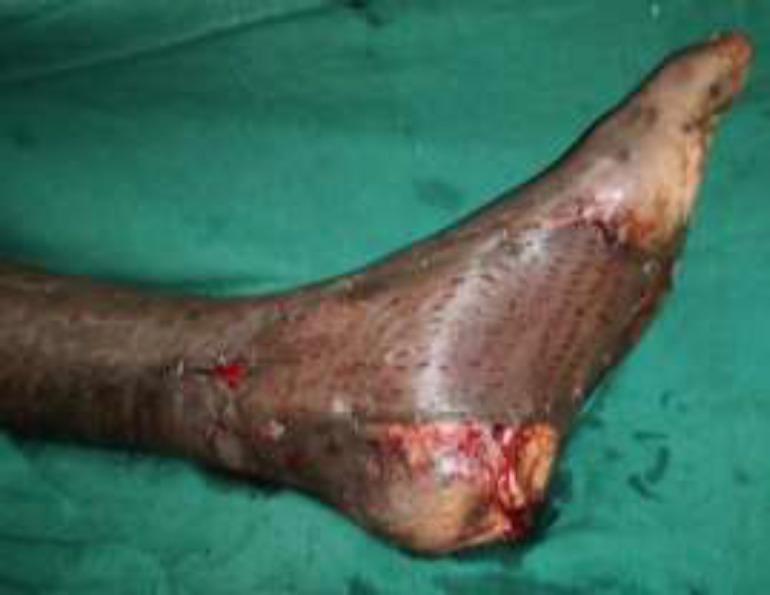
A clinical photograph of the medial aspect of a human foot and ankle showing a post-operative reconstruction for a diabetic foot ulcer. The image demonstrates a large muscular flap covered by a meshed split-thickness skin graft (STSG). The graft exhibits a characteristic reticulated or 'honeycomb' pattern with small, diamond-shaped interstitial spaces designed to allow for graft expansion and fluid drainage. Surgical sutures are visible at the margins where the flap is integrated with the surrounding host skin. There is evidence of normal immediate post-operative inflammation, including localized erythema and minor serosanguinous exudate at the wound edges. This visual represents a complex reconstructive procedure, likely involving a free muscle flap (such as a gracilis muscle) to provide bulk and vascularity to a weight-bearing or joint-adjacent area, followed by meshed STSG for epithelial coverage.
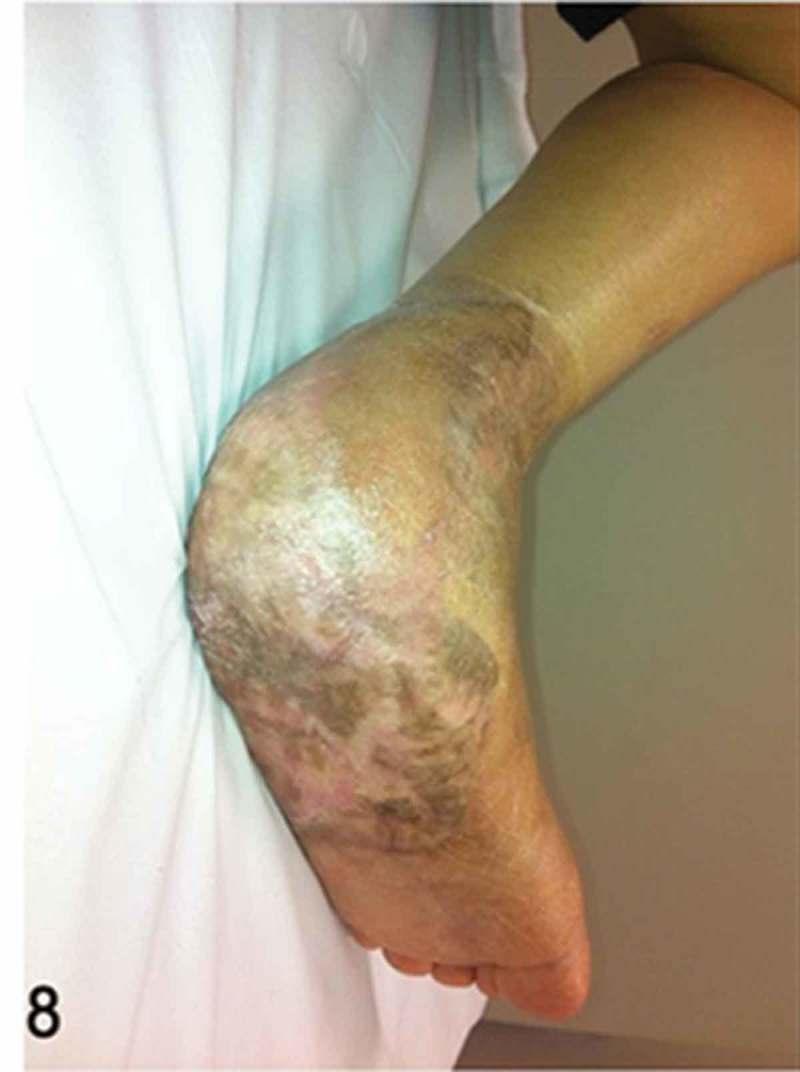
This clinical photograph displays a lateral and plantar view of a human foot at a 12-week follow-up, demonstrating the successful integration of a free musculocutaneous flap and a split-thickness skin graft. The surgical site covers the posterior heel and extends onto the plantar aspect, which was previously a site of deep necrosis and bone exposure. The grafted area shows characteristic variegated pigmentation with a mixture of dark brown, tan, and pale pinkish-white tones, indicative of post-operative remodeling and melanocyte activity. The texture of the graft is relatively smooth and stable, though it exhibits slight surface irregularities and a visible, well-defined border where it meets the native skin of the distal leg and ankle. There are no signs of active inflammation, erythema, dehiscence, or infection. This image illustrates late-stage surgical healing and soft-tissue reconstruction in the management of complex diabetic foot ulcers.
/tmp/workspace
mkdir -p "/tmp/workspace/df-final-seminar/source_text" "/tmp/workspace/df-final-seminar/src" "/tmp/workspace/df-final-seminar/output" "/tmp/workspace/df-final-seminar/assets" && python -c "from pypdf import PdfReader; import os; d='/tmp/workspace/attachments/c7c31351-9feb-4752-8ce4-defa10ddfead'; out='/tmp/workspace/df-final-seminar/source_text'; files=['Diabeticfootulcers.pdf','10-1055-s-0042-1756135.pdf','Study_of_various_reconstructive_modalities_in_mana.pdf','IJPS-44-390.pdf']; [(lambda p,fn: (lambda r,t: (open(os.path.join(out,fn+'.txt'),'w',encoding='utf-8').write(t),print(fn,'pages',len(r.pages),'chars',len(t))))(PdfReader(p),'\\n'.join((pg.extract_text() or '') for pg in PdfReader(p).pages)))(os.path.join(d,fn),fn) for fn in files]"
"Classification" in ~/df-final-seminar/source_text
"free flap" in ~/df-final-seminar/source_text
"amputation" in ~/df-final-seminar/source_text
"neuropathy" in ~/df-final-seminar/source_text
https://www.idsociety.org/practice-guideline/diabetic-foot-i…
python /tmp/skills/shared/scripts/fetch_images.py "https://cdn.orris.care/image-gen/a85cf1d8509c46c0a40422585d791a90.png" "https://cdn.orris.care/image-gen/1a918954e6894018a7a9f778513a11d7.png" "https://cdn.orris.care/image-gen/d3e30ce758eb4ffb9ceeff0e0922ac5a.png" "https://cdn.orris.care/image-gen/792145d5cff54371a5232d1462d18017.png" "https://cdn.orris.care/cdss_images/pmc_clinical_VQA_04bd5c7c0d25c533770acd017d32838379850a2343191e5ee14b1d3b02c95282.jpg" "https://cdn.orris.care/cdss_images/pmc_clinical_VQA_0ea6ab75aab3284ce2f053487b95280bd17b55300b27111fe1770b716008ef32.jpg" "https://cdn.orris.care/cdss_images/medpix_vqa_7980d001-5efc-4c6b-8826-e3a4aab2e69d_1766169394181.png" "https://cdn.orris.care/cdss_images/pmc_clinical_VQA_2e79ba2b14c763330ddeacec7f17661fb82e6176704de4bd8fa6b128cb9ae3be.jpg" "https://cdn.orris.care/cdss_images/pmc_clinical_VQA_29ed8b12e97b76e05ac8ef2db987485ce49e230e37d4eb945890faa390d7c185.jpg" > "/tmp/workspace/df-final-seminar/assets/fetch.json"
~/df-final-seminar/src/build_full.py
import os, json, base64
from io import BytesIO
from pptx import Presentation
from pptx.util import Inches, Pt
from pptx.dml.color import RGBColor
from pptx.enum.shapes import MSO_SHAPE
from pptx.enum.text import PP_ALIGN, MSO_ANCHOR
ROOT='/tmp/workspace/df-final-seminar'; AS=ROOT+'/assets'; OUT=ROOT+'/output/Diabetic_Foot_Full_Seminar_Evidence_Based.pptx'
W,H=13.333,7.5
prs=Presentation(); prs.slide_width=Inches(W); prs.slide_height=Inches(H)
NAVY='102A43'; TEAL='187C80'; MINT='E2F3F1'; PALE='F5F8FA'; INK='152B3C'; GREY='5B7080'; RED='B23A48'; AMBER='C97914'; BLUE='3177A8'; WHITE='FFFFFF'; LINE='D4E0E7'
def C(x): return RGBColor.from_string(x)
def rect(s,x,y,w,h,fill=WHITE,line=None,kind=MSO_SHAPE.ROUNDED_RECTANGLE):
sh=s.shapes.add_shape(kind,Inches(x),Inches(y),Inches(w),Inches(h)); sh.fill.solid(); sh.fill.fore_color.rgb=C(fill); sh.line.color.rgb=C(line or fill); return sh
def txt(s,x,y,w,h,t,sz=16,col=INK,b=False,align=PP_ALIGN.LEFT):
tb=s.shapes.add_textbox(Inches(x),Inches(y),Inches(w),Inches(h)); tf=tb.text_frame; tf.clear(); tf.word_wrap=True; tf.margin_left=tf.margin_right=Inches(.06); tf.margin_top=tf.margin_bottom=Inches(.03); tf.vertical_anchor=MSO_ANCHOR.TOP
for i,line in enumerate(str(t).split('\n')):
p=tf.paragraphs[0] if i==0 else tf.add_paragraph(); p.text=line;p.alignment=align;p.space_after=Pt(2)
for r in p.runs:r.font.name='Aptos';r.font.size=Pt(sz);r.font.bold=b;r.font.color.rgb=C(col)
return tb
def base(s,sec=''):
rect(s,0,0,W,H,PALE,PALE,MSO_SHAPE.RECTANGLE);rect(s,0,0,W,.17,TEAL,TEAL,MSO_SHAPE.RECTANGLE)
if sec: txt(s,.5,.3,8,.18,sec.upper(),8,TEAL,True)
def head(s,t,sub='',sec=''):
base(s,sec);txt(s,.5,.63,12.1,.48,t,27,NAVY,True)
if sub:txt(s,.52,1.14,11.9,.28,sub,11,GREY)
def foot(s,src='Sources: IWGDF 2023 | IWGDF/IDSA 2023 | standard surgical texts'):
rect(s,.45,7.08,12.43,.015,LINE,LINE,MSO_SHAPE.RECTANGLE); txt(s,.5,7.15,12,.15,src,6.5,GREY)
def bul(s,items,x=.65,y=1.55,w=5.8,h=5.3,sz=15):
step=h/max(len(items),1)
for i,a in enumerate(items):
yy=y+i*step;rect(s,x,yy+.1,.12,.12,TEAL,TEAL,MSO_SHAPE.OVAL);txt(s,x+.25,yy,w-.25,step-.03,a,sz,INK)
def card(s,x,y,w,h,hdr,body,fill=MINT,accent=TEAL):
rect(s,x,y,w,h,fill,fill);rect(s,x,y,.07,h,accent,accent,MSO_SHAPE.RECTANGLE);txt(s,x+.18,y+.12,w-.28,.28,hdr,14,accent,True);txt(s,x+.18,y+.48,w-.28,h-.55,body,11.5,INK)
def flow(s,labels,x=.6,y=2.2,w=2.0):
for i,(a,b,c) in enumerate(labels):
xx=x+i*(w+.35);rect(s,xx,y,w,1.1,b,b);txt(s,xx+.08,y+.2,w-.16,.28,a,13,c,True,PP_ALIGN.CENTER)
if i<len(labels)-1:txt(s,xx+w+.03,y+.34,.25,.25,'→',20,TEAL,True,PP_ALIGN.CENTER)
# assets
imgs={}
for k,r in enumerate(json.load(open(AS+'/fetch.json'))):
if r.get('base64'):
raw=base64.b64decode(r['base64'].split(',',1)[1]); p=f'{AS}/im{k}.jpg';open(p,'wb').write(raw);imgs[k]=p
def pic(s,i,x,y,w,h,cap=''):
if i in imgs:
s.shapes.add_picture(imgs[i],Inches(x),Inches(y),Inches(w),Inches(h));
if cap: rect(s,x,y+h-.31,w,.31,'102A43','102A43',MSO_SHAPE.RECTANGLE);txt(s,x+.05,y+h-.27,w-.1,.2,cap,7.5,WHITE)
slides=[]
def new(t,sub='',sec=''):
s=prs.slides.add_slide(prs.slide_layouts[6]);head(s,t,sub,sec);slides.append(s);return s
# 1 title
s=new('Diabetic Foot: Evidence-based limb salvage and reconstruction','Plastic Surgery seminar | Educational use only: follow local multidisciplinary protocols','TITLE');rect(s,0,1.55,W,5.2,NAVY,NAVY,MSO_SHAPE.RECTANGLE);txt(s,.7,2.05,7.0,1.3,'Assess infection.\nRestore perfusion.\nCorrect pressure.\nReconstruct durable coverage.',30,WHITE,True);pic(s,4,8.5,1.75,3.9,4.45,'Clinical spectrum - may be graphic');txt(s,.72,6.25,6.8,.3,'Based on supplied PDFs, IWGDF 2023, IWGDF/IDSA 2023, Bailey & Love, Sabiston, Schwartz and Campbell.',10,'DFF4F0');foot(s,'Seminar deck | Supplied articles were used as evidence and reference material')
s=new('Learning objectives','The surgical decision is a sequence, not an isolated flap choice','ROADMAP');flow(s,[('1. Define','risk and phenotype',NAVY),('2. Stabilise','infection and perfusion',NAVY),('3. Prepare','wound and mechanics',NAVY),('4. Cover','graft, flap or amputation',NAVY),('5. Prevent','recurrence',NAVY)],.48,2.0,2.18);card(s,.8,4.05,11.7,1.65,'Core principle','Every reconstruction requires a clean wound bed, adequate or restored perfusion, pressure redistribution, and a realistic plan for weight bearing.','EAF5F4');foot(s)
# definition & risks
s=new('1. Definition','Diabetic foot disease is broader than an ulcer','DEFINITION');bul(s,['A diabetes-related foot ulcer is a full-thickness break in skin below the ankle, usually driven by neuropathy, PAD, deformity and repetitive mechanical stress.','Diabetic foot infection is a clinical diagnosis: local or systemic inflammatory features, purulence, or deep tissue involvement.','The plastic-surgical endpoint is a plantigrade, durable, shoeable foot with safe ambulation - or the lowest functional amputation level when salvage is not viable.'],.65,1.7,7.0,4.7,16);card(s,8.05,1.85,4.3,2.7,'Key evidence from supplied PDF','Sabapathy & Periasamy: neuropathy, vasculopathy and limited joint mobility are central causes; management must heal the wound and correct the biomechanics to reduce recurrence.','EAF5F4');foot(s,'Sabapathy & Periasamy, Indian J Plast Surg 2016;49:302-313 | IWGDF 2023')
s=new('Why diabetic-foot wounds matter','Ulceration is often the first step in a limb-threatening cascade','DEFINITION');pic(s,4,.65,1.6,4.35,4.95,'Clinical spectrum - may be graphic');bul(s,['DFU reduces mobility, independence and quality of life; infection and PAD sharply increase limb-loss risk.','The supplied 2016 review states that 85% of major amputations in diabetes are preceded by an ulcer.','The goal is not merely closure: preserve functional length, obtain durable coverage, and prevent recurrent pressure injury.'],.6,1.55,4.0,4.8,15);card(s,8.0,1.65,4.45,2.3,'Risk stratification concept','At-risk foot → superficial ulcer → deformed/crippled foot → critical infected or ischemic foot. Escalate early to a multidisciplinary limb-salvage team.','FFF3E0',AMBER);foot(s,'Supplied PDF: Diabeticfootulcers.pdf | Sabapathy & Periasamy 2016')
s=new('2. Risk factors','Look for the combination, not a single cause','RISK FACTORS');items=[('Neuropathy','Loss of protective sensation; intrinsic muscle imbalance; dry fissured skin.'),('PAD','Poor pulses, tissue loss, slow healing, gangrene; may coexist with neuropathy.'),('Prior history','Previous ulcer/amputation or Charcot deformity predicts future ulceration.'),('Systemic factors','Poor glycemic control, CKD, smoking, malnutrition, anemia and immunologic impairment.'),('External stress','Ill-fitting shoes, repetitive trauma, callus, delayed presentation and poor access to foot care.')]
for i,(a,b) in enumerate(items): card(s,.65+(i%3)*4.2,1.65+(i//3)*2.15,3.75,1.6,a,b,'EAF5F4' if i<3 else 'FFF3E0',TEAL if i<3 else AMBER)
foot(s,'Harrison’s Principles of Internal Medicine 22e | IWGDF Prevention Guideline 2023')
# classification
s=new('3. Classification: why use more than one system?','A useful system communicates depth, infection, ischemia and prognosis','CLASSIFICATION');flow(s,[('Wagner','depth / gangrene',NAVY),('University of Texas','depth + infection + ischemia',NAVY),('PEDIS / IWGDF','perfusion, extent, depth, infection, sensation',NAVY),('WIfI','wound + ischemia + infection',NAVY)],.55,1.75,2.8);card(s,.7,3.55,5.9,2.35,'Practical use','Use one anatomical severity system and one infection/perfusion system. Record photographs, wound dimensions, location, probe-to-bone result, infection severity and vascular status at every review.','EAF5F4');card(s,6.85,3.55,5.7,2.35,'Examination pearl','A small plantar opening may conceal deep sinus, abscess or osteomyelitis. Do not grade by surface size alone.','FFF3E0',AMBER);foot(s,'IWGDF Classification Guideline 2023 | Wagner 1981 | University of Texas system')
s=new('Wagner and University of Texas','Know these for seminars and viva','CLASSIFICATION');card(s,.55,1.55,5.85,4.9,'Wagner grade','0: pre-ulcer/callus or healed ulcer\n1: superficial ulcer\n2: ulcer to tendon/capsule\n3: deep ulcer with abscess, osteomyelitis or joint sepsis\n4: localized gangrene\n5: whole-foot gangrene','EAF5F4');card(s,6.75,1.55,5.95,4.9,'University of Texas','Grade 0-3: pre/post-ulcer → tendon/capsule → bone/joint\nStage A: clean\nStage B: infected\nStage C: ischemic\nStage D: infected + ischemic\n\nStrength: separates depth from infection and ischemia.','F0F6FB',BLUE);foot(s,'Wagner; University of Texas classification')
s=new('IWGDF/IDSA infection severity','Treat infection clinically, not from a culture alone','CLASSIFICATION');bul(s,['Uninfected: no local/systemic signs.','Mild: local infection, limited erythema, no deep involvement and no systemic features.','Moderate: deeper or more extensive local infection, but no systemic inflammatory response.','Severe: infection with systemic inflammatory response or organ dysfunction.','Urgent surgical review is needed for severe infection or moderate infection with extensive gangrene, necrotizing infection, deep abscess, compartment syndrome or severe ischemia.'],.65,1.55,7.2,5.3,15);card(s,8.2,1.65,4.1,3.65,'Do not miss','Pain can be absent in neuropathy. “No pain” does not equal “no sepsis.”','FCE9EA',RED);foot(s,'IWGDF/IDSA Diabetic Foot Infection Guideline 2023')
# biomechanics
s=new('4. Biomechanical considerations','Neuropathy + deformity + repetitive load → callus → ulcer','BIOMECHANICS');pic(s,1,.55,1.58,5.25,5.1,'Neuropathy-pressure-ulcer cycle');bul(s,['Sensory neuropathy: loss of protective and joint sensation permits repeated unrecognized microtrauma.','Motor neuropathy: intrinsic muscle imbalance produces claw toes, MTP prominence, cavus/equinus and focal plantar pressure.','Autonomic neuropathy: reduced sweating causes dry, fissured skin; hyperemia and ligamentous laxity contribute to Charcot change.','Limited ankle/subtalar and MTP mobility further concentrates load beneath metatarsal heads.'],6.15,1.55,6.2,4.9,14.5);foot(s,'Supplied PDF: 10-1055-s-0042-1756135.pdf | Sabapathy & Periasamy 2016')
s=new('Vasculopathy: assess healing potential before coverage','Clinical examination alone is not enough','BIOMECHANICS');pic(s,2,.55,1.55,5.1,4.85,'Vascular assessment pathway');bul(s,['Inspect color, temperature, capillary refill, tissue loss and dependent rubor; palpate dorsalis pedis and posterior tibial pulses.','Use pedal Doppler waveforms with ABI and toe pressure/TBI. ABI may be falsely high in medial arterial calcification.','For threatened limb or reconstructive planning: duplex, CTA/MRA or catheter angiography to define target artery and runoff.','PAD + ulcer/gangrene + infection requires urgent joint vascular and surgical planning for drainage and revascularization.'],6.05,1.55,6.25,5.1,14.5);foot(s,'IWGDF/ESVS/SVS PAD Guideline 2023 | Bailey & Love 28e')
s=new('Neuropathy: bedside testing','Screen the whole foot, not just the ulcer','BIOMECHANICS');flow(s,[('Inspect','callus, fissure, deformity',NAVY),('Test sensation','10-g monofilament + vibration',NAVY),('Test motor','claw toes, intrinsic wasting, equinus',NAVY),('Map pressure','callus / prior ulcers / shoe wear',NAVY)],.5,1.75,2.85);card(s,.8,3.55,5.6,2.2,'Clinical point','Callus is a clinical pressure marker. Debride it to inspect the true ulcer and revise the offloading plan.','FFF3E0',AMBER);card(s,6.85,3.55,5.55,2.2,'Interpretation','Loss of protective sensation explains painless injury. It does not exclude PAD, infection or osteomyelitis.','EAF5F4');foot(s,'IWGDF Prevention Guideline 2023 | Supplied PDF: Diabeticfootulcers.pdf')
s=new('Arthropathy: Charcot foot','A hot, swollen neuropathic foot is Charcot until proven otherwise','BIOMECHANICS');pic(s,6,.65,1.5,4.9,5.05,'Charcot / osteomyelitis MRI');bul(s,['Acute Charcot may present with warmth, edema and erythema with relatively little pain. It can mimic cellulitis, DVT or osteomyelitis.','Repetitive trauma in an insensate foot produces fragmentation, subluxation, midfoot collapse and rocker-bottom deformity.','Immediate immobilization and offloading are central. Obtain weight-bearing radiographs when safe; MRI helps assess active disease and differentiate superimposed osteomyelitis.','Surgery is selective: unstable deformity, recurrent ulceration over bony prominence, or non-plantigrade foot after infection and perfusion are controlled.'],.6,1.48,5.9,5.5,14);foot(s,'Bailey & Love 28e | Campbell’s Operative Orthopaedics 15e')
# investigations
s=new('Investigations: a structured work-up','Answer four questions: infection? bone? perfusion? mechanics?','ASSESSMENT');items=[('Bedside','Probe-to-bone, wound depth, photograph/measure, monofilament and pulses.'),('Laboratory','CBC, CRP/ESR, renal function, glucose/HbA1c; blood cultures if systemic illness.'),('Microbiology','Deep tissue specimen after cleansing/debridement; bone sample if osteomyelitis is suspected. Avoid superficial swabs.'),('Imaging','Plain radiograph first. MRI for extent of osteomyelitis/abscess when uncertainty persists.'),('Vascular','Doppler/ABI/TBI, duplex and anatomical imaging when revascularization or flap is considered.')]
for i,(a,b) in enumerate(items):card(s,.6+(i%3)*4.22,1.6+(i//3)*2.2,3.75,1.62,a,b,'EAF5F4' if i!=3 else 'F0F6FB',TEAL if i!=3 else BLUE)
foot(s,'IWGDF/IDSA Infection Guideline 2023 | IWGDF PAD Guideline 2023')
s=new('Osteomyelitis: practical diagnostic pathway','Treat the patient and the anatomy, not an isolated test','ASSESSMENT');pic(s,5,.7,1.6,4.9,4.85,'Heel ulcer and calcaneal osteomyelitis - may be graphic');bul(s,['Suspect with chronic deep ulcer, exposed/probe-to-bone positive wound, elevated inflammatory markers or bony destruction on radiograph.','Plain X-ray may be normal early; MRI defines marrow involvement, sinus tract, abscess and surgical planes.','When diagnosis or pathogen matters, obtain bone for culture and histology aseptically.','Selected forefoot osteomyelitis can be treated without surgery only when no PAD, no exposed bone and no immediate drainage need.'],6.05,1.55,6.2,5.15,14.5);foot(s,'IWGDF/IDSA Infection Guideline 2023')
# acute
s=new('5. Acute diabetic foot: treat as a limb-and-life emergency','Time-critical priorities','ACUTE FOOT');flow(s,[('Resuscitate','sepsis + glucose + analgesia',NAVY),('Assess','infection, perfusion, depth',NAVY),('Culture','deep tissue / blood if septic',NAVY),('Antibiotics','empiric then culture-directed',NAVY),('Source control','drain, fasciotomy, debride',NAVY)],.28,1.7,2.35);card(s,.75,3.5,5.75,2.4,'Admission / emergency red flags','Systemic toxicity, rapidly progressive cellulitis, deep abscess, soft-tissue gas, extensive wet gangrene, necrotizing infection, severe ischemia, compartment syndrome or inability to offload/manage at home.','FCE9EA',RED);card(s,6.85,3.5,5.65,2.4,'Guideline anchor','Consider early surgery within 24-48 h plus antibiotics for moderate/severe infection with necrotic tissue. Infection with PAD requires urgent surgical and vascular consultation.','FFF3E0',AMBER);foot(s,'IWGDF/IDSA Infection Guideline 2023')
s=new('Acute foot: incision, drainage, fasciotomy','Fasciotomy is for compartment syndrome or deep spreading infection - not routine ulcer surgery','ACUTE FOOT');bul(s,['Map tenderness, crepitus, fluctuance, bullae, skin necrosis and tracking infection. Obtain imaging only if it does not delay life- or limb-saving surgery.','Drain all purulent collections and open involved compartments when compartment syndrome/deep fascial infection is present; use incisions that permit repeat debridement.','Excise devitalized skin, fascia, tendon and bone until viable bleeding tissue remains. Send deep tissue/bone samples.','Plan serial returns to theatre. Delay definitive graft/flap coverage until infection is controlled, perfusion is adequate and wound bed is clean.'],.65,1.55,7.0,5.1,15);card(s,8.0,1.75,4.25,3.6,'Avoid common errors','• “Small ulcer” assumption\n• Superficial swab as culture\n• Closing a contaminated dead space\n• Definitive flap before source control\n• Ignoring PAD because the foot is warm from neuropathy','FCE9EA',RED);foot(s,'Bailey & Love 28e | IWGDF/IDSA 2023')
s=new('Acute debridement and wound-bed preparation','Debride until viable tissue and a plan for the next step are visible','ACUTE FOOT');bul(s,['Sharp/excisional debridement removes necrosis, callus, biofilm and infected nonviable tissue. Repeat as needed.','Control hemostasis, eliminate dead space, protect exposed tendon/bone, and use appropriate dressings or NPWT as part of wound-bed preparation.','Reassess perfusion after debridement. Failure to improve substantially by 4 weeks despite wound care, offloading and metabolic control warrants vascular reassessment.','Do not use NPWT, topical agents or oxygen solely as treatment for diabetic foot infection; source control, systemic antibiotics and perfusion are fundamental.'],.65,1.55,7.0,5.1,15);card(s,8.0,1.75,4.25,3.6,'Endpoint before coverage','No progressive necrosis\nNo uncontrolled infection\nAdequate perfusion\nStable, offloadable mechanics\nA reconstruction that fits the patient’s functional goals','EAF5F4');foot(s,'IWGDF/IDSA 2023 | IWGDF PAD Guideline 2023')
s=new('Amputation: choose the lowest reliable functional level','Amputation is sometimes the life-saving and function-preserving operation','ACUTE FOOT');flow(s,[('Toe / digital','limited distal disease',NAVY),('Ray','single ray / focal forefoot',NAVY),('TMA','forefoot salvage',NAVY),('Lisfranc / Chopart','selected midfoot',NAVY),('Syme / BKA','non-salvageable distal foot',NAVY)],.18,1.7,2.47);card(s,.7,3.55,5.9,2.45,'Principles','Aim for the most distal level with realistic healing potential. Preserve length only if coverage, perfusion and biomechanics are durable. Obtain clean margins if infected bone is resected; anticipate transfer lesions and equinus.','FFF3E0',AMBER);card(s,6.85,3.55,5.75,2.45,'When major amputation is appropriate','Uncontrolled sepsis, unreconstructable ischemia, nonviable foot architecture, extensive necrosis, or a limb unlikely to provide useful function despite multiple attempts.','FCE9EA',RED);foot(s,'Campbell’s Operative Orthopaedics 15e | Bailey & Love 28e | IWGDF/IDSA 2023')
s=new('Amputation-level map and postoperative priorities','Every level needs offloading, rehabilitation and surveillance','ACUTE FOOT');pic(s,3,.55,1.5,4.6,5.1,'Rehabilitation after partial-foot/transtibial amputation');items=[('Toe / ray','Distal preservation, but altered push-off and transfer pressure.'),('TMA','Useful lever arm if balanced; long plantar flap, smooth metatarsal cascade; address equinus risk.'),('Lisfranc / Chopart','Higher deformity/equinus risk; consider balancing procedures and brace/prosthetic support.'),('Syme / transtibial','More proximal but often a reliable end-bearing/prosthetic solution when foot salvage fails.')]
for i,(a,b) in enumerate(items):card(s,.65+(i%2)*5.95,1.5+(i//2)*2.3,5.5,1.75,a,b,'EAF5F4' if i<2 else 'F0F6FB',TEAL if i<2 else BLUE)
foot(s,'Campbell’s Operative Orthopaedics 15e | Miller’s Review of Orthopaedics 9e')
s=new('Split-thickness skin graft (STSG)','A graft covers a vascular wound bed. It does not solve infection, ischemia or pressure.','ACUTE FOOT');pic(s,7,.65,1.65,4.85,5.0,'Flap plus meshed STSG - may be graphic');bul(s,['Use after adequate debridement when the wound is clean, well vascularized and has no exposed bone, tendon, joint, hardware or uncontrolled infection.','Best suited to dorsum and non-weight-bearing areas, or over a vascularized flap/muscle bed. The supplied 2024 study used STSG for dorsal and non-weight-bearing plantar defects.','Meshing allows expansion and drainage. Immobilize, secure with bolster/NPWT where appropriate, and protect from shear.','Avoid graft alone on a high-pressure plantar surface unless the underlying mechanics are corrected and long-term offloading is assured.'],.6,1.5,6.1,5.2,14);foot(s,'Supplied PDF: Study_of_various_reconstructive_modalities_in_mana.pdf | Plastic surgery principles')
# chronic flap
s=new('6. Chronic diabetic foot: reconstruct only after optimization','Coverage follows source control, vascular assessment and offloading','CHRONIC FOOT');pic(s,0,.55,1.52,5.0,4.95,'Reconstructive ladder');bul(s,['Optimize glucose, nutrition, renal/cardiac status and smoking cessation; obtain vascular and biomechanical assessment.','Culture-directed treatment and serial debridement create a viable recipient bed.','Choose the simplest option that produces durable closure and permits footwear: secondary healing → STSG → local flap → regional/pedicled flap → free flap.','In selected cases, staged reconstruction allows debridement/vessel identification first, followed by definitive free tissue transfer.'],6.0,1.55,6.2,5.1,14.5);foot(s,'Supplied PDFs: IJPS-44-390; Study_of_various_reconstructive_modalities_in_mana | Schwartz 11e')
s=new('Local flaps: when nearby tissue is enough','Select by defect location, size, vascularity and need for sensate durable cover','CHRONIC FOOT');bul(s,['Indications: small-to-moderate defects with exposed tendon/bone after infection control and with a reliable local vascular bed.','Options vary by location: V-Y advancement, toe fillet flap, abductor hallucis, flexor digitorum brevis, abductor digiti minimi, reverse sural and perforator-based flaps.','Advantages: replaces like-with-like, avoids microsurgery, shorter operating time. Limitations: small arc/volume, scarred or ischemic local tissue, and donor-site morbidity.','For plantar heel and weight-bearing locations, choose a flap that tolerates shear and pressure; plan protective footwear from the outset.'],.65,1.55,7.05,5.2,14.5);card(s,8.05,1.6,4.25,3.8,'Supplied source insight','The provided reconstruction articles emphasize that flap choice depends on site and size of defect, available local tissue and arterial Doppler findings.','EAF5F4');foot(s,'Supplied PDF: Study_of_various_reconstructive_modalities_in_mana.pdf | IJPS 2011;44:390')
s=new('Free flaps: reconstruct the limb, not just the hole','Microsurgical coverage is a limb-salvage option in selected patients','CHRONIC FOOT');pic(s,3,.55,1.5,4.75,5.1,'Free-flap reconstruction schematic');bul(s,['Indications: large complex defect; exposed bone, tendon, joint or hardware; inadequate local tissue; potentially salvageable limb with usable recipient vessels.','Common workhorse options include anterolateral thigh (ALT), gracilis and radial forearm flaps, tailored to defect geometry and need for bulk.','Preoperative planning: angiographic/duplex assessment, recipient vessel selection, infection clearance, medical optimization and a postoperative monitoring plan.','The supplied 2024 study described two-team surgery and staged debridement/vessel identification before definitive free flap in selected contaminated wounds.'],.6,1.48,6.0,5.35,13.8);foot(s,'Supplied PDF: Study_of_various_reconstructive_modalities_in_mana.pdf | Schwartz’s Principles of Surgery 11e')
s=new('Free flap monitoring and failure response','The first 24 hours are surveillance-intensive','CHRONIC FOOT');flow(s,[('Monitor','color, temperature, capillary refill, turgor, Doppler',NAVY),('Detect','arterial insufficiency or venous congestion',NAVY),('Act','release compression / correct systemic factors',NAVY),('Re-explore','urgent return if vascular compromise persists',NAVY)],.35,1.68,3.0);card(s,.75,3.55,5.85,2.25,'Postoperative basics','Keep flap warm and non-compressed, immobilize/elevate appropriately, maintain hemodynamic stability and monitor clinically with Doppler. Avoid pressure on pedicle and flap.','EAF5F4');card(s,6.95,3.55,5.55,2.25,'Evidence note','The supplied series used frequent clinical and handheld Doppler monitoring after free flaps. A 2024 systematic review/meta-analysis supports flap reconstruction as a limb-salvage modality, while selection bias and patient heterogeneity remain important.','F0F6FB',BLUE);foot(s,'Supplied PDF: Study_of_various_reconstructive_modalities_in_mana.pdf | Reed et al, Plast Reconstr Surg 2024, PMID 38334716')
s=new('Coverage decision: graft, local flap, free flap or amputation','Durability and perfusion decide, not technical enthusiasm','CHRONIC FOOT');flow(s,[('Clean viable bed?','No → serial debridement',NAVY),('Adequate perfusion?','No → vascular plan',NAVY),('No exposed critical structure?','Yes → STSG/secondary healing',NAVY),('Small local defect?','Yes → local flap',NAVY),('Large/complex?','Free flap vs amputation',NAVY)],.12,1.75,2.55);card(s,.7,3.55,11.95,1.75,'Non-negotiable','If the planned reconstruction cannot be protected from recurrent pressure or the limb cannot achieve useful function, reconsider the treatment goal and amputation level.','FFF3E0',AMBER);foot(s,'Supplied reconstruction PDFs | IWGDF PAD and Offloading Guidelines 2023')
# deformities
s=new('7. Deformity correction: external and internal offloading','Prevent recurrence by correcting the force that caused the ulcer','DEFORMITY CORRECTION');pic(s,1,.65,1.5,4.9,5.05,'Biomechanical ulcer cycle');bul(s,['External offloading: non-removable knee-high device is preferred for a suitable neuropathic plantar forefoot/midfoot ulcer; alternatives depend on contraindications, tolerance and infection/ischemia.','Therapeutic footwear: extra-depth shoe, rocker sole, custom accommodative insole and toe fillers redistribute load after ulcer healing or partial amputation.','Internal offloading: selective surgery corrects rigid deformity, bony prominence or tendon imbalance that perpetuates a focal ulcer.','Operate after infection control and perfusion assessment, with a postoperative protection plan.'],6.05,1.5,6.15,5.35,14.5);foot(s,'IWGDF Offloading Guideline 2023 | Supplied PDF: 10-1055-s-0042-1756135.pdf')
s=new('Shoes, orthoses and casting','Footwear is a treatment, not an accessory','DEFORMITY CORRECTION');items=[('Acute ulcer','Offload pressure: total-contact cast or non-removable walker in suitable neuropathic plantar ulcers.'),('Healed ulcer','Prescription footwear, accommodative insole, rocker sole and regular fit inspection.'),('Partial foot','Toe filler / custom orthosis and stiff sole or carbon-fiber insert to restore lever arm and reduce transfer lesions.'),('Charcot','Immobilization in active phase; later custom Charcot restraint orthotic walker/extra-depth footwear if plantigrade and stable.')]
for i,(a,b) in enumerate(items):card(s,.65+(i%2)*5.95,1.65+(i//2)*2.25,5.5,1.7,a,b,'EAF5F4' if i<2 else 'F0F6FB',TEAL if i<2 else BLUE)
foot(s,'IWGDF Offloading and Prevention Guidelines 2023')
s=new('Tendon balancing and transfer','Correct muscle imbalance only after defining the deforming force','DEFORMITY CORRECTION');bul(s,['Flexor tenotomy: selected flexible claw/hammer-toe deformity with apex ulcer, often combined with footwear/offloading.','Achilles tendon lengthening or gastrocnemius recession: selected equinus with recurrent plantar forefoot pressure; balance benefit against heel transfer lesion and weakness.','Tendon transfer may balance partial-foot/midfoot amputations or selected deformities. Examples: peroneal transfer to cuboid after Lisfranc to reduce varus; anterior tibial balancing for Chopart-level equinus risk.','These procedures require careful assessment of vascularity, ulcer/infection state, bone stability and postoperative protection.'],.65,1.5,7.05,5.25,14.5);card(s,8.05,1.6,4.25,3.8,'Seminar phrase','“Internal offloading is surgical correction of the static and mobile deformity responsible for abnormal pressure.”','FFF3E0',AMBER);foot(s,'Supplied PDF: 10-1055-s-0042-1756135.pdf | Miller’s Review of Orthopaedics 9e')
s=new('Metatarsal head excision / resection','A targeted procedure for a defined pressure point','DEFORMITY CORRECTION');bul(s,['Consider for recurrent or non-healing plantar metatarsal-head ulcer with a prominent/deformed head after adequate vascular, infection and biomechanical assessment.','Can be combined with excision of localized osteomyelitis when the remaining foot is viable and functional.','The surgical goal is pressure redistribution, not simply removal of bone. Preserve a smooth, stable forefoot and plan postoperative offloading.','Risks: transfer ulcer, instability, recurrent infection, delayed healing and need for more proximal resection/amputation.'],.65,1.5,7.05,5.25,14.5);card(s,8.05,1.6,4.25,3.8,'Do not forget','Correcting one pressure point can create another. Review callus pattern, shoe fit, tendon balance and plantar pressures at follow-up.','EAF5F4');foot(s,'Supplied PDF: Diabeticfootulcers.pdf | IWGDF Offloading Guideline 2023')
# outcomes & final flowchart
s=new('Follow-up and prognosis','Closure is the beginning of prevention','FOLLOW-UP');items=[('Early','Monitor infection control, graft/flap viability, wound dimensions, pressure relief and vascular status.'),('After healing','Footwear review, callus care, nail/skin care, diabetes/PAD risk control, patient education and daily self-inspection.'),('Osteomyelitis','Minimum 6-month follow-up after antibiotics is suggested before calling remission; maintain lifelong frequent foot examinations.'),('Recurrent/non-healing','Reassess infection, bone, perfusion and mechanics. Less than 50% area reduction at 4 weeks should prompt vascular reassessment.')]
for i,(a,b) in enumerate(items):card(s,.65+(i%2)*5.95,1.65+(i//2)*2.25,5.5,1.7,a,b,'EAF5F4' if i<2 else 'F0F6FB',TEAL if i<2 else BLUE)
foot(s,'IWGDF/IDSA 2023 | IWGDF PAD Guideline 2023')
s=new('Crux management flowchart','Original synthesis adapted from the decision logic in your supplied reconstruction-algorithm images','FINAL FLOWCHART');# bespoke vertical
nodes=[('Diabetic foot ulcer / infection','Assess severity, depth, perfusion and biomechanics'),('Immediate danger?','Sepsis, necrotizing infection, gangrene, deep abscess, compartment syndrome, severe ischemia'),('Resuscitate + antibiotics + urgent surgical / vascular consultation','Drain, fasciotomy if indicated, serial debridement; coordinate revascularization'),('After source control: is limb perfused and mechanically salvageable?','Doppler/toe pressure + anatomical vascular imaging when needed'),('Clean, vascular wound bed','Choose secondary healing/STSG/local flap/free flap according to depth, size and location'),('Protect and prevent recurrence','Offload, footwear/orthosis, tendon/bony correction where indicated, surveillance')]
for i,(a,b) in enumerate(nodes):
y=1.35+i*.83;rect(s,2.0,y,9.3,.6,'EAF5F4' if i not in (1,2) else ('FCE9EA' if i==1 else 'FFF3E0'),TEAL if i not in (1,2) else (RED if i==1 else AMBER));txt(s,2.15,y+.07,3.6,.2,a,12,NAVY,True);txt(s,5.6,y+.08,5.4,.2,b,9.7,INK)
if i<len(nodes)-1:txt(s,6.45,y+.58,.35,.18,'↓',15,TEAL,True,PP_ALIGN.CENTER)
foot(s,'Adapted as an original flowchart from user-provided reconstructive algorithms + IWGDF/IDSA 2023')
s=new('Take-home points','Answer these in your seminar conclusion','CRUX');bul(s,['Diabetic foot is a combined neuropathic, ischemic, infectious and biomechanical disease.','Acute infection with deep sepsis, gangrene or ischemia is time critical: antibiotics do not replace drainage/debridement and perfusion assessment.','Do not cover an infected, ischemic or mechanically unprotected wound.','STSG needs a clean vascular bed; local flaps cover selected smaller defects; free flaps are for selected complex limb-salvage defects with recipient vessels and a monitoring pathway.','Prevent recurrence through pressure relief, footwear, correction of defined deformity and lifelong surveillance.'],.65,1.55,7.4,5.35,16);card(s,8.45,1.75,3.8,3.3,'Exam sentence','“The reconstructive ladder should be climbed only after the vascular ladder and infection-control ladder have been addressed.”','EAF5F4');foot(s)
s=new('References','Core sources used in this presentation','REFERENCES');refs=['Supplied PDFs: Sabapathy & Periasamy. Healing ulcers and preventing recurrences in the diabetic foot. Indian J Plast Surg. 2016;49:302-313.','Supplied PDFs: 10-1055-s-0042-1756135.pdf; Study of various reconstructive modalities in management of diabetic foot ulcers (2024); Varma AK. Reconstructive foot and ankle surgeries in diabetic patients. IJPS 2011;44:390.','IWGDF Guidelines 2023: Prevention, Classification, Infection, Offloading, Wound Healing, and PAD.','IWGDF/IDSA Guidelines on Diagnosis and Treatment of Diabetes-related Foot Infections, 2023.','Bailey & Love’s Short Practice of Surgery, 28e; Sabiston Textbook of Surgery; Schwartz’s Principles of Surgery, 11e; Campbell’s Operative Orthopaedics, 15e.','Reed AJM et al. Outcomes of Flap Reconstruction for Diabetic Foot Ulcers: systematic review/meta-analysis. Plast Reconstr Surg. 2024. PMID 38334716.']
bul(s,refs,.65,1.5,11.8,5.5,12.5);foot(s,'Reference slide')
# output
prs.save(OUT);print(OUT,len(prs.slides))python "/tmp/workspace/df-final-seminar/src/build_full.py" && python -c "from pptx import Presentation; p=Presentation('/tmp/workspace/df-final-seminar/output/Diabetic_Foot_Full_Seminar_Evidence_Based.pptx'); assert len(p.slides)>=30; print('slides',len(p.slides)); print('pictures',sum(1 for s in p.slides for sh in s.shapes if getattr(sh,'shape_type',None)==13)); print('last', next((sh.text for sh in p.slides[len(p.slides)-1].shapes if getattr(sh,'has_text_frame',False) and sh.text.strip()),''))" && ls -lh "/tmp/workspace/df-final-seminar/output/Diabetic_Foot_Full_Seminar_Evidence_Based.pptx"
~/df-final-seminar/src/build_full.py
Successfully replaced 1 instance(s) of the string in '/tmp/workspace/df-final-seminar/src/build_full.py'
python "/tmp/workspace/df-final-seminar/src/build_full.py" && python -c "from pptx import Presentation; p=Presentation('/tmp/workspace/df-final-seminar/output/Diabetic_Foot_Full_Seminar_Evidence_Based.pptx'); print('slides',len(p.slides)); print('pictures',sum(1 for s in p.slides for sh in s.shapes if getattr(sh,'shape_type',None)==13)); assert len(p.slides)==32; assert any('Crux management flowchart' in sh.text for s in p.slides for sh in s.shapes if getattr(sh,'has_text_frame',False)); print('validation passed')" && ls -lh "/tmp/workspace/df-final-seminar/output/Diabetic_Foot_Full_Seminar_Evidence_Based.pptx"
python -c "from pptx import Presentation; p=Presentation('/tmp/workspace/df-final-seminar/output/Diabetic_Foot_Full_Seminar_Evidence_Based.pptx'); print('slides',len(p.slides)); print('pictures',sum(1 for s in p.slides for sh in s.shapes if getattr(sh,'shape_type',None)==13)); print('flowchart',any('Crux management flowchart' in sh.text for s in p.slides for sh in s.shapes if getattr(sh,'has_text_frame',False))); print('references',any('REFERENCES' in sh.text for s in p.slides for sh in s.shapes if getattr(sh,'has_text_frame',False)))" && ls -lh "/tmp/workspace/df-final-seminar/output/Diabetic_Foot_Full_Seminar_Evidence_Based.pptx"
- Definition and clinical importance
- Risk factors
- Wagner, University of Texas, PEDIS/IWGDF, WIfI, and IWGDF/IDSA infection classification
- Vasculopathy, neuropathy, Charcot arthropathy, and biomechanical ulcer cycle
- Investigations including probe-to-bone, deep cultures, X-ray, MRI, ABI/TBI, Doppler, CTA/MRA/angiography
- Acute diabetic foot: resuscitation, antibiotics, incision and drainage, fasciotomy indications, serial debridement, osteomyelitis, revascularization, STSG, and level-wise amputation principles
- Chronic diabetic foot: wound-bed preparation, local flaps, free flaps, ALT/gracilis-type concepts, flap monitoring, and reconstruction decision-making
- Deformity correction: offloading, shoes/orthoses, tendon balancing or transfer, Achilles lengthening principles, flexor tenotomy, and metatarsal head excision/resection
- Follow-up, prognosis, viva points, and a final original management flowchart adapted from the logic of your provided algorithm images.
Diabetic Foot Full Seminar Evidence Based
Presentation · PPTX
Add more clinical images and flap diagrams
~/
diabetic foot ulcer clinical photograph plantar neuropathic callus gangrene infection
diabetic foot reconstruction free flap local flap split thickness skin graft clinical photograph
diabetic foot local flap free flap reconstructive diagram educational
Educational plastic surgery flap diagram for diabetic foot reconstruction. Show a plantar heel defect in three panels: abductor hallucis muscle flap for medial heel, flexor digitorum brevis muscle flap for central plantar heel, and abductor digiti minimi flap for lateral heel. Include color-coded vascular pedicles and clear labels. Non-graphic medical illustration.
Educational plastic surgery diagram for a reverse sural artery flap for heel and posterior ankle defect. Show the posterior calf skin paddle, sural nerve, small saphenous vein, pivot point above lateral malleolus, pedicle arc and inset on heel. Clean labeled anatomical illustration, non-graphic.
Educational microsurgery diagram of an anterolateral thigh free flap for diabetic dorsal foot reconstruction. Show ALT skin paddle on thigh, descending branch of lateral circumflex femoral artery, transfer to dorsal foot, end-to-side anastomosis to anterior tibial artery and venous anastomoses. Clean labeled non-graphic teaching illustration.
No generations found in stream.
We encountered an error while processing your request. Please try again or reach out to us for help.
Add more clinical images and flap diagrams. Add flowchart from the given images. Add more details on each and every aspect
~/df-final-seminar
diabetic foot free flap reconstruction clinical images local flap diagrams
"diabetic foot" AND "free flap"
python /tmp/skills/shared/scripts/fetch_images.py "https://cdn.orris.care/cdss_images/pmc_clinical_VQA_44e9e67f777c56d00ecfbde3fd2c27b495d57d58a799fc652fcfde02f9e34132.jpg" "https://cdn.orris.care/cdss_images/pmc_clinical_VQA_1ae993d0b9af81f35b22673829d7754f48ab8541c7336fbaa6d4f54508a52ba0.jpg" "https://cdn.orris.care/cdss_images/pmc_clinical_VQA_0daf577a06d4be14c4d9b0871539e131dfe2d67315b1d0308cab4e54894a37ac.jpg" "https://cdn.orris.care/cdss_images/pmc_clinical_VQA_5d3c454c42e140c6dca47de71ef1b94f6f1742592f79dd0b134b3868fe1ab924.jpg" "https://cdn.orris.care/cdss_images/pmc_clinical_VQA_6f3915f76091e66ffad19f71b455ea1b12771fea63f044d393c20299803f9450.jpg" "https://cdn.orris.care/cdss_images/pmc_clinical_VQA_3bad488a3f42bff68af9573557ee96a315c9555ee7803588d92f130c7bb99aeb.jpg" "https://cdn.orris.care/image-gen/855226f587c8461da29e984fd5ad9f38.png" "https://cdn.orris.care/image-gen/bb03e2d86c7d4e988128fd80c3eaffe5.png" "https://cdn.orris.care/image-gen/1295d039950445428c607cb7181cd91b.png" > "/tmp/workspace/df-final-seminar/assets/enrich_fetch.json"
~/df-final-seminar/src/enrich_deck.py
import os,json,base64
from io import BytesIO
from pptx import Presentation
from pptx.util import Inches,Pt
from pptx.dml.color import RGBColor
from pptx.enum.shapes import MSO_SHAPE
from pptx.enum.text import PP_ALIGN, MSO_ANCHOR
ROOT='/tmp/workspace/df-final-seminar'; AS=ROOT+'/assets'; IN=ROOT+'/output/Diabetic_Foot_Full_Seminar_Evidence_Based.pptx'; OUT=ROOT+'/output/Diabetic_Foot_Full_Seminar_Expanded_Clinical_and_Flap_Atlas.pptx'
prs=Presentation(IN); W,H=13.333,7.5
NAVY='102A43';TEAL='187C80';PALE='F5F8FA';MINT='E2F3F1';INK='152B3C';GREY='5B7080';RED='B23A48';AMBER='C97914';WHITE='FFFFFF';LINE='D4E0E7'
def C(x):return RGBColor.from_string(x)
def rect(s,x,y,w,h,fill=WHITE,line=None,kind=MSO_SHAPE.ROUNDED_RECTANGLE):
sh=s.shapes.add_shape(kind,Inches(x),Inches(y),Inches(w),Inches(h));sh.fill.solid();sh.fill.fore_color.rgb=C(fill);sh.line.color.rgb=C(line or fill);return sh
def txt(s,x,y,w,h,t,sz=16,col=INK,b=False,align=PP_ALIGN.LEFT):
tb=s.shapes.add_textbox(Inches(x),Inches(y),Inches(w),Inches(h));tf=tb.text_frame;tf.clear();tf.word_wrap=True;tf.margin_left=tf.margin_right=Inches(.06);tf.margin_top=tf.margin_bottom=Inches(.03);tf.vertical_anchor=MSO_ANCHOR.TOP
for i,l in enumerate(str(t).split('\n')):
p=tf.paragraphs[0] if i==0 else tf.add_paragraph();p.text=l;p.alignment=align;p.space_after=Pt(2)
for r in p.runs:r.font.name='Aptos';r.font.size=Pt(sz);r.font.bold=b;r.font.color.rgb=C(col)
def base(s,sec):
rect(s,0,0,W,H,PALE,PALE,MSO_SHAPE.RECTANGLE);rect(s,0,0,W,.17,TEAL,TEAL,MSO_SHAPE.RECTANGLE);txt(s,.5,.3,10,.2,sec.upper(),8,TEAL,True)
def title(s,t,sub,sec):base(s,sec);txt(s,.5,.63,12,.45,t,26,NAVY,True);txt(s,.52,1.14,12,.24,sub,10.5,GREY)
def foot(s,src):rect(s,.45,7.08,12.43,.015,LINE,LINE,MSO_SHAPE.RECTANGLE);txt(s,.5,7.15,12,.15,src,6.5,GREY)
def card(s,x,y,w,h,hdr,body,fill=MINT,accent=TEAL):rect(s,x,y,w,h,fill,fill);rect(s,x,y,.07,h,accent,accent,MSO_SHAPE.RECTANGLE);txt(s,x+.17,y+.12,w-.26,.24,hdr,13,accent,True);txt(s,x+.17,y+.44,w-.28,h-.5,body,10.5,INK)
# Decode new assets
assets={}
for i,r in enumerate(json.load(open(AS+'/enrich_fetch.json'))):
if r.get('base64'):
p=f'{AS}/new{i}.jpg';open(p,'wb').write(base64.b64decode(r['base64'].split(',',1)[1]));assets[i]=p
def pic(s,i,x,y,w,h,cap=''):
if i in assets:
s.shapes.add_picture(assets[i],Inches(x),Inches(y),Inches(w),Inches(h))
if cap:rect(s,x,y+h-.32,w,.32,NAVY,NAVY,MSO_SHAPE.RECTANGLE);txt(s,x+.06,y+h-.27,w-.12,.18,cap,7.2,WHITE)
def new(t,sub,sec):
s=prs.slides.add_slide(prs.slide_layouts[6]);title(s,t,sub,sec);return s
# clinical slides
s=new('Clinical atlas: ulcer, infection and Charcot change','Use morphology to determine depth, infection, pressure mechanism and salvage potential','CLINICAL IMAGES');pic(s,0,.55,1.65,4.0,4.95,'Ulcer with radiographic structural pathology - may be graphic');pic(s,1,4.68,1.65,4.0,4.95,'Gangrene/infection evolution - may be graphic');pic(s,2,8.81,1.65,4.0,4.95,'Charcot rocker-bottom ulcer - may be graphic');foot(s,'Clinical images: indexed educational image database | Interpret with clinical examination and imaging')
s=new('How to read a diabetic foot wound','Document the features that change immediate management','CLINICAL ASSESSMENT');pic(s,3,.55,1.6,4.4,4.95,'Lateral foot infection/necrosis - may be graphic');card(s,5.25,1.7,3.35,1.36,'Depth','Probe carefully with a sterile blunt instrument. A positive probe-to-bone raises concern for osteomyelitis in an appropriate clinical context.','EAF5F4');card(s,5.25,3.22,3.35,1.36,'Infection','Purulence, erythema, warmth, swelling, pain/tenderness or systemic toxicity. Neuropathy can mask pain.','FFF1E3',AMBER);card(s,5.25,4.74,3.35,1.36,'Perfusion','Look for coolness, pallor, delayed capillary refill, absent pulses, necrosis. Measure Doppler waveforms plus ABI/TBI/toe pressure.','FCEBEC',RED);card(s,8.92,1.7,3.65,4.4,'Mandatory record','• Site and dimensions\n• Depth/tendon/bone exposure\n• Callus and pressure point\n• Exudate/odour/necrosis\n• Surrounding cellulitis\n• Pedal pulses and Doppler\n• Sensation and deformity\n• Serial photographs after consent','EAF5F4');foot(s,'IWGDF/IDSA 2023 | Bailey & Love 28e | Sabapathy & Periasamy 2016')
# flap diagrams
s=new('Plantar heel reconstruction: local intrinsic muscle flaps','Defect location and arterial patency guide flap selection','LOCAL FLAP DIAGRAMS');pic(s,6,.6,1.55,7.0,5.35,'Original diagram: local muscle options for medial, central and lateral plantar heel');card(s,7.9,1.62,4.6,1.4,'Medial heel','Abductor hallucis muscle flap may provide vascularized cover for medial or plantar-medial defects when its vascular supply is suitable.');card(s,7.9,3.2,4.6,1.4,'Central heel','Flexor digitorum brevis flap is an option for selected central plantar defects; plan for stable skin/graft coverage and later offloading.');card(s,7.9,4.78,4.6,1.4,'Lateral heel','Abductor digiti minimi flap can address selected lateral plantar defects. The local vascular anatomy must be assessed.');foot(s,'Supplied plastic-surgery reference images | Functional Reconstruction of the Diabetic Foot | Original diagram')
s=new('Reverse sural artery flap: regional option','Useful for selected posterior ankle, heel and hindfoot defects when vascular planning supports its use','REGIONAL FLAP');pic(s,7,5.55,1.55,6.1,4.8,'Original reverse sural flap design');card(s,.65,1.6,4.9,1.4,'Design','Mark the posterior-calf skin paddle, sural nerve-small saphenous vein axis and pivot point proximal to the lateral malleolus. Avoid tension or pedicle compression.');card(s,.65,3.2,4.9,1.4,'Prerequisites','Clean wound, controlled infection, viable recipient bed, appropriate arterial inflow/outflow and a plan for postoperative offloading.');card(s,.65,4.8,4.9,1.4,'Limitations','Venous congestion, distal ischemia, bulky contour and neuropathic re-ulceration. It does not compensate for untreated PAD or pressure.');foot(s,'Regional flap concepts: standard reconstructive surgery texts | Diagram is original')
s=new('ALT free flap: vascularized cover for extensive defects','Large dorsal/lateral defects, exposed bone/tendon or failed local options may require free tissue transfer','FREE FLAP DIAGRAM');pic(s,.55,1.52,7.0,5.38,'Original ALT free-flap transfer and recipient-vessel diagram');card(s,7.85,1.62,4.6,1.38,'Before transfer','Debride to healthy tissue, control infection, optimize glucose/nutrition and establish usable recipient artery and vein(s) by Doppler/duplex/CTA/angiography as indicated.');card(s,7.85,3.2,4.6,1.38,'Microsurgical plan','ALT offers a large skin paddle and long pedicle. Choose recipient vessels outside the zone of injury or disease when feasible. Coordinate with vascular reconstruction.');card(s,7.85,4.78,4.6,1.38,'After transfer','Immobilize, maintain warmth and perfusion, use serial clinical and Doppler monitoring. Later debulk only if it improves shoe wear or function.');foot(s,'Schwartz 11e | Supplied reconstruction PDFs | Reed et al., PRS 2024 | Original diagram')
# clinical free flap visual
s=new('Combined revascularization plus free flap: clinical sequence','Limb salvage requires both inflow and durable soft-tissue coverage','CLINICAL FLAP SEQUENCE');pic(s,4,.55,1.52,7.0,5.35,'ALT free flap case sequence with angiography and follow-up - may be graphic');card(s,7.9,1.63,4.55,1.35,'Step 1: define perfusion','Angiography identifies inflow/runoff. Revascularization should be planned jointly with drainage/debridement when infection and PAD coexist.');card(s,7.9,3.16,4.55,1.35,'Step 2: prepare wound','Excise nonviable tissue; obtain appropriate deep samples; address osteomyelitis and create a clean vascularized bed.');card(s,7.9,4.69,4.55,1.35,'Step 3: cover and protect','Inset flap without tension, monitor perfusion, then transition to protected weight bearing, footwear and recurrent-ulcer prevention.');foot(s,'IWGDF PAD 2023 | IWGDF/IDSA 2023 | Clinical sequence: indexed educational image database')
s=new('Free flap and STSG: postoperative appearance and surveillance','Flap survival is not the endpoint. Function, contour, skin durability and offloading determine long-term success.','CLINICAL FLAP SEQUENCE');pic(s,.6,1.6,3.8,4.9,'Flap + meshed STSG reconstruction - may be graphic');pic(s,4.75,1.6,3.8,4.9,'Settled free flap/STSG at follow-up');pic(s,8.9,1.6,3.8,4.9,'Dorsal free-flap reconstruction');foot(s,'Clinical images: indexed educational image database | Graphic clinical content labelled')
# expanded decision details
s=new('Reconstructive decision matrix: match the operation to the defect','The smallest operation that produces durable, shoeable coverage is preferred','DETAILED RECONSTRUCTION');
for i,(h,b,c) in enumerate([('Secondary healing / dressings','Small, superficial, well-perfused wound without exposed critical structures. Needs frequent review and effective offloading.',TEAL),('STSG','Healthy vascular granulation on non-weight-bearing dorsum or carefully selected protected area. Avoid grafting onto untreated ischemia, infection or bare tendon/bone.',AMBER),('Local flap','Small defect with nearby viable tissue and demonstrable local blood supply. Useful for limited exposed bone/tendon after debridement.',BLUE),('Regional flap','Hindfoot/ankle defect outside local-flap reach with a suitable pedicle and acceptable perfusion.',TEAL),('Free flap','Large, complex or recurrent defect with exposed structures when recipient vessels, patient physiology and rehabilitation capacity support reconstruction.',NAVY),('Amputation','Unsalvageable infection/ischemia, nonfunctional foot, uncontrollable sepsis, or when expected reconstruction burden outweighs chance of durable function.',RED)]):
x=.62+(i%3)*4.2;y=1.63+(i//3)*2.48;card(s,x,y,3.75,2.08,h,b,'EAF5F4',c)
foot(s,'Supplied reconstructive PDFs | Schwartz 11e | IWGDF/IDSA 2023')
# screens flowcharts, original
s=new('Flowchart from supplied reference images: preoperative optimization','Recreated as a clean seminar flowchart from your screenshot algorithm','SUPPLIED-IMAGE FLOWCHART');
steps=[('Infected / necrotic diabetic foot ulcer','Assess urgency and limb threat'),('Parallel optimization','Angiography ± revascularization\nVenous assessment as indicated\nBiomechanical examination\nOptimize comorbidities and glucose'),('Source control','Debride nonviable tissue\nDeep specimen and culture-guided antibiotics'),('Reassess wound','Persistent infection? nonviable foot? unstable bony architecture? purulent joint infection?'),('Decision','Repeat debridement / salvage pathway\nOR amputation when limb is unsalvageable')]
for i,(a,b) in enumerate(steps):
y=1.45+i*1.05;rect(s,3.0,y,7.2,.68,'EAF5F4',TEAL);txt(s,3.18,y+.1,2.8,.2,a,12,TEAL,True);txt(s,6.0,y+.08,3.95,.36,b,9.5,INK)
if i<len(steps)-1:txt(s,6.35,y+.67,.35,.3,'↓',18,TEAL,True,PP_ALIGN.CENTER)
card(s,.55,1.62,2.15,3.5,'Teaching note','The original screenshot is a reference for the logical sequence. This redrawn version is readable on a seminar slide and separates preparation, source control, reassessment and definitive reconstruction.', 'FFF1E3',AMBER);card(s,10.55,1.62,2.15,3.5,'Do not delay','Severe infection, gangrene, deep abscess, compartment syndrome or severe ischemia need urgent surgical and vascular input. Reconstruction follows stabilization, not vice versa.','FCEBEC',RED);foot(s,'Redrawn from user-supplied Plastic Surgery textbook algorithm image | IWGDF/IDSA 2023')
s=new('Flowchart from supplied reference images: coverage selection','Redrawn logic for common plantar and heel defects','SUPPLIED-IMAGE FLOWCHART');
rect(s,4.55,1.35,4.1,.62,'EAF5F4',TEAL);txt(s,4.7,1.52,3.8,.2,'Prepared wound after debridement and perfusion assessment',11,TEAL,True,PP_ALIGN.CENTER);txt(s,6.48,1.98,.3,.3,'↓',18,TEAL,True,PP_ALIGN.CENTER)
for x,a,b in [(1.0,'Small superficial defect','Primary / V-Y / local coverage when tension-free'),(4.72,'Small deep plantar/heel defect','Assess posterior tibial/peroneal flow; select intrinsic or regional flap by location'),(8.45,'Large or complex defect','Free flap if patient, vessels and rehabilitation plan are suitable; otherwise consider functional amputation')]:
rect(s,x,2.42,3.45,2.0,'EAF5F4',TEAL);txt(s,x+.15,2.68,3.15,.3,a,12,TEAL,True,PP_ALIGN.CENTER);txt(s,x+.2,3.2,3.05,.72,b,10,INK,False,PP_ALIGN.CENTER)
for x in [2.62,6.34,10.07]:txt(s,x,4.48,.25,.3,'↓',18,TEAL,True,PP_ALIGN.CENTER)
for x,a in [(1.0,'Offload and protect'),(4.72,'Monitor flap/graft and pressure redistribution'),(8.45,'Rehab, shoe modification and lifelong surveillance')]:rect(s,x,4.9,3.45,.7,'FFF1E3',AMBER);txt(s,x+.12,5.1,3.2,.2,a,10,INK,True,PP_ALIGN.CENTER)
card(s,1.5,6.0,10.3,.58,'Clinical rule','Coverage selection is driven by wound depth and location, vascular inflow/outflow, infection control, available tissue, pressure distribution and the patient’s functional goal.','EAF5F4');foot(s,'Redrawn from user-supplied reconstructive algorithms | Supplied PDFs | Standard reconstructive texts')
prs.save(OUT);print(OUT, len(prs.slides))python "/tmp/workspace/df-final-seminar/src/enrich_deck.py" && python -c "from pptx import Presentation; p=Presentation('/tmp/workspace/df-final-seminar/output/Diabetic_Foot_Full_Seminar_Expanded_Clinical_and_Flap_Atlas.pptx'); print('slides',len(p.slides)); print('pictures',sum(1 for s in p.slides for sh in s.shapes if getattr(sh,'shape_type',None)==13)); assert len(p.slides)>=41; assert any('SUPPLIED-IMAGE FLOWCHART' in sh.text for s in p.slides for sh in s.shapes if getattr(sh,'has_text_frame',False)); print('validated')" && ls -lh "/tmp/workspace/df-final-seminar/output/Diabetic_Foot_Full_Seminar_Expanded_Clinical_and_Flap_Atlas.pptx"
~/df-final-seminar/src/enrich_deck.py
Successfully replaced 1 instance(s) of the string in '/tmp/workspace/df-final-seminar/src/enrich_deck.py'
python "/tmp/workspace/df-final-seminar/src/enrich_deck.py" && python -c "from pptx import Presentation; p=Presentation('/tmp/workspace/df-final-seminar/output/Diabetic_Foot_Full_Seminar_Expanded_Clinical_and_Flap_Atlas.pptx'); print('slides',len(p.slides)); print('pictures',sum(1 for s in p.slides for sh in s.shapes if getattr(sh,'shape_type',None)==13)); assert len(p.slides)>=41; assert any('SUPPLIED-IMAGE FLOWCHART' in sh.text for s in p.slides for sh in s.shapes if getattr(sh,'has_text_frame',False)); print('validated')" && ls -lh "/tmp/workspace/df-final-seminar/output/Diabetic_Foot_Full_Seminar_Expanded_Clinical_and_Flap_Atlas.pptx"
- Clinical atlas of diabetic ulcer, gangrene, infection, Charcot deformity, and ulcer with radiographic pathology
- Detailed wound-assessment slide: depth, infection, perfusion, documentation, and investigations
- Original flap diagrams for:
- Intrinsic plantar muscle flaps: abductor hallucis, flexor digitorum brevis, abductor digiti minimi
- Reverse sural artery flap
- Anterolateral thigh free flap, recipient-vessel planning, and anastomosis concept
- Clinical free-flap sequence showing vascular assessment, revascularization, ALT flap coverage, and follow-up
- Free flap with split-thickness skin graft postoperative and follow-up clinical images
- Expanded reconstruction decision matrix: secondary healing, STSG, local flap, regional flap, free flap, and amputation
- Two clean, readable final flowcharts recreated from the logic of your supplied textbook algorithm screenshots:
- Preoperative optimization, source control, reassessment, salvage versus amputation
- Coverage selection based on defect size, depth, location, vascular status, and flap options
Diabetic Foot Full Seminar Expanded Clinical and Flap Atlas
Presentation · PPTX
Using table 1 from the given pdf, create a relevant flowchart or any type of pictorial representation to convey the information into an easy to read format and make it into a downloadble pdf
~/
diabetic plantar forefoot ulcer surgical internal offloading Table 1 10.1055 s-0042-1756135
mkdir -p "/tmp/workspace/table1-flowchart/src" "/tmp/workspace/table1-flowchart/output" "/tmp/workspace/table1-flowchart/assets" && python -c "import pdfplumber; p='/tmp/workspace/attachments/c7c31351-9feb-4752-8ce4-defa10ddfead/10-1055-s-0042-1756135 (1).pdf'; pdf=pdfplumber.open(p); print('pages',len(pdf.pages)); [print('PAGE',i+1, (pg.extract_text() or '')[:1200]) for i,pg in enumerate(pdf.pages)]" > "/tmp/workspace/table1-flowchart/assets/extract.txt"
python -c "import pdfplumber; p='/tmp/workspace/attachments/c7c31351-9feb-4752-8ce4-defa10ddfead/10-1055-s-0042-1756135 (1).pdf'; pg=pdfplumber.open(p).pages[2]; print(pg.extract_table()); print(pg.extract_text(x_tolerance=1,y_tolerance=1))"
https://pmc.ncbi.nlm.nih.gov/articles/PMC9859678
~/table1-flowchart/src/create_table1_infographic.py
from reportlab.lib.pagesizes import landscape, A3
from reportlab.pdfgen import canvas
from reportlab.lib.colors import HexColor, white
from reportlab.lib.units import mm
from reportlab.pdfbase.pdfmetrics import stringWidth
from reportlab.lib.utils import simpleSplit
OUT='/tmp/workspace/table1-flowchart/output/Diabetic_Plantar_First_Metatarsal_Ulcer_Internal_Offloading_Map.pdf'
W,H=landscape(A3)
NAVY=HexColor('#102A43'); TEAL=HexColor('#147D80'); MINT=HexColor('#E4F3F1'); PALE=HexColor('#F6F8FA'); INK=HexColor('#152B3C'); GREY=HexColor('#526A78'); AMBER=HexColor('#BD7417'); RED=HexColor('#B23A48'); BLUE=HexColor('#2E72A5'); LINE=HexColor('#D0DEE5')
c=canvas.Canvas(OUT,pagesize=(W,H)); c.setTitle('Internal Offloading Map for Diabetic Plantar First Metatarsal Head Ulcer')
def box(x,y,w,h,fill=white,stroke=LINE,r=5):
c.setFillColor(fill); c.setStrokeColor(stroke); c.setLineWidth(.8); c.roundRect(x,y,w,h,r,stroke=1,fill=1)
def text(x,y,w,content,size=9,color=INK,bold=False,leading=None,align='left'):
font='Helvetica-Bold' if bold else 'Helvetica'; lead=leading or size*1.23
lines=[]
for para in str(content).split('\n'):
lines += simpleSplit(para,font,size,w)
c.setFont(font,size); c.setFillColor(color)
yy=y
for ln in lines:
if align=='center': xx=x+(w-stringWidth(ln,font,size))/2
elif align=='right': xx=x+w-stringWidth(ln,font,size)
else: xx=x
c.drawString(xx,yy,ln); yy-=lead
return yy
def heading(title,sub,page):
c.setFillColor(PALE);c.rect(0,0,W,H,stroke=0,fill=1);c.setFillColor(TEAL);c.rect(0,H-14,W,14,stroke=0,fill=1)
text(24,H-40,W-48,title,22,NAVY,True)
text(25,H-56,W-50,sub,9,GREY)
text(25,16,W-50,'Adapted into an educational visual summary from Table 1 of Balakrishnan et al., Indian J Plast Surg 2022;55:339-350. DPFMHU = diabetic plantar first metatarsal head ulcer. Clinical use requires specialist assessment.',7,GREY)
text(W-50,16,25,f'{page}/2',8,GREY,True,align='right')
def arrow(x1,y1,x2,y2,color=TEAL):
c.setStrokeColor(color);c.setFillColor(color);c.setLineWidth(2);c.line(x1,y1,x2,y2)
import math
a=math.atan2(y2-y1,x2-x1); L=7
c.line(x2,y2,x2-L*math.cos(a-.5),y2-L*math.sin(a-.5));c.line(x2,y2,x2-L*math.cos(a+.5),y2-L*math.sin(a+.5))
def labelbox(x,y,w,h,title,body,color=TEAL):
box(x,y,w,h,MINT,color,8); c.setFillColor(color);c.roundRect(x,y+h-26,w,26,8,stroke=0,fill=1);c.rect(x,y+h-8,w,8,stroke=0,fill=1)
text(x+8,y+h-18,w-16,title,10,white,True)
text(x+9,y+h-40,w-18,body,8.5,INK,False,10)
# PAGE 1
heading('Internal offloading: a diagnostic-to-procedure map','For diabetic plantar first-metatarsal-head ulceration: do not only close the wound. Identify the deforming force, confirm it clinically, then correct the biomechanical driver.',1)
# top sequence
steps=[('1. Confirm context','Neuropathic plantar first-metatarsal-head ulcer\nExclude significant ischemia and uncontrolled deep infection before elective internal offloading.'),('2. Map mechanics','Clinical examination + gait/weight-bearing assessment\nPedobarogram: peak plantar pressure (PPP) and pressure-time integral (PTI) where available.'),('3. Identify force','Vertical pressure, shear/oblique force, hallux-MTP instability, clawing, or loss of plantar-fat cushioning.'),('4. Match procedure','Use a tailored internal-offloading procedure. Combine with ulcer reconstruction only after infection control and adequate perfusion.'),('5. Protect result','Postoperative offloading, footwear/orthosis, surveillance for transfer lesions and recurrent ulceration.')]
x0=30; y=H-176; bw=142; bh=88
for i,(a,b) in enumerate(steps):
color=[NAVY,TEAL,AMBER,BLUE,TEAL][i];labelbox(x0+i*160,y,bw,bh,a,b,color)
if i<4: arrow(x0+i*160+bw,y+bh/2,x0+(i+1)*160-8,y+bh/2)
# central clinical decision
text(30,H-214,500,'Start with a structured examination of the ulcer and hallux-MTP complex',14,NAVY,True)
rows=[
('Is infection, gangrene or severe ischemia present?','YES → urgent infection/perfusion pathway first: drainage/debridement, cultures, antibiotics when infected, and vascular assessment/revascularization planning.\nNO → proceed to biomechanical mapping.','B23A48'),
('Is the ulcer on a plantar first-metatarsal-head pressure point?','YES → assess all seven force patterns in Table 1. More than one force may coexist, so procedures may need to be combined.','187C80'),
('Is the wound ready for closure?','No necrotic tissue, infection controlled, adequate perfusion, and pressure plan defined → choose secondary healing, graft or flap based on depth and location.','2E72A5'),
]
for j,(a,b,col) in enumerate(rows):
yy=H-255-j*77; box(35,yy,760,57,HexColor('#FFFFFF'),HexColor('#'+col),7);c.setFillColor(HexColor('#'+col));c.circle(55,yy+28,12,stroke=0,fill=1);text(49,yy+23,13,str(j+1),9,white,True,align='center');text(77,yy+36,230,a,10,HexColor('#'+col),True);text(310,yy+38,466,b,8.7,INK,False,10)
# side key
box(825,H-448,330,230,HexColor('#FFFFFF'),LINE,8);text(845,H-245,292,'Seven targets in Table 1',14,NAVY,True)
key=[('A','Hallux-MTP instability / Charcot-related collapse'),('B','Equinus from contracted tendo-Achilles'),('C','Peroneus longus-driven plantarflexion and inversion'),('D','Sesamoid hypertrophy or subluxation'),('E','FHL/EHL recruitment with hallux clawing'),('F','FHB weakness or contracture causing sesamoid subluxation'),('G','Atrophy/displacement of plantar fat pad')]
for i,(a,b) in enumerate(key):
yy=H-278-i*23;c.setFillColor(TEAL);c.circle(855,yy+3,8,stroke=0,fill=1);text(851,yy,8,a,7,white,True,align='center');text(871,yy,263,b,8,INK)
# bottom message
box(30,45,W-60,53,HexColor('#FFF6E7'),AMBER,8);text(48,77,W-96,'Take-home message',11,AMBER,True);text(48,61,W-96,'Reconstruction without offloading treats the consequence. Internal offloading treats the specific force that perpetuates the ulcer and therefore aims to reduce recurrence.',10,INK)
c.showPage()
# PAGE 2
heading('Seven biomechanical targets and matched internal-offloading procedures','Each lane is a concise translation of Table 1. Diagnosis and procedure must be individualized by a diabetic-foot and reconstructive team.',2)
entries=[
('1','Hallux-MTP instability / Charcot-related plantar displacement','Vertical','Clinical: probe-to-bone positive; weight-bearing lateral foot view; high-pressure zone under hallux-MTP on pedobarogram.\nImaging: assess first metatarsal bone destruction or gap arthroplasty status.','Distally based abductor hallucis muscle flap if appropriate.','B23A48'),
('2','Contracted tendo-Achilles causing forefoot overload','Vertical','Clinical Silfverskiöld test for equinus.\nGait and pedobarogram: increased forefoot pressure during walking.','Percutaneous tendo-Achilles lengthening.','C97914'),
('3','Peroneus longus recruitment causing plantarflexion / inversion of first ray','Vertical + oblique shear','Clinical: passive and active inversion at hallux-MTP; assess peroneus longus recruitment.\nPedobarogram: increased PPP/PTI under hallux-MTP.','Peroneus longus to peroneus brevis tendon transfer.','2E72A5'),
('4','Hypertrophied or subluxed sesamoids','Horizontal + oblique shear + vertical','Clinical: prominent sesamoids.\nImaging: AP, lateral and oblique foot radiographs; look for subluxation.','Sesamoidectomy.','187C80'),
('5','Extrinsic FHL/EHL recruitment with hallux clawing','Vertical','Clinical: clawing; FHL subluxation with passive hallux-MTP extension; EHL recruitment.\nPedobarogram supports focal overload.','FHL and EHL tenotomy.','B23A48'),
('6','FHB paresis/contracture with secondary sesamoid subluxation','Vertical','Clinical: hallux clawing; assess FHB deficit or contracture.\nPedobarogram: persistent focal pressure.','Closed hallux interphalangeal capsulotomy after the relevant procedures above.','C97914'),
('7','Atrophy or distal displacement of plantar fat pad','Loss of shear buffer + vertical load','Clinical: soft-tissue shadow / reduced cushion under ball of great toe compared with contralateral foot.\nImaging: MRI when required to confirm fat-pad loss and exclude other pathology.','Fat injection to reconstruct cushioning beneath the sesamoid-metatarsal complex.','2E72A5'),
]
left=25; top=H-83; cols=[42,243,355,630,847]; widths=[30,190,102,205,285]
# header
heads=['#','Biomechanical driver','Force','How to recognize it','Internal offloading option']
x=left
for h,w in zip(heads,widths):
box(x,top-25,w,25,NAVY,NAVY,0);text(x+5,top-16,w-10,h,8,white,True);x+=w
rowh=67
for i,(n,driver,force,diagnosis,proc,col) in enumerate(entries):
y=top-25-(i+1)*rowh
fill=HexColor('#FFFFFF') if i%2==0 else HexColor('#F1F6F7')
x=left; vals=[n,driver,force,diagnosis,proc]
for j,(v,w) in enumerate(zip(vals,widths)):
border=HexColor('#'+col) if j==0 else LINE;box(x,y,w,rowh,fill,border,0)
if j==0:
c.setFillColor(HexColor('#'+col));c.circle(x+w/2,y+rowh/2,12,stroke=0,fill=1);text(x+4,y+rowh/2-3,w-8,n,9,white,True,align='center')
else:
text(x+6,y+rowh-13,w-12,v,8.1,INK,j in [1,4],9.2)
x+=w
# footer callout
box(25,39,W-50,49,HexColor('#EAF5F4'),TEAL,8);text(42,70,W-84,'How to read this page',10,TEAL,True);text(42,53,W-84,'Look from left to right: a specific anatomical/functional finding produces a force, which is established by focused clinical assessment and targeted tests, then matched to the corresponding internal-offloading strategy. The article protocol allows combinations when several drivers coexist.',9,INK)
c.save()
print(OUT)
python "/tmp/workspace/table1-flowchart/src/create_table1_infographic.py" && python -c "from pypdf import PdfReader; p='/tmp/workspace/table1-flowchart/output/Diabetic_Plantar_First_Metatarsal_Ulcer_Internal_Offloading_Map.pdf'; r=PdfReader(p); print('pages',len(r.pages)); print('size',__import__('os').path.getsize(p)); print('text chars',sum(len(pg.extract_text() or '') for pg in r.pages))" && ls -lh "/tmp/workspace/table1-flowchart/output/Diabetic_Plantar_First_Metatarsal_Ulcer_Internal_Offloading_Map.pdf"
- A stepwise diagnostic-to-treatment flowchart
- Seven biomechanical drivers of recurrent ulceration
- The deforming force for each driver
- Focused clinical and investigation clues
- Corresponding surgical internal-offloading procedures
- A concise visual takeaway for presentation or seminar use
Diabetic Plantar First Metatarsal Ulcer Internal Offloading Map
PDF Document · PDF
Create a matching PPT slide from this flowchart
~/
~/table1-flowchart
~/table1-flowchart/src/create_matching_slide.py
from pptx import Presentation
from pptx.util import Inches, Pt
from pptx.dml.color import RGBColor
from pptx.enum.shapes import MSO_SHAPE
from pptx.enum.text import PP_ALIGN, MSO_ANCHOR
OUT='/tmp/workspace/table1-flowchart/output/Internal_Offloading_Diagnostic_to_Procedure_Flowchart.pptx'
prs=Presentation(); prs.slide_width=Inches(13.333); prs.slide_height=Inches(7.5)
NAVY='102A43'; TEAL='147D80'; MINT='E4F3F1'; PALE='F6F8FA'; INK='152B3C'; GREY='526A78'; AMBER='BD7417'; RED='B23A48'; BLUE='2E72A5'; WHITE='FFFFFF'; LINE='D0DEE5'
def rgb(h): return RGBColor.from_string(h)
def rect(s,x,y,w,h,fill,ln=None,kind=MSO_SHAPE.ROUNDED_RECTANGLE):
sh=s.shapes.add_shape(kind, Inches(x), Inches(y), Inches(w), Inches(h)); sh.fill.solid(); sh.fill.fore_color.rgb=rgb(fill); sh.line.color.rgb=rgb(ln or fill); return sh
def text(s,x,y,w,h,t,sz=11,col=INK,b=False,align=PP_ALIGN.LEFT):
tb=s.shapes.add_textbox(Inches(x), Inches(y), Inches(w), Inches(h)); tf=tb.text_frame;tf.clear();tf.word_wrap=True;tf.margin_left=tf.margin_right=Inches(.05);tf.margin_top=tf.margin_bottom=Inches(.02);tf.vertical_anchor=MSO_ANCHOR.MIDDLE
for i,line in enumerate(t.split('\n')):
p=tf.paragraphs[0] if i==0 else tf.add_paragraph();p.text=line;p.alignment=align;p.space_after=Pt(1)
for r in p.runs:r.font.name='Aptos';r.font.size=Pt(sz);r.font.bold=b;r.font.color.rgb=rgb(col)
return tb
def arrow(s,x,y): text(s,x,y,.28,.32,'→',18,TEAL,True,PP_ALIGN.CENTER)
def node(s,x,y,w,title,body,color):
rect(s,x,y,w,1.3,'FFFFFF',color);rect(s,x,y,w,.36,color,color);text(s,x+.07,y+.05,w-.14,.23,title,9,WHITE,True,PP_ALIGN.CENTER);text(s,x+.1,y+.48,w-.2,.72,body,8.2,INK,False,PP_ALIGN.CENTER)
s=prs.slides.add_slide(prs.slide_layouts[6]);rect(s,0,0,13.333,7.5,PALE,PALE,MSO_SHAPE.RECTANGLE);rect(s,0,0,13.333,.17,TEAL,TEAL,MSO_SHAPE.RECTANGLE)
text(s,.52,.34,12,.22,'DIABETIC PLANTAR FIRST-METATARSAL-HEAD ULCER',8,TEAL,True)
text(s,.52,.64,12.1,.42,'Internal offloading: diagnostic-to-procedure flowchart',25,NAVY,True)
text(s,.54,1.10,12,.23,'A single-slide visual translation of Table 1: identify the force pattern, confirm it, and correct the mechanical driver.',10,GREY)
# central steps
steps=[('1. Confirm suitability','Neuropathic plantar 1st-MTH ulcer\nExclude critical ischemia and uncontrolled deep infection',NAVY),('2. Map mechanics','Examination + gait\nPedobarogram: PPP/PTI where available',TEAL),('3. Identify driver','Vertical loading, shear, instability, clawing, or loss of cushion',AMBER),('4. Target correction','Tailored surgical internal-offloading procedure\nOften a combined approach',BLUE),('5. Protect result','Ulcer coverage as appropriate\nPost-op offloading + footwear + surveillance',TEAL)]
x=.35
for i,(a,b,c) in enumerate(steps):
node(s,x,1.55,2.32,a,b,c)
if i<4: arrow(s,x+2.34,2.02)
x+=2.65
# red flag band
rect(s,.55,3.10,12.22,.46,'FCEDEF',RED);text(s,.68,3.20,11.95,.18,'Red flags first: severe infection, gangrene, deep abscess, compartment syndrome or severe ischemia → urgent drainage/debridement and surgical-vascular planning before reconstruction.',8.6,RED,True,PP_ALIGN.CENTER)
# 7 mini paths, 2 rows
items=[
('1','MTP instability / plantar displacement','Probe-to-bone, lateral weight-bearing view, pedobarogram','Distally based abductor hallucis muscle flap',RED),
('2','Equinus from contracted Achilles','Silfverskiöld test; gait and forefoot-pressure assessment','Percutaneous Achilles tendon lengthening',AMBER),
('3','Peroneus longus-driven first-ray plantarflexion','Active/passive inversion; PPP/PTI below hallux-MTP','Peroneus longus → peroneus brevis transfer',BLUE),
('4','Hypertrophy / subluxation of sesamoids','Prominence + AP/lateral/oblique radiographs','Sesamoidectomy',TEAL),
('5','FHL/EHL recruitment with hallux clawing','Clawing; tendon subluxation with passive MTP extension','FHL and EHL tenotomy',RED),
('6','FHB weakness or contracture','Hallux clawing; persistent sesamoid subluxation','Closed hallux IP capsulotomy after relevant procedures',AMBER),
('7','Atrophy / distal shift of plantar fat pad','Reduced cushioning vs contralateral side; MRI if needed','Fat injection under sesamoid-metatarsal complex',BLUE)]
positions=[(.48,3.82),(4.54,3.82),(8.60,3.82),(1.83,5.47),(5.89,5.47),(9.95,5.47),(1.83,6.43)]
for (n,driver,dx,proc,c),(x,y) in zip(items,positions):
w=3.55 if y<5 else 3.55
rect(s,x,y,w,.76,'FFFFFF',c);rect(s,x,y,.33,.76,c,c);text(s,x+.08,y+.29,.16,.14,n,9,WHITE,True,PP_ALIGN.CENTER)
text(s,x+.42,y+.08,w-.5,.18,driver,8.3,c,True);text(s,x+.42,y+.29,w-.5,.18,dx,6.6,INK);text(s,x+.42,y+.52,w-.5,.16,'→ '+proc,7.1,INK,True)
# final take-home
rect(s,5.50,6.43,6.72,.57,MINT,TEAL);text(s,5.70,6.57,6.32,.14,'Take-home: Close the wound and correct its cause. Treating the biomechanical driver is the internal-offloading strategy intended to reduce recurrence.',7.5,INK,True,PP_ALIGN.CENTER)
text(s,.52,7.18,12.1,.12,'Adapted as an educational summary from Table 1, Balakrishnan et al. Internal Offloading or Surgical Offloading Adjuvant Techniques in the Reconstruction of Diabetic Plantar First Metatarsal Head Ulcer. Indian J Plast Surg 2022;55:339-350.',6.2,GREY)
prs.save(OUT)
print(OUT)
python "/tmp/workspace/table1-flowchart/src/create_matching_slide.py" && python -c "from pptx import Presentation; p=Presentation('/tmp/workspace/table1-flowchart/output/Internal_Offloading_Diagnostic_to_Procedure_Flowchart.pptx'); print('slides',len(p.slides)); print('shape count',len(p.slides[0].shapes)); print('has title',any('Internal offloading' in sh.text for sh in p.slides[0].shapes if getattr(sh,'has_text_frame',False)))" && ls -lh "/tmp/workspace/table1-flowchart/output/Internal_Offloading_Diagnostic_to_Procedure_Flowchart.pptx"
- The 5-step internal-offloading decision pathway
- A red-flag safety gate for infection and ischemia
- All 7 biomechanical drivers from Table 1
- Clinical/investigation clues for each driver
- The matched surgical internal-offloading procedure
- A concise take-home message for seminar presentation
Internal Offloading Diagnostic to Procedure Flowchart
Presentation · PPTX
Make a full diabetic-foot seminar deck from this slide
No generations found in stream.
We encountered an error while processing your request. Please try again or reach out to us for help.
Make a full diabetic foot seminar deck from this slide
~/df-final-seminar
~/table1-flowchart/output
"diabetic foot" AND reconstruction
IWGDF 2023 diabetic foot infection offloading PAD guidelines
~/df-final-seminar/output
python -c "import fitz; src='/tmp/workspace/table1-flowchart/output/Diabetic_Plantar_First_Metatarsal_Ulcer_Internal_Offloading_Map.pdf'; d=fitz.open(src); print('pages',d.page_count); [d[i].get_pixmap(matrix=fitz.Matrix(2,2),alpha=False).save(f'/tmp/workspace/df-final-seminar/assets/internal_offloading_map_{i+1}.png') for i in range(d.page_count)]" && ls -lh "/tmp/workspace/df-final-seminar/assets/internal_offloading_map_1.png" "/tmp/workspace/df-final-seminar/assets/internal_offloading_map_2.png"