
lung volumes and capacities
Reading File
Now let me search the medical library and find a diagram simultaneously.
Finding Sources
Searching Images
lung volumes and capacities spirometry diagram
Reading File
Reading File
Reading File
Excellent - I have rich content from three textbooks plus two image URLs. Let me fetch the key spirogram diagram.
Loading Image
Reading File
I now have comprehensive material from multiple authoritative textbooks and the spirogram. Here is the full answer:
Lung Volumes and Capacities
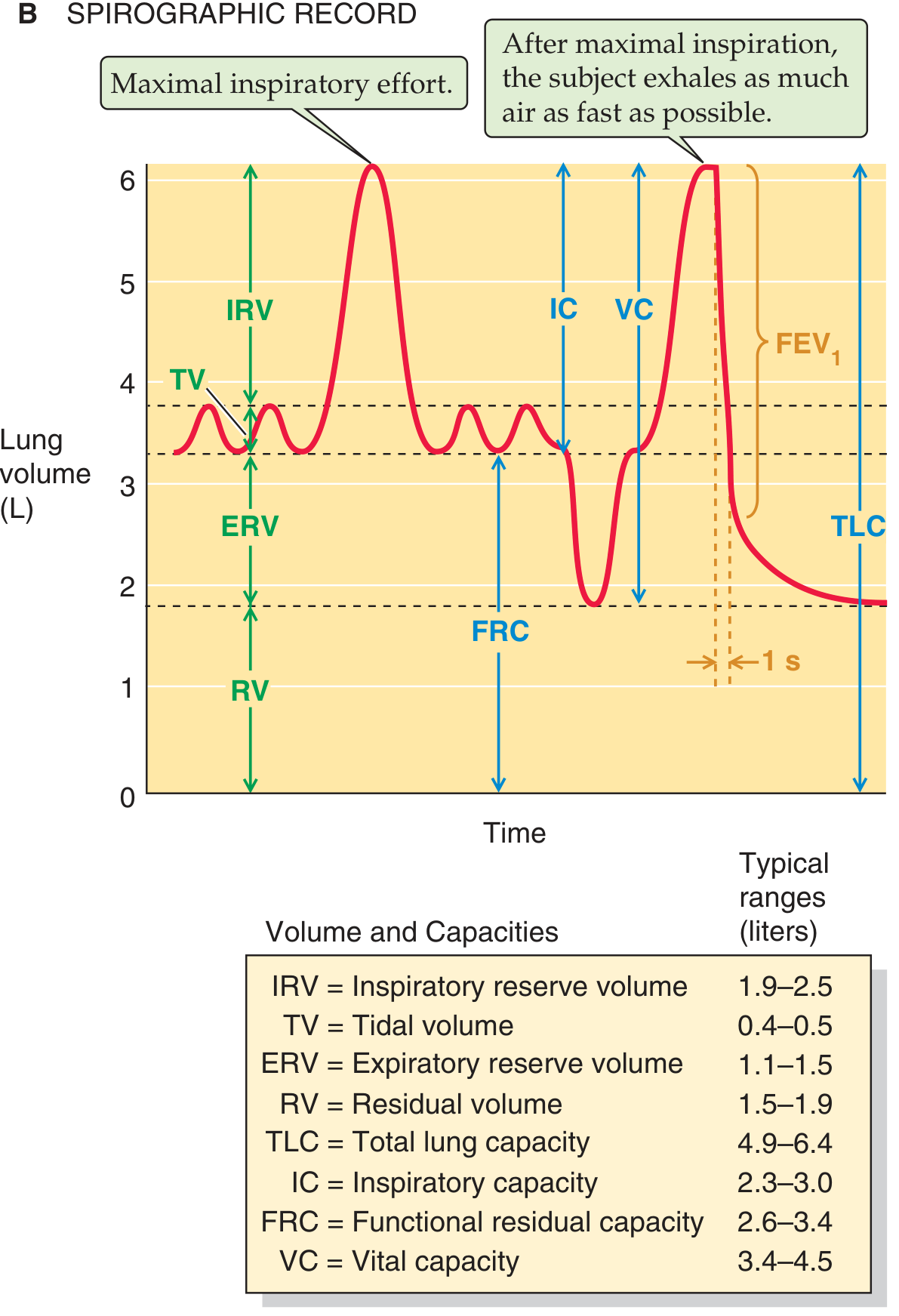
Spirographic record - Medical Physiology (Boron & Boulpaep)
The Four Primary Lung Volumes
These four volumes do not overlap and together make up the total lung capacity.
| Volume | Symbol | Typical Value | Description |
|---|---|---|---|
| Tidal Volume | TV (or V_T) | ~500 mL | Volume inspired or expired with each quiet breath |
| Inspiratory Reserve Volume | IRV | 1,900-2,500 mL | Additional air that can be inhaled after a normal inspiration |
| Expiratory Reserve Volume | ERV | 1,100-1,500 mL | Additional air that can be exhaled after a normal expiration |
| Residual Volume | RV | 1,500-1,900 mL | Air remaining in the lungs after maximal forced expiration |
Key point: RV cannot be measured by spirometry - it is the air that can never be exhaled. It serves two purposes: (1) prevents complete airway collapse (re-inflation of a collapsed airway requires very high pressure), and (2) allows continuous gas exchange with blood even between breaths.
The Four Lung Capacities
Each capacity is a combination of two or more volumes.
| Capacity | Symbol | Formula | Typical Value | Description |
|---|---|---|---|---|
| Inspiratory Capacity | IC | IRV + TV | ~3,500 mL | Max air inspirable from end of quiet expiration |
| Functional Residual Capacity | FRC | ERV + RV | ~2,400 mL | Volume left in lungs after quiet expiration (equilibrium volume) |
| Vital Capacity | VC | IRV + TV + ERV | ~4,700 mL | Max air expirable after maximal inspiration |
| Total Lung Capacity | TLC | IRV + TV + ERV + RV | ~5,900 mL | Total volume of the lungs at maximal inspiration |
What Can and Cannot Be Measured by Spirometry
| Measurable by Spirometry | NOT measurable (contains RV) |
|---|---|
| TV, IRV, ERV | RV |
| VC, IC | FRC, TLC |
Because FRC and TLC include RV, they require special methods:
- Helium dilution - Subject breathes a known amount of insoluble helium; after equilibration, lung volume is back-calculated from the dilution.
- Body plethysmograph - Applies Boyle's law (P × V = constant) to calculate lung volume from pressure-volume changes in a sealed chamber.
Factors Affecting Lung Volumes
IRV and ERV are reduced by:
- Decreased lung compliance (e.g., fibrosis)
- Weak respiratory muscles
- Recumbent posture (diaphragm displacement by abdominal contents)
- Skeletal deformities (kyphoscoliosis)
- Pain limiting effort
Vital Capacity is increased by:
- Larger body size and male sex
- Physical conditioning
Vital Capacity is decreased by:
- Aging
- Pulmonary disease (monitored serially)
FEV1 and the FEV1/FVC Ratio
At the end of a spirographic maneuver, the subject makes a maximal inspiration then exhales as rapidly and completely as possible. The volume exhaled in the first second is the FEV1 (forced expiratory volume in 1 second).
- Normally, FEV1/FVC (forced vital capacity) = ~80%
- Obstructive disease (asthma, COPD): FEV1 falls disproportionately -> ratio < 70%
- Restrictive disease (fibrosis, chest wall disease): both FEV1 and FVC fall proportionally -> ratio normal or elevated
Quick Reference: Typical Values (Adult)
| Measurement | Value |
|---|---|
| TV | 500 mL |
| IRV | ~3,000 mL |
| ERV | ~1,200 mL |
| RV | ~1,200 mL |
| TLC | ~5,900 mL |
| VC | ~4,700 mL |
| FRC | ~2,400 mL |
| IC | ~3,500 mL |
(Values from Costanzo Physiology 7th Edition and Fishman's Pulmonary Diseases)
Sources:
- Medical Physiology (Boron & Boulpaep), pp. 878-882
- Costanzo Physiology, 7th Ed., Ch. 5
- Fishman's Pulmonary Diseases and Disorders, Table 31-1
This is a shared conversation. Sign in to Orris to start your own chat.