
Rheumatoid arthritis
Reading File
The query is quite broad - "Rheumatoid arthritis" could mean many things. Let me clarify before diving deep.
Asking for Preferences
What aspect of rheumatoid arthritis are you most interested in?
Searching sources...
Finding Sources
Searching PubMed
"rheumatoid arthritis"[MeSH Terms] AND treatment
Finding Sources
Searching PubMed
"rheumatoid arthritis"[MeSH Terms] AND treatment
Now let me get the primary rheumatology content from the Family Medicine and Henry's Lab textbooks, plus search for RA pathophysiology and treatment paragraphs.
Reading File
Finding Sources
Finding Sources
Reading File
Reading File
Reading File
Finding Sources
Reading File
Reading File
Loading Image
Reading File
I now have comprehensive content from multiple authoritative textbooks. Let me compile the full overview.
Rheumatoid Arthritis - Comprehensive Overview
Definition
Rheumatoid arthritis (RA) is a chronic, systemic inflammatory autoimmune disease of unknown etiology, characterized by symmetric inflammatory polyarthritis that primarily targets the synovium. Without treatment, the disease course is progressive, leading to joint destruction, disability, and significant comorbidities including premature cardiovascular disease. Extra-articular manifestations affect up to 40% of patients, particularly those who are seropositive.
- Goldman-Cecil Medicine, p. 2790
- Washington Manual of Medical Therapeutics, p. 944
Epidemiology
-
Prevalence: 1-2% of adults; rises to ~10% in those over 65 years
-
Women : Men ratio = 3:1
-
Peak incidence: 20-50 years of age
-
70% have an insidious onset
-
Higher concordance in monozygotic twins than dizygotic twins, reflecting a genetic basis through MHC class II gene products (HLA-DR)
-
Textbook of Family Medicine 9e, p. 1603
Pathophysiology
RA involves a complex interaction of genetic predisposition and an unidentified inciting trigger (possibly infectious). The central mechanism:
- HLA-DR alleles (part of MHC class II) predispose to disease through triggering by various stimuli
- Synovial lining cells and subsynovial vessels proliferate, forming a pannus - an invasive fibrovascular tissue
- Leukocytes invade, releasing proteases and cytokines (especially TNF-alpha, IL-1, IL-6)
- Rheumatoid factor (RF): autoantibody directed against the Fc fragment of IgG - influenced by HLA-DR polymorphism and associated with more severe, extra-articular disease
- Anti-cyclic citrullinated peptide (anti-CCP) antibodies are more specific than RF and appear early in disease
- The inflammatory cascade leads to cartilage destruction, bony erosions, and tendon damage
Patients with active, polyarticular, RF-positive RA have >70% chance of developing joint damage within 2 years without treatment.
- Textbook of Family Medicine 9e, p. 1605
Clinical Features
Articular Manifestations
The hallmark is symmetric synovitis with morning stiffness lasting >1 hour.
Joints most commonly affected (small joints first):
- Metacarpophalangeal (MCP) joints
- Proximal interphalangeal (PIP) joints
- Wrists, ankles, knees, shoulders
Classic deformities (late disease):
| Deformity | Description |
|---|---|
| Ulnar deviation | MCPs deviated toward ulnar side |
| Swan neck | MCP flexion, PIP hyperextension, DIP flexion |
| Boutonniere | PIP flexion, DIP hyperextension |
| Cock-up toes | Forefoot deformities |
Cervical spine - C1-C2 articulation can be involved, causing subluxation that may lead to myelopathy or even death.
Other joints: temporomandibular, cricoarytenoid (hoarseness, rarely acute airway compromise), and sternoclavicular.
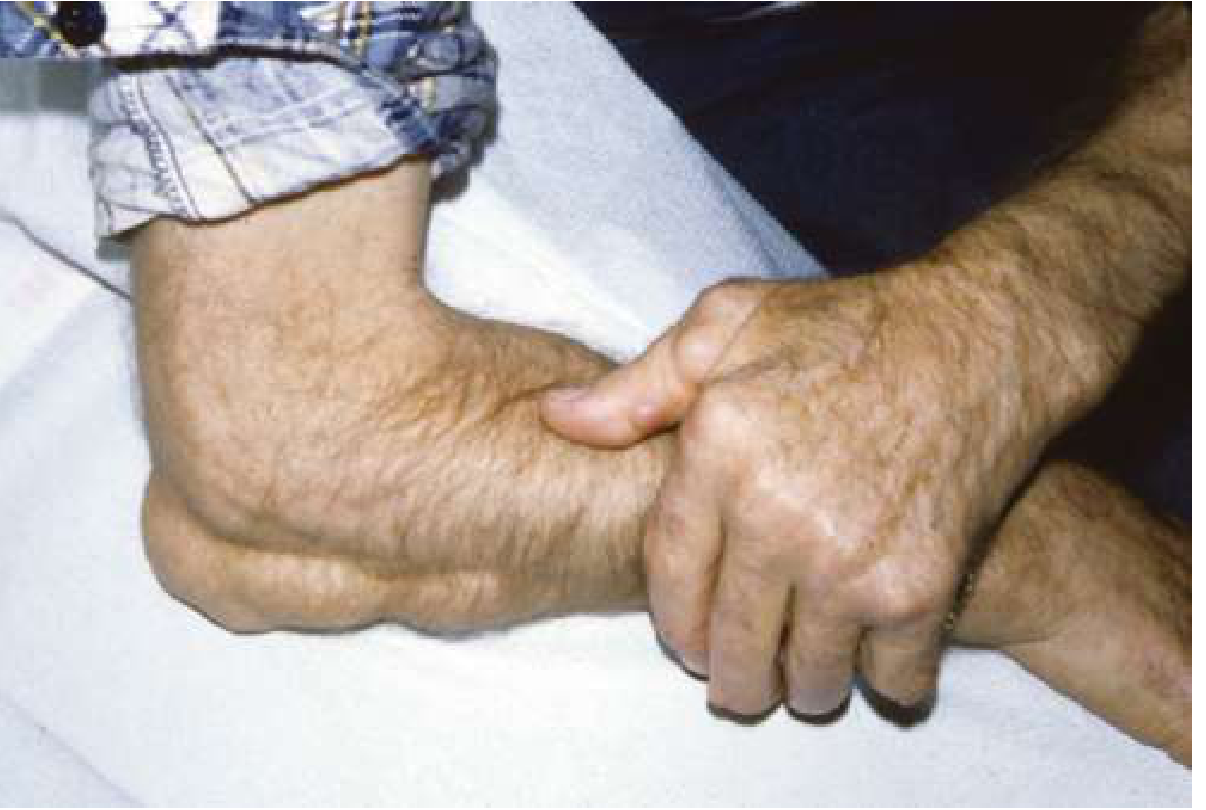
Extra-Articular Manifestations
All extra-articular features are more common in seropositive patients (RF+ or anti-CCP+).
| System | Manifestation |
|---|---|
| Skin | Subcutaneous nodules (~20% of patients, almost exclusively seropositive), vasculitis, pyoderma gangrenosum |
| Cardiovascular | Pericarditis (50% by echo, usually asymptomatic), premature atherosclerosis, valve disease, increased VTE risk |
| Pulmonary | Pleural effusions, interstitial lung disease (up to 45%, may be clinically silent), rheumatoid nodules, bronchiolitis obliterans, Caplan syndrome (with dust exposure) |
| Eyes | Keratoconjunctivitis sicca (secondary Sjögren's, most common), scleritis, episcleritis, scleromalacia perforans |
| Neurologic | Entrapment neuropathy (carpal tunnel most common), cervical myelopathy, mononeuritis multiplex |
| Hematologic | Anemia (chronic disease), thrombocytosis, lymphadenopathy, Felty syndrome (splenomegaly + neutropenia), large granular lymphocyte syndrome |
| Renal | Amyloidosis, vasculitis |
| Bone | Osteopenia/osteoporosis |
Constitutional symptoms (fatigue, weight loss, low-grade fever) are common.
- Goldman-Cecil Medicine, p. 2790; Washington Manual, p. 944
Diagnosis
RA is primarily a clinical diagnosis, confirmed by labs and imaging in context.
2010 ACR/EULAR Classification Criteria
(Score-based; a total score ≥6/10 classifies RA in patients with active synovitis)
| Domain | Score |
|---|---|
| Joint involvement | 1 large joint = 0; 2-10 large joints = 1; 1-3 small joints = 2; 4-10 small joints = 3; >10 joints (at least 1 small) = 5 |
| Serology | Negative RF and anti-CCP = 0; Low-positive = 2; High-positive = 3 |
| Acute-phase reactants | Normal CRP and ESR = 0; Abnormal = 1 |
| Duration of symptoms | <6 weeks = 0; ≥6 weeks = 1 |
(The 1987 ACR criteria require 4 of 7 features and ≥6 weeks of symptoms)
Laboratory Tests
| Test | Finding in RA |
|---|---|
| Rheumatoid Factor (RF) | Positive in ~80%; not specific (also positive in hepatitis C, SBE, lymphoma, SLE, Sjögren's, TB - mnemonic CHRONIC) |
| Anti-CCP antibodies | Positive in 50-60% with early RA; >90% specific for RA; appear before symptoms |
| ESR / CRP | Elevated (reflect disease activity) |
| CBC | Normocytic anemia, thrombocytosis |
| Synovial fluid | WBC >2,000/mm³, no crystals |
| ANA | Low-titer positive in ~30% |
Imaging
-
Plain radiographs (hands/wrists): periarticular osteopenia, joint space narrowing, bony erosions (appear months to 1 year after onset - late finding)
-
MRI and ultrasound: more sensitive than X-rays; detect subclinical synovitis and erosions earlier
-
Washington Manual, p. 944; Textbook of Family Medicine 9e, p. 1610
Treatment
Treatment Goals (Treat-to-Target Strategy)
The target is remission or low disease activity. When treated early, remission is achievable in >50% and low disease activity in at least another 35%.
Treatment pillars:
- Pain control
- Suppression of inflammation
- Prevention of progressive joint destruction
- Maintenance of function
Step 1 - NSAIDs
- Provide symptomatic relief only - do NOT alter the underlying disease or prevent erosions
- Should never be used without a concomitant DMARD
- COX-2 inhibitors (e.g., celecoxib) preferred if GI risk; monitor cardiovascular risk
- Add PPI for GI protection in all RA patients on NSAIDs
Step 2 - Glucocorticoids
- Rapid, dramatic symptom improvement + reduce radiographic progression
- Used as "bridge therapy" while waiting for DMARDs to take effect (2-6 months)
- Prednisone: rarely exceed 10 mg/day; slow taper to lowest effective dose
- Always use with concomitant DMARD - never as monotherapy long-term
- Monitor for: infection risk (25% increased at 5 mg/day; doubled at 5-10 mg/day), osteoporosis (prescribe bisphosphonate prophylaxis)
- Intra-articular injections useful for refractory joint flares
Step 3 - DMARDs (cornerstone of therapy)
DMARDs are initiated as soon as RA is diagnosed - they modify the disease course by halting erosion and synovial destruction.
Conventional (csDMARDs)
| Drug | Dose / Notes | Monitoring |
|---|---|---|
| Methotrexate (MTX) | First-line anchor DMARD for most patients; economical; makes all other DMARDs work better; contraindicated in pregnancy | CBC + AST/ALT every 8-12 weeks; supplement with folic acid |
| Hydroxychloroquine | 200 mg PO once or twice daily; least toxic csDMARD; use for mild RA | Eye exam at 6 months; yearly after 5 years of therapy; keep dose <5 mg/kg/day |
| Sulfasalazine | 2-3 g/day in divided doses; used alone if no poor prognostic factors | CBC for neutropenia (monthly x1 month, then every 4-6 weeks); check sulfa allergy |
| Leflunomide | Alternative to MTX; long half-life (cholestyramine washout needed); contraindicated in pregnancy | CBC + AST/ALT every 4-8 weeks |
Note: Hydroxychloroquine < Sulfasalazine < Methotrexate - in order of increasing toxicity
Poor prognostic factors favoring early aggressive DMARD use:
- Functional limitation
- Extra-articular disease
- RF+ or anti-CCP+
- Bony erosions on imaging
Biologic DMARDs (bDMARDs)
Used when conventional DMARDs are inadequate. Usually added to MTX.
| Class | Examples | Target |
|---|---|---|
| TNF inhibitors | Etanercept, adalimumab, infliximab, certolizumab, golimumab | TNF-alpha |
| IL-6 receptor inhibitors | Tocilizumab, sarilumab | IL-6 receptor |
| B-cell depletion | Rituximab | CD20 on B cells |
| T-cell co-stimulation blocker | Abatacept | CD80/CD86 on APCs |
| IL-1 inhibitor | Anakinra | IL-1 receptor |
Caution with biologics: Stop if fevers/infection symptoms appear; risk of reactivating latent TB (screen before starting TNF inhibitors); may precipitate CHF, demyelinating disease, or lupus-like syndromes.
Targeted Synthetic DMARDs (tsDMARDs) - JAK inhibitors
| Drug | Notes |
|---|---|
| Baricitinib | Effective after inadequate DMARD response; superior to adalimumab in MTX-inadequate responders |
| Tofacitinib, upadacitinib | JAK1/2 or JAK1-selective inhibitors |
- Goldman-Cecil Medicine, p. 2795-2796
Monitoring Disease Activity
Common validated tools:
- DAS28 (Disease Activity Score using 28 joint count)
- CDAI (Clinical Disease Activity Index)
- SDAI (Simplified Disease Activity Index)
Regular monitoring of:
- CBC, liver enzymes, renal function (per DMARD used)
- ESR/CRP
- Joint counts and functional status
- Annual ophthalmology if on hydroxychloroquine (after 5 years)
- Bone density (with glucocorticoids)
- Cardiovascular risk factors
Complications & Comorbidities
- Cardiovascular disease: RA patients have significantly increased morbidity/mortality from CAD and heart failure. Chronic inflammation accelerates atherosclerosis beyond conventional risk factors
- Infection: Increased susceptibility, worsened by immunosuppressive therapy
- Osteoporosis: From disease-related inflammation + glucocorticoid use
- Malignancy: Slightly increased risk of lymphoma (especially with high disease activity)
- Felty syndrome: RA + splenomegaly + profound neutropenia (rare, ~1%)
- Cervical myelopathy: From C1-C2 subluxation
Key Takeaways
- RA is a systemic autoimmune disease, not just a joint disease
- Early diagnosis and early aggressive DMARD therapy are the most important interventions
- Methotrexate is the anchor first-line DMARD
- NSAIDs and glucocorticoids are adjuncts only - never monotherapy substitutes for DMARDs
- Anti-CCP antibodies are more specific than RF for diagnosis
- Seropositive patients (RF+/anti-CCP+) have worse prognosis and more extra-articular disease
- Treat-to-target (remission or low disease activity) is the modern standard of care
Sources: Goldman-Cecil Medicine (International Edition), Textbook of Family Medicine 9e, Washington Manual of Medical Therapeutics
This is a shared conversation. Sign in to Orris to start your own chat.