
Thyroid profile
I'll look up the thyroid profile from the medical library for a thorough, textbook-quality answer.
Reading File
Now let me search the library for thyroid profile content in parallel:
Finding Sources
Finding Sources
Searching the Web
thyroid profile tests TSH T3 T4 normal values interpretation 2024
Now let me read the most relevant textbook sections in parallel:
Reading File
Reading File
Reading File
Good data collected. Let me now get the full thyroid physiology and interpretation sections:
Reading File
Finding Sources
Let me fetch the HPT axis diagram and get the Washington Manual's drug effects section:
Loading Image
Reading File
Excellent - I now have comprehensive data from multiple authoritative textbooks. Here is the full thyroid profile overview:
Thyroid Profile
The thyroid profile (thyroid function tests) is a panel of blood tests used to evaluate the function of the thyroid gland. It typically includes TSH, free T4, free T3, and sometimes total T4/T3 and antibodies.
Hypothalamic-Pituitary-Thyroid (HPT) Axis
The HPT axis is the regulatory backbone of thyroid function:
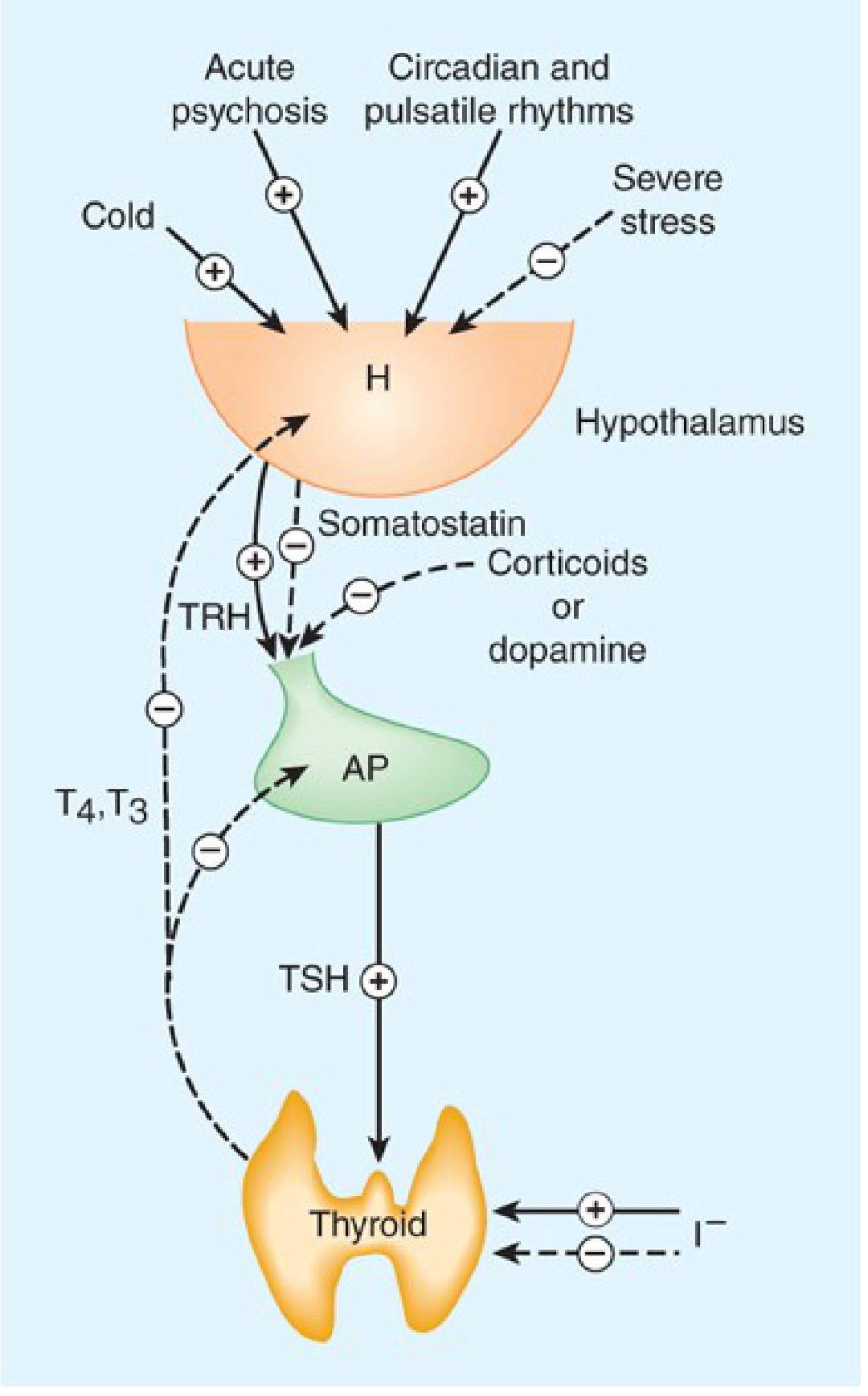
- Hypothalamus secretes TRH (thyrotropin-releasing hormone)
- TRH stimulates the anterior pituitary to release TSH (thyroid-stimulating hormone)
- TSH stimulates the thyroid gland to synthesize and release T3 and T4
- T3/T4 exert negative feedback on both the pituitary (suppressing TSH) and the hypothalamus (suppressing TRH)
- External factors: Cold and acute psychosis stimulate the axis; severe stress and corticoids/dopamine inhibit it
(Katzung's Basic and Clinical Pharmacology, 16th Ed)
The Tests - Normal Reference Ranges
| Test | Normal Value | Hypothyroidism | Hyperthyroidism |
|---|---|---|---|
| Total T4 | 4.8-10.4 mcg/dL (62-134 nmol/L) | Low | High |
| Total T3 | 59-156 ng/dL (0.9-2.4 nmol/L) | Normal or Low | High |
| Free T4 (FT4) | 0.8-1.4 ng/dL (10-18 pmol/L) | Low | High |
| Free T3 (FT3) | 169-371 ng/dL (2.6-5.7 pmol/L) | Low | High |
| TSH | 0.45-4.12 µIU/mL | High | Low |
| 123I uptake (24h) | 5-35% | Low | High |
| Anti-Tg antibodies | <200 IU/mL | Often present | Usually present |
| Anti-TPO antibodies (ATPO) | ≤100 WHO units | Often present | Usually present |
| Serum thyroglobulin | Women: 1.5-38.5 mcg/L; Men: 1.4-29.2 mcg/L | Not indicated | Not indicated |
| TSI / TSH-R Ab | Negative (<140% of baseline) | Not indicated | Elevated in Graves' disease |
(Katzung's Basic and Clinical Pharmacology, 16th Ed, p. 1077)
Individual Tests Explained
1. TSH (Thyroid-Stimulating Hormone)
- The single most sensitive screening test for thyroid dysfunction
- If TSH is normal, thyroid function is almost certainly normal
- TSH is the first test to change in thyroid disease:
- High TSH = Primary hypothyroidism (thyroid under-producing, pituitary compensating)
- Low TSH = Hyperthyroidism or secondary/tertiary hypothyroidism
- Reference: 0.45-4.12 µIU/mL (adults)
- Pregnancy-specific ranges: 1st trimester 0.26-2.66; 2nd trimester 0.55-2.73; 3rd trimester 0.43-2.91 mIU/L
2. Free T4 (FT4) - Preferred over Total T4
- Biologically active, unbound fraction of thyroxine
- Not affected by changes in thyroid-binding globulin (TBG) unlike total T4
- Total T4 is seldom measured nowadays - FT4 has largely replaced it
- Reference: 0.8-1.4 ng/dL
3. Free T3 (FT3)
- Active form; T4 is converted to T3 peripherally by deiodinases
- More useful than total T3 in clinical practice
- Helpful in T3 toxicosis (elevated T3 with normal T4)
- Reference: 2.0-4.4 pg/mL
4. Total T4 and Total T3
- Include both protein-bound and free fractions
- Can be falsely elevated or depressed by changes in TBG (e.g., estrogen raises TBG, androgens lower TBG) without actual thyroid disease
- Seldom used clinically now that free hormone assays are available
(Harper's Illustrated Biochemistry, 32nd Ed)
Interpreting the Pattern
| TSH | FT4 | FT3 | Interpretation |
|---|---|---|---|
| High | Low | Low | Primary hypothyroidism |
| Low | High | High | Primary hyperthyroidism |
| Low/normal | Low | Low | Secondary (pituitary) or tertiary (hypothalamic) hypothyroidism |
| Low | Normal | Normal | Subclinical hyperthyroidism |
| High | Normal | Normal | Subclinical hypothyroidism |
| Normal | Low (total only) | - | Low TBG state (androgens, nephrotic syndrome) |
| Normal | High (total only) | - | High TBG state (estrogens, pregnancy, OCP) |
Thyroid Antibodies
| Antibody | Significance |
|---|---|
| Anti-TPO (thyroid peroxidase) | Hashimoto's thyroiditis, Graves' disease; ≤100 WHO units normal |
| Anti-thyroglobulin (Anti-Tg) | Hashimoto's, thyroid cancer monitoring; <200 IU/mL normal |
| TSH receptor antibody (TSI / TRAb) | Specific for Graves' disease; causes hyperthyroidism by mimicking TSH |
Drug Effects on Thyroid Tests
Drugs can cause both in vitro and in vivo effects - this is a common source of misinterpretation (Henry's Clinical Diagnosis and Management by Laboratory Methods; Washington Manual of Medical Therapeutics):
Drugs causing decreased T4/T3 (true hypothyroidism - TSH elevated):
- Iodine (amiodarone, radiographic contrast), lithium, some tyrosine kinase inhibitors, immune checkpoint inhibitors
Drugs suppressing TSH without true hypothyroidism:
- Glucocorticoids (high dose), dopamine - suppress TSH secretion
Drugs affecting TBG (TSH remains normal):
- Increase TBG (raise total T4/T3 but not free): Estrogens, tamoxifen, raloxifene, methadone, heroin, SERMs
- Decrease TBG (lower total T4/T3 but not free): Androgens
Drugs displacing T4 from binding proteins (TSH normal):
- Furosemide (high dose), salicylates, phenytoin, carbamazepine
Drugs inhibiting T4 → T3 conversion:
- Amiodarone (complex effects - can cause hypo- or hyperthyroidism), glucocorticoids, high-dose propranolol (useful in thyroid storm)
Drugs causing lab artifact only:
- Biotin - interferes with immunoassays, causing false results without real thyroid dysfunction
Key Clinical Points
- Start with TSH - it is the most sensitive marker and often sufficient for screening
- Use FT4 (not total T4) for confirming thyroid hormone levels
- Add FT3 when T3 toxicosis is suspected or when monitoring hyperthyroidism treatment
- TSI/TRAb confirms Graves' disease
- Anti-TPO is the best antibody for diagnosing Hashimoto's thyroiditis
- Thyroglobulin is used as a tumor marker after thyroidectomy for differentiated thyroid cancer
- Always check the medication list before interpreting any thyroid test - many common drugs interfere
Sources: Katzung's Basic and Clinical Pharmacology, 16th Ed | Harper's Illustrated Biochemistry, 32nd Ed | Henry's Clinical Diagnosis and Management by Laboratory Methods | Washington Manual of Medical Therapeutics | Goodman & Gilman's Pharmacological Basis of Therapeutics
This is a shared conversation. Sign in to Orris to start your own chat.