Here is the complete elaboration of FAST HUGS BIDS with both infographics:
FAST HUGS BIDS - Complete ICU Daily Care Checklist
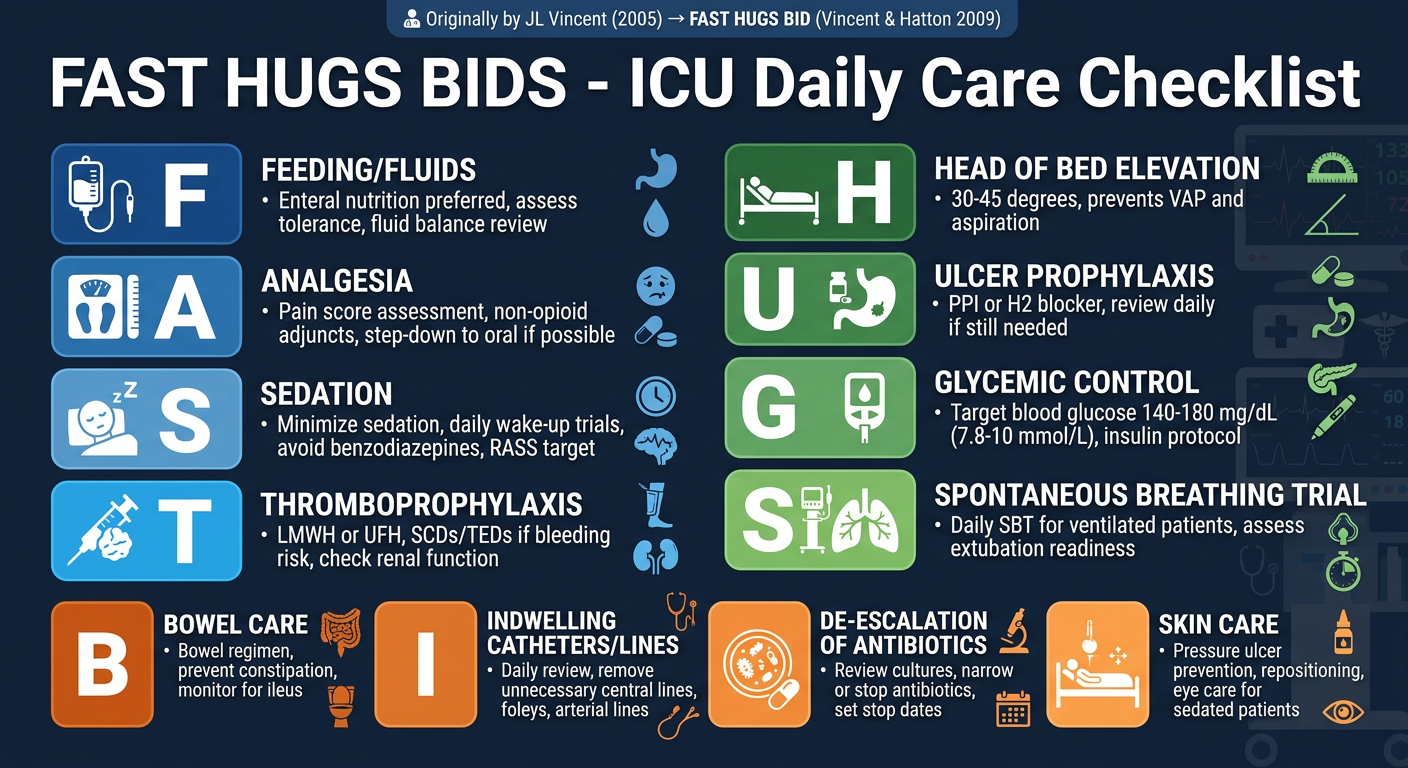
Infographic 1: The Mnemonic Components
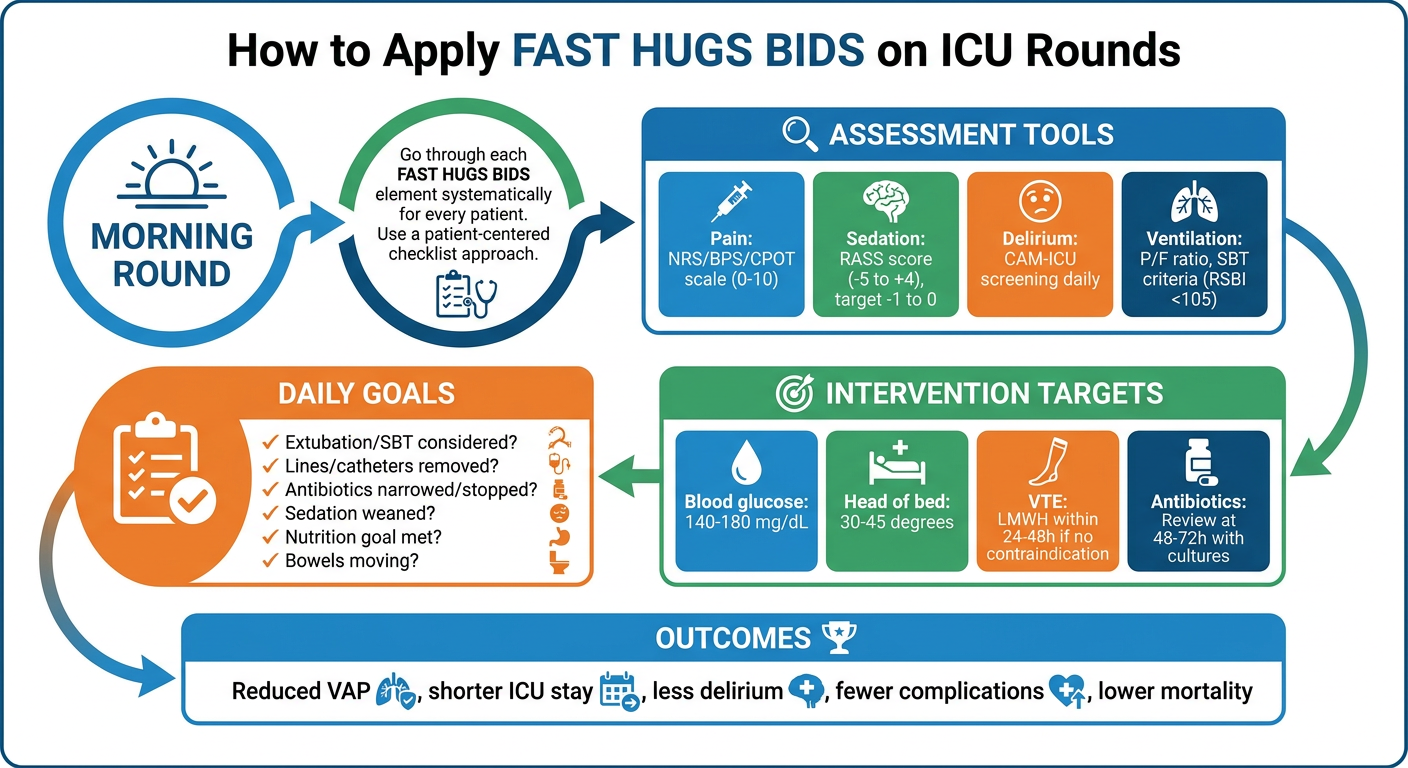
Infographic 2: How to Apply on ICU Rounds
History & Origins
The mnemonic was first introduced by Prof. Jean-Louis Vincent in 2005 as FAST HUG - a 7-element mental checklist for bedside daily care. In 2009, Vincent WR & Hatton KW expanded it to FAST HUGS BID, adding spontaneous breathing trials, bowel care, indwelling catheter review, and antibiotic de-escalation. The acronym "BIDS" is now widely used instead of "BID" to include skin care as the 4th add-on item.
The Full Mnemonic: FAST HUGS BIDS
🔵 F - Feeding / Fluids
Goal: Optimize nutrition and fluid balance early.
| Question to ask on rounds | Clinical Action |
|---|
| Is enteral nutrition started? | Prefer enteral over parenteral (gut function preserved) |
| Is the patient hitting calorie/protein targets? | Target ~25 kcal/kg/day; 1.2-2g protein/kg/day |
| Is the patient NPO unnecessarily? | If NPO >24-48h, consider enteral tube feeds |
| What is the daily fluid balance? | Avoid fluid overload; target neutral to negative balance after resuscitation phase |
- Enteral nutrition reduces bacterial translocation, maintains gut integrity, and lowers infection risk
- Early feeding within 24-48h of ICU admission is supported by ESPEN ICU guidelines
- Assess gastric residual volumes, prokinetics if high
🔵 A - Analgesia
Goal: Ensure adequate pain control with minimal side effects.
| Question to ask | Clinical Action |
|---|
| Is pain being scored? | Use NRS (0-10) in cooperative patients; BPS or CPOT in non-verbal/sedated patients |
| Is analgesia adequate? | Target NRS ≤3 or BPS <5 |
| Are non-opioid adjuncts being used? | Paracetamol, NSAIDs (if renal function OK), ketamine, gabapentin, regional blocks |
| Can we step down from IV to oral? | Convert as soon as enteral route is available |
- Analgesia-first (analgosedation) strategy: treat pain before adding sedation
- Reduces opioid requirements, delirium risk, and time on ventilator
- Avoid uncontrolled pain as it drives sympathetic activation, tachycardia, and catabolism
🔵 S - Sedation
Goal: Minimum effective sedation; avoid over-sedation.
| Question to ask | Clinical Action |
|---|
| What is the RASS score? | Target RASS -1 to 0 (lightly sedated/awake) for most patients |
| Is benzodiazepine being used? | Prefer propofol or dexmedetomidine over midazolam (less delirium) |
| Has a daily sedation interruption (DSI) been done? | Wake-up trial every morning - assess neurological status, wean sedation |
| Is there delirium? | Assess with CAM-ICU; treat with non-pharmacological measures first |
- Protocolized sedation targeting light levels reduces ICU length of stay and ventilator days
- ABCDEF bundle aligns with this: Awakening + Breathing + Coordination + Delirium + Early mobility + Family
🔵 T - Thromboprophylaxis
Goal: Prevent DVT and pulmonary embolism in immobilized ICU patients.
| Question to ask | Clinical Action |
|---|
| Is VTE prophylaxis ordered? | LMWH (e.g., enoxaparin 40 mg SC OD) for most patients within 24-48h |
| Any contraindication to pharmacological prophylaxis? | Active bleeding, platelets <50k, coagulopathy → use mechanical (SCDs, compression stockings) |
| Is dose adjusted for renal function? | Reduce enoxaparin dose if GFR <30 mL/min; consider UFH |
| Are mechanical devices in use? | Sequential compression devices (SCDs) on all patients regardless |
- ICU patients have very high VTE risk (immobility + inflammation + vascular injury)
- Pharmacological + mechanical combination is superior to either alone
🟢 H - Head of Bed Elevation
Goal: Prevent ventilator-associated pneumonia (VAP) and aspiration.
| Question to ask | Clinical Action |
|---|
| Is the head of bed elevated? | Maintain 30-45 degrees for all intubated/mechanically ventilated patients |
| Is the patient at risk of aspiration? | Also apply to patients with NG feeds or impaired swallowing |
| Any contraindication? | Spinal instability, hemodynamic instability may limit elevation - use reverse Trendelenburg if needed |
- Reduces micro-aspiration of gastric contents into the trachea
- Reduces VAP incidence by ~40-50% as part of the VAP bundle
🟢 U - Ulcer (Stress) Prophylaxis
Goal: Prevent stress-related mucosal disease (SRMD) and GI bleeding.
| Question to ask | Clinical Action |
|---|
| Does this patient have risk factors for stress ulcers? | Mechanical ventilation >48h, coagulopathy, burns, traumatic brain injury, history of peptic ulcer |
| Is prophylaxis appropriate? | PPI (pantoprazole 40 mg IV/OD) or H2 receptor antagonist (ranitidine/famotidine) |
| Can prophylaxis be discontinued? | If patient is on enteral feeds, risk decreases significantly - consider stopping |
| Is the patient on anticoagulants? | Higher GI bleeding risk - maintain prophylaxis |
- SUP-ICU and PEPTIC trials inform current practice - PPIs provide greater acid suppression, but H2 blockers may be sufficient in lower-risk patients
- Overuse of PPIs is associated with hospital-acquired pneumonia and C. difficile
🟢 G - Glycemic Control
Goal: Avoid both hyperglycemia and hypoglycemia.
| Question to ask | Clinical Action |
|---|
| What is the blood glucose? | Check every 1-4h based on stability and insulin infusion status |
| What is the glucose target? | 140-180 mg/dL (7.8-10 mmol/L) for most ICU patients (NICE-SUGAR trial) |
| Is there hypoglycemia (<70 mg/dL)? | Treat immediately with dextrose; hypoglycemia is more dangerous acutely |
| Is the insulin protocol appropriate? | Use a validated insulin infusion protocol; avoid sliding-scale only |
- Tight control (<110 mg/dL) is harmful - increases hypoglycemia and mortality (NICE-SUGAR 2009)
- Moderate control (140-180 mg/dL) is standard of care
- Hyperglycemia impairs neutrophil function, promotes infection, and increases inflammation
🟢 S - Spontaneous Breathing Trial (SBT)
Goal: Identify ventilated patients ready for extubation.
| Question to ask | Clinical Action |
|---|
| Is the cause of respiratory failure resolving? | If yes, assess readiness for SBT |
| Does the patient meet SBT criteria? | FiO₂ ≤50%, PEEP ≤5-8 cmH₂O, hemodynamically stable, awake, following commands |
| Has SBT been performed today? | Perform 30-120 min T-piece or low-pressure support trial (PSV 5-8 cmH₂O) |
| Did the patient pass? | If RSBI <105, no distress, stable vitals → proceed to extubation |
- Daily SBT paired with daily sedation interruption (DSI) reduces ventilator days by ~3 days
- Failure to screen for SBT readiness is a major cause of prolonged mechanical ventilation
- Assess for post-extubation support (HFNO, NIV) prophylactically in high-risk patients
🟠 B - Bowel Care
Goal: Prevent constipation, ileus, and their complications.
| Question to ask | Clinical Action |
|---|
| When did the patient last have a bowel movement? | Constipation is defined as >3 days without bowel movement in ICU |
| Is a bowel regimen in place? | Stimulant laxative (bisacodyl) + osmotic agent (lactulose/polyethylene glycol) |
| Is there an ileus? | Hold feeds temporarily, assess for electrolyte disturbances (K+, Mg²+), review opioids |
| Are opioids contributing? | Consider methylnaltrexone (peripheral mu-opioid antagonist) if opioid-induced constipation |
- Constipation affects >50% of ICU patients on opioids and mechanical ventilation
- Increases intra-abdominal pressure, impairs diaphragm function, worsens ventilator weaning
- Diarrhea: rule out C. difficile if on antibiotics; adjust feeds
🟠 I - Indwelling Catheters / Lines
Goal: Remove unnecessary invasive devices daily to reduce infection risk.
| Question to ask | Clinical Action |
|---|
| Is the central venous catheter (CVC) still needed? | Remove if peripheral access is sufficient |
| Is the arterial line still needed? | Remove if patient is stable, not on vasopressors |
| Is the urinary catheter still needed? | Remove as soon as patient can void or doesn't require strict urine output monitoring |
| Is the NG/OG tube still needed? | Remove when patient has adequate oral intake |
- Each day an indwelling catheter remains in place, CLABSI risk increases by ~3%
- CAUTI (catheter-associated UTI) is the most common healthcare-associated infection in ICU
- "If in doubt, take it out" - daily review is mandatory
🟠 D - De-escalation of Antibiotics
Goal: Avoid antibiotic overuse, reduce resistance, and prevent side effects.
| Question to ask | Clinical Action |
|---|
| What are the culture results? | Review all blood, urine, sputum cultures at 48-72h |
| Can antibiotics be narrowed? | Broad-spectrum → narrow-spectrum based on sensitivities |
| Can antibiotics be stopped? | If cultures negative and clinical improvement - consider stopping |
| Do all antibiotics have stop dates? | Every antibiotic order should have a defined duration |
- Antibiotic de-escalation is an antimicrobial stewardship principle
- Reduces C. difficile risk, multiresistant organism (MRO) emergence, and nephrotoxicity
- PCT (procalcitonin)-guided therapy can help shorten antibiotic courses safely
🟠 S (4th) - Skin Care
Goal: Prevent pressure ulcers, eye complications, and oral hygiene issues.
| Question to ask | Clinical Action |
|---|
| Is pressure ulcer prevention in place? | 2-hourly repositioning, pressure-relieving mattresses, barrier creams |
| Is eye care being done for sedated patients? | Lubricating drops/gel 4-6 hourly, eyelid taping if incomplete closure |
| Is oral hygiene being maintained? | Chlorhexidine 0.12% oral rinse reduces VAP; regular mouth care |
| Is the skin being assessed daily? | Grade and document any new pressure injuries (NPUAP/EPUAP grading) |
- Sedated/paralyzed patients cannot protect themselves from pressure injury
- Corneal exposure in sedated patients leads to keratitis if unmanaged
- Oral care with chlorhexidine is part of the standard VAP bundle
Summary Table
| Letter | Component | Key Action | Clinical Goal |
|---|
| F | Feeding/Fluids | Start enteral feeds within 24-48h, balance fluids | Prevent malnutrition, avoid fluid overload |
| A | Analgesia | Score pain, use multimodal analgesia, step down | Pain NRS ≤3 |
| S | Sedation | Daily wake-up trial, target RASS -1 to 0 | Minimize ventilator days, prevent delirium |
| T | Thromboprophylaxis | LMWH ± SCDs within 24-48h | Prevent DVT/PE |
| H | Head elevation | 30-45° for intubated patients | Prevent VAP |
| U | Ulcer prophylaxis | PPI/H2B if risk factors present; reassess daily | Prevent GI bleeding |
| G | Glycemic control | Target 140-180 mg/dL | Avoid infection/hypoglycemia |
| S | Spontaneous breathing trial | Daily SBT if criteria met | Reduce ventilator days |
| B | Bowel care | Laxative regimen, monitor daily | Prevent ileus/constipation |
| I | Indwelling lines/catheters | Remove all unnecessary devices daily | Reduce CLABSI, CAUTI |
| D | De-escalate antibiotics | Review cultures at 48-72h, narrow/stop | Antimicrobial stewardship |
| S | Skin care | Repositioning, eye care, oral hygiene | Prevent pressure ulcers, keratitis, VAP |
How to Apply on ICU Rounds - Practical Approach
- Pre-round preparation: Review overnight events, labs, vitals, culture results
- Bedside assessment: Examine the patient systematically while mentally running through each letter
- Team huddle: Nurse, physiotherapist, pharmacist, and dietitian input at least once daily
- Daily goals sheet: Write explicit daily goals for each element on the patient's whiteboard or chart
- Documentation: Record each element reviewed and plan in the daily ICU note
- Family communication: Include family in goals - explain what you're checking and why
The
original FAST HUG paper by Vincent (2005) and the
FAST HUGS BID update by Vincent & Hatton (2009) remain the foundational references. The
LITFL FAST HUGS IN BED Please resource by Chris Nickson provides the most expanded version applicable to both ED and ICU settings.