
short term regulation of blood pressure
Reading File
Finding Sources
Finding Sources
Reading File
Finding Sources
Reading File
Reading File
Reading File
Finding Sources
Reading File
Finding Sources
I now have comprehensive material to build a thorough answer. Let me fetch the key diagrams and also check for stress relaxation / intermediate-acting mechanisms.
Loading Image
Loading Image
Reading File
I now have all the material needed for a comprehensive answer. Let me compile it.
Short-Term Regulation of Blood Pressure
Short-term regulation of arterial pressure operates on a time scale of seconds to minutes and works almost entirely through neural reflexes targeting the heart, blood vessels, and adrenal medulla. The core principle is a negative-feedback loop with five components: a detector → afferent pathway → CNS coordinating center → efferent pathway → effector.
Overview of the Feedback Loop
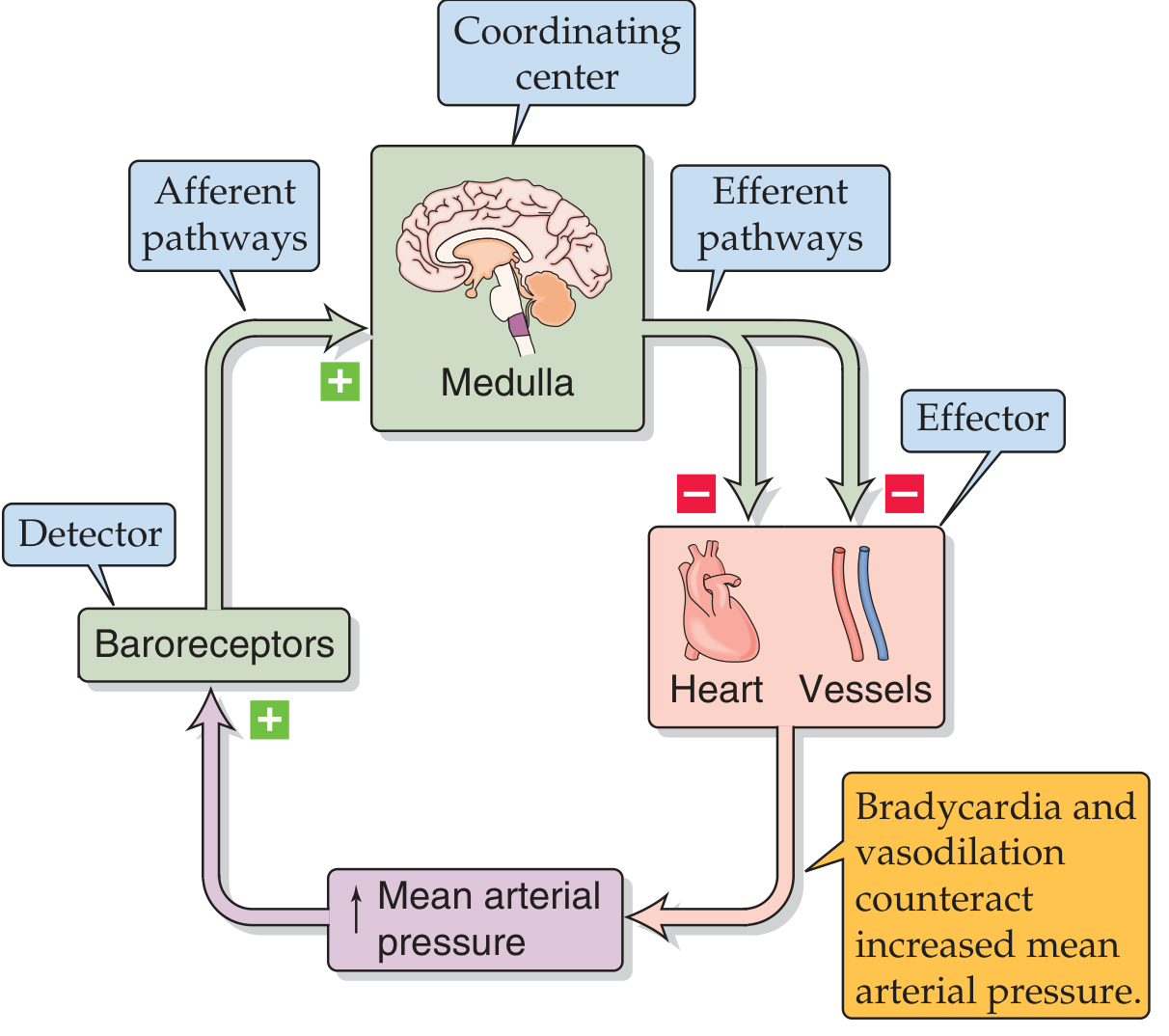
Baroreceptor control of arterial pressure — Medical Physiology (Boron & Boulpaep), Fig. 23-1
A rise in mean arterial pressure (MAP) activates baroreceptors → signals reach the medullary coordinating center → efferent output causes vasodilation + bradycardia → MAP falls back toward normal. The reverse applies when MAP drops.
1. High-Pressure Baroreceptor Reflex (Primary Mechanism)
Sensor locations
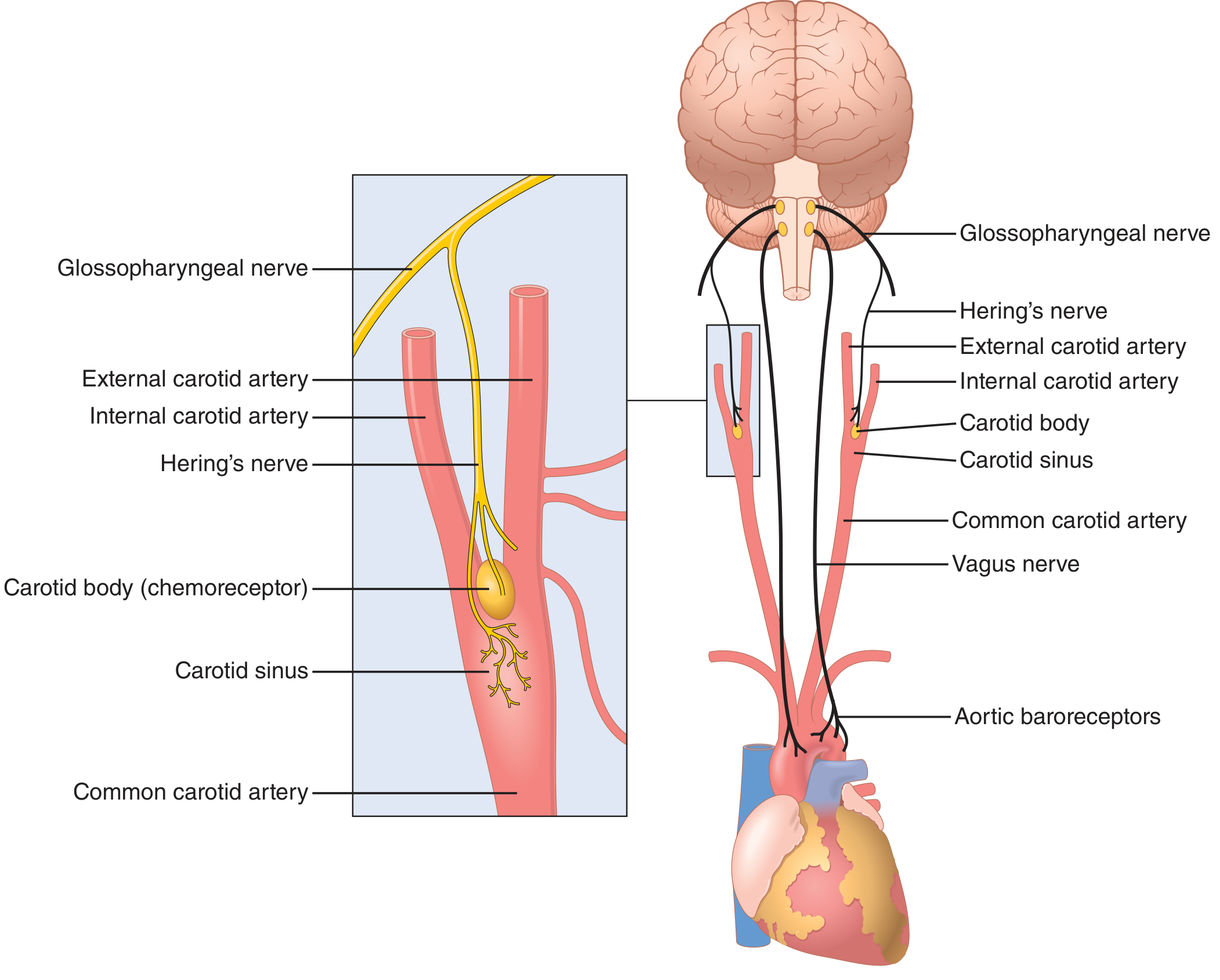
Baroreceptor system anatomy — Guyton & Hall Textbook of Medical Physiology, Fig. 18.5
Baroreceptors are spray-type mechanoreceptors (stretch receptors) in large artery walls:
- Carotid sinus — just above the carotid bifurcation; signals travel via Hering's nerve → glossopharyngeal nerve → nucleus tractus solitarius (NTS) in the medulla.
- Aortic arch — signals travel via the vagus nerve → NTS.
- Additional, less-abundant baroreceptors exist in every large thoracic and neck artery.
Firing characteristics
- Begin firing at ~50–60 mmHg; reach maximum around 180 mmHg.
- The normal operating range (~100 mmHg) sits on the steepest part of the response curve, making the reflex maximally sensitive where it is most needed.
- Respond more vigorously to rapidly changing pressure than to a steady elevated pressure.
Reflex arc
| ↑ MAP | → | Baroreceptors stretch → ↑ firing |
|---|---|---|
| → NTS inhibits vasomotor center; activates vagal center | ||
| Cardiovascular response | → | ↓ Heart rate (bradycardia), ↓ cardiac contractility, vasodilation of arterioles and veins |
| → MAP falls back toward set-point |
Conversely, a fall in MAP reduces baroreceptor firing → vasomotor center disinhibited → ↑ sympathetic output → tachycardia + vasoconstriction → MAP rises.
Pressure buffer function
Baroreceptor denervation studies in dogs showed that pressure variability increased 2.5-fold over 24 hours without the reflex. The system reduces minute-by-minute variation to about one-third of what would occur in its absence.
Resetting
Baroreceptors reset within 1–2 days to a sustained new pressure level, explaining why the baroreflex is a short-term (not long-term) controller. Chronic hypertension resets the sensors at the carotid sinus itself, not at the CNS level.
2. Low-Pressure (Cardiopulmonary) Baroreceptors
Located in the atria, pulmonary artery, and great veins — detect venous filling pressure rather than arterial pressure. Important in responding to changes in blood volume (e.g., the Bainbridge reflex: atrial stretch → reflex tachycardia).
3. Chemoreceptor Reflex (Secondary Mechanism)
- Peripheral chemoreceptors: carotid body and aortic body detect ↓ PO₂, ↑ PCO₂, ↓ pH.
- Central chemoreceptors: medullary, primarily CO₂/pH sensitive.
- Normally a secondary controller of BP, but becomes the dominant mechanism when MAP falls to 40–80 mmHg (where baroreceptor activity is weak).
- ↓ PO₂ or ↑ PCO₂ → chemoreceptor excitation → vasomotor center stimulated → vasoconstriction → ↑ MAP.
4. CNS Ischemic Response ("Last-Ditch" Mechanism)
When cerebral blood flow falls critically (MAP < 60 mmHg), ischemia of the vasomotor center itself triggers a massive, powerful sympathetic discharge:
- MAP can be driven to 250 mmHg for up to 10 minutes.
- Peripheral vasoconstriction so extreme that renal blood flow may effectively cease.
- Not a normal regulatory mechanism — operates only as an emergency/last-resort system.
- Related: Cushing reaction — elevated CSF pressure compresses cerebral arteries → CNS ischemia → reflex hypertension to restore cerebral perfusion.
5. Vasomotor Waves (Mayer Waves)
Cyclical BP oscillations of 10–40 mmHg with a period of ~7–10 sec in humans are caused by reflex oscillations:
- Baroreceptor reflex oscillation → dominant at normal pressures.
- Chemoreceptor reflex oscillation → dominant at 40–80 mmHg.
- CNS ischemic oscillation → at very low pressures.
These arise because feedback loops have a time delay between receptor activation and the effector response — the same principle as any feedback control system.
6. Other Short-Term Reflex Mechanisms
| Mechanism | Trigger | Effect |
|---|---|---|
| Abdominal compression reflex | Baroreceptor/chemoreceptor activation also fires skeletal motor neurons | Abdominal muscle contraction squeezes venous reservoirs → ↑ venous return → ↑ CO and MAP |
| Exercise pressor reflex | Skeletal muscle contraction, anticipation of exercise | Muscle compression of veins + sympathetic activation → ↑ CO and MAP |
| Atrial (Bainbridge) reflex | Atrial stretch from ↑ venous return | Reflex tachycardia to match heart rate to filling |
Time Course Summary
| Mechanism | Onset | Duration | Relative Strength |
|---|---|---|---|
| Baroreceptor reflex | Seconds | Minutes–hours (resets in 1–2 days) | Strong |
| Chemoreceptor reflex | Seconds | Minutes | Moderate (dominant at low pressures) |
| CNS ischemic response | Seconds | Minutes | Extremely powerful (emergency only) |
| Adrenal medulla (epinephrine) | 20–30 sec | Minutes | Moderate |
Sources:
- Guyton and Hall Textbook of Medical Physiology, Ch. 18 (Baroreceptor Arterial Pressure Control)
- Medical Physiology (Boron & Boulpaep), Ch. 23 (Neural Reflexes and Short-Term Regulation)
- Costanzo Physiology, 7th Ed. (Baroreceptor Reflex)
short term regulation of blood pressure
I covered this topic in detail just above. Here's the full summary:
Short-Term Regulation of Blood Pressure
Short-term regulation operates on a time scale of seconds to minutes via neural reflexes targeting the heart, blood vessels, and adrenal medulla. All mechanisms share the same negative-feedback architecture: detector → afferent pathway → CNS coordinating center → efferent pathway → effector.
1. High-Pressure Baroreceptor Reflex (Primary Mechanism)
Sensor Locations
Baroreceptors are stretch-sensitive mechanoreceptors in arterial walls:
- Carotid sinus — signals via Hering's nerve → glossopharyngeal nerve → nucleus tractus solitarius (NTS) in medulla
- Aortic arch — signals via vagus nerve → NTS
Firing Properties
- Begin firing at ~50–60 mmHg; maximum at ~180 mmHg
- Most sensitive in the normal operating range (~100 mmHg) — steepest part of the response curve
- Respond more vigorously to rapidly changing pressure than to sustained pressure
Reflex Arc
| Event | Direction | Response |
|---|---|---|
| ↑ MAP | → stretch baroreceptors | ↑ firing to NTS |
| NTS activated | → inhibits vasomotor center; excites vagal center | ↓ sympathetic, ↑ parasympathetic |
| Effector response | → heart + vessels | Bradycardia + vasodilation → ↓ MAP |
| ↓ MAP | → less baroreceptor stretch | ↓ firing → disinhibit vasomotor center |
| Effector response | → heart + vessels | Tachycardia + vasoconstriction → ↑ MAP |
Key Facts
- Pressure buffer function: baroreceptor denervation increases BP variability 2.5-fold over 24 hours
- Resets in 1–2 days at a sustained new pressure level → explains why it is a short-term, not long-term, controller
- Resetting occurs at the carotid sinus receptors themselves, not centrally
2. Low-Pressure (Cardiopulmonary) Baroreceptors
Located in the atria, pulmonary artery, and great veins — detect venous filling pressure/blood volume changes. Include the Bainbridge reflex: atrial stretch from ↑ venous return → reflex tachycardia.
3. Chemoreceptor Reflex (Secondary Mechanism)
| Receptor | Location | Stimulus |
|---|---|---|
| Peripheral | Carotid body, aortic body | ↓ PO₂, ↑ PCO₂, ↓ pH |
| Central | Medulla | ↑ PCO₂ / ↓ pH |
- Normally a secondary BP controller
- Becomes dominant when MAP falls to 40–80 mmHg (range where baroreceptors are weak)
- Pathway: chemoreceptor activation → stimulates vasomotor center → vasoconstriction → ↑ MAP
4. CNS Ischemic Response ("Last-Ditch Stand")
When MAP falls below ~60 mmHg, ischemia of the vasomotor center itself triggers massive sympathetic discharge:
- Can drive MAP up to 250 mmHg for ~10 minutes
- Peripheral vasoconstriction so intense that renal urine output may cease entirely
- Not a normal regulator — operates only as an emergency mechanism
- Cushing reaction: elevated CSF pressure compresses cerebral arteries → CNS ischemia → reflex hypertension to restore cerebral perfusion
5. Other Short-Term Mechanisms
| Mechanism | Trigger | Effect |
|---|---|---|
| Adrenal medulla | Sympathetic activation | Epinephrine/norepinephrine release → ↑ HR, ↑ contractility, vasoconstriction |
| Abdominal compression reflex | Co-activation during baro/chemoreceptor reflexes | Abdominal muscle contraction → squeezes venous reservoirs → ↑ venous return → ↑ CO and MAP |
| Exercise pressor reflex | Skeletal muscle contraction/anticipation | Muscle venous compression + sympathetic surge → ↑ CO and MAP |
6. Vasomotor Waves (Mayer Waves)
Cyclical BP oscillations of 10–40 mmHg with a period of ~7–10 sec in humans, caused by reflex loop oscillations:
- Baroreceptor oscillation — dominant at normal pressures
- Chemoreceptor oscillation — dominant at 40–80 mmHg
- CNS ischemic oscillation — at very low pressures
These arise from the inherent time delay between receptor stimulation and the cardiovascular effector response.
Time Course Comparison
| Mechanism | Onset | Resets/Fades | Strength |
|---|---|---|---|
| Baroreceptor reflex | Seconds | 1–2 days | Strong, primary |
| Chemoreceptor reflex | Seconds | Minutes | Moderate (dominant at low BP) |
| Adrenal medulla (catecholamines) | ~20–30 sec | Minutes | Moderate |
| CNS ischemic response | Seconds | Minutes | Extremely powerful, emergency only |
Sources: Guyton & Hall Textbook of Medical Physiology, Ch. 18 · Medical Physiology (Boron & Boulpaep), Ch. 23 · Costanzo Physiology, 7th Ed.
This is a shared conversation. Sign in to Orris to start your own chat.