
Heparin - mechanism of action , uses , adverse effects according to kd tripathi
I'll look this up in the medical library (KD Tripathi) right away.
Searching sources...
Reading File
Finding Sources
Finding Sources
KD Tripathi is not in the library, but I have Goodman & Gilman, Katzung, and Lippincott - all authoritative pharmacology references. Let me search for heparin content across these books simultaneously.
Finding Sources
Finding Sources
Good - Katzung and Lippincott have dedicated heparin sections. Let me read those in parallel.
Reading File
Reading File
Excellent - got rich content. Let me read more from both sources to get the full adverse effects, uses, and antidote sections.
Reading File
Reading File
Reading File
Loading Image
I now have comprehensive information. Let me also fetch the adverse effects diagram from Lippincott.
Loading Image
Loading Image
I now have all the information needed for a thorough, well-illustrated answer. Note that KD Tripathi's "Essentials of Medical Pharmacology" is not available in the library, but the content below is drawn from Katzung (Basic & Clinical Pharmacology, 16th Ed) and Lippincott Illustrated Reviews - Pharmacology, which closely align with KD Tripathi in pharmacology curriculum standards.
Heparin - Pharmacology
Note: KD Tripathi's "Essentials of Medical Pharmacology" is not in the available textbook library. The following is compiled from Katzung's Basic & Clinical Pharmacology (16th Ed) and Lippincott Illustrated Reviews: Pharmacology, which are the standard references covering the same content taught in Indian pharmacology curricula alongside KD Tripathi. The factual content is equivalent.
Chemistry
Heparin is a heterogeneous mixture of sulfated mucopolysaccharides (glycosaminoglycans) with a molecular weight range of 5,000 - 30,000 Da. It is strongly acidic due to sulfate and carboxylic acid groups. Commercially, it is extracted from porcine intestinal mucosa or bovine lung. It occurs naturally complexed with histamine in mast cells, though its physiologic role there is unknown.
Mechanism of Action
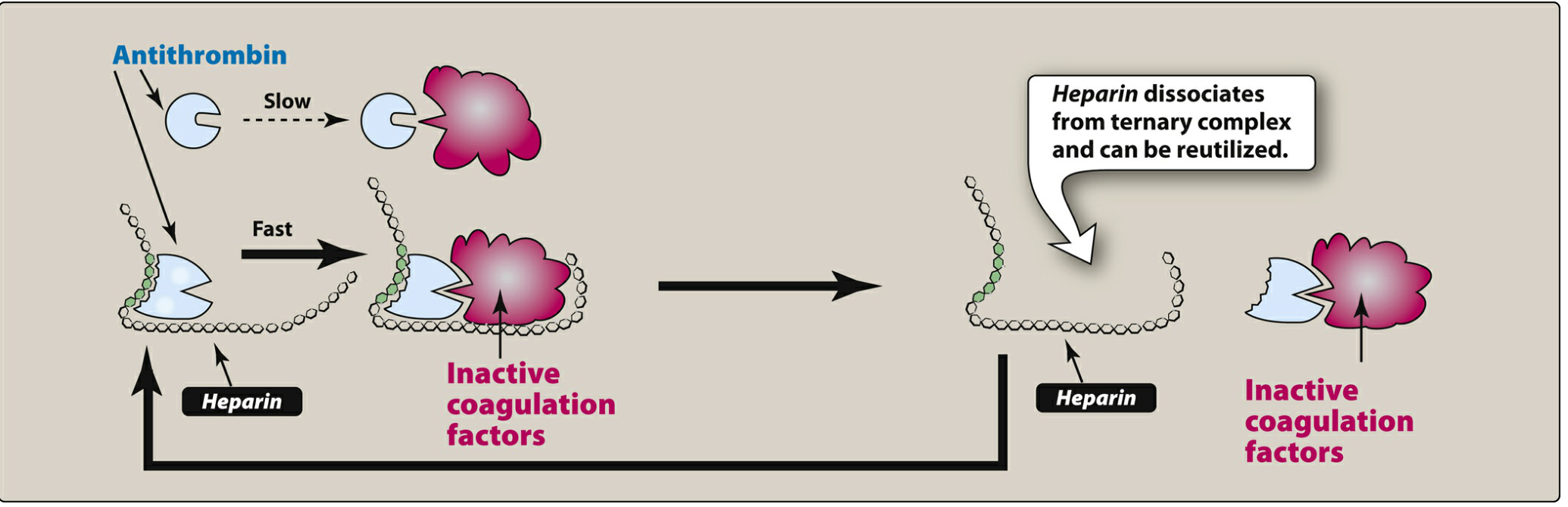
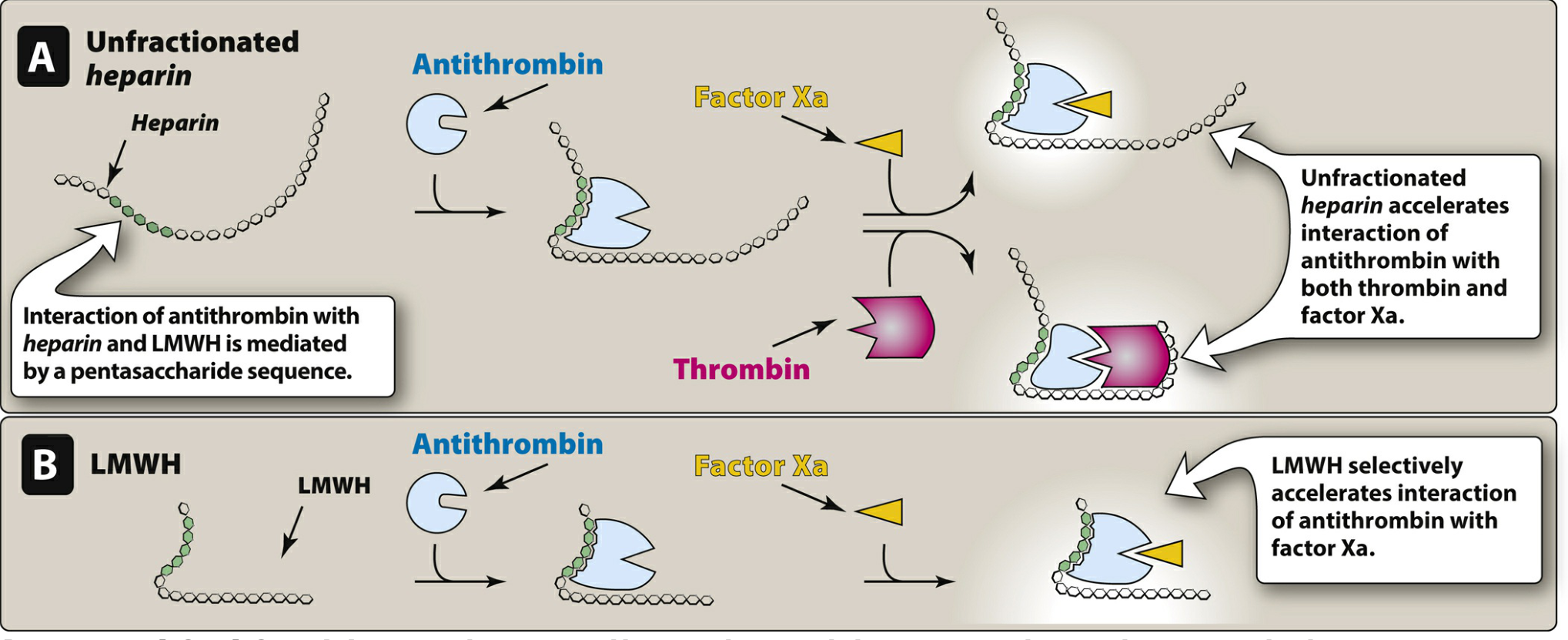
- Heparin is an indirect anticoagulant - it works via the endogenous inhibitor antithrombin (AT, formerly antithrombin III).
- Antithrombin is an α-globulin (serine protease inhibitor) that naturally inhibits thrombin (factor IIa), factor IXa, and factor Xa - but does so very slowly in the absence of heparin.
- When heparin binds to antithrombin via a unique pentasaccharide sequence, it causes a conformational change in antithrombin that accelerates its inhibitory activity ~1,000-fold.
- The antithrombin-protease complex forms, after which heparin is released intact and can bind more antithrombin molecules - acting as a true catalytic cofactor (not consumed).
- Only ~one-third of molecules in commercial UFH preparations carry the active pentasaccharide sequence needed for high-affinity antithrombin binding.
UFH vs LMWH - Key Mechanistic Difference
| Feature | UFH | LMWH (e.g., enoxaparin, dalteparin) |
|---|---|---|
| Inhibits thrombin (IIa) | Yes (strongly) | Minimal |
| Inhibits factor Xa | Yes | Yes (selectively) |
| Requires pentasaccharide | Yes | Yes |
| Chain length needed | Long (to bridge AT + thrombin) | Short (only pentasaccharide needed for Xa) |
Uses (Clinical Pharmacology / Therapeutic Uses)
- Treatment of acute venous thromboembolism - DVT and pulmonary embolism (PE)
- Prophylaxis of postoperative venous thrombosis - patients undergoing major surgery (e.g., hip replacement, general surgery)
- Acute MI / Unstable angina - prevents further clot formation
- Arterial thrombosis and embolism
- Cardiac and arterial surgery - maintenance of anticoagulation during cardiopulmonary bypass, vascular procedures
- Anticoagulant of choice in pregnancy - heparin does not cross the placenta (due to its large molecular size and strong negative charge); safe for the fetus
- Disseminated intravascular coagulation (DIC) - to interrupt consumptive coagulopathy
- Maintenance of IV line patency - in low ("flush") doses
- Extracorporeal circuits - hemodialysis, heart-lung bypass
Pharmacokinetics
- Route: IV (immediate onset) or subcutaneous (SC); never IM (risk of hematoma)
- Onset: Within minutes of IV administration; 1-2 hours after SC injection
- Half-life: ~1.5 hours (UFH); dose-dependent
- Protein binding: Extensive binding to plasma proteins - causes unpredictable pharmacokinetics
- Metabolism: Taken up by monocyte/macrophage system; undergoes depolymerization and desulfation
- Excretion: Renal (inactive metabolites + some parent drug)
- Monitoring: aPTT (target 1.5-2.5x normal) or anti-Xa levels (0.3-0.7 units/mL)
Adverse Effects
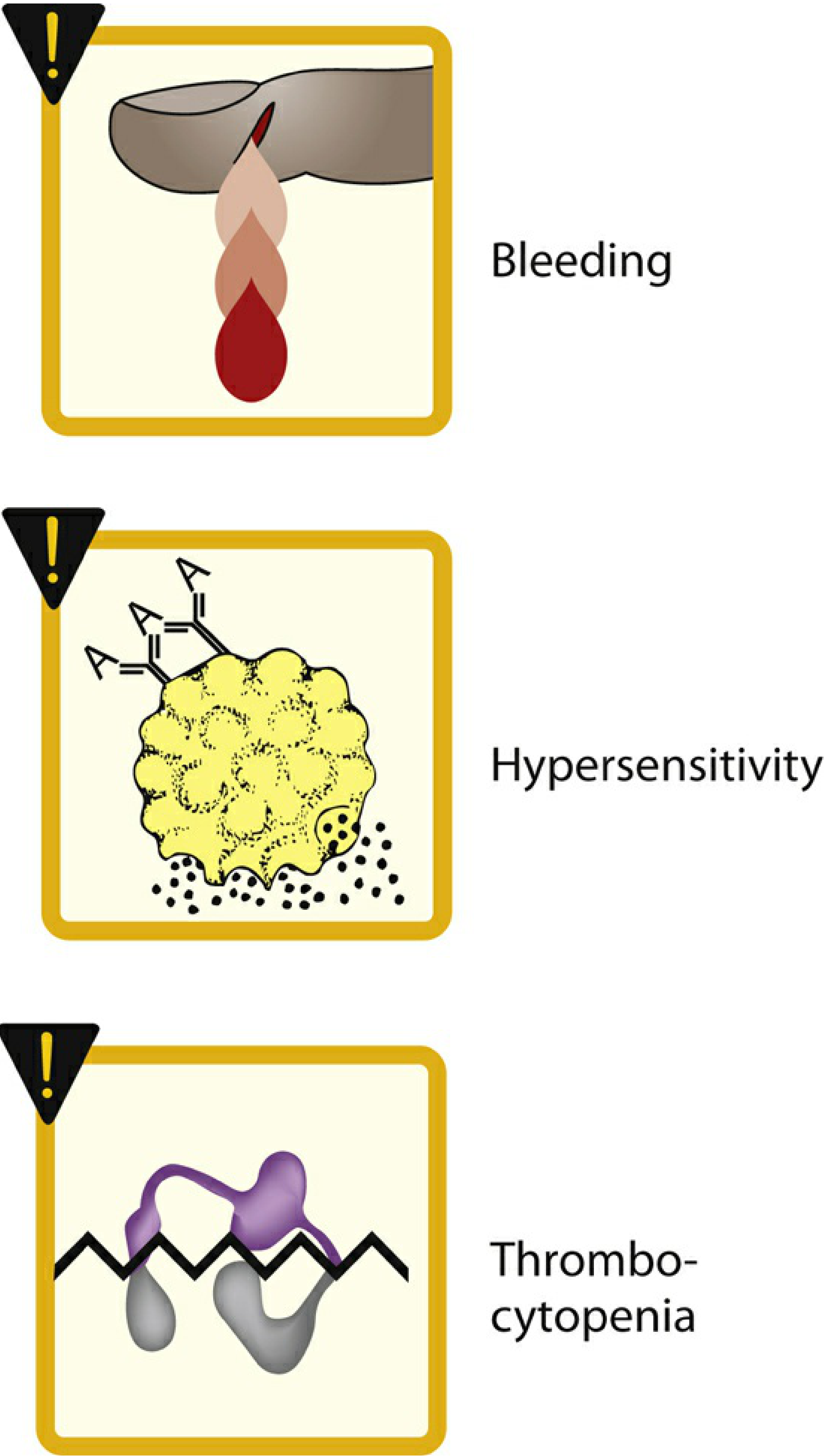
1. Bleeding (Most Common/Major)
- Most important and frequent complication
- Risk higher in: elderly women, renal failure patients
- Managed by: stopping heparin, or giving protamine sulfate (antidote)
- Protamine forms a stable 1:1 ionic complex with heparin, neutralizing it
- Dose: 1 mg protamine per 100 units of heparin administered
- Caution: excess protamine is itself a weak anticoagulant
2. Heparin-Induced Thrombocytopenia (HIT)
- Occurs in 1-4% of UFH-treated patients (lower with LMWH)
- Immune-mediated - antibodies form against heparin-PF4 (platelet factor 4) complex
- Paradoxically causes thrombosis (venous > arterial), not just low platelets
- Monitor platelet counts frequently during therapy
- Management: immediately stop heparin + switch to a direct thrombin inhibitor (e.g., argatroban)
- LMWHs are NOT safe substitutes in HIT (cross-sensitivity risk)
3. Osteoporosis
- Seen with long-term heparin therapy
- Can lead to spontaneous fractures
4. Hypersensitivity Reactions
- Heparin is of animal (porcine) origin - antigenic
- Reactions: chills, fever, urticaria, anaphylactic shock
5. Alopecia
- Reversible hair loss reported with prolonged use
6. Hypoaldosteronism / Mineralocorticoid Deficiency
- Long-term use associated with mineralocorticoid deficiency
7. Hypertriglyceridemia
- Heparin causes release of lipoprotein lipase from tissues
- Initially clears postprandial lipemia, but long-term use can be associated with lipid abnormalities
Contraindications
- HIT (history or active)
- Hypersensitivity to heparin
- Active bleeding / hemophilia
- Significant thrombocytopenia / purpura
- Severe hypertension
- Intracranial hemorrhage
- Infective endocarditis
- Active tuberculosis
- GI ulcerative lesions
- Threatened abortion / visceral carcinoma
- Advanced hepatic or renal disease
- Recent surgery of brain, spinal cord, or eye
Antidote
Protamine sulfate - a strongly basic protein that combines ionically with the acidic heparin in a 1:1 ratio to form an inactive stable complex.
Sources: Katzung's Basic & Clinical Pharmacology, 16th Ed., pp. 959-961; Lippincott Illustrated Reviews: Pharmacology, pp. 451-455
This is a shared conversation. Sign in to Orris to start your own chat.