


Describe the various stage in life cycle of ameloblast? For 5 mark's give point wise answer bds 1st year KU examination pattern
Life Cycle of Ameloblasts
Life Cycle of Ameloblasts
1. Morphogenic Stage
- Ameloblasts are not yet fully differentiated
- Cells are short and columnar with large oval nuclei that almost fill the cell body
- Interact with adjacent mesenchymal cells to determine the shape of the dentinoenamel (DE) junction and crown form
- Golgi apparatus and centrioles are located at the proximal end (closer to stratum intermedium)
- Mitochondria are evenly dispersed throughout the cytoplasm
- Terminal bars appear during differentiation, representing points of close contact between cells
2. Organizing Stage
- Inner enamel epithelium interacts with adjacent connective tissue cells, which differentiate into odontoblasts
- Cells become longer; nucleus-free zones at distal ends become almost as long as proximal parts
- Reversal of polarity occurs - centrioles and Golgi apparatus migrate from proximal to distal ends of cells
- Fine acidophil granules appear in the proximal part of the cell
3. Formative Stage
- Ameloblasts begin enamel matrix formation after the first layer of dentin has been formed
- Cells are tall and columnar (secretory ameloblasts)
- Tomes' processes develop at the distal ends - these are the secretory ends of ameloblasts that project into enamel
- Ameloblasts enter into close contact with the connective tissue of the pulp during dentin formation
- Enamel matrix is secreted; this is the stage of amelogenesis
- Cells are supplied by capillaries that surround the stratum intermedium (reversal of nutrition)
4. Maturative Stage
- Enamel matrix thickness has been fully reached
- Ameloblasts are slightly reduced in length and closely attached to enamel matrix
- Stratum intermedium cells lose their cuboidal shape and become spindle-shaped
- Microvilli appear at distal extremities of ameloblasts for matrix absorption
- Cytoplasmic vacuoles containing enamel matrix material are present - indicating absorptive function
- Crystal growth and mineralization of enamel occurs
- Earliest apparent change is development of blunt cell processes on ameloblast surfaces that penetrate the basal lamina and enter the predentin
5. Protective Stage
- Enamel has completely developed and fully calcified
- Ameloblasts cease to produce enamel matrix
- Stratum intermedium loses regular arrangement; cells can no longer be differentiated from cells of outer enamel epithelium
- All layers (ameloblasts + stratum intermedium + outer enamel epithelium) combine to form the Reduced Enamel Epithelium (REE)
- REE protects the mature enamel by separating it from connective tissue until tooth eruption
- If connective tissue contacts enamel, it may become resorbed or covered by cementum (afibrillar cementum)
- During this phase, the epithelial enamel organ may retract from the cervical edge of enamel
6. Desmolytic Stage
- The reduced enamel epithelium proliferates and induces atrophy of the connective tissue separating it from the oral epithelium
- Fusion of the two epithelia (REE + oral epithelium) occurs, allowing tooth eruption
- Epithelial cells elaborate enzymes that destroy connective tissue fibers by desmolysis
- Premature degeneration of reduced enamel epithelium may prevent tooth eruption
Summary Table
| Stage | Key Feature |
|---|---|
| Morphogenic | Crown shape determination |
| Organizing | Reversal of polarity; odontoblast induction |
| Formative | Enamel matrix secretion (Tomes' process) |
| Maturative | Mineralization; matrix absorption |
| Protective | Reduced enamel epithelium formation |
| Desmolytic | Tissue destruction for tooth eruption |
Exam Tip (KU Pattern): For 5 marks, write all 6 stages with 2-3 points each. Begin with "According to Ten Cate, the life cycle of ameloblasts is divided into 6 stages..." and end with a one-line conclusion about its clinical significance (premature degeneration = failed eruption).
Can you give me short answer
Life Cycle of Ameloblasts (6 Stages)
- Cells are short and columnar
- Determine shape of DE junction and crown
- Golgi and centrioles at proximal end
- Cells become longer
- Induce odontoblast differentiation
- Reversal of polarity occurs
- Enamel matrix secretion begins
- Tomes' process develops
- Occurs after first dentin layer is formed
- Full enamel thickness reached
- Microvilli appear for matrix absorption
- Crystal growth and mineralization occurs
- Enamel fully calcified
- Reduced Enamel Epithelium (REE) forms
- Protects enamel till tooth eruption
- REE fuses with oral epithelium
- Enzymes destroy connective tissue
- Allows tooth eruption
Enamel formation occurs during formative and maturative stages only.
Give 5 point important point each in every stage and give starting line also
Life Cycle of Ameloblasts
1. Morphogenic Stage
- Cells are short and columnar in shape
- Nuclei are large and oval, almost filling the cell body
- Golgi apparatus and centrioles are located at the proximal end
- Mitochondria are evenly dispersed throughout the cytoplasm
- Cells interact with mesenchymal cells to determine the shape of DE junction and crown form
2. Organizing Stage
- Inner enamel epithelium interacts with connective tissue cells, causing them to differentiate into odontoblasts
- Cells become longer and taller
- Reversal of polarity occurs - Golgi and centrioles shift from proximal to distal end
- Nucleus-free zones at distal ends become elongated
- Fine acidophil granules appear in the proximal part of the cell
3. Formative Stage
- Enamel matrix formation begins after the first layer of dentin is formed
- Cells are tall and columnar (secretory ameloblasts)
- Tomes' processes develop at distal ends - the secretory projections into enamel
- Ameloblasts are supplied by capillaries around stratum intermedium (reversal of nutrition)
- This stage is responsible for amelogenesis (enamel formation)
4. Maturative Stage
- Full enamel matrix thickness is reached at this stage
- Ameloblasts are slightly reduced in length
- Stratum intermedium cells lose cuboidal shape and become spindle-shaped
- Microvilli appear at distal ends of ameloblasts for matrix absorption
- Crystal growth and full mineralization of enamel occurs
5. Protective Stage
- Enamel is completely developed and fully calcified
- Ameloblasts cease to produce enamel matrix
- All layers combine to form Reduced Enamel Epithelium (REE)
- REE separates enamel from connective tissue until tooth eruption
- If connective tissue contacts enamel, it may get resorbed or covered by afibrillar cementum
6. Desmolytic Stage
- Reduced enamel epithelium proliferates
- Induces atrophy of connective tissue separating it from oral epithelium
- REE fuses with oral epithelium
- Epithelial cells elaborate enzymes that destroy connective tissue fibers by desmolysis
- Premature degeneration of REE may lead to failure of tooth eruption
Clinical Significance: Premature degeneration of reduced enamel epithelium in the desmolytic stage may prevent eruption of the tooth.
Give 4 point important teacher should give me full marks
Life Cycle of Ameloblasts
1. Morphogenic Stage
- Cells are short and columnar with large oval nuclei filling the cell body
- Golgi apparatus and centrioles are located at the proximal end (near stratum intermedium)
- Mitochondria are evenly dispersed throughout the cytoplasm
- Cells interact with adjacent mesenchymal cells to determine shape of DE junction and crown
2. Organizing Stage
- Inner enamel epithelium induces adjacent connective tissue cells to differentiate into odontoblasts
- Cells become longer and nucleus-free zone at distal end elongates
- Reversal of polarity - Golgi and centrioles migrate from proximal to distal end of cell
- Fine acidophil granules appear in the proximal cytoplasm
3. Formative Stage
- Enamel matrix secretion begins only after the first layer of dentin is deposited
- Tomes' processes develop at distal ends - rod-shaped secretory projections into enamel
- Cells are tall and columnar with well-developed secretory organelles
- Reversal of nutrition occurs - cells are now supplied by capillaries around stratum intermedium
4. Maturative Stage
- Full enamel matrix thickness is reached
- Microvilli appear at distal ends of ameloblasts for matrix reabsorption
- Stratum intermedium cells lose cuboidal shape and become spindle-shaped
- Crystal growth and complete mineralization of enamel takes place
5. Protective Stage
- Enamel is completely calcified and ameloblasts stop secreting matrix
- Ameloblasts, stratum intermedium, and outer enamel epithelium combine to form Reduced Enamel Epithelium (REE)
- REE protects enamel by separating it from connective tissue till tooth erupts
- If connective tissue contacts enamel, it may be resorbed or covered by afibrillar cementum
6. Desmolytic Stage
- Reduced enamel epithelium proliferates and fuses with oral epithelium
- Epithelial cells produce enzymes that destroy connective tissue fibers - called desmolysis
- This creates a pathway for tooth eruption through the oral mucosa
- Premature degeneration of REE may lead to failure of tooth eruption (clinical significance)
Key Fact to impress teacher: Enamel formation (amelogenesis) occurs only during formative and maturative stages. Tomes' process is the hallmark of the formative stage. REE is the hallmark of the protective stage.
Give starting line
Life Cycle of Ameloblasts
"According to Ten Cate's Oral Histology, the life span of the cells of the inner enamel epithelium (ameloblasts) can be divided into six stages based on their function: Morphogenic, Organizing, Formative, Maturative, Protective, and Desmolytic."
1. Morphogenic Stage
- Cells are short and columnar with large oval nuclei filling the cell body
- Golgi apparatus and centrioles are located at the proximal end (near stratum intermedium)
- Mitochondria are evenly dispersed throughout the cytoplasm
- Cells interact with adjacent mesenchymal cells to determine shape of DE junction and crown
2. Organizing Stage
- Inner enamel epithelium induces adjacent connective tissue cells to differentiate into odontoblasts
- Cells become longer and nucleus-free zone at distal end elongates
- Reversal of polarity - Golgi and centrioles migrate from proximal to distal end of cell
- Fine acidophil granules appear in the proximal cytoplasm
3. Formative Stage
- Enamel matrix secretion begins only after the first layer of dentin is deposited
- Tomes' processes develop at distal ends - rod-shaped secretory projections into enamel
- Cells are tall and columnar with well-developed secretory organelles
- Reversal of nutrition occurs - cells are now supplied by capillaries around stratum intermedium
4. Maturative Stage
- Full enamel matrix thickness is reached
- Microvilli appear at distal ends of ameloblasts for matrix reabsorption
- Stratum intermedium cells lose cuboidal shape and become spindle-shaped
- Crystal growth and complete mineralization of enamel takes place
5. Protective Stage
- Enamel is completely calcified and ameloblasts stop secreting matrix
- Ameloblasts, stratum intermedium, and outer enamel epithelium combine to form Reduced Enamel Epithelium (REE)
- REE protects enamel by separating it from connective tissue till tooth erupts
- If connective tissue contacts enamel, it may be resorbed or covered by afibrillar cementum
6. Desmolytic Stage
- Reduced enamel epithelium proliferates and fuses with oral epithelium
- Epithelial cells produce enzymes that destroy connective tissue fibers - called desmolysis
- This creates a pathway for tooth eruption through the oral mucosa
- Premature degeneration of REE may lead to failure of tooth eruption
"Thus, the life cycle of ameloblasts plays a vital role from crown morphology determination to tooth eruption, with enamel formation occurring specifically during the formative and maturative stages."
Give color diagram human sketch diagram of life cycle of ameloblast
A detailed color educational diagram showing the life cycle of ameloblasts in 6 stages arranged in a circular flow with arrows connecting each stage. Hand-drawn human sketch style with color. Each stage shows a labeled cell illustration: 1. MORPHOGENIC STAGE - short columnar cell, large oval nucleus, Golgi at proximal end, labeled in blue 2. ORGANIZING STAGE - longer cell, reversal of polarity arrow, Golgi moves to distal end, labeled in green 3. FORMATIVE STAGE - tall columnar cell, Tomes process at distal end secreting enamel matrix, labeled in orange 4. MATURATIVE STAGE - cell with microvilli at distal end, enamel crystals forming, spindle shaped stratum intermedium, labeled in red 5. PROTECTIVE STAGE - reduced enamel epithelium (REE) shown, short flattened cells protecting enamel, labeled in purple 6. DESMOLYTIC STAGE - REE fusing with oral epithelium, enzymes destroying connective tissue, tooth erupting, labeled in brown Each cell diagram clearly shows: nucleus position, organelle polarity, enamel/dentin relationship, and key features. Arrows show the circular progression. Title at top: LIFE CYCLE OF AMELOBLASTS. Clean medical textbook illustration style with soft pastel colors, neat handwritten-style labels, white background.
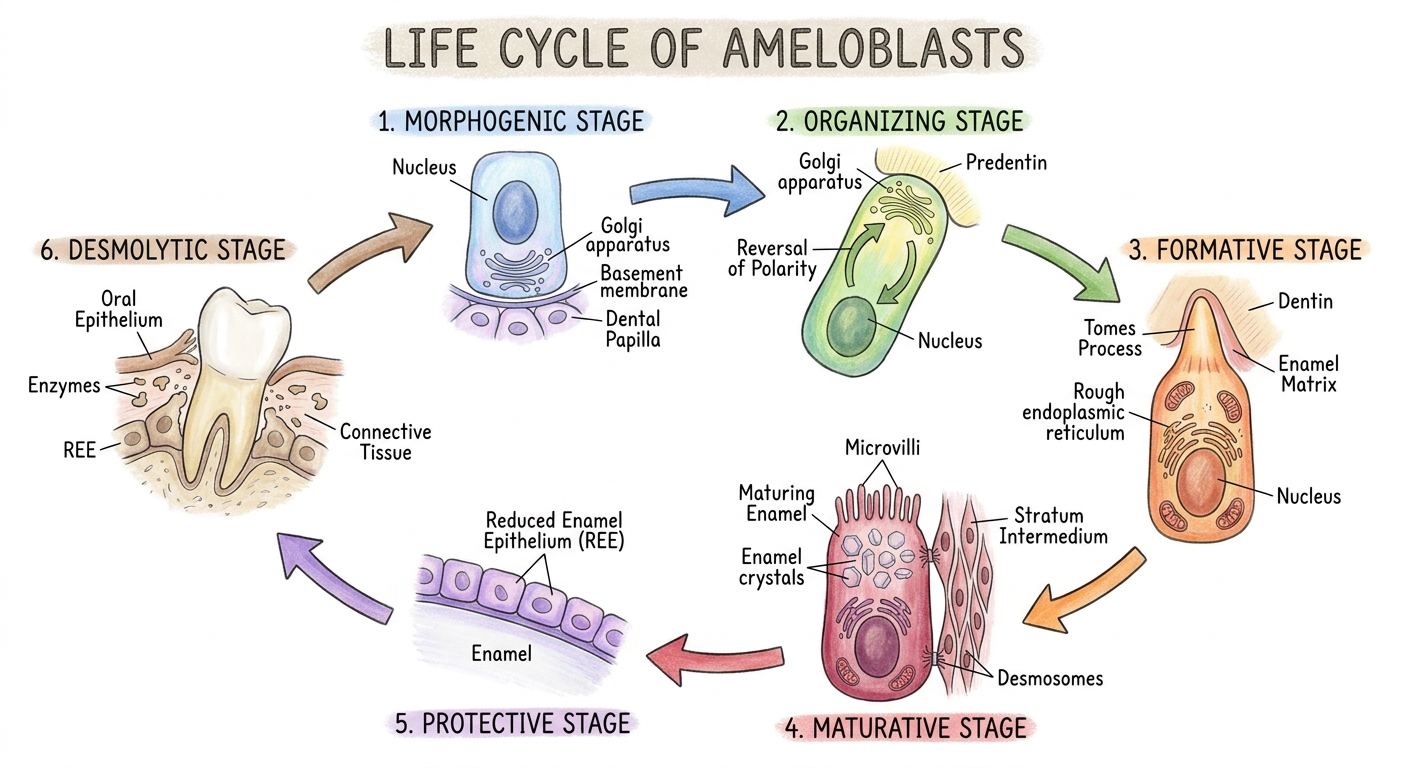
Quick Reference for each stage shown:
| Color | Stage | Key Feature Shown |
|---|---|---|
| 🔵 Blue | Morphogenic | Short cell, nucleus at center |
| 🟢 Green | Organizing | Reversal of polarity |
| 🟠 Orange | Formative | Tomes' process, enamel secretion |
| 🔴 Red | Maturative | Microvilli, crystal growth |
| 🟣 Purple | Protective | REE formation |
| 🟤 Brown | Desmolytic | REE + oral epithelium fusion |
Exam Tip: Draw this circular diagram in your answer sheet with arrows - teachers appreciate visual diagrams and it fetches extra marks in KU examinations!
One diagram
A single large detailed color educational diagram showing all 6 stages of the life cycle of ameloblasts side by side in one horizontal row, hand-drawn sketch style like a medical textbook illustration. Show 6 individual tall rectangular cell drawings side by side, each cell clearly labeled with its stage name below: Cell 1 - MORPHOGENIC: Short columnar cell, large oval nucleus in center, Golgi apparatus and centrioles at top (proximal end), mitochondria scattered throughout, pink/blue color Cell 2 - ORGANIZING: Taller cell, nucleus shifting, Golgi and centrioles moving to bottom (distal end), arrow showing reversal of polarity, green color Cell 3 - FORMATIVE: Tallest columnar cell, nucleus at top (proximal), Tomes process projecting from bottom (distal end) into enamel matrix shown in yellow, orange color Cell 4 - MATURATIVE: Cell slightly shorter, microvilli at distal end, enamel crystals forming shown in yellow below, stratum intermedium spindle shaped beside it, red color Cell 5 - PROTECTIVE: Flattened shorter cell, REE label, enamel fully formed below in yellow, purple color Cell 6 - DESMOLYTIC: Cell fusing with oral epithelium, enzyme activity shown with dotted lines destroying connective tissue, tooth eruption arrow pointing up, brown color Below all cells show: Enamel in yellow, Dentin in orange, Pulp in pink Title at top in bold: LIFE CYCLE OF AMELOBLASTS Arrows connecting each cell stage left to right Clean white background, bright colors, neat handwritten labels, medical diagram style
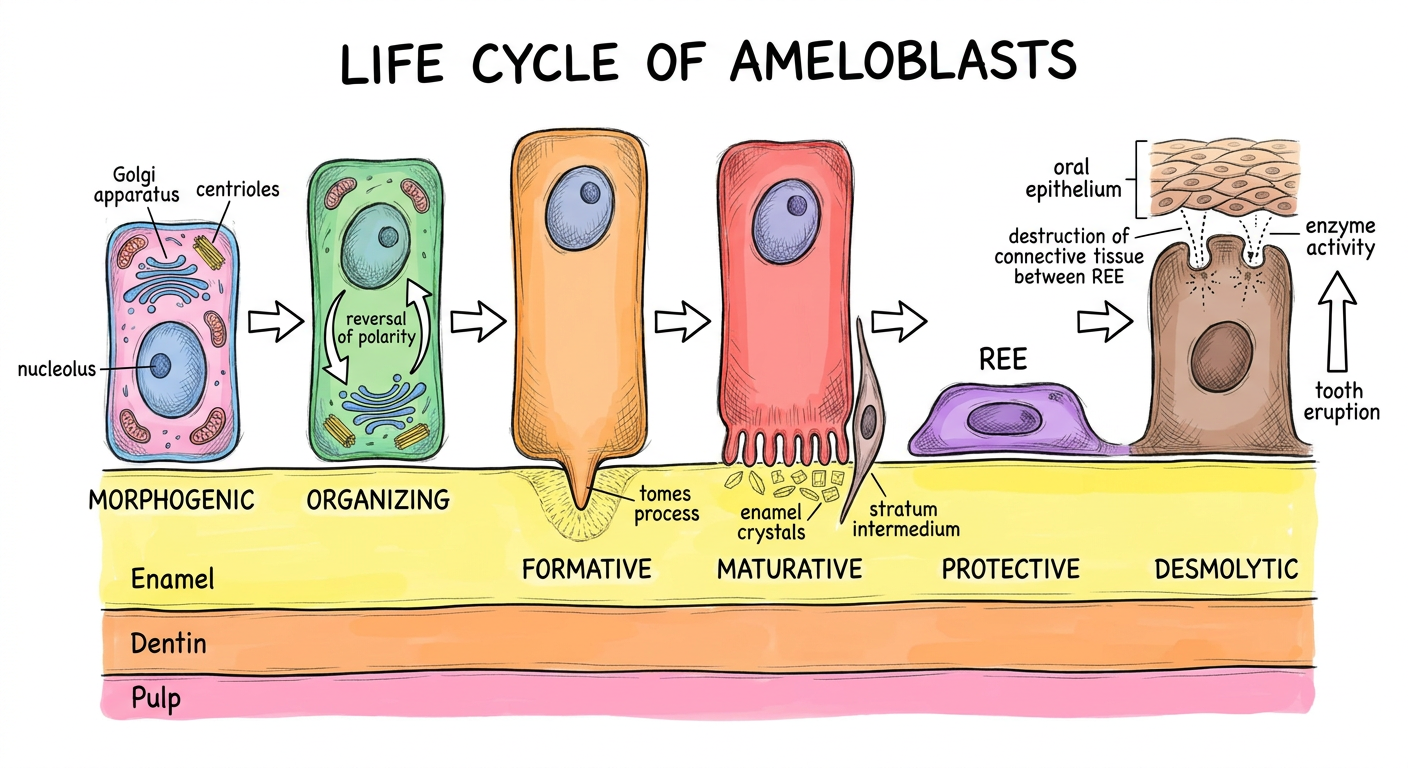
- Each cell shape changing stage by stage
- Tomes' process visible in the formative stage
- Enamel, dentin and pulp shown below the cells
- Arrows showing progression from stage 1 to 6
Tip for exam: Copy this diagram in your answer sheet - it takes only 2-3 minutes to draw and guarantees extra marks in KU BDS exams!
What is the fate of ameloblast? 1 marks
Fate of Ameloblasts
- Form the Reduced Enamel Epithelium (REE) along with stratum intermedium and outer enamel epithelium
- REE protects enamel until tooth eruption
- During desmolytic stage, REE fuses with oral epithelium
- After tooth eruption, ameloblasts are lost/degenerate permanently
Key point: Ameloblasts are lost after eruption, which is why enamel cannot regenerate once damaged - it has no formative cells remaining.
Start line
Fate of Ameloblasts
- After enamel is fully formed, ameloblasts combine with stratum intermedium and outer enamel epithelium to form Reduced Enamel Epithelium (REE)
- REE protects enamel from connective tissue until tooth eruption
- During desmolytic stage, REE fuses with oral epithelium to form eruption pathway
- After tooth eruption, ameloblasts permanently degenerate and are lost
Describe amelogenesis for 3 marks
Amelogenesis
1. Matrix Formation (Formative Stage)
- Begins only after first layer of dentin (predentin) is deposited
- Ameloblasts develop Tomes' processes at their distal ends
- Enamel matrix is secreted in the form of enamel rods and inter-rod enamel
- Matrix is composed of proteins - mainly amelogenin, enamelin and ameloblastin
- Enamel is deposited in an appositional pattern from DEJ towards the surface
2. Maturation (Maturative Stage)
- Enamel matrix proteins are removed by enzymes (proteinases)
- Hydroxyapatite crystals grow in length, width and thickness
- Water and organic content decrease progressively
- Inorganic mineral content increases to 96%
- Final hard, calcified enamel is formed
3. Direction of Enamel Formation
- Begins at cusp tip or incisal edge (most advanced)
- Proceeds towards the cervical region (least advanced)
- Enamel rods run from DEJ to enamel surface
Add a note on physical and chemical properties of enamel (1+1)
Physical and Chemical Properties of Enamel
A. Physical Properties of Enamel (1 mark)
- Hardness: Hardest tissue in the body; measures 5 on Mohs scale (similar to apatite)
- Color: Varies from yellowish white to grayish white; color depends on underlying dentin and enamel thickness
- Translucency: Enamel is translucent - thinner enamel appears more yellow due to dentin showing through
- Thickness: Varies - thickest at cusp tips (2-2.5 mm) and thinnest at cervical margin
- Brittleness: Enamel is brittle (fractures easily without dentin support) due to high mineral content
B. Chemical Properties of Enamel (1 mark)
- Inorganic content: 96% by weight - mainly hydroxyapatite crystals [Ca₁₀(PO₄)₆(OH)₂]
- Organic content: 1% by weight - mainly proteins (amelogenin, enamelin, ameloblastin)
- Water content: 3% by weight
- Solubility: Soluble in acids - basis of dental caries (acid dissolves hydroxyapatite)
- Fluoride effect: Fluoride replaces OH⁻ in hydroxyapatite to form fluorapatite which is more acid-resistant and harder
Give short answer it only of 1+1 marks
Physical and Chemical Properties of Enamel
A. Physical Properties (1 mark)
- Hardest tissue in body - 5 on Mohs scale
- Color - yellowish white to grayish white
- Translucent in nature
- Brittle - fractures without dentin support
- Thickest at cusp tip (2-2.5 mm), thinnest at cervical margin
B. Chemical Properties (1 mark)
- Inorganic - 96% (hydroxyapatite crystals)
- Organic - 1% (amelogenin, enamelin)
- Water - 3%
- Soluble in acids - basis of dental caries
- Fluoride forms fluorapatite - more resistant to acid
Key to remember: 96-1-3 rule for enamel composition (Inorganic-Organic-Water)