
Rheumatoid arthritis
Reading File
Now let me search the medical library for comprehensive rheumatoid arthritis content in parallel.
Finding Sources
Searching PubMed
"rheumatoid arthritis"[MeSH Terms] AND treatment
Now let me search for the dedicated rheumatology textbook sections and look for a primary rheumatology source:
Finding Sources
Finding Sources
Excellent - there are dedicated rheumatology textbooks. Let me find the RA sections in those:
Finding Sources
Finding Sources
Now let me read the key RA sections from Firestein & Kelley's and the Rheumatology 2-volume set:
Reading File
Reading File
Good. Now let me read the main RA chapter from Firestein & Kelley's (the most authoritative rheumatology source) - the block4 section which has 10 paragraphs on RA:
Reading File
Reading File
Now let me read the main clinical chapter on RA (block6 has 24 paragraphs on RA - the main clinical chapter):
Reading File
Let me now read the clinical presentation, diagnosis, and treatment section of RA from this textbook:
Finding Sources
Finding Sources
Finding Sources
Finding Sources
Let me read the key clinical sections from Rheumatology 2-Volume Set and Swanson's:
Reading File
Reading File
Let me read more of the Rheumatology 2-Volume clinical chapter on RA for treatment and extra-articular features:
Reading File
I now have very solid content. Let me read one more section on RA treatment:
Reading File
Reading File
Reading File
I now have comprehensive content. Let me fetch some of the clinical images to include in the response, and also grab the treatment section:
Loading Image
Reading File
I now have comprehensive information to produce an authoritative, detailed answer on Rheumatoid Arthritis. Let me compile this into a thorough response.
Rheumatoid Arthritis (RA)
Overview
Rheumatoid arthritis is the paradigm of a systemic autoimmune disease characterized by inflammatory polyarthritis. The hallmark is symmetric synovial proliferation and tenderness in multiple joints - particularly the small joints of the hands and feet - with a strong tendency to cause progressive joint destruction if untreated. It affects approximately 0.5-1% of the population worldwide, with a female:male ratio of about 3:1, and most commonly presents between ages 40-60.
- Rheumatology, 2-Volume Set (Elsevier 2022), p. 6582
- Firestein & Kelley's Textbook of Rheumatology, 2-Volume Set
Pathogenesis
Genetic & Environmental Risk Factors
RA develops in genetically susceptible individuals exposed to specific environmental triggers. The key genetic risk factor is the HLA-DR shared epitope (HLA-DRB1 alleles), which together with smoking creates a high-risk milieu for autoimmunity.
Environmental triggers include:
- Smoking - a major modifiable risk factor; smokers show 57% higher citrullinated peptide levels vs. 7% in non-smokers (P<0.05) and increased PAD2 expression (86% vs. 63%; P<0.001) in the alveolar compartment. RA-related autoantibodies are detectable in sputum of 39% of at-risk patients
- Periodontal disease - Porphyromonas gingivalis produces PAD enzymes that citrullinate bacterial and host proteins; antibodies to this bacterium are found in 11-23% of RA patients
- Gut microbiome alterations - Prevotella copri enrichment is found in new-onset untreated RA
The Citrullination Story
The central autoimmune mechanism involves anti-citrullinated protein antibodies (ACPAs):
- Citrullination is a post-translational modification converting arginine (positively charged) to citrulline (neutral), catalyzed by peptidyl-arginine deiminase (PAD) enzymes
- In genetically predisposed individuals, this triggers autoimmunity against citrullinated antigens (e.g., collagen type II, fibrinogen, vimentin, α-enolase)
- Neutrophil extracellular traps (NETs) play a key role: NET complexes are elevated in RA and correlate with ACPA levels; NET formation releases active PAD isoforms that citrullinate extracellular histones and fibrinogen
- NETs activate fibroblast-like synoviocytes (FLS), stimulating release of pro-inflammatory cytokines, chemokines, and MMP production
Synovial Pathology
In active RA, the synovium undergoes dramatic transformation:
- Normal synovial lining (1-2 cell layers) proliferates out of control
- The rheumatoid pannus forms - a mass of hyperplastic synovial tissue that invades and destroys cartilage and bone
- Key cytokines driving this process: TNF-α, IL-1, IL-6, IL-17
- FLS in RA show global DNA hypomethylation, overexpression of miR-203 (correlating with IL-6 levels), and an "inflammatory memory" from chronic cytokine exposure
Clinical Features
Articular Manifestations
Typical presentation:
- Symmetric polyarthritis predominantly involving MCP, PIP, and MTP joints (small joints of hands and feet); the index and middle fingers are usually more involved
- Morning stiffness lasting >1 hour - the most characteristic symptom
- "Doughy" or "squishy" synovitis on palpation (distinct from bony enlargement)
- Wrist involvement is nearly universal; the DIP joints are typically spared (distinguishing RA from osteoarthritis and psoriatic arthritis)
Common hand deformities in established disease:
- Swan-neck deformity - PIP hyperextension + DIP flexion
- Boutonniere deformity - PIP flexion + DIP hyperextension
- Ulnar deviation of the fingers at the MCPs
- "Z-deformity" of the thumb
Foot involvement:
- MTP subluxation displaces protective fat pads; metatarsal heads bear direct weight
- Forefoot broadening, calluses, hammertoes, and in advanced cases, plantar ulceration
Cervical spine:
- Atlantoaxial subluxation from transverse ligament laxity or odontoid erosion - potentially serious; C1 can slide forward on neck flexion, compressing the upper cervical cord
- Manifestations: headache, neck pain, paresthesias, weakness, TIAs, sphincter disturbance
- MRI is the best imaging modality for evaluation
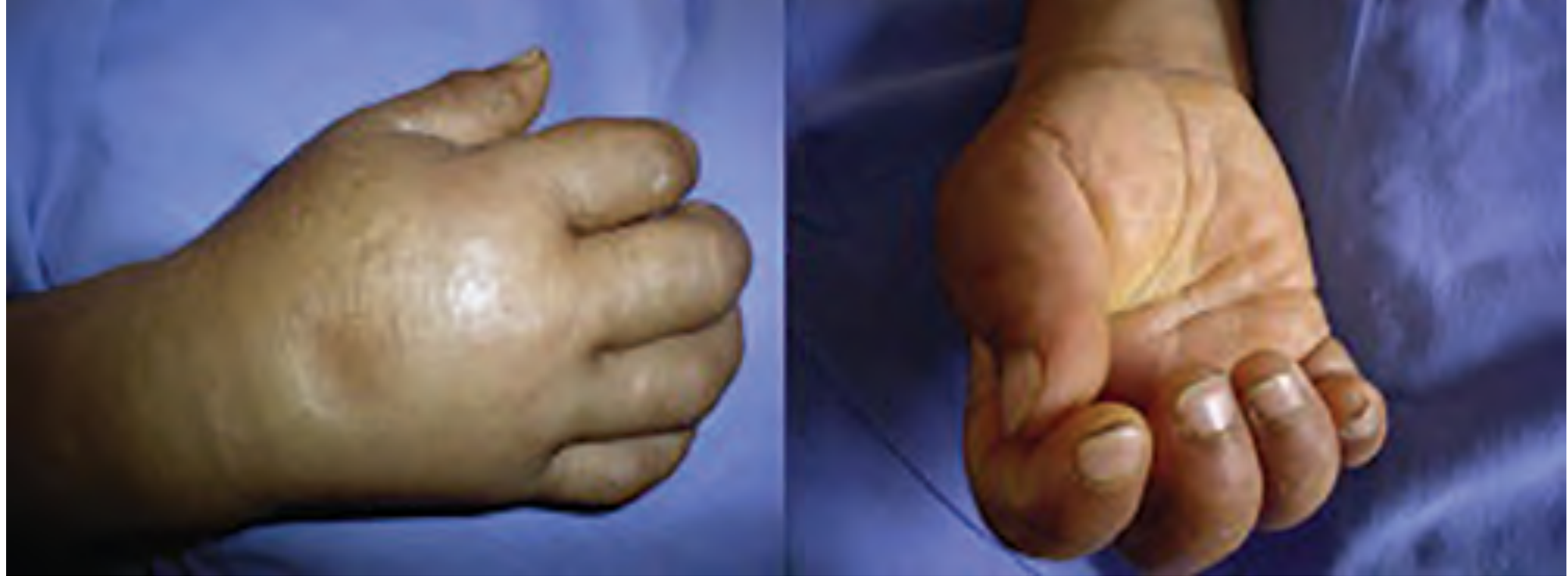
Remitting seronegative symmetric synovitis with pitting edema (RS3PE) - can be a forerunner of full RA. Source: Rheumatology, 2-Volume Set.
Extra-Articular Manifestations
| System | Features |
|---|---|
| Skin | Rheumatoid nodules (~20% of patients, over extensor surfaces); vasculitis |
| Pulmonary | ILD, pleural effusion, rheumatoid nodules in lung |
| Cardiac | Pericarditis; RA is an independent risk factor for atherosclerotic CVD |
| Neurological | Peripheral neuropathy, carpal tunnel syndrome (median nerve at volar wrist), atlantoaxial myelopathy |
| Ocular | Episcleritis, scleritis, keratoconjunctivitis sicca |
| Hematologic | Normocytic anemia, thrombocytosis (correlates with disease activity), Felty's syndrome (splenomegaly + neutropenia in seropositive RA) |
| Renal | Amyloidosis (secondary AA amyloid) in longstanding disease |
Rheumatoid nodules are quite specific for RA, occur in about 20% of patients, generally those with more severe disease and high-titer RF or ACPA. They are centered on a focus of necrosis surrounded by chronic inflammatory cells, occurring over extensor surfaces, at sites of chronic mechanical irritation (elbow, toe, heel), and in the fingers.
Diagnosis
RA is a clinical diagnosis - no single test is pathognomonic. The key diagnostic tools are:
2010 ACR/EULAR Classification Criteria (Score ≥6 = definite RA)
| Domain | Score |
|---|---|
| Joint involvement | |
| 1 large joint | 0 |
| 2-10 large joints | 1 |
| 1-3 small joints | 2 |
| 4-10 small joints | 3 |
| >10 joints (including small) | 5 |
| Serology | |
| Negative RF and ACPA | 0 |
| Low-positive RF or ACPA | 2 |
| High-positive RF or ACPA | 3 |
| Acute-phase reactants | |
| Normal CRP and ESR | 0 |
| Abnormal CRP or ESR | 1 |
| Duration of symptoms | |
| <6 weeks | 0 |
| ≥6 weeks | 1 |
Criteria apply to patients with definite synovitis for which there is no better explanation.
Laboratory Investigations
- Rheumatoid Factor (RF) - present in ~80% of RA patients; an immunoglobulin that binds the Fc region of IgG; not specific (also positive in Sjögren's, infections, healthy elderly)
- Anti-CCP (ACPA) - more specific than RF (>90% specificity); appears earlier in disease; high-positive ACPA predicts more severe erosive disease
- ESR and CRP - reflect disease activity and inflammation; useful for monitoring
- Full blood count - normocytic anemia, thrombocytosis (correlates with activity)
- Imaging: plain X-rays show periarticular osteopenia early, then marginal erosions and joint space narrowing; MRI detects synovitis, bone marrow edema, and early erosions before X-ray changes
Prognostic markers helping guide treatment intensity: ESR, CRP, RF, ACPA, HAQ (disability score), MBDA (multi-biomarker disease activity score), 14-3-3η (highly upregulated in RA, predictive of radiographic progression), baseline radiographs of hands and feet.
Treatment
The central principle in modern RA management is "treat to target" - aiming for clinical remission or low disease activity as early as possible.
"Perhaps the most important concept in our contemporary approach to RA is the recognition that prognosis and outcome are improved when DMARD therapy is started within a few weeks or months of disease onset."
- Rheumatology, 2-Volume Set (Elsevier 2022)
Some data suggest definitive treatment should be started within 3 months of RA onset.
Step 1: Conventional Synthetic DMARDs (csDMARDs)
Methotrexate (MTX) is the anchor drug and first-line DMARD:
- Dose: 15-25 mg once weekly (oral or subcutaneous)
- Folic acid co-administered to reduce toxicity
- Onset of action: 6-8 weeks
- Monitoring: CBC, LFTs (hepatotoxicity risk), avoid in renal failure or pregnancy
Other csDMARDs:
- Hydroxychloroquine - used in combination; also lowers cholesterol and reduces diabetes incidence in RA
- Sulfasalazine - often used in combination with MTX
- Leflunomide - alternative to MTX
Step 2: Biological DMARDs (bDMARDs) - when csDMARDs fail
TNF inhibitors (most commonly used biologics):
- Etanercept, adalimumab, infliximab, certolizumab, golimumab
- Usually combined with MTX for best efficacy
Other biologics by mechanism:
| Drug | Target |
|---|---|
| Abatacept | Co-stimulation (CTLA4-Ig, blocks T cell activation) |
| Rituximab | CD20 (B cell depletion) |
| Tocilizumab | IL-6 receptor |
| Sarilumab | IL-6 receptor |
| Anakinra | IL-1 receptor |
| Secukinumab | IL-17A |
Step 3: JAK Inhibitors (Targeted Synthetic DMARDs)
- Tofacitinib (JAK1/3), Baricitinib (JAK1/2), Upadacitinib (JAK1), Filgotinib (JAK1)
- Oral agents; rapidly effective
- Note: post-marketing cardiovascular safety signals - currently recommended with caution in patients >65 years, smokers, and those with cardiovascular risk factors
Corticosteroids
- Bridge therapy while waiting for DMARDs to act (typically <3 months)
- Low-dose prednisolone (≤7.5 mg/day) can be used as long-term adjunctive therapy
- Modified-release prednisone reduces morning stiffness duration (CAPRA-1 trial)
NSAIDs
- Symptomatic relief only - do not modify disease course
- Used adjunctively for pain and stiffness control
Disease Course & Prognosis
RA can follow several patterns:
- Brief and self-limited (rare)
- Episodic (palindromic) - attacks and remissions
- Prolonged and progressive (most common without treatment)
Factors indicating poor prognosis:
- High-titer RF or ACPA positivity
- Elevated CRP/ESR
- Early radiographic erosions
- Multiple joint involvement at onset
- Extra-articular disease
- Functional disability (high HAQ score)
RA carries excess cardiovascular mortality - largely attributed to accelerated atherosclerosis driven by systemic inflammation (CD4+CD28- T cells are found in atherosclerotic plaques and are expanded in RA). Effective DMARD treatment reduces this cardiovascular risk.
Sources
- Rheumatology, 2-Volume Set (Elsevier 2022), Chapter 90, pp. 6582-7325
- Firestein & Kelley's Textbook of Rheumatology, 2-Volume Set, Blocks 3-6 (Pathogenesis, Immunology, Epigenetics)
- Swanson's Family Medicine Review, Block 3 (Clinical Case: RA)
- Goldman-Cecil Medicine, International Edition (DMARDs section)
This is a shared conversation. Sign in to Orris to start your own chat.