
Acute liver failure
"acute liver failure"[MeSH Terms]
acute liver failure pathophysiology management
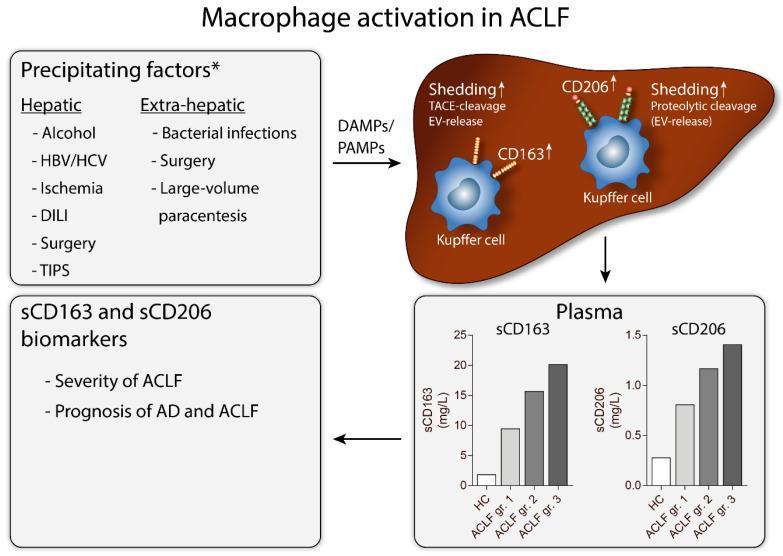
This medical infographic illustrates the pathophysiology of macrophage activation in Acute-on-Chronic Liver Failure (ACLF). The diagram depicts hepatic (e.g., alcohol, HBV/HCV, DILI) and extra-hepatic (e.g., bacterial infections, surgery) precipitating factors that trigger the release of PAMPs and DAMPs. These molecules activate liver resident macrophages, or Kupffer cells. Within the liver, the diagram shows upregulated expression and increased shedding of membrane-bound CD163 and CD206 from Kupffer cells. The shedding of CD163 occurs via TACE-cleavage and extracellular vesicle (EV) release, while CD206 is shed via proteolytic cleavage and EV-release. Two bar graphs demonstrate the clinical significance of these processes, showing a stepwise increase in plasma concentrations of soluble CD163 (sCD163) and soluble CD206 (sCD206) correlating with ACLF severity (Healthy Control vs. Grades 1-3). The infographic identifies sCD163 and sCD206 as prognostic biomarkers for disease severity and mortality in patients with acute decompensation (AD) and ACLF, highlighting their role in monitoring hepatology patients.
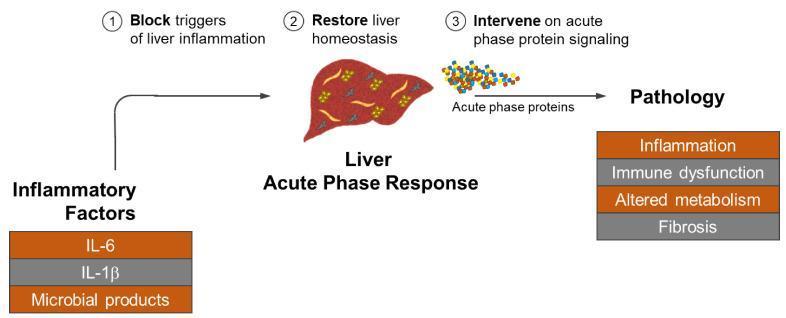
A pathophysiology diagram illustrating the liver acute phase response in the context of cancer and potential points of therapeutic intervention. The process begins with 'Inflammatory Factors' (IL-6, IL-1̧́, and microbial products) triggering a 'Liver Acute Phase Response.' This response results in the production and secretion of 'Acute phase proteins' by the liver. These proteins drive systemic 'Pathology,' categorized into four clinical outcomes: inflammation, immune dysfunction, altered metabolism, and fibrosis. The diagram outlines three numbered strategies for medical intervention: (1) blocking the primary triggers of liver inflammation (e.g., anti-IL-6 antibodies), (2) restoring liver homeostasis by modulating the hepatic cellular response (e.g., STAT3 inhibition), and (3) intervening on acute phase protein signaling by neutralizing the proteins themselves or their downstream receptors (e.g., TLR inhibitors). The illustration emphasizes the liver's role as a central sensor in cancer-associated systemic inflammation and its potential as a target for treating complications like cachexia and metastasis.
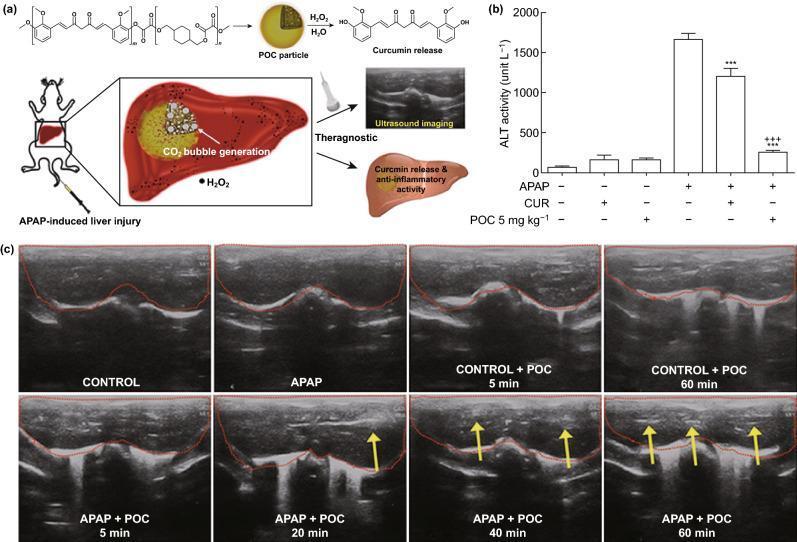
This composite educational graphic illustrates the use of poly(oxalate-co-curcumin) (POC) particles as theranostic agents for acetaminophen (APAP)-induced acute liver failure (ALF) in a murine model. Panel (a) contains a pathophysiology diagram showing the synthesis of POC particles and their mechanism: in the presence of hydrogen peroxide (H2O2) within the injured liver, POC particles undergo an H2O2-responsive degradation to release curcumin (anti-inflammatory) and generate CO2 bubbles (ultrasound contrast). Panel (b) is a bar chart comparing serum alanine aminotransferase (ALT) levels across groups, demonstrating that POC particles significantly reduce hepatic enzymes compared to APAP-only or free curcumin (CUR) treatments. Panel (c) presents longitudinal diagnostic ultrasound images of mouse livers. The liver contours are outlined in red. In the APAP + POC group, there is a progressive increase in echogenicity (bright signals indicated by yellow arrows) from 5 to 60 minutes post-treatment, representing real-time monitoring of ROS-triggered CO2 bubble generation, while control and APAP-only groups remain hypoechoic.
Acute Liver Failure (ALF)
Definition
- Elevated transaminases (hepatocellular injury)
- Coagulopathy (PT prolonged / INR > 1.5)
- Hepatic encephalopathy (HE)
- Sabiston Textbook of Surgery, p. 1068
- Current Surgical Therapy 14e, p. 460
Classification by Time Course
| Subtype | Onset of encephalopathy after symptoms |
|---|---|
| Hyperacute | Within 7 days |
| Acute | 7 - 21 days |
| Subacute (Subfulminant) | 21 days - 26 weeks |
Epidemiology
-
Affects approximately 2,000-3,000 Americans per year
-
73% of patients are female, median age 38 years
-
84% are referred from outside hospitals
-
~44% acquire a culture-proven infection during admission
-
Before liver transplantation, survival was < 20%; current 5-year survival > 70%
-
Schwartz's Principles of Surgery, p. 1388
Etiology
Geographic Variation
- Western countries (USA, UK, Australia): Drug-induced liver injury (DILI) predominates - 65% of cases
- Eastern/developing world: Viral hepatitis (B, A, E) predominates
Common Causes in the USA (US Acute Liver Failure Study Group - 308 patients)
| Cause | Prevalence |
|---|---|
| Acetaminophen overdose | ~40% |
| Idiosyncratic drug-induced liver injury | 13% |
| Indeterminate | 17% |
| Hepatitis B | 6% |
| Ischemic hepatitis | 6% |
| Autoimmune hepatitis | 4% |
| Hepatitis A | 4% |
| Wilson's disease | 3% |
| Pregnancy-related | 2% |
| Budd-Chiari syndrome | 2% |
| Malignancy | 1% |
- Current Surgical Therapy 14e, p. 459
Pathophysiology and Complications
1. Hepatic Encephalopathy & Cerebral Edema
- Hyperammonemia is the critical driver
- Cerebral edema develops in ~80% of patients reaching grade 4 HE
- Ammonia levels > 200 µmol/L are associated with increased risk of cerebral edema and intracranial hypertension
- ALF-induced encephalopathy is different from cirrhotic encephalopathy - cerebral edema does not develop in chronic liver disease, so lactulose has not been shown to improve survival in ALF
- Raised ICP → decreased cerebral perfusion pressure → ischemic brain damage and herniation
- Most common cause of death is cerebral edema/intracranial hypertension, accounting for > half of ALF-associated mortality
2. Coagulopathy
- Impaired synthesis of clotting factors
- INR/PT prolongation; FFP and platelets reserved for active bleeding or pre-procedure
3. Renal Failure
- Occurs in ~40% (creatinine > 2.0 mg/dL in 40% at admission)
- Requires continuous venovenous hemodialysis (CVVHD) rather than intermittent hemodialysis - provides better hemodynamic and ICP stability
- CRRT also effective for rapid ammonia clearance
4. Infection / Sepsis
- High susceptibility to bacterial and fungal infections
- Surveillance cultures should be performed early
5. Metabolic Disturbances
- Hypophosphatemia - a sign of hepatic regeneration; may indicate higher likelihood of spontaneous recovery; correct with IV phosphate
- Hypoglycemia (impaired gluconeogenesis)
- Acid-base disturbances (pH < 7.30 at presentation in 14%)
6. Hemodynamic Instability
-
Hyperdynamic circulation; vasopressor support often needed
-
Current Surgical Therapy 14e, p. 460; Schwartz's, p. 1388-1389
Clinical Presentation
- Jaundice, malaise, nausea/vomiting
- Progressive encephalopathy (grades I-IV)
- Signs of coagulopathy (easy bruising, bleeding)
- Rapid deterioration possible over hours-days
- Median: 6 days ill before onset of encephalopathy; 2 days from jaundice to encephalopathy
Laboratory Evaluation
| Category | Tests |
|---|---|
| Baseline | CBC, comprehensive metabolic panel, amylase/lipase, LFTs |
| Coagulation | PT/INR, Factor V level, Factor VII level |
| Blood gas | Arterial blood gas, arterial ammonia |
| Typing | ABO |
| Etiology screen | Acute hepatitis panel (HAV IgM, HBsAg, HCV), autoimmune markers, ceruloplasmin, toxicology screen, acetaminophen level, HIV, pregnancy test |
- Schwartz's Principles of Surgery, p. 1388
Management
General Measures
- Immediate transfer to a liver transplant center - disease can progress rapidly
- ICU admission for close monitoring
- Head of bed elevated ≥ 30 degrees
- Avoid sedation (impairs neurological assessment); sedation/paralysis only when needed to minimize stimulation
- Avoid nephrotoxic medications
- Euglycemia maintenance
- Maintain serum sodium 140-145 mmol/L (hypertonic saline as needed)
- Liver biopsy (transjugular approach due to coagulopathy) if autoimmune hepatitis or lymphoma is suspected
Specific Therapies
| Condition | Treatment |
|---|---|
| Acetaminophen overdose | Activated charcoal (if within a few hours of ingestion) + N-acetylcysteine (NAC) |
| NAC dosing (oral) | 140 mg/kg loading dose, then 70 mg/kg q4h × 17 doses |
| NAC dosing (IV) | 150 mg/kg loading, then 50 mg/kg q4h × 12 doses |
| ALF of unclear etiology | NAC still recommended (glutathione replenishment) |
| Drug-induced ALF | Discontinue all suspected offending agents |
| Hepatitis B | Antiviral therapy |
| Autoimmune hepatitis | Corticosteroids |
| Wilson's disease | Chelation; transplant often required |
Cerebral Edema / Raised ICP Management
- Head of bed 30 degrees
- Minimize stimulation (sedation/paralysis if needed)
- Hypertonic saline (200 mL of 2.7%, or 20 mL of 30%) for clinical signs of raised ICP
- IV mannitol (150 mL, 20%) over 20 minutes
- Hyperventilation to PaCO2 25-30 mmHg (acute cerebral vasoconstriction)
- ICP monitoring (bolt): controversial due to bleeding risk; if used, target ICP < 20-25 mmHg, CPP > 50 mmHg
- Head CT: insensitive early, but useful to rule out hemorrhage; use with caution as moving severely encephalopathic patients can cause ICP surges
- Noninvasive alternatives: transcranial Doppler, jugular venous oximetry
Extracorporeal Liver Support Devices
| System | Mechanism | Evidence |
|---|---|---|
| MARS (Molecular Adsorbent Recirculating System) | Albumin dialysis - removes protein-bound and water-soluble toxins | Improves HE symptoms; no clear mortality benefit in RCTs |
| Prometheus system | Fractionated plasma separation + adsorption + dialysis | Safety shown; no mortality benefit in ACLF |
| SPAD (Single-pass albumin dialysis) | Albumin-impermeable high-flux membrane | No impact on survival in available studies |
| High-volume plasma exchange (HVP) | Removes toxins + replaces coagulation factors | Small studies suggest survival benefit; further research needed |
- Current Surgical Therapy 14e, p. 493
Prognostic Scoring - King's College Criteria
Acetaminophen-related ALF
- Arterial pH < 7.3 (after resuscitation)
OR - INR > 6.5 AND serum creatinine > 3.4 mg/dL
AND Grade III or IV encephalopathy
Non-Acetaminophen ALF
- INR > 6.5
OR any 3 of the following:- INR > 3.5
- Bilirubin > 17.6 mg/dL
- Age < 10 or > 40 years
- Cause: drug toxicity or indeterminate
- Time from onset of jaundice to encephalopathy > 7 days
- Current Surgical Therapy 14e, p. 461; Sabiston, p. 1068
Liver Transplantation
- Only definitive treatment for patients who meet criteria and fail to improve
- Successful transplantation: 84% 1-year survival (USA data); 73% 5-year survival (single-center data); registry data shows 80% 1-year graft survival
- Superior to no transplant in the right patient, but inferior to spontaneous recovery
- Contraindicated if CT shows evidence of irreversible brain injury or uncal herniation
- Key challenge: Expeditiously identifying who needs transplant vs. who will recover (particularly difficult in young acetaminophen overdose patients with social/psychiatric comorbidities)
- Progression to stage II encephalopathy is often used as a trigger to move toward transplant evaluation
Summary of Key Points
| Feature | Detail |
|---|---|
| Definition | Encephalopathy + coagulopathy + no prior liver disease, within 26 weeks |
| #1 cause (West) | Acetaminophen overdose (~40% USA) |
| #1 cause (East) | Viral hepatitis (B, A, E) |
| Most common death | Cerebral edema / intracranial hypertension |
| Key antidote | N-acetylcysteine (NAC) for acetaminophen |
| Prognostic tool | King's College Criteria |
| Definitive Rx | Liver transplantation (Status 1A) |
| Lactulose in ALF | Not effective (unlike cirrhosis) |
| CRRT advantage | Better ICP + hemodynamic stability vs. IHD |
| Hypophosphatemia | Sign of hepatic regeneration - favorable prognostic sign |
Can eating Chinese food cause it
Chinese food herbal medicine acute liver failure cause
Ordinary Chinese Food and ALF
- Amanita phalloides (death cap mushroom) toxin - sometimes used in wild mushroom foraging; misidentification of medicinal mushrooms has led to liver failure, as noted in Harrison's Principles of Internal Medicine 22E. This is not a "Chinese food" issue per se, but is relevant in East Asian contexts where wild mushroom foraging is culturally common.
Chinese Herbal Medicine (CHM) - A Real and Significant Risk
- Of 9,355 total DILI cases reported in Chinese academic journals from 2001-2010, approximately 20% were associated with herbs
- Another study found 44.2% of all DILI cases were caused by CHM
- CHM-induced liver injury accounts for 26-49% of DILI in Chinese literature from 2013
- A 2014 study (PMID 24335449) found that 30% of ALF patients had accepted herbal therapies before onset; 60% of those patients died
Specific Chinese Herbal Products Linked to Liver Injury / ALF
| Herb / Product | Notes |
|---|---|
| Jin Bu Huan | Sedative/analgesic; causes hepatitis and acute liver failure |
| Ma Huang (Ephedra) | Stimulant; weight-loss products; hepatotoxic |
| Shou Wu Pian (He Shou Wu / Fo-Ti) | Used for hair/anti-aging; well-documented hepatotoxicity |
| Ba Jiao Lian | Used in TCM; contains podophyllotoxin; hepatotoxic |
| Chi R Yun | Reported liver injury cases |
| Aristolochia species | Associated with severe nephropathy and hepatotoxicity |
Why Does This Happen?
- Direct hepatotoxicity - Some plant alkaloids and compounds are directly toxic to hepatocytes
- Idiosyncratic reactions - Unpredictable immune-mediated responses, dose-independent
- Adulteration - Some herbal products contain heavy metals (arsenic, lead, mercury) or undisclosed pharmaceutical drugs
- Misidentification - One plant species substituted for another with different toxicity
- Synergistic toxicity - Combination of multiple herbs with overlapping hepatotoxic profiles
Bottom Line
| Scenario | Risk of ALF |
|---|---|
| Eating Chinese restaurant food | None |
| Taking Chinese herbal medicine (TCM) products | Real risk - especially He Shou Wu, Jin Bu Huan, Ma Huang |
| Wild mushroom consumption with misidentification | Rare but severe risk |