
Methotrexate
I'll start with a quick overview while I pull from the medical library.
Methotrexate (MTX) is a folate antagonist used in oncology (leukemia, lymphoma, solid tumors), rheumatology (RA, psoriatic arthritis), and dermatology (psoriasis). It inhibits dihydrofolate reductase (DHFR), blocking DNA synthesis. Key concerns include hepatotoxicity, myelosuppression, mucositis, and pulmonary toxicity. Leucovorin (folinic acid) rescue is used after high-dose regimens.
Searching sources...
Reading File
Now let me search the medical library for comprehensive methotrexate coverage, running parallel queries:
Finding Sources
Finding Sources
Searching PubMed
methotrexate pharmacology toxicity
Good. The primary pharmacology content is in Lippincott, Katzung, Goodman & Gilman, and Firestein & Kelley's Rheumatology. Let me read all the key sections in parallel:
Reading File
Reading File
Reading File
Finding Sources
Excellent content retrieved. Let me fetch the MTX mechanism diagram and read more of the adverse effects and monitoring sections in parallel:
Loading Image
Reading File
Reading File
I have very rich content. Let me now read the Katzung MTX section (which appears to be focused on rheumatic use) and the Harrison's adverse effects section, and also search for a Lippincott adverse effects figure:
Finding Sources
Reading File
I now have comprehensive content from multiple authoritative sources. Let me compile the full, detailed answer.
Methotrexate (MTX)
Chemical Identity and Classification
Methotrexate is a structural analogue of folic acid (pteroylglutamic acid). It has modifications in the pteridine ring and the para-aminobenzoic acid portion of the folate molecule. It is classified as:
- An antimetabolite (folate antagonist)
- A conventional synthetic DMARD (csDMARD)
- A cytotoxic/immunosuppressive agent
Mechanism of Action
MTX enters cells via the reduced folate carrier (RFC) - the same transporter used by leucovorin. Folic acid, by contrast, enters via separate folate receptors (FRs). Once inside, MTX undergoes polyglutamation by folyl-polyglutamyl synthetase; the polyglutamated form (MTX-PG) is retained in cells for prolonged periods and is the pharmacologically active species.
MTX-PG has three key inhibitory effects:
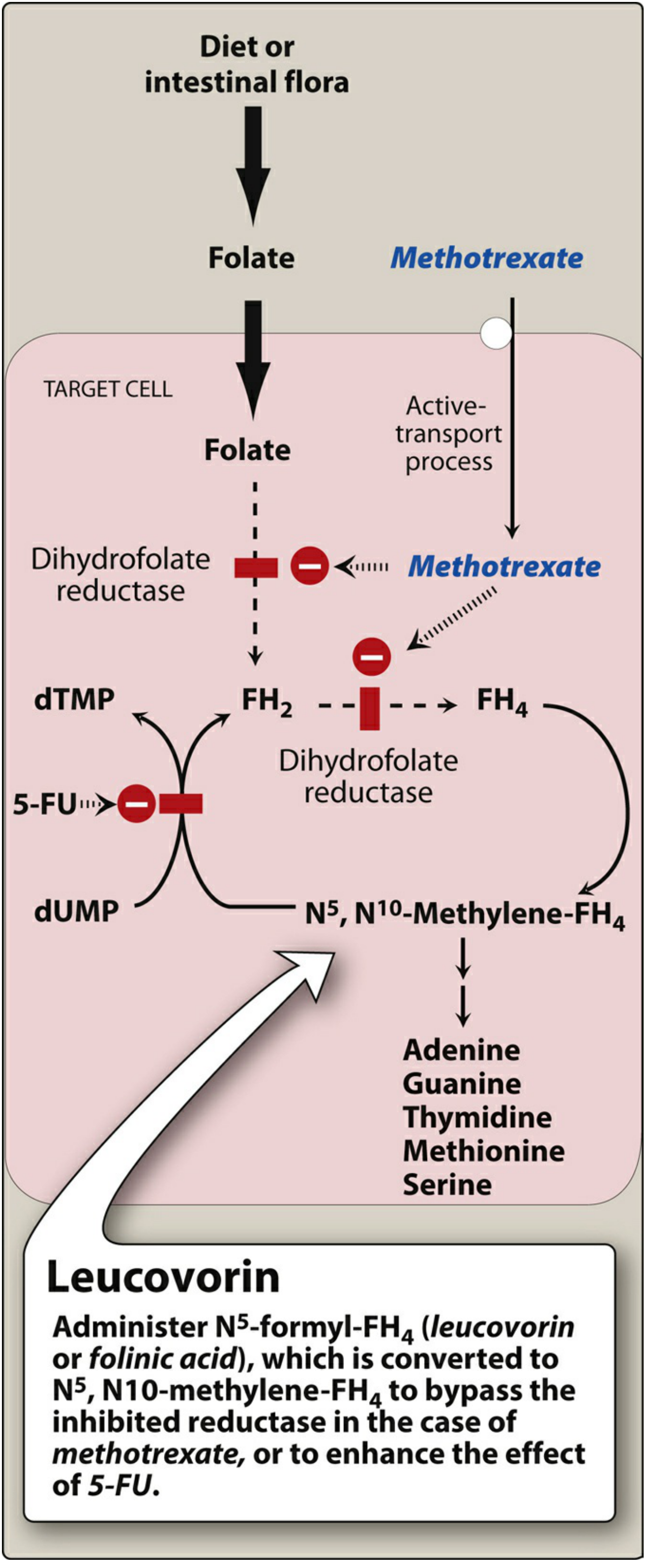
1. Inhibition of DHFR (dihydrofolate reductase)
- Prevents conversion of FH2 (dihydrofolate) to FH4 (tetrahydrofolate)
- Blocks transmethylation reactions essential for cellular function
- Results in NF-kB downregulation and increased sensitivity to apoptosis
- Dominant mechanism at HIGH (oncologic) doses
2. Inhibition of ATIC (AICAR transformylase)
- AICAR accumulates, which inhibits AMP deaminase (AMPDA) and adenosine deaminase (ADA)
- Leads to extracellular adenosine accumulation
- Adenosine (via A1a, A2a, A2b, A3 receptors) is a potent inhibitor of inflammation, suppressing neutrophils, macrophages, dendritic cells, and lymphocytes
- This adenosine-mediated anti-inflammatory pathway is the key mechanism at LOW (rheumatic) doses
3. Inhibition of thymidylate synthetase (TYMS)
- Decreases pyrimidine synthesis
- Contributes to antiproliferative effect
At rheumatic disease doses, DHFR inhibition is relatively minor; the AICAR/adenosine pathway dominates. - Katzung's Basic and Clinical Pharmacology, 16th Ed.
Pharmacokinetics
| Parameter | Details |
|---|---|
| Absorption | Variable at low oral doses (~70%); IM and SC routes more reliable |
| Routes | Oral (PO), IM, SC, IV, intrathecal (IT) |
| CNS penetration | Poor - intrathecal route used for CNS lymphoma/leukemia sanctuary sites |
| Distribution | Accumulates in intestinal epithelium, liver, kidney; also in ascites and pleural effusions (3rd spacing prolongs toxicity) |
| Metabolism | Hepatic hydroxylation at position 7 → 7-hydroxymethotrexate (less water-soluble; risk of crystalluria) |
| Excretion | Primarily renal (parent drug + 7-OH metabolite); up to 30% biliary |
| Half-life | 6-9 hours (serum) |
| Cell retention | MTX-PG retained long-term in cells, explaining once-weekly dosing efficacy |
| Drug interactions | Hydroxychloroquine can reduce MTX clearance; NSAIDs reduce renal excretion and increase toxicity |
To prevent renal toxicity from crystalluria, maintain alkaline urine and adequate hydration, especially with high-dose regimens. - Lippincott Illustrated Reviews: Pharmacology
Therapeutic Uses
Oncology
- Acute lymphocytic leukemia (ALL) - cornerstone therapy
- Burkitt lymphoma (children)
- Breast cancer (combination)
- Head and neck carcinomas
- Osteosarcoma (high-dose with leucovorin rescue)
- Mycosis fungoides
- CNS lymphoma / meningeal leukemia (intrathecal)
- Bladder, choriocarcinoma, gestational trophoblastic disease
Rheumatology / Immunology
- Rheumatoid arthritis - first-line csDMARD; reduces rate of new erosions
- Psoriatic arthritis (peripheral joint disease)
- Juvenile idiopathic arthritis (JIA)
- Ankylosing spondylitis (peripheral joint involvement)
- Systemic sclerosis (SSc) - decreases skin involvement
- Vasculitis, Takayasu arteritis, Polymyositis/Dermatomyositis
- Combined with rituximab for RA
Dermatology
- Severe psoriasis (plaque, pustular, erythrodermic)
- Crohn disease (low dose)
Dosing
| Indication | Dose |
|---|---|
| RA / Rheumatic disease | Start 7.5 mg PO weekly; increase to 15-25 mg/week; max 30-35 mg/week (increased toxicity above 25 mg) |
| High-dose oncology | 1-12 g/m² IV with leucovorin rescue |
| Intrathecal | 12 mg (adult) per protocol |
- Splitting the dose within a 12-hour window can improve tolerability at doses >15 mg/week
- SC or IM routes have better bioavailability than oral, especially at higher doses
Adverse Effects
Major Toxicities
1. Myelosuppression (dose-dependent)
- Leukopenia, thrombocytopenia, anemia
- Most dangerous with high doses or in folate-deficient states
- Leucovorin rescue required with high-dose regimens
2. Hepatotoxicity
- Elevated transaminases (common, usually reversible)
- Hepatic fibrosis/cirrhosis with chronic low-dose use (cumulative dose-related)
- Fibrosis risk increased by alcohol use, obesity, pre-existing liver disease
3. Mucositis / GI toxicity
- Oral ulcers/stomatitis, nausea, vomiting, diarrhea
- Reduced by leucovorin or folic acid supplementation (without significantly decreasing efficacy)
4. Pulmonary toxicity
- MTX pneumonitis - hypersensitivity-like syndrome; can be severe and potentially fatal
- Symptoms: dry cough, dyspnea, fever
- Requires immediate drug discontinuation
- Incidence is rare but serious
5. Nephrotoxicity
- 7-OH metabolite crystallizes in renal tubules at acidic pH
- Managed with alkalinization + hydration (especially high-dose)
- MTX excreted renally - dose must be reduced in renal impairment
6. Teratogenicity / Reproductive
- Pregnancy Category X - absolutely contraindicated in pregnancy
- Causes neural tube defects, fetal death
- Contraception required during treatment and for 3-6 months after stopping
7. CNS toxicity (intrathecal)
- Leukoencephalopathy, arachnoiditis with intrathecal administration
Summary Table of Adverse Effects by System
| System | Effect |
|---|---|
| Hematologic | Myelosuppression, pancytopenia |
| GI | Mucositis, nausea, hepatotoxicity, fibrosis |
| Pulmonary | Pneumonitis (rare but serious) |
| Renal | Crystalluria, tubular necrosis (high dose) |
| Reproductive | Teratogenicity (Category X) |
| Skin | Alopecia, photosensitivity, radiation recall |
| CNS | Leukoencephalopathy (intrathecal/high dose) |
Leucovorin (Folinic Acid) Rescue
Leucovorin is N5-formyl-FH4 (folinic acid). It bypasses the DHFR blockade by entering the folate pool as a preformed tetrahydrofolate derivative, replenishing the folate pool without needing DHFR. It uses the same RFC as MTX, competing for cellular uptake.
- High-dose MTX: Leucovorin rescue is mandatory; administered ~24-36h after MTX infusion
- Leucovorin (or folic acid) also reduces stomatitis and GI toxicity with low-dose MTX
- Note: leucovorin supplementation may decrease MTX efficacy by 10-18% in rheumatic disease
- Folic acid 1 mg/day (rather than leucovorin) is given routinely with low-dose MTX in RA to reduce side effects while preserving efficacy
Contraindications and Precautions
| Contraindication | Reason |
|---|---|
| Pregnancy | Teratogenicity (Category X) |
| Significant renal impairment | Reduced excretion → toxicity |
| Severe hepatic disease / alcoholism | Risk of hepatic fibrosis |
| Immunodeficiency | Enhanced myelosuppression risk |
| Active infection | Immunosuppression |
| Malabsorption syndromes | Unpredictable absorption |
Monitoring
| Parameter | Frequency |
|---|---|
| CBC with differential | Every 4-8 weeks (baseline then periodically) |
| LFTs (AST, ALT, albumin) | Every 4-8 weeks |
| Serum creatinine / eGFR | Baseline and periodic |
| MTX levels | After high-dose IV infusion (to guide leucovorin rescue) |
| Pulmonary function / CXR | If symptoms suggest pneumonitis |
| Liver biopsy | Considered in chronic use when cumulative dose exceeds threshold (varies by guideline) |
Drug Interactions
| Drug | Interaction |
|---|---|
| NSAIDs | Reduce renal MTX excretion → toxicity |
| Probenecid | Blocks renal tubular secretion → increased MTX levels |
| Trimethoprim-sulfamethoxazole | Additive folate antagonism → severe myelosuppression |
| Penicillins | Reduce MTX renal clearance |
| Hydroxychloroquine | Reduces MTX clearance |
| Alcohol | Additive hepatotoxicity |
| Leflunomide | Additive hepatotoxicity when combined |
Resistance Mechanisms
- Decreased MTX influx (reduced RFC expression)
- Increased MTX efflux (overexpression of ABC transporters: ABCC1-4, ABCG2)
- Impaired polyglutamation (reduced folyl-polyglutamyl synthetase activity)
- DHFR gene amplification
- Mutations in DHFR reducing MTX binding affinity
- Genetic polymorphisms in transporter proteins can also produce variable MTX response profiles
Key Points Summary
- MTX is a folic acid analogue that enters cells via RFC and is polyglutamated for intracellular retention
- At high (oncologic) doses: DHFR inhibition dominates - blocks folate-dependent DNA/RNA synthesis (S-phase specific)
- At low (rheumatic) doses: AICAR/adenosine pathway dominates - potent anti-inflammatory effect
- Leucovorin rescue bypasses DHFR blockade - given after high-dose MTX to protect normal tissues
- Folic acid supplementation (not leucovorin) used routinely in RA to reduce side effects
- Must be dose-adjusted for renal function; absolutely contraindicated in pregnancy
- Most serious side effects: hepatic fibrosis (chronic), pneumonitis (rare but potentially fatal), myelosuppression
Sources: Lippincott Illustrated Reviews: Pharmacology; Katzung's Basic and Clinical Pharmacology, 16th Ed.; Firestein & Kelley's Textbook of Rheumatology, 2-Vol. Set; Harrison's Principles of Internal Medicine 22E; Goodman & Gilman's Pharmacological Basis of Therapeutics

1000277367.jpg
What should be the line of treatment to treat this patient
This is a medical question with lab results. Let me read the skill file first, then analyze the report.
Reading File
analyse_media
The pattern is clear: low testosterone + high LH + normal-high FSH = Primary Hypogonadism (hypergonadotropic hypogonadism). Now let me search the medical library for treatment of male hypogonadism.
Finding Sources
Finding Sources
Searching PubMed
"male hypogonadism" AND "testosterone replacement therapy"
Reading File
Finding Sources
Reading File
Finding Sources
Excellent - I now have comprehensive information. Let me also search for workup needed before starting TRT and fertility considerations since this is a young 28-year-old male:
Finding Sources
Finding Sources
Finding Sources
Finding Sources
I have enough comprehensive information. Here is the full clinical analysis and treatment plan:
Clinical Interpretation and Treatment Plan
Patient: Mr Akshansh | 28 Years / Male | Sampled: 27 July 2026
Lab Results Summary and Interpretation
| Test | Result | Reference Range | Status |
|---|---|---|---|
| Testosterone Total | 229 ng/dL | 240-950 ng/dL | LOW |
| LH | 12.0 mIU/mL | 1.5-9.3 mIU/mL | HIGH |
| FSH | 12.3 mIU/mL | 1.4-18.1 mIU/mL | Normal (upper range) |
Hormonal Pattern: Primary (Hypergonadotropic) Hypogonadism
The combination of low testosterone + elevated LH with normal-high FSH is the classic hormonal signature of primary testicular failure. The pituitary is working correctly - it is sensing low testosterone and compensating by releasing excess LH and FSH - but the testes are not responding. This rules out secondary (pituitary/hypothalamic) hypogonadism where LH would be low or inappropriately normal.
Step 1: Establish the Cause (Mandatory Before Treatment)
At 28 years old, identifying the underlying etiology is critical. Common causes of primary hypogonadism include:
| Category | Conditions |
|---|---|
| Genetic/Chromosomal | Klinefelter syndrome (47,XXY) - most common; other chromosomal variants |
| Acquired testicular | Mumps orchitis, trauma, torsion, radiation, chemotherapy |
| Autoimmune | Autoimmune orchitis |
| Infiltrative | Hemochromatosis, sarcoidosis |
| Idiopathic | No identifiable cause |
Additional Investigations to Order NOW
Confirmatory/Etiological:
- Repeat fasting morning testosterone (8-10 AM) - confirm on a second sample (required by guidelines before starting TRT)
- Free testosterone + SHBG - total T can be borderline; free T gives functional status
- Karyotype (chromosomal analysis) - to rule out Klinefelter syndrome (47,XXY), especially in a young male with this pattern
- Estradiol (E2) - may be elevated in Klinefelter; also guides treatment
- Semen analysis - fertility assessment; important at age 28
- Testicular ultrasound - assess testicular volume, rule out tumor or structural cause
- Inhibin B - marker of Sertoli cell function and spermatogenesis
Baseline before TRT:
- PSA (prostate-specific antigen)
- Hematocrit/CBC - TRT can cause polycythemia
- Lipid profile
- Liver function tests
- Sleep apnea screening (TRT can worsen OSA)
- Bone mineral density (DEXA scan) - hypogonadism causes osteoporosis
Step 2: Line of Treatment
First-Line: Testosterone Replacement Therapy (TRT)
TRT is the standard of care for confirmed primary hypogonadism with symptomatic testosterone deficiency. The goal is to restore serum testosterone to mid-normal range (400-700 ng/dL).
Available Formulations
| Formulation | Dose | Frequency | Notes |
|---|---|---|---|
| Testosterone undecanoate IM (preferred) | 750 mg or 1000 mg IM | Every 10-12 weeks (after loading) | Most stable levels; preferred globally |
| Testosterone enanthate/cypionate IM | 150-200 mg IM | Every 2-3 weeks | Peaks and troughs; older standard |
| Testosterone enanthate SC | 50-100 mg SC | Weekly | More stable levels than biweekly IM |
| Testosterone gel 1-2% | 50-100 mg applied daily | Daily | Stable levels; skin-transfer risk |
| Testosterone undecanoate oral capsules | 158-396 mg | Twice daily with food | Avoid 17α-alkylated forms (hepatotoxic) |
| Subcutaneous pellets | 75 mg/pellet | Every 4-6 months | Long-acting; surgical insertion |
Testosterone undecanoate injections are the preferred replacement therapy in many parts of the world. - Goldman-Cecil Medicine, International Edition
Important: Modified 17α-alkylated androgens (methyl testosterone, most oral anabolic steroids) are NOT recommended - they cause hepatotoxicity, lower HDL, and raise total cholesterol.
Special Consideration: Fertility Planning at Age 28
This is a critical point. TRT suppresses sperm production by suppressing the hypothalamic-pituitary-gonadal axis via negative feedback. In a 28-year-old who may want children, this is a major concern.
If fertility is desired (now or in the future):
- Do NOT start standard TRT yet
- Instead, consider:
- Clomiphene citrate (clomifene) 25-50 mg orally every other day to every day - a selective estrogen receptor modulator (SERM) that blocks estrogen feedback at the pituitary, stimulating endogenous LH/FSH and thus testosterone. However, in primary hypogonadism (testicular failure), this is less likely to work because the defect is in the testes, not the pituitary.
- Sperm banking/cryopreservation before starting TRT - strongly recommended
- In the context of primary hypogonadism, the testes have limited reserve, so fertility options are limited; assisted reproductive techniques (ART) such as testicular sperm extraction (TESE) with ICSI (intracytoplasmic sperm injection) may be explored
Note: A 2026 systematic review and meta-analysis comparing clomiphene citrate vs TRT in male hypogonadism found clomiphene more effective at preserving fertility, but TRT superior for symptom control. The choice depends on the patient's priorities.
Step 3: Monitoring During TRT
| Parameter | Timing | Target |
|---|---|---|
| Serum testosterone | 3-6 months after initiation | 400-700 ng/dL (mid-normal) |
| Hematocrit | 3-6 months, then annually | <54% (stop TRT if >54%) |
| PSA | Baseline, 3-6 months, then annually | Watch for >1.4 ng/mL rise |
| LFTs | Periodically | Normal range |
| Lipid profile | Annually | Maintain favorable profile |
| Bone density (DEXA) | Baseline, then every 2 years | T-score improvement |
| Symptoms | Every visit | Libido, energy, mood, body composition |
Step 4: Risks of TRT to Counsel the Patient On
| Risk | Details |
|---|---|
| Infertility | TRT suppresses spermatogenesis - most important at age 28 |
| Polycythemia | Elevated hematocrit; risk of DVT/stroke |
| Gynecomastia | Testosterone aromatizes to estradiol |
| Fluid retention | Mild sodium/water retention |
| Acne, oily skin | Androgenic effects |
| Sleep apnea | Can worsen pre-existing OSA |
| Skin transfer | With gel/cream formulations |
| Cardiovascular | Uncertain long-term risk; monitor |
Summary Treatment Algorithm
Low Testosterone (229 ng/dL) + High LH (12.0) → PRIMARY HYPOGONADISM
          ↓
Confirm with repeat morning testosterone + extended workup
(Free T, SHBG, karyotype, semen analysis, E2, testicular USS, PSA, CBC)
          ↓
Counsel on fertility → Sperm banking if desired
          ↓
Start Testosterone Replacement Therapy (TRT)
  → Preferred: Testosterone undecanoate IM (1000 mg at 0 and 6 weeks, then every 12 weeks)
  → Alternative: Testosterone enanthate 150-200 mg IM every 2-3 weeks
  → Alternative: Testosterone gel 50 mg daily
          ↓
Monitor: T levels, hematocrit, PSA, symptoms at 3-6 months then annually
Bottom line: Mr Akshansh has biochemically confirmed primary hypogonadism (hypergonadotropic). Before starting TRT, confirm the diagnosis with a repeat testosterone, investigate the cause (karyotype is priority at his age), and have a detailed conversation about fertility preservation since TRT will suppress sperm production. Once workup is complete, testosterone replacement therapy - preferably testosterone undecanoate IM or testosterone enanthate IM - is the standard first-line treatment to restore testosterone levels, relieve symptoms, and prevent long-term complications (osteoporosis, metabolic syndrome, cardiovascular risk).
Sources: Goldman-Cecil Medicine International Edition; Henry's Clinical Diagnosis and Management by Laboratory Methods; Tietz Textbook of Laboratory Medicine, 7th Ed.; Pfenninger and Fowler's Procedures for Primary Care; PubMed PMID 42435198 (2026)
This is a shared conversation. Sign in to Orris to start your own chat.