
Anatomical snuff box
I'll look up the anatomical snuff box from the medical library for a thorough answer.
Reading File
Now let me search the library for anatomical snuff box content in parallel:
Finding Sources
Finding Sources
Good results. Let me now read the most relevant blocks in parallel - anatomy detail from Imaging Atlas, surgical anatomy from Fischer's, and clinical content from Bailey & Love:
Reading File
Reading File
Reading File
Now let me get the Bailey & Love clinical exam content and the S. Das content, plus fetch the key anatomical image:
Reading File
Reading File
Loading Image
Let me also get the Bailey & Love snuffbox palpation image and the imaging anatomy block with radial artery detail:
Reading File
Reading File
Now let me fetch the Bailey & Love snuffbox palpation image:
Loading Image
I now have rich material from multiple authoritative textbooks. Here is the complete answer:
Anatomical Snuff Box
Definition and Etymology
The anatomical snuff box (Latin: fovea radialis) is a triangular depression visible on the dorsolateral aspect of the wrist and hand when the thumb is fully extended and abducted. Its name comes from the historical practice of placing powdered tobacco ("snuff") in this hollow before inhaling it.
Boundaries
| Boundary | Structure |
|---|---|
| Medial (ulnar) / posterior | Tendon of extensor pollicis longus (EPL) |
| Lateral (radial) / anterior | Tendons of extensor pollicis brevis (EPB) and abductor pollicis longus (APL) |
| Proximal | Radial styloid process |
| Distal (apex) | Base of 1st metacarpal |
| Floor | Scaphoid and trapezium (with styloid process of radius proximally) |
| Roof | Skin and superficial fascia |
The depression is best visualized with the thumb in full extension and abduction. Bailey & Love notes palpation is performed "between the tendons of extensor pollicis longus and abductor pollicis brevis."
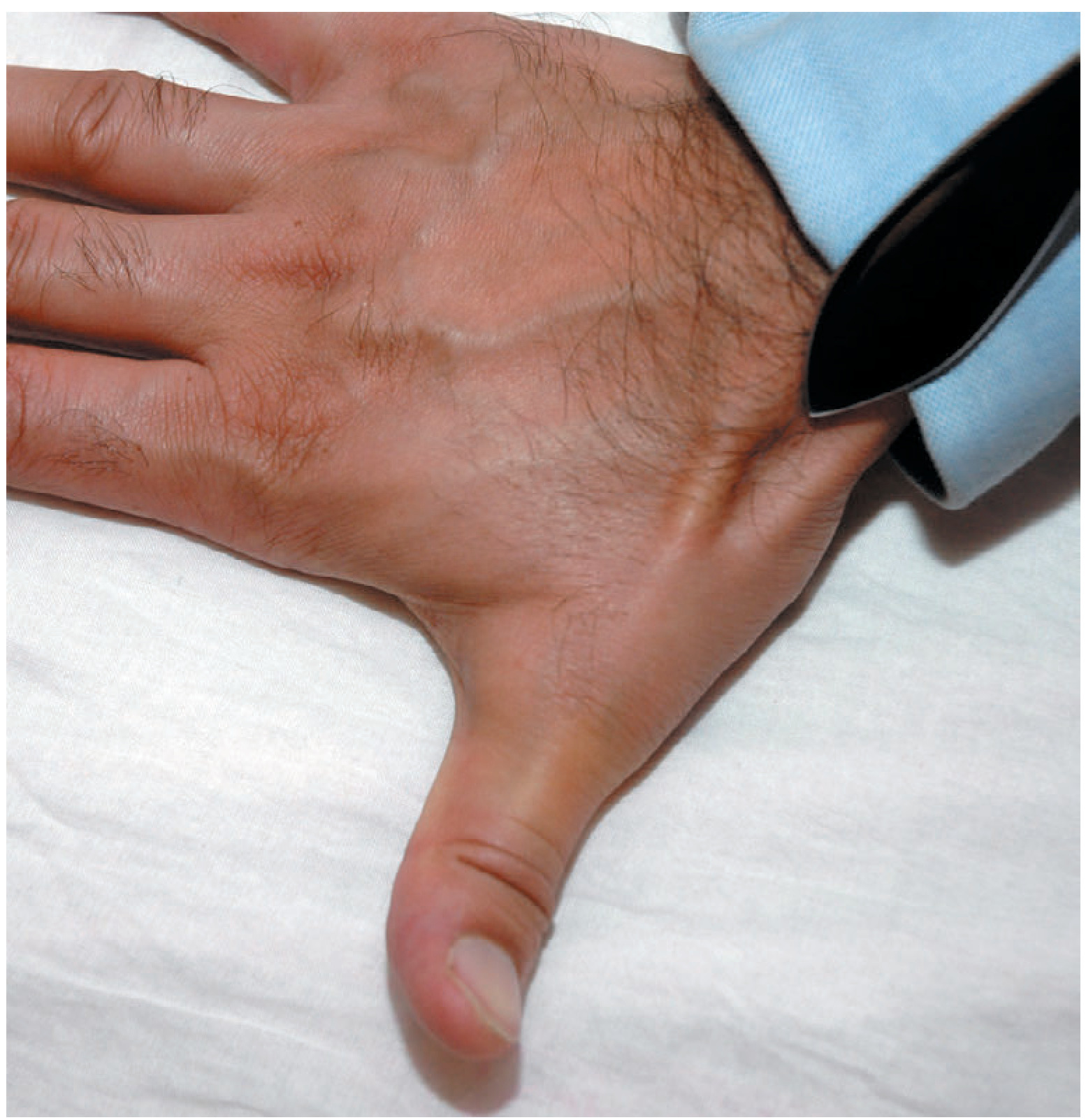
Contents
The following structures pass through or lie within the snuff box:
- Radial artery - the most important content. It crosses the scaphoid bone here (deep branch) before passing between the two heads of the first dorsal interosseous to enter the palm and form the deep palmar arch.
- Cephalic vein - originates here from the dorsal venous network; courses proximally up the forearm.
- Superficial branch of the radial nerve - crosses the floor providing sensory innervation to the skin of the snuff box and the dorsal aspect of the thumb/index finger. This is why the snuff box is the site tested for radial nerve sensation in hand examination.
- Radial nerve (superficial branch) tributaries - Bailey & Love specifically notes that sensation of the radial nerve is tested in the snuff box region.
- Tendons of extensor carpi radialis longus (ECRL) and extensor carpi radialis brevis (ECRB) run beneath the floor.
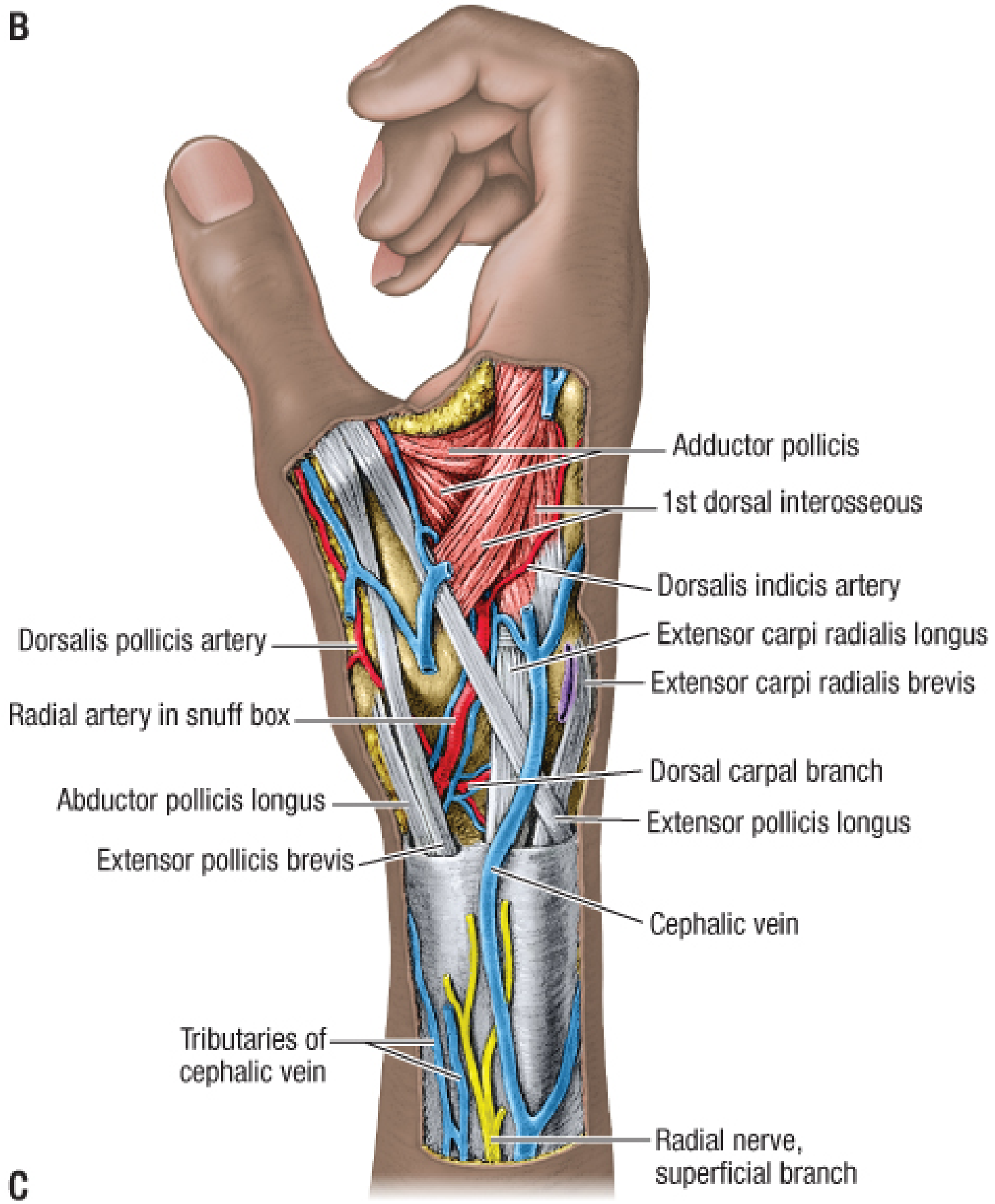
Radial Artery: Course Through the Snuff Box
The radial artery crosses the scaphoid and trapezium bones as it passes through the floor of the snuff box. At the wrist level it gives rise to the dorsal carpal branch, which joins the dorsal carpal arch. It then dives between the two heads of the first dorsal interosseous muscle, entering the palm to complete the deep palmar arch by anastomosing with a branch of the ulnar artery. Branches given off from this segment include:
- Dorsalis pollicis artery (to the thumb)
- Dorsalis indicis artery (to the index finger)
- Dorsal carpal branch
The radial artery is also the clinically accessible pulse point at the wrist, palpable just proximal to the snuff box. - Imaging Anatomy: Bones, Joints, Vessels and Nerves, Vol. 3
Clinical Significance
1. Scaphoid Fracture (Most important)
Tenderness in the anatomical snuff box after a fall on an outstretched hand (FOOSH) is the hallmark sign of a scaphoid fracture until proven otherwise.
- The mechanism is forced dorsiflexion + radial deviation, impacting the scaphoid waist against the radial styloid.
- The wrist may look deceptively normal; there may be only "slight fullness" of the snuff box.
- Tenderness is maximal when wrist is deviated medially (ulnar deviation).
- Initial X-ray may be normal - special "scaphoid views" are required; MRI, CT, or bone scan may be needed if radiographs remain negative but tenderness persists.
- If clinical suspicion persists despite negative initial X-rays, treat as suspected scaphoid fracture: immobilize and re-examine at 10-14 days.
Key complications of missed/untreated scaphoid fracture:
- Avascular necrosis of the proximal pole (blood supply enters distally and is retrograde)
- Non-union (requires prolonged immobilization or surgical fixation)
- Malunion and carpal instability
Management: undisplaced fractures - below-elbow cast; displaced (>1 mm) or unstable - open reduction + headless compression screw. - Bailey & Love's, 28th ed.; S. Das Manual on Clinical Surgery, 13th ed.
2. Radial Artery Access
The radial artery is accessible here for:
- Pulse palpation
- Radial artery cannulation
- Harvesting for coronary artery bypass grafting (CABG)
3. Radial Nerve Sensation Testing
The superficial branch of the radial nerve provides sensation to the skin of the snuff box. In hand examination, this is the test area for radial nerve sensory function. - Bailey & Love's, 28th ed.
4. De Quervain's Tenosynovitis
Inflammation of the first extensor compartment (APL + EPB tendons) causes pain that overlaps the snuff box region. The Finkelstein test (ulnar deviation of the wrist with the thumb adducted) reproduces pain.
5. Scaphoid Cast Application
The scaphoid cast is a standard below-elbow thumb spica cast used for scaphoid fractures and snuff box tenderness without radiographic confirmation. Casting continues until snuff box tenderness resolves on palpation and radiographic healing is confirmed. - Rockwood & Green's Fractures in Adults, 10th ed. 2025; Campbell's Operative Orthopaedics, 15th ed. 2026
Summary Table
| Feature | Detail |
|---|---|
| Location | Dorsolateral wrist, radial side |
| Medial border | Extensor pollicis longus |
| Lateral border | Extensor pollicis brevis + Abductor pollicis longus |
| Floor | Scaphoid + Trapezium |
| Key artery | Radial artery (crosses scaphoid) |
| Key vein | Cephalic vein (origin) |
| Key nerve | Superficial radial nerve |
| Key clinical sign | Snuff box tenderness = scaphoid fracture until excluded |
Sources: Bailey & Love's Short Practice of Surgery 28th ed. | Fischer's Mastery of Surgery 8th ed. | Imaging Anatomy Vol. 3 | S. Das Manual on Clinical Surgery 13th ed. | Rockwood & Green's Fractures in Adults 10th ed. 2025 | Campbell's Operative Orthopaedics 15th ed. 2026
This is a shared conversation. Sign in to Orris to start your own chat.