
Hypertyrosinemia
I'll look this up in the medical library right away.
Searching sources...
Reading File
Finding Sources
Finding Sources
Searching PubMed
tyrosinemia hypertyrosinemia
Good results. Let me now read the most relevant sections in parallel.
Reading File
Reading File
Reading File
Reading File
Let me also read the Tietz Lab Medicine section for Type 1 more fully, and grab a metabolic pathway figure if available.
Reading File
Finding Sources
Finding Sources
Reading File
Finding Sources
Reading File
Loading Image
Let me fetch the tyrosine metabolism pathway figure from Sleisenger & Fordtran which is specifically about tyrosinemia.
Loading Image
I now have comprehensive information from multiple authoritative textbooks. Here is a thorough overview of hypertyrosinemia.
Hypertyrosinemia (Tyrosinemia)
Hypertyrosinemia refers to elevated plasma tyrosine levels. It is not a single disease but a group of conditions - both inherited (inborn errors of tyrosine metabolism) and acquired - in which tyrosine and its toxic metabolites accumulate. The term is broadly used interchangeably with "tyrosinemia," though strictly speaking hypertyrosinemia refers to the biochemical finding, while tyrosinemia refers to the clinical syndrome.
Tyrosine Metabolism - Overview
The normal degradation pathway runs:
Phenylalanine → Tyrosine → p-Hydroxyphenylpyruvate → Homogentisate → Maleylacetoacetate → Fumarylacetoacetate → Fumarate + Acetoacetate
Each step is enzyme-catalyzed. Defects at specific enzymatic steps produce distinct clinical syndromes.
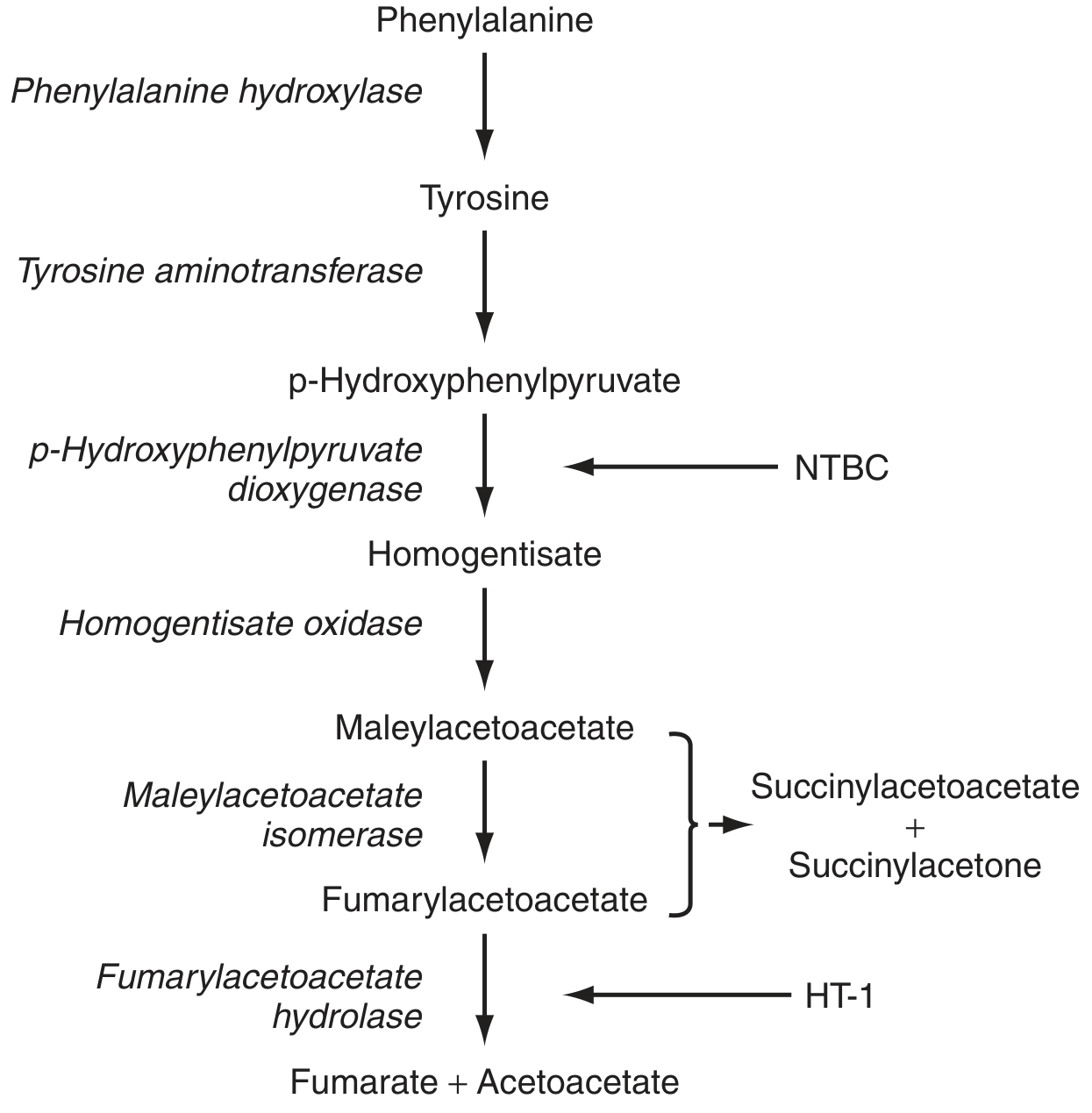
Pathway of tyrosine metabolism. NTBC blocks p-hydroxyphenylpyruvate dioxygenase (upstream), preventing synthesis of the toxic metabolites succinylacetone and succinylacetoacetate. HT-1 = hereditary tyrosinemia type 1 defect site (fumarylacetoacetate hydrolase). - Sleisenger & Fordtran's Gastrointestinal and Liver Disease
Classification of Tyrosinemias
Type 1 - Hepatorenal Tyrosinemia (HT-1)
| Feature | Details |
|---|---|
| Enzyme defect | Fumarylacetoacetate hydrolase (FAH) - the terminal step |
| Gene | FAH gene (multiple mutations) |
| Inheritance | Autosomal recessive |
| Incidence | ~1/100,000 (up to 1/1,800 in Saguenay-Lac Saint-Jean, Quebec - founder effect) |
Pathophysiology: FAH deficiency causes accumulation of fumarylacetoacetate and maleylacetoacetate, which are converted to succinylacetone (SA) and succinylacetoacetate. SA is the key toxic metabolite:
- SA structurally resembles delta-aminolevulinic acid (ALA) and competitively inhibits ALA dehydratase (ALAD), causing buildup of ALA - the mechanism behind porphyria-like neurological crises
- SA causes renal tubular toxicity (Fanconi syndrome) leading to rickets
- SA and related metabolites cause hepatocyte injury, cirrhosis, and hepatocellular carcinoma (HCC)
Clinical Presentations:
- Acute form (< 6 months): Severe liver failure, coagulopathy, jaundice, hypoglycemia - often fatal if untreated
- Chronic form (> 6 months): Failure to thrive, chronic hepatocellular dysfunction, renal Fanconi syndrome (glycosuria, proteinuria, aminoaciduria, hyperphosphaturia), hypophosphatemic rickets, cirrhosis
- Neurological crises: Painful paresthesias, autonomic dysfunction, progressive paralysis, respiratory depression (mimicking acute intermittent porphyria) - caused by ALA accumulation
- HCC: Very high risk even in young children (as early as age 2); untreated patients develop cirrhosis and carcinoma
- Cardiomyopathy: Found in ~30% of newly diagnosed patients (intraventricular septal hypertrophy), usually resolves with treatment
Biochemical/Lab findings:
- Elevated plasma tyrosine (often milder than in Types 2 and 3)
- Succinylacetone in urine - the diagnostic marker (most specific)
- Markedly elevated serum alpha-fetoprotein (AFP) - often extremely high
- Elevated ALA in urine
- Reduced coagulation factors
- Renal tubular findings (glucosuria, aminoaciduria)
Diagnosis: Urine organic acid analysis showing succinylacetone is the gold standard. Plasma tyrosine elevation alone is non-specific. FAH activity can be measured in red blood cells. Newborn screening using succinylacetone (not tyrosine) as the primary marker is now preferred.
Liver histology: Macrovesicular steatosis, pseudoacinar hepatocyte rosettes with bile plugs, hemosiderosis, hepatocyte necrosis/apoptosis, fine diffuse fibrosis progressing to micronodular cirrhosis.
Treatment:
- NTBC (nitisinone / Orfadin) - potent inhibitor of 4-hydroxyphenylpyruvate dioxygenase (upstream enzyme), preventing synthesis of succinylacetone. Start as soon as diagnosis is suspected at 1 mg/kg/day (divided into 2 doses in infancy; single daily dose thereafter). Target blood NTBC concentration: 40-60 μmol/L with SA undetectable. AFP monitoring required (rising AFP despite NTBC suggests non-compliance or HCC).
- Dietary restriction of tyrosine and phenylalanine (phenylalanine is the precursor of tyrosine)
- Liver transplantation: Indicated for liver failure despite therapy, or HCC. Reverses hepatic metabolic abnormalities, prevents neurological disease, and stabilizes kidney disease.
Note: Long-term use of NTBC may cause chronic hypertyrosinemia (since the upstream block raises tyrosine levels), which may contribute to cognitive impairment and learning problems - hence dietary co-restriction is necessary alongside drug therapy.
- Sleisenger & Fordtran's GI and Liver Disease; Yamada's Textbook of Gastroenterology; Tietz Textbook of Laboratory Medicine, 7th Ed.
Type 2 - Oculocutaneous Tyrosinemia (Richner-Hanhart Syndrome)
| Feature | Details |
|---|---|
| Enzyme defect | Tyrosine aminotransferase (TAT) |
| Gene | TAT gene |
| Inheritance | Autosomal recessive |
Pathophysiology: Tyrosine accumulates from the very first degradation step. Crystalline tyrosine deposits in tissues cause the characteristic features.
Clinical features:
- Ocular: Lacrimation, photophobia, corneal erosions (from crystalline tyrosine deposits), neovascularization, opacification - typically onset in first year of life
- Skin: Painful palmar and plantar hyperkeratotic/erosive lesions, often on weight-bearing areas; can track along dermatoglyphs; bullae possible; hyperhydrosis
- Neurological: Mild-to-moderate intellectual disability in >50% of patients; language deficits; occasionally self-mutilation and incoordination
Diagnosis: Elevated serum tyrosine (>0.18 mM) and tyrosinuria. In any child with palmoplantar keratoderma + tearing/photophobia, Type 2 must be considered.
Treatment: Low-tyrosine, low-phenylalanine diet (may prevent or improve ocular and skin lesions; may not benefit established intellectual disability). Oral retinoids can improve skin lesions.
- Andrews' Diseases of the Skin; Adams & Victor's Principles of Neurology, 12th Ed.
Type 3 - Rare Enzyme Deficiency
| Feature | Details |
|---|---|
| Enzyme defect | 4-Hydroxyphenylpyruvate dioxygenase (HPD) |
| Gene | HPD gene |
| Inheritance | Autosomal recessive |
Clinical features: Mild; primarily neurological - ataxia, intellectual disability. Liver and kidney involvement absent. Skin/ocular features absent. Plasma tyrosine is markedly elevated.
Treatment: Low-tyrosine, low-phenylalanine diet.
Transient Tyrosinemia of the Newborn
-
Most common form of hypertyrosinemia
-
Particularly common in premature infants
-
Biochemical defect: Immaturity of 4-hydroxyphenylpyruvate dioxygenase (same enzyme as Type 3), which requires ascorbate (vitamin C) as a cofactor
-
Generally benign and self-limiting
-
Treatment: Dietary protein restriction + ascorbate (vitamin C) supplementation reduces plasma tyrosine
-
Basic Medical Biochemistry, 6th Ed.
Acquired / Secondary Causes of Hypertyrosinemia
Elevated plasma tyrosine is a nonspecific finding that occurs in many conditions and is not by itself used to establish the diagnosis of any specific tyrosinemia:
-
Hepatocellular dysfunction of almost any cause (including galactosemia, fructosemia, peroxisomal disorders, mitochondrial DNA depletion syndrome, gluconeogenesis disorders)
-
High-protein diets
-
Prematurity
-
Tietz Textbook of Laboratory Medicine, 7th Ed.
Summary Table of Tyrosine Disorders
| Type | Enzyme Defect | Key Features | Diagnostic Marker |
|---|---|---|---|
| Type 1 (HT-1) | Fumarylacetoacetate hydrolase (FAH) | Liver failure, HCC, Fanconi syndrome, porphyria-like crises | Succinylacetone in urine |
| Type 2 (Richner-Hanhart) | Tyrosine aminotransferase (TAT) | Keratitis, palmoplantar keratoderma, intellectual disability | Elevated serum tyrosine (>0.18 mM) |
| Type 3 | 4-OH-phenylpyruvate dioxygenase (HPD) | Mild neurological findings | Elevated plasma tyrosine |
| Transient neonatal | Immature HPD (ascorbate-dependent) | Benign, premature infants | Elevated plasma tyrosine; resolves spontaneously |
Key Points to Remember
- Succinylacetone - not tyrosine - is the pathognomonic marker for Type 1; plasma tyrosine may be only mildly elevated in HT-1 compared to Types 2 and 3
- NTBC (nitisinone) works by blocking upstream of FAH, preventing toxic metabolite formation - it paradoxically raises tyrosine further, requiring dietary co-restriction
- AFP is used both for diagnosis and to monitor for HCC in HT-1; a rising AFP on treatment is a red flag
- The neurological crises in HT-1 mimic acute intermittent porphyria due to succinylacetone-mediated ALAD inhibition and ALA accumulation
- Liver transplantation corrects the metabolic defect in HT-1 (FAH is a liver enzyme)
This is a shared conversation. Sign in to Orris to start your own chat.