
Bera result using headphones
Reading File
BERA (Brainstem Evoked Response Audiometry) is a test that measures electrical activity in the auditory nerve and brainstem in response to sound. When performed with headphones (insert or supra-aural), it primarily tests air conduction and helps determine hearing thresholds and site of lesion.
Searching sources...
Finding Sources
Finding Sources
Finding Sources
Finding Sources
Good findings. Now let me read the most relevant sections from Cummings (ABR section) and Scott-Brown's (ABRE section) simultaneously.
Reading File
Reading File
Let me get more detail on BERA waves, normal values, and interpretation - particularly what "using headphones" specifically means for test interpretation.
Reading File
Finding Sources
Reading File
Finding Sources
Now let me get the ABR waveform image and the Scott-Brown section on normal values.
Reading File
Loading Image
Excellent - I have a clear Normal ABR waveform image. Let me read a bit more on the Scott-Brown section about normal values and conductive hearing loss effects, and also get the KJ Lee section on BERA normal latencies.
Reading File
Reading File
Now let me fetch the ABR peaks image and also get the Scott-Brown section on conductive hearing loss effects to complete the headphone-specific interpretation.
Reading File
Reading File
I now have comprehensive information. Let me also get the normative values table that was referenced:
Reading File
I now have everything needed for a comprehensive answer. Here is the full breakdown of BERA results using headphones:
BERA (ABR) Results Using Headphones - Complete Guide
BERA (Brainstem Evoked Response Audiometry), also called ABR (Auditory Brainstem Response), measures far-field electrical potentials generated by the auditory nerve and brainstem in response to sound. When performed using headphones (supra-aural or, preferably, insert earphones), it delivers sound via air conduction, making it the standard method for most clinical BERA testing.
Why Headphones (Insert Earphones) Are Preferred
- Scott-Brown's recommends insert earphones (e.g., ER-3A) for diagnostic ABR. They reduce stimulus artifact, allow inter-aural attenuation up to 70-80 dB (vs. ~40 dB with supra-aural headphones), and reduce contamination from ambient noise.
- Stimulus is typically a 100 microsecond click delivered at 80 dB nHL (or higher if significant hearing loss is present).
- The click tests predominantly 2000-4000 Hz cochlear region (high frequency).
The Normal ABR Waveform (Waves I-V)
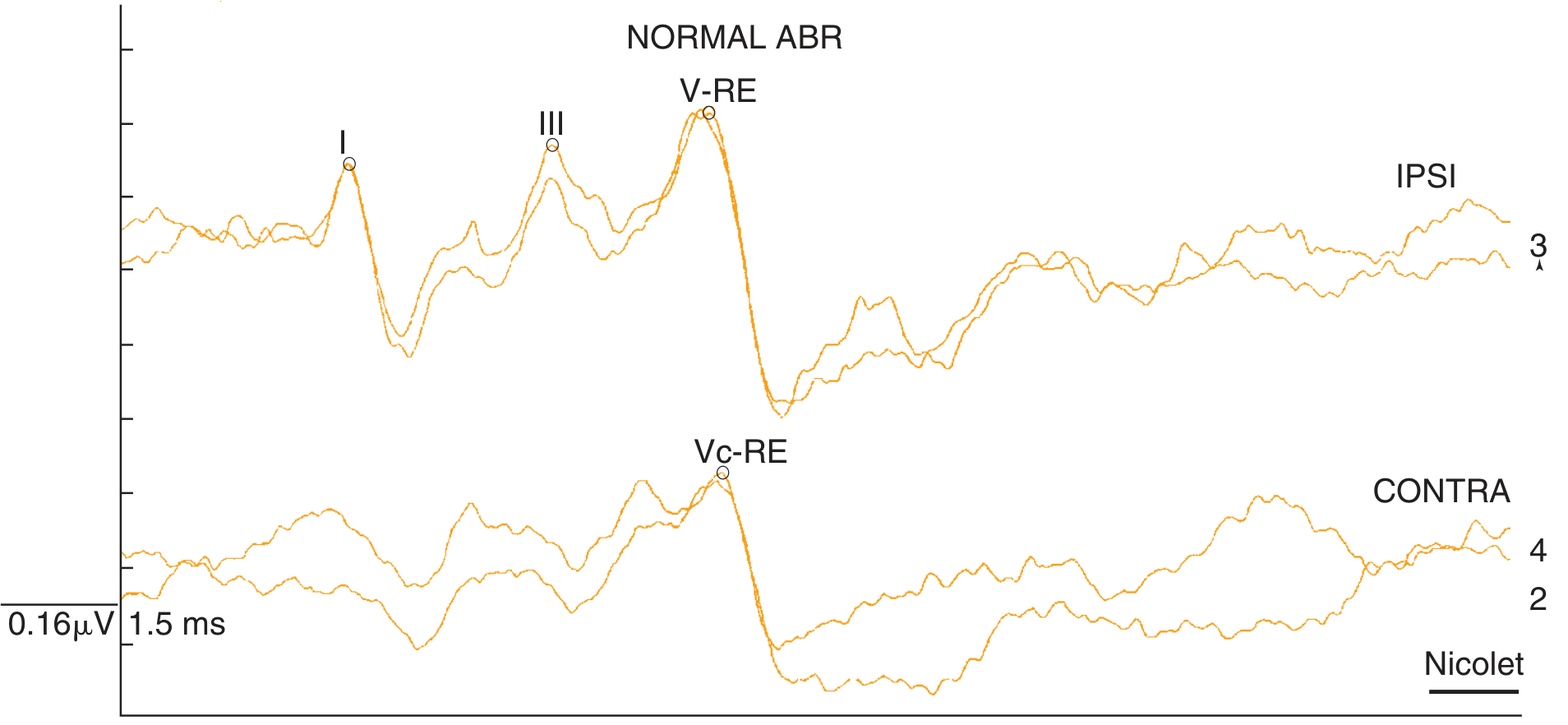
Normal two-channel ABR: IPSI channel strongly emphasizes Wave I; CONTRA channel emphasizes the IV-V separation. Two replicated traces confirm response reliability.
Each wave corresponds to a neural generator - summarized by the mnemonic "EECOL" (KJ Lee's Essential Otolaryngology):
| Wave | Generator | Approximate Latency |
|---|---|---|
| I | Distal 8th nerve (cochlear nerve) | ~1.5 ms |
| II | Proximal 8th nerve | ~2.5 ms |
| III | Cochlear nucleus | ~3.5 ms |
| IV | Superior olivary complex / lateral lemniscus | ~4.5 ms |
| V | Lateral lemniscus (+ inferior colliculus) | ~5.5 ms |
Waves IV and V often appear fused as a IV-V complex. A SN10 negativity may follow wave V (from inferior colliculus).
Normal Values (at 80 dB nHL, click stimulus via air conduction headphones)
From Scott-Brown's Otorhinolaryngology (Table 52.1):
| Measurement | Normal Limit |
|---|---|
| Absolute latency of Wave V | < 6.2 ms |
| Interwave (interpeak) latency I-III | < 2.5 ms |
| Interwave latency III-V | < 2.4 ms |
| Interwave latency I-V | < 4.4 ms |
| Inter-ear latency difference (ILD) for Wave V | < 0.5 ms |
| Fast-rate latency shift | < 1.0 ms |
Cummings Otolaryngology uses slightly tighter values for neurodiagnostic thresholds: I-III ≥ 2.3 ms, III-V ≥ 2.1 ms, I-V ≥ 4.4 ms, and interaural latency difference ≥ 0.4 ms suggest retrocochlear pathology.
How to Interpret the Result (3-Step Hierarchy)
Step 1: Is there a response at all?
- A complete absence of ABR at 85 dB nHL in a patient with near-normal hearing = strongly suggests retrocochlear pathology.
- Absent ABR with severe hearing loss = may simply be due to inadequate cochlear stimulation, not a lesion.
Step 2: Are all major peaks (I, III, V) present?
- Wave V is the most robust - persists even with significant hearing loss.
- Wave I disappears when hearing loss exceeds ~40-45 dB at high frequencies.
- An absent Wave V in the presence of a replicable Wave I or III = definitive indicator of retrocochlear involvement.
Step 3: Measure interpeak latencies
- I-III, III-V, and I-V intervals are the gold standard for neurodiagnostic ABR.
- The I-III interval is the most sensitive for acoustic neuroma (~90% sensitivity).
- Increased I-V or I-III = lesion between cochlear nerve and upper brainstem (e.g., acoustic neuroma, CPA mass, demyelination).
Effect of Headphone Type on Results
| Transducer | Key Feature |
|---|---|
| Insert earphones (ER-3A, preferred) | Greater inter-aural attenuation (~70-80 dB), ~0.9 ms added absolute latency vs. supra-aural (due to tubing), less artefact - normative values must account for this delay |
| Supra-aural headphones (TDH-39/49) | ~40 dB inter-aural attenuation; risk of cross-hearing; historically used for many normative data sets |
When using insert earphones, Wave V latency is approximately 0.9 ms longer than with supra-aural headphones. Laboratories must use transducer-specific normative data.
Conductive vs. Sensorineural Patterns (Headphone ABR)
- Conductive hearing loss: All waves shift to longer latencies uniformly (a parallel shift), with normal interwave intervals (I-III, I-V unchanged). The wave V latency-intensity function is shifted but has normal slope.
- Sensorineural hearing loss: Affects wave morphology variably; slope of the latency-intensity function may increase near threshold.
- Retrocochlear lesion (acoustic neuroma): Prolonged I-III or I-V interwave interval, reduced amplitude of waves, absent wave V, or large inter-ear difference (ILD > 0.5 ms).
ABR Threshold Testing (Hearing Sensitivity)
- Wave V threshold correlates well with behavioral hearing threshold (within 10-20 dB).
- Tone-pip stimuli (500 Hz, 1000 Hz, 2000 Hz, 4000 Hz) can be used for frequency-specific threshold estimation.
- Particularly useful in infants, uncooperative patients, and medico-legal cases where behavioral testing is unreliable.
References:
- Cummings Otolaryngology Head and Neck Surgery, Section on Auditory Brainstem Response (pp. 2577-2580)
- Scott-Brown's Otorhinolaryngology Head & Neck Surgery, Vol. 2, Ch. 52: Acoustic Brainstem Evoked Responses
- K.J. Lee's Essential Otolaryngology, Otology section (Auditory brainstem response, p. 1211)
This is a shared conversation. Sign in to Orris to start your own chat.