Ab main Harrison ke complete ECG chapter se ek systematic, Hindi mein guide banata hoon. Saari content seedha Harrison 22E se hai.
ECG - Basic to Advanced (Harrison 22E)
PART 1: Heart ka Electrical System - Pehle Ye Samjho
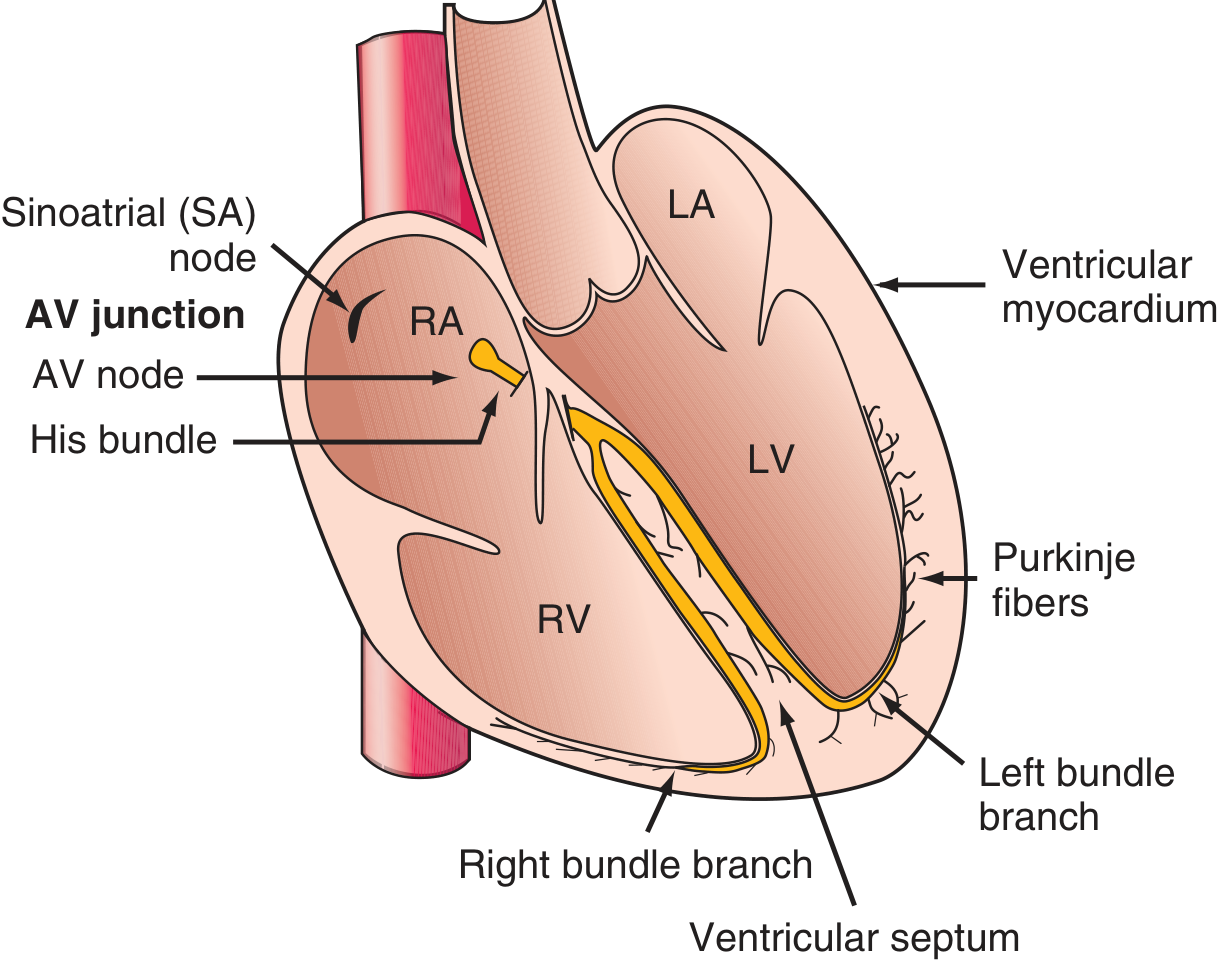
Pehle ECG samajhna hai toh ye samajhna zaroori hai ki current kahan se start hoti hai aur kahan jaati hai:
SA Node (Right Atrium mein) → current start hoti hai yahan se, ye natural pacemaker hai
Pathway:
SA Node → Right Atrium → Left Atrium
              ↓
         AV Node (yahan delay hoti hai - atria ko contract karne ka time milta hai)
              ↓
         His Bundle
              ↓
    Left Bundle Branch + Right Bundle Branch
              ↓
         Purkinje Fibers (endocardium tak)
              ↓
    Ventricular muscle (endocardium → epicardium)
Harrison se exact: "The bundle of His bifurcates into two main divisions, the right and left bundle branches, which rapidly transmit depolarization wavefronts to the RV and LV myocardium via the Purkinje fibers. The main left bundle fans out into left anterior and left posterior fascicular subdivisions."
PART 2: ECG Waves - Har Wave Ka Matlab
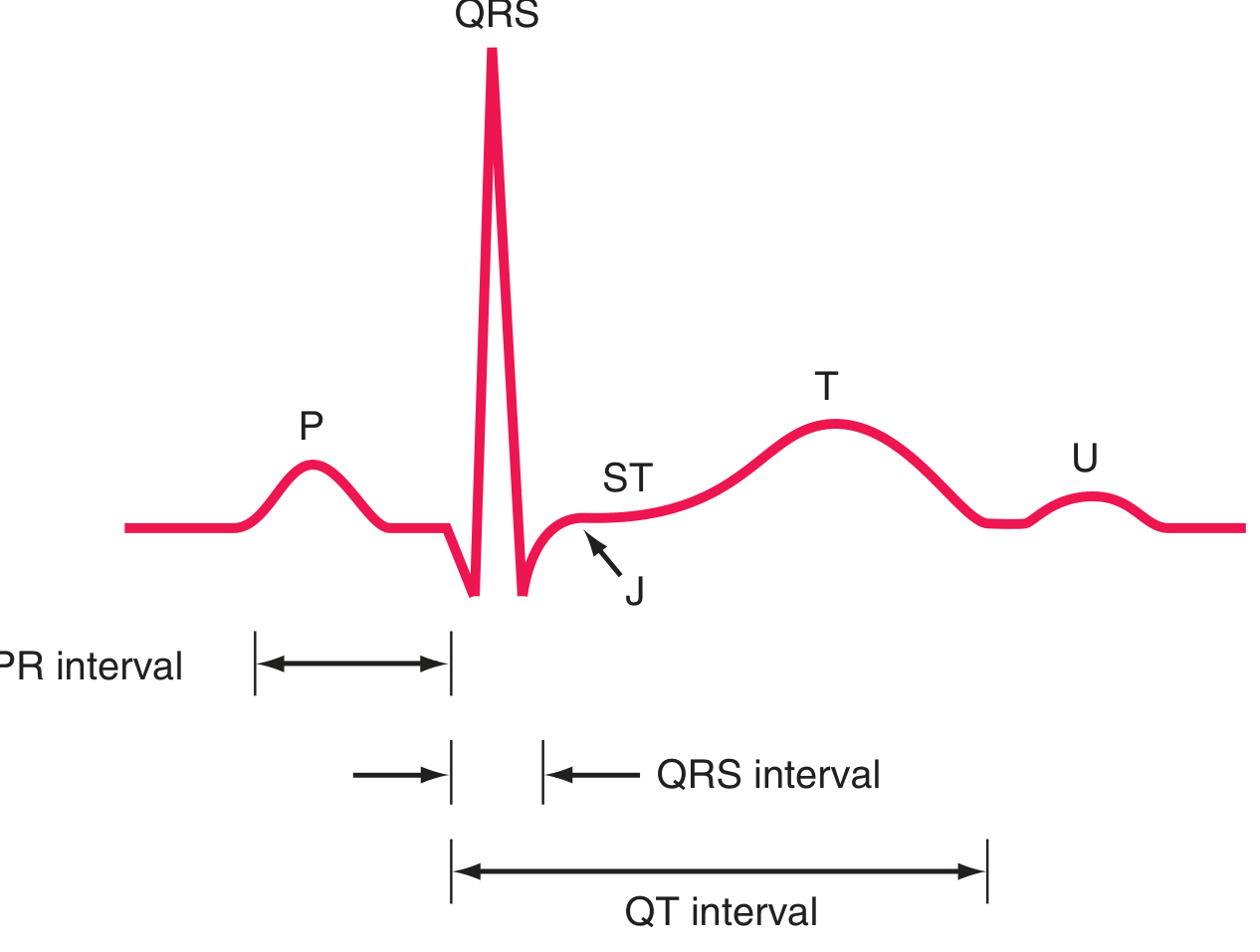
| Wave / Interval | Kya represent karta hai |
|---|
| P wave | Atrial depolarization |
| PR interval | Atria se ventricle tak conduction time (AV node delay) |
| QRS complex | Ventricular depolarization |
| ST segment | Ventricular plateau phase (isoelectric hona chahiye) |
| T wave | Ventricular repolarization |
| U wave | Late ventricular repolarization (Purkinje fibers) |
| QT interval | Total ventricular depolarization + repolarization |
PART 3: ECG Paper - Numbers Yaad Karo
Harrison se: "ECG is recorded on graph paper - 1 mm² boxes. At 25 mm/s sweep speed:"
1 small box (1mm)  = 0.04 seconds (40 ms)
1 large box (5mm)  = 0.20 seconds (200 ms)

Amplitude: 1 mV = 10 mm (standard calibration)
Heart Rate calculate karna:
- 300 ÷ number of large boxes between 2 R waves
- Ya 1500 ÷ number of small boxes between 2 R waves
PART 4: Normal Intervals (Yaad Karo - Exam Important)
| Interval | Normal Range |
|---|
| PR | 120-200 ms (3-5 small boxes) |
| QRS | ≤100-110 ms (≤2.5 small boxes) |
| QT | <460 ms women, <450 ms men |
| QTc | QT ÷ √RR |
PART 5: 12 Leads - Kaun Sa Lead Kahan Dekhta Hai
2 groups hain:
Limb Leads (Frontal plane):
- Lead I, II, III - bipolar
- aVR, aVL, aVF - augmented unipolar
Precordial/Chest Leads (Horizontal plane):
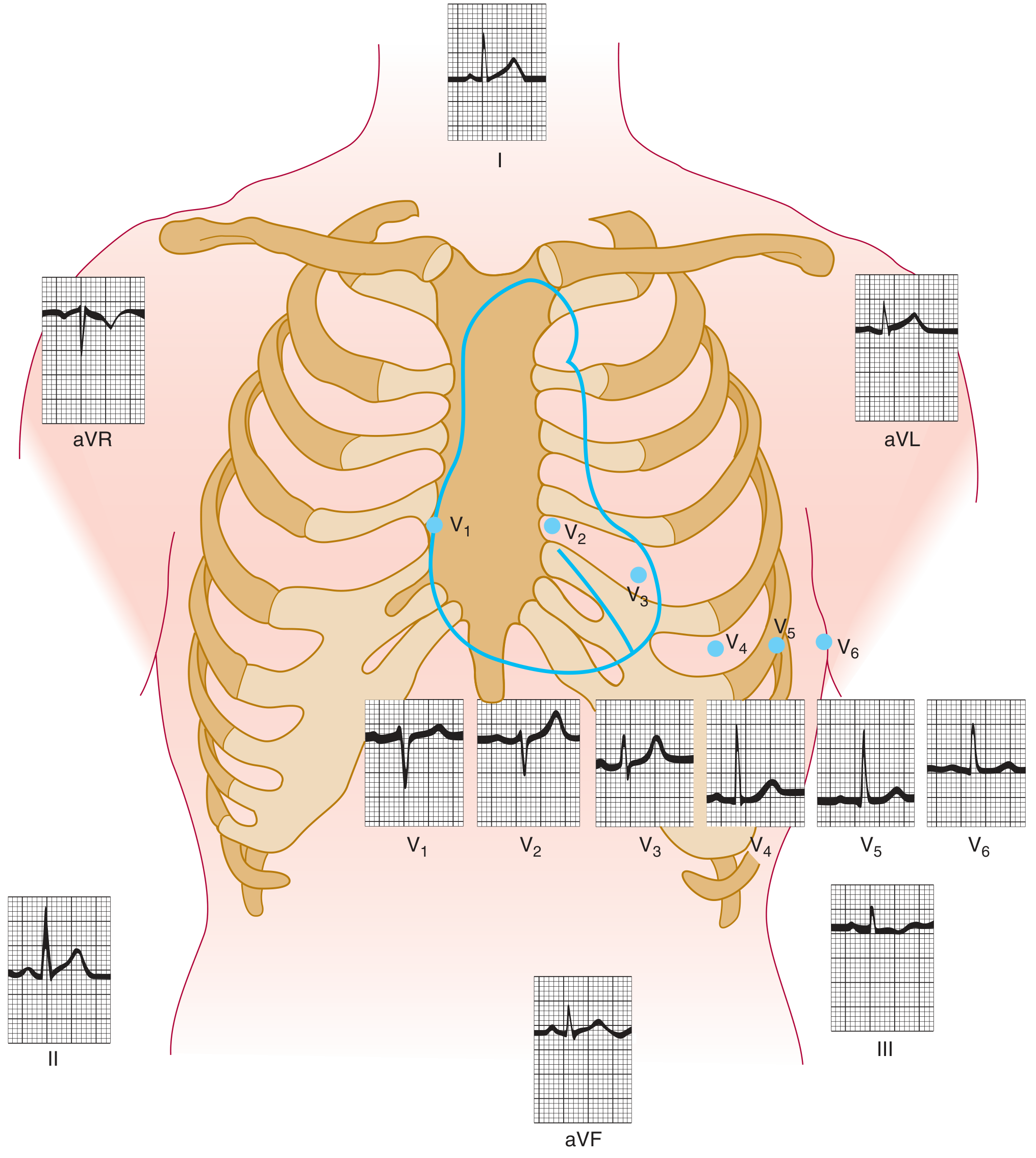
Harrison se: "Each lead is analogous to a different video camera angle looking at the same events from different spatial orientations."
Leads ka Geography (Kaunsa lead kaunsi wall dekhta hai):
| Lead Group | Heart Wall |
|---|
| II, III, aVF | Inferior wall (RCA territory) |
| I, aVL, V5, V6 | Lateral wall (LCx territory) |
| V1-V4 | Anterior/Septal wall (LAD territory) |
| aVR | Right atrium cavity (normally negative) |
PART 6: P Wave - Normal aur Abnormal
Harrison se: "The normal atrial depolarization vector is oriented downward and toward the subject's left."
Normal P wave:
- Lead II mein positive (current SA node se aV node ki taraf = Lead II ki taraf)
- aVR mein negative (current aVR se door)
- V1 mein biphasic hoti hai - pehle positive (RA), phir small negative (LA)
Abnormal:
- Ectopic pacemaker agar lower atrium ya AV junction se ho → retrograde P waves (II mein negative, aVR mein positive)
PART 7: QRS Complex - Ventricular Depolarization
Ye pehle wale questions mein cover ho chuka hai, short recap:
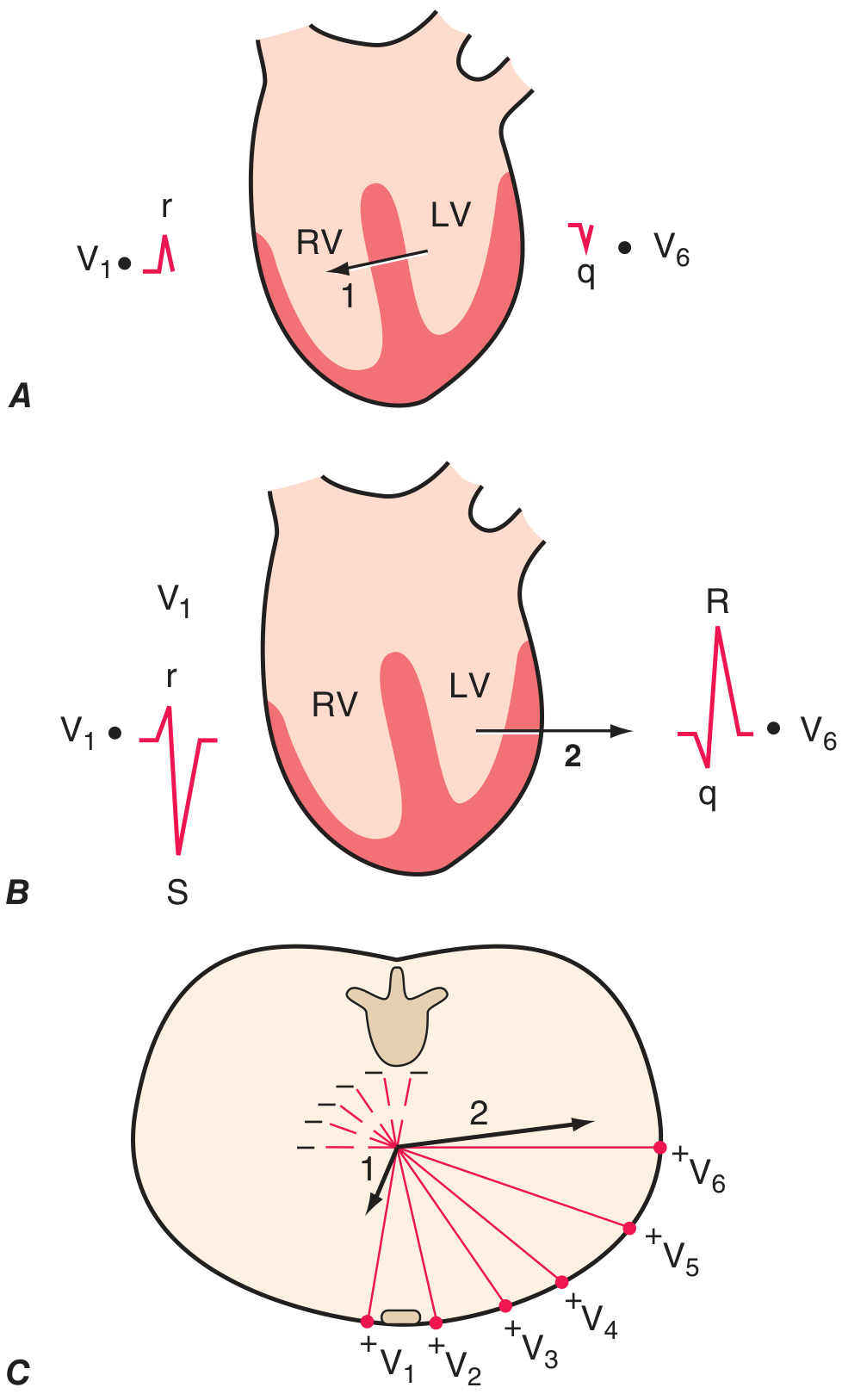
Phase 1 - Septal (Vector 1): Left → Right, anteriorly
- V1: small r (taraf aa raha)
- V6: small q (door ja raha)
Phase 2 - Main Ventricular (Vector 2): Left + Posterior (LV dominant)
- V1: deep S (door ja raha)
- V6: tall R (taraf aa raha)
Normal R-wave progression: V1 se V6 tak R wave badhti jaati hai, S wave ghatti jaati hai. Transition zone V3-V4 pe hoti hai.
PART 8: ST Segment aur T Wave
Harrison se: "The plateau (phase 2) of action potential corresponds to the isoelectric ST segment. Active repolarization (phase 3) corresponds to the T wave."
Normal:
- ST segment isoelectric (baseline pe) hona chahiye
- T wave normally QRS ke same direction mein hoti hai (concordant)
- Repolarization epicardium se endocardium ki taraf hoti hai (depolarization se ulta)
Factors jo QT badhate hain: amiodarone, hypocalcemia, hypokalemia, drugs
Factors jo QT ghataate hain: hypercalcemia, digoxin
PART 9: QRS Axis
Normal axis: -30° se +100° tak
| Axis | Direction | Causes |
|---|
| Normal | -30° to +100° | Normal |
| Left Axis Deviation (LAD) | <-30° | LVH, Left anterior fascicular block, Inferior MI |
| Right Axis Deviation (RAD) | >+100° | RVH, Lateral MI, Left posterior fascicular block, Normal in children |
Quickly check karne ka trick:
- Lead I positive + Lead aVF positive = Normal axis
- Lead I positive + Lead aVF negative = Left axis deviation
- Lead I negative + Lead aVF positive = Right axis deviation
PART 10: Chamber Enlargement
Left Atrial Enlargement (LAE):
- P wave V1 mein - terminal negative component >1 mm² (1mm wide + 1mm deep)
- P wave duration >120 ms in Lead II ("P mitrale" - bifid P)
Right Atrial Enlargement (RAE):
- P wave Lead II mein tall >2.5 mm ("P pulmonale")
Left Ventricular Hypertrophy (LVH) - Sokolow-Lyon Criteria:
Harrison se: "Sv1 + Rv5/v6 > 35 mm" (same jo tumhare image mein tha)
Plus: ST-T changes (strain pattern) - V5/V6 mein ST depression + T wave inversion
Right Ventricular Hypertrophy (RVH):
- V1 mein dominant R wave (R > S in V1)
- Right axis deviation
- ST depression + T inversion in V1-V3
PART 11: Bundle Branch Blocks
RBBB (Right Bundle Branch Block):
- QRS >120 ms
- V1 mein rSR' pattern ("rabbit ears" / M pattern)
- V6 mein qRS (wide S wave)
- T wave discordant in right leads
Harrison se: "With RBBB, the terminal QRS vector is oriented to the right and anteriorly (rSR' in V1 and qRS in V6)"
LBBB (Left Bundle Branch Block):
- QRS >120 ms
- V1 mein deep QS ya rS
- V6 mein broad, notched R wave (no septal q, no S)
- ST-T completely discordant
Important: LBBB mein MI diagnose karna mushkil hota hai (Sgarbossa criteria use karte hain)
Hemiblocks:
- Left Anterior Fascicular Block (LAFB): Left axis deviation (<-45°), qR in I/aVL, rS in II/III/aVF, QRS <120 ms
- Left Posterior Fascicular Block (LPFB): Right axis deviation, rS in I/aVL, qR in III, rare
PART 12: Ischemia aur MI
Harrison se: "Effects of ischemia - depolarization and repolarization changes"
ST Changes:
- ST elevation (STEMI): Transmural ischemia/infarction - current of injury toward electrode
- ST depression: Subendocardial ischemia ya reciprocal changes
Q Waves:
- Pathological Q wave = >40 ms wide OR >1/4 of R wave height
- Represent necrotic (dead) myocardium - electrically silent area
MI Localization:
| MI Location | Leads affected | Artery |
|---|
| Inferior | II, III, aVF | RCA |
| Anterior | V1-V4 | LAD |
| Lateral | I, aVL, V5-V6 | LCx |
| Posterior | Tall R in V1-V2 (mirror image) | RCA/LCx |
| RV infarct | V3R-V4R | RCA (proximal) |
Evolutionary Changes (STEMI mein time ke saath):
Minutes: Hyperacute T waves (tall, peaked)
Hours:   ST elevation
Days:    Q waves form, ST normalizes, T inverts
Weeks:   T waves normalize (Q waves may persist)
PART 13: Other Important ECG Patterns
Hyperkalemia:
- Early: Peaked (tall, narrow, symmetric) T waves
- Later: PR prolongation, QRS widening
- Severe: Sine wave pattern, VF/asystole
Hypokalemia:
- U waves prominent (may merge with T wave)
- Flat/inverted T waves
- QT prolongation (actually QU prolongation)
Hypercalcemia:
Hypocalcemia:
- Long QT interval (ST segment prolonged)
Digoxin effect:
- "Reverse tick" / "Salvador Dali moustache" ST pattern
- Scooped ST depression in lateral leads
- Short QT
Pericarditis:
- Diffuse ST elevation (saddle-shaped) in almost all leads
- PR depression (atrial injury)
- No reciprocal changes (unlike MI)
WPW (Wolff-Parkinson-White):
- Short PR interval (<120 ms)
- Delta wave (slurred QRS upstroke)
- Wide QRS
- SVT tendency
Summary Table - Exam ke liye
| Pattern | Key Finding |
|---|
| Normal SR | P before every QRS, PR 120-200ms, QRS <110ms |
| LVH | Sv1 + Rv5/6 >35mm |
| RVH | R>S in V1, RAD |
| LBBB | QRS>120, V6 broad R, V1 QS |
| RBBB | QRS>120, V1 rSR', V6 wide S |
| STEMI | ST elevation in contiguous leads |
| Old MI | Pathological Q waves |
| Hyperkalemia | Peaked T waves → wide QRS |
| WPW | Short PR + delta wave |
| Pericarditis | Diffuse ST elevation + PR depression |
Ye poora Harrison Chapter 247 ka core hai. Ab specific koi bhi topic aur detail mein explain karna ho - bas bolo. - Harrison's Principles of Internal Medicine, 22E, Chapter 247Ye raha poora ECG basic to advance - Harrison 22E se directly.
Ek important note: Arrhythmias (Harrison Chapter 252-255) ek alag bada topic hai - usmein sinus tachycardia, SVT, AF, VT, heart blocks sab aata hai. Agar wo bhi chahiye toh bolo, woh alag session mein detail mein cover karte hain.
Koi bhi specific topic - jaise LBBB vs RBBB aur unka difference, ya MI localization ka detail, ya axis calculation step-by-step - jo bhi confuse kar raha ho, seedha poocho.