
Cellulitis
Reading File
Now let me search the library for cellulitis content in parallel with a PubMed search.
Finding Sources
Searching PubMed
cellulitis skin infection management
Good sources found. Now let me read the most comprehensive sources in parallel - Andrews' Dermatology, Goldman-Cecil Medicine, and Rosen's Emergency Medicine.
Reading File
Reading File
Reading File
Let me fetch the clinical image and read more from Goldman-Cecil for the detailed management section (Chapter 408).
Loading Image
Finding Sources
I now have sufficient information from multiple authoritative textbooks to provide a comprehensive answer.
Cellulitis
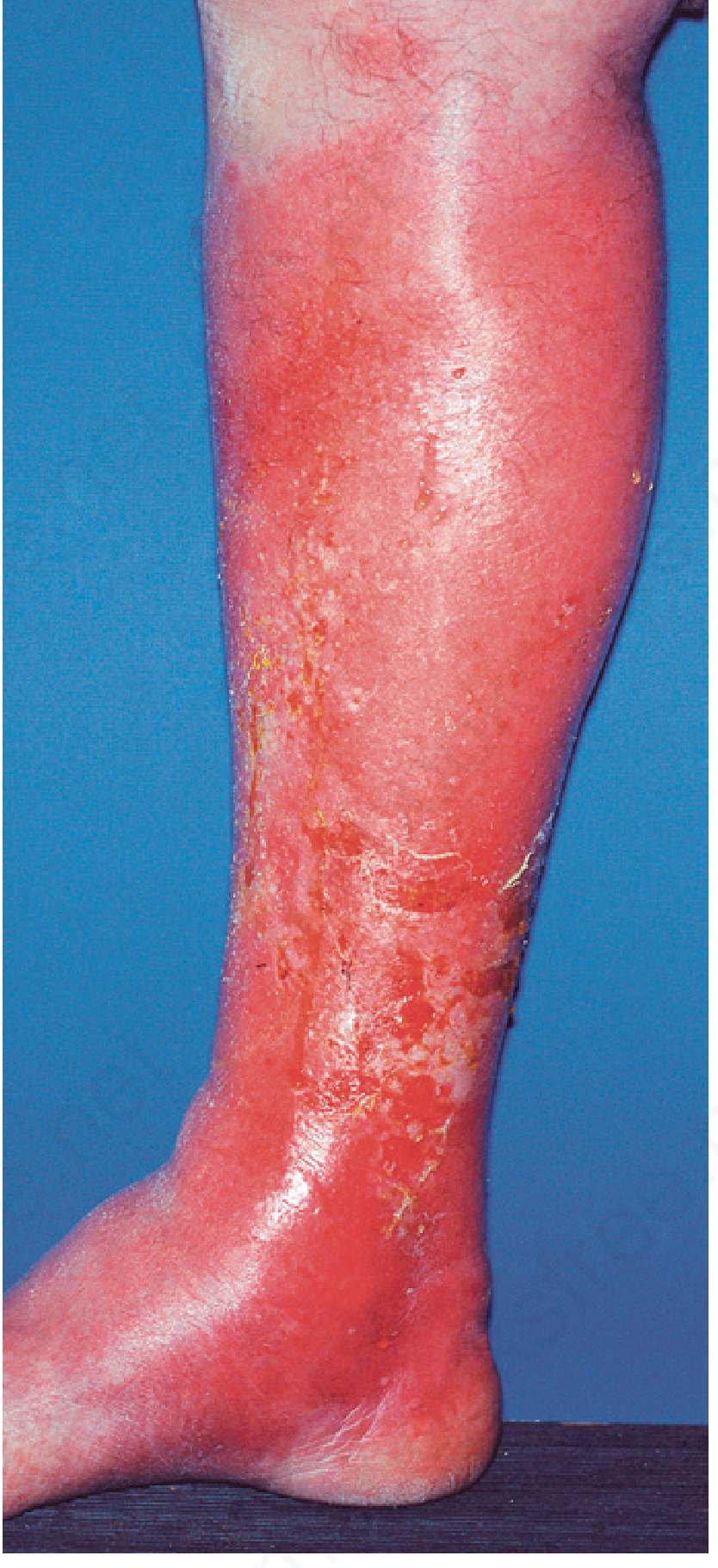
Definition
Cellulitis is a suppurative inflammation of the dermis and subcutaneous tissues, producing a diffuse, spreading infection with poorly defined borders. It differs from erysipelas, which involves the upper dermis/superficial lymphatics and has a sharply demarcated, raised edge. - Goldman-Cecil Medicine, p. 233
Etiology / Microbiology
| Organism | Frequency | Notes |
|---|---|---|
| Group A Streptococcus (S. pyogenes) | ~75% of cases | Usually nonpurulent |
| Staphylococcus aureus | Majority of remainder | Purulent cellulitis; MRSA increasingly common |
| Other streptococcal groups | Less common | Groups B, C, G |
- Andrews' Diseases of the Skin, p. 56
Portal of entry: Often follows a wound, laceration, or skin break. On the lower leg, tinea pedis is a very common entry point.
Risk Factors
- Impaired lymphatic drainage / lymphedema
- Venous insufficiency and edema
- Obesity
- Diabetes mellitus
- Disruption of skin barrier (wounds, tinea pedis, eczema)
- Immunodeficiency
- Prior saphenous phlebectomy, lymphadenectomy, or irradiation
- Alcoholism
- Goldman-Cecil Medicine, p. 233; Andrews' Diseases of the Skin, p. 63
Clinical Features
Symptoms & Signs:
- Localized erythema, swelling, warmth, and pain with ill-defined borders
- Malaise, fever, chills (present but not required for diagnosis)
- The erythema rapidly spreads and intensifies
- The affected area may be indurated and pit on pressure
- Central area may become nodular, develop vesicles that rupture and discharge pus
- Lymphangitic streaking may extend to regional lymph nodes
Complications (uncommon in immunocompetent adults; higher risk in children and immunocompromised):
- Gangrene
- Metastatic abscesses
- Severe sepsis
- Progression to necrotizing fasciitis
- Andrews' Diseases of the Skin, pp. 47-54
Diagnosis
Diagnosis is primarily clinical. Blood cultures, skin biopsies, and aspirates are rarely positive and not routinely needed.
Exception: If an open wound is present, wound cultures may be positive and are useful.
Key mimics to differentiate:
| Condition | Distinguishing Features |
|---|---|
| Stasis dermatitis | No pain, no fever; often bilateral; centered over medial malleoli |
| Allergic contact dermatitis | Itchy, not painful; no fever |
| Eosinophilic cellulitis | Less painful; eosinophilia (not neutrophilia); history of insect bite |
| Erythema migrans (Lyme) | Red expanding patch; less painful; tick exposure |
| Deep vein thrombosis | No fever; ultrasound differentiates |
| Abscess | Fluctuance; ultrasound shows fluid-filled cavity vs. cobblestoning in cellulitis |
Ultrasound can be helpful to differentiate cellulitis (cobblestoning/hypoechoic reticular stranding) from an abscess (fluid-filled cavity). - Rosen's Emergency Medicine, p. 1243
Management
Mild (outpatient, no systemic toxicity)
- Oral dicloxacillin or cephalexin for 5 days
- If MRSA suspected (risk factors: prior MRSA infection, IV drug use, close contacts with MRSA, failure of beta-lactam therapy): use TMP-SMX, doxycycline, or clindamycin
- Andrews' Diseases of the Skin, p. 58
Moderate (requires IV therapy)
- Penicillin, ceftriaxone, cefazolin, or clindamycin IV
- Rosen's Emergency Medicine, p. 1245
Severe (systemic toxicity, rapidly spreading, immunocompromised, or MRSA risk)
- IV vancomycin + piperacillin/tazobactam
- Rosen's Emergency Medicine, p. 1245
Marking the border
- Mark the borders with a skin marker to track progression - failure to respond within 24-48 h warrants reassessment for MRSA, necrotizing fasciitis, or an underlying abscess.
Recurrent Cellulitis - Prevention
- Treat underlying tinea pedis aggressively
- Compression therapy to reduce lymphedema
- Long-term prophylactic antibiotics (low-dose penicillin or erythromycin) in patients with frequent recurrences
- Manage venous insufficiency and edema
- Andrews' Diseases of the Skin, p. 63
A 2026 systematic review (PMID: 41275489) examined secondary prevention strategies for cellulitis, confirming that addressing predisposing factors (particularly lymphedema and tinea pedis) is key to reducing recurrence.
When to Suspect Necrotizing Fasciitis (Red Flags)
- Pain out of proportion to visible skin findings
- Skin discoloration progressing red → purple → blue/black
- Bullae with clear then hemorrhagic fluid
- Crepitus on palpation (gas-forming organisms)
- Systemic shock or organ failure
- Failure to respond to appropriate antibiotics
These are surgical emergencies requiring urgent debridement. - Goldman-Cecil Medicine, p. 251
Recent Evidence
A 2024 network meta-analysis (PMID: 39240378) comparing first- and second-line antibiotics for cellulitis/erysipelas found no significant difference between first-generation cephalosporins and penicillins for nonpurulent cellulitis, supporting the established guideline-based approach. No major changes to standard management are suggested.
Sources: Andrews' Diseases of the Skin (Clinical Dermatology) | Goldman-Cecil Medicine | Rosen's Emergency Medicine | Textbook of Family Medicine 9e | Medical Microbiology 9e
This is a shared conversation. Sign in to Orris to start your own chat.