
Effective diuretic therapy versus... Intensive diuretic therapy.
Reading File
The question is a bit broad - let me clarify what context you're asking in before diving deep.
Asking for Preferences
What clinical context are you asking about? · What aspect are you most interested in?
Searching sources...
Finding Sources
Finding Sources
Finding Sources
Good hits. Now let me read the key sections in parallel.
Reading File
Reading File
Reading File
Excellent content. Let me also fetch the diuretic resistance algorithm image and get the cirrhosis management section from Sleisenger.
Loading Image
Reading File
Reading File
I now have everything I need for a thorough, well-structured answer.
Effective vs. Intensive Diuretic Therapy in Edematous States (Cirrhosis & Nephrotic Syndrome)
The distinction is fundamentally about dose, rate of fluid removal, and acceptable risk - not just the drug used. Both states share resistance mechanisms but require different tactical approaches.
The Core Distinction
| Feature | Effective Diuretic Therapy | Intensive Diuretic Therapy |
|---|---|---|
| Goal | Adequate natriuresis at tolerable doses | Maximal/forced natriuresis overcoming resistance |
| Rate of weight loss | Controlled (0.3-2 kg/day, state-dependent) | Aggressive - exceeds safe daily mobilization limits |
| Risk profile | Low when titrated correctly | High: AKI, electrolyte crises, encephalopathy |
| Monitoring needs | Periodic | Frequent/continuous (creatinine, Na, K) |
| When used | Standard first-line treatment | Refractory or time-sensitive fluid overload |
In Cirrhotic Ascites
Effective therapy - what it looks like:
AASLD guidelines define the standard regimen as spironolactone 100 mg + furosemide 40 mg orally once daily, titrated upward in the same ratio (to preserve normokalemia) every 3-5 days as needed. Maximum doses are spironolactone 400 mg/day and furosemide 160 mg/day.
The key physiological constraint is this: maximal daily ascites drainage from the peritoneal cavity into the systemic circulation is only 300-900 mL/day. This creates a firm ceiling for safe diuresis:
- In patients with ascites + peripheral edema: weight loss of 1-3 kg/day is acceptable - edema fluid buffers the intravascular compartment
- In patients with ascites alone (no edema): weight loss must not exceed 0.3-0.5 kg/day - there is no edema buffer, and overly rapid diuresis pulls volume directly from the plasma
Why spironolactone-dominant regimen? Cirrhosis involves arteriolar underfilling -> elevated angiotensin II and aldosterone -> distal nephron sodium retention. MRAs (spironolactone, eplerenone) block this primary driver. Furosemide is added to augment natriuresis and counteract the hyperkalemia from spironolactone. - Brenner & Rector's The Kidney
When it becomes "intensive" - and the risks:
Pushing beyond the safe weight loss rate, or continuing the same regimen after peripheral edema has resolved, constitutes intensive diuresis. Studies show the same regimen maintained after edema clearance:
- Reduces plasma volume by up to 24%
- Raises risk of hyponatremia, alkalosis, and azotemia sharply
- Can trigger true "underfill edema" - the reduced albumin + increased portal pressure becomes a paradoxical driver of fluid retention despite diuretics
Stopping rules (cirrhosis):
- Serum Na < 125 mEq/L
- AKI (rising creatinine)
- Hepatic encephalopathy
- Hypokalemia < 3 mEq/L (stop furosemide)
- Hyperkalemia > 5.5 mEq/L (stop spironolactone/anti-mineralocorticoid)
- Incapacitating muscle cramps
- Sleisenger & Fordtran's GI and Liver Disease
Refractory ascites:
Defined as ascites that cannot be mobilized despite maximal medical therapy (spiro 400 + furo 160) or where diuretic complications prevent effective dosing. Affects ~10% of cirrhotic patients with ascites. Median survival is ~6 months - all such patients should be evaluated for liver transplant. Large-volume paracentesis (with albumin infusion) and TIPS become the interventions. - Sleisenger & Fordtran's
In Nephrotic Syndrome
Why nephrotic patients are always "diuretic resistant" - the pharmacokinetic problem:
- Reduced protein binding in plasma: Loop diuretics are highly protein-bound for transport from peritubular capillaries into the tubule. Hypoalbuminemia impairs delivery.
- Tubular fluid albumin trapping: Once the drug reaches the tubular lumen, it binds to albumin in the proteinuric urine. At urine albumin > 4 g/L, up to 65% of the diuretic is bound and inactive.
- Rightward + downward shift of the dose-response curve: higher threshold dose needed, and even the maximal effect is blunted.
Because of this, starting doses should be 2-3x the normal oral starting dose. - NKF Primer on Kidney Diseases, 8e
Effective therapy in nephrotic syndrome:
- Loop diuretics are the cornerstone, combined with moderate Na restriction (60-80 mmol/24h)
- Oral twice-daily dosing preferred for longer therapeutic effect vs. single-dose IV
- If gut wall edema impairs absorption -> switch to IV bolus or continuous infusion
- Target fluid removal: no more than 1-2 kg/day in adults. Nephrotic children are at much higher risk of hypovolemic shock and require more cautious removal.
Intensive / escalating strategy (stepwise approach):
The "stepwise escalation" principle applies - move to the next tier only if the target 1-2 kg/day reduction is not achieved:
Step 1: Loop diuretic at increased doses (2-3x normal), bid or tid
Step 2: Add a thiazide or metolazone - sequential nephron blockade. Thiazide prevents distal compensatory sodium reabsorption that develops during chronic loop diuretic use (distal cell hypertrophy is the "braking phenomenon")
Step 3: Add amiloride - nephrotic syndrome activates ENaC in collecting duct via plasminogen/plasmin/uPA pathway; amiloride blocks this
Step 4: IV infusion (continuous) or IV bolus if oral absorption is unreliable
Step 5: Albumin + furosemide infusion - co-infusing albumin carries furosemide to the tubule as a complex, improving delivery efficiency in severe hypoalbuminemia
Step 2: Add a thiazide or metolazone - sequential nephron blockade. Thiazide prevents distal compensatory sodium reabsorption that develops during chronic loop diuretic use (distal cell hypertrophy is the "braking phenomenon")
Step 3: Add amiloride - nephrotic syndrome activates ENaC in collecting duct via plasminogen/plasmin/uPA pathway; amiloride blocks this
Step 4: IV infusion (continuous) or IV bolus if oral absorption is unreliable
Step 5: Albumin + furosemide infusion - co-infusing albumin carries furosemide to the tubule as a complex, improving delivery efficiency in severe hypoalbuminemia
- Comprehensive Clinical Nephrology, 7th Ed.; NKF Primer on Kidney Diseases, 8e
Diuretic Resistance Algorithm (applicable to both conditions)
The algorithm below from the NKF Primer summarizes the decision-making path from inadequate response through escalation to continuous IV infusion:
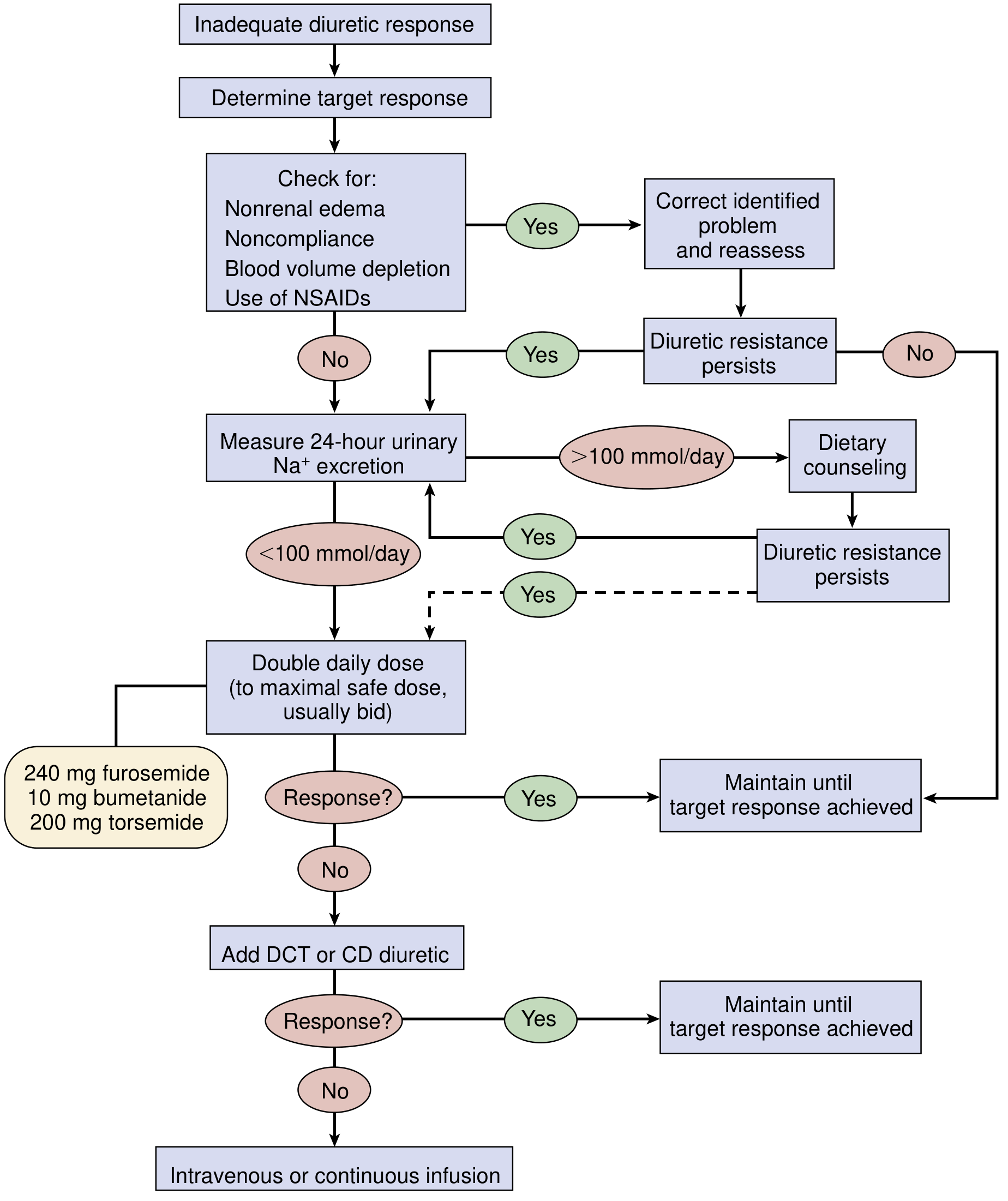
A practical early check: if 24-hour urinary Na+ > 100 mmol/day in a patient not losing weight, the problem is dietary non-compliance, not true diuretic resistance. If < 100 mmol/day despite adequate dosing -> true resistance -> escalate.
A shortcut: measure fractional excretion of sodium (FENa) 1-2 hours after a well-absorbed diuretic. If FENa > 2% -> diuretic is working, and resistance is unlikely. - NKF Primer, 8e
Summary: The Critical Operational Differences
| Point | Cirrhosis | Nephrotic Syndrome |
|---|---|---|
| First-line agents | Spironolactone 100 + Furosemide 40 mg/day (same-ratio titration) | Loop diuretic at 2-3x normal dose |
| Max safe weight loss | 0.3-0.5 kg/day (ascites only); 1-3 kg/day (ascites + edema) | 1-2 kg/day in adults |
| Key resistance mechanism | Hyperaldosteronism + portal hypertension | Albumin binding of drug in tubular lumen + ENaC activation |
| Intensification strategy | Increase dose in spiro:furo ratio; add amiloride for gynecomastia | Sequential nephron blockade (thiazide -> amiloride -> IV -> albumin co-infusion) |
| Dangerous overshoot | Plasma volume depletion 24%; HRS risk | Hypovolemia, hypovolemic shock (especially children) |
| Ceiling / refractory definition | Spiro 400 mg + Furo 160 mg/day | No fixed ceiling - determined by FENa and clinical response |
The fundamental principle in both: effective diuresis respects the rate at which fluid can safely re-enter the vascular compartment from the third space. Intensive diuresis ignores or deliberately exceeds that rate to achieve faster decongestion - acceptable when urgently needed but requires close monitoring and defined stopping criteria.
This is a shared conversation. Sign in to Orris to start your own chat.