Now I have everything needed. Let me compile the comprehensive 10-mark answer.
Bone Morphogenetic Proteins (BMPs) in Orthopaedics
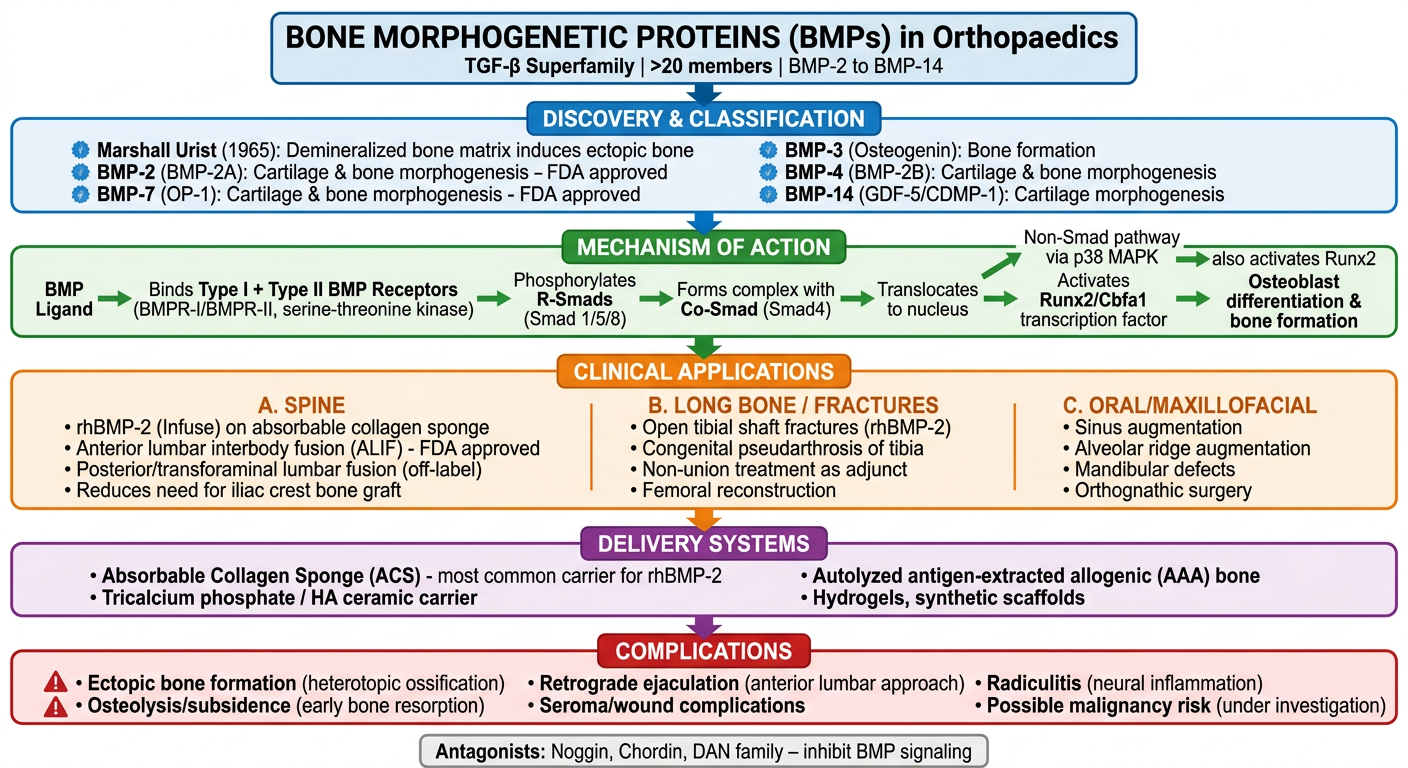
Flowchart / Visual Overview
1. Introduction & Historical Background
Bone morphogenetic proteins (BMPs) are a group of growth and differentiation factors belonging to the transforming growth factor-beta (TGF-β) superfamily. They were first identified in 1965 by Marshall Urist, who observed that demineralized bone matrix implanted in ectopic (non-bony) sites induced new bone and cartilage formation - a phenomenon he termed osteoinduction. The active molecules responsible were subsequently isolated and termed "bone morphogenetic proteins."
More than 20 structurally related BMPs have since been identified (BMP-2 through BMP-14 and beyond). They are not only responsible for embryonic skeletal development but also play a key role in adult fracture healing by recapitulating the cellular cascade of embryonic bone formation.
Rheumatology (Elsevier 2022), p. 58
2. Classification of BMPs (BMP Superfamily)
| BMP | Other Names | Primary Function |
|---|
| BMP-2 | BMP-2A | Cartilage and bone morphogenesis |
| BMP-3 | Osteogenin, GDF-10 | Bone formation |
| BMP-4 | BMP-2B | Cartilage and bone morphogenesis |
| BMP-5 | - | Bone morphogenesis |
| BMP-6 | Vegetal-related-1 (Vgr-1) | Cartilage hypertrophy |
| BMP-7 | Osteogenic protein-1 (OP-1) | Cartilage and bone morphogenesis |
| BMP-8 | Osteogenic protein-2 (OP-2) | Bone morphogenesis |
| BMP-9 | GDF-2 | Cartilage morphogenesis |
| BMP-12 | GDF-7, CDMP-3 | Cartilage morphogenesis |
| BMP-14 | GDF-5, CDMP-1 | Cartilage morphogenesis |
Firestein & Kelley's Textbook of Rheumatology, BMP Superfamily Table
The clinically most relevant BMPs in orthopaedics are BMP-2 and BMP-7 (OP-1), both of which are FDA-approved as recombinant human proteins (rhBMPs).
3. Mechanism of Action
BMPs exert their osteoinductive effects through a well-characterized signal transduction cascade:
BMP Ligand (dimer)
        ↓
Binds Type II BMP Receptors (BMPR-II)
        ↓
Recruits & phosphorylates Type I BMP Receptors (BMPR-I / ALK-2, -3, -6)
        ↓ [serine-threonine kinase activation]
Phosphorylates R-Smads (Smad 1 / 5 / 8)
        ↓
Forms complex with Co-Smad (Smad4)
        ↓
Smad1/5/8 - Smad4 complex translocates to nucleus
        ↓
Activates Runx2 (Cbfa1) / Osterix transcription factors
        ↓
↑ Osteoblast differentiation, ↑ Chondrogenesis, ↑ Osteoclastogenesis
        ↓
New bone and cartilage formation
Non-canonical (Smad-independent) pathway: BMPs also signal through the p38 MAPK pathway, which converges on Runx2 to additionally promote osteoblast differentiation.
Negative regulation: Inhibitory Smads (Smad6, Smad7) prevent R-Smad phosphorylation. Extracellular antagonists - Noggin, Chordin, and DAN family proteins - bind BMP ligands and block receptor interaction.
Key downstream effects:
- Directs mesenchymal stem cells (MSCs) away from myoblastic lineage toward the osteoblastic lineage
- Stimulates MSC differentiation into osteoblasts and chondrocytes
- Coordinates osteoblastogenesis with osteoclastogenesis
Rheumatology (Elsevier 2022), p. 58; BMP/Smad signaling review, Frontiers in Molecular Biosciences 2021
Relevance of fibrodysplasia ossificans progressiva (FOP): A recurrent gain-of-function mutation in activin receptor IA/ALK-2 (a BMP type I receptor) causes massive ectopic ossification in FOP, powerfully illustrating the osteogenic potency of the BMP pathway.
4. Recombinant Human BMPs (rhBMPs) - FDA Approved Products
| Product | BMP Type | Commercial Name | Carrier | FDA-Approved Indication |
|---|
| rhBMP-2 | BMP-2 | INFUSE Bone Graft | Absorbable Collagen Sponge (ACS) | ALIF (L4-S1), open tibial shaft fractures, sinus/alveolar augmentation |
| rhBMP-7 | BMP-7 (OP-1) | OP-1 Putty / OP-1 Implant | Carboxymethyl cellulose putty | Long bone nonunion (HDE device, no longer marketed in US) |
- rhBMP-2 causes more ectopic bone formation than other BMPs and is widely used off-label
- BMP-7 also has emerging use in chronic kidney disease (CKD) reversal of glomerulosclerosis
5. Clinical Applications in Orthopaedics
A. Spinal Fusion
- ALIF (Anterior Lumbar Interbody Fusion): rhBMP-2 on absorbable collagen sponge within an interbody cage is FDA-approved for L4-S1 level - replaces iliac crest bone graft (ICBG), eliminating donor site morbidity
- Posterolateral/PLIF/TLIF fusion: Extensively used off-label; rhBMP-2 putty with pedicle screw-rod constructs
- Significantly reduces pseudarthrosis rates in instrumented fusions
B. Long Bone Fractures & Nonunion
- Open tibial shaft fractures (Grade IIIA/IIIB): FDA-approved use of rhBMP-2 (INFUSE) to augment intramedullary nail fixation - reduces infection rates and secondary interventions
- Congenital pseudarthrosis of the tibia: Campbell's documents successful use of rhBMP with intramedullary fixation and bone grafting as adjunct treatment, with favorable early union rates
- Femoral reconstruction: Used in defect reconstruction alongside autograft
C. Maxillofacial / Oral Surgery
- Sinus floor augmentation, alveolar ridge reconstruction for implant placement
- Mandibular defects after trauma or tumor resection
- rhBMP-7 used in latissimus dorsi muscle pouch as free bone-muscle flap for jaw reconstruction
D. Other (Limited Evidence)
- Adjunct to distraction osteogenesis (Ilizarov procedure)
- Osteonecrosis of femoral head (early stages, as adjunct)
- Acetabular/femoral bone defect restoration in arthroplasty revision
Campbell's Operative Orthopaedics 15th Ed 2026, p. 1331-1332
6. Delivery Systems (Carriers)
The carrier is critical - BMP alone cannot stay at the target site long enough to be effective.
| Carrier | Notes |
|---|
| Absorbable Collagen Sponge (ACS) | Most common; used with rhBMP-2 (INFUSE); degrades over 2-4 weeks |
| Tricalcium phosphate / Hydroxyapatite | Osteoconductive scaffold; longer retention |
| Autolyzed antigen-extracted allogenic (AAA) bone | Historical; Urist's original carrier |
| Carboxymethyl cellulose putty | rhBMP-7 (OP-1 Putty) |
| Hydrogels | Controlled release; under investigation |
| Synthetic bone substitutes | Combined with rhBMP for enhanced scaffold |
7. Complications and Adverse Effects
BMP use carries specific risks, particularly at higher off-label doses:
| Complication | Mechanism / Notes |
|---|
| Ectopic / heterotopic ossification | Uncontrolled osteoinduction at non-target sites |
| Early osteolysis / subsidence | Paradoxical early bone resorption before new formation begins |
| Retrograde ejaculation | Anterior lumbar approach - sympathetic chain disruption (up to 5-8% in ALIF) |
| Seroma / wound complications | Fluid accumulation around collagen sponge |
| Radiculitis / neural inflammation | Nerve root edema from ectopic bone or inflammatory reaction |
| Soft tissue swelling / dysphagia | Cervical spine off-label use - can be life-threatening |
| Malignancy risk | Under investigation; some concern with high doses |
myhealthtoolkit.com/medicalpolicy; Wikipedia BMP article; Frontiers in Bioengineering 2022
8. BMP Antagonists
Extracellular antagonists modulate BMP activity and are of therapeutic interest:
- Noggin - binds BMP-2, -4, -7; potent inhibitor
- Chordin - binds BMP-4; inhibition reversed by BMP-1 (tolloid)
- DAN / Cerberus family - multifunctional antagonists
- Gremlin - implicated in diabetic nephropathy
- I-Smads (Smad6, Smad7) at the intracellular level
These antagonists have been proposed as therapeutic targets to enhance fracture healing by removing endogenous inhibition of BMP signaling.
9. Current Status and Future Directions
- Combining rhBMP with autologous bone graft, hydroxyapatite, or hydrogels achieves better outcomes than BMP alone
- Gene therapy approaches - BMP-2 gene delivery via adenoviral vectors in animal models shows promise
- BMP-6 (OSTEOGROW device) is a novel carrier-based system under clinical investigation in Europe
- Tissue engineering constructs incorporating BMPs on 3D-printed scaffolds are a major research area
- Off-label use is widespread but must be weighed against documented complications, especially in cervical spine and pediatric populations
10. Key Points Summary (Memory Aid - "BMPUSD")
| Letter | Key Concept |
|---|
| B | Belongs to TGF-β superfamily; >20 members |
| M | Mechanism via BMPR → Smad1/5/8 → Runx2 → Osteoblasts |
| P | Products: rhBMP-2 (Infuse) and rhBMP-7 (OP-1) FDA approved |
| U | Urist (1965) - discoverer; ectopic osteoinduction |
| S | Spine fusion (ALIF) + Shaft fractures (open tibia) = primary uses |
| D | Delivery via absorbable collagen sponge; Dangers = ectopic bone, osteolysis |
References:
- Campbell's Operative Orthopaedics, 15th Ed (2026), p. 1331-1332 - BMP in congenital pseudarthrosis of tibia
- Firestein & Kelley's Textbook of Rheumatology - BMP Superfamily classification table
- Rheumatology, 2-Volume Set (Elsevier 2022), p. 58 - BMP signaling, Smad pathway, fibrodysplasia ossificans progressiva
- Frontiers in Bioengineering (2022) - Application of BMP in bone tissue engineering
- Bone Morphogenetic Proteins in Fracture Repair, International Orthopaedics (2018) - BMP in fracture healing cascade
- Smad-dependent TGF-β and BMP signaling, Frontiers in Molecular Biosciences (2021) - Smad pathway in bone remodeling