
Physiotherapy management for varicose veins 10 marks answer
varicose veins compression stockings physiotherapy management
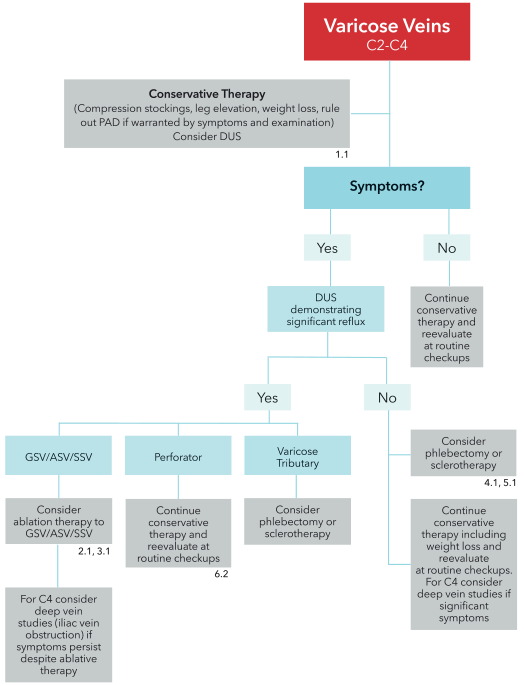
Summary : This flowchart outlines the clinical management pathway for patients with varicose veins (C2–C4), detailing decision points based on symptoms, diagnostic findings, and recommended therapies. flowchart: # Nodes : • Varicose Veins C2–C4 (rectangle, red) • Conservative Therapy (rectangle, grey): "Compression stockings, leg elevation, weight loss, rule out PAD if warranted by symptoms and examination. Consider DUS." • Symptoms? (rectangle, blue) • Yes (branch) • No (branch) • DUS demonstrating significant reflux (rectangle, blue) • Continue conservative therapy and reevaluate at routine checkups (rectangle, grey) • GSV/ASV/SSV (rectangle, blue) • Perforator (rectangle, blue) • Varicose Tributary (rectangle, blue) • Consider ablation therapy to GSV/ASV/SSV (rectangle, grey) • For C4 consider deep vein studies (iliac vein obstruction) if symptoms persist despite ablative therapy (rectangle, grey) • Continue conservative therapy and reevaluate at routine checkups (rectangle, grey) • Consider phlebectomy or sclerotherapy (rectangle, grey) • Consider phlebectomy or sclerotherapy (rectangle, grey) • Continue conservative therapy including weight loss and reevaluate at routine checkups. For C4 consider deep vein studies if significant symptoms (rectangle, grey) # Connectors : • Main flow starts at "Varicose Veins C2–C4" → "Conservative Therapy" • "Conservative Therapy" → "Symptoms?" • "Symptoms?" branches to "Yes" and "No" • "No" → "Continue conservative therapy and reevaluate at routine checkups" • "Yes" → "DUS demonstrating significant reflux" • "DUS demonstrating significant reflux" branches to "GSV/ASV/SSV", "Perforator", and "Varicose Tributary" • "GSV/ASV/SSV" → "Consider ablation therapy to GSV/ASV/SSV" → "For C4 consider deep vein studies..." • "Perforator" → "Continue conservative therapy and reevaluate at routine checkups" • "Varicose Tributary" → "Consider phlebectomy or sclerotherapy" • "DUS demonstrating significant reflux" (No branch) → "Consider phlebectomy or sclerotherapy" and "Continue conservative therapy including weight loss and reevaluate at routine checkups..." # Layout : • Top-down hierarchical structure. • Initial node at top, followed by therapy, then a decision diamond for symptoms. • Branches split left (Yes) and right (No), with further subdivisions for diagnostic findings and therapy options. • Grey boxes indicate therapy recommendations; blue boxes indicate decision or diagnostic steps. • Some nodes reference guideline numbers (e.g., 1.1, 2.1, 3.1, 4.1, 5.1, 6.2). # Analysis : • The flowchart provides a clear, stepwise approach for managing varicose veins, emphasizing conservative therapy as the initial step. • Symptom presence and DUS findings guide further intervention, with ablation, phlebectomy, or sclerotherapy considered for significant reflux or tributary involvement. • Routine reevaluation and consideration of deep vein studies for persistent symptoms are highlighted, especially for C4 cases. • The structure supports evidence-based, individualized patient care, with decision points based on clinical findings and response to therapy.
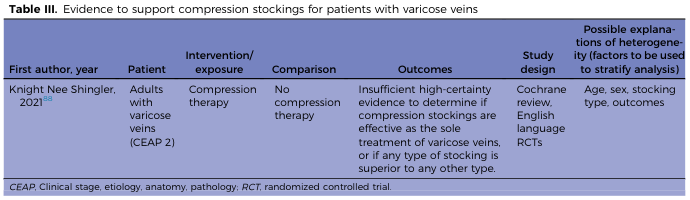
Table III. Evidence to support compression stockings for patients with varicose veins <table><thead><tr><th>First author, year</th><th>Patient</th><th>Intervention/exposure</th><th>Comparison</th><th>Outcomes</th><th>Study design</th><th>Possible explanations of heterogeneity (factors to be used to stratify analysis)</th></tr></thead><tbody><tr><td>Knight Nee Shingler, 2021<sup>88</sup></td><td>Adults with varicose veins (CEAP 2)</td><td>Compression therapy</td><td>No compression therapy</td><td>Insufficient high-certainty evidence to determine if compression stockings are effective as the sole treatment of varicose veins, or if any type of stocking is superior to any other type.</td><td>Cochrane review, English language RCTs</td><td>Age, sex, stocking type, outcomes</td></tr></tbody></table> CEAP, Clinical stage, etiology, anatomy, pathology; RCT, randomized controlled trial.
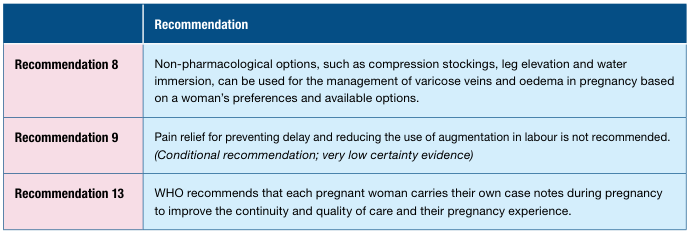
<table><thead><tr><th>Recommendation</th></tr></thead><tbody><tr><td>Recommendation 8</td><td>Non-pharmacological options, such as compression stockings, leg elevation and water immersion, can be used for the management of varicose veins and oedema in pregnancy based on a woman's preferences and available options.</td></tr><tr><td>Recommendation 9</td><td>Pain relief for preventing delay and reducing the use of augmentation in labour is not recommended. (Conditional recommendation; very low certainty evidence)</td></tr><tr><td>Recommendation 13</td><td>WHO recommends that each pregnant woman carries their own case notes during pregnancy to improve the continuity and quality of care and their pregnancy experience.</td></tr></tbody></table>
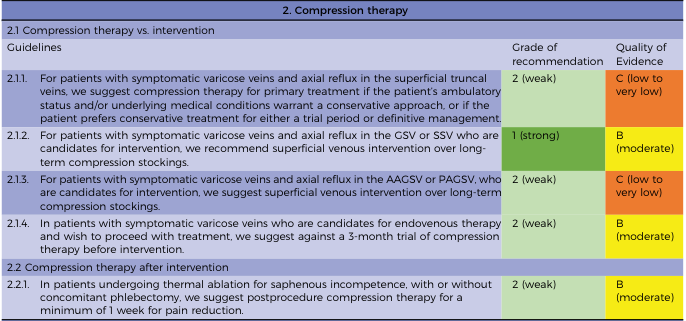
<table><thead><tr><th colspan="3">2. Compression therapy</th></tr><tr><th colspan="3">2.1 Compression therapy vs. intervention</th></tr><tr><th>Guidelines</th><th>Grade of recommendation</th><th>Quality of Evidence</th></tr></thead><tbody><tr><td>2.1.1.</td><td>For patients with symptomatic varicose veins and axial reflux in the superficial truncal veins, we suggest compression therapy for primary treatment if the patient's ambulatory status and/or underlying medical conditions warrant a conservative approach, or if the patient prefers conservative treatment for either a trial period or definitive management.</td><td>2 (weak)</td><td>C (low to very low)</td></tr><tr><td>2.1.2.</td><td>For patients with symptomatic varicose veins and axial reflux in the GSV or SSV who are candidates for intervention, we recommend superficial venous intervention over long-term compression stockings.</td><td>1 (strong)</td><td>B (moderate)</td></tr><tr><td>2.1.3.</td><td>For patients with symptomatic varicose veins and axial reflux in the AAGSV or PAGSV, who are candidates for intervention, we suggest superficial venous intervention over long-term compression stockings.</td><td>2 (weak)</td><td>C (low to very low)</td></tr><tr><td>2.1.4.</td><td>In patients with symptomatic varicose veins who are candidates for endovenous therapy and wish to proceed with treatment, we suggest against a 3-month trial of compression therapy before intervention.</td><td>2 (weak)</td><td>B (moderate)</td></tr><tr><td colspan="3">2.2 Compression therapy after intervention</td></tr><tr><td>2.2.1.</td><td>In patients undergoing thermal ablation for saphenous incompetence, with or without concomitant phlebectomy, we suggest postprocedure compression therapy for a minimum of 1 week for pain reduction.</td><td>2 (weak)</td><td>B (moderate)</td></tr></tbody></table>
Physiotherapy Management of Varicose Veins
Introduction
1. Patient Education and Lifestyle Modification
- Avoid prolonged standing or sitting - these positions increase hydrostatic venous pressure and worsen venous pooling.
- Frequent leg elevation - elevation of the legs above the level of the heart periodically throughout the day and during sleep (elevating the foot of the bed 4-6 inches above the heart) facilitates venous drainage by gravity and reduces oedema.
- Weight reduction - overweight and obese patients should be advised to lose weight, as excess body weight increases intra-abdominal pressure and worsens venous hypertension.
- Avoid constrictive clothing - tight garments around the groin or thigh can obstruct venous return.
2. Compression Therapy
Types of Compression
- Maintains relatively constant pressure both at rest and during exercise.
- 20-30 mmHg graduated compression stockings are suitable for most patients with simple varicose veins (CEAP class C2).
- 30-40 mmHg stockings are used for advanced CVI with oedema, skin changes, or venous ulcers (CEAP C3-C6) - this grade is more effective for healing venous ulcers.
- Length: Calf-length stockings are better tolerated by most patients; thigh-length or panty hose are used when varicosities extend to the thigh.
- Graduated compression means maximum pressure at the ankle, decreasing proximally.
- e.g., Unna's paste boot, four-layer bandage, short-stretch bandages, Velcro band devices.
- Demonstrate a more dramatic pressure increase during exercise (since they don't stretch) and lower pressure at rest.
- Better tolerated overnight.
- Preferred during the active treatment/ulcer healing phase of CVI.
- Inelastic compression results in greater improvement in venous haemodynamics compared to elastic compression at the same pressure.
- Multi-component compression is preferred over single-component compression for healing venous ulcers.
- High compression is more effective than medium compression for ulcer healing.
- Once the ulcer heals, the patient transitions to elastic compression stockings for the maintenance phase.
- Elastic stockings = maintenance phase (keep stable condition)
- Inelastic/multilayer wraps = therapy/healing phase (active ulcer treatment)
3. Exercise and Physical Activity
- Walking is the most beneficial activity - it activates the calf muscle pump, which is the main driver of venous return from the lower limbs.
- Leg muscle strengthening exercises - particularly gastrocnemius and soleus strengthening (e.g., ankle pumping, heel-raises) improve calf muscle pump efficiency.
- Exercise training has been shown to improve antegrade venous flow and reduce the severity of chronic venous insufficiency.
- Aquatic exercises / hydrotherapy - water provides natural external compression and reduces venous stasis.
- Ankle exercises (dorsiflexion-plantarflexion pumping) are especially useful for bedridden or sedentary patients to maintain venous return.
4. Intermittent Pneumatic Compression (IPC)
- IPC devices use compressive bladders that inflate and deflate cyclically to provide pulsatile emptying of the venous system.
- Recommended when standard compression therapy has failed, is unavailable, or cannot be tolerated.
- Evidence shows benefit over no compression but limited evidence that it adds benefit over compression therapy alone.
- Useful in immobile patients who cannot perform active exercises.
5. Wound Care for Venous Ulcers
- Wound dressings: Low-adherent absorbent dressings maintain a moist wound environment and absorb exudates.
- Hydrocolloid dressings - polymers like carboxymethylcellulose that absorb exudates as a gel.
- Hydrogel - moisturises dry wounds.
- Foam dressings - absorbent polyurethane-based.
- Alginate dressings - biodegradable, seaweed-derived, for highly exuding wounds.
- Debridement - necrotic tissue is removed to promote healing. Physiotherapists may use sharp, enzymatic, or autolytic debridement depending on scope.
- The compression bandage or stocking is applied over the wound dressing.
6. Cautions and Contraindications in Compression Therapy
- Peripheral arterial disease (PAD): Compression must be used cautiously if ankle-brachial index (ABI) is < 0.8.
- ABI 0.5-0.8: Modified, lower-pressure compression may be used with caution.
- ABI ≤ 0.5 or ankle pressure < 60 mmHg: Compression is contraindicated.
- Uncontrolled cardiac failure (compression may worsen fluid overload).
- Skin infections / acute dermatitis (need treatment first before applying compression).
7. Role of Physiotherapy in Post-Operative/Post-Intervention Rehabilitation
- Early mobilisation - encouraged to prevent deep vein thrombosis (DVT) and restore function.
- Post-procedure compression - after thermal ablation, compression for a minimum of 1 week reduces pain and swelling.
- Ankle and calf exercises - continued to optimise venous return during healing.
- Gradual return to activity - progressive increase in walking and activity under physiotherapy guidance.
8. CEAP Classification and Physiotherapy Goal-Setting
| CEAP Class | Clinical Features | Physiotherapy Focus |
|---|---|---|
| C2 | Varicose veins | Compression 20-30 mmHg, exercise, education |
| C3 | Oedema | Compression 30-40 mmHg, limb elevation, IPC |
| C4 | Skin changes (lipodermatosclerosis, eczema) | High-grade compression, skin care |
| C5 | Healed venous ulcer | Compression for prevention of recurrence |
| C6 | Active venous ulcer | Multilayer compression + wound care + IPC |
Summary
- Graduated compression therapy (elastic stockings or multilayer bandages tailored to disease severity)
- Leg elevation and avoidance of prolonged dependency
- Calf muscle pump exercises and walking
- Intermittent pneumatic compression for advanced or refractory cases
- Wound management for venous ulcers
- Patient education and lifestyle modification (weight loss, activity)
- Harrison's Principles of Internal Medicine 22E, Treatment of Chronic Venous Disease, pp. 938-942
- Mulholland and Greenfield's Surgery 7e, Medical Therapy and Treatment Options, pp. 853-887