
Tissue ,type, example
The four main tissue types in the human body:
| Tissue Type | Subtypes/Description | Examples |
|---|---|---|
| Epithelial | Lines surfaces, cavities, and organs; forms glands | Skin (epidermis), lining of stomach, intestines, lungs, kidney tubules, salivary glands |
| Connective | Supports, binds, and protects other tissues; contains cells in an extracellular matrix | Bone, cartilage, blood, adipose (fat), tendons, ligaments, loose connective tissue |
| Muscle | Contractile tissue for movement | Skeletal muscle (biceps), cardiac muscle (heart wall), smooth muscle (gut wall, blood vessels) |
| Nervous | Transmits electrical signals; processes information | Brain, spinal cord, peripheral nerves, retina of the eye |
Quick notes:
- Epithelial tissue is further classified by cell shape (squamous, cuboidal, columnar) and layers (simple vs. stratified).
- Connective tissue is the most diverse type - ranges from liquid (blood) to solid (bone).
- Muscle tissue has three distinct subtypes: skeletal (voluntary), cardiac (involuntary, striated), and smooth (involuntary, non-striated).
- Nervous tissue is made of neurons (signal-conducting) and glial cells (support).
/ human
Here is a focused breakdown of the 4 human tissue types with types and examples:
1. Epithelial Tissue
| Type | Example Location |
|---|---|
| Simple squamous | Alveoli (lungs), blood vessel walls |
| Simple cuboidal | Kidney tubules, thyroid follicles |
| Simple columnar | Small intestine lining, stomach |
| Stratified squamous | Skin (epidermis), mouth, esophagus |
| Pseudostratified columnar | Trachea, bronchi |
| Transitional | Urinary bladder |
2. Connective Tissue
| Type | Example Location |
|---|---|
| Loose (areolar) | Under skin, around organs |
| Dense regular | Tendons, ligaments |
| Dense irregular | Dermis of skin |
| Adipose (fat) | Subcutaneous fat, around kidneys |
| Cartilage (hyaline) | Nose tip, trachea rings, articular surfaces |
| Cartilage (fibro) | Intervertebral discs, pubic symphysis |
| Cartilage (elastic) | Ear pinna, epiglottis |
| Bone (osseous) | Femur, skull, ribs |
| Blood | Circulating in blood vessels |
| Lymph | Lymph nodes, lymphatic vessels |
3. Muscle Tissue
| Type | Example Location |
|---|---|
| Skeletal | Biceps, quadriceps, diaphragm |
| Cardiac | Heart wall (myocardium) |
| Smooth | Stomach wall, intestines, blood vessels, uterus |
4. Nervous Tissue
| Type | Example Location |
|---|---|
| Neurons | Brain, spinal cord, peripheral nerves |
| Astrocytes (glial) | Brain (support, blood-brain barrier) |
| Schwann cells | Peripheral nerve myelin sheath |
| Oligodendrocytes | CNS myelin sheath |
| Microglia | Brain (immune defense) |
Memory tip: Every Cell Makes Noise - Epithelial, Connective, Muscle, Nervous.
Search for histology images of each tissue type
Searching the Web
histology microscopy images epithelial connective muscle nervous tissue
Finding Sources
Loading Image
Searching the Web
histology epithelial tissue microscope slide image site:histologyguide.com OR site:wikimedia.org
Loading Image
Loading Image
Now let me fetch more detailed histology images for each individual tissue type:
Searching the Web
simple columnar epithelium histology H&E stain microscope slide wikimedia commons
Searching the Web
skeletal muscle cardiac smooth muscle nervous tissue histology microscope slide H&E stain
Loading Image
Loading Image
Loading Image
Loading Image
Loading Image
Here are the histology images found for each tissue type:
Histology of Human Tissue Types
Overview - All Four Tissue Types

1. Epithelial Tissue
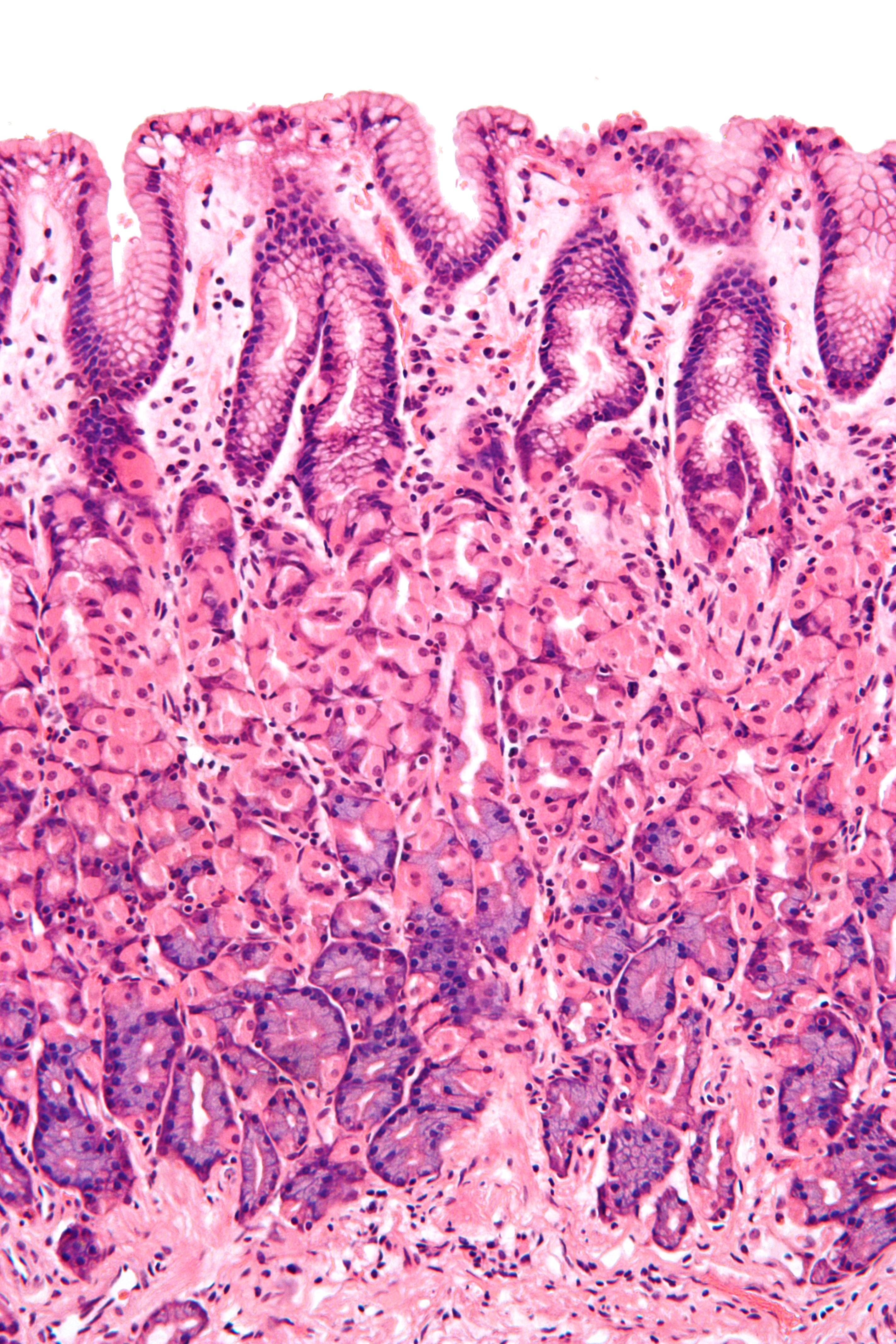
2. Muscle Tissue (All 3 subtypes - H&E stain)

(a) Skeletal muscle - Long parallel fibers, multiple peripheral nuclei, visible striations (alternating dark/light bands)
(b) Cardiac muscle - Branching fibers, single central nucleus, striations, and characteristic intercalated discs between cells
(c) Smooth muscle - Spindle-shaped cells, single central nucleus, no striations
3. Cardiac Muscle Histology (Whole slide)

4. Illustrated Cell Types Reference

Key Histological Features to Identify:
| Tissue | Key Features Under Microscope |
|---|---|
| Epithelial | Cells tightly packed, no gaps, sit on basement membrane, free surface visible |
| Connective | Cells scattered in extracellular matrix (ECM), fibers visible (collagen/elastic) |
| Skeletal Muscle | Long fibers, striations, multiple peripheral nuclei |
| Cardiac Muscle | Branching fibers, striations, intercalated discs, central nucleus |
| Smooth Muscle | Spindle cells, no striations, central nucleus |
| Nervous | Large cell bodies (soma), long processes (axons/dendrites), glial cells around |
For interactive virtual slides, Histology Guide (histologyguide.com) has free high-resolution microscope slide images for every tissue type.
This is a shared conversation. Sign in to Orris to start your own chat.