
Dna recycling
Reading File
Searching the Web
DNA recycling biology mechanisms nucleotide salvage pathway
Finding Sources
Finding Sources
Finding Sources
Reading File
Finding Sources
Reading File
Reading File
Loading Image
DNA Recycling: The Nucleotide Salvage Pathway
"DNA recycling" in biochemistry refers to the nucleotide salvage pathway - the set of reactions by which cells recover and reuse purine and pyrimidine bases that are released during the normal turnover (degradation) of DNA and RNA, rather than synthesizing them from scratch.
Why Salvage Exists
There are two routes to making nucleotides:
- De novo synthesis - building purines/pyrimidines from small non-nucleotide precursors (amino acids, CO2, etc.). Metabolically expensive.
- Salvage pathway - recycling pre-formed bases or nucleosides from degraded nucleic acids or dietary sources. Far more energy-efficient.
The body runs both, but salvage is the preferred route when substrates are available. The brain is especially dependent on purine salvage.
Purine Salvage (the most important)
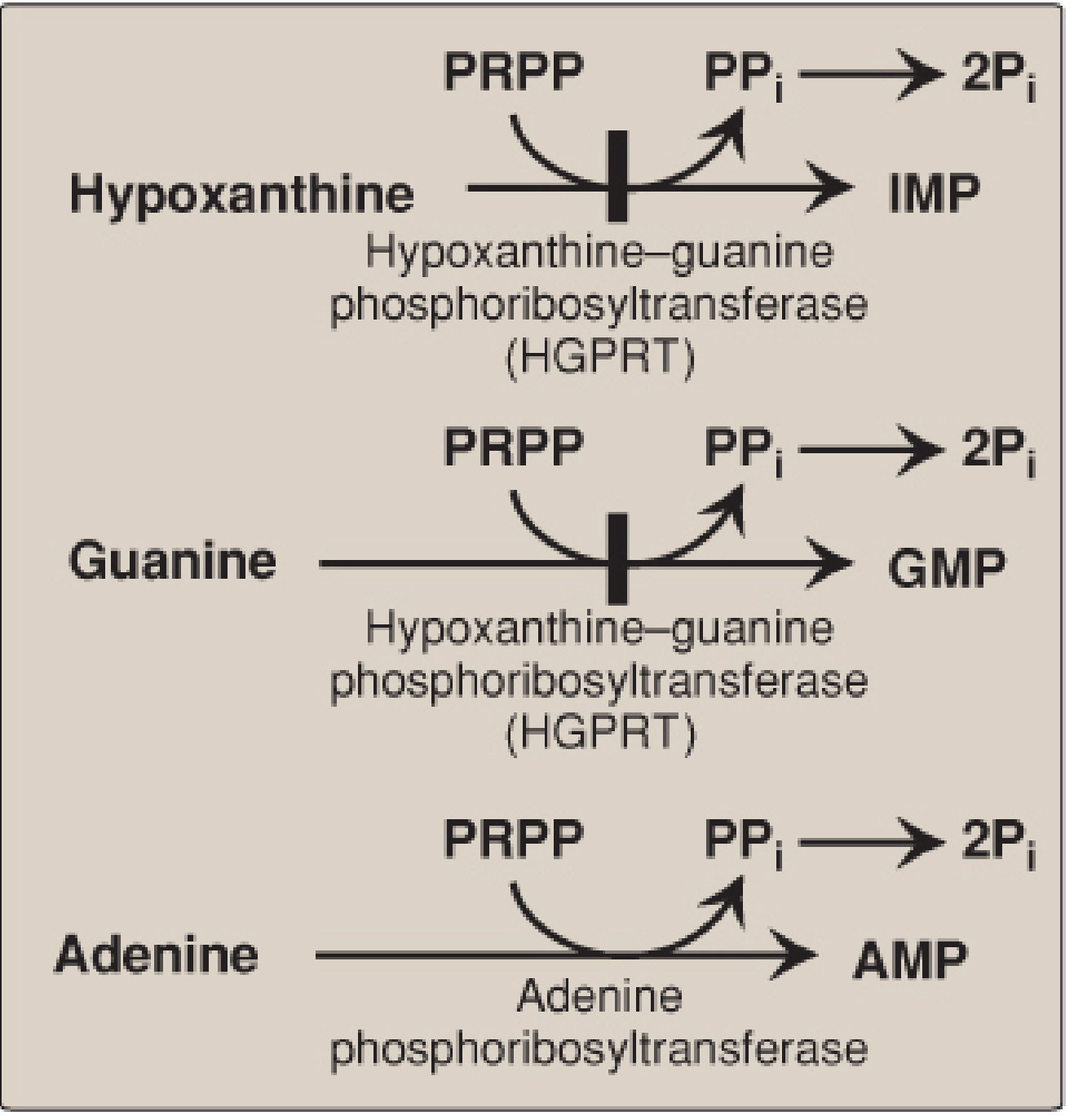
When DNA/RNA is degraded, purine rings are not cleaved (unlike pyrimidines). The free bases - hypoxanthine, guanine, and adenine - are recovered by two key enzymes:
| Enzyme | Substrates | Products |
|---|---|---|
| HGPRT (hypoxanthine-guanine phosphoribosyltransferase) | Hypoxanthine + PRPP | IMP + PPi |
| HGPRT | Guanine + PRPP | GMP + PPi |
| APRT (adenine phosphoribosyltransferase) | Adenine + PRPP | AMP + PPi |
Both enzymes attach the free base to PRPP (5-phosphoribosyl-1-pyrophosphate), converting it back to a nucleotide monophosphate. The released pyrophosphate (PPi) is hydrolyzed to 2 Pi, making the reactions irreversible. Adenosine (the nucleoside) can also be salvaged directly via adenosine kinase.
Pyrimidine Salvage (less critical)
Unlike purines, pyrimidine rings are opened during degradation, producing highly soluble end products:
- CMP/UMP → β-alanine + NH3 + CO2
- TMP → β-aminoisobutyrate + NH3 + CO2
Pyrimidine bases can be salvaged back to nucleosides, which are phosphorylated to nucleotides - but because the degradation products are so water-soluble and easily excreted, pyrimidine salvage is less clinically significant than purine salvage.
Clinical Relevance
Lesch-Nyhan Syndrome (HGPRT deficiency)
A near-total deficiency of HGPRT cripples purine salvage. The consequences cascade:
- Hypoxanthine and guanine cannot be recycled → both are degraded to uric acid instead
- PRPP accumulates (it can't be consumed by salvage)
- Decreased IMP/GMP means less feedback inhibition on de novo synthesis
- De novo purine synthesis accelerates, producing even more purines destined for uric acid
Result: Severe hyperuricemia, gout, urolithiasis, motor dysfunction, intellectual disability, and compulsive self-mutilation.
Adenosine Deaminase (ADA) Deficiency
ADA converts adenosine → inosine. ADA deficiency leads to toxic accumulation of dATP in lymphocytes, which strongly inhibits ribonucleotide reductase (blocking all dNTP synthesis) - causing SCID (Severe Combined Immunodeficiency).
Drug Targets
Salvage-deficient cells die if deprived of de novo synthesis. This is the basis for:
- 6-Mercaptopurine / 6-Thioguanine - antimetabolites incorporated via HGPRT into nucleotide pools, poisoning rapidly dividing cancer cells
- HAT selection (used in hybridoma technology for monoclonal antibody production) - myeloma cells lack HGPRT, so they die in hypoxanthine-aminopterin-thymidine media that blocks de novo synthesis
Summary Table
| Feature | Purine Salvage | Pyrimidine Salvage |
|---|---|---|
| Key enzymes | HGPRT, APRT | Uridine/thymidine kinases |
| Cofactor | PRPP | PRPP |
| Clinical importance | High (Lesch-Nyhan, gout) | Lower |
| Degradation products | Uric acid (insoluble) | β-alanine (soluble) |
| Tissue emphasis | Brain most dependent | - |
- Biochemistry, 8th ed. Lippincott Illustrated Reviews, pp. 833-835, 854
This is a shared conversation. Sign in to Orris to start your own chat.