
What is METS? What are the recent guidelines for assessment of functional capacity in a patient with coronary stents in-situ and what is the relevant role of cardiac biomarkers in this patient? [2+4+4]
Reading File
Now I'll run parallel searches across the library and PubMed for all three parts of this question.
Finding Sources
Finding Sources
Finding Sources
Searching PubMed
functional capacity assessment preoperative cardiac risk coronary stent
Good - I have strong leads. Now let me read the key sections from Sabiston and Miller's Anesthesia in parallel, plus search for more on biomarkers and coronary stents perioperatively.
Reading File
Reading File
Finding Sources
Finding Sources
Excellent data. Now let me read the key stent section and biomarker section from Miller's and Fuster's:
Reading File
Reading File
Finding Sources
Now let me get the key Miller's Anesthesia section on functional capacity assessment and coronary stents, plus fetch the MET figure:
Reading File
Finding Sources
Loading Image
I now have comprehensive material from multiple authoritative sources. Let me also quickly check the Miller's section on coronary stents and get the DASI/MET-REPAIR table data:
Reading File
Reading File
I now have all the material needed for a thorough, structured answer. Let me compose the full response.
METS, Functional Capacity Assessment in Coronary Stent Patients, and Cardiac Biomarkers
Part 1: What is METS? [2 marks]
MET (Metabolic Equivalent of Task) is a unit that expresses the energy cost of a physical activity as a multiple of the resting metabolic rate. One MET is defined as the resting oxygen consumption of a seated individual - approximately 3.5 mL O₂/kg/min (or ~1.2 kcal/min for a 70 kg person).
"One MET is defined as resting metabolic rate in a sitting position, representing the amount of oxygen consumed at rest (approximately 3.5 mL O₂/kg/min or 1.2 kcal/min for a 70-kg person)."
- Sabiston Textbook of Surgery
The METS (Measurement of Exercise Tolerance before Surgery) is a related validated tool used alongside the DASI (Duke Activity Status Index) for preoperative functional capacity scoring. METs can also be estimated using DASI scores: VO₂ peak (mL/min) = (0.43 × DASI) + 9.6, then METs = VO₂ peak × 0.286.
Clinical significance of MET thresholds:
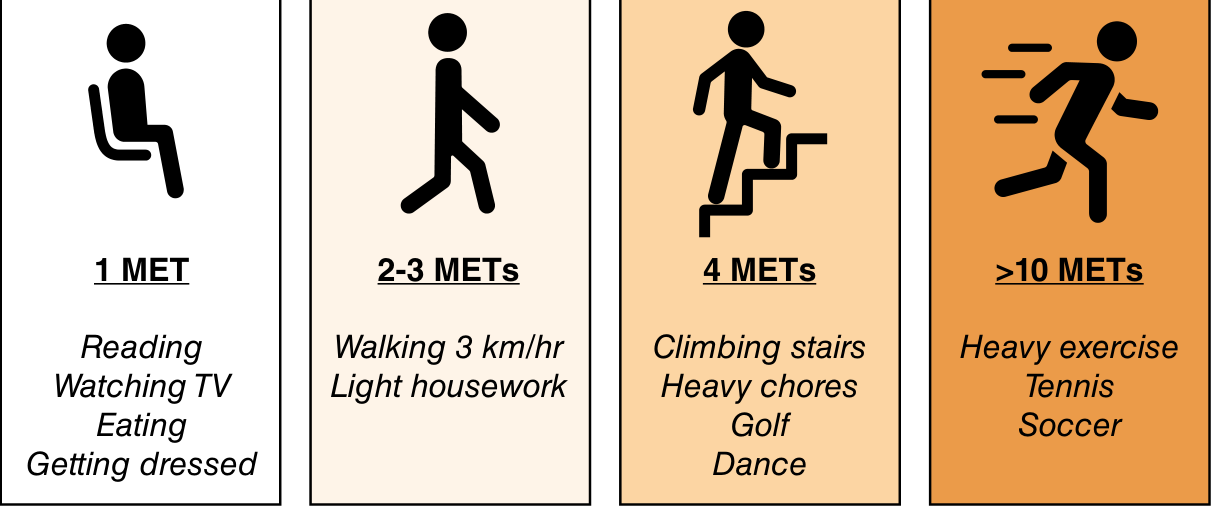
Figure: MET values for common activities (Sabiston Textbook of Surgery)
| MET Level | Activities | Clinical Significance |
|---|---|---|
| 1 MET | Eating, reading, watching TV, dressing | Resting baseline |
| 2-3 METs | Walking slowly, light housework | Poor functional capacity |
| 4 METs | Climbing stairs, heavy chores, golf | The key clinical threshold |
| >10 METs | Heavy exercise, tennis, soccer | Excellent capacity |
The 4-MET threshold is the critical perioperative cutoff: patients unable to achieve >4 METs are considered to have poor functional status and are at increased risk for perioperative morbidity and mortality. A meta-analysis showed that each additional MET correlates with a 13% decrease in all-cause mortality and a 15% decrease in long-term cardiovascular disease risk.
- Sabiston Textbook of Surgery
Part 2: Recent Guidelines for Assessment of Functional Capacity in a Patient with Coronary Stents In-Situ [4 marks]
Preoperative functional capacity assessment in stent patients follows a stepwise approach, informed by the 2014 ACC/AHA guidelines and updated 2022 ESC guidelines. The key concern in stent patients is the intersection of functional status with the risk of stent thrombosis from perioperative hypercoagulability.
Step 1 - Determine Surgical Urgency
Emergency surgery proceeds directly, with postoperative cardiac monitoring and optimization. Non-urgent surgery triggers the full evaluation pathway.
Step 2 - Rule Out Active Cardiac Conditions
Before assessing functional capacity, exclude active cardiac conditions: acute coronary syndrome, decompensated heart failure, severe valvular disease, or significant arrhythmias. The 2014 ACC/AHA guidelines recommend deferring non-urgent surgery until 60 days after a recent myocardial infarction.
Step 3 - Timing Relative to Stent Placement (Stent-Specific Guideline)
This is unique to patients with in-situ coronary stents:
| Stent Type | Minimum Delay Before Elective Non-Cardiac Surgery |
|---|---|
| Balloon angioplasty | ≥14 days |
| Bare metal stent (BMS) | ≥30 days (ACC/AHA); ≥4 weeks (Fuster/Hurst) |
| Drug-eluting stent (DES) | ≥6 months (ideal); may consider after 90 days if surgical delay risk > stent thrombosis risk |
"The increased risk of perioperative cardiac events following PCI is related to perioperative hypercoagulability associated with surgical stress in the setting of non-endothelialized stent surfaces."
- Fuster and Hurst's The Heart, 15th Edition
Step 4 - Functional Capacity Assessment Methods
A. Subjective/Unstructured Interview (traditional, but limited):
- Simply asking patients about their activity level. Sensitivity is only 19% for identifying patients who cannot achieve ≥4 METs on formal testing. Not recommended as the sole method.
- Miller's Anesthesia, 10e
B. Structured Interview Questions (better than unstructured):
- Inability to walk 4 blocks or climb 2 flights of stairs predicts increased perioperative complications.
- Inability to climb ≥3 flights of stairs identifies patients likely unable to achieve ≥4 METs.
C. Validated Questionnaires (preferred over unstructured interview):
-
DASI (Duke Activity Status Index): 12-item validated questionnaire. Score ≤25 is associated with clinically meaningful increased risk of MI and major complications post-surgery. Optimal threshold for ≥4 METs: DASI score ≥32.
-
MET-REPAIR (MET: REvaluation for Perioperative cArdIac Risk): Validated 10-item questionnaire with activities scored 1-10 METs. Functional capacity = highest MET level the patient reports being able to perform. Threshold for ≥4 METs on MET-REPAIR: ≥6 METs self-reported.
Both questionnaires are validated against gold-standard exercise testing and outperform unstructured interviews.
- Miller's Anesthesia, 10e
D. Objective Performance-Based Tests (most accurate):
- 6-Minute Walk Test (6MWT) and Incremental Shuttle Walk Test: poor performance predicts major postoperative complications.
- Cardiopulmonary Exercise Testing (CPET): gold standard for measuring true VO₂ max in METs. Particularly useful for high-risk patients or those with ambiguous questionnaire results.
- Standard Exercise ECG (Bruce Protocol): note that extrapolation from treadmill time on Bruce protocol tends to overestimate true exercise capacity.
- Resting LVEF is NOT a proxy for functional capacity - exercise capacity varies widely among patients with similar resting LVEF.
E. Pharmacological Stress Testing:
Used when patient cannot exercise (e.g., orthopedic limitations). Dobutamine stress echo or nuclear perfusion imaging may be considered in patients with ≥3 RCRI risk factors and poor or unknown functional capacity undergoing intermediate-to-high risk surgery.
Step 5 - Clinical Decision Following Assessment
- Good functional capacity (≥4 METs): Proceed to planned surgery, continue cardiac medications perioperatively.
- Poor functional capacity (<4 METs) or unknown: Consider further cardiac evaluation, specialist consultation (cardiology), and optimization before elective surgery.
Antiplatelet Therapy Management (stent-specific)
Dual antiplatelet therapy (DAPT) must be managed carefully in stent patients:
- Continue DAPT within the first 4 weeks after BMS and 6 months after DES unless surgical bleeding risk clearly outweighs stent thrombosis risk.
- If P2Y12 inhibitor (clopidogrel, prasugrel, ticagrelor) must be stopped, continue aspirin and restart P2Y12 inhibitor as soon as possible postoperatively.
- Decision requires consensus between surgeon, anesthesiologist, and cardiologist.
- Sabiston Textbook of Surgery; Fuster and Hurst's The Heart, 15th Edition
Part 3: Relevant Role of Cardiac Biomarkers in This Patient [4 marks]
In a patient with coronary stents in-situ, cardiac biomarkers serve distinct roles at different timepoints: preoperative risk stratification, intraoperative/perioperative monitoring, and postoperative surveillance.
1. B-Type Natriuretic Peptide (BNP) and NT-proBNP
Role in preoperative risk stratification:
- BNP/NT-proBNP reflect ventricular wall stress and are prognostically useful for perioperative cardiovascular risk assessment.
- A meta-analysis of 18 studies showed that BNP ≥92 ng/L is associated with increased risk of cardiac death or non-fatal MI in non-cardiac surgery.
- AHA/ACC position: Routine BNP measurement is NOT recommended as part of standard preoperative assessment because biomarker-based management strategies have not yet been shown to reduce cardiovascular risk.
- ESC 2022 guideline position: BNP/NT-proBNP may be helpful when the decision to proceed to further preoperative cardiac testing is unclear. A low BNP/NT-proBNP indicates relatively low risk, while an elevated level warrants further workup, discussion, and shared decision-making.
- Sabiston Textbook of Surgery; Fuster and Hurst's The Heart, 15th Edition
2. Cardiac Troponin (cTn)
Role in preoperative assessment:
- AHA/ACC: Do not recommend routine preoperative troponin in asymptomatic patients. Troponin should be measured when signs or symptoms suggest myocardial ischemia or infarction.
- ESC 2022 guidelines: Recommend obtaining preoperative troponin in patients >65 years old or those with cardiac risk factors undergoing intermediate- to high-risk surgery. Elevated preoperative troponin identifies patients at higher perioperative cardiac risk.
- Sabiston Textbook of Surgery; Fuster and Hurst's The Heart, 15th Edition
Role in stent-specific context - Type 4 MI:
- Type 4a MI (PCI-related): Defined by cardiac troponin elevation above the 99th percentile upper reference limit within 48 hours post-PCI, with either new ECG changes, new LBBB, new regional wall motion abnormality, or imaging confirmation of new loss of viable myocardium. Troponin must be >5× 99th percentile URL for this diagnosis (WHO/ESC universal MI definition).
- Type 4b MI (stent thrombosis-related): Troponin elevation with documented stent thrombosis on angiography or at autopsy.
- Type 4c MI: Linked to in-stent restenosis.
- Sabiston Textbook of Surgery; Rosen's Emergency Medicine
Role in postoperative surveillance:
- Perioperative Myocardial Injury (PMI): Defined as troponin elevation within 30 days of surgery. Even asymptomatic troponin rises (>99th percentile URL) in the postoperative period carry prognostic significance.
- In stent patients specifically, postoperative troponin elevation may signal stent thrombosis, acute in-stent restenosis, or type 1 plaque rupture MI - all requiring urgent angiography.
- Monitoring troponin postoperatively (at 24 and 48 hours) is particularly important in stent patients undergoing intermediate-to-high risk surgery, per ESC 2022 recommendations.
3. Natriuretic Peptides for Heart Failure Monitoring
In stent patients who also have reduced LV function (e.g., prior large MI), BNP/NT-proBNP also serve to:
- Guide perioperative fluid management
- Identify decompensated heart failure requiring optimization before surgery
- Track response to treatment in the postoperative period
Summary Table
| Biomarker | Preoperative | Perioperative | Postoperative |
|---|---|---|---|
| BNP/NT-proBNP | Risk stratification (unclear decision); low value = reassuring | Guide fluid management | Monitor for HF decompensation |
| Troponin (cTnI/cTnT) | Routine NOT recommended (AHA/ACC); YES if >65y or cardiac risk + intermediate/high risk surgery (ESC 2022) | If symptoms of ischemia | Detect PMI, stent thrombosis, Type 4 MI |
"While the AHA/ACC guidelines recommend perioperative measurement of cardiac troponin levels whenever signs or symptoms are suggestive of myocardial ischemia or infarction, a routine screening of cardiac troponin levels in asymptomatic patients is not recommended."
- Fuster and Hurst's The Heart, 15th Edition
Sources:
- Sabiston Textbook of Surgery, pp. 88, 469 - MET definition, functional assessment, stent timing, biomarkers
- Miller's Anesthesia, 10e, pp. 3835-3877 - DASI, MET-REPAIR, ACC/AHA/ESC guideline steps
- Fuster and Hurst's The Heart, 15th Edition, pp. biomarker section, antiplatelet section
- Rosen's Emergency Medicine - Type 4 MI classification with troponin
- Maingot's Abdominal Operations - ACC/AHA cardiac risk algorithm
This is a shared conversation. Sign in to Orris to start your own chat.