
Neuromuscular blocking monitoring 10 mark answer
I'll read the medical library skill first, then research this topic thoroughly.
Searching sources...
Reading File
Now let me search the medical library and web simultaneously for comprehensive content.
Finding Sources
Finding Sources
Searching the Web
neuromuscular blockade monitoring train of four TOF clinical anesthesia 10 mark answer
Now let me pull the detailed textbook content from the most relevant sources.
Reading File
Reading File
Reading File
Searching Images
train of four neuromuscular block monitoring peripheral nerve stimulator
Let me fetch the diagram image from the textbook and read more content from Barash and Morgan & Mikhail.
Loading Image
Reading File
Reading File
Excellent - I now have comprehensive content from multiple authoritative sources. Let me also check for the Miller's Anesthesia section on monitoring modes and the clinical assessment section.
Finding Sources
Finding Sources
Reading File
I now have comprehensive textbook content. Let me compose the complete 10-mark answer.
Neuromuscular Blocking (NMB) Monitoring
Introduction
Monitoring neuromuscular blockade (NMB) is mandatory whenever neuromuscular blocking drugs (NMBDs) are administered. The primary reason is safety: no clinical test - head lift, grip strength, tidal volume - reliably excludes residual paralysis. Objective monitoring guides dosing intraoperatively and confirms adequate recovery before extubation. The 2023 ASA practice guidelines recommend quantitative monitoring as the standard of care, with a train-of-four (TOF) ratio ≥ 0.9 confirmed before extubation.
Sites of Monitoring
The most common site is the ulnar nerve at the wrist, with thumb (adductor pollicis) movement observed. Other sites include:
- Facial nerve (orbicularis oculi) - recovers first due to better vascular supply, but may overestimate peripheral recovery
- Posterior tibial nerve (flexor hallucis brevis) - slower to recover; last to return four twitches
The adductor pollicis at the ulnar nerve is the gold standard because it reliably reflects conditions at respiratory muscles and correlates best with clinical recovery. - Morgan & Mikhail's Clinical Anesthesiology, 7e, p. 377
Stimulus Parameters
A supramaximal square-wave pulse is used - typically 20-50 mA at 0.2 ms pulse width. Supramaximal means the stimulus intensity is 10-20% above the level that produces maximal twitch, ensuring all motor fibers are activated regardless of electrode placement. Current is delivered via surface electrodes.
Patterns of Electrical Stimulation
Four main patterns are used, each suited to different phases of block:
1. Single Twitch
- A single 0.2 ms pulse delivered at 0.1-1.0 Hz
- Requires a baseline control value before drug administration
- No twitch detectable until 75-80% of receptors are occupied
- Limited utility because it cannot differentiate depth of block at moderate levels
- Rarely used as the sole monitor
2. Train-of-Four (TOF) - Most Important
Introduced by Ali et al. in 1970. Four supramaximal stimuli at 2 Hz over 2 seconds (0.5 ms intervals). The key advantage: no baseline control needed - the ratio of the 4th twitch (T4) to the 1st twitch (T1) is self-referencing.
TOF ratio (TOFR) = T4/T1
| TOF Count (TOFC) | Clinical Significance |
|---|---|
| 4 twitches, TOFR ≥ 0.9 | Adequate recovery for extubation |
| 4 twitches, TOFR 0.4-0.9 | Minimal block |
| 4 twitches, TOFR < 0.4 | Shallow block |
| 1-3 twitches | Moderate block |
| 0 twitches, PTC ≥ 1 | Deep block |
| 0 twitches, PTC = 0 | Complete block |
In nondepolarizing block: fade occurs - T4 disappears first, then T3, T2, T1 as block deepens. The mechanism of fade is blockade of presynaptic nicotinic receptors, reducing ACh mobilization during repeated stimulation.
In depolarizing phase I block (succinylcholine): all four twitches diminish equally - NO fade, TOFR remains 1.0.
In phase II block: resembles nondepolarizing block - fade appears.
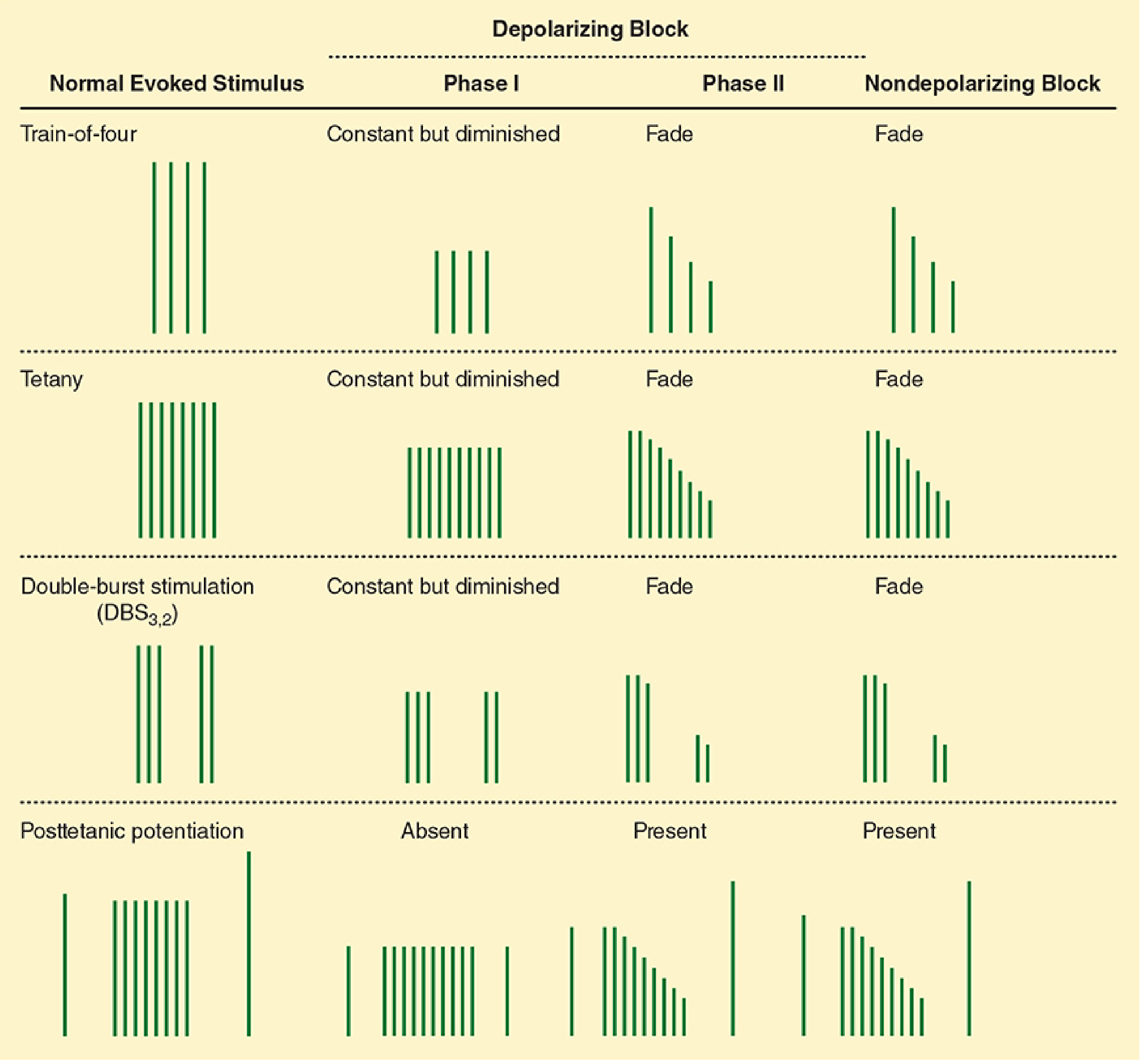
Figure: Evoked responses to different stimulation patterns - normal vs. block types. (Morgan & Mikhail's Clinical Anesthesiology, 7e)
3. Tetanic Stimulation
- Sustained stimulus at 50 Hz for 5 seconds (or 100 Hz)
- Nondepolarizing/phase II block: fade occurs
- Phase I depolarizing block: sustained, no fade
- After tetanus, a subsequent twitch is augmented - called posttetanic potentiation (PTP), due to transient increase in ACh mobilization
- Painful in awake patients; not used for routine monitoring
4. Post-Tetanic Count (PTC)
Used during profound/deep block when TOF gives no response. Involves:
- A 5-second 50 Hz tetanic burst
- A 3-second pause
- Single 1 Hz twitches counted
The number of twitches after tetanus (PTC) predicts time to spontaneous recovery of TOF count 1. In clinical practice, 1-5 PTC responses (deep block) are adequate for most surgical procedures where diaphragmatic movement must be prevented. - Barash Clinical Anesthesia, 9e, p. 1650
5. Double-Burst Stimulation (DBS)
- Two short bursts of 50 Hz tetanic stimulation separated by 750 ms
- DBS₃,₂: 3 impulses in first burst, 2 in second
- DBS₃,₃: 3 impulses in both bursts
- Designed to detect residual block more sensitively by tactile assessment - fade is more obvious in DBS than TOF
- The two tactile responses should feel equal in amplitude if TOF ratio ≥ 0.9
- Especially useful when qualitative (visual/tactile) monitoring is the only method available - Morgan & Mikhail's Clinical Anesthesiology, 7e, p. 378
Depths of Block and Receptor Occupancy
| Depth | Receptor Occupancy | Quantitative Monitor |
|---|---|---|
| Pre-block (normal) | 0% | TOFR 1.0 |
| Complete block | >95% | TOFC 0, PTC 0 |
| Deep block | 90-95% | TOFC 0, PTC ≥ 1 |
| Moderate block | 70-90% | TOFC 1-3 |
| Shallow block | 60-70% | TOFC 4, TOFR < 0.4 |
| Minimal block | 60-70% | TOFC 4, TOFR 0.4-0.9 |
| Recovered | <70% | TOFC 4, TOFR ≥ 0.9 |
Note: 65-75% receptor occupancy is needed for block to be clinically detectable on single twitch; complete paralysis occurs at 90-95% occupancy. - Barash Clinical Anesthesia, 9e
Intraoperative Use
- For most surgical procedures: 1-2 TOF responses provide adequate surgical relaxation
- For procedures requiring immobile diaphragm (laparoscopic, ophthalmic, neurosurgery): 1-5 PTC responses (deep block)
- Continuous dosing should be guided by monitoring to avoid over- or under-dosing
Methods of Recording Responses
| Method | Principle | Comment |
|---|---|---|
| Mechanomyography (MMG) | Measures isometric thumb force directly | Gold standard; cumbersome for clinical use |
| Electromyography (EMG) | Records compound muscle action potential | Accurate; used in modern quantitative monitors |
| Acceleromyography (AMG) | Accelerometer measures thumb acceleration (Newton's 2nd law) | Most widely used; portable; TOFR ≥ 1.0 required for extubation (as it overestimates recovery vs. MMG) |
| Kinemyography (KMG) | Piezoelectric film measures flexion force | Less widely used |
| Phonomyography | Records muscle sound during contraction | Investigational |
Qualitative (subjective) monitoring - visual or tactile assessment of TOF/DBS - is unreliable. Fade on TOF is tactilely undetectable until TOFR falls below 0.3-0.4. DBS is better than TOF for qualitative assessment of residual block. Neither method can exclude TOFR < 0.9.
Clinical Assessment (Limitations)
Bedside tests traditionally used - 5-second head lift, hand grip, tongue depressor test - can be performed at TOFR of only 0.5-0.6 and thus DO NOT confirm adequate recovery. Residual paralysis can exist with TOFR 0.7-0.9, producing:
- Upper airway obstruction
- Pharyngeal dysfunction and aspiration risk
- Hypoxic ventilatory response impairment
- Atelectasis and postoperative pulmonary complications
Criteria for Safe Extubation
The 2023 ASA guidelines state:
- Against relying on clinical assessment alone
- Recommend quantitative monitoring over qualitative
- Confirm TOFR ≥ 0.9 before extubation (TOFR ≥ 1.0 if using AMG, as AMG overestimates vs. MMG)
- Reversal with neostigmine should only be given when spontaneous recovery to TOF count ≥ 2 is present (typically TOFC 4 for best reversal)
- Sugammadex can reverse deep block from rocuronium/vecuronium at any depth; 16 mg/kg reverses a dose of 1.2 mg/kg rocuronium given within 3 minutes
Residual Neuromuscular Block (RNMB)
Pooled incidence of RNMB (TOFR < 0.9 on arrival to PACU) is 30-40% without monitoring guidance. RNMB is associated with increased PACU stay, ICU admissions, and respiratory complications. Objective monitoring plus appropriate reversal reduces this significantly. - Miller's Anesthesia, 10e
Summary Table
| Stimulation | Frequency | Use Phase | Nondepolarizing | Phase I Block |
|---|---|---|---|---|
| Single twitch | 0.1-1 Hz | Onset | Diminished | Diminished |
| TOF (2 Hz × 4) | 2 Hz | All phases | Fade | No fade |
| Tetanus | 50 Hz × 5s | Differentiate blocks | Fade + PTP | No fade |
| PTC | Tetanus + 1 Hz | Deep/profound block | Count predicts recovery | - |
| DBS₃,₂ | 50 Hz bursts | Residual block | Fade | No fade |
Key take-home points:
- TOF is the workhorse - self-referencing, useful across all phases
- PTC is used only in profound block (TOFC = 0)
- DBS detects residual fade better than TOF by touch
- Quantitative monitoring (AMG/EMG) is mandatory - subjective monitoring misses TOFR < 0.9
- TOFR ≥ 0.9 (confirmed by quantitative monitor) is the threshold for safe extubation
- Phase I block = no fade; Phase II/nondepolarizing block = fade + posttetanic potentiation
Sources: Morgan & Mikhail's Clinical Anesthesiology 7e; Barash Clinical Anesthesia 9e; Miller's Anesthesia 10e; 2023 ASA Practice Guidelines for Monitoring and Antagonism of Neuromuscular Blockade
This is a shared conversation. Sign in to Orris to start your own chat.