
Determinats of gait
Reading File
The six determinants of gait are classic biomechanics principles that minimize energy expenditure during walking: (1) pelvic rotation, (2) pelvic tilt, (3) knee flexion in stance, (4) foot and ankle motion, (5) knee and ankle interaction, and (6) lateral pelvic displacement. These work together to smooth the body's center of mass trajectory.
Searching sources...
Finding Sources
Finding Sources
Reading File
Reading File
Reading File
Loading Image
Here is a thorough breakdown of the Determinants of Gait, drawn from Miller's Review of Orthopaedics 9th Edition and Gray's Anatomy for Students.
Determinants of Gait
The six determinants of gait are biomechanical processes that work in concert to minimize vertical and lateral displacement of the body's center of mass (CoM) during walking, thereby reducing energy expenditure. Three occur at the pelvis; the others involve the knee, ankle, and foot.
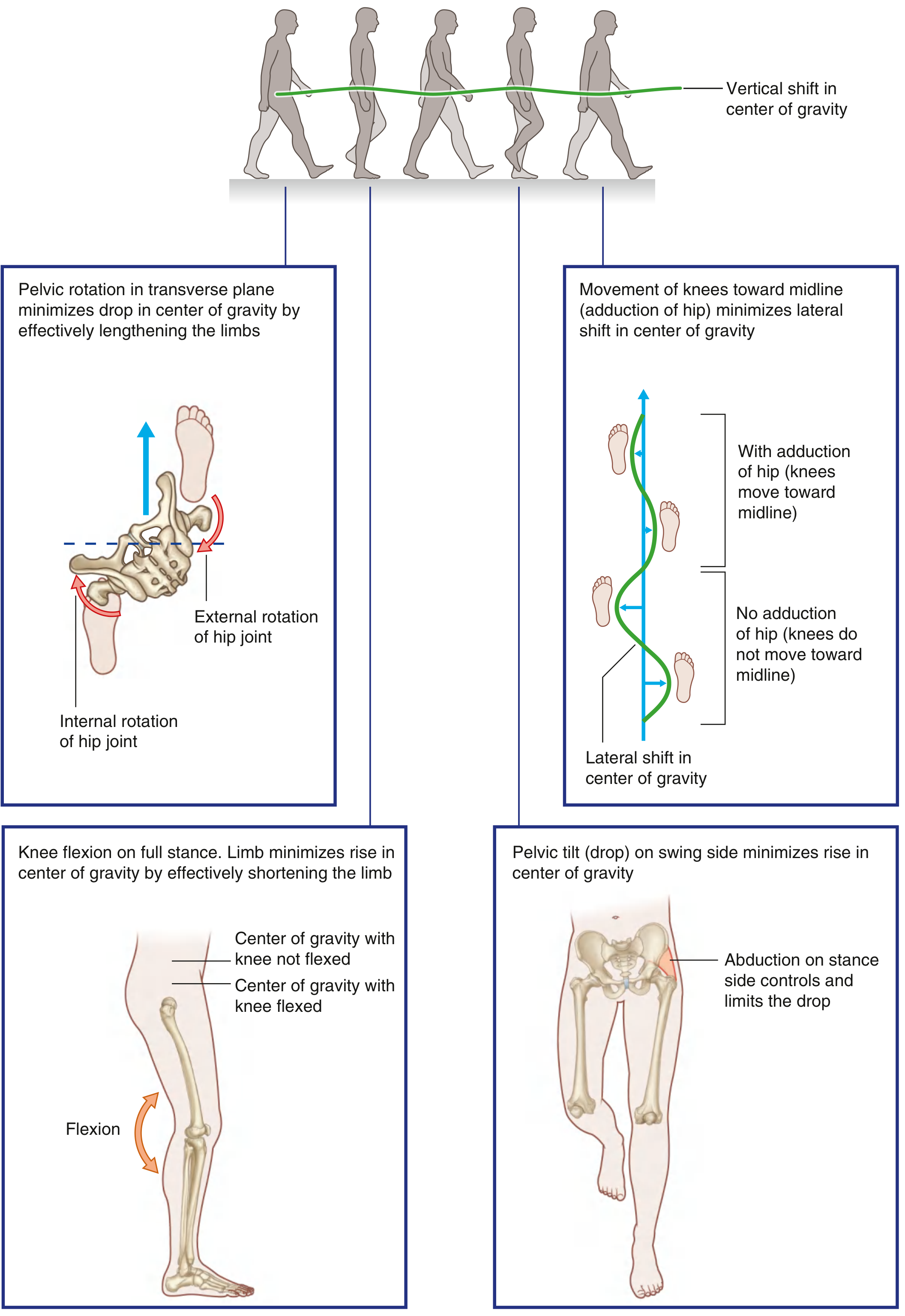
Background: Gait Dynamics
- The body's center of mass lies 2 cm anterior to S2
- Head, neck, trunk, and arms account for 70% of body weight; the trunk's CoG is just anterior to T10
- During normal walking, the CoM traces a sinusoidal path - the determinants flatten this curve to conserve energy
- The ground reaction force (GRF) changes in both magnitude and direction throughout the gait cycle and determines the torque acting on each joint
The Six Determinants
| # | Determinant | Mechanism | Effect on CoM |
|---|---|---|---|
| 1 | Pelvic Rotation | Pelvis externally rotates from initial contact (IC) to pre-swing (PSw), then internally rotates during PSw and swing | Minimizes vertical displacement - effectively lengthens the limb so the arc of the CoM is less steep |
| 2 | Pelvic List (Tilt) | Non-weight-bearing (contralateral) side drops 5 degrees | Reduces superior deviation of CoM; hip abductors on the stance side (gluteus medius) control and limit this drop |
| 3 | Knee Flexion at Loading | Stance-phase limb flexes 15 degrees at loading response | Dampens impact of initial loading; lowers the CoM peak and smooths the trajectory |
| 4 | Foot and Ankle Motion | Through the subtalar joint, loading response is absorbed (pronation/eversion); stability maintained at midstance; propulsion at push-off | Absorbs shock during loading, provides a stable platform at midstance, and generates forward propulsion |
| 5 | Knee Motion (Knee-Ankle Interaction) | Knee flexes at IC and extends at midstance (MSt), working in concert with the ankle | Decreases unnecessary limb motion; knee and ankle act as a coordinated unit to smooth CoM path |
| 6 | Lateral Pelvic Displacement (Pelvic Shift) | During weight transfer to the leading limb, the pelvis shifts 5 cm over the weight-bearing limb | Narrows the base of support and increases stance-phase stability; hip adduction moves knees toward the midline, reducing lateral CoM excursion |
Key Points to Remember
- Determinants 1-3 (pelvic rotation, pelvic tilt, knee flexion) primarily reduce vertical CoM displacement
- Determinant 6 (lateral pelvic displacement) reduces lateral CoM displacement
- Determinants 4-5 (foot/ankle + knee interaction) primarily act as shock absorbers and stabilizers
- Without these determinants, the CoM would follow a much higher and wider sinusoidal arc, dramatically increasing energy cost
- The gluteus medius is the key muscle for determinant 2 - its weakness produces a Trendelenburg gait, where the contralateral hip drops excessively
- Ankle rocker mechanisms (heel rocker, ankle rocker, forefoot rocker) are intimately linked to determinants 4 and 5
Clinical Relevance: When Determinants Fail
| Lost Determinant | Resulting Pathological Gait |
|---|---|
| Pelvic list control lost (weak gluteus medius) | Trendelenburg (lurching) gait |
| Knee flexion at loading absent (stiff knee) | Vaulting or circumduction gait |
| Ankle/foot motion absent | Antalgic or steppage gait |
| Lateral displacement control lost | Wide-based, ataxic gait |
Miller's Review of Orthopaedics 9th Edition, Section 1: Gait - Determinants of Gait (Motion Patterns), p. 784 | Gray's Anatomy for Students, Fig. 6.7
This is a shared conversation. Sign in to Orris to start your own chat.