I have all the content I need to write a comprehensive, well-organized answer. Let me now compose it.
Paediatric Growth and Development Milestones by Age
Development is assessed across four core domains: motor (gross and fine), language/communication, cognitive (learning, thinking, problem-solving), and social/emotional. Milestone acquisition follows an orderly, sequential pattern - a child must achieve earlier milestones before advancing to later ones.
Newborn (Birth - 4 Weeks)
| Domain | Milestones |
|---|
| Motor | Hand-to-mouth reflex, grasping reflex, Moro (startle) reflex, Babinski reflex, sucking and rooting reflexes; moves head laterally when prone; makes alternating crawling movements |
| Sensory | Differentiates sounds and orients to human voice; fixed focal distance of ~8 inches; visual tracking begins |
| Adaptive | Anticipatory feeding-approach behavior by day 4; responds to rattle/bell |
| Social | Responsive to mother's face, eyes, and voice within hours of birth; quiets when picked up; endogenous smile |
Key primitives present at birth: Rooting, grasp, plantar (Babinski), Moro, tonic neck, sucking. The grasp, Moro, and tonic neck reflexes disappear by ~4 months; Babinski disappears by 12 months.
2 Months
| Domain | Milestones |
|---|
| Social/Emotional | Calms when spoken to or picked up; smiles when talked to; happy to see caregiver |
| Language | Makes sounds other than crying; reacts to loud sounds |
| Cognitive | Watches moving faces; looks at a toy for several seconds |
| Motor | Holds head up while on tummy; moves both arms and legs; opens hands briefly |
4 Months
| Domain | Milestones |
|---|
| Social/Emotional | Smiles spontaneously to get attention; chuckles; makes sounds/moves to maintain your attention |
| Language | Cooing sounds ("ooo", "aahh"); turns head toward your voice; takes turns making sounds |
| Cognitive | Opens mouth when sees breast/bottle if hungry; looks at own hands with interest |
| Motor | Holds head steady without support; holds toy placed in hand; swings arms at toys; brings hands to mouth; pushes onto elbows when prone |
6 Months
| Domain | Milestones |
|---|
| Social/Emotional | Recognizes familiar people; laughs; enjoys mirror reflection |
| Language | Takes turns making sounds; blows "raspberries"; squeals |
| Cognitive | Puts things in mouth to explore; reaches for wanted toys; closes lips to refuse food |
| Motor | Rolls tummy to back; pushes up with straight arms; leans on hands when sitting; sits with support |
9 Months
| Domain | Milestones |
|---|
| Social/Emotional | Stranger/separation anxiety; shows range of facial expressions (happy, sad, angry, surprised); reacts when parent leaves; plays peek-a-boo |
| Language | Babbling with varied sounds ("mamama", "bababa"); lifts arms to be picked up |
| Cognitive | Object permanence emerging - looks for dropped objects; bangs two objects together |
| Motor | Sits independently; moves objects hand-to-hand; "rakes" food with fingers; beginning to pull to stand |
12 Months (1 Year)
| Domain | Milestones |
|---|
| Social/Emotional | Plays pat-a-cake; shows affection; waves bye-bye |
| Language | Calls a parent "mama" or "dada"; understands "no"; 1-2 words with meaning |
| Cognitive | Puts objects in containers; looks for hidden objects (object permanence established) |
| Motor | Pulls to stand; walks holding furniture (cruising); pincer grasp (thumb + index finger); drinks from cup with help |
15 Months
| Domain | Milestones |
|---|
| Social/Emotional | Copies other children; shows favorite objects; claps when excited; shows affection (hugs, cuddles) |
| Language | 1-2 words besides "mama/dada"; follows directions with gesture + words; points to request |
| Cognitive | Uses objects correctly (phone, cup, book); stacks 2+ blocks |
| Motor | Walking independently |
18 Months
| Domain | Milestones |
|---|
| Social/Emotional | Moves away from caregiver but checks in; points to show interest; helps with dressing |
| Language | ~10 words; names body parts; follows simple 2-step commands |
| Cognitive | Uses spoon; scribbles; stacks 3-4 blocks; beginning symbolic play |
| Motor | Walks well; stoops to pick up objects; runs (somewhat unsteady) |
Gender identity begins to manifest at 18 months and is often fixed by 24-30 months.
2 Years (24 Months)
| Domain | Milestones |
|---|
| Social/Emotional | Notices other children; plays alongside (parallel play); looks to others for emotional cues (social referencing); separation anxiety may peak |
| Language | ~50 words; 2-word phrases ("more milk"); points to pictures in books; strangers can understand ~50% of speech |
| Cognitive | Sorts shapes and colors; completes simple puzzles; follows 2-step instructions; symbolic play (uses doll to represent feeding) |
| Motor | Runs; kicks a ball; goes up/down stairs with support; uses spoon and fork; stacks 6+ blocks |
Daytime urinary continence usually achieved by 2½ years.
3 Years (Preschool Begins)
| Domain | Milestones |
|---|
| Social/Emotional | Shows concern for crying friends; cooperative play begins; may show jealousy/sibling rivalry; takes turns |
| Language | Short sentences (4-5 words); strangers understand ~75% of speech; names colors; asks "why?" |
| Cognitive | Draws a circle; matches objects to pictures; counts to 3; plays make-believe; understands "mine/his/hers" |
| Motor | Rides tricycle; runs well; briefly balances on one foot; uses scissors; climbs stairs alternating feet |
Thinking is still egocentric (Piagetian preoperational stage) - cannot take another's perspective.
4 Years
| Domain | Milestones |
|---|
| Social/Emotional | Begins to share and show concern for others; capacity for empathy emerging but fragile; pretend play is rich |
| Language | Sentences of 5-6 words; tells simple stories; can say first and last name; strangers understand most speech |
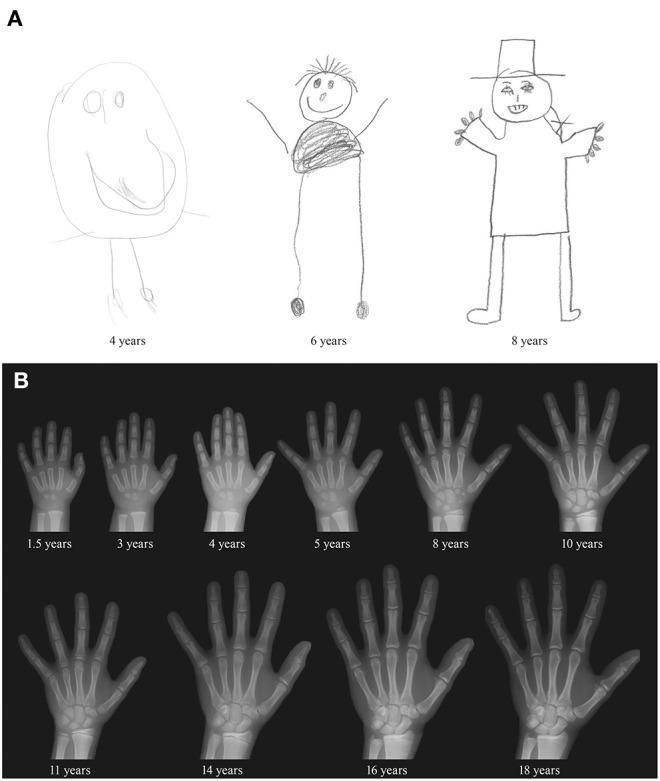
| Cognitive | Draws a person with 2-4 body parts; counts to 4; understands sequencing; can distinguish fantasy from reality |
| Motor | Hops on one foot; catches bounced ball; draws a cross (+); uses scissors correctly |
5 Years
| Domain | Milestones |
|---|
| Social/Emotional | Follows rules in games; sings/dances/acts; does simple chores; wants to please friends |
| Language | Tells a story with 2+ events; sustains 3+ back-and-forth conversation; simple rhymes (bat-cat); answers questions about stories |
| Cognitive | Counts to 10; names some numbers; understands concepts of time (yesterday, tomorrow); pays attention for 5-10 minutes; writes some letters in own name |
| Motor | Buttons clothes; hops on one foot; skips; draws recognizable person |
Nighttime urinary continence usually complete by age 4-5.
6-12 Years (School Age)
| Domain | Milestones |
|---|
| Cognitive | Enters Piagetian concrete operational stage (~7 years): logical thinking, reversibility, conservation; understands multiple points of view on moral issues (before 7, rules are "absolute") |
| Social | Peer relationships become increasingly important; best friendships emerge; industry vs. inferiority (Erikson); rule-based games |
| Language | Complex grammar; reading and writing solidify; vocabulary expands rapidly |
| Motor | Refined fine motor skills; sports participation; writing is legible |
| Emotional | Self-concept and self-esteem develop; conscience is well-established |
Developmental "Red Flags" (Warning Signs)
These warrant immediate evaluation:
| Age | Red Flag |
|---|
| 2 months | Does not respond to loud sounds; does not watch things move; does not smile at people |
| 4 months | Does not hold head steady; does not coo or make sounds |
| 6 months | Does not laugh or make squealing sounds; does not reach for things |
| 9 months | Does not babble; does not respond to own name |
| 12 months | No babbling; no gesturing (pointing, waving); no single words |
| 18 months | No words at all; does not point to show things; loses previously acquired skills |
| 2 years | No 2-word phrases; does not follow 2-step instructions; loses skills |
| Any age | Loss of previously acquired skills is always a red flag (possible regression/neurological cause) |
Summary Table - Key Gross Motor Milestones
| Age | Gross Motor |
|---|
| 2 months | Holds head up prone |
| 4 months | Head steady; forearm support |
| 6 months | Rolls over; sits with support |
| 9 months | Sits independently; pulls to stand |
| 12 months | Walks with support |
| 15 months | Walks independently |
| 18 months | Runs (unsteady) |
| 2 years | Runs well; kicks ball |
| 3 years | Rides tricycle; 1-foot balance briefly |
| 4 years | Hops on one foot; catches ball |
| 5 years | Skips; hops well |
Summary Table - Key Language Milestones
| Age | Language |
|---|
| 2 months | Cooing |
| 6 months | Babbling (consonant-vowel chains) |
| 12 months | 1-2 meaningful words |
| 18 months | ~10 words |
| 2 years | ~50 words; 2-word phrases |
| 3 years | Short sentences; 75% intelligible |
| 4 years | Full sentences; story-telling |
| 5 years | Fluent speech; 10,000+ word vocabulary |
Sources:
- The Harriet Lane Handbook, 23rd Edition (Johns Hopkins Hospital) - Table 9.1, CDC Developmental Milestones (updated Dec 2022), p. 313-318
- Kaplan and Sadock's Synopsis of Psychiatry - Table 32-3: Landmarks of Normal Behavioral Development, pp. 2756-2790
- Adams and Victor's Principles of Neurology, 12th Edition - Developmental Milestones of the Normal Preschool Child
AAP Screening Recommendation: Standardized developmental screening should be administered at 9-month, 18-month, and 30-month well child visits (or 24-month if 30-month visit is not possible), plus developmental surveillance at every well child visit.