
Can you give me a strategic way of approaching an AKI question to solve it very easily in MBME and USMLE step 1? The goal is to solve it tension-free and strategically because it has many causes like pre-renal, intrinsic, and post-renal. Where you always confuse is ATN can also cause nephrotoxic drugs. Drugs can also cause ATN and then acute interstitial nephritis also. There are drugs which can cause and in acute papillary necrosis also there are some drugs which can cause. Then how can you single step for solving 99% questions?
Reading File
Now let me pull the relevant textbook content on AKI classification, ATN, AIN, and drug causes in parallel.
Finding Sources
Finding Sources
Finding Sources
Good sources found. Now let me read the most high-yield content in parallel - the Frameworks for Internal Medicine (best for exam strategy), Comprehensive Clinical Nephrology, and Robbins for pathology distinctions.
Reading File
Reading File
Reading File
Now let me get the AIN drugs list, the pre-renal vs intrinsic differentiation labs, and the papillary necrosis content:
Reading File
Finding Sources
Finding Sources
Excellent - I now have all the textbook content I need. Let me fetch that AKI flowchart image which will be very helpful visually:
Loading Image
Loading Image
I now have all the material needed to give you a complete, strategic framework. Here is the full answer:
The Single-Step AKI Strategy for USMLE Step 1 / NBME
The master trick is this: read the urine, read the clue words in the stem, then apply a 3-second filter. Every AKI question gives you enough context clues to classify it in under 10 seconds. Here is exactly how.
Step 1 - The AKI Classification Map (memorize this once)
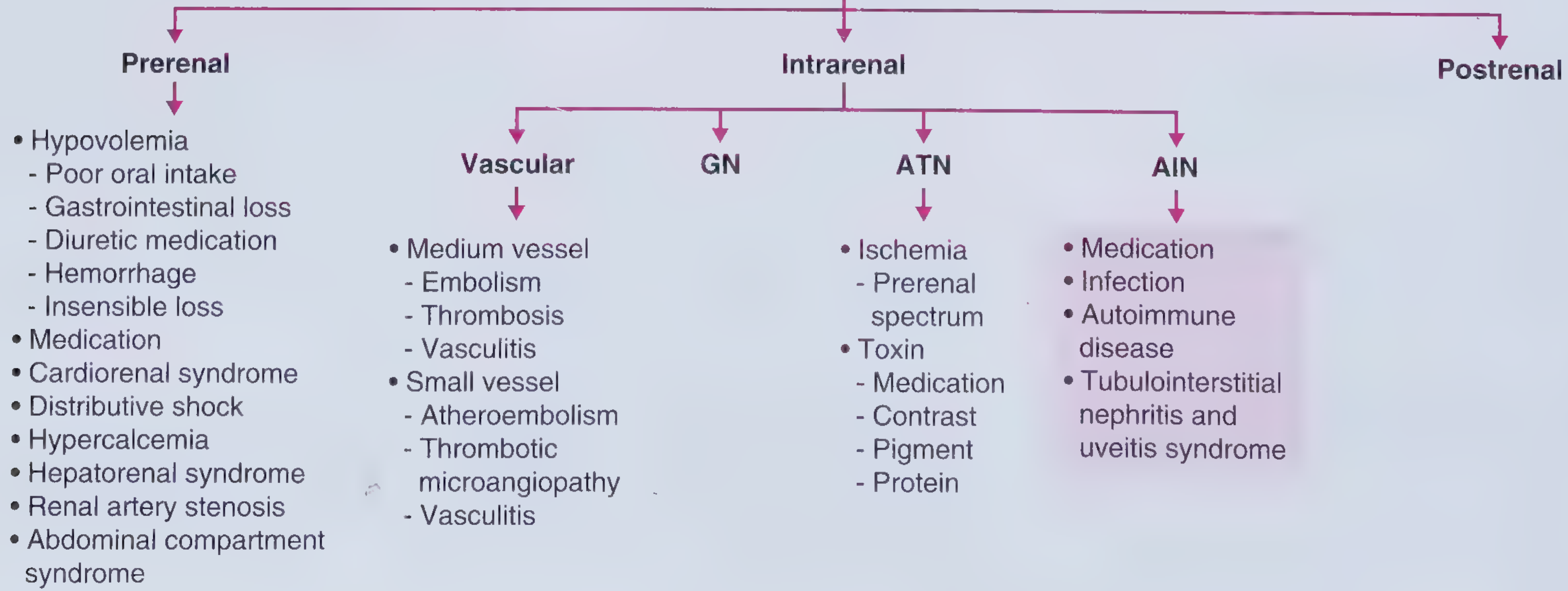
Frameworks for Internal Medicine, p. 454
The three buckets are Pre-renal, Intrinsic (Intrarenal), Post-renal. Intrinsic is the big one - it splits into Vascular, GN, ATN, and AIN. Your confusion lives inside that ATN vs AIN overlap. The framework below cuts through it.
Step 2 - The 3-Second Urine Filter (your single step)
Look at what the question says about the urine first - before anything else.
| What you see in urine | Diagnosis | Mechanism |
|---|---|---|
| "Muddy brown" / granular casts | ATN | Sloughed tubular epithelial cells |
| WBC casts / eosinophiluria + sterile pyuria | AIN | Interstitial inflammation |
| RBC casts / dysmorphic RBCs | GN (glomerulonephritis) | Glomerular injury |
| Waxy / broad casts | Chronic kidney disease | Long-standing |
| Hyaline casts only | Pre-renal (concentrated urine) | Normal tubules, just dehydrated |
| No casts, normal sediment | Pre-renal OR Post-renal | Tubules intact |
| Dipstick + for blood, but 0 RBCs on microscopy | ATN from pigment (rhabdo or hemolysis) | Myoglobin/hemoglobin |
This one filter solves 70% of AKI questions immediately, without thinking about FENa at all.
Step 3 - The Drug Confusion Killer
This is where most students get stuck. Here is the master drug table:
Drugs That Cause ATN (tubular cell death - "muddy brown casts")
Mechanism: direct tubular toxicity or ischemia
- Aminoglycosides (gentamicin, tobramycin) - proximal tubule
- Amphotericin B - proximal + distal tubule
- Cisplatin - proximal tubule
- Contrast dye (iodinated) - onset 24-48 hrs after imaging
- NSAIDs - vasoconstriction (also papillary necrosis - see below)
- Vancomycin, polymyxins, pentamidine, foscarnet, tenofovir, methotrexate
- Myoglobin (crush injury / rhabdomyolysis) - pigment ATN
Drugs That Cause AIN (interstitial inflammation - "WBC casts")
Mechanism: immune/allergic reaction - NOT direct toxicity
- NSAIDs (yes, both lists - this is where overlap happens)
- PPIs (omeprazole, pantoprazole) - classic boards favorite
- Antibiotics: penicillins (methicillin is the classic triad trigger), cephalosporins, ciprofloxacin, rifampin, sulfonamides, vancomycin
- Others: allopurinol, furosemide, phenytoin, acyclovir
- Average delay = 7-10 days after drug exposure (key clue in the stem)
Drugs That Cause Papillary Necrosis
Mechanism: ischemia of the renal medulla/papilla
- NSAIDs (chronic use - analgesic nephropathy)
- Acetaminophen (especially in combination with NSAIDs)
- Sickle cell disease + above drugs accelerates it
- Urine shows sloughed papillary tissue, hematuria, flank pain
The NSAIDs "3-in-1" Rule (kills the confusion permanently)
NSAIDs are the only class that causes all three intrinsic patterns:
NSAIDs:
  1. ATN → by constricting afferent arteriole → ischemic tubular injury
  2. AIN → by triggering immune reaction in interstitium (+ nephrotic syndrome)
  3. Papillary necrosis → by chronic medullary ischemia
The question will always tell you which one via:
- Urine casts (granular = ATN, WBC = AIN)
- Timing (acute/short use vs chronic use for papillary necrosis)
- Associated features (rash + eosinophilia = AIN; crush/hypotension = ATN)
Step 4 - FENa: The Confirmation Tool (not the primary tool)
Only use this when the urine sediment is not mentioned or is unhelpful:
| FENa | Interpretation |
|---|---|
| < 1% | Pre-renal (kidneys avid for Na, tubules intact) |
| > 2% | ATN (tubules damaged, can't reabsorb Na) |
| 1-2% | Ambiguous - use FE-Urea instead |
Trap: FENa can be falsely low (< 1%) in early ATN from contrast or myoglobin, because vasoconstriction mimics pre-renal physiology. If the stem has contrast/rhabdo + FENa < 1% but the clinical story screams ATN - trust the story and casts.
If patient is on diuretics: Use FE-Urea instead (> 35-50% = ATN/intrinsic).
Also useful: BUN:Creatinine ratio
-
20:1 = pre-renal (urea reabsorbed by intact tubules)
- ~10:1 = intrinsic (tubules damaged, can't reabsorb urea)
Step 5 - Post-Renal: The Easy One
Never forget to check for obstruction clues:
- Bilateral hydronephrosis on imaging
- Enlarged prostate (BPH) / pelvic tumor / retroperitoneal fibrosis
- Anuria (sudden complete anuria is more post-renal than pre-renal)
- Relief with catheterization
The 30-Second Algorithm for Any AKI Question
READ THE STEM:

1. Is there OBSTRUCTION clue (hydronephrosis, BPH, anuria)?
      → POST-RENAL. Done.

2. Is there a VOLUME/PERFUSION clue (dehydration, hypotension, CHF,
   blood loss, NSAIDs/ACEi reducing GFR) AND normal urine sediment?
      → PRE-RENAL. Done.

3. Are there CASTS?
      → Granular/muddy brown = ATN
         (now ask: was it ischemia [hypotension, sepsis] or a toxin [drug/contrast/pigment]?)
      → WBC casts + pyuria ± rash ± eosinophilia = AIN
         (drug started 7-10 days ago? NSAID or PPI or antibiotic = AIN)
      → RBC casts = GN
         (hematuria + proteinuria = glomerular disease)

4. Sloughed tissue + hematuria + flank pain + chronic NSAID/acetaminophen use?
      → PAPILLARY NECROSIS
The Clue-Word Cheat Sheet
| Clue word / phrase in stem | Think |
|---|---|
| "Crush injury," "marathon runner," "statin + rhabdomyolysis" | ATN (pigment - myoglobin) |
| "Started gentamicin / amphotericin 3 days ago" | ATN (direct tubular toxin) |
| "Contrast CT done 2 days ago" | ATN (contrast nephropathy) |
| "Started omeprazole / methicillin 10 days ago" + fever + rash | AIN |
| "Chronic NSAID use" + hematuria + flank pain | Papillary necrosis |
| "Acute NSAID use" + WBC casts + proteinuria | AIN |
| "Acute NSAID use" + hypotension/low-flow state | ATN (ischemic) |
| "Blood pressure drops, no output, responds to fluids" | Pre-renal |
| "Old man, can't urinate, enlarged prostate" | Post-renal (BPH) |
| "Multiple myeloma, Bence-Jones protein" | ATN (protein/cast nephropathy) |
| "Hemolytic anemia + thrombocytopenia + AKI" | TMA/HUS → ATN |
Summary: The Single Rule
Urine casts tell you the compartment. Drug timing and context tell you the cause. FENa just confirms.
If you always look at the urine first (casts = what structure is injured), you will never confuse pre-renal with ATN, or ATN with AIN again. The drug question resolves itself once you know the compartment - because the same drug (NSAIDs) hits different compartments depending on the clinical scenario the question sets up.
- Granular casts shown? = ATN. Ask which drug is nephrotoxic to tubules.
- WBC casts / allergic triad shown? = AIN. Ask which drug triggered immune interstitial reaction.
- Chronic use + papilla clues? = Papillary necrosis. Ask which analgesic drug causes medullary ischemia.
The question can never trick you if you identify the urinary sediment pattern first - Frameworks for Internal Medicine, p. 453-456; Comprehensive Clinical Nephrology 7th ed., p. 990.
Whenever I see a graphical question, I guess just out. Like I'll be adding one picture, so it makes sense.
Please go ahead and share the picture! Once I see it, I can help you break down exactly how to approach that type of graphical question systematically so you never have to guess again.
This is a shared conversation. Sign in to Orris to start your own chat.