
analyse_media
Reading File
Finding Sources
Finding Sources
Here are the answers to the case-based questions visible in your image (the third case is cut off in the screenshot, so I've covered the two complete ones):
Case 1: 45-year-old man with yellow eyes/skin, dark urine, fatigue
- Organ primarily affected: The liver. (Dark urine plus jaundice with a 1-week history points to hepatocellular/hepatic dysfunction, e.g. viral hepatitis.)
- Condition name: Jaundice (icterus) - yellowish discoloration of the skin, sclera, and mucous membranes caused by hyperbilirubinemia - Schwartz's Principles of Surgery, p. 924.
- Pigment responsible: Bilirubin (breakdown product of hemoglobin/heme catabolism) - Costanzo Physiology, "Bilirubin Production and Excretion."
- One important liver function (any one is sufficient for the answer):
- Bile production/secretion (aids fat digestion and bilirubin excretion)
- Detoxification and metabolism of drugs/toxins
- Synthesis of plasma proteins (albumin, clotting factors)
- Glycogen storage and glucose homeostasis
- Bilirubin conjugation and excretion
Case 2: 50-year-old woman with thirst, polyuria, increased hunger, high blood glucose
- Organ regulating blood glucose: The pancreas (specifically its endocrine portion).
- Hormone deficient: Insulin.
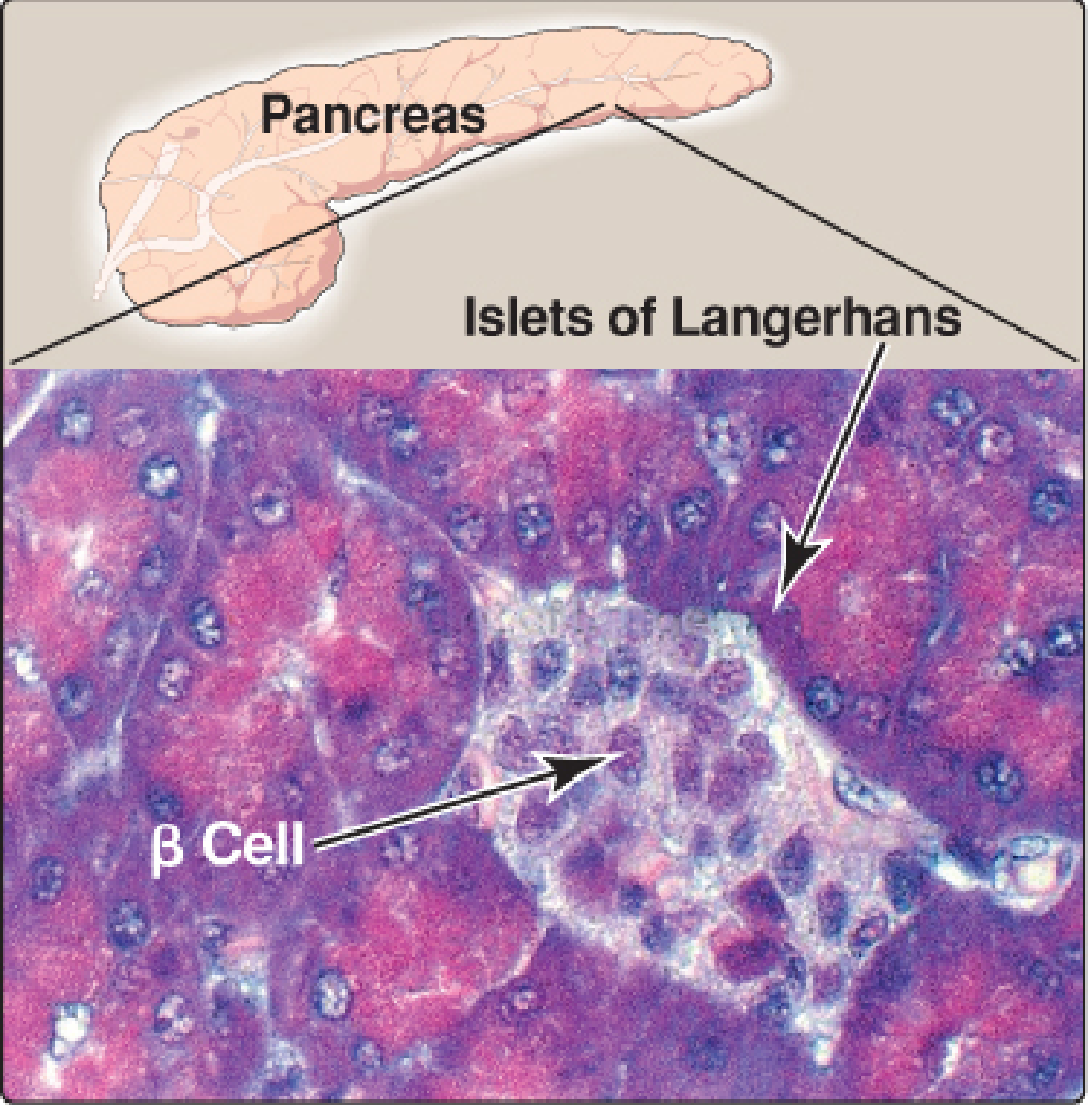
- Endocrine cells secreting it: Beta (β) cells of the Islets of Langerhans in the pancreas - confirmed in Costanzo Physiology ("Endocrine Pancreas") and Robbins & Kumar Basic Pathology.
- Diagnosis: Diabetes mellitus - the classic triad here is polydipsia (excessive thirst), polyuria (frequent urination), and polyphagia (increased hunger) with hyperglycemia. Given the age (50) and presentation, this most likely represents Type 2 diabetes mellitus, though the case doesn't give enough detail (e.g., BMI, onset speed, ketosis) to fully exclude Type 1 - if your exam expects a single general answer, "Diabetes Mellitus" is safe.
A quick supporting note on beta cells - here's a labeled diagram of the pancreatic islets showing beta cells:
The third question ("3. A 25-year-old man presents...") is cut off at the bottom of your screenshot below the keyboard. If you can send the full text or scroll down and share the rest, I'll answer that one too.
Finding Sources
Finding Sources
Case 3: 25-year-old man with fever, cough, chest pain, difficulty breathing; CXR shows right lung infection
- Organ system affected: The respiratory system.
- Likely diagnosis: Pneumonia (right lower/right-sided pneumonia, given the localized infiltrate on chest X-ray).
- Structural unit where gas exchange occurs: The alveolus (alveoli) - the thin-walled air sacs where O2/CO2 exchange happens across the alveolar-capillary membrane.
- Number of lobes in the right lung: Three lobes - superior (upper), middle, and inferior (lower) - separated by the oblique and horizontal fissures (Gray's Anatomy for Students; Medical Physiology, p. 1083). This differs from the left lung, which has only two lobes (upper and lower) because of the cardiac notch.
Case 4: 35-year-old man with loin pain radiating to groin; ultrasound shows renal stone
- Organ affected: The kidney.
- Functional unit of the kidney: The nephron - composed of the renal corpuscle (glomerulus + Bowman's capsule) and the renal tubule (Brenner & Rector's The Kidney; Tietz Textbook of Laboratory Medicine).
- Tube carrying urine from kidney to bladder: The ureter.
- Likely diagnosis: Renal calculus / urolithiasis (kidney stone disease) - the classic "loin to groin" colicky pain pattern is characteristic of a stone moving through the ureter (ureteric colic).
Case 5 (60-year-old man with central chest pain radiating to the left arm, sweating, breathlessness - classic MI presentation) is cut off again at the bottom of your screenshot. Send the rest of that case (the questions under it) and I'll answer it too - based on what's shown, it's clearly heading toward acute myocardial infarction, but I'd rather confirm the exact sub-questions before answering fully.
Finding Sources
Finding Sources
Case 5: 60-year-old man with severe central chest pain radiating to left arm, sweating, breathlessness
- Organ primarily affected: The heart.
- Most likely diagnosis: Acute myocardial infarction (heart attack) - the classic presentation of central/retrosternal chest pain radiating to the left arm with diaphoresis and dyspnea.
- Blood vessels supplying the heart: The coronary arteries - specifically the right coronary artery (RCA), and the left coronary artery, which divides into the left anterior descending (LAD) and left circumflex (LCx) branches. These arise directly from the aorta just above the aortic valve (Goldman-Cecil Medicine; Barash, Cullen, and Stoelting's Clinical Anesthesia).
- Chamber pumping oxygenated blood to the body: The left ventricle.
Case 6: 52-year-old man, alcohol history, abdominal swelling, loss of appetite, yellow eyes
- Organ affected: The liver.
- Likely diagnosis: Alcoholic liver disease progressing to cirrhosis (alcoholic cirrhosis / alcoholic hepatitis with ascites and jaundice). The triad of chronic alcohol use + abdominal swelling (ascites) + jaundice strongly suggests decompensated cirrhosis.
- Two major functions of the liver (any two):
- Bile production/secretion - aids fat digestion and bilirubin excretion
- Detoxification of drugs, alcohol, and toxins
- Synthesis of plasma proteins (albumin, clotting factors) - deficiency contributes to ascites via low oncotic pressure
- Storage of glycogen and glucose homeostasis
- Vein carrying blood from the GI tract to the liver: The hepatic portal vein (formed by union of the superior mesenteric vein and splenic vein). Portal vein pathology and portal hypertension are classically linked to cirrhosis and ascites - Sleisenger and Fordtran's Gastrointestinal and Liver Disease.
Quick teaching link: ascites in cirrhosis develops via a combination of portal hypertension (raising vein pressure) and low serum albumin (reduced oncotic pressure) - both stemming from the same underlying liver damage described in question 3 above.
If there are more cases below this one in your chat (the message looks like it may continue), send the next screenshot and I'll keep going through them.
This is a shared conversation. Sign in to Orris to start your own chat.