
ALL
I need a bit more context to help you well. What would you like to know or do?
Asking for Preferences
What topic or task are you referring to?
Acute lymphblastic leukemia
Reading File
Finding Sources
Searching PubMed
"acute lymphoblastic leukemia" treatment
Now let me read the most comprehensive sources - Robbins Pathology for the disease mechanism/pathology, Goldman-Cecil for clinical management, and Washington Manual for therapeutics, all in parallel:
Reading File
Reading File
Reading File
Reading File
Reading File
Reading File
Reading File
Loading Image
Finding Sources
Reading File
Reading File
Reading File
Finding Sources
I now have comprehensive information to write a thorough response. Let me compile everything.
Acute Lymphoblastic Leukemia (ALL) - Complete Overview
Definition and Classification
Acute lymphoblastic leukemia/lymphoma (ALL) is a neoplasm of immature B-cell (pre-B) or T-cell (pre-T) lymphoblasts that arises in the bone marrow or thymus. The same disease is called "leukemia" when the bone marrow and blood are predominantly involved, and "lymphoma" when it presents as a tissue mass without much circulating disease.
- B-ALL: ~85% of cases; typically childhood leukemias
- T-ALL: ~15%; tends to present in adolescent males as thymic (mediastinal) lymphomas
(Robbins, Cotran & Kumar Pathologic Basis of Disease)
Epidemiology
- Most common cancer in children; ~6,150 new US cases/year
- Median age at presentation: 35 years (bimodal: peak at age 3-5 years, and a second peak after age 50)
- Slightly more frequent in boys than girls
- Hispanic/Latino children have the highest incidence of any ethnic group in the US
- B-ALL peaks at ~3 years of age; T-ALL peaks in adolescence when the thymus is largest
(Washington Manual of Medical Therapeutics; Robbins Pathology)
Pathogenesis
The figure below shows where B-ALL and T-ALL arise in the lymphocyte differentiation pathway:
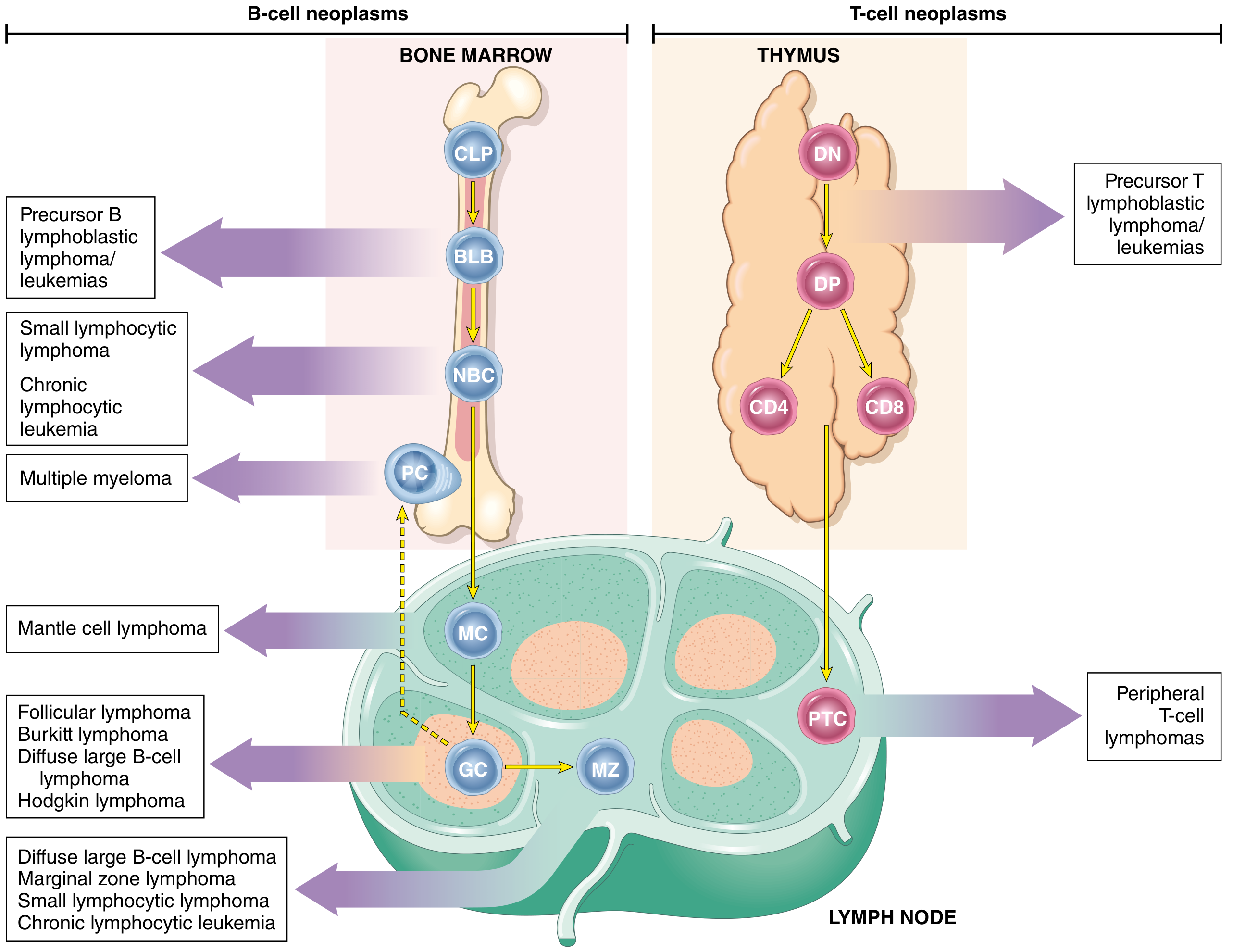
Key molecular events:
- T-ALL: NOTCH1 mutations in 50-70% of cases (NOTCH1 is essential for T-cell development)
- B-ALL: Mutations in PAX5, TCF3, ETV6, RUNX1, BCR::ABL1, KMT2A, PBX1 (all required for early hematopoietic differentiation)
- These mutations cause maturation arrest and increased self-renewal (stem cell-like phenotype)
- Complementary mutations activate tyrosine kinase signaling (RAS, BCR-ABL1, JAK2) to drive proliferation
- Fewer than ~10 driver mutations are sufficient to produce full-blown ALL
(Robbins Pathology, p. 556-557)
Cytogenetics and Molecular Biology
~90% of ALLs have numerical or structural chromosomal changes.
| Abnormality | Frequency | Significance |
|---|---|---|
| Hyperdiploidy (>50 chromosomes) | Common in childhood B-ALL | Better prognosis |
| Hypodiploidy (<44 chromosomes) | Less common | Worse prognosis |
| t(12;21) ETV6::RUNX1 | ~25% of pediatric B-ALL | Favorable |
| t(9;22) BCR::ABL1 (Ph+) | 5% pediatric, 25% adult ALL | Poor prognosis; requires TKI |
| t(4;11) KMT2A::AF4 | ~7% adult ALL | Very poor prognosis |
| t(8;14) MYC::IGH | Burkitt-like ALL | Distinct treatment approach |
| NOTCH1 mutations | 50-70% of T-ALL | T-cell specific |
| PAX5 mutations | ~30% of B-ALL | B-cell specific |
| IKZF1 mutations | ~25% of B-ALL | Associated with Ph-like ALL |
| Ph-like ALL (CRLF2/JAK2) | 20-25% of adult ALL | Poor prognosis |
The Philadelphia chromosome t(9;22) in ALL produces a slightly smaller 190 kD BCR-ABL1 fusion protein (vs. 210 kD in CML), but constitutively activates ABL1 kinase.
(Goldman-Cecil Medicine)
Immunophenotyping
B-ALL subtypes (~75% of ALL):
- Pro-B ALL (~10%): CD19+/CD22+, CD10-
- Common ALL / Pre-B ALL (~50-60%): CD19+/CD22+, CD10+ (CALLA+) - best outcomes
- Pre-B ALL (~10%): intracytoplasmic immunoglobulin present
- Mature B-ALL (<5%): surface immunoglobulin present
T-ALL subtypes (~25% of ALL):
- Early T-cell precursor (ETP-ALL): CD7+, CD1a-, surface CD3-
- Thymic T-ALL: CD1a+, surface CD3-
- Mature T-ALL: surface CD3+
(Goldman-Cecil Medicine)
Clinical Manifestations
Symptoms arise from two mechanisms: (1) suppression of normal marrow and (2) organ infiltration by blasts.
Bone marrow failure:
- Fatigue, pallor, dyspnea (anemia - nearly universal at diagnosis)
- Petechiae, ecchymoses, bleeding gums, epistaxis (thrombocytopenia - ~1/3 have clinical bleeding)
- Recurrent bacterial infections (granulocytopenia)
Organ infiltration (more prominent in ALL than AML):
- Lymphadenopathy and splenomegaly (~20% of cases)
- Mediastinal/thymic mass - particularly in T-ALL (may cause SVC syndrome)
- Bone pain (periosteal infiltration - common in children)
- CNS involvement: headache, nausea, cranial nerve palsies, seizures (<5% at diagnosis but CNS is a major relapse site)
- Leukemia cutis (raised, non-pruritic rash)
- Testicular involvement (a sanctuary site for relapse)
(Goldman-Cecil Medicine, p. 2432)
Diagnosis
Laboratory Workup
- CBC: Anemia + thrombocytopenia (nearly universal); WBC highly variable
- ~25% have WBC >50,000/μL; ~25% have WBC <5,000/μL
- Peripheral smear: Blasts usually present
- LDH: Elevated (cell turnover)
- Uric acid: Elevated - risk of tumor lysis syndrome
- Coagulation: PT/aPTT may be elevated
Definitive Diagnosis
- Bone marrow aspiration/biopsy: ≥20% blasts (hypercellular marrow replacing normal elements)
- Flow cytometry (immunophenotyping): Distinguishes ALL from AML and classifies lineage
- Cytogenetics/FISH/molecular: Essential for risk stratification and guiding therapy
- Lumbar puncture (CSF analysis): Recommended in ALL to assess CNS involvement
(Goldman-Cecil Medicine, p. 2444-2445)
Treatment
Treatment spans 2-3 years and is divided into three phases:
Phase 1: Induction (~3-4 weeks)
Goal: Achieve complete remission (blasts undetectable, normal marrow function restored)
- Core drugs: Vincristine + prednisone/dexamethasone + L-asparaginase + daunorubicin
- Complete remission achieved in 90% of children and 80-90% of adults
- Add rituximab for CD20-positive ALL
- Add BCR-ABL1 TKI (imatinib, dasatinib, ponatinib) for Philadelphia chromosome-positive ALL
Phase 2: Consolidation and Maintenance
- Consolidation: 6-8 courses of intensive chemotherapy (high-dose methotrexate, cytarabine, cyclophosphamide)
- Maintenance: Daily 6-mercaptopurine + weekly methotrexate for up to 2-3 years
- Adolescents and young adults (AYA): Pediatric-inspired regimens (more asparaginase, more CNS prophylaxis) yield better outcomes
Phase 3: CNS Prophylaxis
- Without it, ≥35% of adults develop CNS relapse
- Options: High-dose IV methotrexate + cytarabine, intrathecal chemotherapy, or cranial radiation (2400 cGy)
- CNS relapse reduced to <10% with prophylaxis
Targeted Therapies
| Agent | Target | Indication |
|---|---|---|
| Imatinib/Dasatinib/Ponatinib | BCR-ABL1 | Ph+ ALL |
| Rituximab | CD20 | CD20+ B-ALL |
| Blinatumomab (BiTE) | CD3 × CD19 | MRD+ remission or relapsed/refractory CD19+ ALL |
| Inotuzumab ozogamicin (ADC) | CD22 | Relapsed/refractory CD22+ ALL |
| Tisagenlecleucel (CAR-T) | CD19 | ≤25 years; refractory or ≥2nd relapse B-ALL |
Hematopoietic Stem Cell Transplantation (HSCT)
- Allogeneic HSCT considered for high-risk disease and relapsed ALL
- Strategy for relapsed ALL: achieve 2nd complete remission → proceed to allogeneic HSCT
(Washington Manual; Goldman-Cecil Medicine)
Prognosis
Favorable factors:
- Age 1-9 years (pediatric)
- WBC <50 × 10⁹/L
- Hyperdiploidy
- t(12;21) ETV6::RUNX1
- CALLA-positive (CD10+) B-ALL
- Rapid clearance of minimal residual disease (MRD)
Unfavorable factors:
- Age <1 year or ≥10 years (pediatric); older age in adults
- WBC ≥50 × 10⁹/L at presentation
- Philadelphia chromosome t(9;22)
- Ph-like ALL genotype
- KMT2A (MLL) rearrangement
- Hypodiploidy
- Persistent MRD after induction
Outcomes:
- Children: >90% complete remission; long-term cure rates ~85-90%
- Adults: Complete remission 80-90%, but relapse is common; overall survival much lower (~40-50%)
- Relapsed ALL: Generally poor prognosis regardless of age; goal is 2nd CR → allogeneic HSCT
(Goldman-Cecil Medicine; Washington Manual)
Recent Evidence Update (2024-2025)
Two recent systematic reviews are relevant:
-
A 2024 meta-analysis on chemotherapy-free regimens in Ph+ ALL (Ali MA et al., Clin Lymphoma Myeloma Leuk) evaluated TKI-based chemo-free approaches - PMID 38972767
-
A 2025 meta-analysis comparing ponatinib vs. first/second-generation TKIs for Ph+ ALL (Raza MZ et al., Crit Rev Oncol Hematol) - ponatinib (3rd-gen TKI) shows superior outcomes; particularly relevant for T315I mutation - PMID 40517974
These studies support the growing role of TKI-based and chemotherapy-reduced strategies in Ph+ ALL, especially in older patients.
Sources: Robbins, Cotran & Kumar Pathologic Basis of Disease | Goldman-Cecil Medicine | Washington Manual of Medical Therapeutics
Aryabhatta Knowledge University
Aryabhatta Knowledge University (AKU) is a state university in Bihar, India, established in 2008, primarily affiliating technical and professional colleges across the state. Let me get you current and detailed information.
Searching sources...
Searching the Web
Aryabhatta Knowledge University AKU Patna Bihar overview 2024
Searching the Web
Aryabhatta Knowledge University AKU courses affiliated colleges admission
Reading Web Page
https://en.wikipedia.org/wiki/Aryabhatta_Knowledge_Universit…
Here is a complete overview of Aryabhatta Knowledge University:
Aryabhatta Knowledge University (AKU)
At a Glance
| Detail | Information |
|---|---|
| Full Name | Aryabhatta Knowledge University |
| Short Name | AKU, Patna |
| Type | Public State University |
| Established | 19 March 2010 (via AKU Act, 2008) |
| Location | Mithapur, Patna, Bihar, India |
| Motto | Satyadharmaya Drshtaye (Sanskrit) - "For the vision of truth and righteousness" |
| Chancellor | Governor of Bihar |
| Vice-Chancellor | Sharad Kumar Yadav |
| Website | akubihar.ac.in |
| Budget | ₹33.23 crore |
History
AKU was established on 19 March 2010 by the Government of Bihar through the Aryabhatta Knowledge University Act, 2008. It is named after Aryabhatta, the celebrated ancient Indian mathematician and astronomer, often called the "Father of Indian Mathematics."
The university was created specifically for the development and management of professional and technical higher education in Bihar - covering engineering, management, law, journalism, pharmacy, and allied fields. It has jurisdiction over the entire state of Bihar.
The first Chancellor was Governor Devanand Konwar.
Accreditation and Recognition
- UGC (University Grants Commission) approved
- NAAC accredited
- AICTE approved for engineering programs
- PCI (Pharmacy Council of India) approved for pharmacy courses
- AIU (Association of Indian Universities) member
- NIRF Ranking 2024: Band 101-150 (University category)
University Schools
AKU runs several specialized schools directly on campus:
| School | Focus Area |
|---|---|
| School of Astronomy | Space science and astrophysics |
| School of Stem Cell Technology | Stem cell biology and regenerative medicine |
| School of Philosophy | Classical and contemporary philosophy |
| School of Nanoscience & Nanotechnology | Nano materials and applications |
| School of Geographical Studies | Geography and earth sciences |
| School of River Studies | River ecology and sustainable water management |
| School of Journalism & Mass Communication | Media and communication |
| Patliputra School of Economics | Economics and policy |
| School of Management Teachings | Business administration (MBA) |
These schools reflect AKU's push into frontier and interdisciplinary disciplines - somewhat unique for a state affiliating university.
Affiliated Colleges
AKU is primarily an affiliating university - the bulk of its students study at affiliated colleges across Bihar.
- 250+ affiliated colleges across Bihar (as per recent data)
- As of 2022-23: 33 educational colleges, 8 community colleges, 11 vocational colleges
- By statutory requirement (from 2022-23), all colleges in Bihar offering professional programs (except medical sciences and engineering, which fall under other regulators) must affiliate with AKU
Programs Offered
Undergraduate (UG)
- B.Tech (Engineering - via JEE Main / BCECE)
- B.Pharm (Pharmacy)
- BPT (Bachelor of Physiotherapy - ~₹1 lakh/year)
- BBA, BCA
- B.Ed (Education)
- B.Sc (Nursing, Agriculture, etc.)
- BA / B.Sc / B.Com (General)
- LLB (Law)
- BJMC (Journalism & Mass Communication)
Postgraduate (PG)
- M.Tech, MBA, MCA
- M.Pharm
- M.Ed
- MA / M.Sc / M.Com
- LLM
Doctoral
- Ph.D. in multiple disciplines (Education, Sciences, Management, etc.)
Admission Process
- UG Engineering: JEE Main scores + BCECE (Bihar Combined Entrance Competitive Examination)
- Medical/Allied Health: NEET mandatory for MBBS, BDS, Nursing
- Other UG programs: 10+2 with 45-50% marks (40-45% for SC/ST)
- PG programs: Bachelor's degree with 50-55% (45-50% for SC/ST)
- Direct university school admissions: AKU entrance exam + merit + interview
BCECE 2026 Exam was conducted on 30-31 May 2026, with results declared on 23 June 2026.
Research and Innovation
AKU has been active in filing patents, including:
- Yttrium Aluminum Borate-based functional nanomaterials for LED applications (2026)
- Low-cost eggshell-based water purification system (2026)
The university maintains a dedicated R&D Cell and Incubation Centre for student startups.
Placements
- Average package: ₹3-6 LPA
- High-demand tech roles: ₹12-17 LPA
- University runs a dedicated Placement & Incubation Cell
Student Support
- NSS (National Service Scheme) unit
- Anti-Ragging Cell
- IQAC (Internal Quality Assurance Cell)
- SC/ST and economically weaker section scholarship schemes
- NEP 2020 implementation
- Dean of Students' Welfare
- Student Grievance portal
Contact
- Official Website: akubihar.ac.in
- Admissions Portal: adms.akubihar.ac.in
- Phone: 0612-2351919 / 08102915842
- Location: Mithapur, Patna, Bihar - 800001
AKU occupies an important place in Bihar's higher education landscape as the primary affiliating body for professional and technical colleges across the state. Its own campus schools in niche areas like Astronomy, Stem Cell Technology, and River Studies make it stand out among state affiliating universities.
Mbbs final year subjects important topic
Reading File
MBBS Final Year (Part II) covers Medicine, Surgery, Obstetrics & Gynaecology, and Paediatrics - with high-yield topics across all four subjects. Let me pull comprehensive coverage from the textbook library and supplement with exam pattern knowledge.
Searching sources...
Finding Sources
Searching the Web
MBBS final year important topics Medicine Surgery Obstetrics Paediatrics exam 2024 2025
Finding Sources
Reading Web Page
https://www.diginerve.com/blogs/important-topics-of-medicine…
Searching the Web
MBBS final year OBG Obstetrics Paediatrics important topics university exam NEET PG
Finding Sources
Reading Web Page
https://www.diginerve.com/blogs/important-topics-of-obgyn-in…
Here is a comprehensive, exam-focused guide to all MBBS Final Year subjects and their most important topics:
MBBS Final Year - Important Topics (Complete Guide)
Subjects in Final Year MBBS (Part II - India / CBME)
| Subject | Theory | Practical/Clinical |
|---|---|---|
| General Medicine (+ Psychiatry + Dermatology) | 2 papers × 100 marks | 200 marks |
| General Surgery (+ Anaesthesia + Orthopaedics) | 2 papers × 100 marks | 200 marks |
| Obstetrics & Gynaecology | 2 papers × 100 marks | 200 marks |
| Paediatrics | 1 paper × 100 marks | 100 marks |
| Ophthalmology | Theory + Practical | - |
| ENT | Theory + Practical | - |
1. GENERAL MEDICINE
Cardiology ⭐⭐⭐
- Hypertension - classification, management (JNC/ACC-AHA)
- Heart failure - types (HFrEF vs HFpEF), management
- Acute MI / STEMI / NSTEMI - diagnosis, ECG, management, thrombolysis
- Infective endocarditis - Duke criteria, organisms, treatment
- Rheumatic fever - Jones criteria
- Atrial fibrillation - management, anticoagulation
- Shock - types and management
Respiratory ⭐⭐⭐
- COPD - GOLD staging, management
- Bronchial asthma - classification, stepwise management
- Tuberculosis - types, RNTCP/NTEP regimens, drug side effects
- Pneumonia - classification, organisms, treatment
- Pleural effusion - causes, Light's criteria (exudate vs transudate)
- Lung carcinoma - types, paraneoplastic syndromes
Gastroenterology ⭐⭐⭐
- Peptic ulcer disease - H. pylori, treatment
- Cirrhosis of liver - causes, complications (ascites, variceal bleeding, hepatic encephalopathy, SBP)
- Jaundice - classification, approach
- Inflammatory bowel disease - Crohn's vs UC
- Hepatitis B & C - serology, interpretation, treatment
Nephrology ⭐⭐⭐
- Acute kidney injury (AKI) - causes, RIFLE/KDIGO criteria
- Chronic kidney disease (CKD) - staging, complications
- Glomerulonephritis - types, nephritic vs nephrotic syndrome
- Nephrotic syndrome - causes and management
- Renal tubular acidosis
Neurology ⭐⭐⭐
- Stroke - ischemic vs hemorrhagic, management, thrombolysis window
- Meningitis - bacterial vs viral, CSF findings
- Epilepsy - classification, drug treatment
- Myasthenia gravis - diagnosis, cholinergic vs myasthenic crisis
- Guillain-Barre syndrome
- Parkinson's disease - features and management
Endocrinology ⭐⭐⭐
- Diabetes mellitus - type 1 vs 2, complications, insulin types, oral hypoglycemics
- Diabetic ketoacidosis (DKA) vs HHS - management
- Thyroid disorders - hypothyroidism, hyperthyroidism, thyroid storm
- Cushing's syndrome - causes, investigations
- Addison's disease / adrenal crisis
- Pheochromocytoma
Haematology ⭐⭐⭐
- Iron deficiency anaemia - investigations, treatment
- Megaloblastic anaemia (B12 / Folate)
- Aplastic anaemia
- ITP (Immune Thrombocytopenic Purpura)
- CML - Philadelphia chromosome, imatinib
- Sickle cell disease - pathology, crises
- Coagulation disorders - haemophilia, DIC
Infectious Disease ⭐⭐⭐
- Malaria - P. vivax vs P. falciparum, complications, chloroquine resistance
- Typhoid fever - Widal, complications, treatment
- HIV/AIDS - WHO staging, ART, opportunistic infections
- Dengue - classification (DF, DHF, DSS), NS1, management
- Leptospirosis
- Rabies - post-exposure prophylaxis
- Cholera
Immunology & Rheumatology ⭐⭐
- Rheumatoid arthritis - extra-articular manifestations, treatment (DMARDs)
- SLE - diagnostic criteria (ACR/EULAR), cutaneous manifestations
- Ankylosing spondylitis
- Gout - pathophysiology, management
- Vasculitis syndromes (Wegener's/GPA)
Dermatology (Allied - 15 marks) ⭐⭐
- Psoriasis - types and treatment
- Scabies - treatment
- Leprosy - lepra reactions (Type 1, Type 2/ENL), classification
- Drug eruptions - Stevens-Johnson syndrome, TEN
- Pemphigus vs pemphigoid (bullous lesions)
- Tinea infections
- Atopic dermatitis
- Urticaria and Angioedema
Psychiatry (Allied - 15 marks) ⭐⭐
- Schizophrenia - features, antipsychotics
- Depression - PHQ-9, antidepressants (SSRIs, TCAs)
- Bipolar disorder - mood stabilizers (lithium - toxicity)
- Delirium vs Dementia
- Substance use disorders - alcohol withdrawal, delirium tremens
- Anxiety disorders
- Suicide risk assessment
2. GENERAL SURGERY
General Principles ⭐⭐⭐
- Wound healing - phases, types
- Fluid management and electrolyte disturbances
- Blood transfusion - complications
- Shock - types, management
- Surgical infections (sepsis, necrotizing fasciitis)
- Burns - rule of nines, Parkland formula, fluid management, inhalation burns
- Post-operative complications (DVT, PE, wound dehiscence)
Alimentary Tract ⭐⭐⭐
- Acute appendicitis - Alvarado score, management, complications
- Intestinal obstruction - classification, management
- Peptic ulcer disease - surgical management, complications
- Colorectal carcinoma - staging (Dukes/TNM), management
- Anal canal disorders - haemorrhoids, fistula-in-ano, fissure
- Hernia - direct vs indirect inguinal, femoral, management
- Gallstone disease / Acute cholecystitis / Laparoscopic cholecystectomy
- Pancreatitis (acute) - Ranson's criteria, management
Breast and Endocrine ⭐⭐⭐
- Carcinoma breast - staging, management (lumpectomy vs mastectomy), sentinel node biopsy
- Thyroid - goiter, thyroid carcinoma (papillary - most common, psammoma bodies)
- Thyroglossal cyst
- Pleomorphic adenoma of parotid
Vascular Surgery ⭐⭐
- Varicose veins - clinical features, management
- Deep vein thrombosis (DVT) - Virchow's triad, management, Wells criteria
- Peripheral arterial disease - ABI, management
- Aortic aneurysm
Head and Neck ⭐⭐
- Carcinoma tongue / oral cavity
- Cystic hygroma
- Neck swellings - differential diagnosis
Skin ⭐⭐
- Basal cell carcinoma vs Squamous cell carcinoma vs Melanoma
- Pilonidal sinus
- Carbuncle vs furuncle
Orthopaedics (Allied) ⭐⭐
- Fracture healing - complications (non-union, malunion, compartment syndrome)
- Colles' fracture
- Hip fractures - types, management
- Osteomyelitis - acute vs chronic
- Bone tumours (osteosarcoma, Ewing's)
- Osteoarthritis vs Rheumatoid arthritis (orthopedic perspective)
- Open fractures - management
Anaesthesia (Allied) ⭐⭐
- Spinal vs epidural anaesthesia
- General anaesthesia stages
- Malignant hyperthermia
- Preoperative assessment (ASA grading)
3. OBSTETRICS & GYNAECOLOGY (OBG)
NEET-PG weightage: 25-30 questions
Obstetrics ⭐⭐⭐
- Antenatal care - schedule, investigations, TPAL
- Normal labour - stages, partograph
- Abnormal labour - prolonged labour, shoulder dystocia, cord prolapse
- Pre-eclampsia / Eclampsia - diagnosis (ISSHP criteria), management, magnesium sulfate
- Antepartum haemorrhage (APH) - placenta praevia vs abruption
- Postpartum haemorrhage (PPH) - causes (4 T's), management, bimanual compression
- Preterm labour - management, tocolytics
- Intrauterine growth restriction (IUGR) - types, monitoring
- Multiple pregnancy - complications
- Gestational diabetes - screening (GCT), management
- Fetal distress - CTG interpretation, decelerations
- Caesarean section - indications, types
Gynaecology ⭐⭐⭐
- PCOS (Polycystic Ovarian Syndrome) - Rotterdam criteria, management
- Endometriosis - sites, chocolate cyst, management
- Fibroids (uterine leiomyoma) - types, presentation, management
- Carcinoma cervix - staging (FIGO), Pap smear, HPV, colposcopy
- Carcinoma endometrium - risk factors, staging
- Ovarian tumours - classification, tumor markers (CA-125, AFP, β-hCG)
- Pelvic inflammatory disease (PID) - organisms, treatment
- Ectopic pregnancy - sites, management (salpingectomy vs methotrexate)
- Menstrual disorders - DUB, amenorrhoea, dysmenorrhoea
- Infertility - male and female factors, investigations
- Contraception - OCPs (mechanism, contraindications), IUDs, sterilization
- Prolapse - classification, management
4. PAEDIATRICS
NEET-PG weightage: ~10 questions
Growth, Development & Nutrition ⭐⭐⭐
- Developmental milestones (motor, speech, social, cognitive) - age-wise
- Failure to thrive
- PEM (Protein Energy Malnutrition) - Kwashiorkor vs Marasmus
- Vitamin deficiencies - Vit D (rickets), Vit A, Vit C (scurvy), Vit B12
- Iron deficiency anaemia in children
- Breast feeding - advantages, complementary feeding
Neonatology ⭐⭐⭐
- Newborn assessment - APGAR score, Ballard score
- Neonatal jaundice - physiological vs pathological, kernicterus, phototherapy
- Respiratory distress syndrome (RDS/HMD) - surfactant deficiency
- Neonatal sepsis - organisms, treatment
- Birth asphyxia - management
- Congenital hypothyroidism
- Neonatal resuscitation (NRP)
Immunisation ⭐⭐⭐
- National Immunisation Schedule (India) - vaccines at each age
- Cold chain
- Contraindications to vaccines
- Adverse events following immunisation (AEFI)
Infectious Diseases ⭐⭐⭐
- Measles, Mumps, Rubella, Varicella - features and complications
- Dengue in children
- Typhoid in children
- Meningitis in children - organisms (age-wise), CSF findings
- Whooping cough (pertussis)
Respiratory ⭐⭐⭐
- Acute respiratory infections (ARI) - WHO classification
- Bronchiolitis - RSV, management
- Bronchial asthma in children - management
- Croup vs Epiglottitis
- Pneumonia in children - treatment by age group
Gastrointestinal ⭐⭐⭐
- Acute diarrhoea - oral rehydration therapy (ORT), PLAN A/B/C
- Dehydration assessment
- Intussusception - features, management
- Pyloric stenosis - projectile vomiting, metabolic alkalosis
Cardiovascular ⭐⭐
- Congenital heart disease - acyanotic (VSD, ASD, PDA) vs cyanotic (TOF, TGA)
- TOF (Tetralogy of Fallot) - 4 features, Tet spells
- Kawasaki disease
Kidney ⭐⭐
- Nephrotic syndrome in children - minimal change disease
- Urinary tract infection (UTI) in children
- Acute glomerulonephritis (APSGN)
Neurology / Developmental ⭐⭐
- Febrile seizures - simple vs complex
- Cerebral palsy - classification, management
- Down syndrome - trisomy 21 features
- Autism spectrum disorder
- Neural tube defects
Haematology / Oncology ⭐⭐
- ALL (Acute Lymphoblastic Leukemia) - most common childhood cancer
- Haemophilia - types, management
- Thalassaemia
5. OPHTHALMOLOGY
| Important Topic | Key Points |
|---|---|
| Glaucoma | Types (open vs closed angle), tonometry, treatment |
| Cataract | Types, surgical management (PHACO), complications |
| Diabetic retinopathy | Classification, laser treatment |
| Hypertensive retinopathy | Keith-Wagener classification |
| Corneal ulcer | Bacterial vs viral, dendritic ulcer (HSV) |
| Retinal detachment | Symptoms, types |
| Uveitis | Anterior vs posterior, causes |
| Squint (Strabismus) | Cover test |
| Conjunctivitis | Types, treatment |
| Trachoma | WHO grading |
| Red eye | Differential diagnosis |
6. ENT (Ear, Nose & Throat)
| Important Topic | Key Points |
|---|---|
| Otitis media - ASOM / CSOM | Types, organisms, management |
| Ear anatomy | Ossicles, tympanogram types |
| Hearing loss | Conductive vs sensorineural, audiogram |
| Otosclerosis | Carhart's notch, stapes surgery |
| Epistaxis | Little's area, management |
| Nasal polyps | Types, management |
| Sinusitis | Organisms, management |
| Tonsillitis / Adenoid | Indications for tonsillectomy |
| Carcinoma larynx | Types, staging |
| Vocal cord palsy | Causes, management |
| Foreign body airway | Emergency management |
Exam Strategy Tips
- Medicine - Most vast subject. Start with high-yield systems: Cardiology, Respiratory, Endocrinology, Neurology. Complete one system at a time.
- Surgery - Read Bailey & Love throughout the year. Focus on long case topics (hernia, thyroid, breast, appendix).
- OBG - DC Dutta is standard. Prioritize eclampsia, PPH, ectopic pregnancy, carcinoma cervix - these are near-constant long questions.
- Paediatrics - Most focused subject. Master developmental milestones, immunization chart, and neonatology cold.
- Ophthalmology & ENT - Relatively concise. Standard textbooks + previous year questions cover 90% of exam content.
- Clinicals/Viva - Know long case format, short case examination, and instrument identification.
Recommended Books:
- Medicine: Harrison's / Davidson's / Kumar & Clark
- Surgery: Bailey & Love / SRB
- OBG: DC Dutta (Obs) / DC Dutta (Gynae) / Shaw's
- Paediatrics: Nelson's / O.P. Ghai / Aruchami
- Ophthalmology: Khurana
- ENT: Dhingra
This is a shared conversation. Sign in to Orris to start your own chat.